The ordinal numbers
(Los números ordinales)
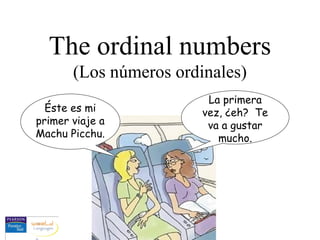
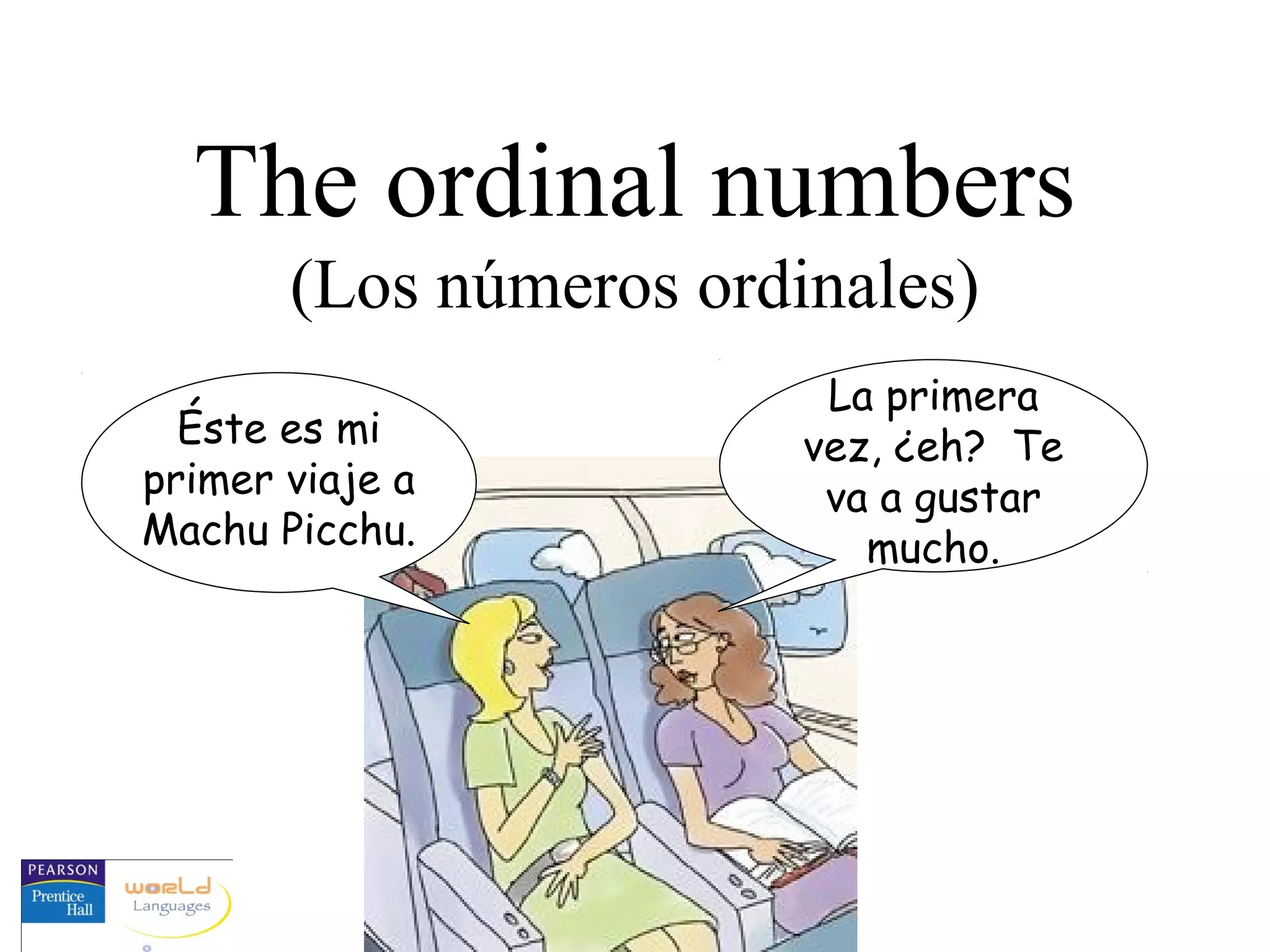
Éste es mi
primer viaje a
Machu Picchu.
La primera
vez, ¿eh? Te
va a gustar
mucho.
The ordinal numbers
Ordinal numbers vs. cardinal numbers
Ordinal numbers are those that refer to the order of
things, that is, first, second, third, and so on. It may
help to remember that ordinal refers to order.
Cardinal numbers, by contrast, are those that are
used for counting: one, two, three, and so on. It
may be useful to think cardinal means counting.
In Spanish, ordinal numbers beyond tenth are rarely
used in everyday speech or writing.
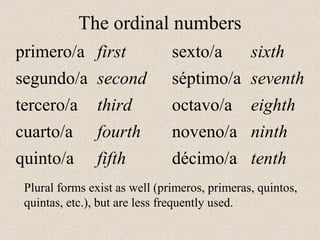
The ordinal numbers first through tenth are shown
on the following slide.
primero/a
segundo/a
tercero/a
cuarto/a
quinto/a
first
second
third
fourth
fifth
sexto/a
séptimo/a
octavo/a
noveno/a
décimo/a
sixth
seventh
eighth
ninth
tenth
The ordinal numbers
Plural forms exist as well (primeros, primeras, quintos,
quintas, etc.), but are less frequently used.
primer
0 0 0 0 0 0 0 0 0 0
segundo
tercer
cuarto
quinto
sexto
séptimo
octavo
noveno
décimo
el
el
el
el
el
el
el
el
el
el
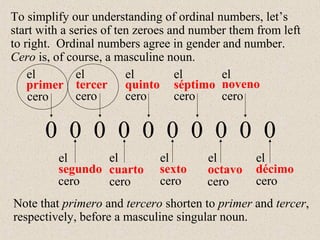
To simplify our understanding of ordinal numbers, let’s
start with a series of ten zeroes and number them from left
to right. Ordinal numbers agree in gender and number.
Cero is, of course, a masculine noun.
Note that primero and tercero shorten to primer and tercer,
respectively, before a masculine singular noun.
cerocero cero cero cero
cero cero cero cero cero
primer
0 0 0 0 0 0 0 0 0 0
segundo
tercer
cuarto
quinto
sexto
séptimo
octavo
noveno
décimo
el
el
el
el
el
el
el
el
el
el
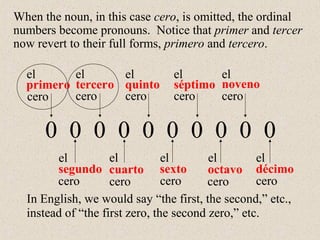
When the noun, in this case cero, is omitted, the ordinal
numbers become pronouns. Notice that primer and tercer
now revert to their full forms, primero and tercero.
In English, we would say “the first, the second,” etc.,
instead of “the first zero, the second zero,” etc.
cerocero cero cero cero
cero cero cero cero cero
o o
primera
segunda
tercera
cuarta
quinta
sexta
séptima
octava
novena
décima
la
la
la
la
la
la
la
la
la
la
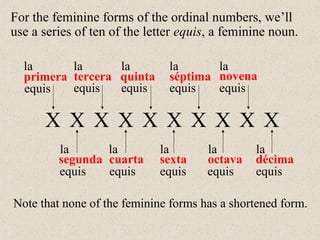
Note that none of the feminine forms has a shortened form.
equisequis equis equis equis
equis equis equis equis equis
X X X X X X X X X X
For the feminine forms of the ordinal numbers, we’ll
use a series of ten of the letter equis, a feminine noun.
primera
segunda
tercera
cuarta
quinta
sexta
séptima
octava
novena
décima
la
la
la
la
la
la
la
la
la
la
Note that none of the feminine forms has a shortened form.
equisequis equis equis equis
equis equis equis equis equis
X X X X X X X X X X
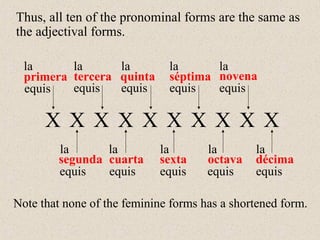
Thus, all ten of the pronominal forms are the same as
the adjectival forms.
X X X
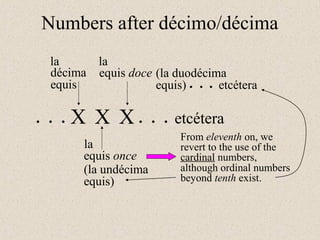
décima
equis
equis once
equis doce
la
la
la
. . .
(la undécima
equis)
(la duodécima
equis)
etcétera. . .
From eleventh on, we
revert to the use of the
cardinal numbers,
etcétera. . .
Numbers after décimo/décima
although ordinal numbers
beyond tenth exist.
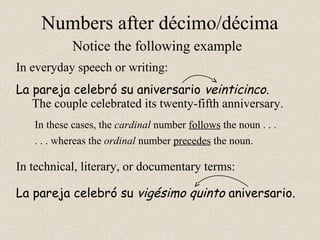
Numbers after décimo/décima
In everyday speech or writing:
Notice the following example
La pareja celebró su aniversario veinticinco.
In technical, literary, or documentary terms:
La pareja celebró su vigésimo quinto aniversario.
The couple celebrated its twenty-fifth anniversary.
In these cases, the cardinal number follows the noun . . .
. . . whereas the ordinal number precedes the noun.
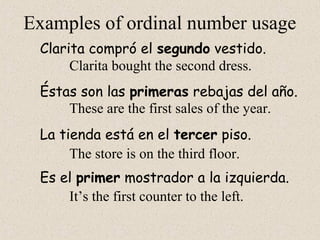
Examples of ordinal number usage
Clarita compró el segundo vestido.
Éstas son las primeras rebajas del año.
La tienda está en el tercer piso.
Es el primer mostrador a la izquierda.
Clarita bought the second dress.
These are the first sales of the year.
The store is on the third floor.
It’s the first counter to the left.
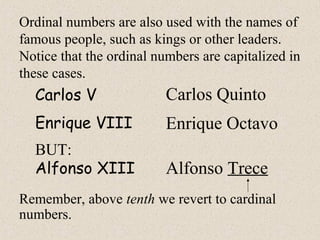
Carlos V
Ordinal numbers are also used with the names of
famous people, such as kings or other leaders.
Notice that the ordinal numbers are capitalized in
these cases.
Carlos Quinto
Enrique VIII Enrique Octavo
Alfonso XIII Alfonso Trece
BUT:
Remember, above tenth we revert to cardinal
numbers.
FIN

Ordinal numbers

  • 1.
    The ordinal numbers (Losnúmeros ordinales) Éste es mi primer viaje a Machu Picchu. La primera vez, ¿eh? Te va a gustar mucho.
  • 2.
    The ordinal numbers Ordinalnumbers vs. cardinal numbers Ordinal numbers are those that refer to the order of things, that is, first, second, third, and so on. It may help to remember that ordinal refers to order. Cardinal numbers, by contrast, are those that are used for counting: one, two, three, and so on. It may be useful to think cardinal means counting. In Spanish, ordinal numbers beyond tenth are rarely used in everyday speech or writing. The ordinal numbers first through tenth are shown on the following slide.
  • 3.
  • 4.
    primer 0 0 00 0 0 0 0 0 0 segundo tercer cuarto quinto sexto séptimo octavo noveno décimo el el el el el el el el el el To simplify our understanding of ordinal numbers, let’s start with a series of ten zeroes and number them from left to right. Ordinal numbers agree in gender and number. Cero is, of course, a masculine noun. Note that primero and tercero shorten to primer and tercer, respectively, before a masculine singular noun. cerocero cero cero cero cero cero cero cero cero
  • 5.
    primer 0 0 00 0 0 0 0 0 0 segundo tercer cuarto quinto sexto séptimo octavo noveno décimo el el el el el el el el el el When the noun, in this case cero, is omitted, the ordinal numbers become pronouns. Notice that primer and tercer now revert to their full forms, primero and tercero. In English, we would say “the first, the second,” etc., instead of “the first zero, the second zero,” etc. cerocero cero cero cero cero cero cero cero cero o o
  • 6.
    primera segunda tercera cuarta quinta sexta séptima octava novena décima la la la la la la la la la la Note that noneof the feminine forms has a shortened form. equisequis equis equis equis equis equis equis equis equis X X X X X X X X X X For the feminine forms of the ordinal numbers, we’ll use a series of ten of the letter equis, a feminine noun.
  • 7.
    primera segunda tercera cuarta quinta sexta séptima octava novena décima la la la la la la la la la la Note that noneof the feminine forms has a shortened form. equisequis equis equis equis equis equis equis equis equis X X X X X X X X X X Thus, all ten of the pronominal forms are the same as the adjectival forms.
  • 8.
    X X X décima equis equisonce equis doce la la la . . . (la undécima equis) (la duodécima equis) etcétera. . . From eleventh on, we revert to the use of the cardinal numbers, etcétera. . . Numbers after décimo/décima although ordinal numbers beyond tenth exist.
  • 9.
    Numbers after décimo/décima Ineveryday speech or writing: Notice the following example La pareja celebró su aniversario veinticinco. In technical, literary, or documentary terms: La pareja celebró su vigésimo quinto aniversario. The couple celebrated its twenty-fifth anniversary. In these cases, the cardinal number follows the noun . . . . . . whereas the ordinal number precedes the noun.
  • 10.
    Examples of ordinalnumber usage Clarita compró el segundo vestido. Éstas son las primeras rebajas del año. La tienda está en el tercer piso. Es el primer mostrador a la izquierda. Clarita bought the second dress. These are the first sales of the year. The store is on the third floor. It’s the first counter to the left.
  • 11.
    Carlos V Ordinal numbersare also used with the names of famous people, such as kings or other leaders. Notice that the ordinal numbers are capitalized in these cases. Carlos Quinto Enrique VIII Enrique Octavo Alfonso XIII Alfonso Trece BUT: Remember, above tenth we revert to cardinal numbers.
  • 12.