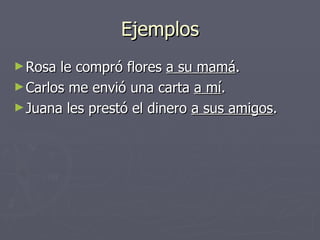
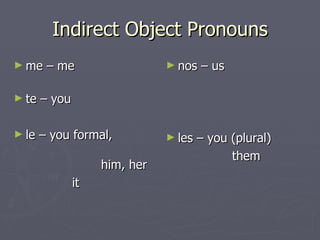
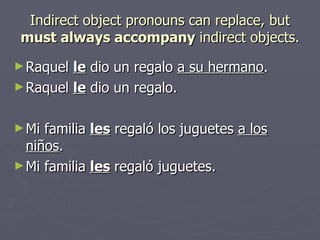
Indirect object pronouns replace indirect objects in a sentence. They tell to whom or for whom the verb takes place. Some examples of indirect object pronouns are me, te, le, nos, and les. Indirect object pronouns replace indirect objects but must accompany them in the sentence and can be placed before the conjugated verb, attached to an infinitive verb, or attached to a present participle or command form of a verb.