Possessive adjectives
Showing Possession In Spanish there are  NO  apostrophes. You cannot say, for example,  Jorge’s dog, (using an apostrophe)
Showing Posession You must say, “The dog of Jorge,” only in Spanish.  Like this: El perro de Jorge.
De + noun This concept of showing possession is using “ de + noun .” For example:  Tengo el cuaderno  de  Felipe.
General info Unlike English, Spanish has two forms of possessive adjectives: a short form that is  used before  nouns and a long form that is  used after  nouns.  The more common type is the short form that you learned in Spanish 1.  We will review the short term and then learn the long form.
Short Form—before noun Possessive   adjectives  show ownership or relationships between people.  ellas ella sus  libros ellos sus  libros él su  libro ustedes su  libro usted tus  libros tu  libro t ú nuestros  libros/ nuestras  casas mis  libros nuestro   libro/ nuestra  casa nosotros(as) mi  libro yo Owner Owner
Gender and number agreement While possessive adjectives refer to the owner, their form  agrees in gender and number  with the noun that comes after them. Martín  vive con  su s  abuelo s . Carlos y yo  vivimos con  nuestr a  abuel a . refers to agrees grammatically
Long Form—after noun Possessive   adjectives  show ownership or relationships between people.  ellas ella suyos, suyas ellos suyos, suyas él suyo, suya ustedes suyo, suya usted tuyos, tuyas tuyo, tuya t ú nuestros, nuestras m ío s,  mías nuestro, nuestra nosotros m ío, mía yo Owner Owner
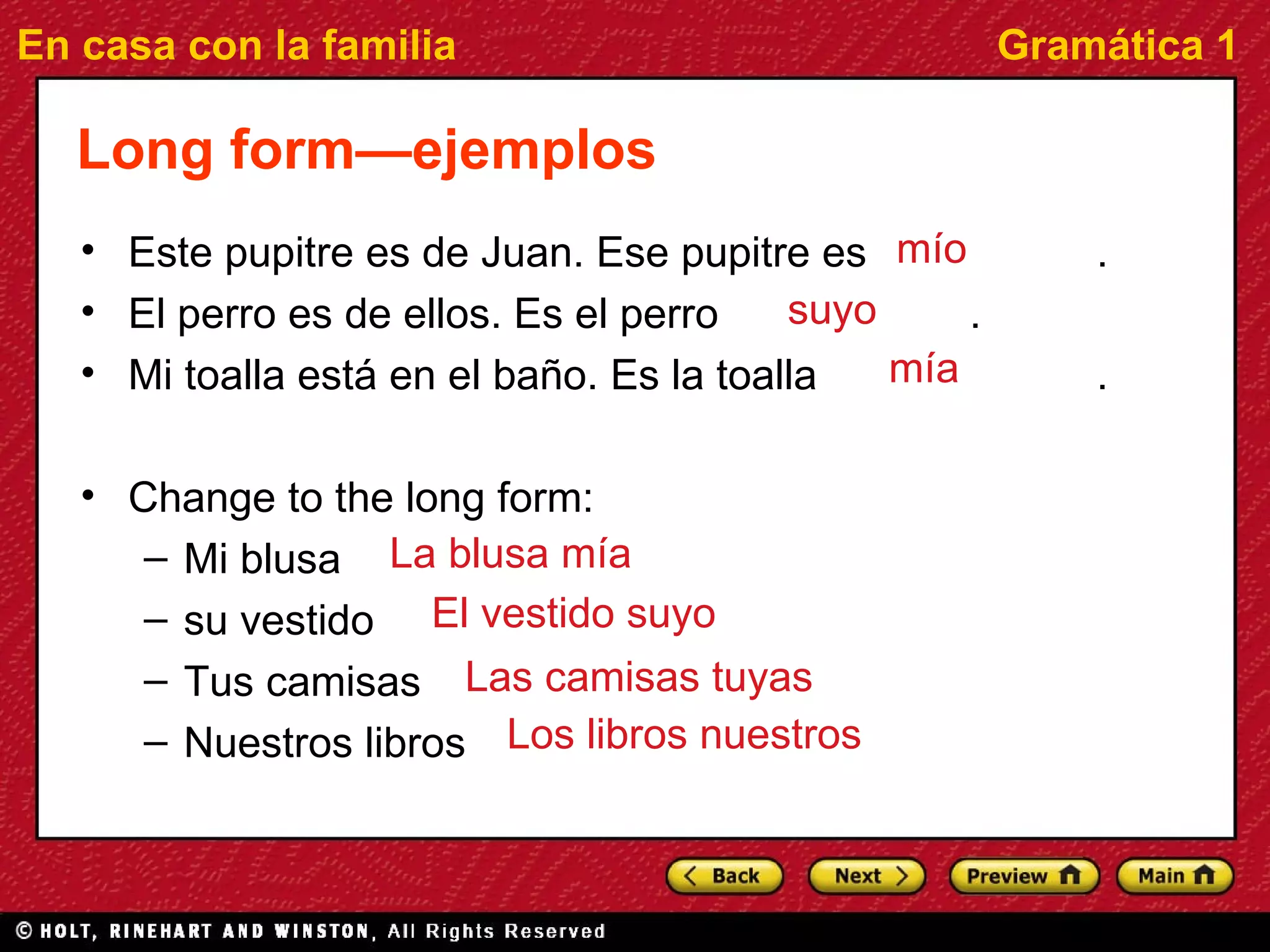
Long form—ejemplos  Este pupitre es de Juan. Ese pupitre es  .  El perro es de ellos. Es el perro  . Mi toalla est á en el baño. Es la toalla  .  Change to the long form: Mi blusa  su vestido  Tus camisas  Nuestros libros  m ío suyo mía La blusa mía El vestido suyo Las camisas tuyas Los libros nuestros
Just a note… As you may have noticed, the short form and long forms of  nuestro  are identical. They differ only as to whether they are used before or after the noun.

Possessive adjectives short and long

  • 1.
  • 2.
    Showing Possession InSpanish there are NO apostrophes. You cannot say, for example, Jorge’s dog, (using an apostrophe)
  • 3.
    Showing Posession Youmust say, “The dog of Jorge,” only in Spanish. Like this: El perro de Jorge.
  • 4.
    De + nounThis concept of showing possession is using “ de + noun .” For example: Tengo el cuaderno de Felipe.
  • 5.
    General info UnlikeEnglish, Spanish has two forms of possessive adjectives: a short form that is used before nouns and a long form that is used after nouns. The more common type is the short form that you learned in Spanish 1. We will review the short term and then learn the long form.
  • 6.
    Short Form—before nounPossessive adjectives show ownership or relationships between people. ellas ella sus libros ellos sus libros él su libro ustedes su libro usted tus libros tu libro t ú nuestros libros/ nuestras casas mis libros nuestro libro/ nuestra casa nosotros(as) mi libro yo Owner Owner
  • 7.
    Gender and numberagreement While possessive adjectives refer to the owner, their form agrees in gender and number with the noun that comes after them. Martín vive con su s abuelo s . Carlos y yo vivimos con nuestr a abuel a . refers to agrees grammatically
  • 8.
    Long Form—after nounPossessive adjectives show ownership or relationships between people. ellas ella suyos, suyas ellos suyos, suyas él suyo, suya ustedes suyo, suya usted tuyos, tuyas tuyo, tuya t ú nuestros, nuestras m ío s, mías nuestro, nuestra nosotros m ío, mía yo Owner Owner
  • 9.
    Long form—ejemplos Este pupitre es de Juan. Ese pupitre es . El perro es de ellos. Es el perro . Mi toalla est á en el baño. Es la toalla . Change to the long form: Mi blusa su vestido Tus camisas Nuestros libros m ío suyo mía La blusa mía El vestido suyo Las camisas tuyas Los libros nuestros
  • 10.
    Just a note…As you may have noticed, the short form and long forms of nuestro are identical. They differ only as to whether they are used before or after the noun.