The Imperfect Tense: Other Uses P. 248 Realidades 2
Imperfect Tense: Other Uses You already know how to use the imperfect tense together with the preterite to describe a situation that existed when something else happened. Nadie  estaba  en la casa cuando los bomberos  entraron .
Preterite Tense: Other Uses The preterite tense may also be used: When something occurred  El huracán  llegó  a la costa de Honduras.
Preterite Tense: Other Uses The preterite tense may also be used: For actions completed in the past El edificio  se quemó  ayer.
Preterite Tense: Other Uses The preterite tense may also be used: To talk about an event El concierto  fue  ayer.
Imperfect Tense: Other Uses The imperfect tense may also be used: To tell what day or time it was Eran  las cinco de la mañana.
Imperfect Tense: Other Uses The imperfect tense may also be used: To tell what day or time it was Eran  las cinco de la mañana y  llovía  mucho cuando el accidente occurió.
Imperfect Tense: Other Uses The imperfect tense may also be used: To tell what the weather was like. Llovía   mucho cuando el accidente occurió.
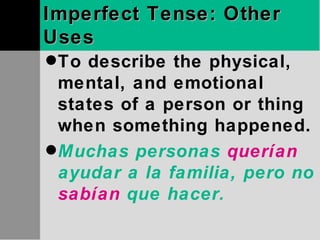
Imperfect Tense: Other Uses To describe the physical, mental, and emotional states of a person or thing when something happened. Muchas personas  querían  ayudar a la familia, pero no  sabían  que hacer.
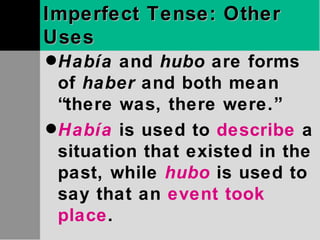
Imperfect Tense: Other Uses Había  and  hubo  are forms of  haber  and both mean “there was, there were.” Había  is used to  describe  a situation that existed in the past, while  hubo  is used to say that an  event took place .
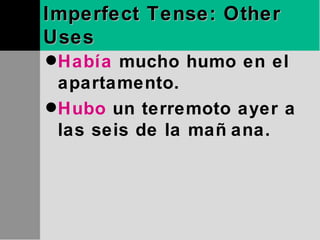
Imperfect Tense: Other Uses Había  mucho humo en el apartamento. Hubo  un terremoto ayer a las seis de la mañana.
Imperfect Tense: Other Uses These verbs are often used in the imperfect to describe states of being:
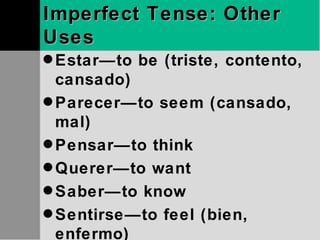
Imperfect Tense: Other Uses Estar—to be (triste, contento, cansado) Parecer—to seem (cansado, mal) Pensar—to think Querer—to want Saber—to know Sentirse—to feel (bien, enfermo) Tener—to have (calor, frío, hambre, sed, sueño)

Using the Imperfect & Preterite

  • 1.
    The Imperfect Tense:Other Uses P. 248 Realidades 2
  • 2.
    Imperfect Tense: OtherUses You already know how to use the imperfect tense together with the preterite to describe a situation that existed when something else happened. Nadie estaba en la casa cuando los bomberos entraron .
  • 3.
    Preterite Tense: OtherUses The preterite tense may also be used: When something occurred El huracán llegó a la costa de Honduras.
  • 4.
    Preterite Tense: OtherUses The preterite tense may also be used: For actions completed in the past El edificio se quemó ayer.
  • 5.
    Preterite Tense: OtherUses The preterite tense may also be used: To talk about an event El concierto fue ayer.
  • 6.
    Imperfect Tense: OtherUses The imperfect tense may also be used: To tell what day or time it was Eran las cinco de la mañana.
  • 7.
    Imperfect Tense: OtherUses The imperfect tense may also be used: To tell what day or time it was Eran las cinco de la mañana y llovía mucho cuando el accidente occurió.
  • 8.
    Imperfect Tense: OtherUses The imperfect tense may also be used: To tell what the weather was like. Llovía mucho cuando el accidente occurió.
  • 9.
    Imperfect Tense: OtherUses To describe the physical, mental, and emotional states of a person or thing when something happened. Muchas personas querían ayudar a la familia, pero no sabían que hacer.
  • 10.
    Imperfect Tense: OtherUses Había and hubo are forms of haber and both mean “there was, there were.” Había is used to describe a situation that existed in the past, while hubo is used to say that an event took place .
  • 11.
    Imperfect Tense: OtherUses Había mucho humo en el apartamento. Hubo un terremoto ayer a las seis de la mañana.
  • 12.
    Imperfect Tense: OtherUses These verbs are often used in the imperfect to describe states of being:
  • 13.
    Imperfect Tense: OtherUses Estar—to be (triste, contento, cansado) Parecer—to seem (cansado, mal) Pensar—to think Querer—to want Saber—to know Sentirse—to feel (bien, enfermo) Tener—to have (calor, frío, hambre, sed, sueño)