Indigenous Knowledge
Used in
Agricultural Practice
Presented By:
Ms Students’16
Department of Agricultural Extension Education
Bangladesh Agricultural University
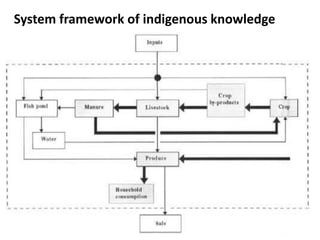
System framework of indigenous knowledge
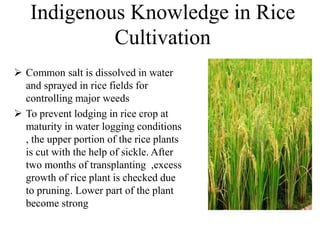
Indigenous Knowledge in Rice
Cultivation
 Common salt is dissolved in water
and sprayed in rice fields for
controlling major weeds
 To prevent lodging in rice crop at
maturity in water logging conditions
, the upper portion of the rice plants
is cut with the help of sickle. After
two months of transplanting ,excess
growth of rice plant is checked due
to pruning. Lower part of the plant
become strong
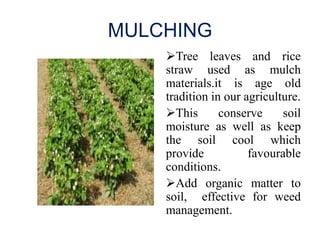
MULCHING
Tree leaves and rice
straw used as mulch
materials.it is age old
tradition in our agriculture.
This conserve soil
moisture as well as keep
the soil cool which
provide favourable
conditions.
Add organic matter to
soil, effective for weed
management.
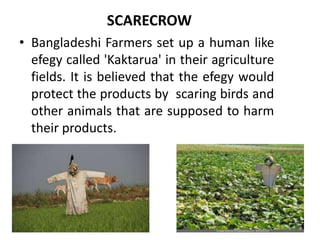
SCARECROW
• Bangladeshi Farmers set up a human like
efegy called 'Kaktarua' in their agriculture
fields. It is believed that the efegy would
protect the products by scaring birds and
other animals that are supposed to harm
their products.
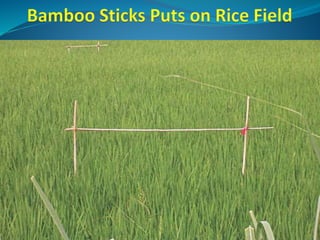
Birds sits and eats insects.
Especially, Rice Bug, Green leaf
hopper, Brown Plant hopper control.
Procedure of Biological control.
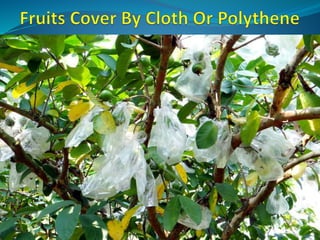
 Fruit cover at mature stage.
 Insect infestation control especially fruit borer,
White fly, Ants, Beetle etc.
All fruits mature same time
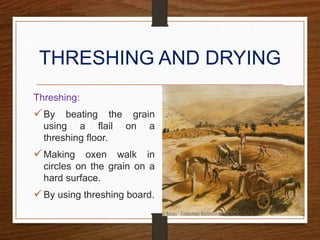
THRESHING AND DRYING
Threshing:
By beating the grain
using a flail on a
threshing floor.
Making oxen walk in
circles on the grain on a
hard surface.
By using threshing board.
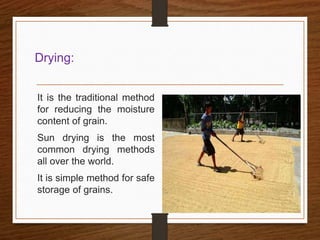
Drying:
It is the traditional method
for reducing the moisture
content of grain.
Sun drying is the most
common drying methods
all over the world.
It is simple method for safe
storage of grains.
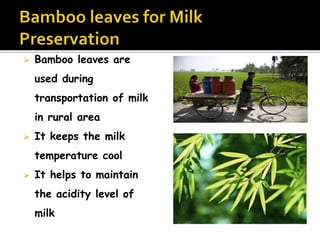
 Bamboo leaves are
used during
transportation of milk
in rural area
 It keeps the milk
temperature cool
 It helps to maintain
the acidity level of
milk
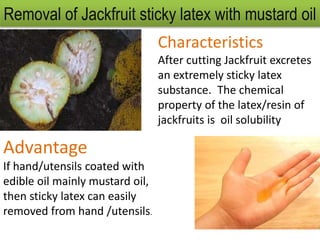
Removal of Jackfruit sticky latex with mustard oil
Characteristics
After cutting Jackfruit excretes
an extremely sticky latex
substance. The chemical
property of the latex/resin of
jackfruits is oil solubility
Advantage
If hand/utensils coated with
edible oil mainly mustard oil,
then sticky latex can easily
removed from hand /utensils.
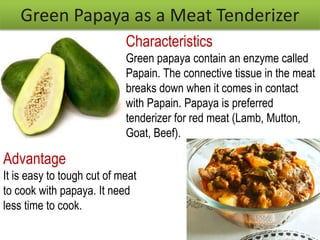
Green Papaya as a Meat Tenderizer
Characteristics
Green papaya contain an enzyme called
Papain. The connective tissue in the meat
breaks down when it comes in contact
with Papain. Papaya is preferred
tenderizer for red meat (Lamb, Mutton,
Goat, Beef).
Advantage
It is easy to tough cut of meat
to cook with papaya. It need
less time to cook.
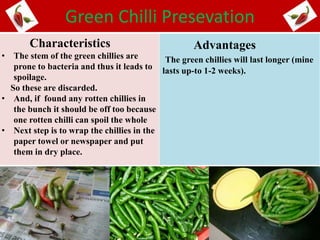
Green Chilli Presevation
Characteristics
• The stem of the green chillies are
prone to bacteria and thus it leads to
spoilage.
So these are discarded.
• And, if found any rotten chillies in
the bunch it should be off too because
one rotten chilli can spoil the whole
• Next step is to wrap the chillies in the
paper towel or newspaper and put
them in dry place.
Advantages
The green chillies will last longer (mine
lasts up-to 1-2 weeks).
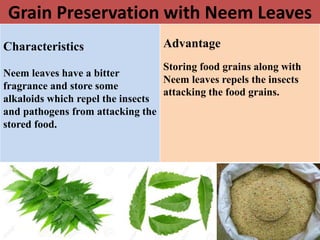
Grain Preservation with Neem Leaves
Characteristics
Neem leaves have a bitter
fragrance and store some
alkaloids which repel the insects
and pathogens from attacking the
stored food.
Advantage
Storing food grains along with
Neem leaves repels the insects
attacking the food grains.
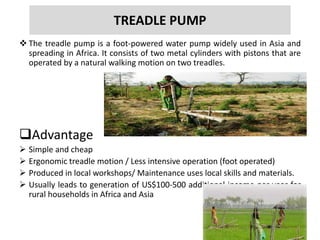
TREADLE PUMP
 The treadle pump is a foot-powered water pump widely used in Asia and
spreading in Africa. It consists of two metal cylinders with pistons that are
operated by a natural walking motion on two treadles.
Advantage
 Simple and cheap
 Ergonomic treadle motion / Less intensive operation (foot operated)
 Produced in local workshops/ Maintenance uses local skills and materials.
 Usually leads to generation of US$100-500 additional income per year for
rural households in Africa and Asia
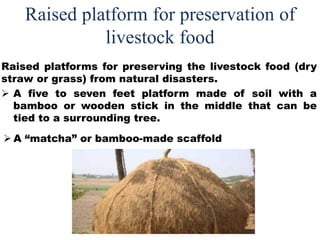
Raised platform for preservation of
livestock food
Raised platforms for preserving the livestock food (dry
straw or grass) from natural disasters.
 A five to seven feet platform made of soil with a
bamboo or wooden stick in the middle that can be
tied to a surrounding tree.
 A “matcha” or bamboo-made scaffold
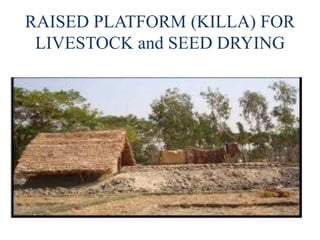
RAISED PLATFORM (KILLA) FOR
LIVESTOCK and SEED DRYING
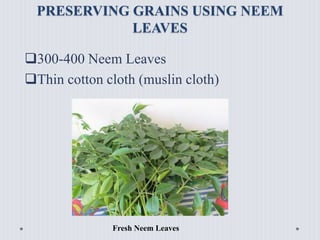
PRESERVING GRAINS USING NEEM
LEAVES
300-400 Neem Leaves
Thin cotton cloth (muslin cloth)
Fresh Neem Leaves
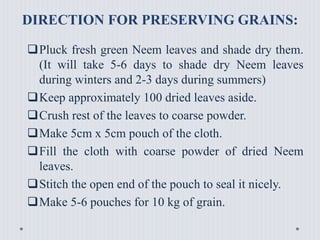
DIRECTION FOR PRESERVING GRAINS:
Pluck fresh green Neem leaves and shade dry them.
(It will take 5-6 days to shade dry Neem leaves
during winters and 2-3 days during summers)
Keep approximately 100 dried leaves aside.
Crush rest of the leaves to coarse powder.
Make 5cm x 5cm pouch of the cloth.
Fill the cloth with coarse powder of dried Neem
leaves.
Stitch the open end of the pouch to seal it nicely.
Make 5-6 pouches for 10 kg of grain.
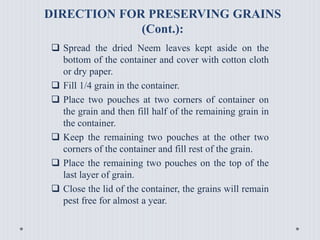
DIRECTION FOR PRESERVING GRAINS
(Cont.):
 Spread the dried Neem leaves kept aside on the
bottom of the container and cover with cotton cloth
or dry paper.
 Fill 1/4 grain in the container.
 Place two pouches at two corners of container on
the grain and then fill half of the remaining grain in
the container.
 Keep the remaining two pouches at the other two
corners of the container and fill rest of the grain.
 Place the remaining two pouches on the top of the
last layer of grain.
 Close the lid of the container, the grains will remain
pest free for almost a year.
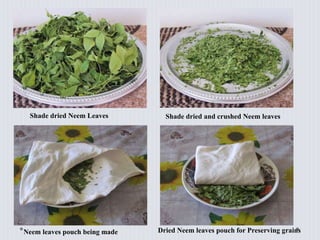
Shade dried Neem Leaves Shade dried and crushed Neem leaves
Neem leaves pouch being made Dried Neem leaves pouch for Preserving grains
USE OF SYNTHETIC MATERIALS TO
PREVENT BIRDS
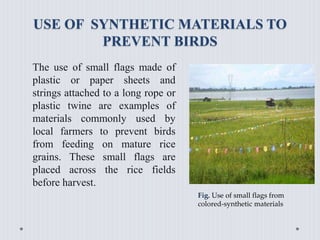
The use of small flags made of
plastic or paper sheets and
strings attached to a long rope or
plastic twine are examples of
materials commonly used by
local farmers to prevent birds
from feeding on mature rice
grains. These small flags are
placed across the rice fields
before harvest.
Fig. Use of small flags from
colored-synthetic materials
IK in Good Germination:
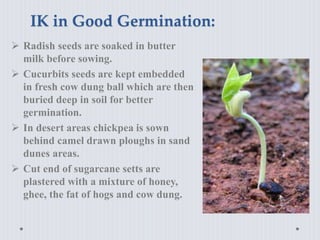
 Radish seeds are soaked in butter
milk before sowing.
 Cucurbits seeds are kept embedded
in fresh cow dung ball which are then
buried deep in soil for better
germination.
 In desert areas chickpea is sown
behind camel drawn ploughs in sand
dunes areas.
 Cut end of sugarcane setts are
plastered with a mixture of honey,
ghee, the fat of hogs and cow dung.
Jhum Cultivation/Slash and Burn
Cultivation/Shifting Cultivation:
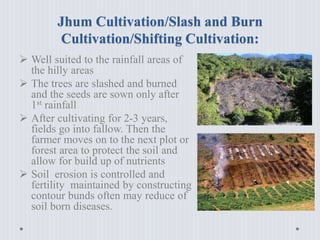
 Well suited to the rainfall areas of
the hilly areas
 The trees are slashed and burned
and the seeds are sown only after
1st rainfall
 After cultivating for 2-3 years,
fields go into fallow. Then the
farmer moves on to the next plot or
forest area to protect the soil and
allow for build up of nutrients
 Soil erosion is controlled and
fertility maintained by constructing
contour bunds often may reduce of
soil born diseases.
Continued….
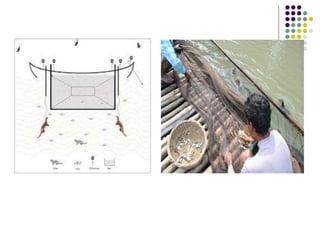
OTTERS FISHING
IN MONGLA, BANGLADESH--
• Fishermen do fishing with Otters at the
channel of Sundarbans National park
• Using Otters is a traditional way of
fishing in Sundarbans area
Continued….
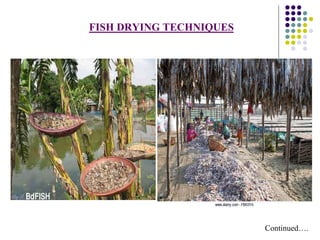
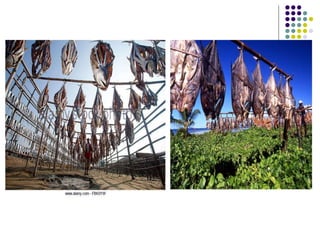
FISH DRYING TECHNIQUES
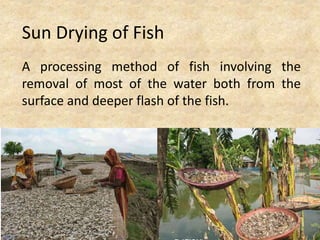
Sun Drying of Fish
A processing method of fish involving the
removal of most of the water both from the
surface and deeper flash of the fish.
Importance of Dried Fish:
Dried fish processed through sun drying or
dehydration is highly concentrated fish compared to
other preserved form of fish.
As water content become reduced so microbial
activity can not run at normal rate thus reduce the
spoilage of fish.
Less expensive method and comparatively simple
procedure.
Reduced water content, enzymatic and many
chemical process which are responsible for fish
spoilage retarded.
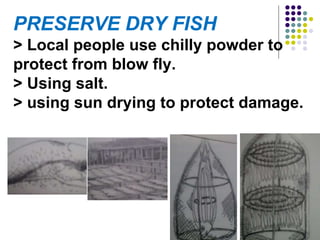
PRESERVE DRY FISH
> Local people use chilly powder to
protect from blow fly.
> Using salt.
> using sun drying to protect damage.
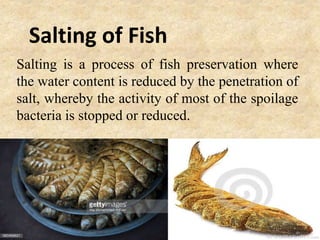
Salting of Fish
Salting is a process of fish preservation where
the water content is reduced by the penetration of
salt, whereby the activity of most of the spoilage
bacteria is stopped or reduced.
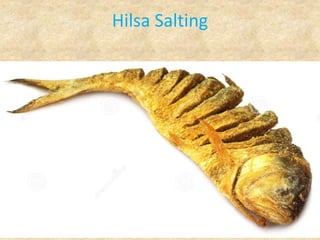
Hilsa Salting
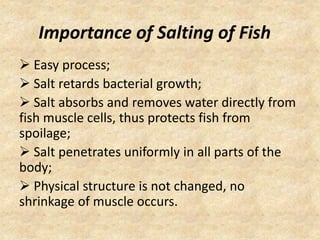
Importance of Salting of Fish
 Easy process;
 Salt retards bacterial growth;
 Salt absorbs and removes water directly from
fish muscle cells, thus protects fish from
spoilage;
 Salt penetrates uniformly in all parts of the
body;
 Physical structure is not changed, no
shrinkage of muscle occurs.
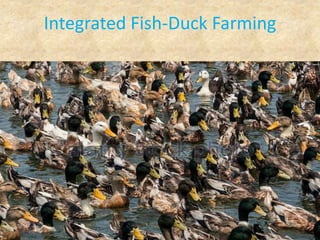
Integrated Fish-Duck Farming
Features of Integrated Duck Farming
Ducks are highly compatible with cultivated
fishes.
Duck fertilize the pond by their dropping.
Ducks keep water plants in check.
Duck aerate the water while swimming.
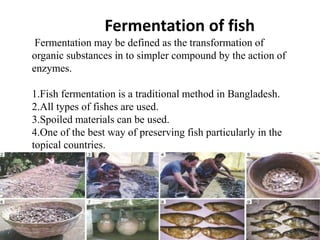
Fermentation of fish
Fermentation may be defined as the transformation of
organic substances in to simpler compound by the action of
enzymes.
1.Fish fermentation is a traditional method in Bangladesh.
2.All types of fishes are used.
3.Spoiled materials can be used.
4.One of the best way of preserving fish particularly in the
topical countries.
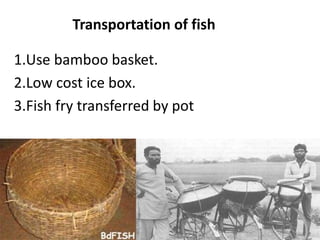
Transportation of fish
1.Use bamboo basket.
2.Low cost ice box.
3.Fish fry transferred by pot
HOW INDEGENOUS KNOWLEDGE
USE IN CLOSE WATER
> When Oxygen reduces the fish come
to surface.
> Specially in the evening it occur then
people use swimming in the pond.
> Or by stirring the water by bamboo.
HOW INDEGENOUS KNOWLEDGE
HELPS IN FISH CULTURE
> Local people put branches of tree
on pond water specially one side.
> They do it traditionally but it work
in many way.
> It provide fish for shelter from
sunlight.
> Also work as Sanctuary.
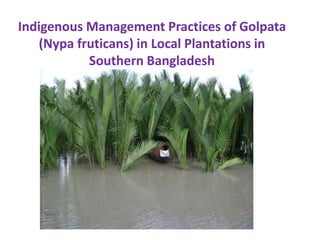
Indigenous Management Practices of Golpata
(Nypa fruticans) in Local Plantations in
Southern Bangladesh
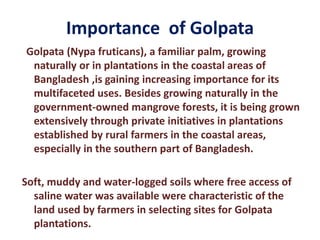
Importance of Golpata
Golpata (Nypa fruticans), a familiar palm, growing
naturally or in plantations in the coastal areas of
Bangladesh ,is gaining increasing importance for its
multifaceted uses. Besides growing naturally in the
government-owned mangrove forests, it is being grown
extensively through private initiatives in plantations
established by rural farmers in the coastal areas,
especially in the southern part of Bangladesh.
Soft, muddy and water-logged soils where free access of
saline water was available were characteristic of the
land used by farmers in selecting sites for Golpata
plantations.
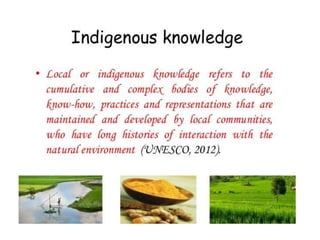
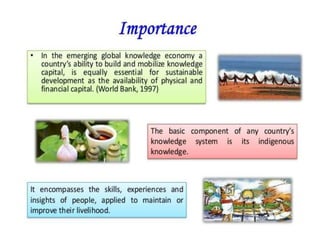
Indigenous knowledge

Indigenous knowledge

  • 1.
    Indigenous Knowledge Used in AgriculturalPractice Presented By: Ms Students’16 Department of Agricultural Extension Education Bangladesh Agricultural University
  • 4.
    System framework ofindigenous knowledge
  • 5.
    Indigenous Knowledge inRice Cultivation  Common salt is dissolved in water and sprayed in rice fields for controlling major weeds  To prevent lodging in rice crop at maturity in water logging conditions , the upper portion of the rice plants is cut with the help of sickle. After two months of transplanting ,excess growth of rice plant is checked due to pruning. Lower part of the plant become strong
  • 6.
    MULCHING Tree leaves andrice straw used as mulch materials.it is age old tradition in our agriculture. This conserve soil moisture as well as keep the soil cool which provide favourable conditions. Add organic matter to soil, effective for weed management.
  • 7.
    SCARECROW • Bangladeshi Farmersset up a human like efegy called 'Kaktarua' in their agriculture fields. It is believed that the efegy would protect the products by scaring birds and other animals that are supposed to harm their products.
  • 9.
    Birds sits andeats insects. Especially, Rice Bug, Green leaf hopper, Brown Plant hopper control. Procedure of Biological control.
  • 11.
     Fruit coverat mature stage.  Insect infestation control especially fruit borer, White fly, Ants, Beetle etc. All fruits mature same time
  • 12.
    THRESHING AND DRYING Threshing: Bybeating the grain using a flail on a threshing floor. Making oxen walk in circles on the grain on a hard surface. By using threshing board.
  • 13.
    Drying: It is thetraditional method for reducing the moisture content of grain. Sun drying is the most common drying methods all over the world. It is simple method for safe storage of grains.
  • 14.
     Bamboo leavesare used during transportation of milk in rural area  It keeps the milk temperature cool  It helps to maintain the acidity level of milk
  • 15.
    Removal of Jackfruitsticky latex with mustard oil Characteristics After cutting Jackfruit excretes an extremely sticky latex substance. The chemical property of the latex/resin of jackfruits is oil solubility Advantage If hand/utensils coated with edible oil mainly mustard oil, then sticky latex can easily removed from hand /utensils.
  • 16.
    Green Papaya asa Meat Tenderizer Characteristics Green papaya contain an enzyme called Papain. The connective tissue in the meat breaks down when it comes in contact with Papain. Papaya is preferred tenderizer for red meat (Lamb, Mutton, Goat, Beef). Advantage It is easy to tough cut of meat to cook with papaya. It need less time to cook.
  • 17.
    Green Chilli Presevation Characteristics •The stem of the green chillies are prone to bacteria and thus it leads to spoilage. So these are discarded. • And, if found any rotten chillies in the bunch it should be off too because one rotten chilli can spoil the whole • Next step is to wrap the chillies in the paper towel or newspaper and put them in dry place. Advantages The green chillies will last longer (mine lasts up-to 1-2 weeks).
  • 18.
    Grain Preservation withNeem Leaves Characteristics Neem leaves have a bitter fragrance and store some alkaloids which repel the insects and pathogens from attacking the stored food. Advantage Storing food grains along with Neem leaves repels the insects attacking the food grains.
  • 19.
    TREADLE PUMP  Thetreadle pump is a foot-powered water pump widely used in Asia and spreading in Africa. It consists of two metal cylinders with pistons that are operated by a natural walking motion on two treadles. Advantage  Simple and cheap  Ergonomic treadle motion / Less intensive operation (foot operated)  Produced in local workshops/ Maintenance uses local skills and materials.  Usually leads to generation of US$100-500 additional income per year for rural households in Africa and Asia
  • 20.
    Raised platform forpreservation of livestock food Raised platforms for preserving the livestock food (dry straw or grass) from natural disasters.  A five to seven feet platform made of soil with a bamboo or wooden stick in the middle that can be tied to a surrounding tree.  A “matcha” or bamboo-made scaffold
  • 21.
    RAISED PLATFORM (KILLA)FOR LIVESTOCK and SEED DRYING
  • 22.
    PRESERVING GRAINS USINGNEEM LEAVES 300-400 Neem Leaves Thin cotton cloth (muslin cloth) Fresh Neem Leaves
  • 23.
    DIRECTION FOR PRESERVINGGRAINS: Pluck fresh green Neem leaves and shade dry them. (It will take 5-6 days to shade dry Neem leaves during winters and 2-3 days during summers) Keep approximately 100 dried leaves aside. Crush rest of the leaves to coarse powder. Make 5cm x 5cm pouch of the cloth. Fill the cloth with coarse powder of dried Neem leaves. Stitch the open end of the pouch to seal it nicely. Make 5-6 pouches for 10 kg of grain.
  • 24.
    DIRECTION FOR PRESERVINGGRAINS (Cont.):  Spread the dried Neem leaves kept aside on the bottom of the container and cover with cotton cloth or dry paper.  Fill 1/4 grain in the container.  Place two pouches at two corners of container on the grain and then fill half of the remaining grain in the container.  Keep the remaining two pouches at the other two corners of the container and fill rest of the grain.  Place the remaining two pouches on the top of the last layer of grain.  Close the lid of the container, the grains will remain pest free for almost a year.
  • 25.
    Shade dried NeemLeaves Shade dried and crushed Neem leaves Neem leaves pouch being made Dried Neem leaves pouch for Preserving grains
  • 26.
    USE OF SYNTHETICMATERIALS TO PREVENT BIRDS The use of small flags made of plastic or paper sheets and strings attached to a long rope or plastic twine are examples of materials commonly used by local farmers to prevent birds from feeding on mature rice grains. These small flags are placed across the rice fields before harvest. Fig. Use of small flags from colored-synthetic materials
  • 27.
    IK in GoodGermination:  Radish seeds are soaked in butter milk before sowing.  Cucurbits seeds are kept embedded in fresh cow dung ball which are then buried deep in soil for better germination.  In desert areas chickpea is sown behind camel drawn ploughs in sand dunes areas.  Cut end of sugarcane setts are plastered with a mixture of honey, ghee, the fat of hogs and cow dung.
  • 28.
    Jhum Cultivation/Slash andBurn Cultivation/Shifting Cultivation:  Well suited to the rainfall areas of the hilly areas  The trees are slashed and burned and the seeds are sown only after 1st rainfall  After cultivating for 2-3 years, fields go into fallow. Then the farmer moves on to the next plot or forest area to protect the soil and allow for build up of nutrients  Soil erosion is controlled and fertility maintained by constructing contour bunds often may reduce of soil born diseases.
  • 29.
    Continued…. OTTERS FISHING IN MONGLA,BANGLADESH-- • Fishermen do fishing with Otters at the channel of Sundarbans National park • Using Otters is a traditional way of fishing in Sundarbans area
  • 31.
  • 32.
    Sun Drying ofFish A processing method of fish involving the removal of most of the water both from the surface and deeper flash of the fish.
  • 33.
    Importance of DriedFish: Dried fish processed through sun drying or dehydration is highly concentrated fish compared to other preserved form of fish. As water content become reduced so microbial activity can not run at normal rate thus reduce the spoilage of fish. Less expensive method and comparatively simple procedure. Reduced water content, enzymatic and many chemical process which are responsible for fish spoilage retarded.
  • 35.
    PRESERVE DRY FISH >Local people use chilly powder to protect from blow fly. > Using salt. > using sun drying to protect damage.
  • 36.
    Salting of Fish Saltingis a process of fish preservation where the water content is reduced by the penetration of salt, whereby the activity of most of the spoilage bacteria is stopped or reduced.
  • 37.
  • 38.
    Importance of Saltingof Fish  Easy process;  Salt retards bacterial growth;  Salt absorbs and removes water directly from fish muscle cells, thus protects fish from spoilage;  Salt penetrates uniformly in all parts of the body;  Physical structure is not changed, no shrinkage of muscle occurs.
  • 39.
  • 40.
    Features of IntegratedDuck Farming Ducks are highly compatible with cultivated fishes. Duck fertilize the pond by their dropping. Ducks keep water plants in check. Duck aerate the water while swimming.
  • 41.
    Fermentation of fish Fermentationmay be defined as the transformation of organic substances in to simpler compound by the action of enzymes. 1.Fish fermentation is a traditional method in Bangladesh. 2.All types of fishes are used. 3.Spoiled materials can be used. 4.One of the best way of preserving fish particularly in the topical countries.
  • 42.
    Transportation of fish 1.Usebamboo basket. 2.Low cost ice box. 3.Fish fry transferred by pot
  • 43.
    HOW INDEGENOUS KNOWLEDGE USEIN CLOSE WATER > When Oxygen reduces the fish come to surface. > Specially in the evening it occur then people use swimming in the pond. > Or by stirring the water by bamboo.
  • 44.
    HOW INDEGENOUS KNOWLEDGE HELPSIN FISH CULTURE > Local people put branches of tree on pond water specially one side. > They do it traditionally but it work in many way. > It provide fish for shelter from sunlight. > Also work as Sanctuary.
  • 45.
    Indigenous Management Practicesof Golpata (Nypa fruticans) in Local Plantations in Southern Bangladesh
  • 46.
    Importance of Golpata Golpata(Nypa fruticans), a familiar palm, growing naturally or in plantations in the coastal areas of Bangladesh ,is gaining increasing importance for its multifaceted uses. Besides growing naturally in the government-owned mangrove forests, it is being grown extensively through private initiatives in plantations established by rural farmers in the coastal areas, especially in the southern part of Bangladesh. Soft, muddy and water-logged soils where free access of saline water was available were characteristic of the land used by farmers in selecting sites for Golpata plantations.