FOOD
PRESERVATION
TLE – HOME EDUCATION
Quarter 3 - Module 6
MARY ANN M. SISON
Learning Competency: Explain different ways of food
preservation, using different tools /equipment in preserving
foods and applying different principles and skills in food
preservation processing.
LC Code: TLE6HE-0f-10
Specific Objectives:
1. Explain different ways of food preservation (drying,
salting, freezing, processing )
2. Use tools /utensils and equipment and their substitutes
in food preservation and processes.
3. Preserve food applying principles and skills in food
preservation processing.
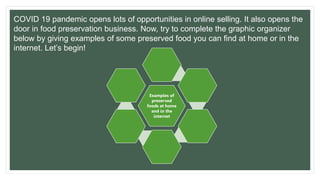
COVID 19 pandemic opens lots of opportunities in online selling. It also opens the
door in food preservation business. Now, try to complete the graphic organizer
below by giving examples of some preserved food you can find at home or in the
internet. Let’s begin!
Examples of
preserved
foods at home
and in the
internet
Food preservation is very in demand in
the market today. Fresh fruits,
vegetables, fish and meat are foods
often used for food preservation. Many
people love to have them at home and
give them as a gift, therefore it can be a
source of income for the family.
Planning a Preserved Food Project
Here are some things to consider before
deciding to preserve large amount of food as an
income generating activity.
1.Choose the main ingredient very well. Make
sure the rest of ingredients are of high quality.
2. Prepare all the materials and
make sure that the tools and
equipment are very clean before
starting the task.
3. Once you start preserving the
food, finish the task immediately.
Do not leave anything exposed for
so long to prevent it from being
contaminated with dirt, dust and
insects.
4. Follow the instruction on how
to preserve food carefully.
5. Strictly follow the prescribed
cooking time.
6. Use sterilized bottles or containers to
store the preserved food. Let it stay in
the boiling water for 20 minutes. Avoid

containers made from metal, copper or
zinc. Use bottles or plastics when
making pickles.
7. Be sure the food is in the right
temperature before it is placed
inside the container especially
glass bottles. Test the bottles for
leaks by turning it upside down.
8. Keep the preserved food in a
cool and dry place where it will
not be disturbed. Add label
indicating expiration date and
the date it was made.
Different Ways of
Preserving Food
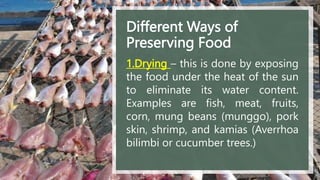
1.Drying – this is done by exposing
the food under the heat of the sun
to eliminate its water content.
Examples are fish, meat, fruits,
corn, mung beans (munggo), pork
skin, shrimp, and kamias (Averrhoa
bilimbi or cucumber trees.)
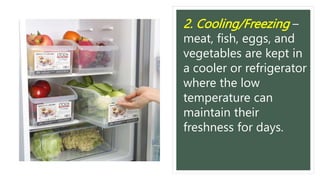
2. Cooling/Freezing –
meat, fish, eggs, and
vegetables are kept in
a cooler or refrigerator
where the low
temperature can
maintain their
freshness for days.
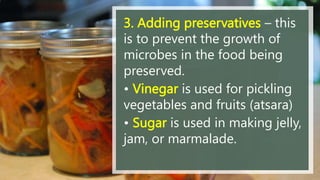
3. Adding preservatives – this
is to prevent the growth of
microbes in the food being
preserved.
• Vinegar is used for pickling
vegetables and fruits (atsara)
• Sugar is used in making jelly,
jam, or marmalade.
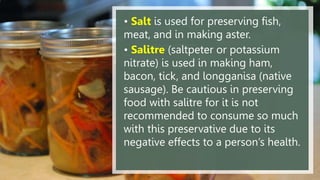
• Salt is used for preserving fish,
meat, and in making aster.
• Salitre (saltpeter or potassium
nitrate) is used in making ham,
bacon, tick, and longganisa (native
sausage). Be cautious in preserving
food with salitre for it is not
recommended to consume so much
with this preservative due to its
negative effects to a person’s health.
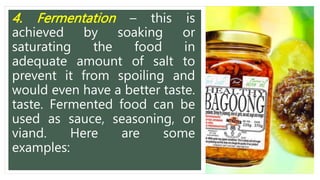
4. Fermentation – this is
achieved by soaking or
saturating the food in
adequate amount of salt to
prevent it from spoiling and
would even have a better taste.
taste. Fermented food can be
used as sauce, seasoning, or
viand. Here are some
examples:
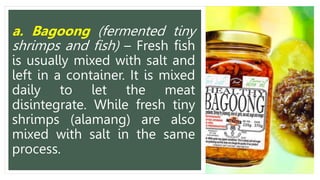
a. Bagoong (fermented tiny
shrimps and fish) – Fresh fish
is usually mixed with salt and
left in a container. It is mixed
daily to let the meat
disintegrate. While fresh tiny
shrimps (alamang) are also
mixed with salt in the same
process.
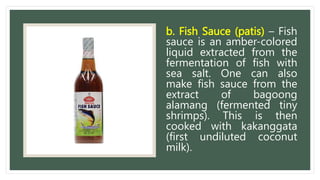
b. Fish Sauce (patis) – Fish
sauce is an amber-colored
liquid extracted from the
fermentation of fish with
sea salt. One can also
make fish sauce from the
extract of bagoong
alamang (fermented tiny
shrimps). This is then
cooked with kakanggata
(first undiluted coconut
milk).
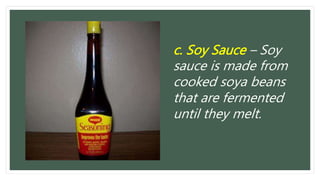
c. Soy Sauce – Soy
sauce is made from
cooked soya beans
that are fermented
until they melt.
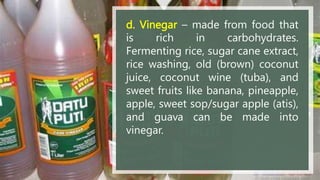
d. Vinegar – made from food that
is rich in carbohydrates.
Fermenting rice, sugar cane extract,
rice washing, old (brown) coconut
juice, coconut wine (tuba), and
sweet fruits like banana, pineapple,
apple, sweet sop/sugar apple (atis),
and guava can be made into
vinegar.
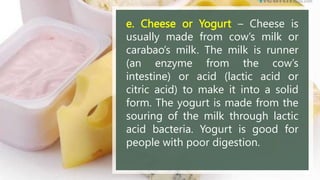
e. Cheese or Yogurt – Cheese is
usually made from cow’s milk or
carabao’s milk. The milk is runner
(an enzyme from the cow’s
intestine) or acid (lactic acid or
citric acid) to make it into a solid
form. The yogurt is made from the
souring of the milk through lactic
acid bacteria. Yogurt is good for
people with poor digestion.
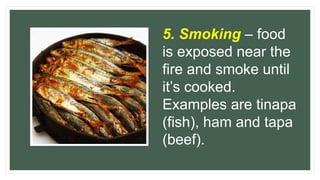
5. Smoking – food
is exposed near the
fire and smoke until
it’s cooked.
Examples are tinapa
(fish), ham and tapa
(beef).
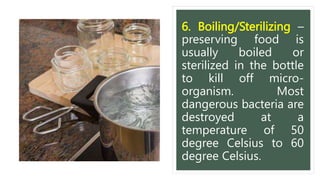
6. Boiling/Sterilizing –
preserving food is
usually boiled or
sterilized in the bottle
to kill off micro-
organism. Most
dangerous bacteria are
destroyed at a
temperature of 50
degree Celsius to 60
degree Celsius.
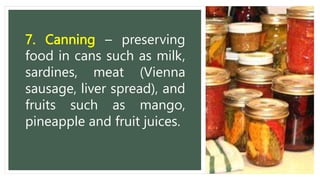
7. Canning – preserving
food in cans such as milk,
sardines, meat (Vienna
sausage, liver spread), and
fruits such as mango,
pineapple and fruit juices.
Basic Tools and Utensils Used for
Food Preservation and Processing
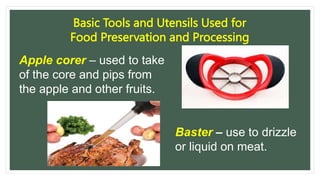
Apple corer – used to take
of the core and pips from
the apple and other fruits.
Baster – use to drizzle
or liquid on meat.
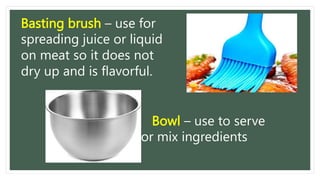
Basting brush – use for
spreading juice or liquid
on meat so it does not
dry up and is flavorful.
Bowl – use to serve
or mix ingredients
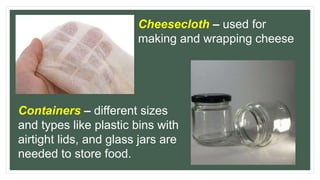
Cheesecloth – used for
making and wrapping cheese
Containers – different sizes
and types like plastic bins with
airtight lids, and glass jars are
needed to store food.
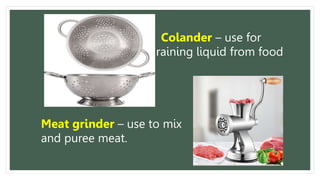
Colander – use for
draining liquid from food
Meat grinder – use to mix
and puree meat.
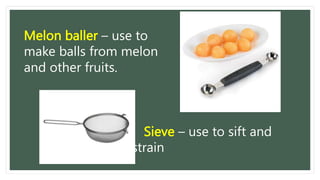
Melon baller – use to
make balls from melon
and other fruits.
Sieve – use to sift and
strain
Tips on Selecting Fresh Products
1.Fish – Eyes should be clear; flesh
should be firm; belly should be intact;
gills are reddish; scales are shiny and
slippery; and firmly attached to the
flesh.
2. Meat – The product should not have
any foul smell; there should be no marks
or stain in the meat; it should be reddish
and natural in color; and the flesh should
be soft and firm.
3. Vegetable – Choose leafy
vegetables that are in season.
Make sure that they are whole,
green, and crispy; no stain or
scratches.
4. Fruits – It should be ripe in
natural way; should be in
season; ripeness should be
even and without any
damaged (defect, rotten) part.
5. Eggs – It should have a rough
shell; it should submerge in water
(should not float); it should be
clear inside when placed in front
of the light.
Healthy and Safety Practices in Food
Preservation
Food preservation can be done safely and
sanitarily if the following steps are done
correctly.
1.Prepare the necessary tools, equipment, and
ingredients before starting the task.
2. Return everything to their
respective storage once you are
done with the task.
3. Concentrate on the
task to avoid accidents
in the work area.
4. As much as possible, sit
down while doing the task to
avoid getting tired easily.
5. Be sure to know how to
use the different tools and
equipment in food
preservation.
6. Keep the work area clean.
7. Try to work as fast as possible to
avoid exposing the preserved food
for so long. This would prevent
microbes from getting into the
preserved food.
8. Be sure to add labels to
all ingredients to be used to
avoid the mistake of mixing
the wrong ingredients.
ATSARANG
PAPAYA
GROUP ACTIVITY
Atchara (Papaya)
Ingredients
 3 to 4 lbs. green papaya
julienned
 2 medium sized carrots
julienned
 1 large onion thinly sliced
lengthwise
 10 cloves garlic thinly sliced
 2 tbsp whole peppercorn
 1 large red bell pepper cut
into strips
 1 knob ginger cut into
thin strips
 1/4 cup salt to dehydrate
papaya
 1 1/2 tsp salt for the brine
or syrup
 2 cups white vinegar
 1 1/3 cups granulated
sugar
 2 small boxes raisins
Instructions
1. Place the julienned papaya in a
large bowl and combine 1/4 cup
salt then mix until the salt is well
distributed.
Instructions
2. Cover the bowl and place inside the
refrigerator overnight (the salt will
dehydrate the papaya).
Place the julienned papaya in a colander
or strainer then rinse with running water.
3. Using cheesecloth (or any cloth) as a
container, put the rinsed papaya inside the
cloth and squeeze until all the liquid comes
out.
4. Put the papaya back in the large bowl
and combine with carrots, garlic, ginger,
onions, whole peppercorn, bell pepper, and
raisins
5. Heat the saucepan and pour-in
the vinegar and bring to a boil.
6. Add the sugar and 1 1/2 tsp salt
then stir until well diluted
7. Add the sugar and 1 1/2 tsp salt then
stir until well diluted
8. Turn off the heat and allow the syrup
to cool down until temperature is low
enough to handle.
9. Place the combined vegetables and spices in a
sterilized airtight jar and pour-in the syrup
10. Seal the jar and place inside the refrigerator for
a week (or 5 days minimum to achieve the
expected texture and flavor).
11. Serve cold with fried dishes. Share and Enjoy!

Food Preservation.pptx

  • 1.
    FOOD PRESERVATION TLE – HOMEEDUCATION Quarter 3 - Module 6 MARY ANN M. SISON
  • 2.
    Learning Competency: Explaindifferent ways of food preservation, using different tools /equipment in preserving foods and applying different principles and skills in food preservation processing. LC Code: TLE6HE-0f-10 Specific Objectives: 1. Explain different ways of food preservation (drying, salting, freezing, processing ) 2. Use tools /utensils and equipment and their substitutes in food preservation and processes. 3. Preserve food applying principles and skills in food preservation processing.
  • 3.
    COVID 19 pandemicopens lots of opportunities in online selling. It also opens the door in food preservation business. Now, try to complete the graphic organizer below by giving examples of some preserved food you can find at home or in the internet. Let’s begin! Examples of preserved foods at home and in the internet
  • 4.
    Food preservation isvery in demand in the market today. Fresh fruits, vegetables, fish and meat are foods often used for food preservation. Many people love to have them at home and give them as a gift, therefore it can be a source of income for the family.
  • 5.
    Planning a PreservedFood Project Here are some things to consider before deciding to preserve large amount of food as an income generating activity. 1.Choose the main ingredient very well. Make sure the rest of ingredients are of high quality.
  • 6.
    2. Prepare allthe materials and make sure that the tools and equipment are very clean before starting the task.
  • 7.
    3. Once youstart preserving the food, finish the task immediately. Do not leave anything exposed for so long to prevent it from being contaminated with dirt, dust and insects.
  • 8.
    4. Follow theinstruction on how to preserve food carefully. 5. Strictly follow the prescribed cooking time.
  • 9.
    6. Use sterilizedbottles or containers to store the preserved food. Let it stay in the boiling water for 20 minutes. Avoid containers made from metal, copper or zinc. Use bottles or plastics when making pickles.
  • 10.
    7. Be surethe food is in the right temperature before it is placed inside the container especially glass bottles. Test the bottles for leaks by turning it upside down.
  • 11.
    8. Keep thepreserved food in a cool and dry place where it will not be disturbed. Add label indicating expiration date and the date it was made.
  • 12.
    Different Ways of PreservingFood 1.Drying – this is done by exposing the food under the heat of the sun to eliminate its water content. Examples are fish, meat, fruits, corn, mung beans (munggo), pork skin, shrimp, and kamias (Averrhoa bilimbi or cucumber trees.)
  • 13.
    2. Cooling/Freezing – meat,fish, eggs, and vegetables are kept in a cooler or refrigerator where the low temperature can maintain their freshness for days.
  • 14.
    3. Adding preservatives– this is to prevent the growth of microbes in the food being preserved. • Vinegar is used for pickling vegetables and fruits (atsara) • Sugar is used in making jelly, jam, or marmalade.
  • 15.
    • Salt isused for preserving fish, meat, and in making aster. • Salitre (saltpeter or potassium nitrate) is used in making ham, bacon, tick, and longganisa (native sausage). Be cautious in preserving food with salitre for it is not recommended to consume so much with this preservative due to its negative effects to a person’s health.
  • 16.
    4. Fermentation –this is achieved by soaking or saturating the food in adequate amount of salt to prevent it from spoiling and would even have a better taste. taste. Fermented food can be used as sauce, seasoning, or viand. Here are some examples:
  • 17.
    a. Bagoong (fermentedtiny shrimps and fish) – Fresh fish is usually mixed with salt and left in a container. It is mixed daily to let the meat disintegrate. While fresh tiny shrimps (alamang) are also mixed with salt in the same process.
  • 18.
    b. Fish Sauce(patis) – Fish sauce is an amber-colored liquid extracted from the fermentation of fish with sea salt. One can also make fish sauce from the extract of bagoong alamang (fermented tiny shrimps). This is then cooked with kakanggata (first undiluted coconut milk).
  • 19.
    c. Soy Sauce– Soy sauce is made from cooked soya beans that are fermented until they melt.
  • 20.
    d. Vinegar –made from food that is rich in carbohydrates. Fermenting rice, sugar cane extract, rice washing, old (brown) coconut juice, coconut wine (tuba), and sweet fruits like banana, pineapple, apple, sweet sop/sugar apple (atis), and guava can be made into vinegar.
  • 21.
    e. Cheese orYogurt – Cheese is usually made from cow’s milk or carabao’s milk. The milk is runner (an enzyme from the cow’s intestine) or acid (lactic acid or citric acid) to make it into a solid form. The yogurt is made from the souring of the milk through lactic acid bacteria. Yogurt is good for people with poor digestion.
  • 22.
    5. Smoking –food is exposed near the fire and smoke until it’s cooked. Examples are tinapa (fish), ham and tapa (beef).
  • 23.
    6. Boiling/Sterilizing – preservingfood is usually boiled or sterilized in the bottle to kill off micro- organism. Most dangerous bacteria are destroyed at a temperature of 50 degree Celsius to 60 degree Celsius.
  • 24.
    7. Canning –preserving food in cans such as milk, sardines, meat (Vienna sausage, liver spread), and fruits such as mango, pineapple and fruit juices.
  • 25.
    Basic Tools andUtensils Used for Food Preservation and Processing Apple corer – used to take of the core and pips from the apple and other fruits. Baster – use to drizzle or liquid on meat.
  • 26.
    Basting brush –use for spreading juice or liquid on meat so it does not dry up and is flavorful. Bowl – use to serve or mix ingredients
  • 27.
    Cheesecloth – usedfor making and wrapping cheese Containers – different sizes and types like plastic bins with airtight lids, and glass jars are needed to store food.
  • 28.
    Colander – usefor draining liquid from food Meat grinder – use to mix and puree meat.
  • 29.
    Melon baller –use to make balls from melon and other fruits. Sieve – use to sift and strain
  • 30.
    Tips on SelectingFresh Products 1.Fish – Eyes should be clear; flesh should be firm; belly should be intact; gills are reddish; scales are shiny and slippery; and firmly attached to the flesh.
  • 31.
    2. Meat –The product should not have any foul smell; there should be no marks or stain in the meat; it should be reddish and natural in color; and the flesh should be soft and firm.
  • 32.
    3. Vegetable –Choose leafy vegetables that are in season. Make sure that they are whole, green, and crispy; no stain or scratches.
  • 33.
    4. Fruits –It should be ripe in natural way; should be in season; ripeness should be even and without any damaged (defect, rotten) part.
  • 34.
    5. Eggs –It should have a rough shell; it should submerge in water (should not float); it should be clear inside when placed in front of the light.
  • 35.
    Healthy and SafetyPractices in Food Preservation Food preservation can be done safely and sanitarily if the following steps are done correctly. 1.Prepare the necessary tools, equipment, and ingredients before starting the task.
  • 36.
    2. Return everythingto their respective storage once you are done with the task.
  • 37.
    3. Concentrate onthe task to avoid accidents in the work area.
  • 38.
    4. As muchas possible, sit down while doing the task to avoid getting tired easily.
  • 39.
    5. Be sureto know how to use the different tools and equipment in food preservation.
  • 40.
    6. Keep thework area clean. 7. Try to work as fast as possible to avoid exposing the preserved food for so long. This would prevent microbes from getting into the preserved food.
  • 41.
    8. Be sureto add labels to all ingredients to be used to avoid the mistake of mixing the wrong ingredients.
  • 42.
  • 43.
    Atchara (Papaya) Ingredients  3to 4 lbs. green papaya julienned  2 medium sized carrots julienned  1 large onion thinly sliced lengthwise  10 cloves garlic thinly sliced  2 tbsp whole peppercorn  1 large red bell pepper cut into strips  1 knob ginger cut into thin strips  1/4 cup salt to dehydrate papaya  1 1/2 tsp salt for the brine or syrup  2 cups white vinegar  1 1/3 cups granulated sugar  2 small boxes raisins
  • 44.
    Instructions 1. Place thejulienned papaya in a large bowl and combine 1/4 cup salt then mix until the salt is well distributed.
  • 45.
    Instructions 2. Cover thebowl and place inside the refrigerator overnight (the salt will dehydrate the papaya). Place the julienned papaya in a colander or strainer then rinse with running water.
  • 46.
    3. Using cheesecloth(or any cloth) as a container, put the rinsed papaya inside the cloth and squeeze until all the liquid comes out. 4. Put the papaya back in the large bowl and combine with carrots, garlic, ginger, onions, whole peppercorn, bell pepper, and raisins
  • 47.
    5. Heat thesaucepan and pour-in the vinegar and bring to a boil. 6. Add the sugar and 1 1/2 tsp salt then stir until well diluted
  • 48.
    7. Add thesugar and 1 1/2 tsp salt then stir until well diluted 8. Turn off the heat and allow the syrup to cool down until temperature is low enough to handle.
  • 49.
    9. Place thecombined vegetables and spices in a sterilized airtight jar and pour-in the syrup 10. Seal the jar and place inside the refrigerator for a week (or 5 days minimum to achieve the expected texture and flavor). 11. Serve cold with fried dishes. Share and Enjoy!