Indigenous Knowledge Systems
lesson 5 - Indigenous soil management practices (2hrs)
• Course Code: MS 5208 (02:30/00)
• Saturday 3.30 pm – 5.30 pm
• P.B. Dharmasena
• 0777 - 613234, 0717 – 613234
• dharmasenapb@ymail.com , dharmasenapb@gmail.com
• Links to publications:
https://independent.academia.edu/PunchiBandageDharmasena
https://www.researchgate.net/profile/Punchi_Bandage_Dharmasena/
contributions
http://www.slideshare.net/DharmasenaPb
https://www.youtube.com/channel/UC_PFqwl0OqsrxH1wTm_jZeg
Indigenous Knowledge Systems
2. Fundamental features of Sri Lankan Agriculture; climate, Soil, Genetic
resources, agro biodiversity (2 hrs)
3. History and the culture of Sri Lankan agriculture sector development (1 hr)
4. Green revolution and its impact on Sri Lankan traditional agricultural
system (biodiversity deterioration, inorganic substances for pest and disease
controlling, development of hybrid varieties etc.) (1hr)
5. Indigenous soil management practices (2hrs)
6. Indigenous Irrigation systems (cascade system, water harvesting concepts)
(2hrs)
9. Traditional practices for, weather forecasting, plant nutrient supplementing,
pest and disease control and indigenous agricultural machines and tools (2hrs)
13. Cultural dimensions of Agricultural rituals in Sri Lanka (1 hr)
14. Climate change and Indigenous Agricultural knowledge in Sri Lanka(1 hr)
Total: 12 hours)
List of lectures by P.B. Dharmasena
3
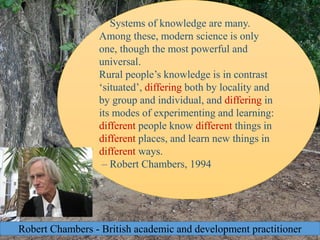
Systems of knowledge are many.
Among these, modern science is only
one, though the most powerful and
universal.
Rural people’s knowledge is in contrast
‘situated’, differing both by locality and
by group and individual, and differing in
its modes of experimenting and learning:
different people know different things in
different places, and learn new things in
different ways.
– Robert Chambers, 1994
Robert Chambers - British academic and development practitioner
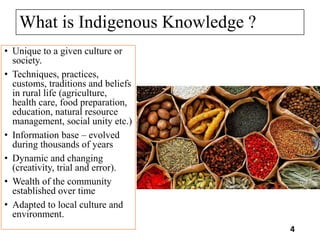
What is Indigenous Knowledge ?
• Unique to a given culture or
society.
• Techniques, practices,
customs, traditions and beliefs
in rural life (agriculture,
health care, food preparation,
education, natural resource
management, social unity etc.)
• Information base – evolved
during thousands of years
• Dynamic and changing
(creativity, trial and error).
• Wealth of the community
established over time
• Adapted to local culture and
environment.
4
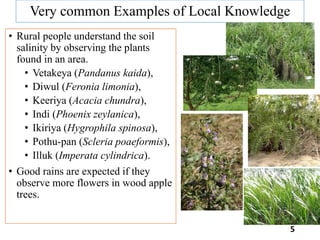
• Rural people understand the soil
salinity by observing the plants
found in an area.
• Vetakeya (Pandanus kaida),
• Diwul (Feronia limonia),
• Keeriya (Acacia chundra),
• Indi (Phoenix zeylanica),
• Ikiriya (Hygrophila spinosa),
• Pothu-pan (Scleria poaeformis),
• Illuk (Imperata cylindrica).
• Good rains are expected if they
observe more flowers in wood apple
trees.
Very common Examples of Local Knowledge
5
Indigenous knowledge
• Indigenous knowledge has two powerful advantages
over outside Knowledge
• It has little or no cost and is readily available.
• Indigenous knowledge systems and technologies are
found to be socially desirable, economically affordable,
sustainable, and involve minimum risk to rural farmers
and producers
• Above all, they are widely believed to conserve
resources.
• There are situations in which modern science is not
appropriate, and use of simpler technologies and
procedures are required. Thus, indigenous
knowledge provides basis for problem solving
strategies for local communities, especially the poor.
Indigenous knowledge
• Indigenous knowledge has always placed human
being within the context of total environment.
• As such it pays attention to all living things
including plants, animals, water, soil and other
natural resources.
• It tries to achieve human wellbeing without
jeopardizing the environmental totality.
• For example, people are not permitted to destroy
woods haphazardly, although clearing jungles is
needed for cultivation.
• There is a jungle low to which people should obey.
Forests cannot be burned without following certain
rituals.
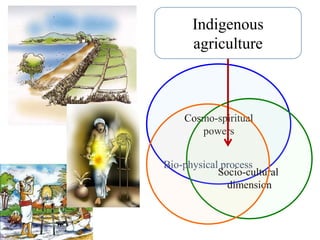
Cosmo-spiritual
powers
Socio-cultural
dimension
Bio-physical process
Indigenous
agriculture
Principles of Indigenous Agriculture
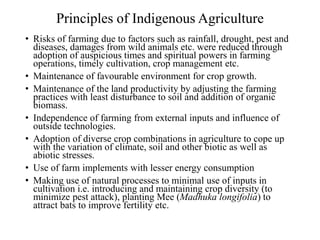
• Risks of farming due to factors such as rainfall, drought, pest and
diseases, damages from wild animals etc. were reduced through
adoption of auspicious times and spiritual powers in farming
operations, timely cultivation, crop management etc.
• Maintenance of favourable environment for crop growth.
• Maintenance of the land productivity by adjusting the farming
practices with least disturbance to soil and addition of organic
biomass.
• Independence of farming from external inputs and influence of
outside technologies.
• Adoption of diverse crop combinations in agriculture to cope up
with the variation of climate, soil and other biotic as well as
abiotic stresses.
• Use of farm implements with lesser energy consumption
• Making use of natural processes to minimal use of inputs in
cultivation i.e. introducing and maintaining crop diversity (to
minimize pest attack), planting Mee (Madhuka longifolia) to
attract bats to improve fertility etc.
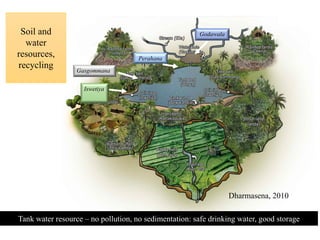
Godawala
Perahana
Gasgommana
Iswetiya
Tank water resource – no pollution, no sedimentation: safe drinking water, good storage
Soil and
water
resources,
recycling
Dharmasena, 2010
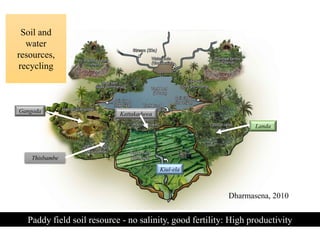
Landa
Thisbambe
Gangoda Kattakaduwa
Kiul-ela
Paddy field soil resource - no salinity, good fertility: High productivity
Soil and
water
resources,
recycling
Dharmasena, 2010
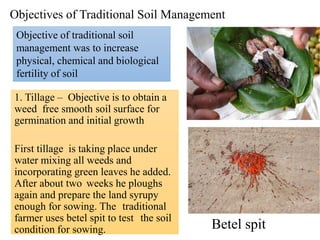
Objectives of Traditional Soil Management
1. Tillage – Objective is to obtain a
weed free smooth soil surface for
germination and initial growth
First tillage is taking place under
water mixing all weeds and
incorporating green leaves he added.
After about two weeks he ploughs
again and prepare the land syrupy
enough for sowing. The traditional
farmer uses betel spit to test the soil
condition for sowing. Betel spit
Objective of traditional soil
management was to increase
physical, chemical and biological
fertility of soil
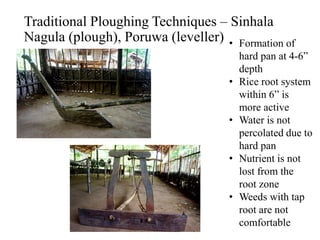
Traditional Ploughing Techniques – Sinhala
Nagula (plough), Poruwa (leveller) • Formation of
hard pan at 4-6”
depth
• Rice root system
within 6” is
more active
• Water is not
percolated due to
hard pan
• Nutrient is not
lost from the
root zone
• Weeds with tap
root are not
comfortable
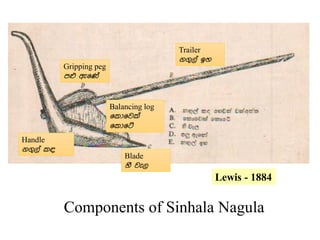
Lewis - 1884
Handle
නගුල් කඳ
Gripping peg
පළු ඇණේ
Blade
හී වැල
Trailer
නගුල් ඉහ
Balancing log
ණකොණවක්
ණකොණේ
Components of Sinhala Nagula
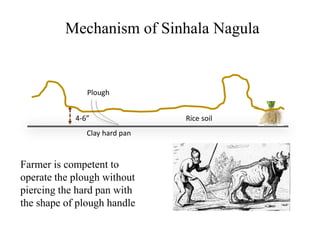
Rice soil
Mechanism of Sinhala Nagula
Clay hard pan
4-6”
Plough
Farmer is competent to
operate the plough without
piercing the hard pan with
the shape of plough handle
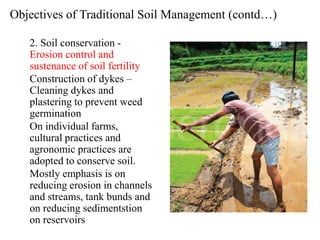
Objectives of Traditional Soil Management (contd…)
2. Soil conservation -
Erosion control and
sustenance of soil fertility
Construction of dykes –
Cleaning dykes and
plastering to prevent weed
germination
On individual farms,
cultural practices and
agronomic practices are
adopted to conserve soil.
Mostly emphasis is on
reducing erosion in channels
and streams, tank bunds and
on reducing sedimentstion
on reservoirs
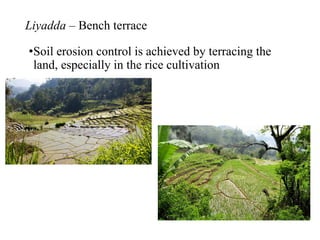
Liyadda – Bench terrace
•Soil erosion control is achieved by terracing the
land, especially in the rice cultivation
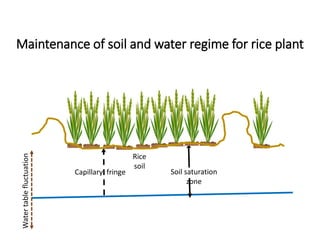
Maintenance of soil and water regime for rice plant
Soil saturation
zone
Capillary fringe
Water
table
fluctuation
Rice
soil
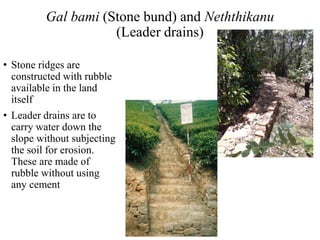
Gal bami (Stone bund) and Neththikanu
(Leader drains)
• Stone ridges are
constructed with rubble
available in the land
itself
• Leader drains are to
carry water down the
slope without subjecting
the soil for erosion.
These are made of
rubble without using
any cement
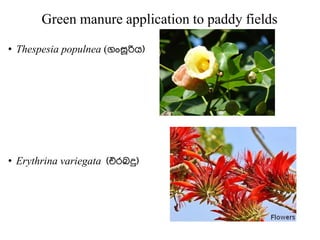
Green manure application to paddy fields
• Thespesia populnea (ගංසූරිය)
• Erythrina variegata (එරබදු)
Green manure application to paddy fields
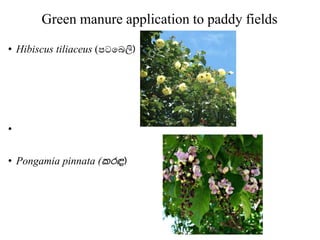
• Hibiscus tiliaceus (පටබෙලි)
•
• Pongamia pinnata (කරඳ)
Green manure application to paddy fields
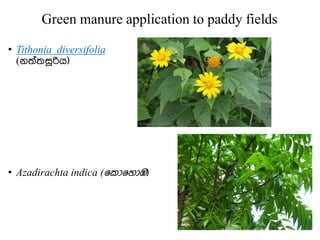
• Tithonia diversifolia
(නත්තසූරිය)
• Azadirachta indica (ණකොණහොඹ)
Social Aspect of Soil Management Practices
• Working together – ‘Ekathu pada nowi hari haman wedak
nokaran’
• Sharing
– Hada beda ganeema and beda hada ganeema (grow and share
and share and grow)
– Bethma - It is a practice that temporarily redistributes plots of
land among shareholders (paddy landowners) in part of the
command area (territory) of a tank (reservoir) during drought
periods.
– ‘Pangu’ method—The tank had to be maintained properly to
avoid breach, leak, and excess seepage. Repair and desiltation
of tanks and cleaning of canals during dry periods are shared
tasks assigned to each farmer proportionately to land
ownership
• Village commons (common ownership)
– Micro-landscapes are utilized to reduce tank water losses,
mitigate salinity effects, prevent tank sedimentation and so on
Social Cohesion
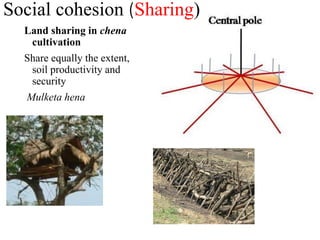
Land sharing in chena
cultivation
Share equally the extent,
soil productivity and
security
Mulketa hena
Social cohesion (Sharing)
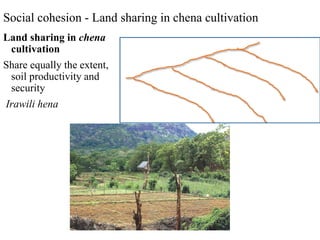
Social cohesion - Land sharing in chena cultivation
Land sharing in chena
cultivation
Share equally the extent,
soil productivity and
security
Irawili hena
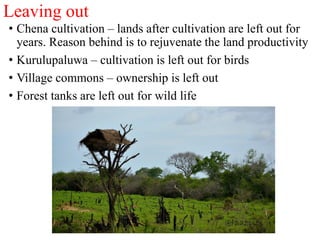
Leaving out
• Chena cultivation – lands after cultivation are left out for
years. Reason behind is to rejuvenate the land productivity
• Kurulupaluwa – cultivation is left out for birds
• Village commons – ownership is left out
• Forest tanks are left out for wild life
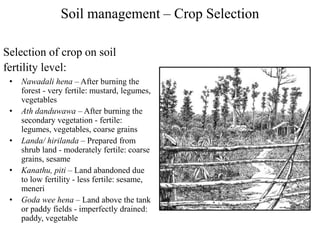
Soil management – Crop Selection
Selection of crop on soil
fertility level:
• Nawadali hena – After burning the
forest - very fertile: mustard, legumes,
vegetables
• Ath danduwawa – After burning the
secondary vegetation - fertile:
legumes, vegetables, coarse grains
• Landa/ hirilanda – Prepared from
shrub land - moderately fertile: coarse
grains, sesame
• Kanathu, piti – Land abandoned due
to low fertility - less fertile: sesame,
meneri
• Goda wee hena – Land above the tank
or paddy fields - imperfectly drained:
paddy, vegetable
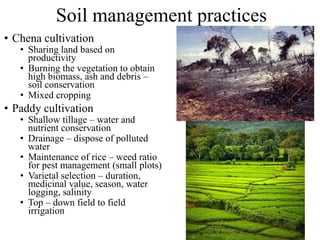
Soil management practices
• Chena cultivation
• Sharing land based on
productivity
• Burning the vegetation to obtain
high biomass, ash and debris –
soil conservation
• Mixed cropping
• Paddy cultivation
• Shallow tillage – water and
nutrient conservation
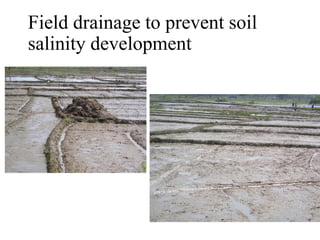
• Drainage – dispose of polluted
water
• Maintenance of rice – weed ratio
for pest management (small plots)
• Varietal selection – duration,
medicinal value, season, water
logging, salinity
• Top – down field to field
irrigation
Field drainage to prevent soil
salinity development
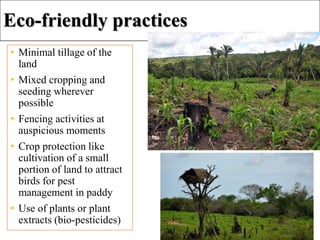
Eco-friendly practices
• Minimal tillage of the
land
• Mixed cropping and
seeding wherever
possible
• Fencing activities at
auspicious moments
• Crop protection like
cultivation of a small
portion of land to attract
birds for pest
management in paddy
• Use of plants or plant
extracts (bio-pesticides)
30
Kem and bio-pesticides
Kem
• Ash spreading with
chanting manthra
• Oil lamp or fire torch
• Fumigation (keppetiya,
gandapana, sera)
• Plant extracts (Madu,
Valdel, kokun, Godapara,
Demata, Kukuruman)
Bio-pesticides
• Ash spreading
• Light trap
• Fumigation (keppetiya,
gandapana, sera)
• Plant extracts (Madu,
Valdel, kokun, Godapara,
Demata, Kukuruman)
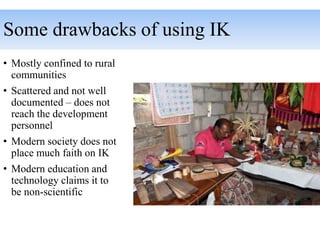
Some drawbacks of using IK
• Mostly confined to rural
communities
• Scattered and not well
documented – does not
reach the development
personnel
• Modern society does not
place much faith on IK
• Modern education and
technology claims it to
be non-scientific
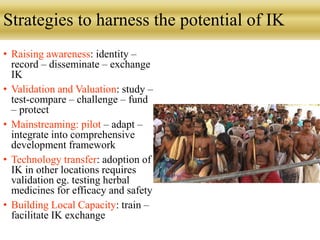
Strategies to harness the potential of IK
• Raising awareness: identity –
record – disseminate – exchange
IK
• Validation and Valuation: study –
test-compare – challenge – fund
– protect
• Mainstreaming: pilot – adapt –
integrate into comprehensive
development framework
• Technology transfer: adoption of
IK in other locations requires
validation eg. testing herbal
medicines for efficacy and safety
• Building Local Capacity: train –
facilitate IK exchange
Areas, which need improvement
• Policy and legal frameworks for incorporating traditional
knowledge practices in place
• Collection and compilation of traditional/indigenous
knowledge scattered in the country.
• Information, communication and educational strategy to
be operational
• Research in traditional knowledge programmes that can
be implemented
• Capacity building of stakeholders using existing
traditional knowledge
• Institutional mechanism for incorporating/mainstreaming
traditional knowledge
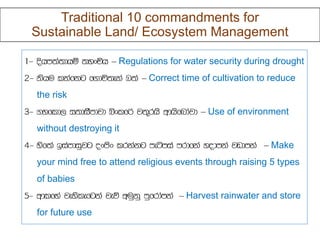
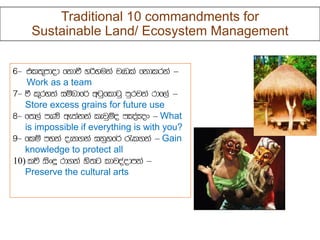
Traditional 10 commandments for
Sustainable Land/ Ecosystem Management
– Regulations for water security during drought
– Correct time of cultivation to reduce
the risk
– Use of environment
without destroying it
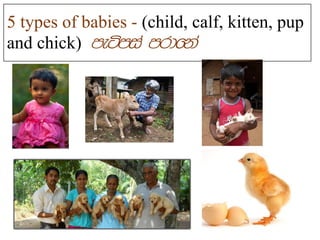
– Make
your mind free to attend religious events through raising 5 types
of babies
– Harvest rainwater and store
for future use
5 types of babies - (child, calf, kitten, pup
and chick)
–
Work as a team
–
Store excess grains for future use
– What
is impossible if everything is with you?
– Gain
knowledge to protect all
10) –
Preserve the cultural arts
Traditional 10 commandments for
Sustainable Land/ Ecosystem Management

Indigenous Knowledge Systems - 5

  • 1.
    Indigenous Knowledge Systems lesson5 - Indigenous soil management practices (2hrs) • Course Code: MS 5208 (02:30/00) • Saturday 3.30 pm – 5.30 pm • P.B. Dharmasena • 0777 - 613234, 0717 – 613234 • dharmasenapb@ymail.com , dharmasenapb@gmail.com • Links to publications: https://independent.academia.edu/PunchiBandageDharmasena https://www.researchgate.net/profile/Punchi_Bandage_Dharmasena/ contributions http://www.slideshare.net/DharmasenaPb https://www.youtube.com/channel/UC_PFqwl0OqsrxH1wTm_jZeg
  • 2.
    Indigenous Knowledge Systems 2.Fundamental features of Sri Lankan Agriculture; climate, Soil, Genetic resources, agro biodiversity (2 hrs) 3. History and the culture of Sri Lankan agriculture sector development (1 hr) 4. Green revolution and its impact on Sri Lankan traditional agricultural system (biodiversity deterioration, inorganic substances for pest and disease controlling, development of hybrid varieties etc.) (1hr) 5. Indigenous soil management practices (2hrs) 6. Indigenous Irrigation systems (cascade system, water harvesting concepts) (2hrs) 9. Traditional practices for, weather forecasting, plant nutrient supplementing, pest and disease control and indigenous agricultural machines and tools (2hrs) 13. Cultural dimensions of Agricultural rituals in Sri Lanka (1 hr) 14. Climate change and Indigenous Agricultural knowledge in Sri Lanka(1 hr) Total: 12 hours) List of lectures by P.B. Dharmasena
  • 3.
    3 Systems of knowledgeare many. Among these, modern science is only one, though the most powerful and universal. Rural people’s knowledge is in contrast ‘situated’, differing both by locality and by group and individual, and differing in its modes of experimenting and learning: different people know different things in different places, and learn new things in different ways. – Robert Chambers, 1994 Robert Chambers - British academic and development practitioner
  • 4.
    What is IndigenousKnowledge ? • Unique to a given culture or society. • Techniques, practices, customs, traditions and beliefs in rural life (agriculture, health care, food preparation, education, natural resource management, social unity etc.) • Information base – evolved during thousands of years • Dynamic and changing (creativity, trial and error). • Wealth of the community established over time • Adapted to local culture and environment. 4
  • 5.
    • Rural peopleunderstand the soil salinity by observing the plants found in an area. • Vetakeya (Pandanus kaida), • Diwul (Feronia limonia), • Keeriya (Acacia chundra), • Indi (Phoenix zeylanica), • Ikiriya (Hygrophila spinosa), • Pothu-pan (Scleria poaeformis), • Illuk (Imperata cylindrica). • Good rains are expected if they observe more flowers in wood apple trees. Very common Examples of Local Knowledge 5
  • 6.
    Indigenous knowledge • Indigenousknowledge has two powerful advantages over outside Knowledge • It has little or no cost and is readily available. • Indigenous knowledge systems and technologies are found to be socially desirable, economically affordable, sustainable, and involve minimum risk to rural farmers and producers • Above all, they are widely believed to conserve resources. • There are situations in which modern science is not appropriate, and use of simpler technologies and procedures are required. Thus, indigenous knowledge provides basis for problem solving strategies for local communities, especially the poor.
  • 7.
    Indigenous knowledge • Indigenousknowledge has always placed human being within the context of total environment. • As such it pays attention to all living things including plants, animals, water, soil and other natural resources. • It tries to achieve human wellbeing without jeopardizing the environmental totality. • For example, people are not permitted to destroy woods haphazardly, although clearing jungles is needed for cultivation. • There is a jungle low to which people should obey. Forests cannot be burned without following certain rituals.
  • 8.
  • 9.
    Principles of IndigenousAgriculture • Risks of farming due to factors such as rainfall, drought, pest and diseases, damages from wild animals etc. were reduced through adoption of auspicious times and spiritual powers in farming operations, timely cultivation, crop management etc. • Maintenance of favourable environment for crop growth. • Maintenance of the land productivity by adjusting the farming practices with least disturbance to soil and addition of organic biomass. • Independence of farming from external inputs and influence of outside technologies. • Adoption of diverse crop combinations in agriculture to cope up with the variation of climate, soil and other biotic as well as abiotic stresses. • Use of farm implements with lesser energy consumption • Making use of natural processes to minimal use of inputs in cultivation i.e. introducing and maintaining crop diversity (to minimize pest attack), planting Mee (Madhuka longifolia) to attract bats to improve fertility etc.
  • 10.
    Godawala Perahana Gasgommana Iswetiya Tank water resource– no pollution, no sedimentation: safe drinking water, good storage Soil and water resources, recycling Dharmasena, 2010
  • 11.
    Landa Thisbambe Gangoda Kattakaduwa Kiul-ela Paddy fieldsoil resource - no salinity, good fertility: High productivity Soil and water resources, recycling Dharmasena, 2010
  • 12.
    Objectives of TraditionalSoil Management 1. Tillage – Objective is to obtain a weed free smooth soil surface for germination and initial growth First tillage is taking place under water mixing all weeds and incorporating green leaves he added. After about two weeks he ploughs again and prepare the land syrupy enough for sowing. The traditional farmer uses betel spit to test the soil condition for sowing. Betel spit Objective of traditional soil management was to increase physical, chemical and biological fertility of soil
  • 13.
    Traditional Ploughing Techniques– Sinhala Nagula (plough), Poruwa (leveller) • Formation of hard pan at 4-6” depth • Rice root system within 6” is more active • Water is not percolated due to hard pan • Nutrient is not lost from the root zone • Weeds with tap root are not comfortable
  • 14.
    Lewis - 1884 Handle නගුල්කඳ Gripping peg පළු ඇණේ Blade හී වැල Trailer නගුල් ඉහ Balancing log ණකොණවක් ණකොණේ Components of Sinhala Nagula
  • 15.
    Rice soil Mechanism ofSinhala Nagula Clay hard pan 4-6” Plough Farmer is competent to operate the plough without piercing the hard pan with the shape of plough handle
  • 16.
    Objectives of TraditionalSoil Management (contd…) 2. Soil conservation - Erosion control and sustenance of soil fertility Construction of dykes – Cleaning dykes and plastering to prevent weed germination On individual farms, cultural practices and agronomic practices are adopted to conserve soil. Mostly emphasis is on reducing erosion in channels and streams, tank bunds and on reducing sedimentstion on reservoirs
  • 17.
    Liyadda – Benchterrace •Soil erosion control is achieved by terracing the land, especially in the rice cultivation
  • 18.
    Maintenance of soiland water regime for rice plant Soil saturation zone Capillary fringe Water table fluctuation Rice soil
  • 19.
    Gal bami (Stonebund) and Neththikanu (Leader drains) • Stone ridges are constructed with rubble available in the land itself • Leader drains are to carry water down the slope without subjecting the soil for erosion. These are made of rubble without using any cement
  • 20.
    Green manure applicationto paddy fields • Thespesia populnea (ගංසූරිය) • Erythrina variegata (එරබදු)
  • 21.
    Green manure applicationto paddy fields • Hibiscus tiliaceus (පටබෙලි) • • Pongamia pinnata (කරඳ)
  • 22.
    Green manure applicationto paddy fields • Tithonia diversifolia (නත්තසූරිය) • Azadirachta indica (ණකොණහොඹ)
  • 23.
    Social Aspect ofSoil Management Practices • Working together – ‘Ekathu pada nowi hari haman wedak nokaran’ • Sharing – Hada beda ganeema and beda hada ganeema (grow and share and share and grow) – Bethma - It is a practice that temporarily redistributes plots of land among shareholders (paddy landowners) in part of the command area (territory) of a tank (reservoir) during drought periods. – ‘Pangu’ method—The tank had to be maintained properly to avoid breach, leak, and excess seepage. Repair and desiltation of tanks and cleaning of canals during dry periods are shared tasks assigned to each farmer proportionately to land ownership • Village commons (common ownership) – Micro-landscapes are utilized to reduce tank water losses, mitigate salinity effects, prevent tank sedimentation and so on Social Cohesion
  • 24.
    Land sharing inchena cultivation Share equally the extent, soil productivity and security Mulketa hena Social cohesion (Sharing)
  • 25.
    Social cohesion -Land sharing in chena cultivation Land sharing in chena cultivation Share equally the extent, soil productivity and security Irawili hena
  • 26.
    Leaving out • Chenacultivation – lands after cultivation are left out for years. Reason behind is to rejuvenate the land productivity • Kurulupaluwa – cultivation is left out for birds • Village commons – ownership is left out • Forest tanks are left out for wild life
  • 27.
    Soil management –Crop Selection Selection of crop on soil fertility level: • Nawadali hena – After burning the forest - very fertile: mustard, legumes, vegetables • Ath danduwawa – After burning the secondary vegetation - fertile: legumes, vegetables, coarse grains • Landa/ hirilanda – Prepared from shrub land - moderately fertile: coarse grains, sesame • Kanathu, piti – Land abandoned due to low fertility - less fertile: sesame, meneri • Goda wee hena – Land above the tank or paddy fields - imperfectly drained: paddy, vegetable
  • 28.
    Soil management practices •Chena cultivation • Sharing land based on productivity • Burning the vegetation to obtain high biomass, ash and debris – soil conservation • Mixed cropping • Paddy cultivation • Shallow tillage – water and nutrient conservation • Drainage – dispose of polluted water • Maintenance of rice – weed ratio for pest management (small plots) • Varietal selection – duration, medicinal value, season, water logging, salinity • Top – down field to field irrigation
  • 29.
    Field drainage toprevent soil salinity development
  • 30.
    Eco-friendly practices • Minimaltillage of the land • Mixed cropping and seeding wherever possible • Fencing activities at auspicious moments • Crop protection like cultivation of a small portion of land to attract birds for pest management in paddy • Use of plants or plant extracts (bio-pesticides) 30
  • 31.
    Kem and bio-pesticides Kem •Ash spreading with chanting manthra • Oil lamp or fire torch • Fumigation (keppetiya, gandapana, sera) • Plant extracts (Madu, Valdel, kokun, Godapara, Demata, Kukuruman) Bio-pesticides • Ash spreading • Light trap • Fumigation (keppetiya, gandapana, sera) • Plant extracts (Madu, Valdel, kokun, Godapara, Demata, Kukuruman)
  • 32.
    Some drawbacks ofusing IK • Mostly confined to rural communities • Scattered and not well documented – does not reach the development personnel • Modern society does not place much faith on IK • Modern education and technology claims it to be non-scientific
  • 33.
    Strategies to harnessthe potential of IK • Raising awareness: identity – record – disseminate – exchange IK • Validation and Valuation: study – test-compare – challenge – fund – protect • Mainstreaming: pilot – adapt – integrate into comprehensive development framework • Technology transfer: adoption of IK in other locations requires validation eg. testing herbal medicines for efficacy and safety • Building Local Capacity: train – facilitate IK exchange
  • 34.
    Areas, which needimprovement • Policy and legal frameworks for incorporating traditional knowledge practices in place • Collection and compilation of traditional/indigenous knowledge scattered in the country. • Information, communication and educational strategy to be operational • Research in traditional knowledge programmes that can be implemented • Capacity building of stakeholders using existing traditional knowledge • Institutional mechanism for incorporating/mainstreaming traditional knowledge
  • 35.
    Traditional 10 commandmentsfor Sustainable Land/ Ecosystem Management – Regulations for water security during drought – Correct time of cultivation to reduce the risk – Use of environment without destroying it – Make your mind free to attend religious events through raising 5 types of babies – Harvest rainwater and store for future use
  • 36.
    5 types ofbabies - (child, calf, kitten, pup and chick)
  • 37.
    – Work as ateam – Store excess grains for future use – What is impossible if everything is with you? – Gain knowledge to protect all 10) – Preserve the cultural arts Traditional 10 commandments for Sustainable Land/ Ecosystem Management