INDIGENOUS KNOWLEDGE IN
DISASTER MANAGEMENT
By
Mr. Ringo, J.
Ringo, J. is a Lecturer at the University of Dodoma, Department of Geography and
Environmental Studies. He lectures Geography, Environmental Resources Management
and Conservation, and Disaster Management Subjects. He has a Master of Science in
Natural Resources Management and a Bachelor of Arts in Geography & Environmental
Studies. He has 9 publications in International Referred Journals (ie.International
Journal of Environment and Bioenegry, International Journal of Modern Management
Sciences, International Journal of Marine, Atmospheric, and Earth Sciences,
International Journal of Modern Social Sciences, International Journal of Modern
Plant & Animal Sciences, and Sustainability in Environment)encompassing; Human-
wildlife interactions, Environmental resources management and conservation, and
Disaster management aspects.
Office no: 307A
Email: japhetelis@yahoo.com
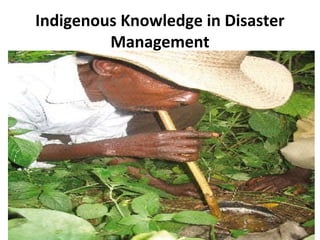
Indigenous Knowledge in Disaster
Management
Indigenous knowledge
• Indigenous knowledge is the total
sum of the knowledge and skills
accumulated over generations which
people in a particular geographical
area possess, and which enable them
to get the most out of their natural
environment.
Disaster management
• Disaster management is a general term which
incorporate actions related to disasters.
• It is the body of policy and administrative
decisions and operational activities, which
pertain various stages of a disasters at all
levels.
• It is a continuous and integrated multi-
sectoral, multi-disciplinary process of
planning and implementing measures aimed
at: preventing and reducing the risk of
disasters; mitigating the severity or
consequences of disasters; emergency
preparedness; a rapid and effective response
to disasters; and post-disaster recovery and
rehabilitation.
• Therefore, disaster management refers to all
actions aimed at preventing, reducing and
dealing with disasters.
• For centuries ago, indigenous knowledge has
been used by many communities around the
world to thwart disasters.
Characteristics of indigenous
knowledge
• Indigenous Knowledge has the following
characteristics:
Is generated within communities;
• Only the community in place and time
formulate IK from their long normal practices
Is oral in nature;
• IK developed outside the formal education
system.
• IK is orally transmitted and is not recorded or
documented in any medium as it is verbally
transmitted from one generation to the next.
Is not systematically documented;
• As stated earlier, indigenous knowledge is
transferred mainly orally by word-of-mouth.
• This means that in most cases it is not
scientifically documented and recorded in
writings.
Is location and culture specific;
• Indigenous Knowledge is unique to a given
culture, location or society.
• This means that, each locality has its own
unique local knowledge.
Forms the basis for decision-making on
survival strategies;
• This means that this knowledge is developed
by people to help them survive in their
particular locality in different areas of life,
such as health, food preparation, education
and Disaster Risk Reduction
Is dynamic and based on innovation,
adaptation, and experimentation.
• This means that IK evolves and adapts
according to the circumstances in the
particular environment.
• IK can be combined and used with knowledge
based on science and technology
• The dynamism, adaptability, uniqueness and
innovation of Indigenous knowledge is
revealed on how communities living in a
particular locality or region develop and
determine their own Indigenous Knowledge.
• This is usually unique and conducive to their
continued existence and survival in their
particular community.
Application of Indigenous Knowledge
in Disaster Management
• Weather prediction and interpretation
• Food Security
• Treatment of disaster victims
• Early warning dissemination
• Enhance coping strategies
Challenges facing the use of indigenous
knowledge in Disaster Management
• Although Indigenous Knowledge plays an
important role in disaster management, it is
faced by many challenges.
• The main challenges are discussed below:
Marginalization;
• Marginalization refers to exclusion – a state of
being left out, or of insufficient attention to
something.
• Marginalization is caused by the perception
that Indigenous Knowledge is primitive and
old-fashioned, and therefore has no value.
• This perception results in Indigenous
Knowledge being marginalized, and this being
so, Western Knowledge is used, because it is
thought that it is more advanced and better
suited to a third-world country.
Not being captured and stored in a systematic
way;
• Indigenous Knowledge faces the risk of not
being captured and stored in a systematic
way, because it is handed down orally from
generation to generation.
• This emphasizes the fact that Indigenous
Knowledge needs to be recorded, protected
and utilized – in ways that could benefit its
owners and the communities.
 Disappearance;
• Indigenous Knowledge faces the threat of
extinction, because of the failure to record it,
and because of problems associated with the
preservation and protection of such
knowledge.
• This is mainly due to the fact that most of the
Indigenous Knowledge practices are not
written down.
• The knowledge is transmitted from one
generation to the next, orally and in practice.
• It is therefore easy for Indigenous Knowledge
to become extinct – due to the lack of any
reliable records.
Management of Indigenous Knowledge;
• The main challenges to the management of
Indigenous Knowledge include the methods of
identifying it, the access to it, the intellectual
property rights and the media and format in
which to preserve it.
• The collection of Indigenous Knowledge is
laborious, time-consuming and costly.
• The implication is that Indigenous Knowledge
ends up not being collected, due to the time
taken and the cost of collecting it.
• Major threat to Indigenous Knowledge is how
to reconcile it with modern science, without
one substituting the other, thereby respecting
both of the two sets of values, and building on
their respective strengths.
Reconciling Indigenous Knowledge and
Western Knowledge.
• A major challenge that IK continue to face is
how to reconcile it and modern science
without substituting each other, respecting
the two sets of values, and building on their
respective strengths.
• In most instances Western knowledge ends up
taking precedence over Indigenous
Knowledge and this is mainly due to the
perception that it is superior to such
knowledge.
indigenous knowledge

indigenous knowledge

  • 1.
    INDIGENOUS KNOWLEDGE IN DISASTERMANAGEMENT By Mr. Ringo, J. Ringo, J. is a Lecturer at the University of Dodoma, Department of Geography and Environmental Studies. He lectures Geography, Environmental Resources Management and Conservation, and Disaster Management Subjects. He has a Master of Science in Natural Resources Management and a Bachelor of Arts in Geography & Environmental Studies. He has 9 publications in International Referred Journals (ie.International Journal of Environment and Bioenegry, International Journal of Modern Management Sciences, International Journal of Marine, Atmospheric, and Earth Sciences, International Journal of Modern Social Sciences, International Journal of Modern Plant & Animal Sciences, and Sustainability in Environment)encompassing; Human- wildlife interactions, Environmental resources management and conservation, and Disaster management aspects. Office no: 307A Email: japhetelis@yahoo.com
  • 2.
    Indigenous Knowledge inDisaster Management
  • 3.
    Indigenous knowledge • Indigenousknowledge is the total sum of the knowledge and skills accumulated over generations which people in a particular geographical area possess, and which enable them to get the most out of their natural environment.
  • 4.
    Disaster management • Disastermanagement is a general term which incorporate actions related to disasters. • It is the body of policy and administrative decisions and operational activities, which pertain various stages of a disasters at all levels.
  • 5.
    • It isa continuous and integrated multi- sectoral, multi-disciplinary process of planning and implementing measures aimed at: preventing and reducing the risk of disasters; mitigating the severity or consequences of disasters; emergency preparedness; a rapid and effective response to disasters; and post-disaster recovery and rehabilitation.
  • 6.
    • Therefore, disastermanagement refers to all actions aimed at preventing, reducing and dealing with disasters. • For centuries ago, indigenous knowledge has been used by many communities around the world to thwart disasters.
  • 7.
    Characteristics of indigenous knowledge •Indigenous Knowledge has the following characteristics: Is generated within communities; • Only the community in place and time formulate IK from their long normal practices
  • 8.
    Is oral innature; • IK developed outside the formal education system. • IK is orally transmitted and is not recorded or documented in any medium as it is verbally transmitted from one generation to the next.
  • 9.
    Is not systematicallydocumented; • As stated earlier, indigenous knowledge is transferred mainly orally by word-of-mouth. • This means that in most cases it is not scientifically documented and recorded in writings.
  • 10.
    Is location andculture specific; • Indigenous Knowledge is unique to a given culture, location or society. • This means that, each locality has its own unique local knowledge.
  • 11.
    Forms the basisfor decision-making on survival strategies; • This means that this knowledge is developed by people to help them survive in their particular locality in different areas of life, such as health, food preparation, education and Disaster Risk Reduction
  • 12.
    Is dynamic andbased on innovation, adaptation, and experimentation. • This means that IK evolves and adapts according to the circumstances in the particular environment. • IK can be combined and used with knowledge based on science and technology
  • 13.
    • The dynamism,adaptability, uniqueness and innovation of Indigenous knowledge is revealed on how communities living in a particular locality or region develop and determine their own Indigenous Knowledge. • This is usually unique and conducive to their continued existence and survival in their particular community.
  • 14.
    Application of IndigenousKnowledge in Disaster Management • Weather prediction and interpretation • Food Security • Treatment of disaster victims • Early warning dissemination • Enhance coping strategies
  • 15.
    Challenges facing theuse of indigenous knowledge in Disaster Management • Although Indigenous Knowledge plays an important role in disaster management, it is faced by many challenges. • The main challenges are discussed below:
  • 16.
    Marginalization; • Marginalization refersto exclusion – a state of being left out, or of insufficient attention to something. • Marginalization is caused by the perception that Indigenous Knowledge is primitive and old-fashioned, and therefore has no value.
  • 17.
    • This perceptionresults in Indigenous Knowledge being marginalized, and this being so, Western Knowledge is used, because it is thought that it is more advanced and better suited to a third-world country.
  • 18.
    Not being capturedand stored in a systematic way; • Indigenous Knowledge faces the risk of not being captured and stored in a systematic way, because it is handed down orally from generation to generation.
  • 19.
    • This emphasizesthe fact that Indigenous Knowledge needs to be recorded, protected and utilized – in ways that could benefit its owners and the communities.
  • 20.
     Disappearance; • IndigenousKnowledge faces the threat of extinction, because of the failure to record it, and because of problems associated with the preservation and protection of such knowledge. • This is mainly due to the fact that most of the Indigenous Knowledge practices are not written down.
  • 21.
    • The knowledgeis transmitted from one generation to the next, orally and in practice. • It is therefore easy for Indigenous Knowledge to become extinct – due to the lack of any reliable records.
  • 22.
    Management of IndigenousKnowledge; • The main challenges to the management of Indigenous Knowledge include the methods of identifying it, the access to it, the intellectual property rights and the media and format in which to preserve it. • The collection of Indigenous Knowledge is laborious, time-consuming and costly.
  • 23.
    • The implicationis that Indigenous Knowledge ends up not being collected, due to the time taken and the cost of collecting it. • Major threat to Indigenous Knowledge is how to reconcile it with modern science, without one substituting the other, thereby respecting both of the two sets of values, and building on their respective strengths.
  • 24.
    Reconciling Indigenous Knowledgeand Western Knowledge. • A major challenge that IK continue to face is how to reconcile it and modern science without substituting each other, respecting the two sets of values, and building on their respective strengths.
  • 25.
    • In mostinstances Western knowledge ends up taking precedence over Indigenous Knowledge and this is mainly due to the perception that it is superior to such knowledge.