Indicator Random Variable


Raditya W Erlangga (G651120714)
Bogor, 15 Desember 2012
AGENDA

• Introduction
• Hiring Problem overview
• Indicator Random Variable
• Examples
•Q&A
Hiring Problem
HIRING NEW OFFICE ASSISTANT
 Optimal strategy to maximize the
          probability of selecting
                    best applicant


        SECURITY UPDATE

        <ISC SA or IR Number>
        <Date>
HIRING PROBLEM OVERVIEW

» A new office assistant is required
» Using employment agency
» Interviews the candidate each day
» A small fee required to pay the interview process done by the agency.
  However, hiring an applicant is more expensive: pay substantial hiring
  fee + fire current office assistant to get the best candidate for the job
» What is the price needed for this strategy?
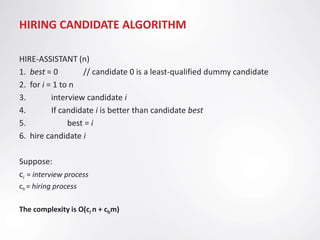
HIRING CANDIDATE ALGORITHM

HIRE-ASSISTANT (n)
1. best = 0        // candidate 0 is a least-qualified dummy candidate
2. for i = 1 to n
3.        interview candidate i
4.        If candidate i is better than candidate best
5.             best = i
6. hire candidate i

Suppose:
ci = interview process
ch = hiring process

The complexity is O(ci n + chm)
INDICATOR RANDOM VARIABLES

» Is used to analyze the hiring problem algorithm
» a convenient method for converting between probabilities and
  expectations
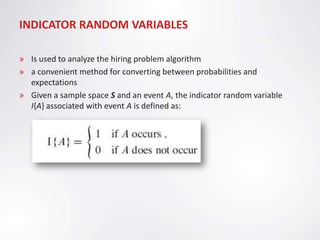
» Given a sample space S and an event A, the indicator random variable
  I{A} associated with event A is defined as:
EXAMPLES

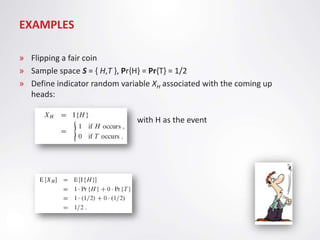
» Flipping a fair coin
» Sample space S = { H,T }, Pr{H} = Pr{T} = 1/2
» Define indicator random variable XH associated with the coming up
  heads:

                               with H as the event
LEMMA 1
Given a sample space S and an event A in the sample space S, let XA =I{A}.
Then E [XA ] = Pr{A}


Proof:
E [XA ] = E[I{A}]
       = 1. Pr{A} + 0. Pr{A’}
       = Pr{A}

where A’ is S – A, the complement of A
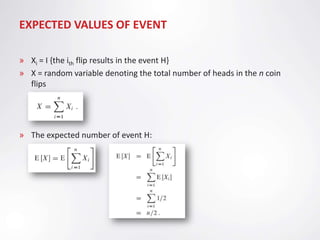
EXPECTED VALUES OF EVENT

» Xi = I {the ith flip results in the event H}
» X = random variable denoting the total number of heads in the n coin
  flips


» The expected number of event H:
ANALYSIS OF THE HIRING PROBLEM USING
INDICATOR RANDOM VARIABLES
» Assume the candidates arrive in random order
» X = random variable whose value equals the number of times we hire
  a new office assistant
» We may use expected value of random variable equation:


» However, a simplified calculation is using indicator random variables.
» Instead of computing E[X] by defining one variable associated with the
  number of times we hire a new office assistant, define n variables
  related to whether or not each particular candidate is hired. In
  particular, let Xi be the indicator random variable associated with the
  event in which the ith candidate is hired

                                 and
ANALYSIS OF THE HIRING PROBLEM USING INDICATOR
RANDOM VARIABLES
» Based on lemma E [XA ] = Pr{A}, we have:


» Since the candidate i arrives in random order, any one of these first i
  candidates is likely to be best-qualified candidate so far. Thus, the
  probability of candidate i is 1/i better qualified than candidates 1 till i-
  1, which yields:


» Now we can compute E[X]:
QUESTIONS?
THANK YOU

Indicator Random Variables

  • 1.
    Indicator Random Variable RadityaW Erlangga (G651120714) Bogor, 15 Desember 2012
  • 2.
    AGENDA • Introduction • HiringProblem overview • Indicator Random Variable • Examples •Q&A
  • 3.
    Hiring Problem HIRING NEWOFFICE ASSISTANT Optimal strategy to maximize the probability of selecting best applicant SECURITY UPDATE <ISC SA or IR Number> <Date>
  • 4.
    HIRING PROBLEM OVERVIEW »A new office assistant is required » Using employment agency » Interviews the candidate each day » A small fee required to pay the interview process done by the agency. However, hiring an applicant is more expensive: pay substantial hiring fee + fire current office assistant to get the best candidate for the job » What is the price needed for this strategy?
  • 5.
    HIRING CANDIDATE ALGORITHM HIRE-ASSISTANT(n) 1. best = 0 // candidate 0 is a least-qualified dummy candidate 2. for i = 1 to n 3. interview candidate i 4. If candidate i is better than candidate best 5. best = i 6. hire candidate i Suppose: ci = interview process ch = hiring process The complexity is O(ci n + chm)
  • 6.
    INDICATOR RANDOM VARIABLES »Is used to analyze the hiring problem algorithm » a convenient method for converting between probabilities and expectations » Given a sample space S and an event A, the indicator random variable I{A} associated with event A is defined as:
  • 7.
    EXAMPLES » Flipping afair coin » Sample space S = { H,T }, Pr{H} = Pr{T} = 1/2 » Define indicator random variable XH associated with the coming up heads: with H as the event
  • 8.
    LEMMA 1 Given asample space S and an event A in the sample space S, let XA =I{A}. Then E [XA ] = Pr{A} Proof: E [XA ] = E[I{A}] = 1. Pr{A} + 0. Pr{A’} = Pr{A} where A’ is S – A, the complement of A
  • 9.
    EXPECTED VALUES OFEVENT » Xi = I {the ith flip results in the event H} » X = random variable denoting the total number of heads in the n coin flips » The expected number of event H:
  • 10.
    ANALYSIS OF THEHIRING PROBLEM USING INDICATOR RANDOM VARIABLES » Assume the candidates arrive in random order » X = random variable whose value equals the number of times we hire a new office assistant » We may use expected value of random variable equation: » However, a simplified calculation is using indicator random variables. » Instead of computing E[X] by defining one variable associated with the number of times we hire a new office assistant, define n variables related to whether or not each particular candidate is hired. In particular, let Xi be the indicator random variable associated with the event in which the ith candidate is hired and
  • 11.
    ANALYSIS OF THEHIRING PROBLEM USING INDICATOR RANDOM VARIABLES » Based on lemma E [XA ] = Pr{A}, we have: » Since the candidate i arrives in random order, any one of these first i candidates is likely to be best-qualified candidate so far. Thus, the probability of candidate i is 1/i better qualified than candidates 1 till i- 1, which yields: » Now we can compute E[X]:
  • 12.
  • 13.

Editor's Notes

  • #4 Slide title text color may be changed once the photo background is added.