INDIA’S INDEPENDENCE
AND PARTITION
PRESENTED BY:
NIYATI PANDEY
10TH B
A JOURNEY OF INDIA’S
INDEPENDENCE
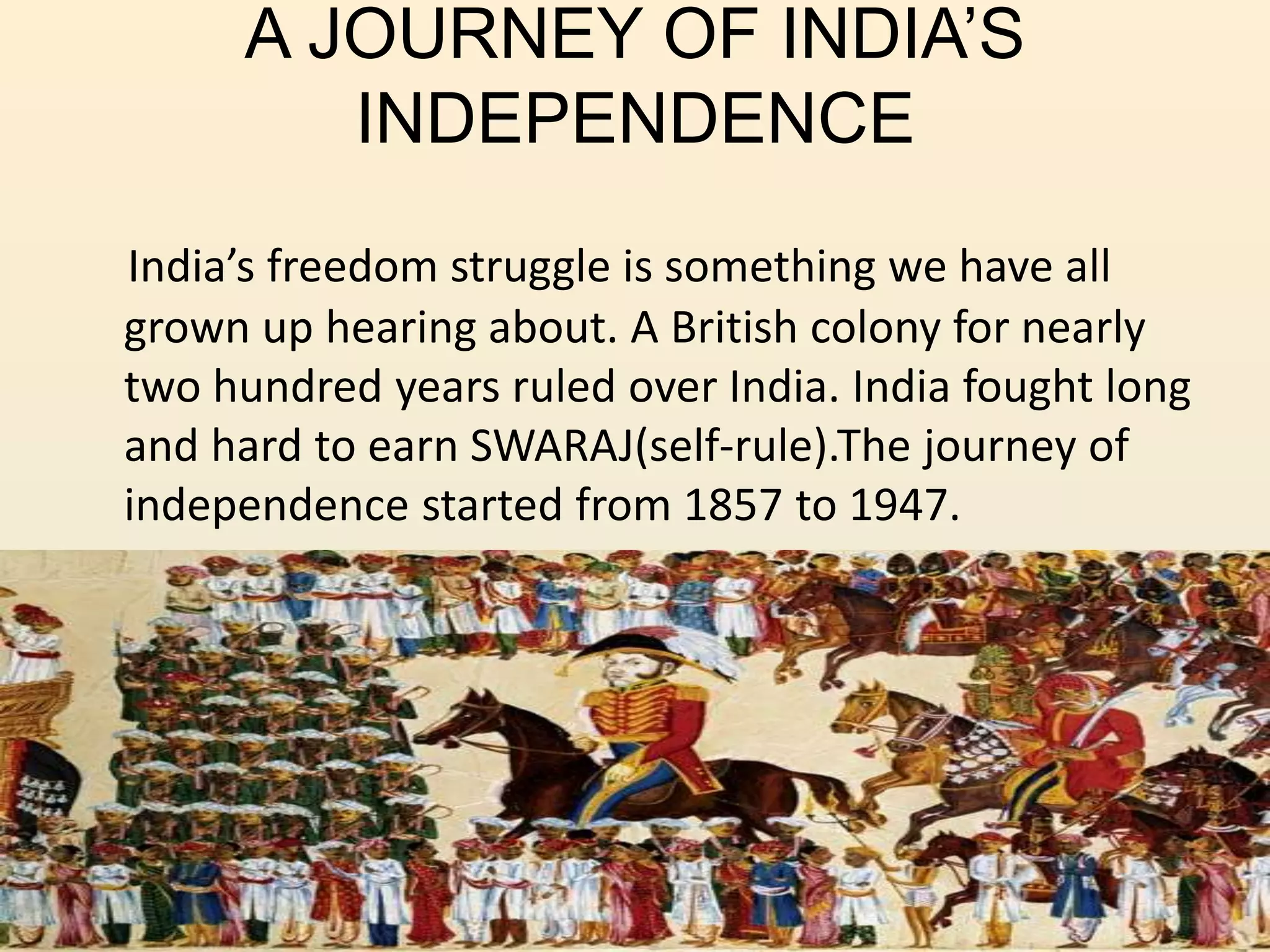
India’s freedom struggle is something we have all
grown up hearing about. A British colony for nearly
two hundred years ruled over India. India fought long
and hard to earn SWARAJ(self-rule).The journey of
independence started from 1857 to 1947.
THE REVOLT OF 1857-1947
• Mangal Pandey planned a rebellion
against the East India Company army for
issuing cartridges laced with beef and
pork fat in 1857 barrack pore (Kolkata).
• He tried to shoot himself but didn’t
succeed and finally executed by the
britishers.
• Chandra Shekhar Azad executed the Kakori
train robbery near Lucknow ,to steal money
from the British for ammunition in 1925.
• In 1929,Bhagat Singh and Batukeshwar Dutt
exploded bombs with slogan “INQUILAB
ZINDABAD” inside the Central Legislative
Assembly in Delhi.
• After the bombings,Bhagat Singh along with
two other revolutionaries,Sukhdev and
Rajguru convicted and hanged in March 1931.
• GANDHIAN MOVEMENT
Mahatma Gandhi launched various movements
against Britishers like Non- cooperation
movement(1920),Civil disobedience
movement(1930) and most important Quit India
movement(1942) ,the final push towards freedom.
The two pillars of these movements were Truth and
Non-violence .Gandhiji was followed and supported
by masses. He led India to independence and
inspired movements for civil rights and freedom
across the world.
CABINET MISSION IN INDIA
• Formulated by Clement Attlee (Prime Minister
of U.K.)
• The mission had Lord Pethic Lawrence, Sir
Stafford Cripps and A.V. Alexander arrived in
India in 1946.
• The objective of Cabinet Mission was to help
India achieve her independence and to set up
a Constituent Assembly to prepare a
Constitution for India.
• Proposals of the
Cabinet Mission Plan
There will be a federal
union of the British
Provinces and the
Princely States. The
British Provinces would
be divided into 3 groups
A,B and C on the basis
of religion. A
Constituent Assembly
would draw up the
future Constitution of
India.
• Reaction to the Cabinet
Mission Plan
The Congress accepted
this mission plan with
reservations. The
Muslim League
accepted it because of
chances of formation of
Pakistan. The Sikhs
rejected the Plan
because Punjab was
Group ‘B’ along with
Muslim majority States.
• MOUNTBATTEN PLAN
a. India was to be partitioned and two
independent and sovereign states namely
India and Pakistan were to be formed on
August 15, 1947
b. The plan provided for the partition of Punjab
and Bengal. The Princely states were given
the choice of joining either of the two new
states – India or Pakistan.
c. The congress accepted the Mountbatten plan
because it had no other alternative. The
Muslim league also accepted the plan.
THE INDIAN INDEPENDENCE ACT 1947
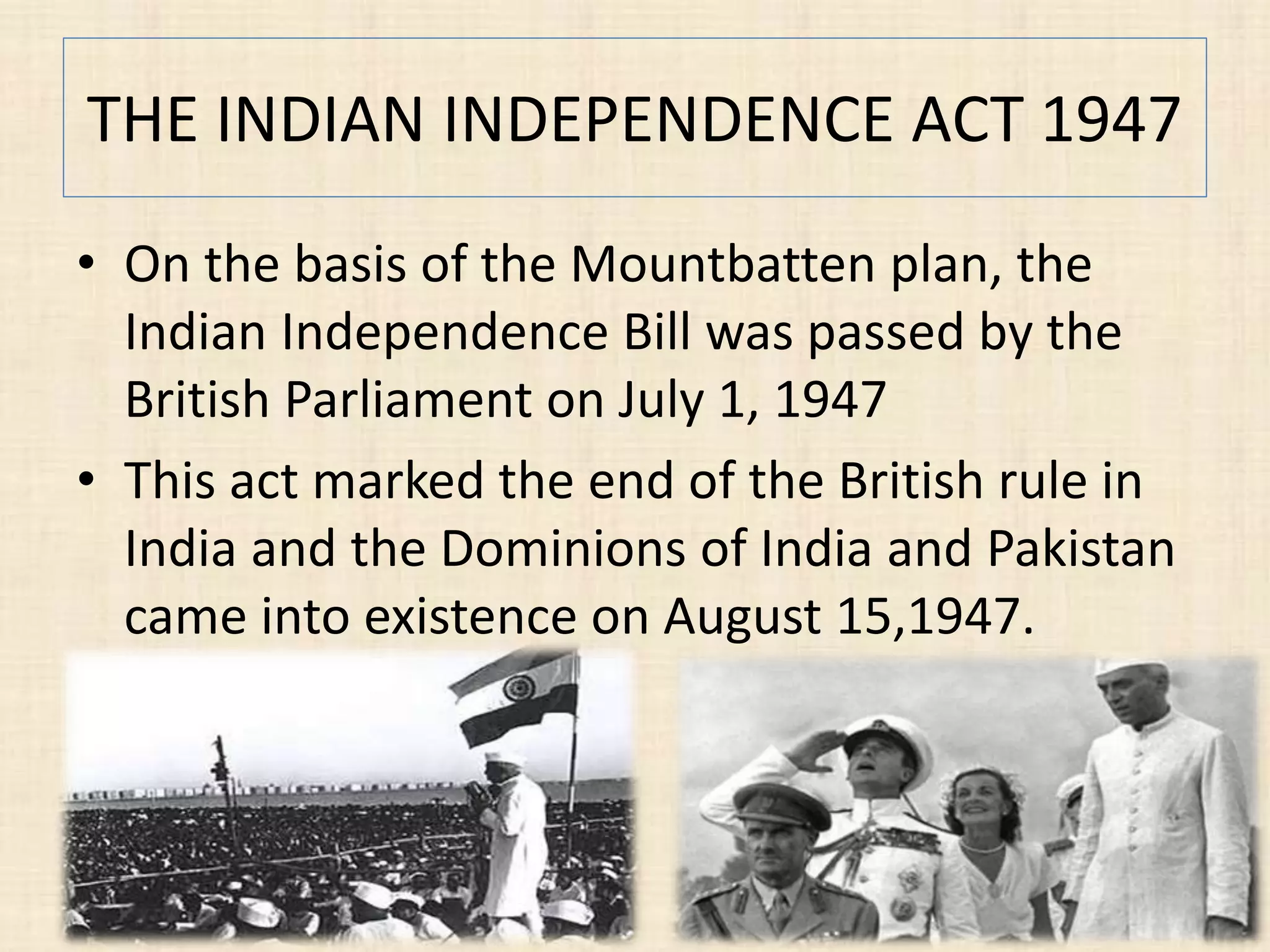
• On the basis of the Mountbatten plan, the
Indian Independence Bill was passed by the
British Parliament on July 1, 1947
• This act marked the end of the British rule in
India and the Dominions of India and Pakistan
came into existence on August 15,1947.
CONCLUSION
• The road that India took to get its independence
shows how nations and its people change in
order to adjust to the world and make things at
home as just and favorable as possible even if it
means separating their nation in half to do it.
• The Indian people involved during their
independence movement suffered a great deal in
order to have their freedom ,although it took two
World Wars for them to get enough momentum
to win their independence.
THANK YOU

India’s independence and partition

  • 1.
  • 2.
    A JOURNEY OFINDIA’S INDEPENDENCE India’s freedom struggle is something we have all grown up hearing about. A British colony for nearly two hundred years ruled over India. India fought long and hard to earn SWARAJ(self-rule).The journey of independence started from 1857 to 1947.
  • 3.
    THE REVOLT OF1857-1947 • Mangal Pandey planned a rebellion against the East India Company army for issuing cartridges laced with beef and pork fat in 1857 barrack pore (Kolkata). • He tried to shoot himself but didn’t succeed and finally executed by the britishers.
  • 4.
    • Chandra ShekharAzad executed the Kakori train robbery near Lucknow ,to steal money from the British for ammunition in 1925. • In 1929,Bhagat Singh and Batukeshwar Dutt exploded bombs with slogan “INQUILAB ZINDABAD” inside the Central Legislative Assembly in Delhi. • After the bombings,Bhagat Singh along with two other revolutionaries,Sukhdev and Rajguru convicted and hanged in March 1931.
  • 6.
    • GANDHIAN MOVEMENT MahatmaGandhi launched various movements against Britishers like Non- cooperation movement(1920),Civil disobedience movement(1930) and most important Quit India movement(1942) ,the final push towards freedom. The two pillars of these movements were Truth and Non-violence .Gandhiji was followed and supported by masses. He led India to independence and inspired movements for civil rights and freedom across the world.
  • 8.
    CABINET MISSION ININDIA • Formulated by Clement Attlee (Prime Minister of U.K.) • The mission had Lord Pethic Lawrence, Sir Stafford Cripps and A.V. Alexander arrived in India in 1946. • The objective of Cabinet Mission was to help India achieve her independence and to set up a Constituent Assembly to prepare a Constitution for India.
  • 9.
    • Proposals ofthe Cabinet Mission Plan There will be a federal union of the British Provinces and the Princely States. The British Provinces would be divided into 3 groups A,B and C on the basis of religion. A Constituent Assembly would draw up the future Constitution of India. • Reaction to the Cabinet Mission Plan The Congress accepted this mission plan with reservations. The Muslim League accepted it because of chances of formation of Pakistan. The Sikhs rejected the Plan because Punjab was Group ‘B’ along with Muslim majority States.
  • 10.
    • MOUNTBATTEN PLAN a.India was to be partitioned and two independent and sovereign states namely India and Pakistan were to be formed on August 15, 1947 b. The plan provided for the partition of Punjab and Bengal. The Princely states were given the choice of joining either of the two new states – India or Pakistan. c. The congress accepted the Mountbatten plan because it had no other alternative. The Muslim league also accepted the plan.
  • 11.
    THE INDIAN INDEPENDENCEACT 1947 • On the basis of the Mountbatten plan, the Indian Independence Bill was passed by the British Parliament on July 1, 1947 • This act marked the end of the British rule in India and the Dominions of India and Pakistan came into existence on August 15,1947.
  • 12.
    CONCLUSION • The roadthat India took to get its independence shows how nations and its people change in order to adjust to the world and make things at home as just and favorable as possible even if it means separating their nation in half to do it. • The Indian people involved during their independence movement suffered a great deal in order to have their freedom ,although it took two World Wars for them to get enough momentum to win their independence.
  • 13.