LATIN AMERICA POST-INDEPENDENCE (1820-1920)
• Socially, not much changed w/ independence-
large gap between wealthy landowners & poor
laborers
• Politically unstable- military dictators called
caudillos often seized power- used bribery,
patronage, force to keep it
• Economically, mostly focused on exporting
agricultural crops, commodities to USA, EUR
• Borrowed money from USA, EUR at high
interest- if couldn’t pay back, foreign countries
took control of industries
• Large foreign involvement in LA (especially
USA- Spanish-American War, built Panama
Canal; Roosevelt Corollary- US “
police power” in Western hemisphere
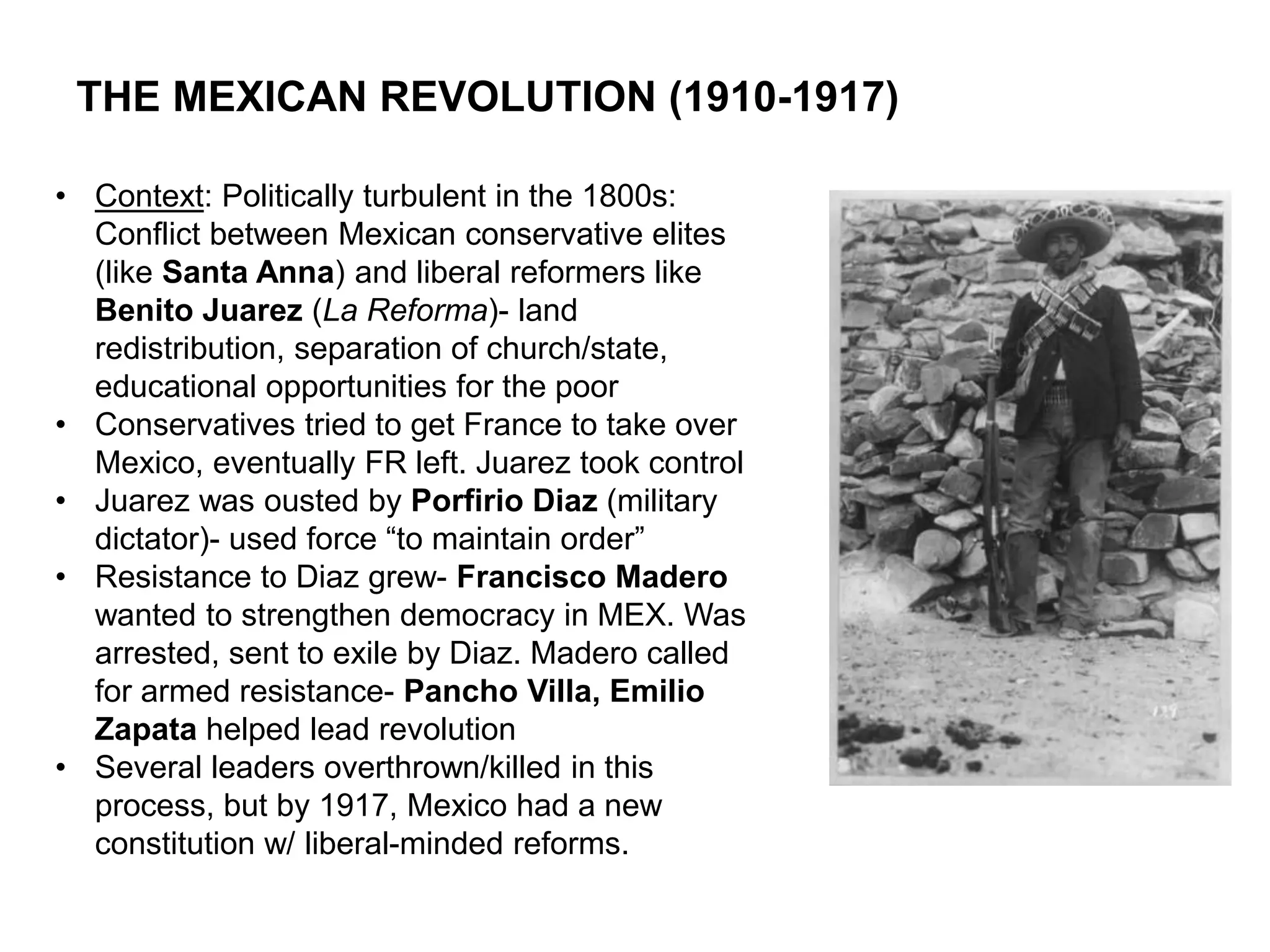
THE MEXICAN REVOLUTION (1910-1917)
• Context: Politically turbulent in the 1800s:
Conflict between Mexican conservative elites
(like Santa Anna) and liberal reformers like
Benito Juarez (La Reforma)- land
redistribution, separation of church/state,
educational opportunities for the poor
• Conservatives tried to get France to take over
Mexico, eventually FR left. Juarez took control
• Juarez was ousted by Porfirio Diaz (military
dictator)- used force “to maintain order”
• Resistance to Diaz grew- Francisco Madero
wanted to strengthen democracy in MEX. Was
arrested, sent to exile by Diaz. Madero called
for armed resistance- Pancho Villa, Emilio
Zapata helped lead revolution
• Several leaders overthrown/killed in this
process, but by 1917, Mexico had a new
constitution w/ liberal-minded reforms.
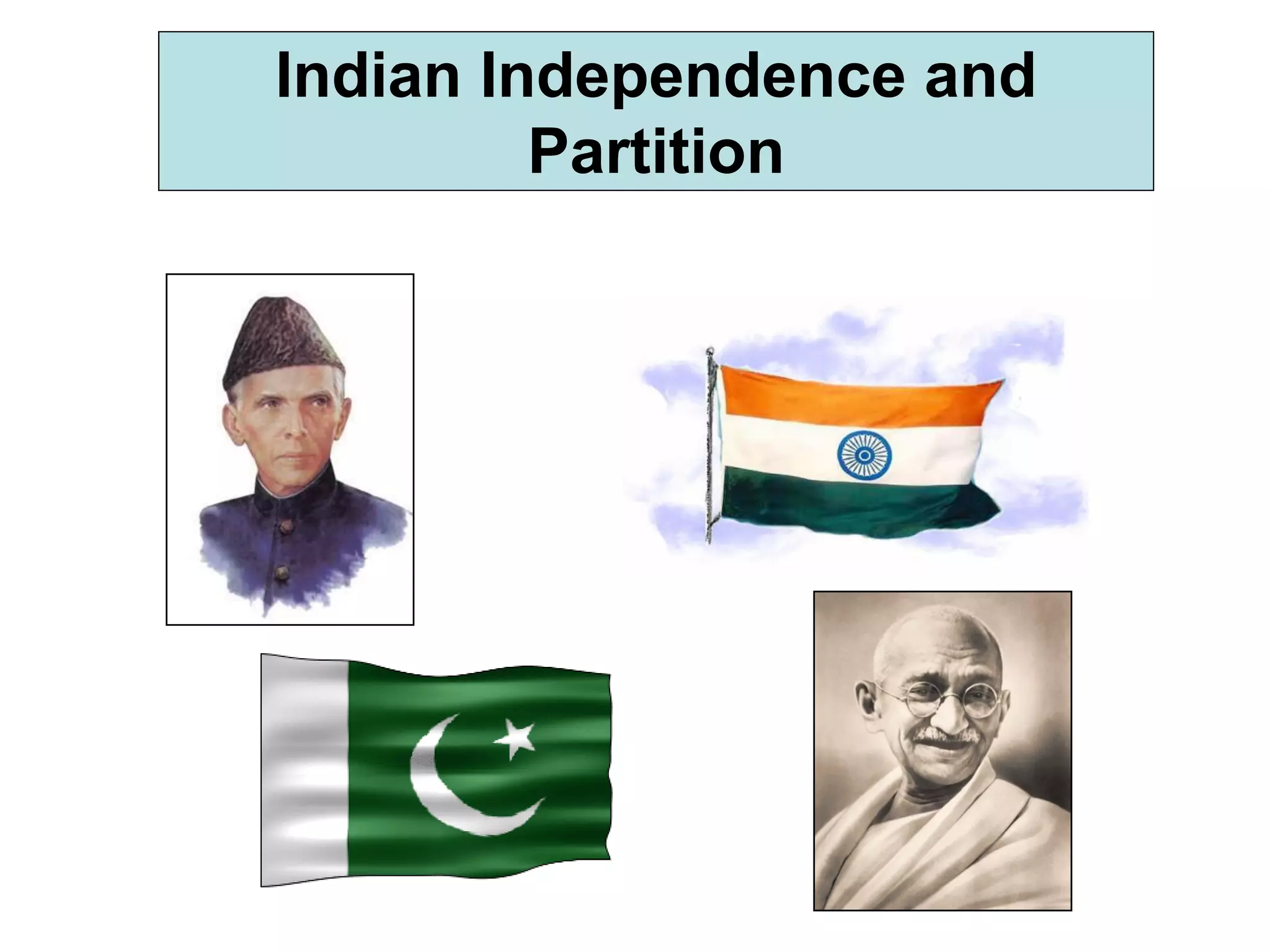
Indian Independence and
Partition
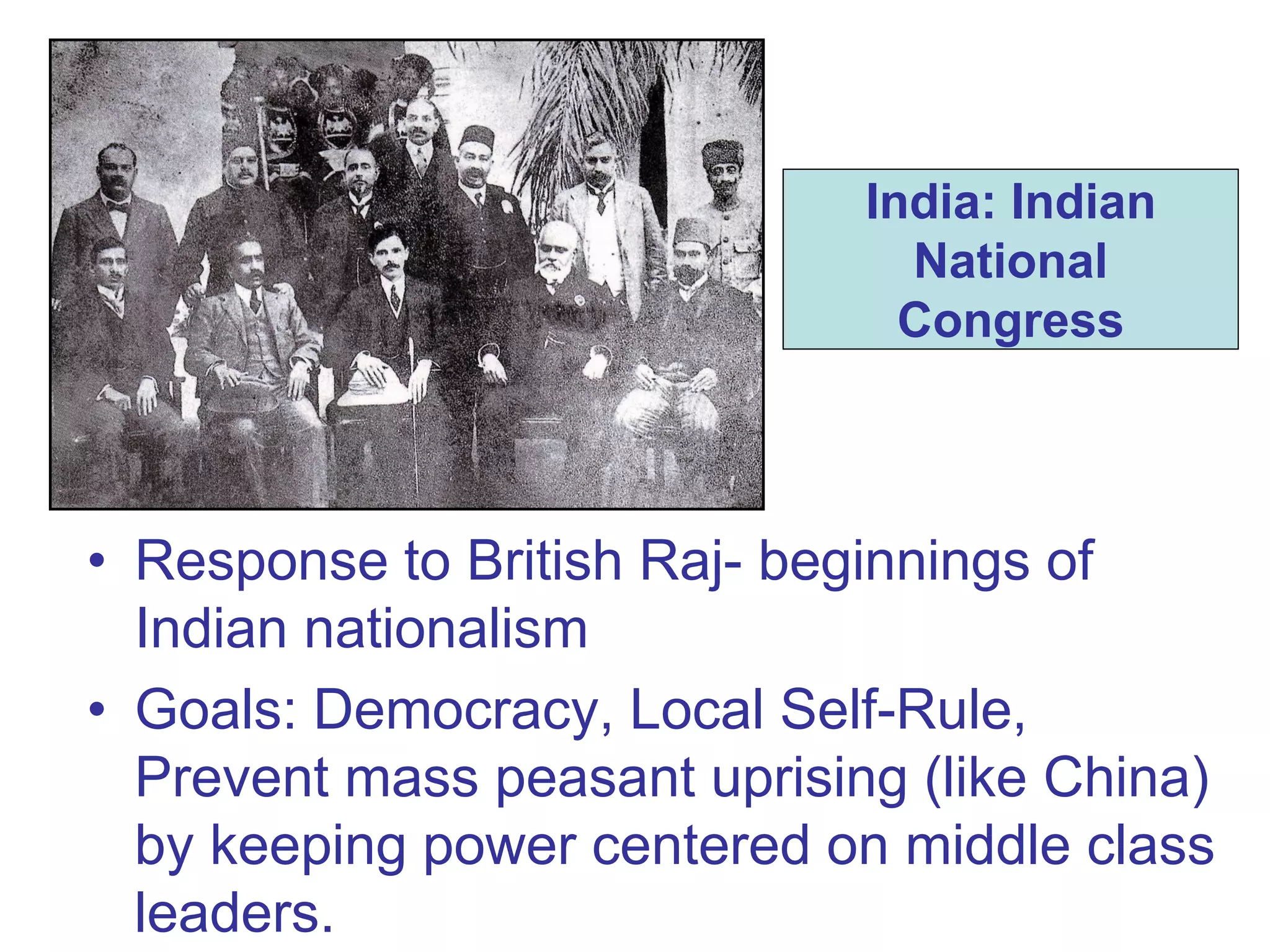
India: Indian
National
Congress
• Response to British Raj- beginnings of
Indian nationalism
• Goals: Democracy, Local Self-Rule,
Prevent mass peasant uprising (like China)
by keeping power centered on middle class
leaders.
India: The Muslim League Forms, 1906
Goals:
• Protect the interests,
liberties and rights of
Muslims
• Promote an
understanding between
the Muslim community
and other Indians -
discourage violence.
• Muslims mistrusted
Hindu domination of the
INC.
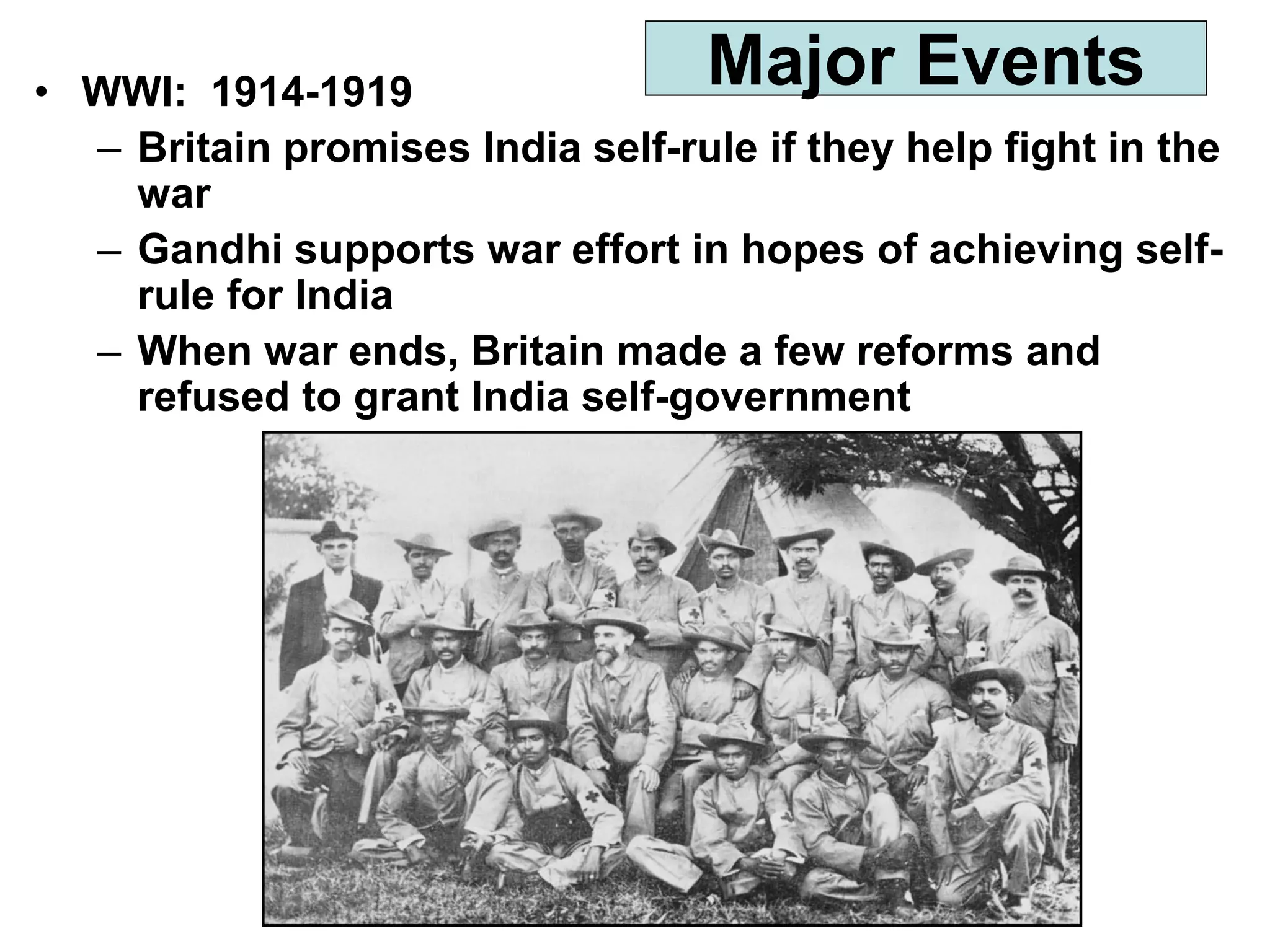
• WWI: 1914-1919
– Britain promises India self-rule if they help fight in the
war
– Gandhi supports war effort in hopes of achieving self-
rule for India
– When war ends, Britain made a few reforms and
refused to grant India self-government
Major Events
• The Amritsar Massacre
of 1919
Major Events
General Dyer
How did the Amritsar
massacre change the
attitude and goals of the
Indian National
Congress and Muslim
League?
Gandhi said, “Cooperation in any shape or form with this satanic
government is sinful.”
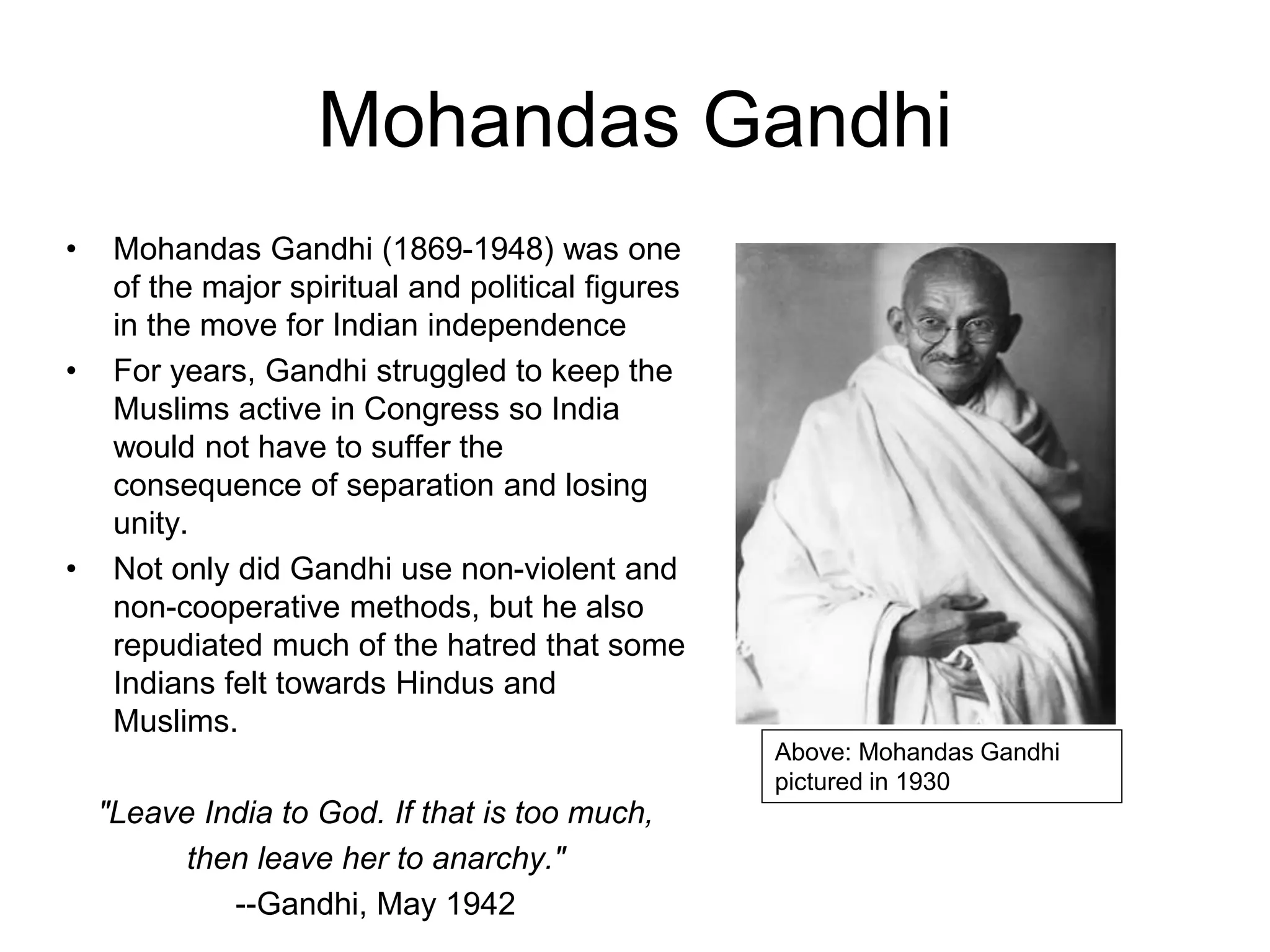
Mohandas Gandhi
• Mohandas Gandhi (1869-1948) was one
of the major spiritual and political figures
in the move for Indian independence
• For years, Gandhi struggled to keep the
Muslims active in Congress so India
would not have to suffer the
consequence of separation and losing
unity.
• Not only did Gandhi use non-violent and
non-cooperative methods, but he also
repudiated much of the hatred that some
Indians felt towards Hindus and
Muslims.
"Leave India to God. If that is too much,
then leave her to anarchy."
--Gandhi, May 1942
Above: Mohandas Gandhi
pictured in 1930
• Civil Disobedience is the
refusing to obey unjust
laws and purposely
breaking them
• Passive resistance is
non-violent protests
using two major aspects:
– Satyagraha (“truth or soul
force”)
– Ahimsa (causing no harm
to any living thing)
Mohandas K. Gandhi,
The “Mahatma” or Great Soul
“Satyagraha is a weapon of the
strong; it admits of no violence
under any circumstance
whatsoever; and it ever insists
upon truth.”
• According to
Gandhi, what are
his three goals to
win independence
from Great
Britain?
Message to the
Masses
3. Must defy the British – Not through violence
1. Hindu-Muslim Unity
2. Must end “untouchability”
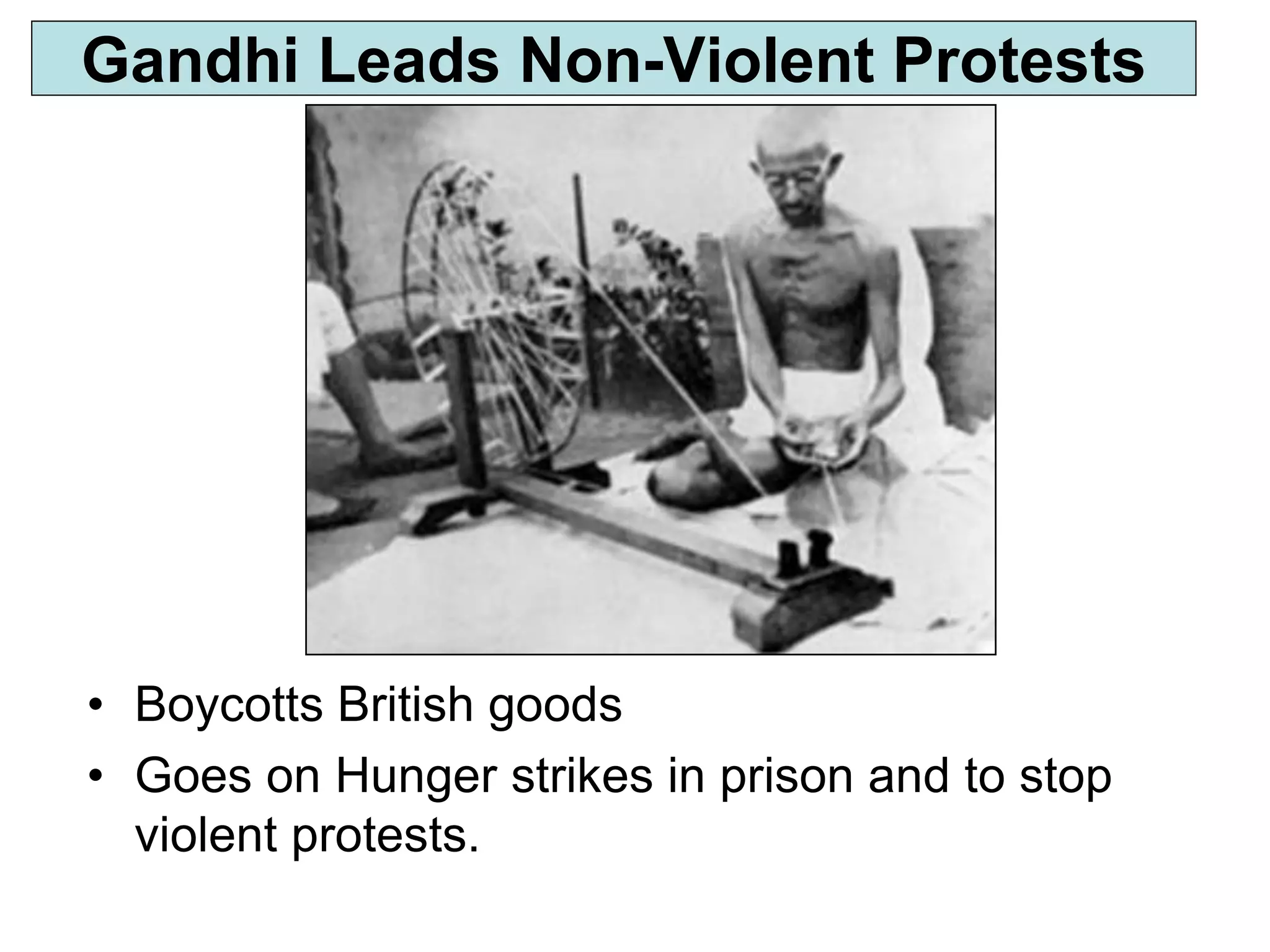
• Boycotts British goods
• Goes on Hunger strikes in prison and to stop
violent protests.
Gandhi Leads Non-Violent Protests
The Salt March
1. British law claimed that the British had
sole right to produce and sell salt in India
2. Gandhi wrote to Viceroy stating his intent
to break the law
3. With 78 followers he marched 240 miles
to the sea. By the time he reached the sea,
thousands of people had joined the march
The Salt March
4. Gandhi and others harvested salt from
the sea and were arrested
5. Reporters around the world reported the
incident. The event embarrassed the
British government who prided
themselves on their democratic
traditions.
March 12, 1930, Gandhi and 78 male
satyagrahis started their 23-day-long journey
Muhammad Ali Jinnah
A. Middle Class lawyer
educated in Britain
B. First supported Hindu-
Muslim Unity – called
“Ambassador of Hindu-
Muslim Unity”
C. Proposed Lucknow
Pact
Muhammad Ali Jinnah
D. Disagreement with Gandhi led to
Muslim- Congress split
E. Jinnah began to fear Hindu
domination of Congress – A “Hindu
Raj”
F. Began to support the idea for an
independent Muslim homeland,
Pakistan or “land of the pure”.
Gandhi Dies
• Gandhi was
assassinated in
1948
• It was the 6th
attempt on his
life
• Assassin was
angry at Gandhi
for preaching
peace with
Pakistan
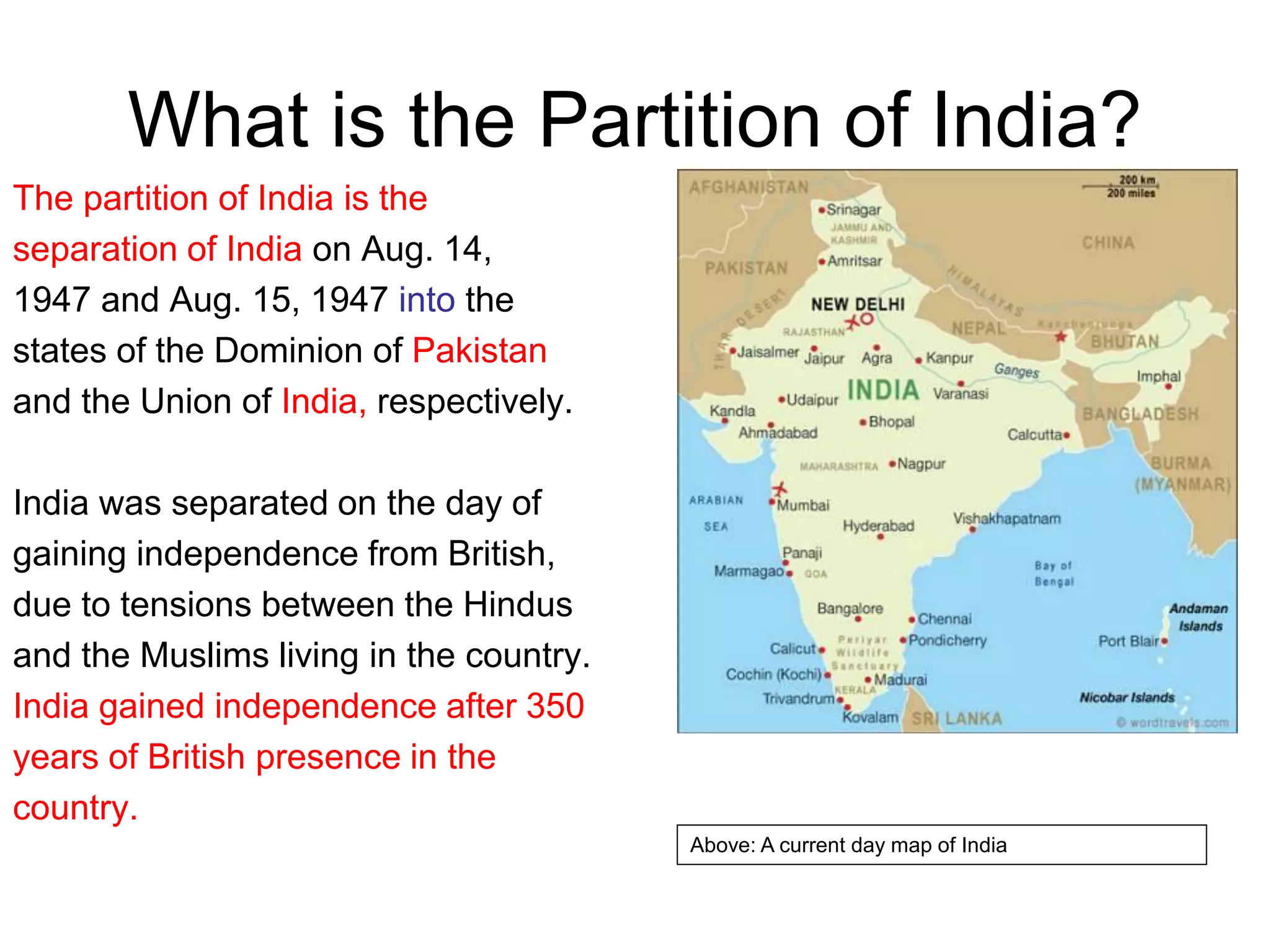
What is the Partition of India?
The partition of India is the
separation of India on Aug. 14,
1947 and Aug. 15, 1947 into the
states of the Dominion of Pakistan
and the Union of India, respectively.
India was separated on the day of
gaining independence from British,
due to tensions between the Hindus
and the Muslims living in the country.
India gained independence after 350
years of British presence in the
country.
Above: A current day map of India
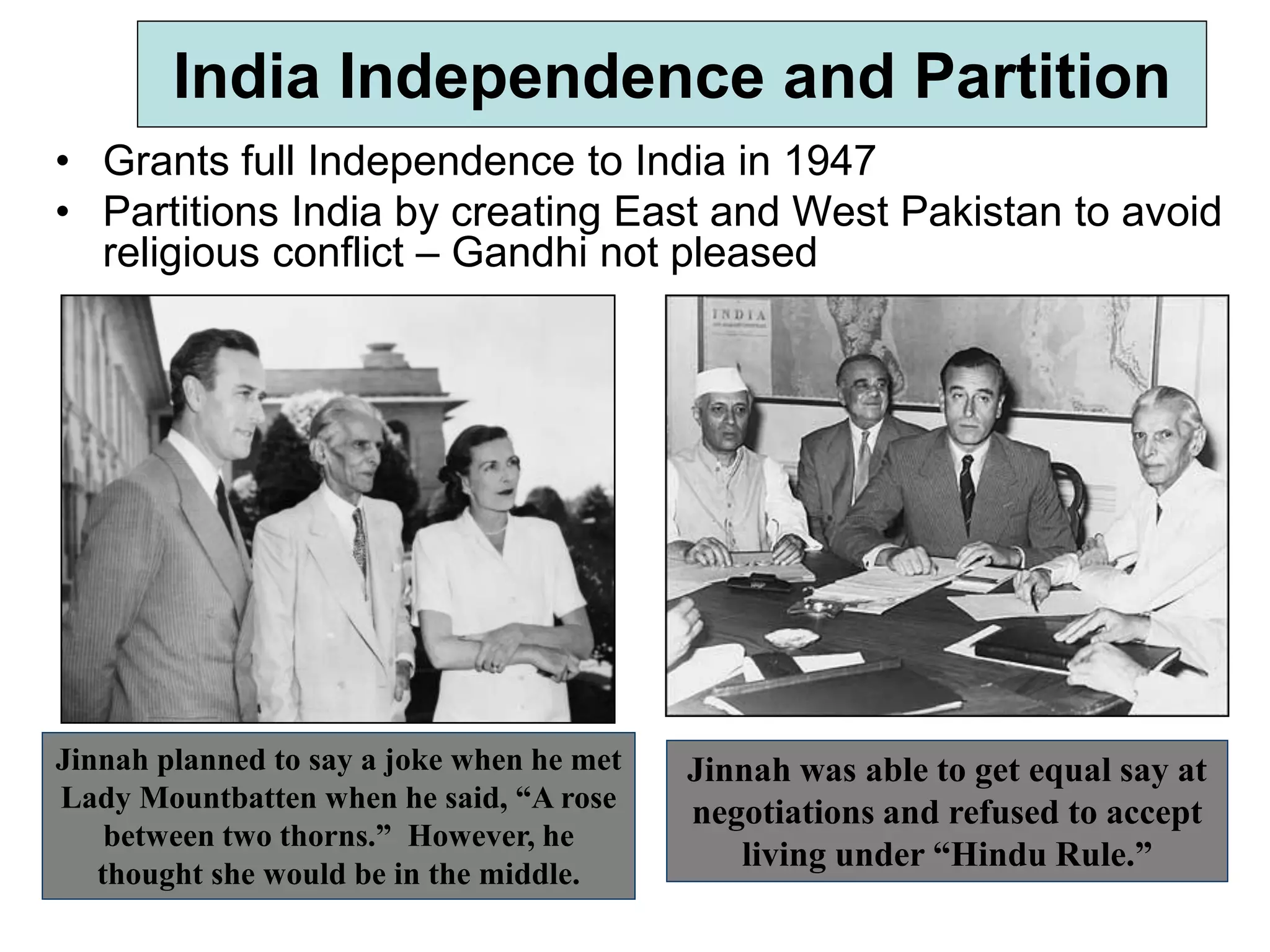
India Independence and Partition
• Grants full Independence to India in 1947
• Partitions India by creating East and West Pakistan to avoid
religious conflict – Gandhi not pleased
Jinnah was able to get equal say at
negotiations and refused to accept
living under “Hindu Rule.”
Jinnah planned to say a joke when he met
Lady Mountbatten when he said, “A rose
between two thorns.” However, he
thought she would be in the middle.
Indian Independence and Partition
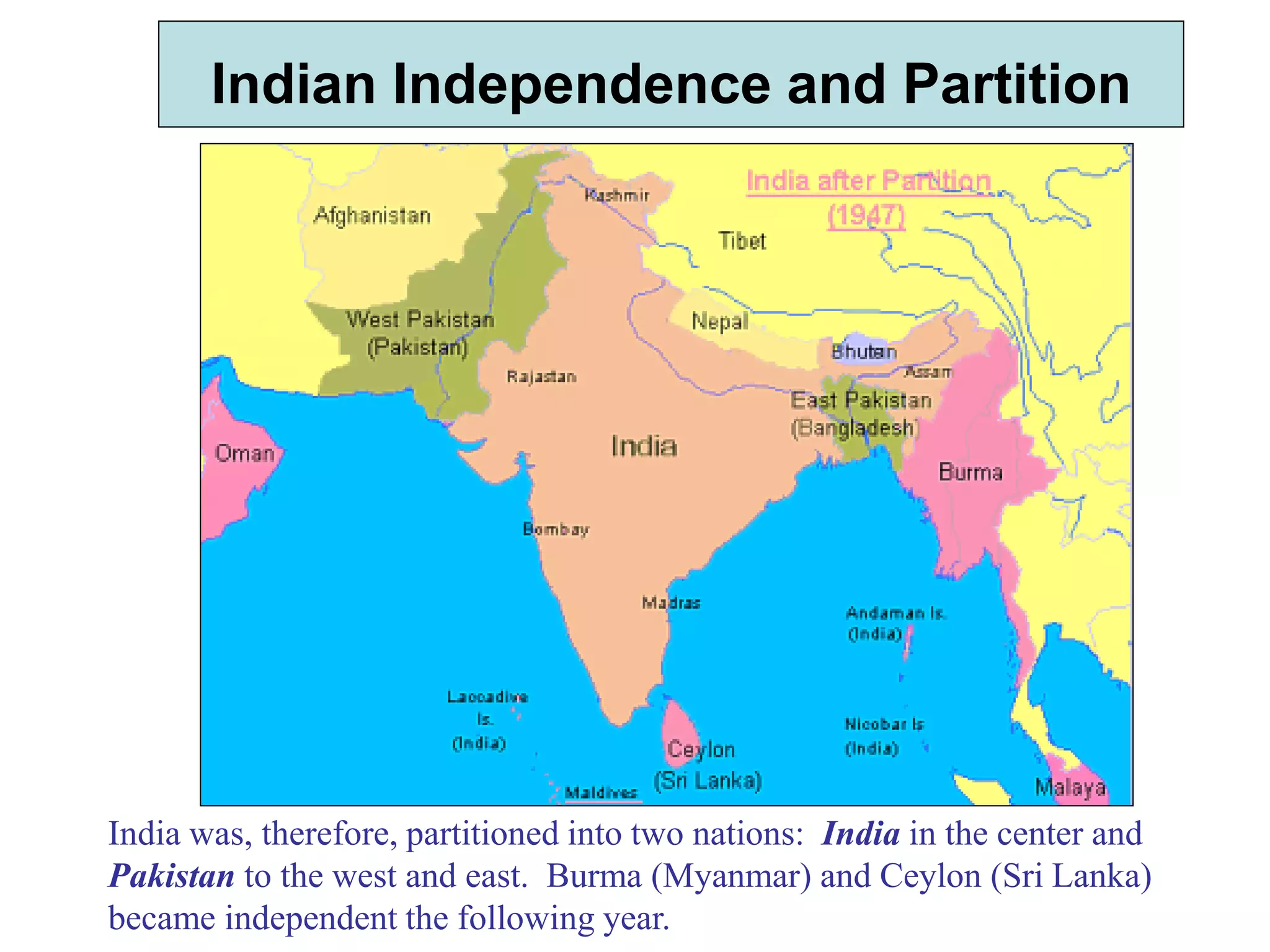
India was, therefore, partitioned into two nations: India in the center and
Pakistan to the west and east. Burma (Myanmar) and Ceylon (Sri Lanka)
became independent the following year.
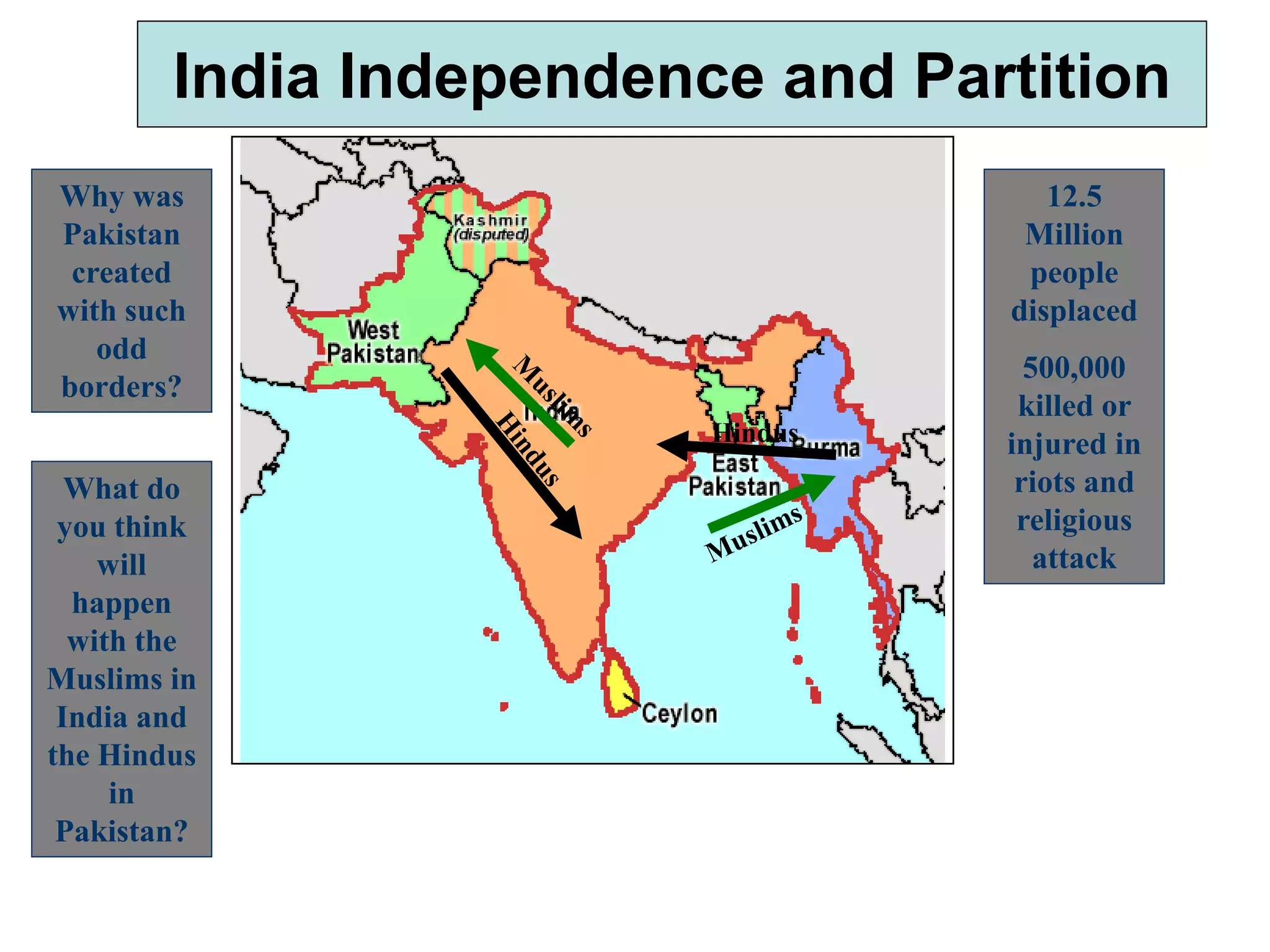
India Independence and Partition
Why was
Pakistan
created
with such
odd
borders?
What do
you think
will
happen
with the
Muslims in
India and
the Hindus
in
Pakistan?
Hindus
12.5
Million
people
displaced
500,000
killed or
injured in
riots and
religious
attack
Indian Independence and
Partition
Due to this Hindu-Muslim split, a Great Migration occurred where Hindus in
Pakistan and Muslims in India left their homes in an attempt to go where they
felt accepted. Unfortunately, this led to horrendous violence that killed
millions of people.
Indian Independence and Partition
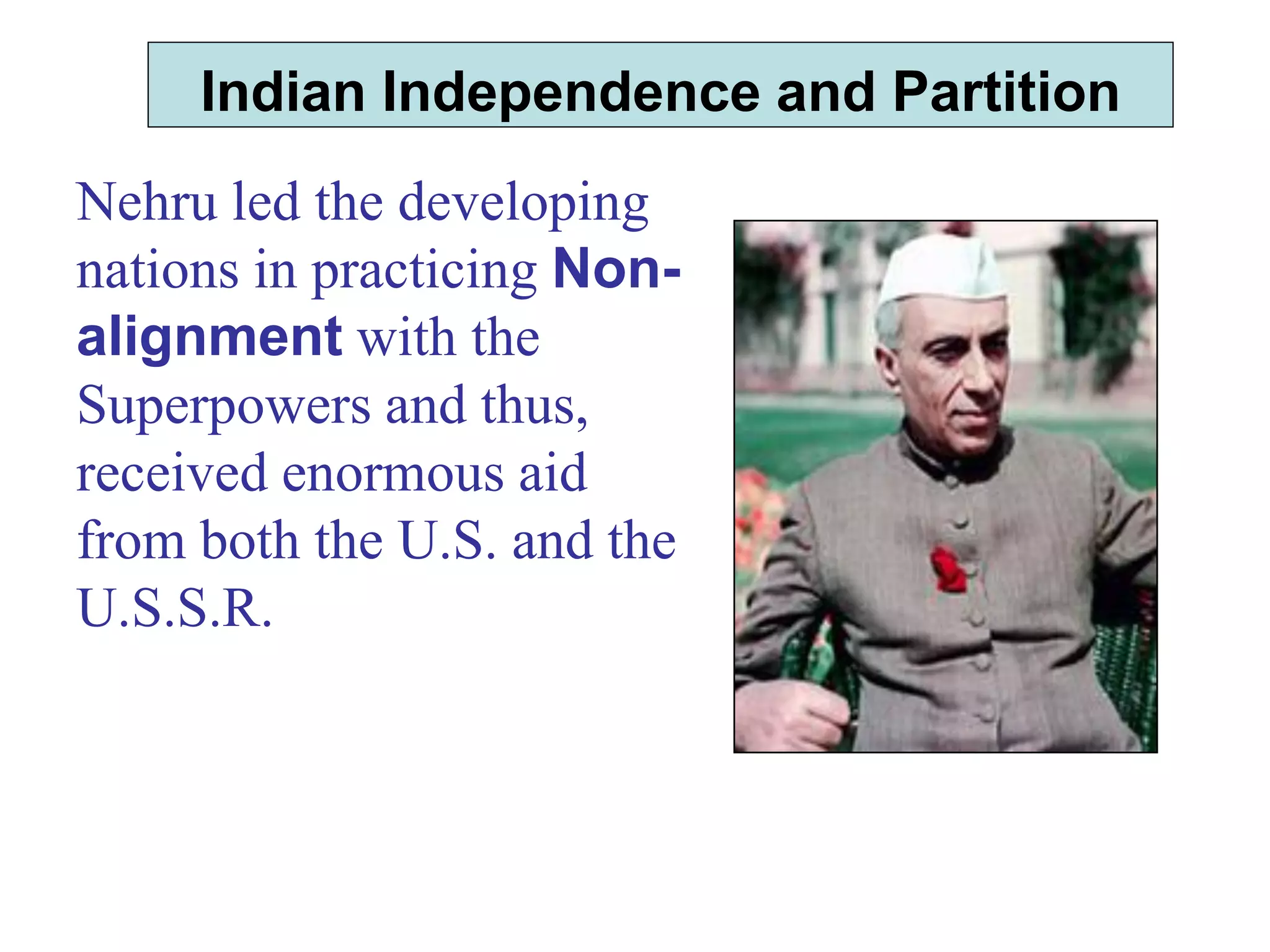
Nehru led the developing
nations in practicing Non-
alignment with the
Superpowers and thus,
received enormous aid
from both the U.S. and the
U.S.S.R.
Indian Independence and Partition
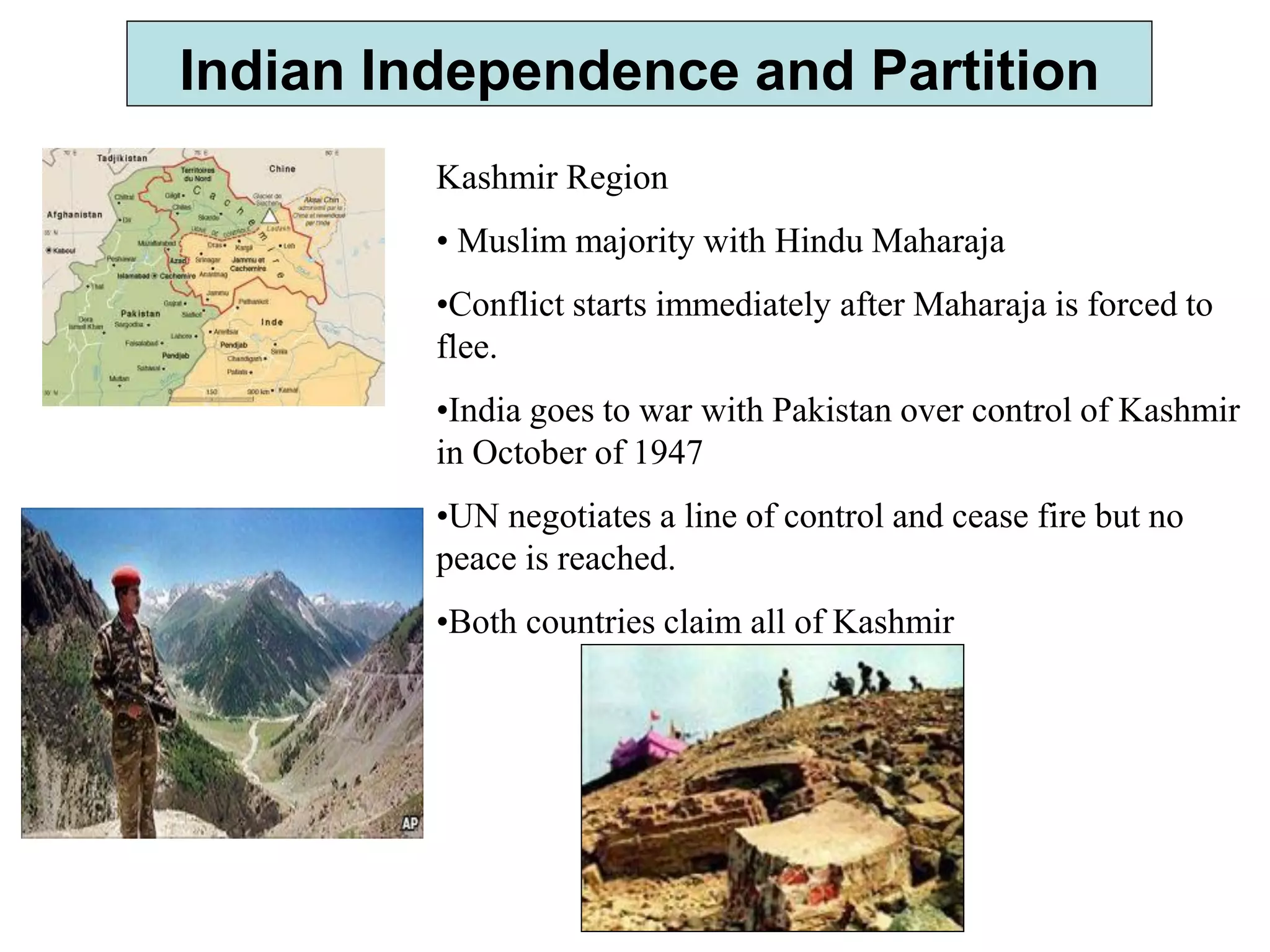
Kashmir Region
• Muslim majority with Hindu Maharaja
•Conflict starts immediately after Maharaja is forced to
flee.
•India goes to war with Pakistan over control of Kashmir
in October of 1947
•UN negotiates a line of control and cease fire but no
peace is reached.
•Both countries claim all of Kashmir
Indian Independence and Partition
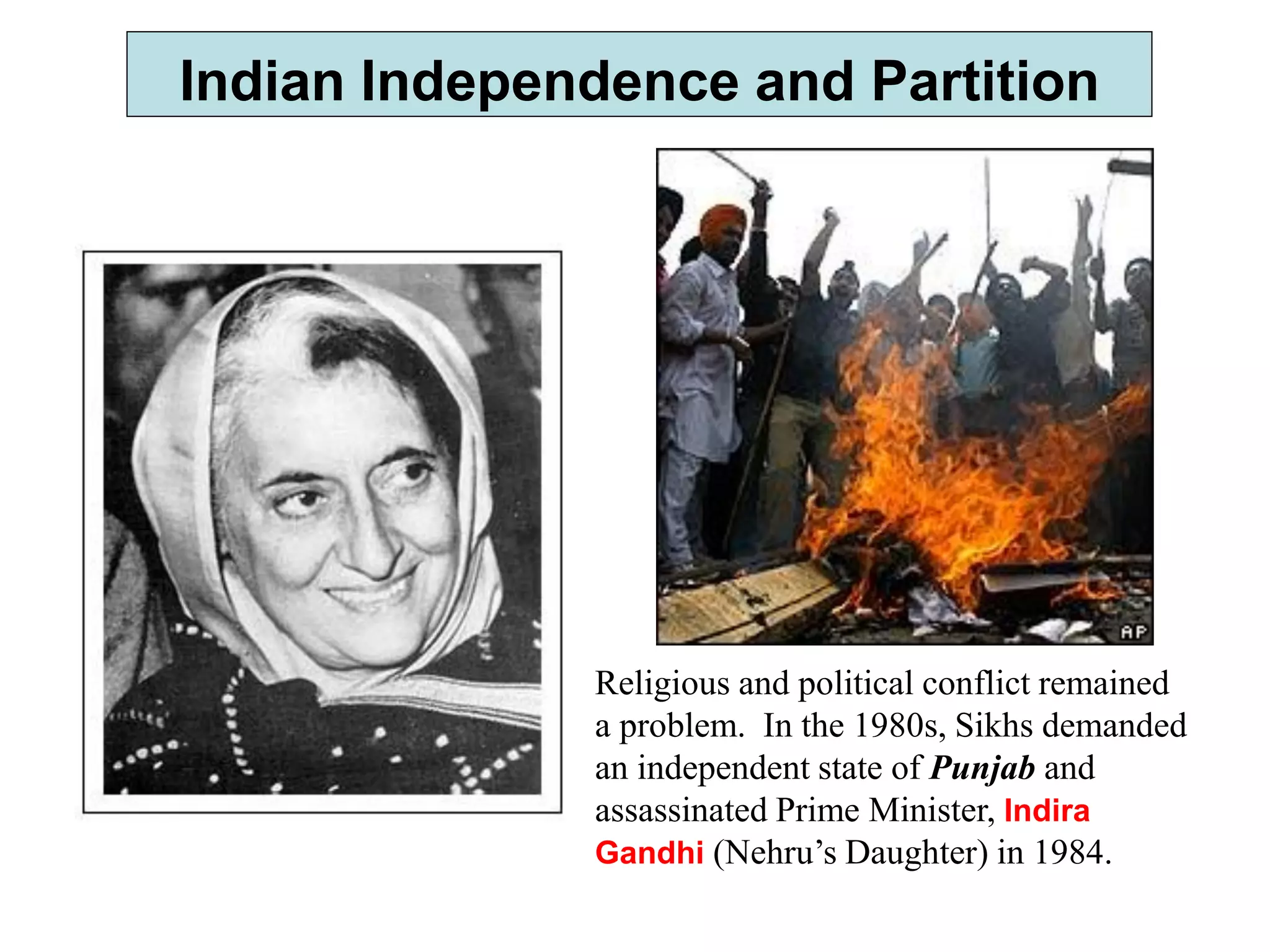
Religious and political conflict remained
a problem. In the 1980s, Sikhs demanded
an independent state of Punjab and
assassinated Prime Minister, Indira
Gandhi (Nehru’s Daughter) in 1984.
Indian Independence and Partition
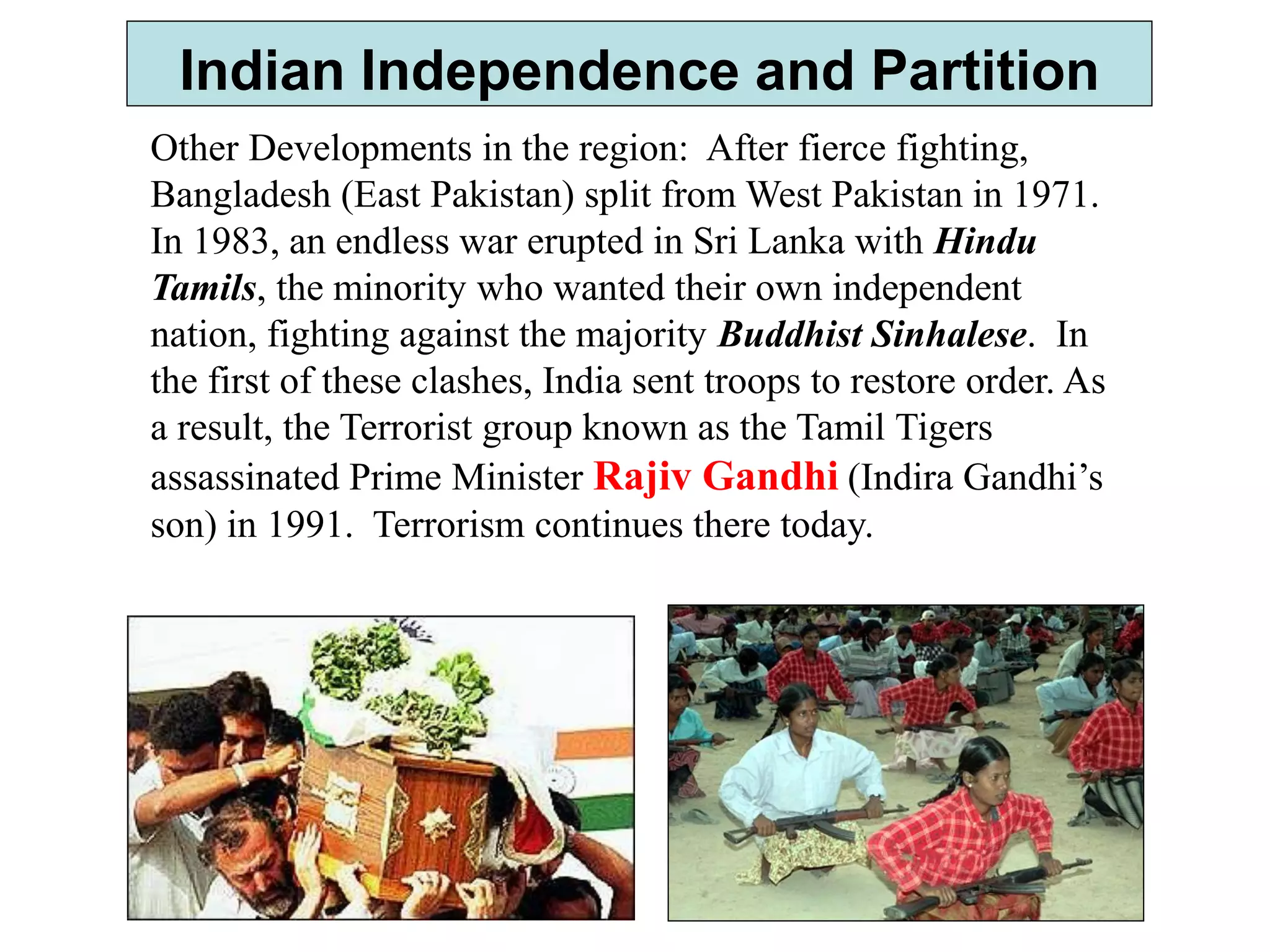
Other Developments in the region: After fierce fighting,
Bangladesh (East Pakistan) split from West Pakistan in 1971.
In 1983, an endless war erupted in Sri Lanka with Hindu
Tamils, the minority who wanted their own independent
nation, fighting against the majority Buddhist Sinhalese. In
the first of these clashes, India sent troops to restore order. As
a result, the Terrorist group known as the Tamil Tigers
assassinated Prime Minister Rajiv Gandhi (Indira Gandhi’s
son) in 1991. Terrorism continues there today.
Indian Independence and Partition
Relations between Pakistan and India remain tense.
Both nations want to control the Jammu and Kasmir
regions near the Pakistan-India border. Tensions based
on religious and ethnic claims continued to increase
after both India and Pakistan tested nuclear weapons in
1998.
Indian Independence and Partition PPT.pdf

Indian Independence and Partition PPT.pdf

  • 1.
    LATIN AMERICA POST-INDEPENDENCE(1820-1920) • Socially, not much changed w/ independence- large gap between wealthy landowners & poor laborers • Politically unstable- military dictators called caudillos often seized power- used bribery, patronage, force to keep it • Economically, mostly focused on exporting agricultural crops, commodities to USA, EUR • Borrowed money from USA, EUR at high interest- if couldn’t pay back, foreign countries took control of industries • Large foreign involvement in LA (especially USA- Spanish-American War, built Panama Canal; Roosevelt Corollary- US “ police power” in Western hemisphere
  • 2.
    THE MEXICAN REVOLUTION(1910-1917) • Context: Politically turbulent in the 1800s: Conflict between Mexican conservative elites (like Santa Anna) and liberal reformers like Benito Juarez (La Reforma)- land redistribution, separation of church/state, educational opportunities for the poor • Conservatives tried to get France to take over Mexico, eventually FR left. Juarez took control • Juarez was ousted by Porfirio Diaz (military dictator)- used force “to maintain order” • Resistance to Diaz grew- Francisco Madero wanted to strengthen democracy in MEX. Was arrested, sent to exile by Diaz. Madero called for armed resistance- Pancho Villa, Emilio Zapata helped lead revolution • Several leaders overthrown/killed in this process, but by 1917, Mexico had a new constitution w/ liberal-minded reforms.
  • 4.
  • 5.
    India: Indian National Congress • Responseto British Raj- beginnings of Indian nationalism • Goals: Democracy, Local Self-Rule, Prevent mass peasant uprising (like China) by keeping power centered on middle class leaders.
  • 6.
    India: The MuslimLeague Forms, 1906 Goals: • Protect the interests, liberties and rights of Muslims • Promote an understanding between the Muslim community and other Indians - discourage violence. • Muslims mistrusted Hindu domination of the INC.
  • 7.
    • WWI: 1914-1919 –Britain promises India self-rule if they help fight in the war – Gandhi supports war effort in hopes of achieving self- rule for India – When war ends, Britain made a few reforms and refused to grant India self-government Major Events
  • 8.
    • The AmritsarMassacre of 1919 Major Events General Dyer How did the Amritsar massacre change the attitude and goals of the Indian National Congress and Muslim League?
  • 9.
    Gandhi said, “Cooperationin any shape or form with this satanic government is sinful.”
  • 10.
    Mohandas Gandhi • MohandasGandhi (1869-1948) was one of the major spiritual and political figures in the move for Indian independence • For years, Gandhi struggled to keep the Muslims active in Congress so India would not have to suffer the consequence of separation and losing unity. • Not only did Gandhi use non-violent and non-cooperative methods, but he also repudiated much of the hatred that some Indians felt towards Hindus and Muslims. "Leave India to God. If that is too much, then leave her to anarchy." --Gandhi, May 1942 Above: Mohandas Gandhi pictured in 1930
  • 11.
    • Civil Disobedienceis the refusing to obey unjust laws and purposely breaking them • Passive resistance is non-violent protests using two major aspects: – Satyagraha (“truth or soul force”) – Ahimsa (causing no harm to any living thing) Mohandas K. Gandhi, The “Mahatma” or Great Soul “Satyagraha is a weapon of the strong; it admits of no violence under any circumstance whatsoever; and it ever insists upon truth.”
  • 12.
    • According to Gandhi,what are his three goals to win independence from Great Britain? Message to the Masses 3. Must defy the British – Not through violence 1. Hindu-Muslim Unity 2. Must end “untouchability”
  • 13.
    • Boycotts Britishgoods • Goes on Hunger strikes in prison and to stop violent protests. Gandhi Leads Non-Violent Protests
  • 14.
    The Salt March 1.British law claimed that the British had sole right to produce and sell salt in India 2. Gandhi wrote to Viceroy stating his intent to break the law 3. With 78 followers he marched 240 miles to the sea. By the time he reached the sea, thousands of people had joined the march
  • 15.
    The Salt March 4.Gandhi and others harvested salt from the sea and were arrested 5. Reporters around the world reported the incident. The event embarrassed the British government who prided themselves on their democratic traditions. March 12, 1930, Gandhi and 78 male satyagrahis started their 23-day-long journey
  • 16.
    Muhammad Ali Jinnah A.Middle Class lawyer educated in Britain B. First supported Hindu- Muslim Unity – called “Ambassador of Hindu- Muslim Unity” C. Proposed Lucknow Pact
  • 17.
    Muhammad Ali Jinnah D.Disagreement with Gandhi led to Muslim- Congress split E. Jinnah began to fear Hindu domination of Congress – A “Hindu Raj” F. Began to support the idea for an independent Muslim homeland, Pakistan or “land of the pure”.
  • 18.
    Gandhi Dies • Gandhiwas assassinated in 1948 • It was the 6th attempt on his life • Assassin was angry at Gandhi for preaching peace with Pakistan
  • 19.
    What is thePartition of India? The partition of India is the separation of India on Aug. 14, 1947 and Aug. 15, 1947 into the states of the Dominion of Pakistan and the Union of India, respectively. India was separated on the day of gaining independence from British, due to tensions between the Hindus and the Muslims living in the country. India gained independence after 350 years of British presence in the country. Above: A current day map of India
  • 20.
    India Independence andPartition • Grants full Independence to India in 1947 • Partitions India by creating East and West Pakistan to avoid religious conflict – Gandhi not pleased Jinnah was able to get equal say at negotiations and refused to accept living under “Hindu Rule.” Jinnah planned to say a joke when he met Lady Mountbatten when he said, “A rose between two thorns.” However, he thought she would be in the middle.
  • 21.
    Indian Independence andPartition India was, therefore, partitioned into two nations: India in the center and Pakistan to the west and east. Burma (Myanmar) and Ceylon (Sri Lanka) became independent the following year.
  • 22.
    India Independence andPartition Why was Pakistan created with such odd borders? What do you think will happen with the Muslims in India and the Hindus in Pakistan? Hindus 12.5 Million people displaced 500,000 killed or injured in riots and religious attack
  • 24.
    Indian Independence and Partition Dueto this Hindu-Muslim split, a Great Migration occurred where Hindus in Pakistan and Muslims in India left their homes in an attempt to go where they felt accepted. Unfortunately, this led to horrendous violence that killed millions of people.
  • 25.
    Indian Independence andPartition Nehru led the developing nations in practicing Non- alignment with the Superpowers and thus, received enormous aid from both the U.S. and the U.S.S.R.
  • 26.
    Indian Independence andPartition Kashmir Region • Muslim majority with Hindu Maharaja •Conflict starts immediately after Maharaja is forced to flee. •India goes to war with Pakistan over control of Kashmir in October of 1947 •UN negotiates a line of control and cease fire but no peace is reached. •Both countries claim all of Kashmir
  • 27.
    Indian Independence andPartition Religious and political conflict remained a problem. In the 1980s, Sikhs demanded an independent state of Punjab and assassinated Prime Minister, Indira Gandhi (Nehru’s Daughter) in 1984.
  • 28.
    Indian Independence andPartition Other Developments in the region: After fierce fighting, Bangladesh (East Pakistan) split from West Pakistan in 1971. In 1983, an endless war erupted in Sri Lanka with Hindu Tamils, the minority who wanted their own independent nation, fighting against the majority Buddhist Sinhalese. In the first of these clashes, India sent troops to restore order. As a result, the Terrorist group known as the Tamil Tigers assassinated Prime Minister Rajiv Gandhi (Indira Gandhi’s son) in 1991. Terrorism continues there today.
  • 29.
    Indian Independence andPartition Relations between Pakistan and India remain tense. Both nations want to control the Jammu and Kasmir regions near the Pakistan-India border. Tensions based on religious and ethnic claims continued to increase after both India and Pakistan tested nuclear weapons in 1998.