WATER QUALITY STANDARD
Indian Standard
Drinking Water - Specification
IS 10500 : 1991
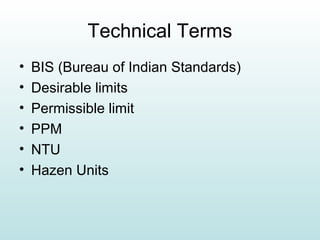
Technical Terms
• BIS (Bureau of Indian Standards)
• Desirable limits
• Permissible limit
• PPM
• NTU
• Hazen Units
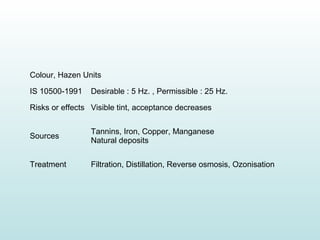
Colour, Hazen Units
IS 10500-1991 Desirable : 5 Hz. , Permissible : 25 Hz.
Risks or effects Visible tint, acceptance decreases
Sources
Tannins, Iron, Copper, Manganese
Natural deposits
Treatment Filtration, Distillation, Reverse osmosis, Ozonisation
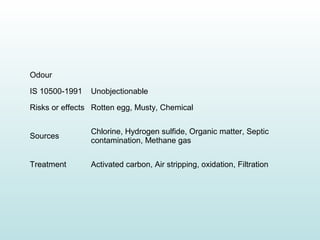
Odour
IS 10500-1991 Unobjectionable
Risks or effects Rotten egg, Musty, Chemical
Sources
Chlorine, Hydrogen sulfide, Organic matter, Septic
contamination, Methane gas
Treatment Activated carbon, Air stripping, oxidation, Filtration
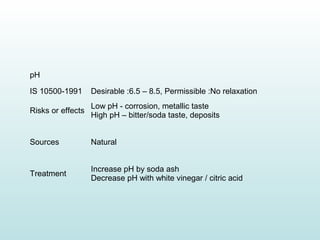
pH
IS 10500-1991 Desirable :6.5 – 8.5, Permissible :No relaxation
Risks or effects
Low pH - corrosion, metallic taste
High pH – bitter/soda taste, deposits
Sources Natural
Treatment
Increase pH by soda ash
Decrease pH with white vinegar / citric acid
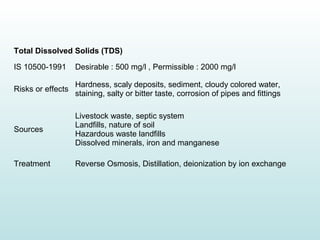
Total Dissolved Solids (TDS)
IS 10500-1991 Desirable : 500 mg/l , Permissible : 2000 mg/l
Risks or effects
Hardness, scaly deposits, sediment, cloudy colored water,
staining, salty or bitter taste, corrosion of pipes and fittings
Sources
Livestock waste, septic system
Landfills, nature of soil
Hazardous waste landfills
Dissolved minerals, iron and manganese
Treatment Reverse Osmosis, Distillation, deionization by ion exchange
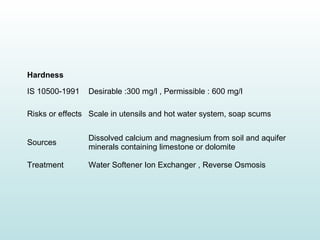
Hardness
IS 10500-1991 Desirable :300 mg/l , Permissible : 600 mg/l
Risks or effects Scale in utensils and hot water system, soap scums
Sources
Dissolved calcium and magnesium from soil and aquifer
minerals containing limestone or dolomite
Treatment Water Softener Ion Exchanger , Reverse Osmosis
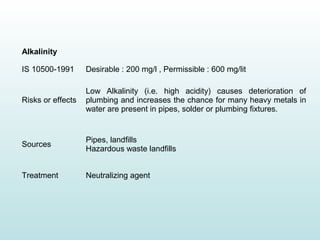
Alkalinity
IS 10500-1991 Desirable : 200 mg/l , Permissible : 600 mg/lit
Risks or effects
Low Alkalinity (i.e. high acidity) causes deterioration of
plumbing and increases the chance for many heavy metals in
water are present in pipes, solder or plumbing fixtures.
Sources
Pipes, landfills
Hazardous waste landfills
Treatment Neutralizing agent
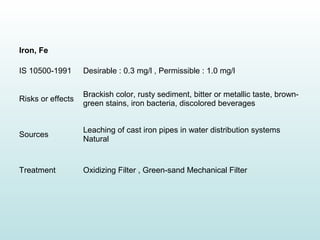
Iron, Fe
IS 10500-1991 Desirable : 0.3 mg/l , Permissible : 1.0 mg/l
Risks or effects
Brackish color, rusty sediment, bitter or metallic taste, brown-
green stains, iron bacteria, discolored beverages
Sources
Leaching of cast iron pipes in water distribution systems
Natural
Treatment Oxidizing Filter , Green-sand Mechanical Filter
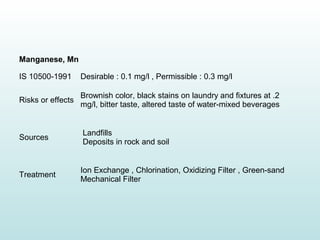
Manganese, Mn
IS 10500-1991 Desirable : 0.1 mg/l , Permissible : 0.3 mg/l
Risks or effects
Brownish color, black stains on laundry and fixtures at .2
mg/l, bitter taste, altered taste of water-mixed beverages
Sources
Landfills
Deposits in rock and soil
Treatment
Ion Exchange , Chlorination, Oxidizing Filter , Green-sand
Mechanical Filter
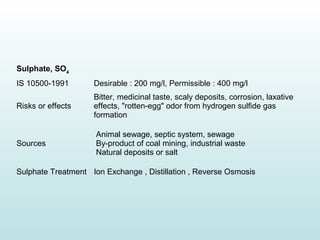
Sulphate, SO4
IS 10500-1991 Desirable : 200 mg/l, Permissible : 400 mg/l
Risks or effects
Bitter, medicinal taste, scaly deposits, corrosion, laxative
effects, "rotten-egg" odor from hydrogen sulfide gas
formation
Sources
Animal sewage, septic system, sewage
By-product of coal mining, industrial waste
Natural deposits or salt
Sulphate Treatment Ion Exchange , Distillation , Reverse Osmosis
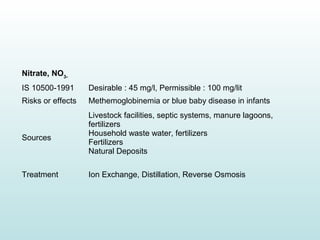
Nitrate, NO3-
IS 10500-1991 Desirable : 45 mg/l, Permissible : 100 mg/lit
Risks or effects Methemoglobinemia or blue baby disease in infants
Sources
Livestock facilities, septic systems, manure lagoons,
fertilizers
Household waste water, fertilizers
Fertilizers
Natural Deposits
Treatment Ion Exchange, Distillation, Reverse Osmosis
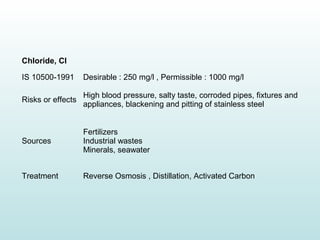
Chloride, Cl
IS 10500-1991 Desirable : 250 mg/l , Permissible : 1000 mg/l
Risks or effects
High blood pressure, salty taste, corroded pipes, fixtures and
appliances, blackening and pitting of stainless steel
Sources
Fertilizers
Industrial wastes
Minerals, seawater
Treatment Reverse Osmosis , Distillation, Activated Carbon
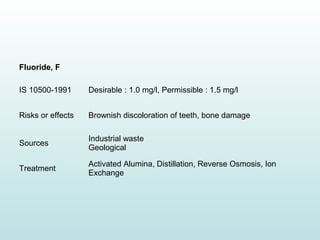
Fluoride, F
IS 10500-1991 Desirable : 1.0 mg/l, Permissible : 1.5 mg/l
Risks or effects Brownish discoloration of teeth, bone damage
Sources
Industrial waste
Geological
Treatment
Activated Alumina, Distillation, Reverse Osmosis, Ion
Exchange
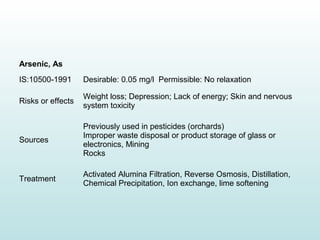
Arsenic, As
IS:10500-1991 Desirable: 0.05 mg/l Permissible: No relaxation
Risks or effects
Weight loss; Depression; Lack of energy; Skin and nervous
system toxicity
Sources
Previously used in pesticides (orchards)
Improper waste disposal or product storage of glass or
electronics, Mining
Rocks
Treatment
Activated Alumina Filtration, Reverse Osmosis, Distillation,
Chemical Precipitation, Ion exchange, lime softening
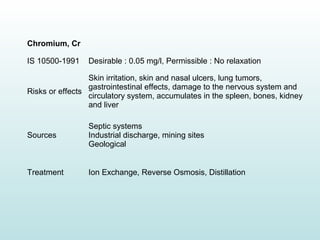
Chromium, Cr
IS 10500-1991 Desirable : 0.05 mg/l, Permissible : No relaxation
Risks or effects
Skin irritation, skin and nasal ulcers, lung tumors,
gastrointestinal effects, damage to the nervous system and
circulatory system, accumulates in the spleen, bones, kidney
and liver
Sources
Septic systems
Industrial discharge, mining sites
Geological
Treatment Ion Exchange, Reverse Osmosis, Distillation
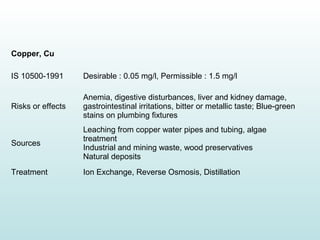
Copper, Cu
IS 10500-1991 Desirable : 0.05 mg/l, Permissible : 1.5 mg/l
Risks or effects
Anemia, digestive disturbances, liver and kidney damage,
gastrointestinal irritations, bitter or metallic taste; Blue-green
stains on plumbing fixtures
Sources
Leaching from copper water pipes and tubing, algae
treatment
Industrial and mining waste, wood preservatives
Natural deposits
Treatment Ion Exchange, Reverse Osmosis, Distillation
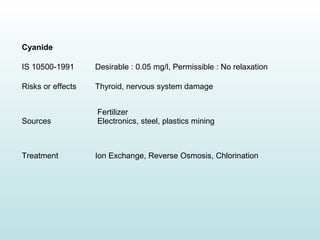
Cyanide
IS 10500-1991 Desirable : 0.05 mg/l, Permissible : No relaxation
Risks or effects Thyroid, nervous system damage
Sources
Fertilizer
Electronics, steel, plastics mining
Treatment Ion Exchange, Reverse Osmosis, Chlorination
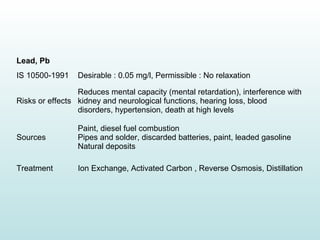
Lead, Pb
IS 10500-1991 Desirable : 0.05 mg/l, Permissible : No relaxation
Risks or effects
Reduces mental capacity (mental retardation), interference with
kidney and neurological functions, hearing loss, blood
disorders, hypertension, death at high levels
Sources
Paint, diesel fuel combustion
Pipes and solder, discarded batteries, paint, leaded gasoline
Natural deposits
Treatment Ion Exchange, Activated Carbon , Reverse Osmosis, Distillation
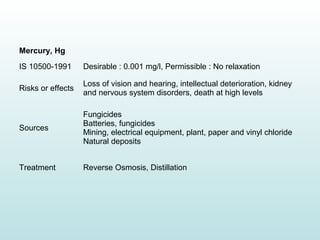
Mercury, Hg
IS 10500-1991 Desirable : 0.001 mg/l, Permissible : No relaxation
Risks or effects
Loss of vision and hearing, intellectual deterioration, kidney
and nervous system disorders, death at high levels
Sources
Fungicides
Batteries, fungicides
Mining, electrical equipment, plant, paper and vinyl chloride
Natural deposits
Treatment Reverse Osmosis, Distillation
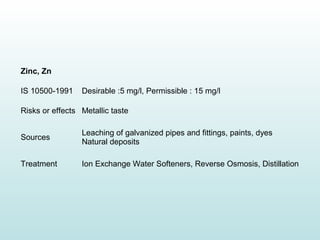
Zinc, Zn
IS 10500-1991 Desirable :5 mg/l, Permissible : 15 mg/l
Risks or effects Metallic taste
Sources
Leaching of galvanized pipes and fittings, paints, dyes
Natural deposits
Treatment Ion Exchange Water Softeners, Reverse Osmosis, Distillation
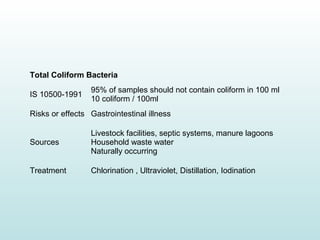
Total Coliform Bacteria
IS 10500-1991
95% of samples should not contain coliform in 100 ml
10 coliform / 100ml
Risks or effects Gastrointestinal illness
Sources
Livestock facilities, septic systems, manure lagoons
Household waste water
Naturally occurring
Treatment Chlorination , Ultraviolet, Distillation, Iodination
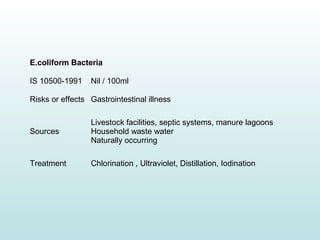
E.coliform Bacteria
IS 10500-1991 Nil / 100ml
Risks or effects Gastrointestinal illness
Sources
Livestock facilities, septic systems, manure lagoons
Household waste water
Naturally occurring
Treatment Chlorination , Ultraviolet, Distillation, Iodination
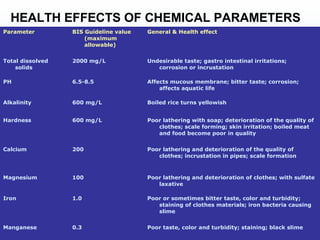
HEALTH EFFECTS OF CHEMICAL PARAMETERS
Parameter BIS Guideline value
(maximum
allowable)
General & Health effect
Total dissolved
solids
2000 mg/L Undesirable taste; gastro intestinal irritations;
corrosion or incrustation
PH 6.5-8.5 Affects mucous membrane; bitter taste; corrosion;
affects aquatic life
Alkalinity 600 mg/L Boiled rice turns yellowish
Hardness 600 mg/L Poor lathering with soap; deterioration of the quality of
clothes; scale forming; skin irritation; boiled meat
and food become poor in quality
Calcium 200 Poor lathering and deterioration of the quality of
clothes; incrustation in pipes; scale formation
Magnesium 100 Poor lathering and deterioration of clothes; with sulfate
laxative
Iron 1.0 Poor or sometimes bitter taste, color and turbidity;
staining of clothes materials; iron bacteria causing
slime
Manganese 0.3 Poor taste, color and turbidity; staining; black slime
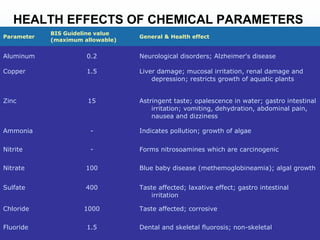
Parameter
BIS Guideline value
(maximum allowable)
General & Health effect
Aluminum 0.2 Neurological disorders; Alzheimer's disease
Copper 1.5 Liver damage; mucosal irritation, renal damage and
depression; restricts growth of aquatic plants
Zinc 15 Astringent taste; opalescence in water; gastro intestinal
irritation; vomiting, dehydration, abdominal pain,
nausea and dizziness
Ammonia - Indicates pollution; growth of algae
Nitrite - Forms nitrosoamines which are carcinogenic
Nitrate 100 Blue baby disease (methemoglobineamia); algal growth
Sulfate 400 Taste affected; laxative effect; gastro intestinal
irritation
Chloride 1000 Taste affected; corrosive
Fluoride 1.5 Dental and skeletal fluorosis; non-skeletal
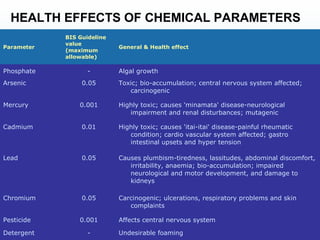
HEALTH EFFECTS OF CHEMICAL PARAMETERS
Parameter
BIS Guideline
value
(maximum
allowable)
General & Health effect
Phosphate - Algal growth
Arsenic 0.05 Toxic; bio-accumulation; central nervous system affected;
carcinogenic
Mercury 0.001 Highly toxic; causes 'minamata' disease-neurological
impairment and renal disturbances; mutagenic
Cadmium 0.01 Highly toxic; causes 'itai-itai' disease-painful rheumatic
condition; cardio vascular system affected; gastro
intestinal upsets and hyper tension
Lead 0.05 Causes plumbism-tiredness, lassitudes, abdominal discomfort,
irritability, anaemia; bio-accumulation; impaired
neurological and motor development, and damage to
kidneys
Chromium 0.05 Carcinogenic; ulcerations, respiratory problems and skin
complaints
Pesticide 0.001 Affects central nervous system
Detergent - Undesirable foaming
HEALTH EFFECTS OF CHEMICAL PARAMETERS

Indiandrinking

  • 1.
    WATER QUALITY STANDARD IndianStandard Drinking Water - Specification IS 10500 : 1991
  • 2.
    Technical Terms • BIS(Bureau of Indian Standards) • Desirable limits • Permissible limit • PPM • NTU • Hazen Units
  • 3.
    Colour, Hazen Units IS10500-1991 Desirable : 5 Hz. , Permissible : 25 Hz. Risks or effects Visible tint, acceptance decreases Sources Tannins, Iron, Copper, Manganese Natural deposits Treatment Filtration, Distillation, Reverse osmosis, Ozonisation
  • 4.
    Odour IS 10500-1991 Unobjectionable Risksor effects Rotten egg, Musty, Chemical Sources Chlorine, Hydrogen sulfide, Organic matter, Septic contamination, Methane gas Treatment Activated carbon, Air stripping, oxidation, Filtration
  • 5.
    pH IS 10500-1991 Desirable:6.5 – 8.5, Permissible :No relaxation Risks or effects Low pH - corrosion, metallic taste High pH – bitter/soda taste, deposits Sources Natural Treatment Increase pH by soda ash Decrease pH with white vinegar / citric acid
  • 6.
    Total Dissolved Solids(TDS) IS 10500-1991 Desirable : 500 mg/l , Permissible : 2000 mg/l Risks or effects Hardness, scaly deposits, sediment, cloudy colored water, staining, salty or bitter taste, corrosion of pipes and fittings Sources Livestock waste, septic system Landfills, nature of soil Hazardous waste landfills Dissolved minerals, iron and manganese Treatment Reverse Osmosis, Distillation, deionization by ion exchange
  • 7.
    Hardness IS 10500-1991 Desirable:300 mg/l , Permissible : 600 mg/l Risks or effects Scale in utensils and hot water system, soap scums Sources Dissolved calcium and magnesium from soil and aquifer minerals containing limestone or dolomite Treatment Water Softener Ion Exchanger , Reverse Osmosis
  • 8.
    Alkalinity IS 10500-1991 Desirable: 200 mg/l , Permissible : 600 mg/lit Risks or effects Low Alkalinity (i.e. high acidity) causes deterioration of plumbing and increases the chance for many heavy metals in water are present in pipes, solder or plumbing fixtures. Sources Pipes, landfills Hazardous waste landfills Treatment Neutralizing agent
  • 9.
    Iron, Fe IS 10500-1991Desirable : 0.3 mg/l , Permissible : 1.0 mg/l Risks or effects Brackish color, rusty sediment, bitter or metallic taste, brown- green stains, iron bacteria, discolored beverages Sources Leaching of cast iron pipes in water distribution systems Natural Treatment Oxidizing Filter , Green-sand Mechanical Filter
  • 10.
    Manganese, Mn IS 10500-1991Desirable : 0.1 mg/l , Permissible : 0.3 mg/l Risks or effects Brownish color, black stains on laundry and fixtures at .2 mg/l, bitter taste, altered taste of water-mixed beverages Sources Landfills Deposits in rock and soil Treatment Ion Exchange , Chlorination, Oxidizing Filter , Green-sand Mechanical Filter
  • 11.
    Sulphate, SO4 IS 10500-1991Desirable : 200 mg/l, Permissible : 400 mg/l Risks or effects Bitter, medicinal taste, scaly deposits, corrosion, laxative effects, "rotten-egg" odor from hydrogen sulfide gas formation Sources Animal sewage, septic system, sewage By-product of coal mining, industrial waste Natural deposits or salt Sulphate Treatment Ion Exchange , Distillation , Reverse Osmosis
  • 12.
    Nitrate, NO3- IS 10500-1991Desirable : 45 mg/l, Permissible : 100 mg/lit Risks or effects Methemoglobinemia or blue baby disease in infants Sources Livestock facilities, septic systems, manure lagoons, fertilizers Household waste water, fertilizers Fertilizers Natural Deposits Treatment Ion Exchange, Distillation, Reverse Osmosis
  • 13.
    Chloride, Cl IS 10500-1991Desirable : 250 mg/l , Permissible : 1000 mg/l Risks or effects High blood pressure, salty taste, corroded pipes, fixtures and appliances, blackening and pitting of stainless steel Sources Fertilizers Industrial wastes Minerals, seawater Treatment Reverse Osmosis , Distillation, Activated Carbon
  • 14.
    Fluoride, F IS 10500-1991Desirable : 1.0 mg/l, Permissible : 1.5 mg/l Risks or effects Brownish discoloration of teeth, bone damage Sources Industrial waste Geological Treatment Activated Alumina, Distillation, Reverse Osmosis, Ion Exchange
  • 15.
    Arsenic, As IS:10500-1991 Desirable:0.05 mg/l Permissible: No relaxation Risks or effects Weight loss; Depression; Lack of energy; Skin and nervous system toxicity Sources Previously used in pesticides (orchards) Improper waste disposal or product storage of glass or electronics, Mining Rocks Treatment Activated Alumina Filtration, Reverse Osmosis, Distillation, Chemical Precipitation, Ion exchange, lime softening
  • 16.
    Chromium, Cr IS 10500-1991Desirable : 0.05 mg/l, Permissible : No relaxation Risks or effects Skin irritation, skin and nasal ulcers, lung tumors, gastrointestinal effects, damage to the nervous system and circulatory system, accumulates in the spleen, bones, kidney and liver Sources Septic systems Industrial discharge, mining sites Geological Treatment Ion Exchange, Reverse Osmosis, Distillation
  • 17.
    Copper, Cu IS 10500-1991Desirable : 0.05 mg/l, Permissible : 1.5 mg/l Risks or effects Anemia, digestive disturbances, liver and kidney damage, gastrointestinal irritations, bitter or metallic taste; Blue-green stains on plumbing fixtures Sources Leaching from copper water pipes and tubing, algae treatment Industrial and mining waste, wood preservatives Natural deposits Treatment Ion Exchange, Reverse Osmosis, Distillation
  • 18.
    Cyanide IS 10500-1991 Desirable: 0.05 mg/l, Permissible : No relaxation Risks or effects Thyroid, nervous system damage Sources Fertilizer Electronics, steel, plastics mining Treatment Ion Exchange, Reverse Osmosis, Chlorination
  • 19.
    Lead, Pb IS 10500-1991Desirable : 0.05 mg/l, Permissible : No relaxation Risks or effects Reduces mental capacity (mental retardation), interference with kidney and neurological functions, hearing loss, blood disorders, hypertension, death at high levels Sources Paint, diesel fuel combustion Pipes and solder, discarded batteries, paint, leaded gasoline Natural deposits Treatment Ion Exchange, Activated Carbon , Reverse Osmosis, Distillation
  • 20.
    Mercury, Hg IS 10500-1991Desirable : 0.001 mg/l, Permissible : No relaxation Risks or effects Loss of vision and hearing, intellectual deterioration, kidney and nervous system disorders, death at high levels Sources Fungicides Batteries, fungicides Mining, electrical equipment, plant, paper and vinyl chloride Natural deposits Treatment Reverse Osmosis, Distillation
  • 21.
    Zinc, Zn IS 10500-1991Desirable :5 mg/l, Permissible : 15 mg/l Risks or effects Metallic taste Sources Leaching of galvanized pipes and fittings, paints, dyes Natural deposits Treatment Ion Exchange Water Softeners, Reverse Osmosis, Distillation
  • 22.
    Total Coliform Bacteria IS10500-1991 95% of samples should not contain coliform in 100 ml 10 coliform / 100ml Risks or effects Gastrointestinal illness Sources Livestock facilities, septic systems, manure lagoons Household waste water Naturally occurring Treatment Chlorination , Ultraviolet, Distillation, Iodination
  • 23.
    E.coliform Bacteria IS 10500-1991Nil / 100ml Risks or effects Gastrointestinal illness Sources Livestock facilities, septic systems, manure lagoons Household waste water Naturally occurring Treatment Chlorination , Ultraviolet, Distillation, Iodination
  • 24.
    HEALTH EFFECTS OFCHEMICAL PARAMETERS Parameter BIS Guideline value (maximum allowable) General & Health effect Total dissolved solids 2000 mg/L Undesirable taste; gastro intestinal irritations; corrosion or incrustation PH 6.5-8.5 Affects mucous membrane; bitter taste; corrosion; affects aquatic life Alkalinity 600 mg/L Boiled rice turns yellowish Hardness 600 mg/L Poor lathering with soap; deterioration of the quality of clothes; scale forming; skin irritation; boiled meat and food become poor in quality Calcium 200 Poor lathering and deterioration of the quality of clothes; incrustation in pipes; scale formation Magnesium 100 Poor lathering and deterioration of clothes; with sulfate laxative Iron 1.0 Poor or sometimes bitter taste, color and turbidity; staining of clothes materials; iron bacteria causing slime Manganese 0.3 Poor taste, color and turbidity; staining; black slime
  • 25.
    Parameter BIS Guideline value (maximumallowable) General & Health effect Aluminum 0.2 Neurological disorders; Alzheimer's disease Copper 1.5 Liver damage; mucosal irritation, renal damage and depression; restricts growth of aquatic plants Zinc 15 Astringent taste; opalescence in water; gastro intestinal irritation; vomiting, dehydration, abdominal pain, nausea and dizziness Ammonia - Indicates pollution; growth of algae Nitrite - Forms nitrosoamines which are carcinogenic Nitrate 100 Blue baby disease (methemoglobineamia); algal growth Sulfate 400 Taste affected; laxative effect; gastro intestinal irritation Chloride 1000 Taste affected; corrosive Fluoride 1.5 Dental and skeletal fluorosis; non-skeletal HEALTH EFFECTS OF CHEMICAL PARAMETERS
  • 26.
    Parameter BIS Guideline value (maximum allowable) General &Health effect Phosphate - Algal growth Arsenic 0.05 Toxic; bio-accumulation; central nervous system affected; carcinogenic Mercury 0.001 Highly toxic; causes 'minamata' disease-neurological impairment and renal disturbances; mutagenic Cadmium 0.01 Highly toxic; causes 'itai-itai' disease-painful rheumatic condition; cardio vascular system affected; gastro intestinal upsets and hyper tension Lead 0.05 Causes plumbism-tiredness, lassitudes, abdominal discomfort, irritability, anaemia; bio-accumulation; impaired neurological and motor development, and damage to kidneys Chromium 0.05 Carcinogenic; ulcerations, respiratory problems and skin complaints Pesticide 0.001 Affects central nervous system Detergent - Undesirable foaming HEALTH EFFECTS OF CHEMICAL PARAMETERS