Functioning of TRAI,DOT &TDSAT in telecommunicationPresented by-Sanjaya kumar mallik(PGDM-TM),XIMJ
Outline of presentation Introduction to telecommunication.
Importance of telecommunication.
Telecommunication in India .
Growth of Telecom in India.
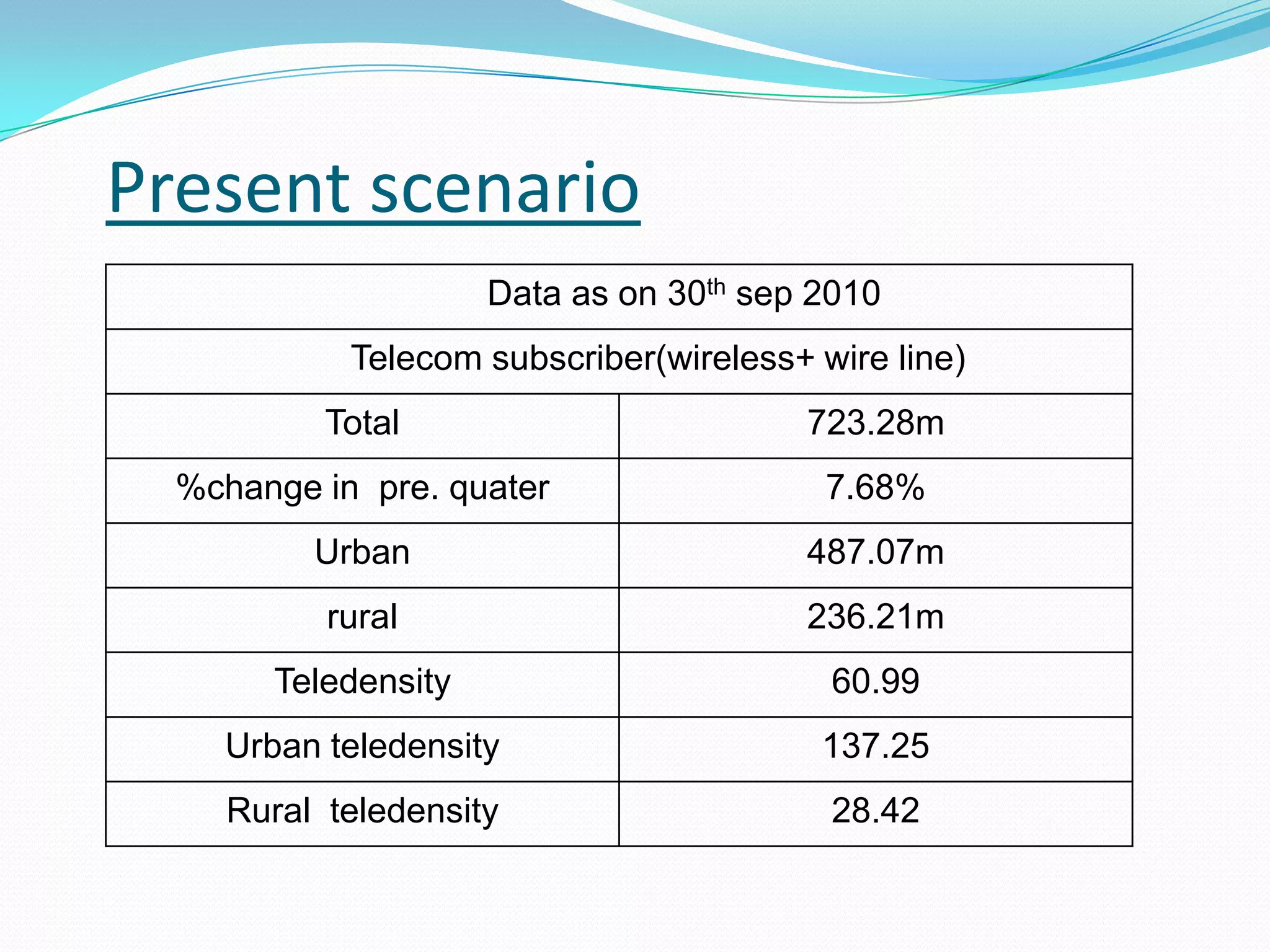
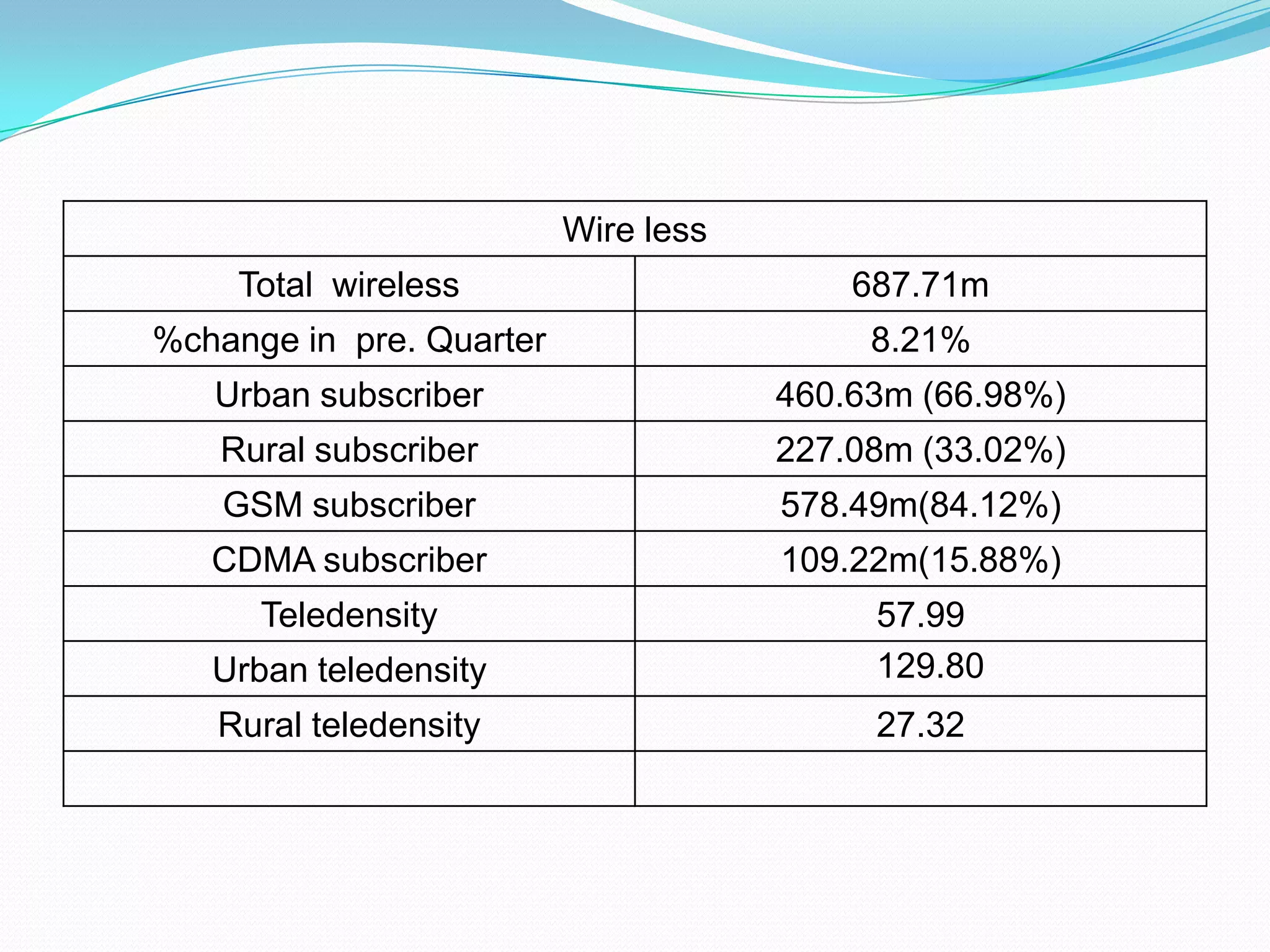
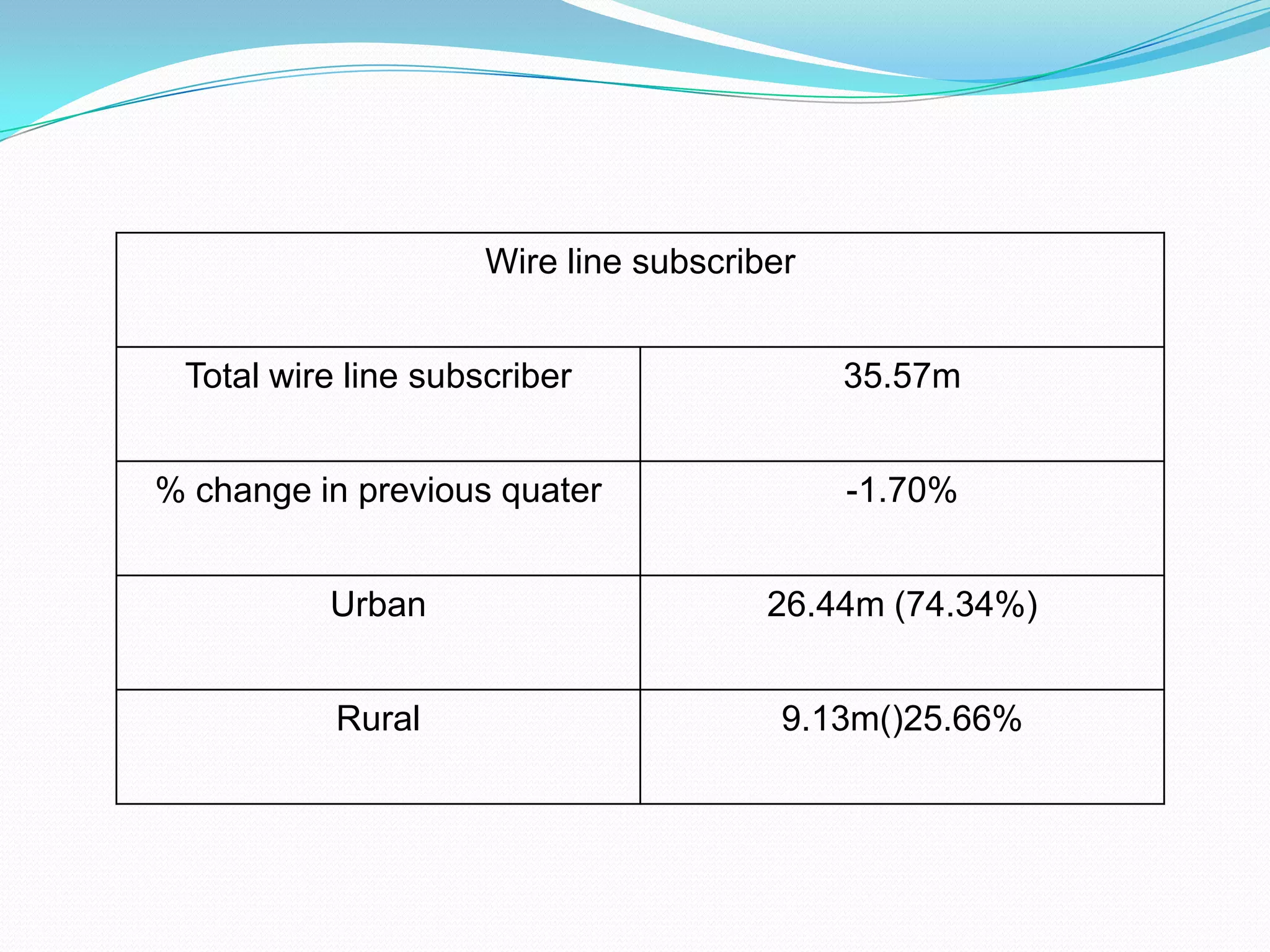
Present scenario  of Indian telecom sector.
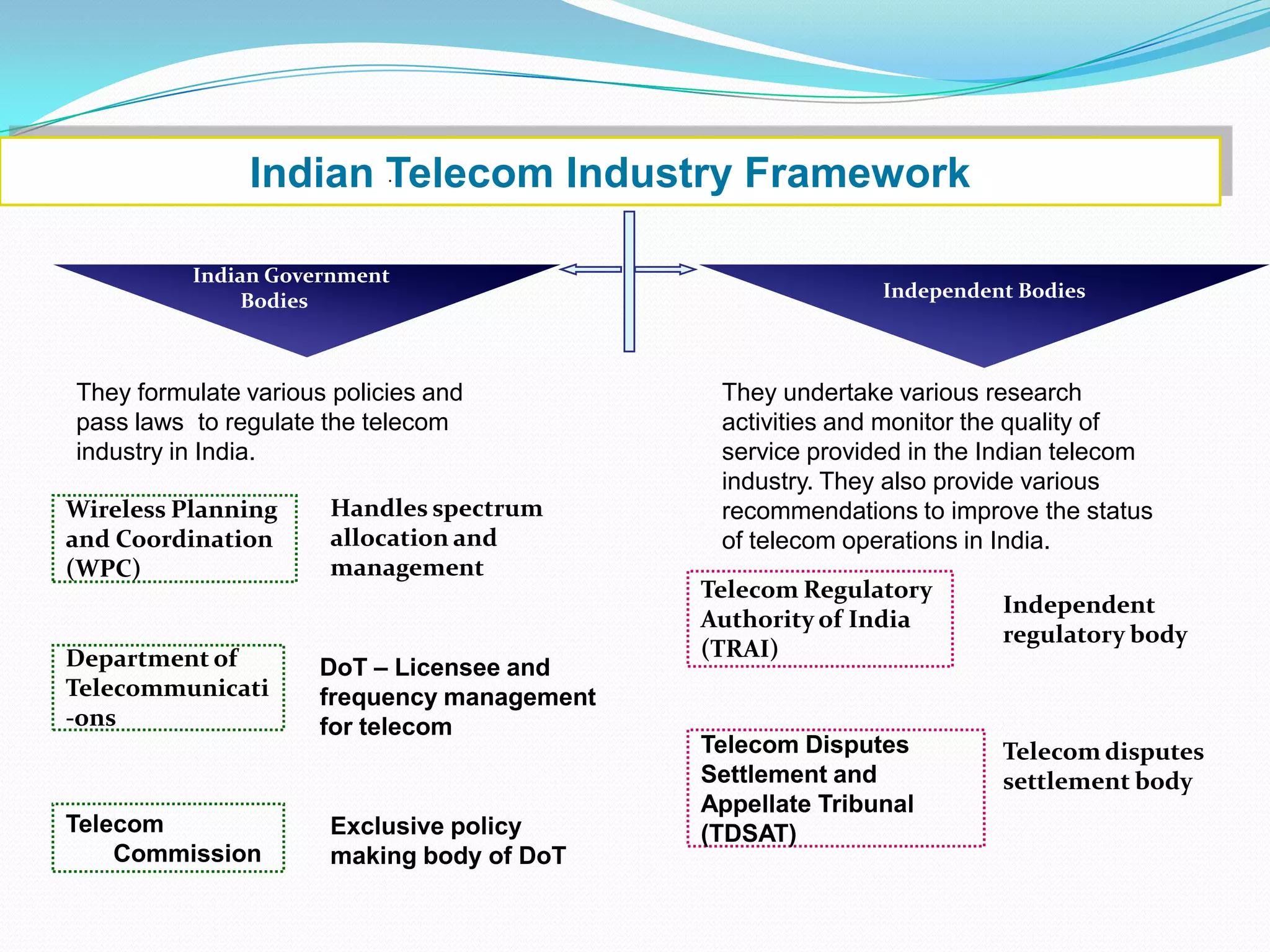
Indian Telecom Industry Framework.
Functions of DoT, TRAI & TDSAT.
Conclusion .Introduction to telecommunication Telecommunication is the transmission and reception of messages       over long distances.Telecommunications is the communication of information by electronic means usually over some distance.Modern telecommunication systems send and receive sound, printed materials, and visual images in a fraction of a second.
Importance of telecommunicationThe telecom services have been recognized the world-over as an important tool for socio-economic development for a nation. It is one of the prime support services needed for rapid growth and modernization of various sectors of the economy. The entire sector is now open to unrestricted competition in all. The opening of the sector has not only led to rapid growth but also helped a great deal towards maximization of consumer benefits.
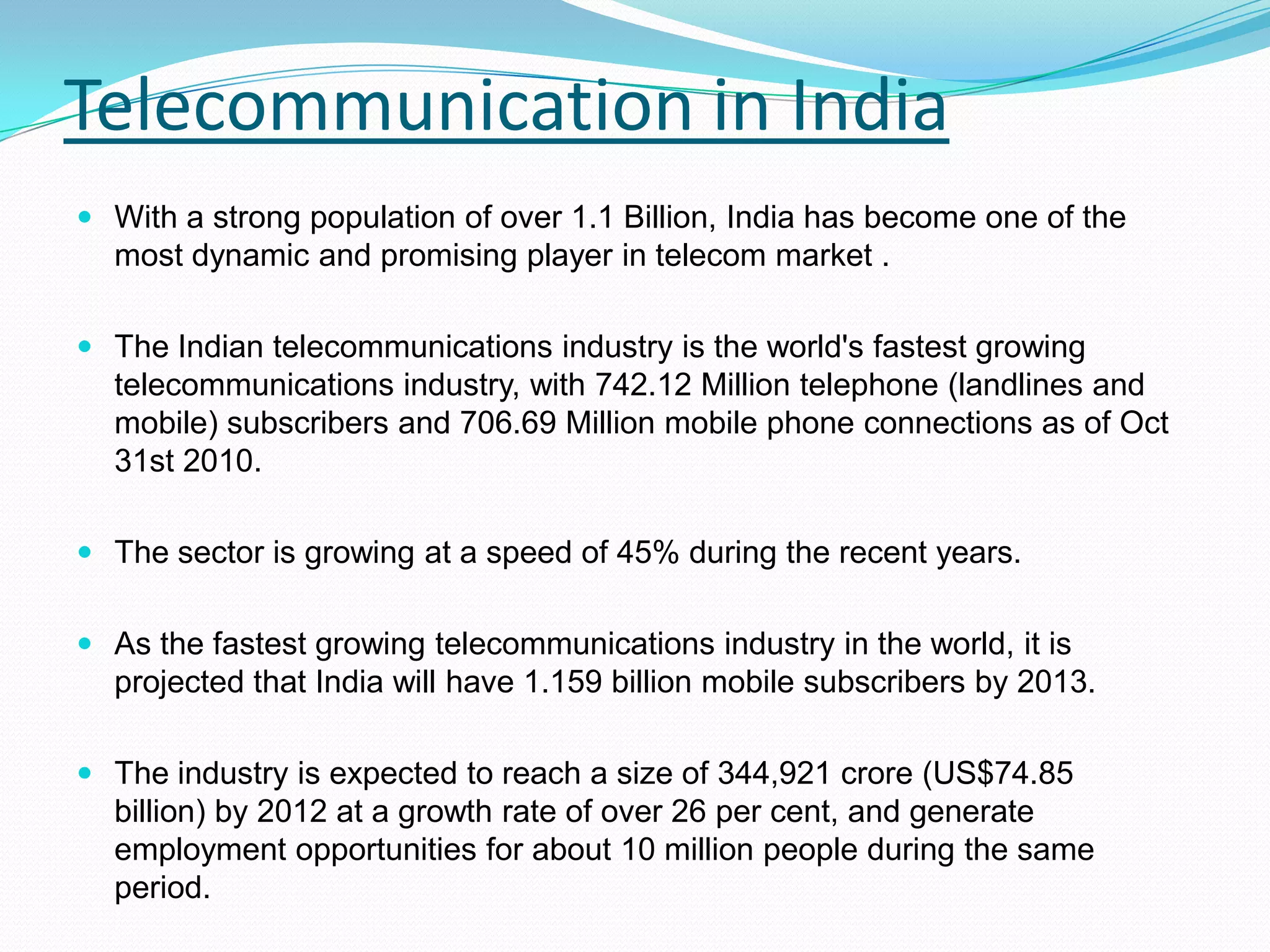
Telecommunication in India With a strong population of over 1.1 Billion, India has become one of the most dynamic and promising player in telecom market .The Indian telecommunications industry is the world's fastest growing telecommunications industry, with 742.12 Million telephone (landlines and mobile) subscribers and 706.69 Million mobile phone connections as of Oct 31st 2010.The sector is growing at a speed of 45% during the recent years. As the fastest growing telecommunications industry in the world, it is projected that India will have 1.159 billion mobile subscribers by 2013.The industry is expected to reach a size of 344,921 crore (US$74.85 billion) by 2012 at a growth rate of over 26 per cent, and generate employment opportunities for about 10 million people during the same period.
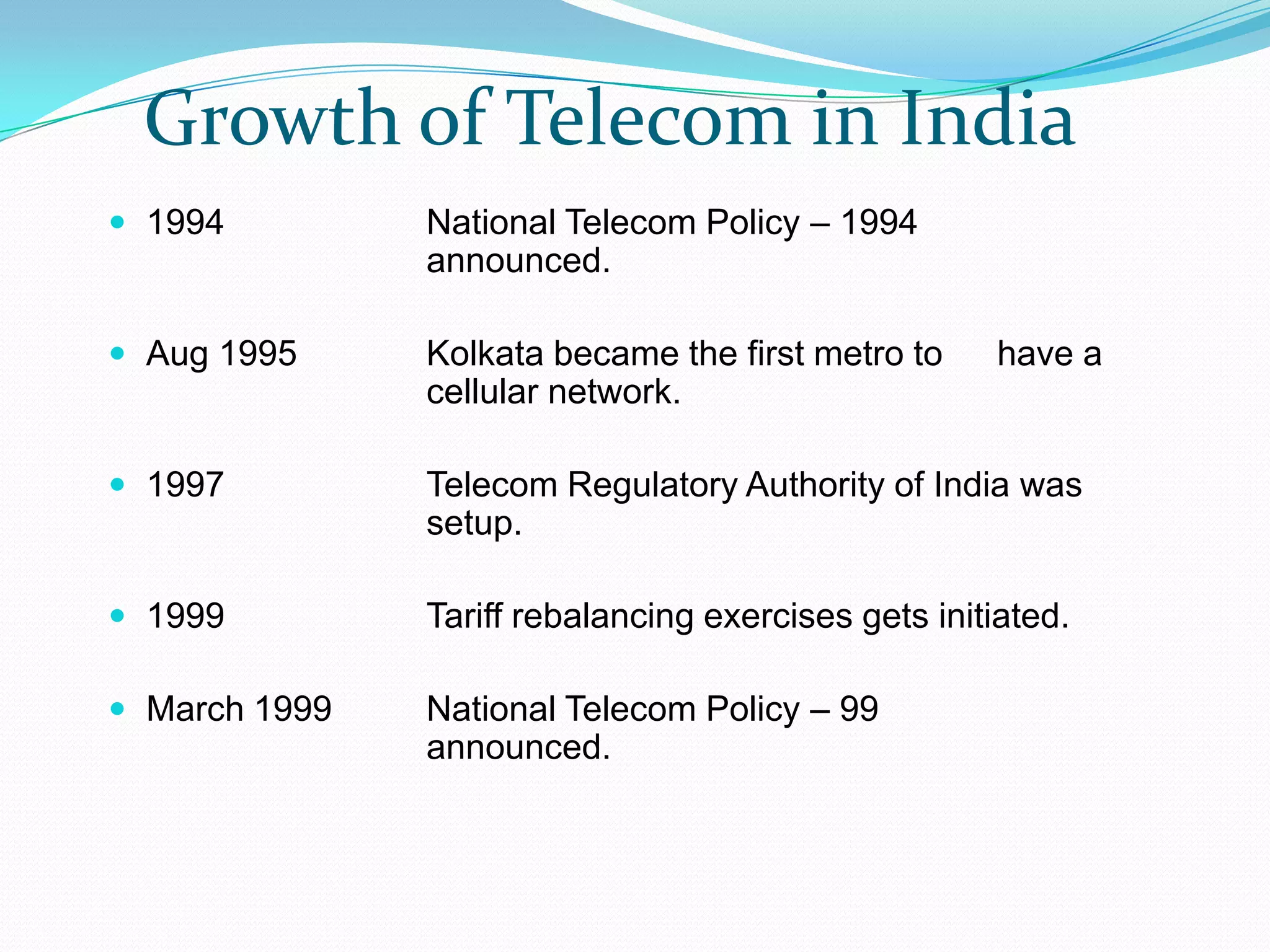
Growth of Telecom in India1994	National Telecom Policy – 1994 	announced.Aug 1995	Kolkata became the first metro to 	have a 	cellular network.1997	Telecom Regulatory Authority of India was 	setup.1999	Tariff rebalancing exercises gets initiated.March 1999 	National Telecom Policy – 99  	announced.
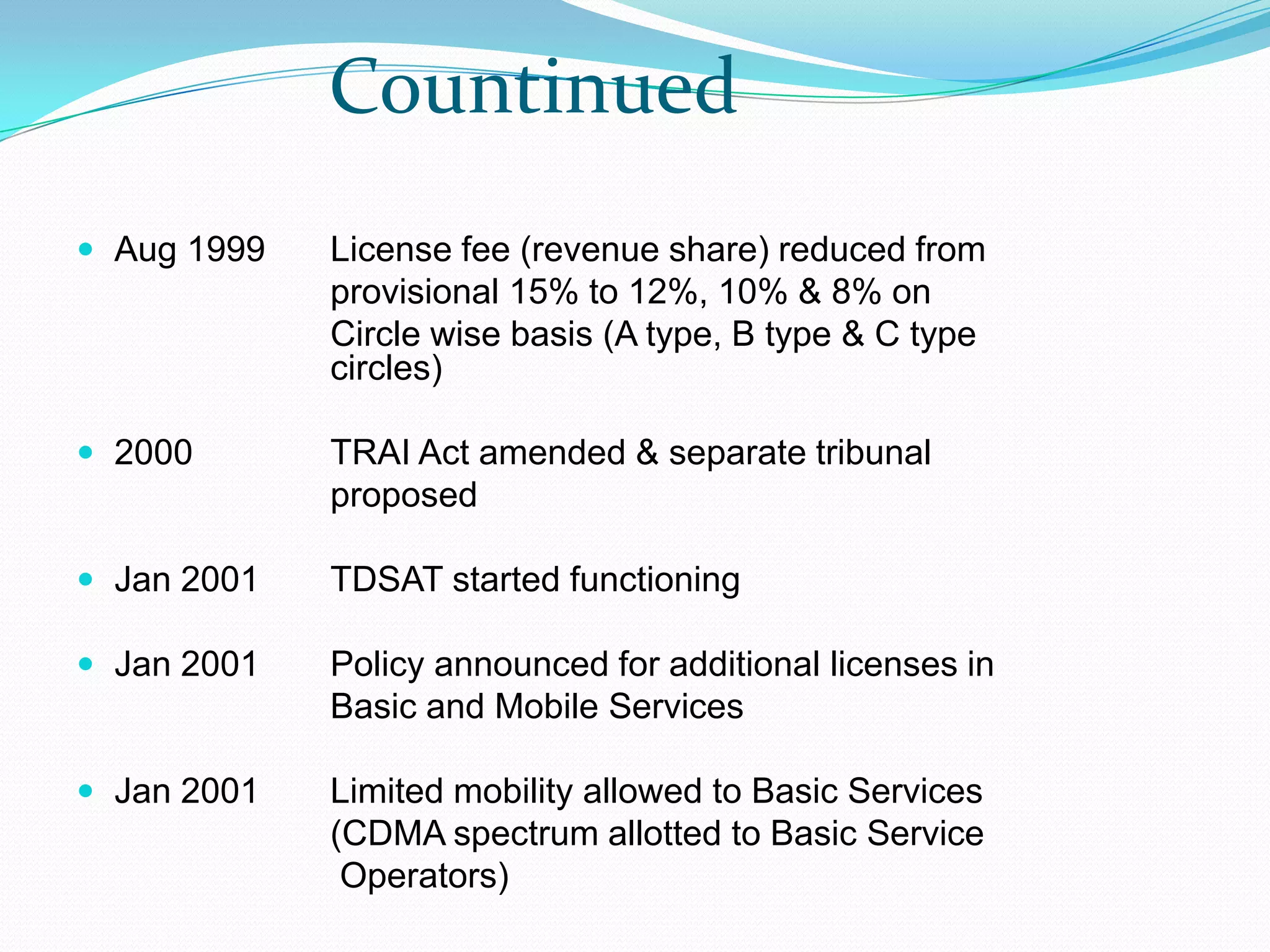
CountinuedAug 1999	License fee (revenue share) reduced from 		provisional 15% to 12%, 10% & 8% on 		Circle wise basis (A type, B type & C type 	circles)2000	TRAI Act amended & separate tribunal 		proposedJan 2001	TDSAT started functioningJan 2001	Policy announced for additional licenses in 		Basic and Mobile ServicesJan 2001	Limited mobility allowed to Basic Services 		(CDMA spectrum allotted to Basic Service		 Operators)
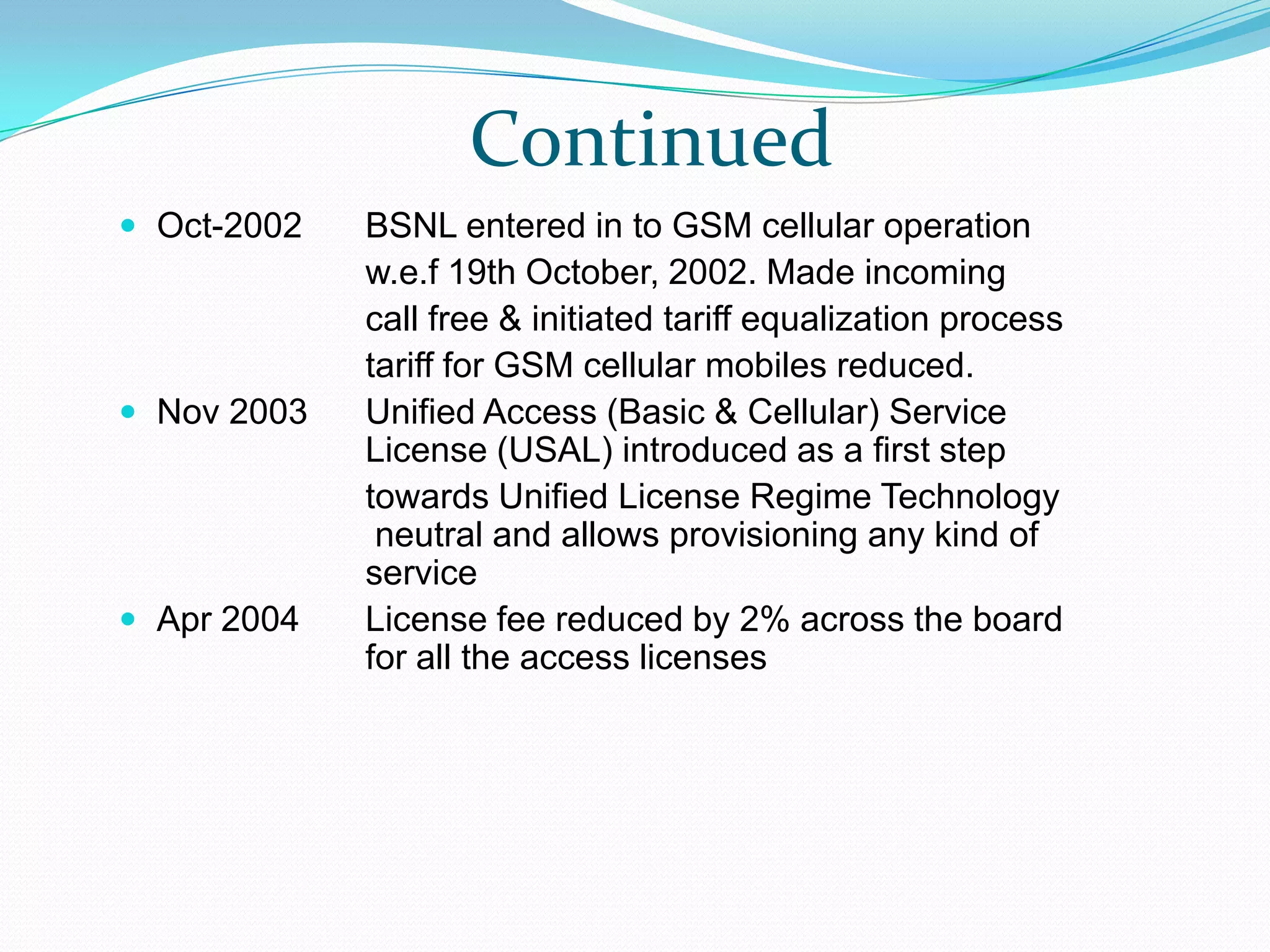
ContinuedOct-2002	BSNL entered in to GSM cellular operationw.e.f 19th October, 2002. Made incoming 		call free & initiated tariff equalization process          	tariff for GSM cellular mobiles reduced.Nov 2003	Unified Access (Basic & Cellular) Service 	License (USAL) introduced as a first step		towards Unified License Regime Technology            	 neutral and allows provisioning any kind of 	serviceApr 2004	License fee reduced by 2% across the board                                                   	for all the access licenses
Present scenario
Indian Telecom Industry Framework.Indian Government BodiesIndependent BodiesThey formulate various policies and pass laws to regulate the telecom industry in India.They undertake various research activities and monitor the quality of service provided in the Indian telecom industry. They also provide various recommendations to improve the status of telecom operations in India.Handles spectrum allocation and managementWireless Planning and Coordination (WPC)Telecom Regulatory Authority of India (TRAI)Independent regulatory bodyDepartment of Telecommunicati-onsDoT – Licensee and frequency management for telecomTelecom Disputes Settlement and Appellate Tribunal (TDSAT)Telecom disputes settlement bodyTelecom CommissionExclusive policy making body of DoT
Governance bodiesDoTTRAITDSAT
Department of Telecom(DoT) In 1975, the Department of Telecom (DoT) was separated from Indian Post & Telecommunication Accounts and Finance ServiceDoT was responsible for telecom services in entire country until 1985 when Mahanagar Telephone Nigam Limited (MTNL) was carved out of DoT to run the telecom services of Delhi and Mumbai. The demand for telephones was ever increasing. It was during this period that the NarsimhaRao-led government introduced the national telecommunications policy [NTP] in 1994 which brought change in telecommunication The Government of India corporatized the operations wing of DoT on 1 October 2000 and named it as Bharat Sanchar NigamLimited (BSNL).
VisionTo provide to the people of India, reliable and affordable tele-connectivity capable of delivering tele-services   anytime, anywhere.Mission To develop a strong, vibrant and state-of-the-art telecommunication network.Promote Research and Development for India-specific applications and for developing cutting edge  technologies. To provide seamless access , across the country and in particular rural and remote areas .
Functions  of DoT in telecomPolicy, Licensing and coordination matters relating to Telegraphs, Telephones, Wireless, Data , Facsimile, Telematics  services and other like forms communications.Promotion of standardization, research and development in telecommunications.Promotion of private investment in telecommunications.Allocates frequency and manages radio communications in close coordination with the International bodies
TRAIFormation-1997Legal status -Created by Telecom Regulatory Authority of India Act, 1997Purpose/focus -Independent regulatorHeadquarter-   MahanagarDoorsancharBhawan, Jawaharlal Nehru Marg, New Delhi 110 002 Chairman -DR. J.S. SHARMA
MISSION OF TRAITRAI’s mission is to create and nurture conditions for the growth of telecommunications including broadcasting and cable services in the country in a manner and at a pace which will enable India to play a leading role in the emerging global information society.
Regulatory Process (Adopted by TRAI)Section 11(4) of the TRAI Act mandates TRAI to ensure transparency in Discharge of its Functions.
To Ensure Transparency TRAI adopts the following process before taking any regulatory decisions-
Consultation Paper is issued soliciting comments from stakeholders
The Comments of the stake holders are published on the website
Stake holders are invited in the Open House Discussions (OHDs) organized in different parts of the country.
The issue is discussed in detail and after providing multiple opportunity to the stake holders for submission of their views the decision is taken by  Authority.Recommendatory functions of TRAINeed and timing for introduction of new service provider.Terms and conditions of license to service provider.Measures to facilitate competition and promote efficiency in operation of Telecom Services so as to facilitate growth.Technological improvement in the services provided by services providers.Measures for development of technology and any other matter related  to the telecom industry in general.Efficient management of available spectrum.Ensure technical compatibility and effective inter-connection between different service providers;

Functioning of TRAI,DoT&TDSAT IN TELECOMMUNICATION

  • 1.
    Functioning of TRAI,DOT&TDSAT in telecommunicationPresented by-Sanjaya kumar mallik(PGDM-TM),XIMJ
  • 2.
    Outline of presentationIntroduction to telecommunication.
  • 3.
  • 4.
  • 5.
  • 6.
    Present scenario of Indian telecom sector.
  • 7.
  • 8.
    Functions of DoT,TRAI & TDSAT.
  • 9.
    Conclusion .Introduction totelecommunication Telecommunication is the transmission and reception of messages over long distances.Telecommunications is the communication of information by electronic means usually over some distance.Modern telecommunication systems send and receive sound, printed materials, and visual images in a fraction of a second.
  • 10.
    Importance of telecommunicationThetelecom services have been recognized the world-over as an important tool for socio-economic development for a nation. It is one of the prime support services needed for rapid growth and modernization of various sectors of the economy. The entire sector is now open to unrestricted competition in all. The opening of the sector has not only led to rapid growth but also helped a great deal towards maximization of consumer benefits.
  • 11.
    Telecommunication in IndiaWith a strong population of over 1.1 Billion, India has become one of the most dynamic and promising player in telecom market .The Indian telecommunications industry is the world's fastest growing telecommunications industry, with 742.12 Million telephone (landlines and mobile) subscribers and 706.69 Million mobile phone connections as of Oct 31st 2010.The sector is growing at a speed of 45% during the recent years. As the fastest growing telecommunications industry in the world, it is projected that India will have 1.159 billion mobile subscribers by 2013.The industry is expected to reach a size of 344,921 crore (US$74.85 billion) by 2012 at a growth rate of over 26 per cent, and generate employment opportunities for about 10 million people during the same period.
  • 12.
    Growth of Telecomin India1994 National Telecom Policy – 1994 announced.Aug 1995 Kolkata became the first metro to have a cellular network.1997 Telecom Regulatory Authority of India was setup.1999 Tariff rebalancing exercises gets initiated.March 1999 National Telecom Policy – 99 announced.
  • 13.
    CountinuedAug 1999 License fee(revenue share) reduced from provisional 15% to 12%, 10% & 8% on Circle wise basis (A type, B type & C type circles)2000 TRAI Act amended & separate tribunal proposedJan 2001 TDSAT started functioningJan 2001 Policy announced for additional licenses in Basic and Mobile ServicesJan 2001 Limited mobility allowed to Basic Services (CDMA spectrum allotted to Basic Service Operators)
  • 14.
    ContinuedOct-2002 BSNL entered into GSM cellular operationw.e.f 19th October, 2002. Made incoming call free & initiated tariff equalization process tariff for GSM cellular mobiles reduced.Nov 2003 Unified Access (Basic & Cellular) Service License (USAL) introduced as a first step towards Unified License Regime Technology neutral and allows provisioning any kind of serviceApr 2004 License fee reduced by 2% across the board for all the access licenses
  • 15.
  • 18.
    Indian Telecom IndustryFramework.Indian Government BodiesIndependent BodiesThey formulate various policies and pass laws to regulate the telecom industry in India.They undertake various research activities and monitor the quality of service provided in the Indian telecom industry. They also provide various recommendations to improve the status of telecom operations in India.Handles spectrum allocation and managementWireless Planning and Coordination (WPC)Telecom Regulatory Authority of India (TRAI)Independent regulatory bodyDepartment of Telecommunicati-onsDoT – Licensee and frequency management for telecomTelecom Disputes Settlement and Appellate Tribunal (TDSAT)Telecom disputes settlement bodyTelecom CommissionExclusive policy making body of DoT
  • 19.
  • 20.
    Department of Telecom(DoT)In 1975, the Department of Telecom (DoT) was separated from Indian Post & Telecommunication Accounts and Finance ServiceDoT was responsible for telecom services in entire country until 1985 when Mahanagar Telephone Nigam Limited (MTNL) was carved out of DoT to run the telecom services of Delhi and Mumbai. The demand for telephones was ever increasing. It was during this period that the NarsimhaRao-led government introduced the national telecommunications policy [NTP] in 1994 which brought change in telecommunication The Government of India corporatized the operations wing of DoT on 1 October 2000 and named it as Bharat Sanchar NigamLimited (BSNL).
  • 21.
    VisionTo provide tothe people of India, reliable and affordable tele-connectivity capable of delivering tele-services anytime, anywhere.Mission To develop a strong, vibrant and state-of-the-art telecommunication network.Promote Research and Development for India-specific applications and for developing cutting edge technologies. To provide seamless access , across the country and in particular rural and remote areas .
  • 22.
    Functions ofDoT in telecomPolicy, Licensing and coordination matters relating to Telegraphs, Telephones, Wireless, Data , Facsimile, Telematics services and other like forms communications.Promotion of standardization, research and development in telecommunications.Promotion of private investment in telecommunications.Allocates frequency and manages radio communications in close coordination with the International bodies
  • 23.
    TRAIFormation-1997Legal status -Created by TelecomRegulatory Authority of India Act, 1997Purpose/focus -Independent regulatorHeadquarter- MahanagarDoorsancharBhawan, Jawaharlal Nehru Marg, New Delhi 110 002 Chairman -DR. J.S. SHARMA
  • 24.
    MISSION OF TRAITRAI’smission is to create and nurture conditions for the growth of telecommunications including broadcasting and cable services in the country in a manner and at a pace which will enable India to play a leading role in the emerging global information society.
  • 25.
    Regulatory Process (Adoptedby TRAI)Section 11(4) of the TRAI Act mandates TRAI to ensure transparency in Discharge of its Functions.
  • 26.
    To Ensure TransparencyTRAI adopts the following process before taking any regulatory decisions-
  • 27.
    Consultation Paper isissued soliciting comments from stakeholders
  • 28.
    The Comments ofthe stake holders are published on the website
  • 29.
    Stake holders areinvited in the Open House Discussions (OHDs) organized in different parts of the country.
  • 30.
    The issue isdiscussed in detail and after providing multiple opportunity to the stake holders for submission of their views the decision is taken by Authority.Recommendatory functions of TRAINeed and timing for introduction of new service provider.Terms and conditions of license to service provider.Measures to facilitate competition and promote efficiency in operation of Telecom Services so as to facilitate growth.Technological improvement in the services provided by services providers.Measures for development of technology and any other matter related  to the telecom industry in general.Efficient management of available spectrum.Ensure technical compatibility and effective inter-connection between different service providers;
  • 31.
    Continued….Regulate arrangement amongstservice providers of sharing their revenue derived from providing telecommunication services.Ensure compliance of terms and conditions of license. lay down and ensure the time period for providing local and long distance circuits of telecommunication between different service providers.Facilitate competition and promote efficiency in the operation of telecommunication services so as to facilitate growth in the industry.protect the interest of the consumers of telecommunication service.Monitor the quality of service and conduct the periodical survey of such provided by the service providers
  • 32.
    Continued….Inspect the equipmentused in the network and recommend the type of equipment to be used by the service providers.Maintain register of interconnect agreements and of all such other matters as may be provided in the regulations.Perform such other functions including such administrative and financial functions as may be entrusted to it by the Central Government or as may be necessary to carry out the provisions of this Act.
  • 33.
    TDSATAn integrated &comprehensive dispute settlement mechanism.Set up on 29th May 2000 & started hearing w.e.f. Jan 2001.TDSAT was established by carving out the adjudicatory functions from TRAI 83% cases disposed off from 2001 till 2007.TDSAT was established with the view to protect the interest of the consumers and service providers of the telecommunication sector.To encourage and ensure the growth of the telecommunication sector.
  • 34.
    TDSAT function Toadjudicate any dispute
  • 35.
    Between a licensorand a licensee.
  • 36.
    Between two ormore service providers.
  • 37.
    Between a serviceprovider and a group of consumers.
  • 38.
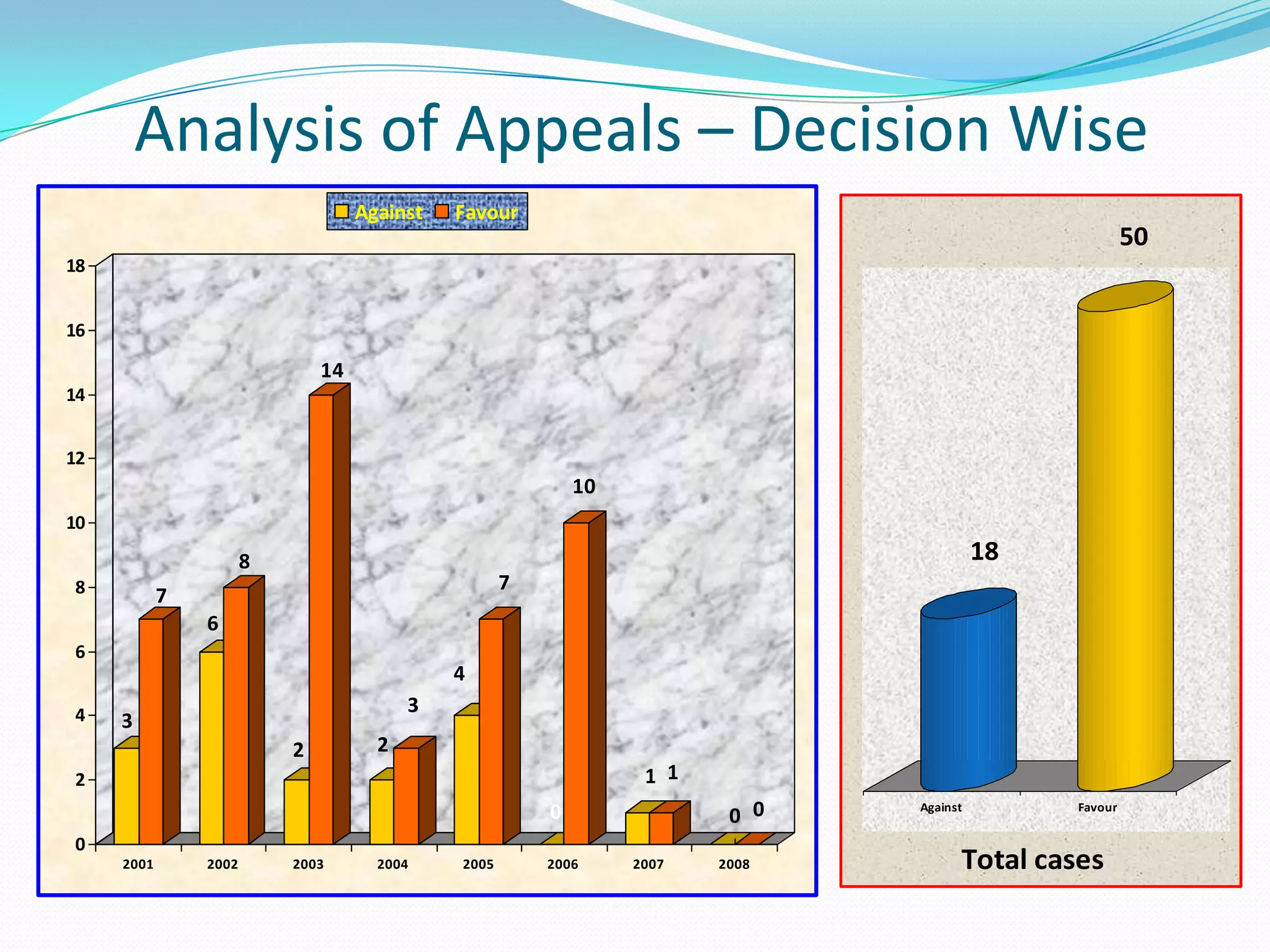
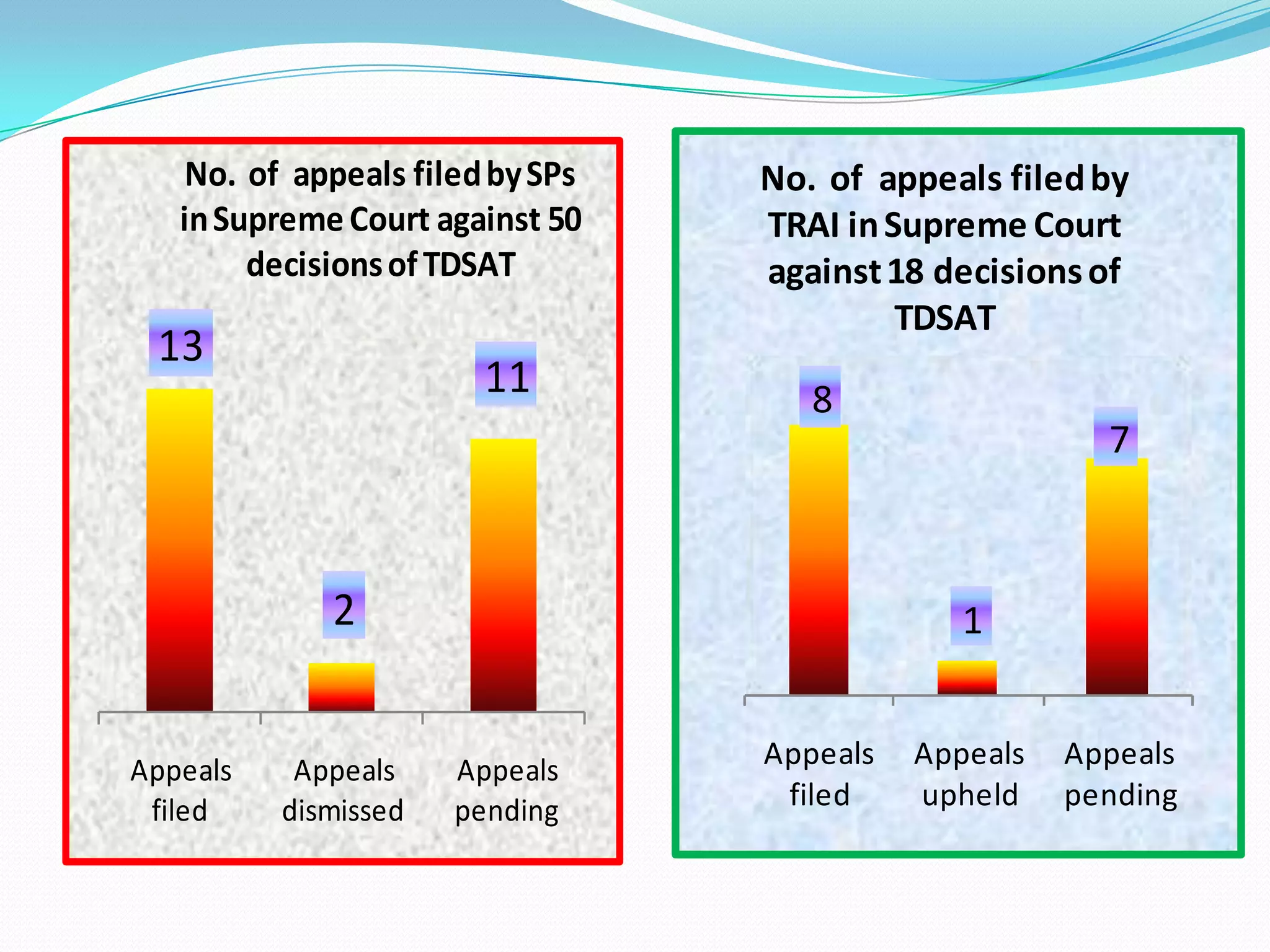
    To hear anddispose of appeals against decisions of TRAI.
  • 39.
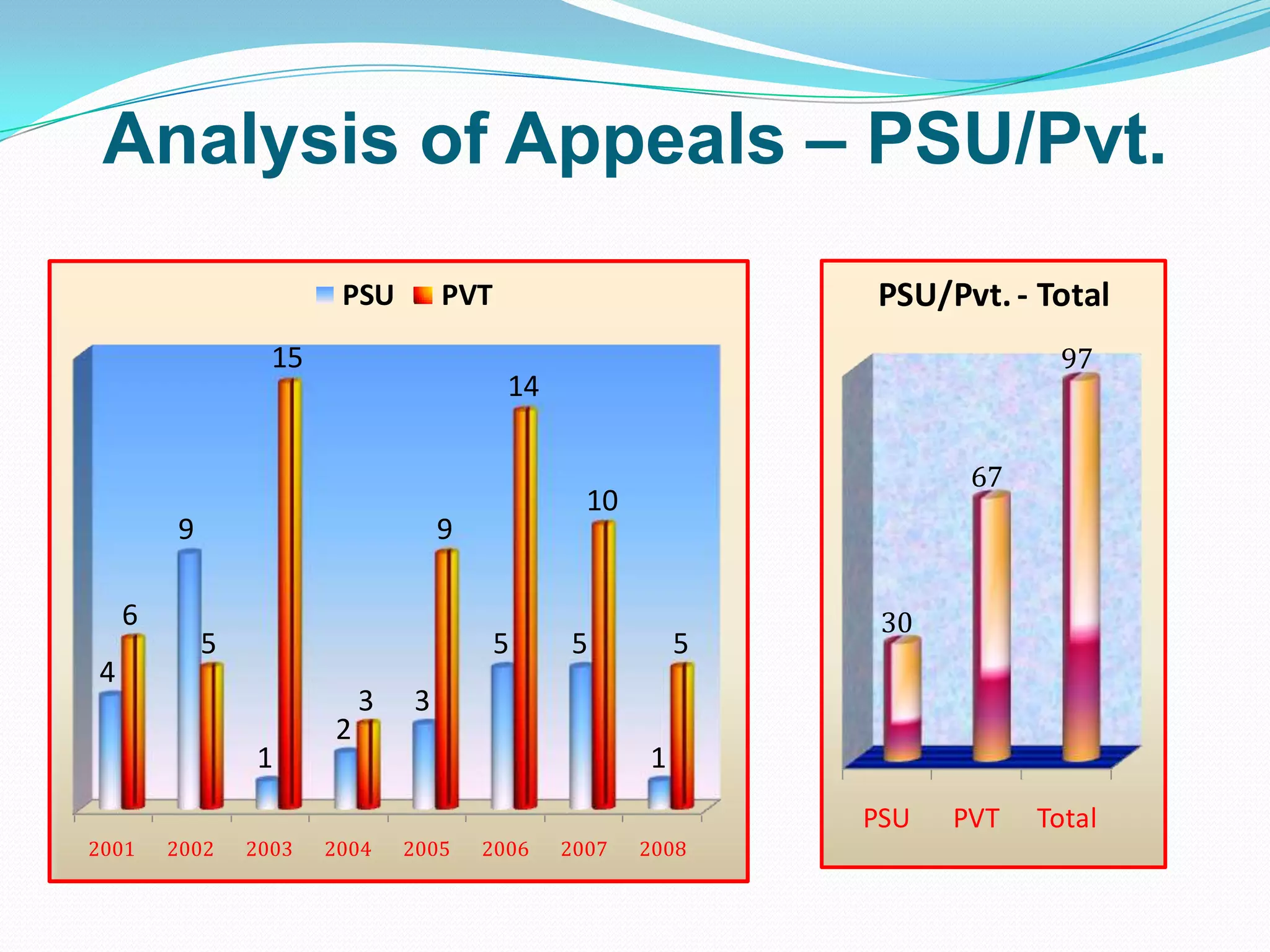
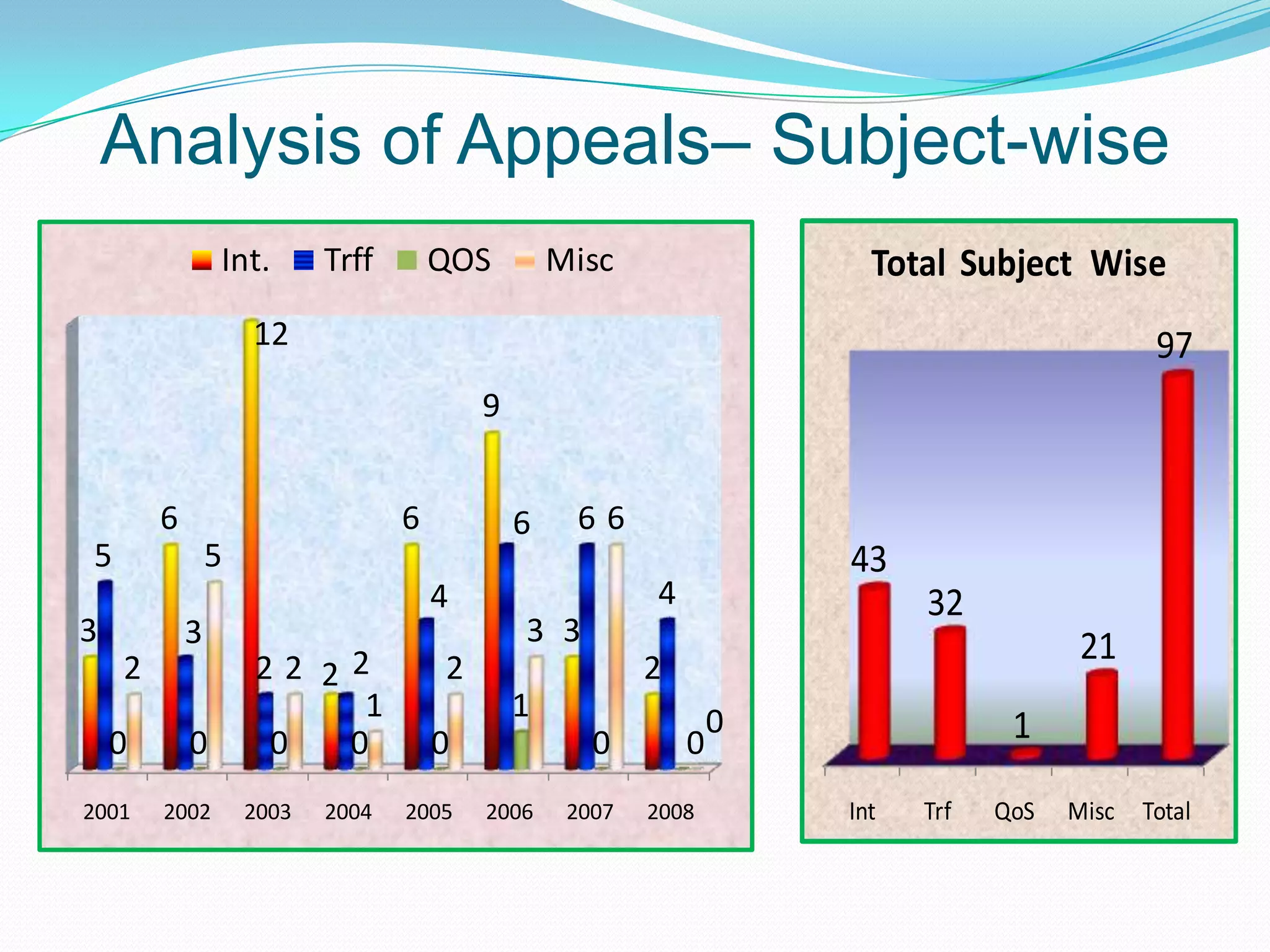
    Central Govt. or State Govt. or a local Authority or any person aggrieved by decision/direction/order of Authority may prefer an appeal in TDSAT.Analysis of Appeals – PSU/Pvt.
  • 40.
  • 41.
    Analysis of Appeals– Decision Wise
  • 43.
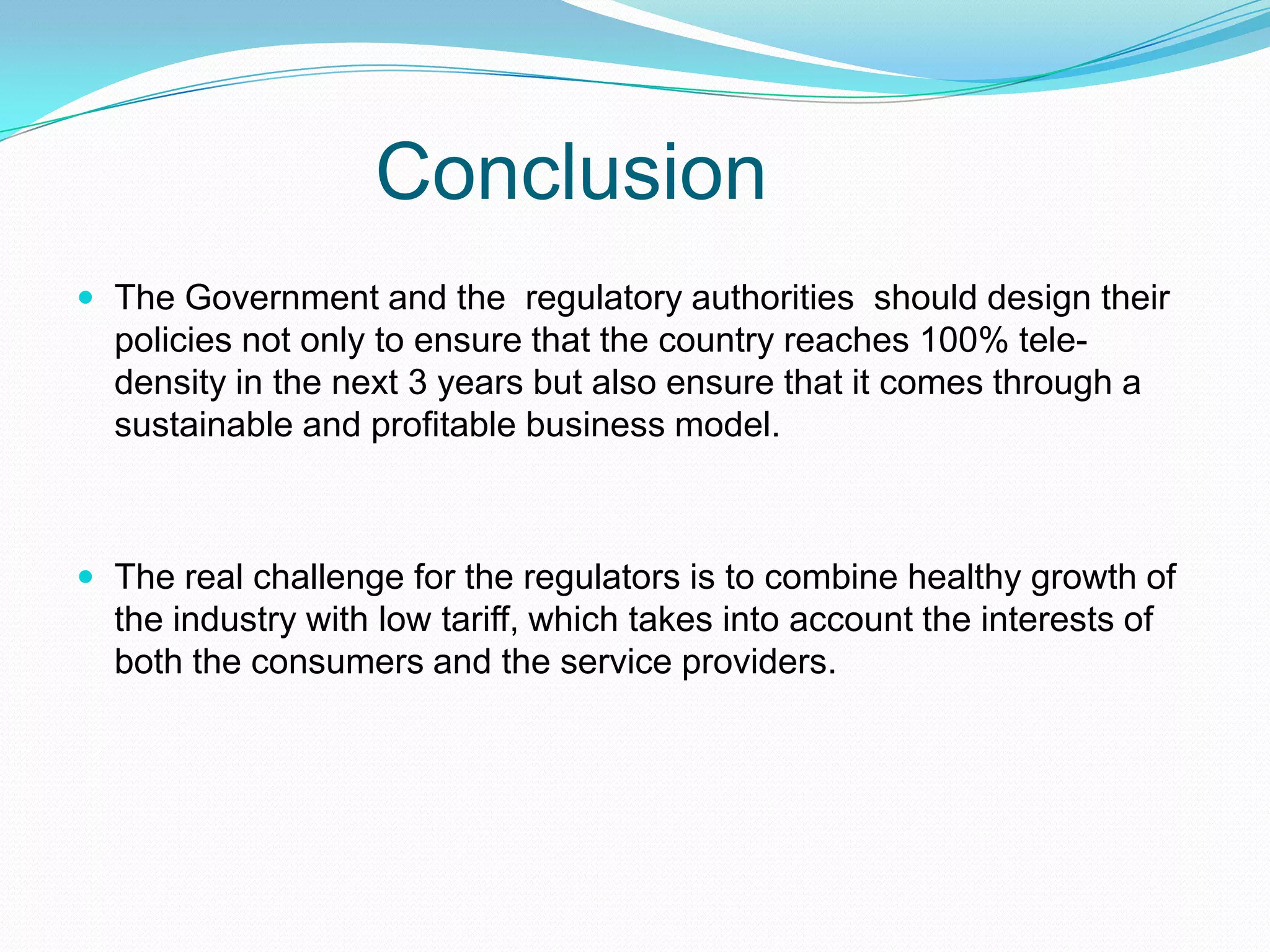
    ConclusionThe Government andthe regulatory authorities should design their policies not only to ensure that the country reaches 100% tele-density in the next 3 years but also ensure that it comes through a sustainable and profitable business model.The real challenge for the regulators is to combine healthy growth of the industry with low tariff, which takes into account the interests of both the consumers and the service providers.
  • 44.