Electrical Power Generation with
Himalayan Mud Soil using a Microbial
Fuel Cell
Debajyoti Bose M-Tech Renewable energy
Objectives of this Research Work
• Study the sub-Himalayan soil available in Dehradun with a microbial fuel cell
and see if it is capable of producing any power
• Observe and record if any power is produced, the peak power and when it
starts to drop
• Adding nutrients and secondary chemicals (example: sodium acetate) to soil
and check how it affects the microbial growth (positively or negatively)
• Speculate the possibility of scaling up the present system in an efficient
manner which can then be sold to villagers at an easily affordable price and
they can power their own small scale utility devices just by using the local soil
Introduction to Electrogenic Bacteria
From the top of the Himalayan Mountains to the bottom of the ocean, these two
types of microbes exhibit truly remarkable abilities:
1. Shewanella: Due to their unique ability to expel electrons to compounds outside their bodies,
Shewanella can metabolize a variety of substances and link together through conductive
appendages, transferring electrons to their neighbors. They can even metabolize toxic compounds
containing radioactive Uranium.
2. Geobacter: Geobacter species have the ability to metabolize iron compounds and use them in a
way similar to the way humans respire oxygen, thus liberating electrons during the process.
“This is accomplished by using MFCs that use microbes from the soil to generate electricity. Among
these diverse communities of microbes are particular species with the unique ability to release
electrons outside their own bodies as part of their natural respiration. ”
Introduction to Fuel Cells
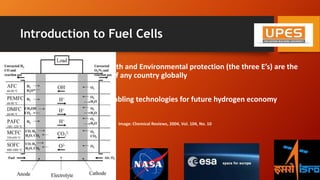
• Energy security, Economic growth and Environmental protection (the three E’s) are the
national energy policy drivers of any country globally
• Fuel cells are one of the key enabling technologies for future hydrogen economy
Image: Chemical Reviews, 2004, Vol. 104, No. 10
Fuel Cells: Mechanism
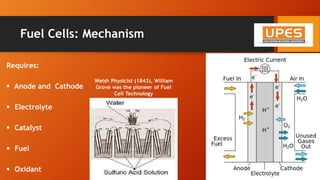
Requires:
 Anode and Cathode
 Electrolyte
 Catalyst
 Fuel
 Oxidant
Welsh Physicist (1843), William
Grove was the pioneer of Fuel
Cell Technology
Microbial Fuel Cells (MFC): Scope
• Primitive Life forms: Cyanobacteria and Early Life
“Topsoil is packed with bacteria that generate electricity when placed in a microbial
fuel cell. Because such bacteria-laden soil is found almost everywhere on Earth,
microbial fuel cells can make clean, renewable electricity nearly anyplace around
the globe.”
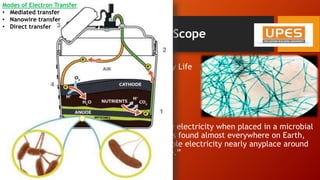
Modes of Electron Transfer
• Mediated transfer
• Nanowire transfer
• Direct transfer
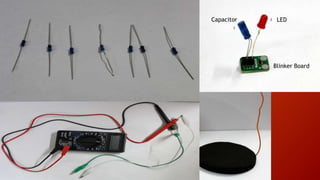
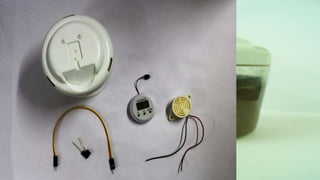
Methodology
LED
Blinker Board
Capacitor
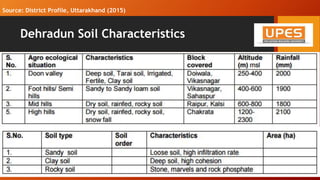
Dehradun Soil Characteristics
Source: District Profile, Uttarakhand (2015)
Methodology (Continued)
1. Study the Dehradun soil with a microbial fuel cell and see if it is capable of
producing any power
2. Observe and record
V= I.R (Ohm’s Law)
P = V.I
P = V2/R
NAME UPES, BIDHOLI
TYPE LOCALITY
LATITUDE 30.3165
LONGITUDE 78.0322
STATE UTTARAKHAND
DISTRICT DEHRADUN
FOR SAMPLE BELOW ANODE:
6CM×6CM×2CM (= 83.402gm)
FOR SAMPLE BELOW CATHODE AND ABOVE ANODE(ELECTROLYTE) :
6CM×6CM×3CM (=91.407gm)
Results and Discussions
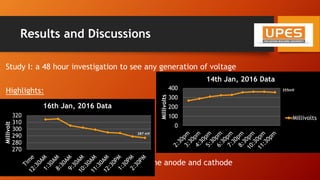
Study I: a 48 hour investigation to see any generation of voltage
Highlights:
Peak Voltage= 361mV
Ambient Temp. = 19°C
Kept in Open Circuit
Deduction:
Soil does act as an electrolyte between the anode and cathode
0
100
200
300
400
Millivolts
14th Jan, 2016 Data
Millivolts
355mV
270
280
290
300
310
320
Millivolt
16th Jan, 2016 Data
287 mV
Other Studies for Voltage Generation
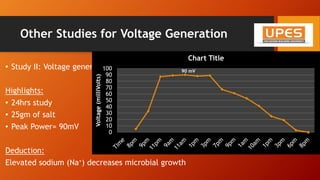
• Study II: Voltage generation with Salt (NaCl)
Highlights:
• 24hrs study
• 25gm of salt
• Peak Power= 90mV
Deduction:
Elevated sodium (Na+) decreases microbial growth
0
10
20
30
40
50
60
70
80
90
100
Voltage(milliVolts)
Chart Title
90 mV
Other Studies for Voltage Generation
• Study III: With Sodium Acetate (CH₃COONa)
Highlights:
72 hour study
Two samples each with 25gm acetate solution
Peak Power (I)= 83mV
Peak Power (II)= 119mV
Deduction:
Microbes producing power in the range of millivolts (compared to one study in Boston [1])
Shows the soil microbes here generate a greater potential between the electrodes
0
20
40
60
80
100
120
140
Resitance
(ohms)
47 100 220 470 1000 2200 4700
VoltagesGenerated(mV)
Voltage vs. Resistance (CH₃COONa in MFC)
Sample 1
Sample 2
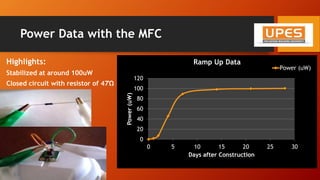
Power Data with the MFC
Highlights:
Stabilized at around 100uW
Closed circuit with resistor of 47Ώ
0
20
40
60
80
100
120
0 5 10 15 20 25 30
Power(uW)
Days after Construction
Ramp Up Data
Power (uW)
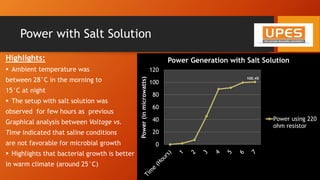
Power with Salt Solution
Highlights:
 Ambient temperature was
between 28°C in the morning to
15°C at night
 The setup with salt solution was
observed for few hours as previous
Graphical analysis between Voltage vs.
Time indicated that saline conditions
are not favorable for microbial growth
 Highlights that bacterial growth is better
in warm climate (around 25°C)
0
20
40
60
80
100
120
Power(inmicrowatts)
Power Generation with Salt Solution
Power using 220
ohm resistor
100.45
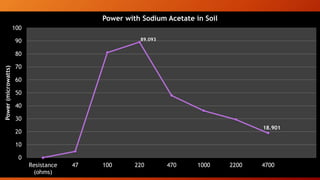
Power with Sodium Acetate
Interesting Data Achieved:
• But time limitations discontinued the work
• Peak value of 89uW
• Power production started dropping all the way up to 18uW
• We deduce that Himalayan soil or simply soil microbes in this region do not
consume acetate the way some literature suggested soil microbes in the United
Sates do
• And that further contributes to soil characterization and indeed the vegetation
that these soil structures support
0
10
20
30
40
50
60
70
80
90
100
Resistance
(ohms)
47 100 220 470 1000 2200 4700
Power(microwatts)
Power with Sodium Acetate in Soil
18.901
89.093
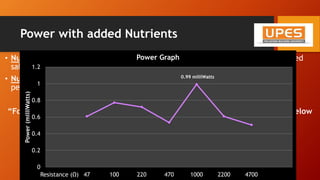
Power with added Nutrients
• Nutrient 1 (mixture): water, tomato paste (34.5%), sugar, liquid glucose, iodized
salt, thickener (INS415), onion, garlic, spices and condiments
• Nutrient 2 (mixture): water, tomato paste (34%), sugar, edible common salt,
permitted acid (ins260), permitted emulsifiers and stabilizer (ins1422, ins415)
“For the anode, the soil sample was mixed with Nutrient 1 and the sample below
cathode was mixed with Nutrient 2”
0
0.2
0.4
0.6
0.8
1
1.2
Resistance (Ω) 47 100 220 470 1000 2200 4700
Power(milliWatts)
Power Graph
0.99 milliWatts
0
0.5
1
1.5
2
2.5
3
3.5
4
Resistance
(Ω)
47 100 220 470 1000 2200 4700
ParametersforVandI
V-I characteristics vs. Resistance
Voltage (Volts)
Current (milliamps)
0
0.2
0.4
0.6
0.8
1
1.2
1.4
1.6
1.8
Resistance
(Ω)
47 100 220 470 1000 2200 4700
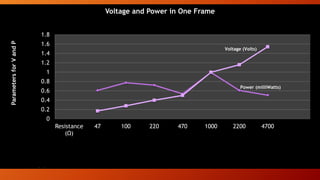
ParametersforVandP Voltage and Power in One Frame
Voltage (Volts)
Power (milliWatts)
Highlights and Deductions
• Voltage generated across the terminals increases rapidly up to 1.54 Volts
• Peak power produced by the system in two weeks’ time is 0.99 milliwatts
• Power value fluctuates because different resistors are used to record the voltage which then fed into
the equation: P= V2/R gives the power produced
• The Microbial fuel cell generates DC or direct current, and with increasing resistance the value of
Power produced goes down as both are inversely related to each other
“Microbial Fuel Cell demonstrates the capability of the soil microbes to produce voltage in a
higher range and if this is allowed to continue (say for a month), there can be some
remarkable current produced from the system which we can then speculate to help
run/charge less energy intensive devices in rural areas where electricity is still not
available.”
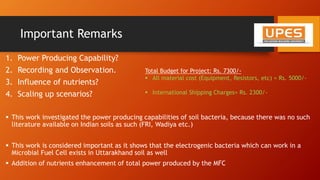
Important Remarks
1. Power Producing Capability?
2. Recording and Observation.
3. Influence of nutrients?
4. Scaling up scenarios?
 This work investigated the power producing capabilities of soil bacteria, because there was no such
literature available on Indian soils as such (FRI, Wadiya etc.)
 This work is considered important as it shows that the electrogenic bacteria which can work in a
Microbial Fuel Cell exists in Uttarakhand soil as well
 Addition of nutrients enhancement of total power produced by the MFC
Total Budget for Project: Rs. 7300/-
 All material cost (Equipment, Resistors, etc) = Rs. 5000/-
 International Shipping Charges= Rs. 2300/-
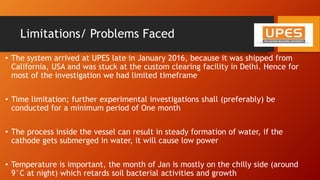
Limitations/ Problems Faced
• The system arrived at UPES late in January 2016, because it was shipped from
California, USA and was stuck at the custom clearing facility in Delhi. Hence for
most of the investigation we had limited timeframe
• Time limitation; further experimental investigations shall (preferably) be
conducted for a minimum period of One month
• The process inside the vessel can result in steady formation of water, if the
cathode gets submerged in water, it will cause low power
• Temperature is important, the month of Jan is mostly on the chilly side (around
9°C at night) which retards soil bacterial activities and growth
Precautions
• Large air bubbles should not be present inside the system, in the soil
• The soil preparation is a very important step, soil should be saturated but not
soupy, also it should be homogenous and not too dry
• All connections to the Hacker Board (LED, Capacitor, etc) should be tight
• There should be at least 3 cm of soil between the anode and cathode, the more
soil added; the greater will be the voltage, as present experimental setup is not
particularly big to handle larger volumes
• In the case when electronics (LED, Capacitor etc.) are not working, the checking of
the MFC from time to time can be done by unplugging the cathode and anode from
Blinker board and connecting the leads of a Multimeter to the titanium wires of
cathode and anode; 0.35V- we can infer that the electronics is affected
• Starting the initial process takes a lot of time (3-7 days), but once a good microbial
community is established, the system works well
Ending on a Positive Note
• The system we have used is manufactured by Keegotech in California, USA
• Through our investigation we have opened a plethora of possibilities to experiment
and collect more data about the soil in the Himalayan ranges of Uttarakhand
• The power of the MFC can be increased by putting the MFC (stacked approach)
• Renewable and clean forms of energy are one of society's greatest needs
• The direct conversion of organic matter to electricity using bacteria is possible in
MFC; use of compost is a future prospect
• Expensive and toxic chemicals were not needed for mediated electron transfer
• Such technology has the possibility to be used even for rural and urban waste
management which includes cleaning of river, production of electricity
simultaneously
Worldwide Developments (At Present)
• At Penn State University, Prof. Bruce Logan, one of the most eminent name in MFC research is
working on developing MFCs that can generated electricity while accomplishing wastewater
treatment(www.microbialfuelcell.org)
• In a project supported by the National Science Foundation (NSF), they are researching methods
to increase power generation from MFCs while at the same time recovering more of the energy
as electricity
• A study conducted by Prof. J. Li, Steven Institute of Technology, New Jersey observed the
relationship between organic matter and electrical capacity of MFC fuelled by a vermicompost
sample
• Prof. James Karz, Clarkson Univ., NY, The reduction of peroxide in dichloromethane, and the
oxidation of glucose in aqueous solution, bio-electro-catalyzed by the electrode, enabled
designing a liquid-liquid interface microbial fuel cell using peroxide and glucose as cathodic and
anodic substrates respectively
THANK YOU !!!
DEBAJYOTI BOSE (R102224007)
M TECH RENEWABLE ENERGY ENGINEERING
Acknowledgements:
Department of Chemistry for allowing this investigation
Department of Electrical, Power & Energy for support

Microbial Fuel Cell Applications in Dehradun

  • 1.
    Electrical Power Generationwith Himalayan Mud Soil using a Microbial Fuel Cell Debajyoti Bose M-Tech Renewable energy
  • 2.
    Objectives of thisResearch Work • Study the sub-Himalayan soil available in Dehradun with a microbial fuel cell and see if it is capable of producing any power • Observe and record if any power is produced, the peak power and when it starts to drop • Adding nutrients and secondary chemicals (example: sodium acetate) to soil and check how it affects the microbial growth (positively or negatively) • Speculate the possibility of scaling up the present system in an efficient manner which can then be sold to villagers at an easily affordable price and they can power their own small scale utility devices just by using the local soil
  • 3.
    Introduction to ElectrogenicBacteria From the top of the Himalayan Mountains to the bottom of the ocean, these two types of microbes exhibit truly remarkable abilities: 1. Shewanella: Due to their unique ability to expel electrons to compounds outside their bodies, Shewanella can metabolize a variety of substances and link together through conductive appendages, transferring electrons to their neighbors. They can even metabolize toxic compounds containing radioactive Uranium. 2. Geobacter: Geobacter species have the ability to metabolize iron compounds and use them in a way similar to the way humans respire oxygen, thus liberating electrons during the process. “This is accomplished by using MFCs that use microbes from the soil to generate electricity. Among these diverse communities of microbes are particular species with the unique ability to release electrons outside their own bodies as part of their natural respiration. ”
  • 4.
    Introduction to FuelCells • Energy security, Economic growth and Environmental protection (the three E’s) are the national energy policy drivers of any country globally • Fuel cells are one of the key enabling technologies for future hydrogen economy Image: Chemical Reviews, 2004, Vol. 104, No. 10
  • 5.
    Fuel Cells: Mechanism Requires: Anode and Cathode  Electrolyte  Catalyst  Fuel  Oxidant Welsh Physicist (1843), William Grove was the pioneer of Fuel Cell Technology
  • 6.
    Microbial Fuel Cells(MFC): Scope • Primitive Life forms: Cyanobacteria and Early Life “Topsoil is packed with bacteria that generate electricity when placed in a microbial fuel cell. Because such bacteria-laden soil is found almost everywhere on Earth, microbial fuel cells can make clean, renewable electricity nearly anyplace around the globe.” Modes of Electron Transfer • Mediated transfer • Nanowire transfer • Direct transfer
  • 7.
  • 9.
    Dehradun Soil Characteristics Source:District Profile, Uttarakhand (2015)
  • 10.
    Methodology (Continued) 1. Studythe Dehradun soil with a microbial fuel cell and see if it is capable of producing any power 2. Observe and record V= I.R (Ohm’s Law) P = V.I P = V2/R NAME UPES, BIDHOLI TYPE LOCALITY LATITUDE 30.3165 LONGITUDE 78.0322 STATE UTTARAKHAND DISTRICT DEHRADUN FOR SAMPLE BELOW ANODE: 6CM×6CM×2CM (= 83.402gm) FOR SAMPLE BELOW CATHODE AND ABOVE ANODE(ELECTROLYTE) : 6CM×6CM×3CM (=91.407gm)
  • 11.
    Results and Discussions StudyI: a 48 hour investigation to see any generation of voltage Highlights: Peak Voltage= 361mV Ambient Temp. = 19°C Kept in Open Circuit Deduction: Soil does act as an electrolyte between the anode and cathode 0 100 200 300 400 Millivolts 14th Jan, 2016 Data Millivolts 355mV 270 280 290 300 310 320 Millivolt 16th Jan, 2016 Data 287 mV
  • 12.
    Other Studies forVoltage Generation • Study II: Voltage generation with Salt (NaCl) Highlights: • 24hrs study • 25gm of salt • Peak Power= 90mV Deduction: Elevated sodium (Na+) decreases microbial growth 0 10 20 30 40 50 60 70 80 90 100 Voltage(milliVolts) Chart Title 90 mV
  • 13.
    Other Studies forVoltage Generation • Study III: With Sodium Acetate (CH₃COONa) Highlights: 72 hour study Two samples each with 25gm acetate solution Peak Power (I)= 83mV Peak Power (II)= 119mV Deduction: Microbes producing power in the range of millivolts (compared to one study in Boston [1]) Shows the soil microbes here generate a greater potential between the electrodes 0 20 40 60 80 100 120 140 Resitance (ohms) 47 100 220 470 1000 2200 4700 VoltagesGenerated(mV) Voltage vs. Resistance (CH₃COONa in MFC) Sample 1 Sample 2
  • 14.
    Power Data withthe MFC Highlights: Stabilized at around 100uW Closed circuit with resistor of 47Ώ 0 20 40 60 80 100 120 0 5 10 15 20 25 30 Power(uW) Days after Construction Ramp Up Data Power (uW)
  • 15.
    Power with SaltSolution Highlights:  Ambient temperature was between 28°C in the morning to 15°C at night  The setup with salt solution was observed for few hours as previous Graphical analysis between Voltage vs. Time indicated that saline conditions are not favorable for microbial growth  Highlights that bacterial growth is better in warm climate (around 25°C) 0 20 40 60 80 100 120 Power(inmicrowatts) Power Generation with Salt Solution Power using 220 ohm resistor 100.45
  • 16.
    Power with SodiumAcetate Interesting Data Achieved: • But time limitations discontinued the work • Peak value of 89uW • Power production started dropping all the way up to 18uW • We deduce that Himalayan soil or simply soil microbes in this region do not consume acetate the way some literature suggested soil microbes in the United Sates do • And that further contributes to soil characterization and indeed the vegetation that these soil structures support 0 10 20 30 40 50 60 70 80 90 100 Resistance (ohms) 47 100 220 470 1000 2200 4700 Power(microwatts) Power with Sodium Acetate in Soil 18.901 89.093
  • 17.
    Power with addedNutrients • Nutrient 1 (mixture): water, tomato paste (34.5%), sugar, liquid glucose, iodized salt, thickener (INS415), onion, garlic, spices and condiments • Nutrient 2 (mixture): water, tomato paste (34%), sugar, edible common salt, permitted acid (ins260), permitted emulsifiers and stabilizer (ins1422, ins415) “For the anode, the soil sample was mixed with Nutrient 1 and the sample below cathode was mixed with Nutrient 2” 0 0.2 0.4 0.6 0.8 1 1.2 Resistance (Ω) 47 100 220 470 1000 2200 4700 Power(milliWatts) Power Graph 0.99 milliWatts
  • 18.
    0 0.5 1 1.5 2 2.5 3 3.5 4 Resistance (Ω) 47 100 220470 1000 2200 4700 ParametersforVandI V-I characteristics vs. Resistance Voltage (Volts) Current (milliamps) 0 0.2 0.4 0.6 0.8 1 1.2 1.4 1.6 1.8 Resistance (Ω) 47 100 220 470 1000 2200 4700 ParametersforVandP Voltage and Power in One Frame Voltage (Volts) Power (milliWatts)
  • 19.
    Highlights and Deductions •Voltage generated across the terminals increases rapidly up to 1.54 Volts • Peak power produced by the system in two weeks’ time is 0.99 milliwatts • Power value fluctuates because different resistors are used to record the voltage which then fed into the equation: P= V2/R gives the power produced • The Microbial fuel cell generates DC or direct current, and with increasing resistance the value of Power produced goes down as both are inversely related to each other “Microbial Fuel Cell demonstrates the capability of the soil microbes to produce voltage in a higher range and if this is allowed to continue (say for a month), there can be some remarkable current produced from the system which we can then speculate to help run/charge less energy intensive devices in rural areas where electricity is still not available.”
  • 20.
    Important Remarks 1. PowerProducing Capability? 2. Recording and Observation. 3. Influence of nutrients? 4. Scaling up scenarios?  This work investigated the power producing capabilities of soil bacteria, because there was no such literature available on Indian soils as such (FRI, Wadiya etc.)  This work is considered important as it shows that the electrogenic bacteria which can work in a Microbial Fuel Cell exists in Uttarakhand soil as well  Addition of nutrients enhancement of total power produced by the MFC Total Budget for Project: Rs. 7300/-  All material cost (Equipment, Resistors, etc) = Rs. 5000/-  International Shipping Charges= Rs. 2300/-
  • 21.
    Limitations/ Problems Faced •The system arrived at UPES late in January 2016, because it was shipped from California, USA and was stuck at the custom clearing facility in Delhi. Hence for most of the investigation we had limited timeframe • Time limitation; further experimental investigations shall (preferably) be conducted for a minimum period of One month • The process inside the vessel can result in steady formation of water, if the cathode gets submerged in water, it will cause low power • Temperature is important, the month of Jan is mostly on the chilly side (around 9°C at night) which retards soil bacterial activities and growth
  • 22.
    Precautions • Large airbubbles should not be present inside the system, in the soil • The soil preparation is a very important step, soil should be saturated but not soupy, also it should be homogenous and not too dry • All connections to the Hacker Board (LED, Capacitor, etc) should be tight • There should be at least 3 cm of soil between the anode and cathode, the more soil added; the greater will be the voltage, as present experimental setup is not particularly big to handle larger volumes • In the case when electronics (LED, Capacitor etc.) are not working, the checking of the MFC from time to time can be done by unplugging the cathode and anode from Blinker board and connecting the leads of a Multimeter to the titanium wires of cathode and anode; 0.35V- we can infer that the electronics is affected • Starting the initial process takes a lot of time (3-7 days), but once a good microbial community is established, the system works well
  • 23.
    Ending on aPositive Note • The system we have used is manufactured by Keegotech in California, USA • Through our investigation we have opened a plethora of possibilities to experiment and collect more data about the soil in the Himalayan ranges of Uttarakhand • The power of the MFC can be increased by putting the MFC (stacked approach) • Renewable and clean forms of energy are one of society's greatest needs • The direct conversion of organic matter to electricity using bacteria is possible in MFC; use of compost is a future prospect • Expensive and toxic chemicals were not needed for mediated electron transfer • Such technology has the possibility to be used even for rural and urban waste management which includes cleaning of river, production of electricity simultaneously
  • 24.
    Worldwide Developments (AtPresent) • At Penn State University, Prof. Bruce Logan, one of the most eminent name in MFC research is working on developing MFCs that can generated electricity while accomplishing wastewater treatment(www.microbialfuelcell.org) • In a project supported by the National Science Foundation (NSF), they are researching methods to increase power generation from MFCs while at the same time recovering more of the energy as electricity • A study conducted by Prof. J. Li, Steven Institute of Technology, New Jersey observed the relationship between organic matter and electrical capacity of MFC fuelled by a vermicompost sample • Prof. James Karz, Clarkson Univ., NY, The reduction of peroxide in dichloromethane, and the oxidation of glucose in aqueous solution, bio-electro-catalyzed by the electrode, enabled designing a liquid-liquid interface microbial fuel cell using peroxide and glucose as cathodic and anodic substrates respectively
  • 25.
    THANK YOU !!! DEBAJYOTIBOSE (R102224007) M TECH RENEWABLE ENERGY ENGINEERING Acknowledgements: Department of Chemistry for allowing this investigation Department of Electrical, Power & Energy for support