FINANCIAL
SYSTEM IN INDIA
 FINANCIAL SYSTEM:
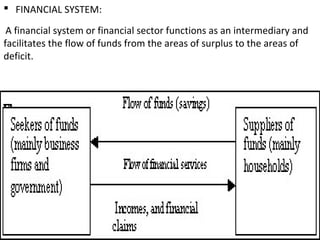
A financial system or financial sector functions as an intermediary and
facilitates the flow of funds from the areas of surplus to the areas of
deficit.
 Non-banking Financial Institutions provide loans and hire-purchase
finance, mostly for retail assets and are regulated by RBI
 Insurance sector in India has been traditionally dominated by state
owned Life Insurance Corporation and General Insurance
Corporation and its four subsidiaries.
 RBI also regulates foreign exchange under the Foreign Exchange
Management Act (FERA).
 Securities and Exchange Board of India (SEBI) established under the
Securities and Exchange aboard of India Act, 1992 is the regulatory
authority for capital markets in India
 India has a financial system that is regulated by independent
regulators in the sectors of banking, insurance, capital markets,
competition and various services sectors
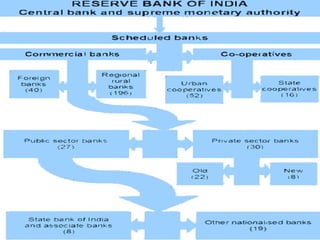
 Reserve bank of India (RBI) established in 1935 is the Central bank.
Role/ Functions of Financial System:
* It serves as a link between savers and investors.
* It assists in the selection of the projects to be financed and also
reviews the performance of such projects periodically.
* It provides payment mechanism for exchange of goods and services.
* It provides a mechanism for the transfer of resources across
geographic boundaries.
* It provides a mechanism for managing and controlling the risk
involved in mobilizing savings and allocating credit.
* It promotes the process of capital formation by bringing together the
supply of saving and the demand for investible funds.
* It helps in lowering the cost of transaction and increase returns.
Reduce cost motives people to save more.
* It provides you detailed information to the operators/ players in the
market such as individuals, business houses, Governments etc.
Financial institutions:
Financial institutions are the intermediaries who facilitates smooth
functioning of the financial system by making investors and borrowers
meet.
They mobilize savings of the surplus units and allocate them in
productive activities promising a better rate of return.
Financial institutions also provide services to entities seeking advises on
various issues ranging from restructuring to diversification plans.
Financial institutions act as financial intermediaries because they act as
middlemen between savers and borrowers
Were these financial institutions may be of Banking or Non-Banking
institutions.
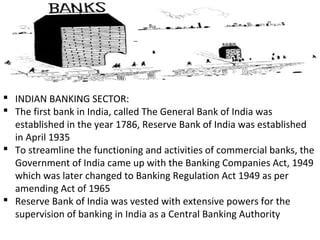
 INDIAN BANKING SECTOR:
 The first bank in India, called The General Bank of India was
established in the year 1786, Reserve Bank of India was established
in April 1935
 To streamline the functioning and activities of commercial banks, the
Government of India came up with the Banking Companies Act, 1949
which was later changed to Banking Regulation Act 1949 as per
amending Act of 1965
 Reserve Bank of India was vested with extensive powers for the
supervision of banking in India as a Central Banking Authority
Role Of RBI
• Monetary Authority
• Issuer of Currency
• Banker and Debt Manager to Government
• Banker to Banks
• Regulator of the Banking System
• Manager of Foreign Exchange
• Regulator and Supervisor of the Payment and
Settlement Systems
• Maintaining Financial Stability
• Developmental Role
Nationalization
On 19th July, 1969, major process of nationalization was carried out. At
the same time 14 major Indian commercial banks of the country were
nationalized. In 1980, another six banks were nationalized, and thus
raising the number of nationalized banks to 20
Seven more banks were nationalized with deposits over 200 Crores. Till
the year 1980 approximately 80% of the banking segment in India was
under government’s ownership
the Banking Regulation Act was amended in 1993 and thus the gates for
the new private sector banks were opened
The following are the major steps taken by the Government of India to
Regulate Banking
institutions in the country:-
1949 : Enactment of Banking Regulation Act.
1955 : Nationalization of State Bank of India.
1959 : Nationalization of SBI subsidiaries.
1961 : Insurance cover extended to deposits.
1969 : Nationalization of 14 major Banks.
1971 : Creation of credit guarantee corporation.
1975 : Creation of regional rural banks.
1980 : Nationalization of seven banks with deposits over 200 Crores
 Non-Banking Financial Company (NBFC)
 Difference between banks & NBFCs
 Every NBFC should be registered with RBI
 Different types/categories of NBFCs registered with RBI
• Asset Finance Company (AFC) :
• Investment Company (IC)
• Loan Company (LC)
• Infrastructure Finance Company (IFC)
• Systemically Important Core Investment Company
• Infrastructure Debt Fund:
• Non-Banking Financial Company - Micro Finance Institution
• Non-Banking Financial Company – Factors (NBFC-Factors)
Financial Markets:
Finance is a prerequisite for modern business and financial institutions
play a vital role in economic system.
It's through financial markets the financial system of an economy works.
The main functions of financial markets are:
1. to facilitate creation and allocation of credit and liquidity;
2. to serve as intermediaries for mobilization of savings;
3. to assist process of balanced economic growth;
4. to provide financial convenience
Financial Instruments
Another important constituent of financial system is financial
instruments.
They represent a claim against the future income and wealth of others.
It will be a claim against a person or an institutions, for the payment of
the some of the money at a specified future date.
Financial Services:
Efficiency of emerging financial system largely depends upon the quality
and variety of financial services provided by financial intermediaries.
The term financial services can be defined as "activites, benefits and
satisfaction connected with sale of money, that offers to users and
customers, financial related value".
Pre-reforms Phase
Until the early 1990s, the role of the financial system in India was primarily restricted to the
function of channeling resources from the surplus to deficit sectors. Whereas the financial
system performed this role reasonably well, its operations came to be marked by some serious
deficiencies over the years. The banking sector suffered from lack of competition, low capital
base, low Productivity and high intermediation cost. After the nationalization of large banks in
1969 and 1980, the Government-owned banks dominated the banking sector. The role of
technology was minimal and the quality of service was not given adequate importance. Banks
also did not follow proper risk management systems and the prudential standards were weak.
All these resulted in poor asset quality and low profitability. Among non-banking financial
intermediaries, development finance institutions (DFIs) operated in an over-protected
environment with most of the funding coming from assured sources at concessional terms. In
the insurance sector, there was little competition. The mutual fund industry also suffered from
lack of competition and was dominated for long by one institution, viz., the Unit Trust of India.
Non-banking financial companies (NBFCs) grew rapidly, but there was no regulation of their
asset side. Financial markets were characterized by control over pricing of financial assets,
barriers to entry, high transaction costs and restrictions on movement of funds/participants
between the market segments. This apart from inhibiting the development of the markets also
affected their efficiency.
Financial Sector Reforms
• The far-reaching changes in the Indian economy
since liberalization have had a deep impact on the
Indian financial services sector. Financial sector
reforms that were initiated by the government
since the early ‘90s have been to meet the
challenges of a complex financial architecture. This
has ensured that the new emerging face of the
Indian financial sector will culminate in a strong,
transparent and resilient system.
Broadly, financial sector reforms can be categorized in two
phases.
The first phase of economic reforms that started in 1985
focused on increasing productivity, new technology import
and effective use of human resources
the second phase, beginning in 1991-92, the government
aimed at reducing fiscal deficit by opening the economy to
foreign investments
Financial sector reforms during this period focused on
modification of the policy framework, improvement in
financial health of the entities and creation of a competitive
environment.
These reforms targeted three interrelated issues viz.
(i)strengthening the foundations of the banking system;
(ii)streamlining procedures, upgrading technology and human
resource development
(iii)structural changes in the system
Raising the Foreign Direct Investment (FDI) cap in the insurance and
pension sector. This will lead to foreign players being able to acquire a
larger share in their joint ventures that are already operating in the
country.
The revised Companies Bill is now just a small step away from being
law.
steps has been taken in the form of allowing new banks to set up shop.
Private corporates, public sector entities and Non Banking Finance
Companies with a strong track record can now apply to set up new
banks and the Reserve bank of India will consider these applications in
the coming months

Indian Financial System

  • 1.
  • 2.
     FINANCIAL SYSTEM: Afinancial system or financial sector functions as an intermediary and facilitates the flow of funds from the areas of surplus to the areas of deficit.
  • 3.
     Non-banking FinancialInstitutions provide loans and hire-purchase finance, mostly for retail assets and are regulated by RBI  Insurance sector in India has been traditionally dominated by state owned Life Insurance Corporation and General Insurance Corporation and its four subsidiaries.  RBI also regulates foreign exchange under the Foreign Exchange Management Act (FERA).  Securities and Exchange Board of India (SEBI) established under the Securities and Exchange aboard of India Act, 1992 is the regulatory authority for capital markets in India  India has a financial system that is regulated by independent regulators in the sectors of banking, insurance, capital markets, competition and various services sectors  Reserve bank of India (RBI) established in 1935 is the Central bank.
  • 4.
    Role/ Functions ofFinancial System: * It serves as a link between savers and investors. * It assists in the selection of the projects to be financed and also reviews the performance of such projects periodically. * It provides payment mechanism for exchange of goods and services. * It provides a mechanism for the transfer of resources across geographic boundaries. * It provides a mechanism for managing and controlling the risk involved in mobilizing savings and allocating credit. * It promotes the process of capital formation by bringing together the supply of saving and the demand for investible funds. * It helps in lowering the cost of transaction and increase returns. Reduce cost motives people to save more. * It provides you detailed information to the operators/ players in the market such as individuals, business houses, Governments etc.
  • 5.
    Financial institutions: Financial institutionsare the intermediaries who facilitates smooth functioning of the financial system by making investors and borrowers meet. They mobilize savings of the surplus units and allocate them in productive activities promising a better rate of return. Financial institutions also provide services to entities seeking advises on various issues ranging from restructuring to diversification plans. Financial institutions act as financial intermediaries because they act as middlemen between savers and borrowers Were these financial institutions may be of Banking or Non-Banking institutions.
  • 6.
     INDIAN BANKINGSECTOR:  The first bank in India, called The General Bank of India was established in the year 1786, Reserve Bank of India was established in April 1935  To streamline the functioning and activities of commercial banks, the Government of India came up with the Banking Companies Act, 1949 which was later changed to Banking Regulation Act 1949 as per amending Act of 1965  Reserve Bank of India was vested with extensive powers for the supervision of banking in India as a Central Banking Authority
  • 7.
    Role Of RBI •Monetary Authority • Issuer of Currency • Banker and Debt Manager to Government • Banker to Banks • Regulator of the Banking System • Manager of Foreign Exchange • Regulator and Supervisor of the Payment and Settlement Systems • Maintaining Financial Stability • Developmental Role
  • 9.
    Nationalization On 19th July,1969, major process of nationalization was carried out. At the same time 14 major Indian commercial banks of the country were nationalized. In 1980, another six banks were nationalized, and thus raising the number of nationalized banks to 20 Seven more banks were nationalized with deposits over 200 Crores. Till the year 1980 approximately 80% of the banking segment in India was under government’s ownership the Banking Regulation Act was amended in 1993 and thus the gates for the new private sector banks were opened
  • 10.
    The following arethe major steps taken by the Government of India to Regulate Banking institutions in the country:- 1949 : Enactment of Banking Regulation Act. 1955 : Nationalization of State Bank of India. 1959 : Nationalization of SBI subsidiaries. 1961 : Insurance cover extended to deposits. 1969 : Nationalization of 14 major Banks. 1971 : Creation of credit guarantee corporation. 1975 : Creation of regional rural banks. 1980 : Nationalization of seven banks with deposits over 200 Crores
  • 11.
     Non-Banking FinancialCompany (NBFC)  Difference between banks & NBFCs  Every NBFC should be registered with RBI  Different types/categories of NBFCs registered with RBI • Asset Finance Company (AFC) : • Investment Company (IC) • Loan Company (LC) • Infrastructure Finance Company (IFC) • Systemically Important Core Investment Company • Infrastructure Debt Fund: • Non-Banking Financial Company - Micro Finance Institution • Non-Banking Financial Company – Factors (NBFC-Factors)
  • 12.
    Financial Markets: Finance isa prerequisite for modern business and financial institutions play a vital role in economic system. It's through financial markets the financial system of an economy works. The main functions of financial markets are: 1. to facilitate creation and allocation of credit and liquidity; 2. to serve as intermediaries for mobilization of savings; 3. to assist process of balanced economic growth; 4. to provide financial convenience
  • 13.
    Financial Instruments Another importantconstituent of financial system is financial instruments. They represent a claim against the future income and wealth of others. It will be a claim against a person or an institutions, for the payment of the some of the money at a specified future date.
  • 14.
    Financial Services: Efficiency ofemerging financial system largely depends upon the quality and variety of financial services provided by financial intermediaries. The term financial services can be defined as "activites, benefits and satisfaction connected with sale of money, that offers to users and customers, financial related value".
  • 15.
    Pre-reforms Phase Until theearly 1990s, the role of the financial system in India was primarily restricted to the function of channeling resources from the surplus to deficit sectors. Whereas the financial system performed this role reasonably well, its operations came to be marked by some serious deficiencies over the years. The banking sector suffered from lack of competition, low capital base, low Productivity and high intermediation cost. After the nationalization of large banks in 1969 and 1980, the Government-owned banks dominated the banking sector. The role of technology was minimal and the quality of service was not given adequate importance. Banks also did not follow proper risk management systems and the prudential standards were weak. All these resulted in poor asset quality and low profitability. Among non-banking financial intermediaries, development finance institutions (DFIs) operated in an over-protected environment with most of the funding coming from assured sources at concessional terms. In the insurance sector, there was little competition. The mutual fund industry also suffered from lack of competition and was dominated for long by one institution, viz., the Unit Trust of India. Non-banking financial companies (NBFCs) grew rapidly, but there was no regulation of their asset side. Financial markets were characterized by control over pricing of financial assets, barriers to entry, high transaction costs and restrictions on movement of funds/participants between the market segments. This apart from inhibiting the development of the markets also affected their efficiency.
  • 16.
    Financial Sector Reforms •The far-reaching changes in the Indian economy since liberalization have had a deep impact on the Indian financial services sector. Financial sector reforms that were initiated by the government since the early ‘90s have been to meet the challenges of a complex financial architecture. This has ensured that the new emerging face of the Indian financial sector will culminate in a strong, transparent and resilient system.
  • 17.
    Broadly, financial sectorreforms can be categorized in two phases. The first phase of economic reforms that started in 1985 focused on increasing productivity, new technology import and effective use of human resources the second phase, beginning in 1991-92, the government aimed at reducing fiscal deficit by opening the economy to foreign investments Financial sector reforms during this period focused on modification of the policy framework, improvement in financial health of the entities and creation of a competitive environment.
  • 18.
    These reforms targetedthree interrelated issues viz. (i)strengthening the foundations of the banking system; (ii)streamlining procedures, upgrading technology and human resource development (iii)structural changes in the system
  • 19.
    Raising the ForeignDirect Investment (FDI) cap in the insurance and pension sector. This will lead to foreign players being able to acquire a larger share in their joint ventures that are already operating in the country. The revised Companies Bill is now just a small step away from being law. steps has been taken in the form of allowing new banks to set up shop. Private corporates, public sector entities and Non Banking Finance Companies with a strong track record can now apply to set up new banks and the Reserve bank of India will consider these applications in the coming months