BOMB THREAT A bomb threat is  an effective means of disrupting business.
The problems are intensified when the incident involves an  actual explosive or incendiary device.Although there is no foolproof means of securing a premises against a bomb threat  (or bomb attack), a good security plan, correctly executed,  will enable a business to deal with an incident properly. Bombs and the threat of their use have become the primary  weapon of the terrorist. They are also used as a means of  retaliation by employees with real or fancied grievances, as  well as by criminal extortionists.
Reasons: 1.Political and/or social unrest 2.Labour unrest 37% were preceded by a threatening note, letter, or telephone call to the establishment or individual target.  Financial institutions received some type of threat b4 the incident 72% of the time and commercial/retail establishments  58 % of the time.  Offices were warned 29% of the time, academic facilities 30%, and Residential property owners were warned 18% of the time.
Purpose The caller has definite knowledge or believes that an explosive or incendiary device has been or willbe placed and may want to minimize personal injury or property damage. The caller may be either the person who placed the device or someone else who has become aware of such information The caller wants to create an atmosphere of anxiety and panic which will, in turn, possibly result in a disruption of the normal activities at the facility where the device is purportedly located. Panic  personal injury and property damage ultimate achievement of the caller - Panic
Responding To Bomb Threats   Instruct Employees in what to do if a bomb threat call is received.  A calm response to the bomb threat caller could result in obtaining additional information.  Especially true if the caller wishes to avoid injuries or deaths.  If told that the building is occupied or cannot be evacuated in time, the bomb threat caller may be willing to give more specific information on the bomb’s location, components, or methods of initiation.
If Called – Actions to be performed Remain calm Attempt to keep the caller on the line as long as possible.  Ask him/her to repeat the message.  Record every word spoken by the person and use the telephone bomb threat checklist (Attachment II). *Ask for the exact location where bomb has been or  is going to be planted. *Get as much information as possible about the  caller, e.g., vocal characteristic, race, sex, group  affiliation, why the bomb was placed. *Clues from background noises, which might indicate  caller's identification and location. Immediately after the caller hangs up, report the threat to  911 , your supervisor, and the Emergency Response Coordinator.  *Remain available, as law enforcement personnel will  want to interview you. *Wait for further direction from the Emergency  Response Coordinator.  *Do not spread rumors
Written Received, Perform to be performed Remain calm. Avoid handling it unnecessarily in order to preserve possible fingerprint(s), handwriting or typewriting, paper, and postal marks. These will prove essential in tracing the threat and identifying the writer.  While written messages are usually associated with generalized threats and extortion attempts, a written warning of a specific device may occasionally be received; it should never be ignored. Contact the Emergency Response Coordinator. Wait for further direction from the Emergency Response Coordinator.  Do not spread rumors
Physical Characteristics of Suspicious Packages and Letters   Ticking sound Marked with restrictive endorsements, such as “Personal” or “Confidential” Excessive security material such as masking tape, string, etc. No return address discoloration or odor Excessive weight Oily stains Misspellings of common words Title, but no name Lopsided or uneven envelope Protruding wires or aluminum foil Handwritten or poorly typed addresses Incorrect titles Excessivepostage Foreign Mail, Air mail and Special Delivery Shows a city or state in the postmark that does not match the return address
Suspicious Object or Package Is Discovered   Remain calm. The finder must not disturb or move the suspected object.  Clear all persons from the immediate vicinity.  Call the Emergency Response Coordinator or 911  Retreat to a safe distance and warn others to avoid the area.  Be available to provide the whereabouts of the suspected object to the police. Wait for further direction from the Emergency Response Coordinator.  Do not spread rumors
BOMB THREAT EVACUATION PROCEDURES   The Emergency Response  Coordinator will: Notify  911 -  make a decision to: 1. Ignore the threat 2. Search and Evacuate  3. Evacuate Immediately If Search and Evacuate is warranted: 1.Emergency Response Coordinator  notify by telephone all Assistant Emergency Response Coordinators who in turn contact Floor Monitors within their areas of responsibility. Instructions must be obeyed promptly. 2.  suspicious items reported  3.  Floor Monitors and Facilities Management personnel should check their assigned areas such as restrooms, office areas, stairwells, and other common areas.  4.  Employees should check (SCAN) their immediate work area for any unusual or suspicious items as they leave their workstation.
If a suspicious object/item is located: Clear the area  where the suspicious object is located, and then evacuate the  rest of the building. 1.Employees should take all personal belongings with  them (i.e., car keys, coats, purse, and bags or backpacks). If a  suspect item is found, the employee may not return to the  building until it is found clear.  This may take considerable  time. 2. All employees should exit through a designated  evacuation route that has been checked for any devices, and  proceed to their designated assembly area. 3.Parking lots and garages should be avoided, as they  may contain a vehicle bomb. After the bomb disposal organization has disposed of the  suspicious object or verified that it is harmless, initiate action  to recall evacuees to their offices and work areas.
Types of actions considered essential are   Planning and Inspecting Suspicious Actions Building Service Spaces Stairwells and Restrooms Key Control   After‑Hour Entry
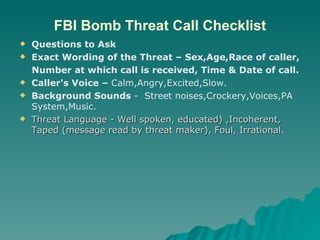
FBI Bomb Threat Call Checklist Questions to Ask Exact Wording of the Threat – Sex,Age,Race of caller, Number at which call is received, Time & Date of call.  Caller's Voice –  Calm,Angry,Excited,Slow. Background Sounds  -  Street noises,Crockery,Voices,PA System,Music. Threat Language - Well spoken, educated) ,Incoherent, Taped (message read by threat maker), Foul, Irrational.

Bomb threat

  • 1.
    BOMB THREAT Abomb threat is an effective means of disrupting business.
  • 2.
    The problems areintensified when the incident involves an actual explosive or incendiary device.Although there is no foolproof means of securing a premises against a bomb threat (or bomb attack), a good security plan, correctly executed, will enable a business to deal with an incident properly. Bombs and the threat of their use have become the primary weapon of the terrorist. They are also used as a means of retaliation by employees with real or fancied grievances, as well as by criminal extortionists.
  • 3.
    Reasons: 1.Political and/orsocial unrest 2.Labour unrest 37% were preceded by a threatening note, letter, or telephone call to the establishment or individual target. Financial institutions received some type of threat b4 the incident 72% of the time and commercial/retail establishments 58 % of the time. Offices were warned 29% of the time, academic facilities 30%, and Residential property owners were warned 18% of the time.
  • 4.
    Purpose The callerhas definite knowledge or believes that an explosive or incendiary device has been or willbe placed and may want to minimize personal injury or property damage. The caller may be either the person who placed the device or someone else who has become aware of such information The caller wants to create an atmosphere of anxiety and panic which will, in turn, possibly result in a disruption of the normal activities at the facility where the device is purportedly located. Panic personal injury and property damage ultimate achievement of the caller - Panic
  • 5.
    Responding To BombThreats Instruct Employees in what to do if a bomb threat call is received. A calm response to the bomb threat caller could result in obtaining additional information. Especially true if the caller wishes to avoid injuries or deaths. If told that the building is occupied or cannot be evacuated in time, the bomb threat caller may be willing to give more specific information on the bomb’s location, components, or methods of initiation.
  • 6.
    If Called –Actions to be performed Remain calm Attempt to keep the caller on the line as long as possible. Ask him/her to repeat the message. Record every word spoken by the person and use the telephone bomb threat checklist (Attachment II). *Ask for the exact location where bomb has been or is going to be planted. *Get as much information as possible about the caller, e.g., vocal characteristic, race, sex, group affiliation, why the bomb was placed. *Clues from background noises, which might indicate caller's identification and location. Immediately after the caller hangs up, report the threat to 911 , your supervisor, and the Emergency Response Coordinator. *Remain available, as law enforcement personnel will want to interview you. *Wait for further direction from the Emergency Response Coordinator. *Do not spread rumors
  • 7.
    Written Received, Performto be performed Remain calm. Avoid handling it unnecessarily in order to preserve possible fingerprint(s), handwriting or typewriting, paper, and postal marks. These will prove essential in tracing the threat and identifying the writer. While written messages are usually associated with generalized threats and extortion attempts, a written warning of a specific device may occasionally be received; it should never be ignored. Contact the Emergency Response Coordinator. Wait for further direction from the Emergency Response Coordinator. Do not spread rumors
  • 8.
    Physical Characteristics ofSuspicious Packages and Letters Ticking sound Marked with restrictive endorsements, such as “Personal” or “Confidential” Excessive security material such as masking tape, string, etc. No return address discoloration or odor Excessive weight Oily stains Misspellings of common words Title, but no name Lopsided or uneven envelope Protruding wires or aluminum foil Handwritten or poorly typed addresses Incorrect titles Excessivepostage Foreign Mail, Air mail and Special Delivery Shows a city or state in the postmark that does not match the return address
  • 9.
    Suspicious Object orPackage Is Discovered Remain calm. The finder must not disturb or move the suspected object. Clear all persons from the immediate vicinity. Call the Emergency Response Coordinator or 911 Retreat to a safe distance and warn others to avoid the area. Be available to provide the whereabouts of the suspected object to the police. Wait for further direction from the Emergency Response Coordinator. Do not spread rumors
  • 10.
    BOMB THREAT EVACUATIONPROCEDURES The Emergency Response Coordinator will: Notify 911 - make a decision to: 1. Ignore the threat 2. Search and Evacuate 3. Evacuate Immediately If Search and Evacuate is warranted: 1.Emergency Response Coordinator notify by telephone all Assistant Emergency Response Coordinators who in turn contact Floor Monitors within their areas of responsibility. Instructions must be obeyed promptly. 2. suspicious items reported 3. Floor Monitors and Facilities Management personnel should check their assigned areas such as restrooms, office areas, stairwells, and other common areas. 4. Employees should check (SCAN) their immediate work area for any unusual or suspicious items as they leave their workstation.
  • 11.
    If a suspiciousobject/item is located: Clear the area where the suspicious object is located, and then evacuate the rest of the building. 1.Employees should take all personal belongings with them (i.e., car keys, coats, purse, and bags or backpacks). If a suspect item is found, the employee may not return to the building until it is found clear. This may take considerable time. 2. All employees should exit through a designated evacuation route that has been checked for any devices, and proceed to their designated assembly area. 3.Parking lots and garages should be avoided, as they may contain a vehicle bomb. After the bomb disposal organization has disposed of the suspicious object or verified that it is harmless, initiate action to recall evacuees to their offices and work areas.
  • 12.
    Types of actionsconsidered essential are Planning and Inspecting Suspicious Actions Building Service Spaces Stairwells and Restrooms Key Control After‑Hour Entry
  • 13.
    FBI Bomb ThreatCall Checklist Questions to Ask Exact Wording of the Threat – Sex,Age,Race of caller, Number at which call is received, Time & Date of call. Caller's Voice – Calm,Angry,Excited,Slow. Background Sounds - Street noises,Crockery,Voices,PA System,Music. Threat Language - Well spoken, educated) ,Incoherent, Taped (message read by threat maker), Foul, Irrational.