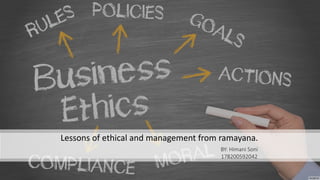
Lessons of ethical and management from ramayana.
BY: Himani Soni
178200592042
What is Ethics
 Ethics, also called moral philosophy, the discipline concerned with what is
morally good and bad, right and wrong. The term is also applied to any
system or theory of moral values or principles.
 Ethics deals with the study and justification of moral beliefs.
Ethics Branches
• Meta ethics:
Meta ethics is one of the
fundamental branches of
philosophy which
examines the nature of
morality in general, and
what justifies moral
judgments.
• Normative ethics:
Normative ethics attempts to
provide a system of
principles, rules and
procedures for determining
what (morally speaking) a
person should do and should
not do.
• Applied ethics:
Applied ethics is the branch
of ethics which investigates
the application of ethical
theories in actual life.
Applied Ethics
• Medical ethics
• Bioethics
• Public sector ethics
• Welfare ethics
• Business ethics
• Decision making ethics
• Legal ethics (justice)
• Media ethics
• Environmental ethics
• Manufacturing ethics
• Computer ethics
• Robot ethics
• Automation ethics
What is Business Ethics?
• Business ethics is the study of proper business policies and practices regarding potentially
controversial issues such as corporate governance, insider trading, bribery, discrimination,
corporate social responsibility and fiduciary responsibilities. Law often guides business ethics,
while other times business ethics provide a basic framework that businesses may follow to
gain public acceptance.
• According to Andrew Crane, "Business ethics is the study of business situations, activities,
and decisions where issues of right and wrong are addressed.“
• According to Raymond C. Baumhart, "The ethics of business is the ethics of responsibility.
The business man must promise that he will not harm knowingly."
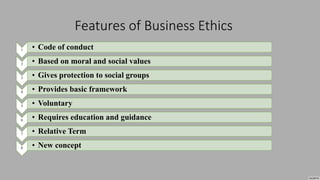
Features of Business Ethics
1 • Code of conduct
2 • Based on moral and social values
3 • Gives protection to social groups
4 • Provides basic framework
5 • Voluntary
6 • Requires education and guidance
7 • Relative Term
8 • New concept
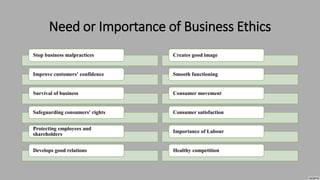
Need or Importance of Business Ethics
Stop business malpractices
Improve customers' confidence
Survival of business
Safeguarding consumers' rights
Protecting employees and
shareholders
Develops good relations
Creates good image
Smooth functioning
Consumer movement
Consumer satisfaction
Importance of Labour
Healthy competition
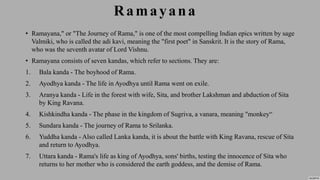
• Ramayana," or "The Journey of Rama," is one of the most compelling Indian epics written by sage
Valmiki, who is called the adi kavi, meaning the "first poet" in Sanskrit. It is the story of Rama,
who was the seventh avatar of Lord Vishnu.
• Ramayana consists of seven kandas, which refer to sections. They are:
1. Bala kanda - The boyhood of Rama.
2. Ayodhya kanda - The life in Ayodhya until Rama went on exile.
3. Aranya kanda - Life in the forest with wife, Sita, and brother Lakshman and abduction of Sita
by King Ravana.
4. Kishkindha kanda - The phase in the kingdom of Sugriva, a vanara, meaning "monkey“
5. Sundara kanda - The journey of Rama to Srilanka.
6. Yuddha kanda - Also called Lanka kanda, it is about the battle with King Ravana, rescue of Sita
and return to Ayodhya.
7. Uttara kanda - Rama's life as king of Ayodhya, sons' births, testing the innocence of Sita who
returns to her mother who is considered the earth goddess, and the demise of Rama.
Ramayana
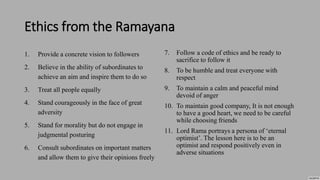
Ethics from the Ramayana
1. Provide a concrete vision to followers
2. Believe in the ability of subordinates to
achieve an aim and inspire them to do so
3. Treat all people equally
4. Stand courageously in the face of great
adversity
5. Stand for morality but do not engage in
judgmental posturing
6. Consult subordinates on important matters
and allow them to give their opinions freely
7. Follow a code of ethics and be ready to
sacrifice to follow it
8. To be humble and treat everyone with
respect
9. To maintain a calm and peaceful mind
devoid of anger
10. To maintain good company, It is not enough
to have a good heart, we need to be careful
while choosing friends
11. Lord Rama portrays a persona of ‘eternal
optimist’. The lesson here is to be an
optimist and respond positively even in
adverse situations
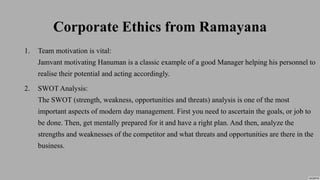
Corporate Ethics from Ramayana
1. Team motivation is vital:
Jamvant motivating Hanuman is a classic example of a good Manager helping his personnel to
realise their potential and acting accordingly.
2. SWOT Analysis:
The SWOT (strength, weakness, opportunities and threats) analysis is one of the most
important aspects of modern day management. First you need to ascertain the goals, or job to
be done. Then, get mentally prepared for it and have a right plan. And then, analyze the
strengths and weaknesses of the competitor and what threats and opportunities are there in the
business.
Corporate Ethics from Ramayana
3. Work on strategic alliances:
It is said that businesses are run on relations. A manager who can nurture good relations with the
employees, clients etc, can do wonders for his company. Lord Ram was very good at it. He was the
master of nurturing relations. His prowess at it was so great that while Ravana was lying wounded in
the battle field and was about to die, he shared some important lessons which he had learnt in his life.
4. Value your subordinates:
: A good manager is the one, who can get his work done even from the rivals. A good manager listens
to what his subordinates has to say and tries to keep them together especially when the organization
needs them the most. But Ravana’s mismanagement was responsible for Vibhishan (one of the wisest
manager) leaving him amidst a crisis
Corporate Ethics from Ramayana
5. Leaders need to create more leaders:
A time comes in every leader's life when he has to create leaders around him. This involves
making people around him competent enough to take independent decisions
6. No one is bigger than the brand:
The stone sank because it was not inscribed with ‘Rama’. Lord Rama was confident that he do
not need to use his "brand" as he was THE "brand" and tried to repeat the magic. But it did
not work. It was not "branded" with "Rama". Moral of the story is that the Brand is bigger
than the "owner" of the brand. A manager should feel good, when people recognize him by
the name of his company
Corporate Ethics from Ramayana
7. Importance of communication:
The cause of mortal enmity between brothers Sugriva and Bali originated in a terrible
miscommunication. The turn of events helped Rama do his bit. Lesson is to be beware of
miscommunication at any stage, whether in acquisition or in management of talent.
8. Believe in your team:
Set ambitious goals and motivate your team to meet them
9. Succession planning:
All well-managed companies ensure that the career development plans of their top performers are
directly linked to succession plans. Good leaders should invariably groom the managers under them
Corporate Ethics from Ramayana
10. Leave the comfort zone:
Marketing honchos of today who travel through the hinterland to get a better
first-hand feel of the customer’s pulse do a far better job of servicing the
market.
11. Excellence in execution
The manner in which Hanuman assures Sita of his genuineness exhorts
managers to conduct commercial negotiations by first setting the anxieties of
the opposite party at rest
Corporate Ethics from Ramayana
12. Always stick to the plan
13. Have a clear vision
14. Beware of dubious attractions
15. Maintain cool during crisis
16. A premium on values
17. Empower subordinates
18. Never have too many controlling stakeholders in your business
19. Never sign a document without reading the terms and conditions
20. Learn from the experts
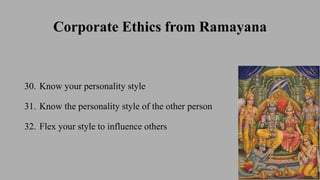
Corporate Ethics from Ramayana
21. Be willing to compete
22. Do not covet what does not belong to you
23. Keep wise counsel
24. Choose your joint venture alliances carefully
25. Negotiate and do not fight disruption
26. Begin with end in mind
27. Identify/Create an opportunity
28. Be ready to lose some to win some
29. Time your actions
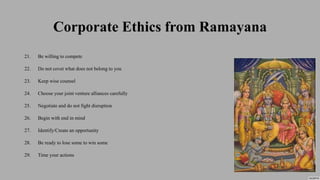
Corporate Ethics from Ramayana
30. Know your personality style
31. Know the personality style of the other person
32. Flex your style to influence others
RAVANA
1. Power Of Faith
2. Power Of Knowledge
3. That Everyone Is A Consortium
Of Multiple Layers
4. To Be A Good King
5. One Must Never Forget That
Ego Kills
6. Unplanned expansion
7. Making enemies
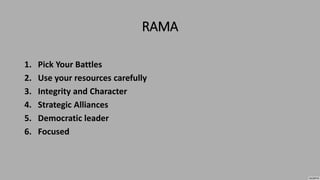
RAMA
1. Pick Your Battles
2. Use your resources carefully
3. Integrity and Character
4. Strategic Alliances
5. Democratic leader
6. Focused
HANUMAN
• No Boss, yet rise to the pantheon
• Right Advice
• Apply the power when it is
necessary
• Good leader cum follower
• Dedication to work
• Finding sita
• Communicating with sita
• Convincing sita
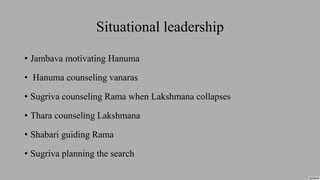
Situational leadership
• Jambava motivating Hanuma
• Hanuma counseling vanaras
• Sugriva counseling Rama when Lakshmana collapses
• Thara counseling Lakshmana
• Shabari guiding Rama
• Sugriva planning the search
strategic alliance
• Rama and Sugriva
• Rama and Vibhishana
• Ravana and Vali
• Ravana’s tactics for Angada
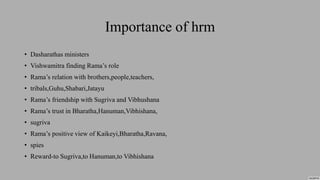
Importance of hrm
• Dasharathas ministers
• Vishwamitra finding Rama’s role
• Rama’s relation with brothers,people,teachers,
• tribals,Guhu,Shabari,Jatayu
• Rama’s friendship with Sugriva and Vibhushana
• Rama’s trust in Bharatha,Hanuman,Vibhishana,
• sugriva
• Rama’s positive view of Kaikeyi,Bharatha,Ravana,
• spies
• Reward-to Sugriva,to Hanuman,to Vibhishana
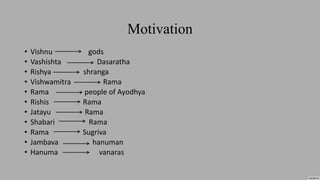
Motivation
• Vishnu gods
• Vashishta Dasaratha
• Rishya shranga
• Vishwamitra Rama
• Rama people of Ayodhya
• Rishis Rama
• Jatayu Rama
• Shabari Rama
• Rama Sugriva
• Jambava hanuman
• Hanuma vanaras
VALUES TAUGHT IN RAMAYANA
• Relationships v/s Money.
• Forgiveness.
• Protecting the weak.
• Equality of race and creed.
• After Ravana was killed SriRama asks Vibhishana, Ravana’s brother to perform the final rites for
Ravana.
• Rama then commands Lakshmana to coronate Vibhishana as the king of Lanka with the help of Sugriva
and others.
• He orders Vibhishana to reward the monkey army with gold and gemstones for their valor displayed in
warfare.
• Hanuma keeps back mountain sanjeevini in its original place.
Management lesson from ramayana

Management lesson from ramayana

  • 1.
    Lessons of ethicaland management from ramayana. BY: Himani Soni 178200592042
  • 2.
    What is Ethics Ethics, also called moral philosophy, the discipline concerned with what is morally good and bad, right and wrong. The term is also applied to any system or theory of moral values or principles.  Ethics deals with the study and justification of moral beliefs.
  • 3.
    Ethics Branches • Metaethics: Meta ethics is one of the fundamental branches of philosophy which examines the nature of morality in general, and what justifies moral judgments. • Normative ethics: Normative ethics attempts to provide a system of principles, rules and procedures for determining what (morally speaking) a person should do and should not do. • Applied ethics: Applied ethics is the branch of ethics which investigates the application of ethical theories in actual life.
  • 4.
    Applied Ethics • Medicalethics • Bioethics • Public sector ethics • Welfare ethics • Business ethics • Decision making ethics • Legal ethics (justice) • Media ethics • Environmental ethics • Manufacturing ethics • Computer ethics • Robot ethics • Automation ethics
  • 5.
    What is BusinessEthics? • Business ethics is the study of proper business policies and practices regarding potentially controversial issues such as corporate governance, insider trading, bribery, discrimination, corporate social responsibility and fiduciary responsibilities. Law often guides business ethics, while other times business ethics provide a basic framework that businesses may follow to gain public acceptance. • According to Andrew Crane, "Business ethics is the study of business situations, activities, and decisions where issues of right and wrong are addressed.“ • According to Raymond C. Baumhart, "The ethics of business is the ethics of responsibility. The business man must promise that he will not harm knowingly."
  • 6.
    Features of BusinessEthics 1 • Code of conduct 2 • Based on moral and social values 3 • Gives protection to social groups 4 • Provides basic framework 5 • Voluntary 6 • Requires education and guidance 7 • Relative Term 8 • New concept
  • 7.
    Need or Importanceof Business Ethics Stop business malpractices Improve customers' confidence Survival of business Safeguarding consumers' rights Protecting employees and shareholders Develops good relations Creates good image Smooth functioning Consumer movement Consumer satisfaction Importance of Labour Healthy competition
  • 8.
    • Ramayana," or"The Journey of Rama," is one of the most compelling Indian epics written by sage Valmiki, who is called the adi kavi, meaning the "first poet" in Sanskrit. It is the story of Rama, who was the seventh avatar of Lord Vishnu. • Ramayana consists of seven kandas, which refer to sections. They are: 1. Bala kanda - The boyhood of Rama. 2. Ayodhya kanda - The life in Ayodhya until Rama went on exile. 3. Aranya kanda - Life in the forest with wife, Sita, and brother Lakshman and abduction of Sita by King Ravana. 4. Kishkindha kanda - The phase in the kingdom of Sugriva, a vanara, meaning "monkey“ 5. Sundara kanda - The journey of Rama to Srilanka. 6. Yuddha kanda - Also called Lanka kanda, it is about the battle with King Ravana, rescue of Sita and return to Ayodhya. 7. Uttara kanda - Rama's life as king of Ayodhya, sons' births, testing the innocence of Sita who returns to her mother who is considered the earth goddess, and the demise of Rama. Ramayana
  • 9.
    Ethics from theRamayana 1. Provide a concrete vision to followers 2. Believe in the ability of subordinates to achieve an aim and inspire them to do so 3. Treat all people equally 4. Stand courageously in the face of great adversity 5. Stand for morality but do not engage in judgmental posturing 6. Consult subordinates on important matters and allow them to give their opinions freely 7. Follow a code of ethics and be ready to sacrifice to follow it 8. To be humble and treat everyone with respect 9. To maintain a calm and peaceful mind devoid of anger 10. To maintain good company, It is not enough to have a good heart, we need to be careful while choosing friends 11. Lord Rama portrays a persona of ‘eternal optimist’. The lesson here is to be an optimist and respond positively even in adverse situations
  • 10.
    Corporate Ethics fromRamayana 1. Team motivation is vital: Jamvant motivating Hanuman is a classic example of a good Manager helping his personnel to realise their potential and acting accordingly. 2. SWOT Analysis: The SWOT (strength, weakness, opportunities and threats) analysis is one of the most important aspects of modern day management. First you need to ascertain the goals, or job to be done. Then, get mentally prepared for it and have a right plan. And then, analyze the strengths and weaknesses of the competitor and what threats and opportunities are there in the business.
  • 11.
    Corporate Ethics fromRamayana 3. Work on strategic alliances: It is said that businesses are run on relations. A manager who can nurture good relations with the employees, clients etc, can do wonders for his company. Lord Ram was very good at it. He was the master of nurturing relations. His prowess at it was so great that while Ravana was lying wounded in the battle field and was about to die, he shared some important lessons which he had learnt in his life. 4. Value your subordinates: : A good manager is the one, who can get his work done even from the rivals. A good manager listens to what his subordinates has to say and tries to keep them together especially when the organization needs them the most. But Ravana’s mismanagement was responsible for Vibhishan (one of the wisest manager) leaving him amidst a crisis
  • 12.
    Corporate Ethics fromRamayana 5. Leaders need to create more leaders: A time comes in every leader's life when he has to create leaders around him. This involves making people around him competent enough to take independent decisions 6. No one is bigger than the brand: The stone sank because it was not inscribed with ‘Rama’. Lord Rama was confident that he do not need to use his "brand" as he was THE "brand" and tried to repeat the magic. But it did not work. It was not "branded" with "Rama". Moral of the story is that the Brand is bigger than the "owner" of the brand. A manager should feel good, when people recognize him by the name of his company
  • 13.
    Corporate Ethics fromRamayana 7. Importance of communication: The cause of mortal enmity between brothers Sugriva and Bali originated in a terrible miscommunication. The turn of events helped Rama do his bit. Lesson is to be beware of miscommunication at any stage, whether in acquisition or in management of talent. 8. Believe in your team: Set ambitious goals and motivate your team to meet them 9. Succession planning: All well-managed companies ensure that the career development plans of their top performers are directly linked to succession plans. Good leaders should invariably groom the managers under them
  • 14.
    Corporate Ethics fromRamayana 10. Leave the comfort zone: Marketing honchos of today who travel through the hinterland to get a better first-hand feel of the customer’s pulse do a far better job of servicing the market. 11. Excellence in execution The manner in which Hanuman assures Sita of his genuineness exhorts managers to conduct commercial negotiations by first setting the anxieties of the opposite party at rest
  • 15.
    Corporate Ethics fromRamayana 12. Always stick to the plan 13. Have a clear vision 14. Beware of dubious attractions 15. Maintain cool during crisis 16. A premium on values 17. Empower subordinates 18. Never have too many controlling stakeholders in your business 19. Never sign a document without reading the terms and conditions 20. Learn from the experts
  • 16.
    Corporate Ethics fromRamayana 21. Be willing to compete 22. Do not covet what does not belong to you 23. Keep wise counsel 24. Choose your joint venture alliances carefully 25. Negotiate and do not fight disruption 26. Begin with end in mind 27. Identify/Create an opportunity 28. Be ready to lose some to win some 29. Time your actions
  • 17.
    Corporate Ethics fromRamayana 30. Know your personality style 31. Know the personality style of the other person 32. Flex your style to influence others
  • 18.
    RAVANA 1. Power OfFaith 2. Power Of Knowledge 3. That Everyone Is A Consortium Of Multiple Layers 4. To Be A Good King 5. One Must Never Forget That Ego Kills 6. Unplanned expansion 7. Making enemies
  • 19.
    RAMA 1. Pick YourBattles 2. Use your resources carefully 3. Integrity and Character 4. Strategic Alliances 5. Democratic leader 6. Focused
  • 20.
    HANUMAN • No Boss,yet rise to the pantheon • Right Advice • Apply the power when it is necessary • Good leader cum follower • Dedication to work • Finding sita • Communicating with sita • Convincing sita
  • 21.
    Situational leadership • Jambavamotivating Hanuma • Hanuma counseling vanaras • Sugriva counseling Rama when Lakshmana collapses • Thara counseling Lakshmana • Shabari guiding Rama • Sugriva planning the search
  • 22.
    strategic alliance • Ramaand Sugriva • Rama and Vibhishana • Ravana and Vali • Ravana’s tactics for Angada
  • 23.
    Importance of hrm •Dasharathas ministers • Vishwamitra finding Rama’s role • Rama’s relation with brothers,people,teachers, • tribals,Guhu,Shabari,Jatayu • Rama’s friendship with Sugriva and Vibhushana • Rama’s trust in Bharatha,Hanuman,Vibhishana, • sugriva • Rama’s positive view of Kaikeyi,Bharatha,Ravana, • spies • Reward-to Sugriva,to Hanuman,to Vibhishana
  • 24.
    Motivation • Vishnu gods •Vashishta Dasaratha • Rishya shranga • Vishwamitra Rama • Rama people of Ayodhya • Rishis Rama • Jatayu Rama • Shabari Rama • Rama Sugriva • Jambava hanuman • Hanuma vanaras
  • 25.
    VALUES TAUGHT INRAMAYANA • Relationships v/s Money. • Forgiveness. • Protecting the weak. • Equality of race and creed. • After Ravana was killed SriRama asks Vibhishana, Ravana’s brother to perform the final rites for Ravana. • Rama then commands Lakshmana to coronate Vibhishana as the king of Lanka with the help of Sugriva and others. • He orders Vibhishana to reward the monkey army with gold and gemstones for their valor displayed in warfare. • Hanuma keeps back mountain sanjeevini in its original place.