FUNCTIONS OF MANAGEMENT –I
PLANNING:
NATURE, SCOPE, OBJECTIVE AND SIGNIFICANCES OF
PLANNING, KEY FACTORS TO PLANNING, TYPES OF PLANS,
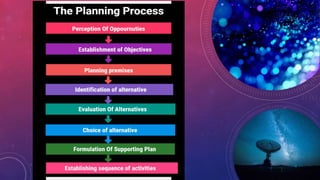
PROCESS OF PLANNING, EFFECTIVE PLANNING-PRINCIPLES,
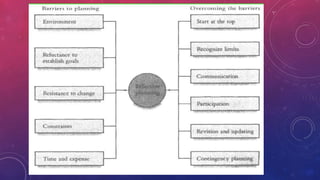
BARRIERS & HOW TO OVERCOME BARRIERS,
PLANNING PREMISES AND FORECASTING.
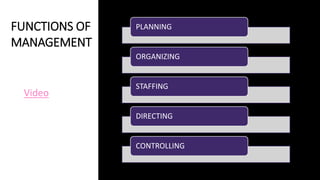
FUNCTIONS OF
MANAGEMENT
PLANNING
ORGANIZING
STAFFING
DIRECTING
CONTROLLING
Video
PLANNING
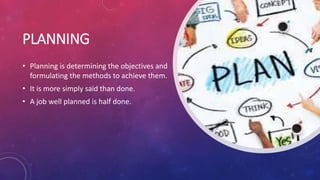
• Planning is determining the objectives and
formulating the methods to achieve them.
• It is more simply said than done.
• A job well planned is half done.
PLANNING
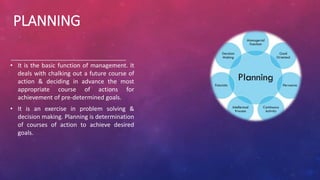
• It is the basic function of management. It
deals with chalking out a future course of
action & deciding in advance the most
appropriate course of actions for
achievement of pre-determined goals.
• It is an exercise in problem solving &
decision making. Planning is determination
of courses of action to achieve desired
goals.
PLANNING
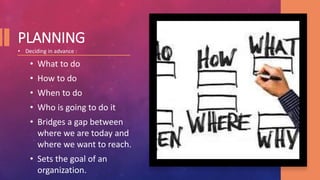
• Deciding in advance :
• What to do
• How to do
• When to do
• Who is going to do it
• Bridges a gap between
where we are today and
where we want to reach.
• Sets the goal of an
organization.
PLANNING
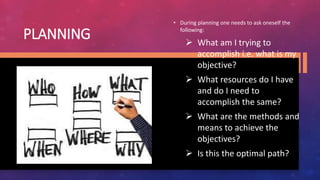
• During planning one needs to ask oneself the
following:
 What am I trying to
accomplish i.e. what is my
objective?
 What resources do I have
and do I need to
accomplish the same?
 What are the methods and
means to achieve the
objectives?
 Is this the optimal path?
PLANNING
• Planning is a systematic thinking about
ways & means for accomplishment of
pre-determined goals.
• Planning is necessary to ensure proper
utilization of human & non-human
resources.
• It is all pervasive, it is an intellectual
activity and it also helps in avoiding
confusion, uncertainties.
Functions of Management
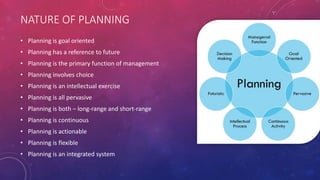
NATURE OF PLANNING
• Planning is goal oriented
• Planning has a reference to future
• Planning is the primary function of management
• Planning involves choice
• Planning is an intellectual exercise
• Planning is all pervasive
• Planning is both – long-range and short-range
• Planning is continuous
• Planning is actionable
• Planning is flexible
• Planning is an integrated system
OBJECTIVES OF PLANNING
• To bring certainty in future events
• To provide specific direction
• Forecasting
• To bring economy in managerial operations
• To attain predetermined goals
• To get victory over competitions
IMPORTANCE /SIGNIFICANCE OF PLANNING
• Planning provides Direction
• Planning Reduces the risk of uncertainties
• Planning reduces over lapping and wasteful activities
• Planning Promotes innovative ideas
• Planning Facilitates Decision Making
• Planning establishes standard for controlling
• Focuses attention on objectives of the company
TYPES OF PLAN
On the basis of Nature
• Operational Plan
• Tactical Plan
(Functional Plan)
• Strategic Plan
On the basis of Managerial Level
• Top level Plans
• Middle level Plans
• Lower level Plans
On the basis of Time
• Long term Plan
• Intermediate Plan
• Short term Plan
On the basis of Use
• Single Plan
• Standing Plan
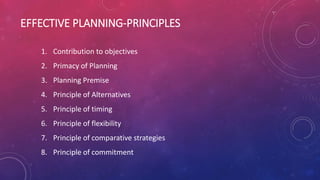
EFFECTIVE PLANNING-PRINCIPLES
1. Contribution to objectives
2. Primacy of Planning
3. Planning Premise
4. Principle of Alternatives
5. Principle of timing
6. Principle of flexibility
7. Principle of comparative strategies
8. Principle of commitment
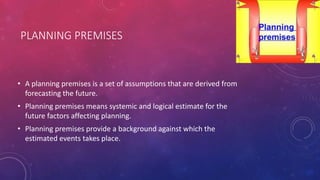
PLANNING PREMISES
• A planning premises is a set of assumptions that are derived from
forecasting the future.
• Planning premises means systemic and logical estimate for the
future factors affecting planning.
• Planning premises provide a background against which the
estimated events takes place.
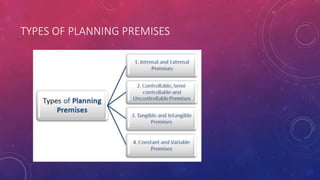
TYPES OF PLANNING PREMISES
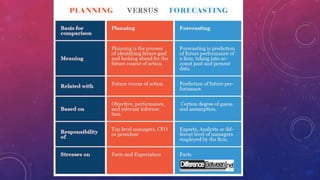
FORECASTING
• Forecasting is a process of predicting or estimating the future based on
past and present data.
• Forecasting provides information about the potential future events and
their consequences for the organization.
• It may not reduce the complications and uncertainty of the future.
• It increases the confidence of the management to make
important decisions
Forecasting
FEATURES OF FORECASTING
• Forecasting is concerned with future events.
• It shows the probability of happening of future events.
• It analysis past and present data.
• It uses statistical tools and techniques.
• It uses personal observations.
LIMITATIONS OF FORECASTING
• The collection and analysis of data about the past, present and future involves a lot of time
and money. Therefore, managers have to balance the cost of forecasting with its benefits.
• Forecasting can only estimate the future events. It cannot guarantee that these events will
take place in the future. Long-term forecasts will be less accurate as compared to short-term
forecast.
• Forecasting is based on certain assumptions. If these assumptions are wrong, the forecasting
will be wrong.
• Forecasts may go wrong due to bad judgment and skills on the part of some of the managers.
Therefore, forecasts are subject to human error.
THANK YOU!

Functions of management - Planning

  • 1.
    FUNCTIONS OF MANAGEMENT–I PLANNING: NATURE, SCOPE, OBJECTIVE AND SIGNIFICANCES OF PLANNING, KEY FACTORS TO PLANNING, TYPES OF PLANS, PROCESS OF PLANNING, EFFECTIVE PLANNING-PRINCIPLES, BARRIERS & HOW TO OVERCOME BARRIERS, PLANNING PREMISES AND FORECASTING.
  • 2.
  • 3.
    PLANNING • Planning isdetermining the objectives and formulating the methods to achieve them. • It is more simply said than done. • A job well planned is half done.
  • 4.
    PLANNING • It isthe basic function of management. It deals with chalking out a future course of action & deciding in advance the most appropriate course of actions for achievement of pre-determined goals. • It is an exercise in problem solving & decision making. Planning is determination of courses of action to achieve desired goals.
  • 5.
    PLANNING • Deciding inadvance : • What to do • How to do • When to do • Who is going to do it • Bridges a gap between where we are today and where we want to reach. • Sets the goal of an organization.
  • 6.
    PLANNING • During planningone needs to ask oneself the following:  What am I trying to accomplish i.e. what is my objective?  What resources do I have and do I need to accomplish the same?  What are the methods and means to achieve the objectives?  Is this the optimal path?
  • 7.
    PLANNING • Planning isa systematic thinking about ways & means for accomplishment of pre-determined goals. • Planning is necessary to ensure proper utilization of human & non-human resources. • It is all pervasive, it is an intellectual activity and it also helps in avoiding confusion, uncertainties. Functions of Management
  • 8.
    NATURE OF PLANNING •Planning is goal oriented • Planning has a reference to future • Planning is the primary function of management • Planning involves choice • Planning is an intellectual exercise • Planning is all pervasive • Planning is both – long-range and short-range • Planning is continuous • Planning is actionable • Planning is flexible • Planning is an integrated system
  • 9.
    OBJECTIVES OF PLANNING •To bring certainty in future events • To provide specific direction • Forecasting • To bring economy in managerial operations • To attain predetermined goals • To get victory over competitions
  • 10.
    IMPORTANCE /SIGNIFICANCE OFPLANNING • Planning provides Direction • Planning Reduces the risk of uncertainties • Planning reduces over lapping and wasteful activities • Planning Promotes innovative ideas • Planning Facilitates Decision Making • Planning establishes standard for controlling • Focuses attention on objectives of the company
  • 11.
    TYPES OF PLAN Onthe basis of Nature • Operational Plan • Tactical Plan (Functional Plan) • Strategic Plan On the basis of Managerial Level • Top level Plans • Middle level Plans • Lower level Plans On the basis of Time • Long term Plan • Intermediate Plan • Short term Plan On the basis of Use • Single Plan • Standing Plan
  • 13.
    EFFECTIVE PLANNING-PRINCIPLES 1. Contributionto objectives 2. Primacy of Planning 3. Planning Premise 4. Principle of Alternatives 5. Principle of timing 6. Principle of flexibility 7. Principle of comparative strategies 8. Principle of commitment
  • 15.
    PLANNING PREMISES • Aplanning premises is a set of assumptions that are derived from forecasting the future. • Planning premises means systemic and logical estimate for the future factors affecting planning. • Planning premises provide a background against which the estimated events takes place.
  • 16.
  • 17.
    FORECASTING • Forecasting isa process of predicting or estimating the future based on past and present data. • Forecasting provides information about the potential future events and their consequences for the organization. • It may not reduce the complications and uncertainty of the future. • It increases the confidence of the management to make important decisions Forecasting
  • 18.
    FEATURES OF FORECASTING •Forecasting is concerned with future events. • It shows the probability of happening of future events. • It analysis past and present data. • It uses statistical tools and techniques. • It uses personal observations.
  • 19.
    LIMITATIONS OF FORECASTING •The collection and analysis of data about the past, present and future involves a lot of time and money. Therefore, managers have to balance the cost of forecasting with its benefits. • Forecasting can only estimate the future events. It cannot guarantee that these events will take place in the future. Long-term forecasts will be less accurate as compared to short-term forecast. • Forecasting is based on certain assumptions. If these assumptions are wrong, the forecasting will be wrong. • Forecasts may go wrong due to bad judgment and skills on the part of some of the managers. Therefore, forecasts are subject to human error.
  • 21.