From Wikipedia, the free encyclopedia                                                    Mughal era


Mughal era

 History of South Asia (Indian                       Sikh Empire                  1799–1849
 Subcontinent)
                                                     Company rule in India        1757–1858
 Stone Age                   70,000–3300 BCE
                                                     British Raj                  1858–1947
 • Mehrgarh Culture          • 7000–3300 BCE
                                                     Partition of British India   1947
 Indus Valley Civilization   3300–1700 BCE
                                                     Nation histories
 Late Harappan Culture       1700–1300 BCE
                                                     Afghanistan • Bangladesh • Bhutan • India
 Iron Age                    1200–1 BCE              Maldives • Nepal • Pakistan • Sri Lanka

 • Maha Janapadas            • 700–300 BCE           Regional histories

 • Magadha Empire            • 545–550 BCE           Assam • Bihar • Balochistan • Bengal
                                                     Himachal Pradesh • Orissa • Pakistani Regions
 • Maurya Empire             • 321–184 BCE           Punjab • South India • Tibet
 • Chera Empire              • 300 BCE–1200          Specialised histories
                             CE
                                                     Coinage • Dynasties • Economy
 • Chola Empire              • 300 BCE–1279          Indology • Language • Literature • Maritime
                             CE                      Military • Science and Technology • Timeline
 • Pandyan Empire            • 250 BCE–1345
                             CE
                                                    The Mughal era is the historic period of the
 • Satavahana                • 230 BCE–220 CE       Mughal Empire in India, it ran from the early
 Middle Kingdoms             1CE–1279 CE
                                                    sixteenth century, to a point in the early
                                                    eighteenth century when the Mughal Emper-
 • Kushan Empire             • 60–240 CE            ors’ power had dwindled. It ended in several
 • Gupta Empire              • 280–550              generations of conflicts between rival
                                                    warlords.
 • Pala Empire               • 750–1174

 • Chalukya Dynasty          • 543–753
                                                    The Mughal Empire
 • Rashtrakuta               • 753–982

 • Western Chalukya          • 973–1189
 Empire

 • Yadava Empire             • 850–1334

 Hoysala Empire              1040–1346

 Kakatiya Empire             1083–1323

 Islamic Sultanates          1206–1596

 • Delhi Sultanate           • 1206–1526

 • Deccan Sultanates         • 1490–1596

 Ahom Kingdom                1228–1826

 Vijayanagara Empire         1336–1646

 Mughal Empire               1526–1858

 Maratha Empire              1674–1818

 Sikh Confederacy            1716–1799


                                                1
From Wikipedia, the free encyclopedia                                                Mughal era


India in the 16th century had numerous un-
popular rulers, both Muslim and Hindu, with
an absence of common bodies of laws or in-
stitutions. External developments also played
a role in the rise of the Mughal Empire. The
circumnavigation of Africa by the Portuguese
explorer Vasco da Gama in 1498 allowed
Europeans to challenge Arab control of the
trading routes between Europe and Asia. In
Central Asia and Afghanistan, shifts in power
pushed Babur of Ferghana (in present-day
Uzbekistan) southward, first to Kabul and
then to India. The Mughal Empire lasted for
more than three centuries. The Mughal Em-
pire was one of the largest centralized states
in premodern history and was the precursor
to the British Indian Empire.                        Zahir ud-Din Mohammad
                                                     (Babur)
                                                     Claiming descent from both Chengiz Khan
                                                     and Timur, Babur was known for his love of
                                                     beauty in addition to his military ability .
                                                     Babur concentrated on gaining control of
                                                     northwestern India.He was invited to India
                                                     by Daulat Khan Lodi and Rana Sanga who
                                                     wanted to end the Lodi dynasty.He defeated
                                                     Ibrahim Lodi in 1526 at the First battle of
                                                     Panipat, a town north of Delhi. Babur then
                                                     turned to the tasks of persuading his Central
The Taj Mahal - the most famous structure in         Asian followers to stay on in India and of
India built during Mughal Era                        overcoming other contenders for power,
                                                     mainly the Rajputs and the Afghans. He suc-
    The title of the greatest of the six most        ceeded in both tasks but died shortly there-
prominent Mughal Emperors receives vary-             after in 1530.
ing answers in present-day Pakistan and In-          Babur kept the record of his life in Chagatay
dia. Some favour Babur the pioneer and oth-          Turkish, the spoken language of the Timurids
ers his great-grandson, Shah Jahan (r.               and the whole Turco-Mongol world at the
1628-58), builder of the Taj Mahal and other         time. Baburnama is one of the longest ex-
magnificent buildings. The other two promin-         amples of sustained narrative prose in
ent rulers were Akbar (r. 1556-1605) and             Chagatay Turkish. Akbar’s regent, Bayram
Aurangzeb (r. 1658-1707). Both rulers expan-         Khan, a Turcoman of eastern Anatolian and
ded the empire greatly and were able admin-          Azerbaijani origin whose father and grand-
istrators. However, Akbar was known for his          father had joined Babur’s service. Bayram
religious tolerance and administrative geni-         Khan wrote poetry in Chaghatay and Persian.
us, whereas Aurangzeb was a zealous ruler            His son, Abdul-Rahim Khankhanan, was flu-
and fierce proselytizer of orthodox Islam            ent in Chaghatay, Hindi, and Persian and
across the heterodox Indian landscape.               composed in all three languages. Using
                                                     Babur’s own text he translated the
                                                     Baburnama into Persian. The Chaghatay ori-
                                                     ginal was last seen in the imperial library
                                                     sometime between 1628 and 1638 during Ja-
                                                     hangir’s reign.

                                                     Humayun
                                                     (1508-1556)


                                                 2
From Wikipedia, the free encyclopedia                                                  Mughal era


                                                     ruled in India barely for ten years and died at
                                                     the age of forty-eight, leaving behind Akbar
                                                     then only thirteen-year-old as his heir. As a
                                                     tribute to his father, Akbar later built the Hu-
                                                     mayun’s tomb in Delhi (completed in 1571),
                                                     from red sandstone, that would become the
                                                     precursor of future Mughal architecture. Ak-
                                                     bar’s mother and Humayun’s wife Hamida
                                                     Begum personally supervised the building of
                                                     the tomb.

                                                     Akbar
                                                     (1542-1605)
                                                     Akbar succeeded his father, Humayun (r.
                                                     1530-40 and 1555-56), whose rule was inter-
                                                     rupted by the Afghan Sur Dynasty, which re-
                                                     belled against him. It was only just before his
Babur’s favorite son Humayun took the reins          death that Humayun was able to regain the
of the empire after his father succumbed to          empire and leave it to his son. In restoring
disease at the young age of forty-seven. In          and expanding Mughal rule, Akbar based his
1539, Humayun and Sher Khan met in battle            authority on the ability and loyalty of his fol-
in Chausa, between Varanasi and Patna. Hu-           lowers, irrespective of their religion. In 1564
mayun barely escaped with his own life and           the jizya tax on non-Muslims was abolished,
in the next year, in 1540, his army of 40,000        and bans on temple building and Hindu pil-
lost to the Afghan army of 15,000 of Sher            grimages were lifted.
Khan.                                                   Akbar’s methods of administration rein-
   Sher Khan had now become the monarch              forced his power against two possible
in Delhi under the name Sher Shah Suri and           sources of challenge--the Afghan-Turkish ar-
ruled from 1540 to 1545. He consolidated his         istocracy and the traditional interpreters of
kingdom form Punjab to Bengal (first one to          Islamic law, the ulama. He created a ranked
enter Bengal after Ala-ud-din Khilji did more        imperial service based on ability rather than
than two centuries earlier).He was credited          birth, whose members were obliged to serve
to have organized and administered the gov-          wherever required. They were remunerated
ernment and military in such a way that fu-          with cash rather than land and were kept
ture Mughal kings used it as their own mod-          away from their inherited estates, thus cent-
els. He also added to the fort in Delhi (sup-        ralizing the imperial power base and assuring
posed site of Indraprastha), first started by        its supremacy. The military and political
Humayun, and now called the Purana Qila              functions of the imperial service were separ-
(Old Fort). The mosque Qila-I-Kuhna inside           ate from those of revenue collection, which
the fort is a masterpiece of the period,             was supervised by the imperial treasury. This
though only parts of it have survived.               system of administration, known as the mans-
   The charred remains of Sher Shah were             abdari, was based on loyal service and cash
taken to a tomb in Sahasaram, midway                 payments and was the backbone of the
between Varanasi and Gaya. Although rarely           Mughal Empire; its effectiveness depended
visited, the future great Mughal builders like       on personal loyalty to the emperor and his
Akbar, Jahangir and Shah Jahan emulated the          ability and willingness to choose, remuner-
architecture of this tomb. The massive palace        ate, and supervise.
like mausoleum is three stories and fifty               Akbar declared himself the final arbiter in
meters high. [1] Sher Shah’s son Islam Shah          all disputes of law derived from the Qur’an
held on to power until 1553 and following his        and the sharia. He backed his religious au-
death the Sur dynasty lost most of its clout         thority primarily with his authority in the
due to strife and famine.                            state. In 1580 he also initiated a syncretic
   Humayun was a keen astronomer.In fact             court religion called the Din-i-Ilahi (Divine
he died due to a fall from the rooftop of Sher       Faith). In theory, the new faith was compat-
Shah’s Delhi palace in 1554. Thus Humayun            ible with any other, provided that the devotee


                                                 3
From Wikipedia, the free encyclopedia                                                 Mughal era


was loyal to the emperor. In practice,                the administration by his father, Akbar. The
however, its ritual and content profoundly of-        Mughal Empire reached its pinnacle during
fended orthodox Muslims. The ulema found              Jahangir and Shah Jahan’s rule. Jahangir
their influence undermined.                           built his famous gardens in Kashmir though
   Several well known heritage sites were             the daily administration was delegated to
built during the reign of Akbar. The fort city        close aides. One such person was Jahangir’s
of Fatehpur Sikri was used as the political           wife, Nur Jahan, whom he married in 1611.
capital of the Empire from 1571 to 1578. The          She was the thirty-year-old widow of one of
numerous palaces and the grand entrances              his Afghan nobles. Her father, Persian born
with intricate art work have been recognized          Itimad-ud-Daula became a minister and
as a world heritage site by UNESCO. Akbar             closest advisor to the emperor. Very able Nur
also began construction of his own tomb at            Jahan along with her father and brother Asaf
Sikandra near Agra in 1600 CE.                        Khan, who was a successful general, ran the
                                                      kingdom.
Jahangir                                              Jahangir had kept a diary are used as his
(1569-1627)                                           memoirs. Though not a soldier, Jahangir was
                                                      an ardent patron of Mughal art and an avid
                                                      builder. He completed Akbar’s five-tiered
                                                      tomb in Sikandra. The emperor kept busy
                                                      building in Lahore, Allahabad and Agra.
                                                      While the de facto emperor, Nur Jahan was
                                                      attending to administrative details, Jahangir
                                                      found solace in loitering in his gardens and
                                                      appreciating art and nature.
                                                      The darkest incident of his rule perhaps was
                                                      the disposition of a peaceful leader of newly
                                                      formed religion called Sikhism. Akbar had
                                                      watched the blossoming of the new religion
                                                      founded by Guru Nanak, with fascination. Ja-
                                                      hangir, in a controversy with its leader, was
                                                      responsible for the death of Sikh Guru Ar-
                                                      jan(who was placed on a hot iron until he
Prince Salim (b. 1569 of Hindu Rajput prin-
                                                      died, unwilling to convert to Islam) and this
cess from Amber), who would later be known
                                                      would have lasting consequences for future
as Emperor Jahangir showed signs of rest-
                                                      Mughal emperors. The peaceful religion of
lessness at the end of a long reign by his
                                                      Sikhism would turn militant later when Ja-
father Akbar. During the absence of his fath-
                                                      hangir’s grandson Aurangzeb murdered the
er from Agra he pronounced himself as the
                                                      ninth Sikh Guru Tegh Bahadur. Jahangir,
king and turned rebellious. Akbar was able to
                                                      died in 1627 from alcohol abuse and Prince
wrestle the throne back. Salim did not have
                                                      Khurram(Shah Jahan)’s reign as the emperor
to worry about his sibling’s aspirations to the
                                                      began.
throne. His two brothers, Murad and Daniyal,
had both died early from alcoholism.
                                                      Shah Jahan
    Jahangir began his era as a Mughal em-
peror after the death of Akbar in the year            Prince Khurram, who would later be known
1605. He considered his third son Prince              as Emperor Shah Jahan, ascended to the
Khurram (future Shah Jahan-born 1592 of               throne after a tumultuous succession battle.
Hindu Rajput princess Manmati), his favour-               With the wealth created by Akbar, the
ite. Rana of Mewar and Prince Khurram had             Mughal kingdom was probably the richest in
a standoff that resulted in a treaty acceptable       the world. Prince Khurram gave himself the
to both parties. Khurram was kept busy with           title of Shah Jahan, the ‘King of the World’
several campaigns in Bengal and Kashmir. Ja-          and this was the name that was immortalized
hangir claimed the victories of Khurram –             by history. With his imagination and aspira-
Shah Jahan as his own.                                tion, Shah Jahan gained a reputation as an
He also had unlimited sources of revenue              aesthete par excellence. He built the black
largely due to a systematic organization of           marble pavilion at the Shalimar Gardens in


                                                  4
From Wikipedia, the free encyclopedia                                                  Mughal era


Srinagar and a white marble palace in Ajmer.
He also built a tomb for his father, Jahangir
in Lahore and built a massive city
Shahajanabad in Delhi but his imagination
surpassed all Mughal glory in his most fam-
ous building the Taj Mahal. It was in
Shahajanabad that his daughter Jahanara
built the marketplace called Chandni Chowk.
   His beloved wife Arjuman Banu (daughter
of Asaf Khan and niece of Nur Jahan) died
while delivering their fourteenth child in the
year 1631. The distraught emperor started
building a memorial for her the following
year. The Taj Mahal, named for Arjuman
Banu, who was called Mumtaz Mahal, be-
came one of the Seven Wonders of the World.
   The great Jama Masjid built by him was
the largest in India at the time. He renamed
Delhi after himself as Shahjahanabad. The
Red Fort made of red sandstone built during
his reign near Jama Masjid around the same
time came to be regarded as the seat of
power of India itself. The Prime Minister of
India addresses the nation from the ramparts
of this fort on Independence day even to this
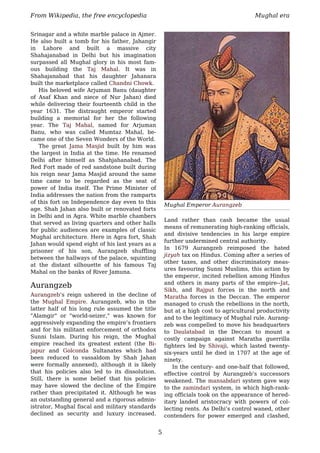
                                                     Mughal Emperor Aurangzeb
age. Shah Jahan also built or renovated forts
in Delhi and in Agra. White marble chambers
                                                     Land rather than cash became the usual
that served as living quarters and other halls
                                                     means of remunerating high-ranking officials,
for public audiences are examples of classic
                                                     and divisive tendencies in his large empire
Mughal architecture. Here in Agra fort, Shah
                                                     further undermined central authority.
Jahan would spend eight of his last years as a
                                                     In 1679 Aurangzeb reimposed the hated
prisoner of his son, Aurangzeb shuffling
                                                     jizyah tax on Hindus. Coming after a series of
between the hallways of the palace, squinting
                                                     other taxes, and other discriminatory meas-
at the distant silhouette of his famous Taj
                                                     ures favouring Sunni Muslims, this action by
Mahal on the banks of River Jamuna.
                                                     the emperor, incited rebellion among Hindus
                                                     and others in many parts of the empire--Jat,
Aurangzeb
                                                     Sikh, and Rajput forces in the north and
Aurangzeb’s reign ushered in the decline of          Maratha forces in the Deccan. The emperor
the Mughal Empire. Aurangzeb, who in the             managed to crush the rebellions in the north,
latter half of his long rule assumed the title       but at a high cost to agricultural productivity
"Alamgir" or "world-seizer," was known for           and to the legitimacy of Mughal rule. Aurang-
aggressively expanding the empire’s frontiers        zeb was compelled to move his headquarters
and for his militant enforcement of orthodox         to Daulatabad in the Deccan to mount a
Sunni Islam. During his reign, the Mughal            costly campaign against Maratha guerrilla
empire reached its greatest extent (the Bi-          fighters led by Shivaji, which lasted twenty-
japur and Golconda Sultanates which had              six-years until he died in 1707 at the age of
been reduced to vassaldom by Shah Jahan              ninety.
were formally annexed), although it is likely            In the century- and one-half that followed,
that his policies also led to its dissolution.       effective control by Aurangzeb’s successors
Still, there is some belief that his policies        weakened. The mansabdari system gave way
may have slowed the decline of the Empire            to the zamindari system, in which high-rank-
rather than precipitated it. Although he was         ing officials took on the appearance of hered-
an outstanding general and a rigorous admin-         itary landed aristocracy with powers of col-
istrator, Mughal fiscal and military standards       lecting rents. As Delhi’s control waned, other
declined as security and luxury increased.           contenders for power emerged and clashed,


                                                 5
From Wikipedia, the free encyclopedia                                                  Mughal era


thus preparing the way for the eventual Brit-        eight hours, using a lame excuse, Nadir Shah
ish takeover.                                        ordered a general massacre of Delhi citizens
    The Mughal state reached its hight under         and looted every bit of wealth they could ex-
Aurangzeb’s leadership. It had 29.2 percent          tort out of the royalty as well as Delhi’s cit-
of the world population under its flag (175          izenry. Nadir Shah remained in Delhi for
million out of 600 million in 1700 AD) and           forty eighty days and departed with millions
was one of the richest states the world had          worth of gold, jewelry and coins. Even the
ever seen, with 24.5% of the world’s GDP             emperor’s bejeweled peacock throne made
(the equivalent of $90.8 billion out of $371         during Shah Jahan’s reign was packed on ele-
billion in 1700).                                    phants and carried away to Persia. Another
    Aurangzeb, as is his father before him, is       prize, the Koh-I-nur diamond (Humayun’s
remembered as a builder-emperor. The Bad-            diamond) now passed into Persian hands).
shahi Masjid (Imperial Mosque) in Lahore             Later an Afghani, Ahmad Shah Abdali started
was constructed in 1673 on his orders. It was        his incursions into Delhi just for the purpose
not only the largest mosque ever built by a          of looting the capital. In a series of attacks
Mughal emperor but was at that point the             starting in 1748 until 1761, Abdali would not
largest mosque in the world. He also con-            only pillage and loot Delhi, he also cleaned
structed the Alamgiri Gate of the Lahore             out Mathura, Kashmir and cities in Panjab.
Fort, which is today a UNESCO World Herit-           From the east the British defeated the
age Site. Moti Masjid inside Delhi’s Red Fort        Nawab of Bengal and occupied the state of
was also finalized by him.                           Bengal.
                                                        The raids by Nadir Shah and repeated in-
Later Mughals                                        cursions of Abdali resulted in quick disposal
When Aurangzeb died close to the age of              of the next two emperors Ahmad Shah and
ninety, there were seventeen legitimate              Alamgir II until in 1759 Shah Alam II ascen-
claimants to the throne that included not only       ded the throne. His reign would last several
his sons but also his grandsons and great            decades. However, he would preside over
grandsons. After the death of the emperor            more loss of territory to the British. When the
two brothers fought near Agra (in the same           Nawab of Bengal lost to Robert Clive, Shah
battle site that Aurangzeb had fought his            Alam II was forced to recognize Clive as a di-
brother Dara Shikoh. Prince Muazzam pre-             wan (chancellor) and Bengal slipped to the
vailed and killed his brother Prince Azam            British hands permanently.
Shah and assumed the title Bahadur Shah I               In 1806 Shah Alam’s son Akbar Shah II ac-
or Shah Alam I. Bahadur Shah’s son Jahandar          ceded to the much diminished empire of the
Shah succeeded after his death. In Deccan            Mughals and ruled until 1837. His son Ba-
Saiyid Husain Ali Khan colluded with the             hadur Shah Zafar II would be the last emper-
Marathas and attacked Delhi and using trick-         or of Mughals before the British deposed him
ery and intrigue seized Farrukhsiyar in the          in 1858 and the Mughal dynasty would offi-
Red Fort. The emperor was blinded and                cially come to an end. During the Indian Re-
caged and later poisoned as well as stabbed          bellion of 1857, Bahadur Shah II was forced
to death. However, prior to his death, Far-          to take the side of the mutineers though he
rukhsiyar had the dubious distinction of aid-        had no power to affect the outcome of the
ing the British to have a firm foothold in In-       events. The mutineers had outwitted his Brit-
dia, by signing the much-coveted farman an           ish sponsors and now the emperor neither
imperial directive that would seal the future        had the troops nor the competence. He had
of British takeover of India.                        no choice but to join the winning side.
   Marathas were now constantly attacking            However, the success of the mutineers was
Delhi. Of more consequence and humiliation           soon reversed and the octogenarian (he was
was the plunder of Delhi by Nadir Shah. A            eighty-two years old) was relieved of his em-
Timur descendent, Nadir Shah usurped the             pire and deposed in 1858. The emperor was
throne in Persia and seized Kandahar and             then exiled to Rangoon in Burma where he
Kabul. He marched through Panjab and was             died in obscurity in 1862.
invited by Muhammad Shah as a guest to
Delhi (only because he had neither the will
nor the resources to fight him). Within forty-


                                                 6
From Wikipedia, the free encyclopedia                                                   Mughal era


Arrival of the Europeans                              companies found themselves more and more
                                                      involved in local politics in the south and in
Vasco da Gama led the first documented
                                                      Bengal. Plots and counterplots climaxed
European expedition to India, sailing into
                                                      when British East India Company forces, led
Calicut on the southwest coast in 1498. In
                                                      by Robert Clive, decisively defeated the lar-
1510 the Portuguese captured Goa, which be-
                                                      ger but divided forces of Nawab Siraj-ud-
came the seat of their activity. Under Admiral
                                                      Dawlah at Plassey (Pilasi) in Bengal in 1757.
Afonso de Albuquerque, Portugal successfully
challenged Arab power in the Indian Ocean
and dominated the sea routes for a century.           The Marathas
Jesuits came to convert, to converse, and to
                                                      Maratha chieftains were originally in the ser-
record observations of India. The Protestant
                                                      vice of Bijapur sultans in the western Deccan,
countries of the Netherlands and England,
                                                      which was under siege by the Mughals.
upset by the Portuguese monopoly, formed
                                                          Shivaji Bhonsle (1627-80) Shivaji was a
private trading companies at the turn of the
                                                      fighter regarded as the "father of the
seventeenth century to challenge the
                                                      Maratha nation," who took advantage of this
Portuguese.
                                                      conflict and carved out his own principality
   Mughal officials permitted the new carri-
                                                      near Pune, which later became the Maratha
ers of India’s considerable export trade to es-
                                                      capital. Adopting guerrilla tactics, he waylaid
tablish trading posts (factories) in India. The
                                                      caravans in order to sustain and expand his
Dutch East India Company concentrated
                                                      army, which soon had money, arms, and
mainly on the spice trade from present-day
                                                      horses. Shivaji led a series of successful as-
Indonesia. Britain’s East India Company car-
                                                      saults in the 1660s against Mughal strong-
ried on trade with India. The French East In-
                                                      holds, including the major port of Surat. Shiv-
dia Company also set up factories.
                                                      aji’s battle cries were swaraj (translated vari-
                                                      ously as freedom, self-rule, independence),
                                                      swadharma (religious freedom), and gorak-
                                                      sha (cow protection). Aurangzeb relentlessly
                                                      pursued Shivaji’s successors between 1681
                                                      and 1705 but eventually retreated to the
                                                      north as his treasury became depleted and as
                                                      thousands of lives had been lost either on the
                                                      battlefield or to natural calamities. In 1717 a
                                                      Mughal emissary signed a treaty with the
                                                      Marathas confirming their claims to rule in
                                                      the Deccan in return for acknowledging the
                                                      fictional Mughal suzerainty and remission of
                                                      annual taxes.
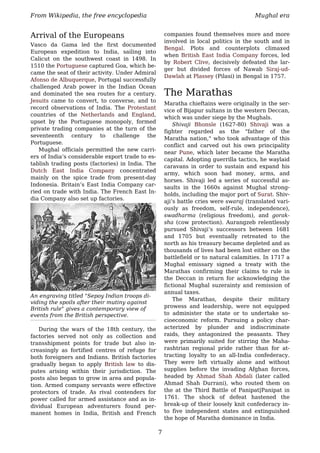
An engraving titled "Sepoy Indian troops di-
                                                          The Marathas, despite their military
viding the spoils after their mutiny against
British rule" gives a contemporary view of            prowess and leadership, were not equipped
events from the British perspective.                  to administer the state or to undertake so-
                                                      cioeconomic reform. Pursuing a policy char-
   During the wars of the 18th century, the           acterized by plunder and indiscriminate
factories served not only as collection and           raids, they antagonized the peasants. They
transshipment points for trade but also in-           were primarily suited for stirring the Maha-
creasingly as fortified centres of refuge for         rashtrian regional pride rather than for at-
both foreigners and Indians. British factories        tracting loyalty to an all-India confederacy.
gradually began to apply British law to dis-          They were left virtually alone and without
putes arising within their jurisdiction. The          supplies before the invading Afghan forces,
posts also began to grow in area and popula-          headed by Ahmad Shah Abdali (later called
tion. Armed company servants were effective           Ahmad Shah Durrani), who routed them on
protectors of trade. As rival contenders for          the at the Third Battle of Panipat|Panipat in
power called for armed assistance and as in-          1761. The shock of defeat hastened the
dividual European adventurers found per-              break-up of their loosely knit confederacy in-
manent homes in India, British and French             to five independent states and extinguished
                                                      the hope of Maratha dominance in India.

                                                  7
From Wikipedia, the free encyclopedia                                                 Mughal era


The Nizams of                                        equality and increasing prosperity. Ranjit
                                                     Singh employed European officers and intro-
Hyderabad                                            duced strict military discipline into his army
                                                     before expanding into Afghanistan, Kashmir,
Maratha raids into Berar, Kandesh, Gujarat
                                                     and Ladakh.
and Malwa resumed after the death of Aur-
angzeb, and loosened Mughal control in the
Deccan. In 1724 Asaf Jah, the Mughal Nizam           Establishment of the
ul Mulk, or viceroy, of the Deccan, defeated
several contenders for control of the Mughal
                                                     Europeans
southern provinces, and established himself
of ruler of an independent state with its cap-
ital at Hyderabad. He and his successors
ruled as hereditary Nizams, and their state,
known as Hyderabad after the capital, outlas-
ted the Mughal empire, persisting until it was
incorporated into newly-independent India in
1948. Nizam-ul-Mulk Asaf Jahi was a strong
ruler and established an orderly system of
administration. He also attempted to reform
the revenue system. The dynasty founded by
him came to be known as the Asaf Jahi dyn-
asty and lasted until the accession of Hydera-
bad to Independent India


The Sikhs
The Afghan defeat of the Maratha armies ac-
celerated the breakaway of Punjab from Del-
hi and helped the founding of Sikh overlord-
                                                     An Indian depiction of a 17th century Dutch
ship in the northwest. Rooted in the bhakti
                                                     ship off the Coromandel Coast
movements that developed in the second cen-
tury B.C. but swept across North India dur-
                                                     The quest for wealth and power brought
ing the fifteenth and sixteenth centuries, the
                                                     Europeans to Indian shores in 1498 when
teachings of the Sikh gurus appealed to the
                                                     Vasco da Gama, the Portuguese voyager, ar-
hard-working peasants. Facing extended per-
                                                     rived in Calicut (modern Kozhikode, Kerala)
secution from the Mughals, the Sikhs, under
                                                     on the west coast. In their search for spices
Guru Gobind Singh formed the Khalsa (Army
                                                     and Christian converts, the Portuguese chal-
of Pure). The khalsa rose up against the eco-
                                                     lenged Arab supremacy in the Indian Ocean,
nomic and political repressions in Punjab to-
                                                     and, with their galleons fitted with powerful
ward the end of Aurangzeb’s rule. Guerrilla
                                                     cannons, set up a network of strategic trad-
fighters took advantage of the political in-
                                                     ing posts along the Arabian Sea and the Per-
stability created by the Persian and Afghan
                                                     sian Gulf. In 1510 the Portuguese took over
onslaught against Delhi, enriching them-
                                                     the enclave of Goa, which became the center
selves and expanding territorial control. By
                                                     of their commercial and political power in In-
the 1770s, Sikh hegemony extended from the
                                                     dia and which they controlled for nearly four
Indus in the west to the Yamuna in the east,
                                                     and a half centuries.
from Multan in the south to Jammu in the
north. But the Sikhs, like the Marathas, were
a loose, disunited, and quarrelsome conglom-
                                                     Economic competition
erate of twelve kin-groups. It took Ranjit           Economic competition among the European
Singh (1780-1839), an individual with mod-           nations led to the founding of commercial
ernizing vision and leadership, to achieve su-       companies in England (the East India Com-
premacy over the other kin-groups and estab-         pany, founded in 1600) and in the Nether-
lish his kingdom in which Sikhs, Hindus, and         lands (Verenigde Oost-Indische Compagnie--
Muslims lived together in comparative                the United East India Company, founded in


                                                 8
From Wikipedia, the free encyclopedia                                                    Mughal era


1602), whose primary aim was to capture the            silver bullion and copper to pay for transac-
spice trade by breaking the Portuguese                 tions, helping the smooth functioning of the
monopoly in Asia. Although the Dutch, with a           Mughal revenue system and increasing the
large supply of capital and support from their         benefits to local artisans and traders.
government, preempted and ultimately ex-                   The fortified warehouses of the British
cluded the British from the heartland of               brought extraterritorial status, which en-
spices in the East Indies (modern-day Indone-          abled them to administer their own civil and
sia), both companies managed to establish              criminal laws and offered numerous employ-
trading "factories" (actually warehouses)              ment opportunities as well as asylum to for-
along the Indian coast. The Dutch, for ex-             eigners and Indians. The British factories
ample, used various ports on the Coromandel            successfully competed with their rivals as
Coast in South India, especially Pulicat               their size and population grew. The original
(about twenty kilometers north of Madras),             clusters of fishing villages (Madras and Cal-
as major sources for slaves for their planta-          cutta) or series of islands (Bombay) became
tions in the East Indies and for cotton cloth          headquarters of the British administrative
as early as 1609. (The English, however, es-           zones, or presidencies as they generally came
tablished their first factory at what today is         to be known. The factories and their immedi-
known as Madras only in 1639.) Indian rulers           ate environs, known as the White-town, rep-
enthusiastically accommodated the new-                 resented the actual and symbolic preemin-
comers in hopes of pitting them against the            ence of the British--in terms of their political
Portuguese. In 1619 Jahangir granted them              power--as well as their cultural values and so-
permission to trade in his territories at Surat        cial practices; meanwhile, their Indian collab-
(in Gujarat) on the west coast and Hughli (in          orators lived in the Black-town, separated
West Bengal) in the east. These and other              from the factories by several kilometres.
locations on the peninsula became centers of               The British company employed sepoys--
international trade in spices, cotton, sugar,          European-trained and European-led Indian
raw silk, saltpeter, calico, and indigo.               soldiers--to protect its trade, but local rulers
                                                       sought their services to settle scores in re-
British influence                                      gional power struggles. South India wit-
English company agents became familiar                 nessed the first open confrontation between
with Indian customs and languages, includ-             the British and the French, whose forces
ing Persian, the unifying official language un-        were led by Robert Clive and François
der the Mughals. In many ways, the English             Dupleix, respectively. Both companies de-
agents of that period lived like Indians, inter-       sired to place their own candidate as the
married willingly, and a large number of               nawab, or ruler, of Arcot, the area around
them never returned to their home country.             Madras. At the end of a protracted struggle
The knowledge of India thus acquired and               between 1744 and 1763, when the Peace of
the mutual ties forged with Indian trading             Paris was signed, the British gained an upper
groups gave the English a competitive edge             hand over the French and installed their man
over    other    Europeans.      The    French         in power, supporting him further with arms
commercial interest--Compagnie des Indes               and lending large sums as well. The French
Orientales (East India Company, founded in             and the British also backed different factions
1664)--came late, but the French also estab-           in the succession struggle for Mughal vice-
lished themselves in India, emulating the pre-         royalty in Bengal, but Clive intervened suc-
cedents set by their competitors as they foun-         cessfully and defeated Nawab Siraj-ud-daula
ded their enclave at Pondicherry (Puduch-              in the Battle of Plassey (Palashi, about 150
cheri) on the Coromandel Coast.                        kilometres north of Calcutta) in 1757. Clive
    In 1717 the Mughal emperor, Farrukh-               found help from a combination of vested in-
siyar (r. 1713-19), gave the British--who by           terests that opposed the existing nawab: dis-
then had already established themselves in             gruntled soldiers, landholders, and influential
the south and the west--a grant of thirty-eight        merchants whose commercial profits were
villages near Calcutta, acknowledging their            closely linked to British fortunes.
importance to the continuity of international              Later, Clive defeated the Mughal forces at
trade in the Bengal economy. As did the                Buxar (Baksar, west of Patna in Bihar) in
Dutch and the French, the British brought              1765, and the Mughal emperor (Shah Alam,
                                                       r. 1759-1806) conferred on the company

                                                   9
From Wikipedia, the free encyclopedia                                                    Mughal era


administrative rights over Bengal, Bihar, and          to be poor to avoid taxation. The bulk of the
Orissa, a region of roughly 25 million people          people were poor. The standard of living of
with an annual revenue of 40 million rupees            the poor was as low as, or somewhat higher
(for current value of the rupee). The imperial         than, the standard of living of the Indian poor
grant virtually established the company as a           under the British Raj; whatever benefits the
sovereign power, and Clive became the first            British brought with canals and modern in-
British governor of Bengal.                            dustry were neutralized by rising population
   Besides the presence of the Portuguese,             growth, high taxes, and the collapse of tradi-
Dutch, British, and French, there were two             tional industry in the nineteenth century.
lesser but noteworthy colonial groups. Dan-            Some of the notable changes to societies of
ish entrepreneurs established themselves at            the subcontinent and culture, during this era
several ports on the Malabar coast and the             were
Coromandel coast notably Tranquebar, in the            • Centralised government which brought
vicinity of Calcutta, and inland at Patna                 together many smaller kingdoms
between 1695 and 1740. Austrian enterprises            • Persian art and culture amalgamated with
were set up in the 1720s on the vicinity of               native Indian art and culture
Surat in modern-day southeastern Gujarat.              • Started new trade routes to Arab and Turk
As with the other non-British enterprises, the            lands, Islam was at its very highest
Danish and Austrian enclaves were taken                • Mughlai cuisine
over by the British between 1765 and 1815.             • Urdu language was formed by
                                                          amalgamation of Persian, Arabic, Turkish
Mughal Society                                            with many North Indian languages.
                                                          Spoken Hindi branched off from Urdu at a
The Indian economy boomed under the                       much later date (late 19th Cent.) retaining
Mughals, because of the creation of a road                a more distinct Sanskrit flavour.
system and a uniform currency, together with           • A new style of architecture
the unification of the country. Manufactured           • Landscape gardening
goods and peasant-grown cash crops were
sold throughout the world. Key industries in-
cluded shipbuilding (the Indian shipbuilding
                                                       References
industry was as advanced as the European,              [1] Shershah Suri’s Tomb, Sasaram -
and Indians sold ships to European firms),                 Ticketed Monument - Archaeological
textiles, and steel. The Mughals maintained a              Survey of India
small fleet, which merely carried pilgrims to          •     This article incorporates public domain
Mecca, imported a few Arab horses, trans-                 material from websites or documents of
ported soldiers over rivers, and fought pir-              the Library of Congress Country Studies. -
ates; however, the Muslim Siddis of Janjira,              India Pakistan
and the Marathas sent ships to China, and
the eastern limits of Africa, together with
some Mughal subjects carrying out private-
                                                       Literature
sector trade.                                          • Elliot and Dowson: The History of India as
   Cities and towns boomed under the                     told by its own Historians, New Delhi
Mughals; however, for the most part, they                reprint, 1990.
were military and political centres, not manu-         • Elliot, Sir H. M., Edited by Dowson, John.
facturing or commerce centres. Only those                The History of India, as Told by Its Own
guilds which produced goods for the bureau-              Historians. The Muhammadan Period;
cracy made goods in the towns; most in-                  published by London Trubner Company
dustry was based in rural areas.                         1867–1877. (Online Copy: The History of
   The nobility was a heterogeneous body;                India, as Told by Its Own Historians. The
while it primarily consisted of Rajput aristo-           Muhammadan Period; by Sir H. M. Elliot;
crats and foreigners from Muslim countries,              Edited by John Dowson; London Trubner
people of all castes and nationalities could             Company 1867–1877 - This online Copy
gain a title from the emperor. The middle                has been posted by: The Packard
class of openly affluent traders consisted of a          Humanities Institute; Persian Texts in
few wealthy merchants living in the coastal              Translation; Also find other historical
towns; the bulk of the merchants pretended               books: Author List and Title List)

                                                  10
From Wikipedia, the free encyclopedia                                            Mughal era


• Majumdar, R. C. (ed.), The History and
  Culture of the Indian People, Volume VI,
                                                   External links
  The Delhi Sultanate, Bombay, 1960;               • The Great Mughals Timurids-Mongolian
  Volume VII, The Mughal Empire, Bombay,             dynasty of Turkish origin
  1973.                                            • British India
                                                   • British Education in India


Retrieved from "http://en.wikipedia.org/wiki/Mughal_era"

Categories: Mughal Empire, History of India


This page was last modified on 20 April 2009, at 06:01 (UTC). All text is available under the
terms of the GNU Free Documentation License. (See Copyrights for details.) Wikipedia® is a
registered trademark of the Wikimedia Foundation, Inc., a U.S. registered 501(c)(3) tax-
deductible nonprofit charity. Privacy policy About Wikipedia Disclaimers

                                              11

Mughal_era

  • 1.
    From Wikipedia, thefree encyclopedia Mughal era Mughal era History of South Asia (Indian Sikh Empire 1799–1849 Subcontinent) Company rule in India 1757–1858 Stone Age 70,000–3300 BCE British Raj 1858–1947 • Mehrgarh Culture • 7000–3300 BCE Partition of British India 1947 Indus Valley Civilization 3300–1700 BCE Nation histories Late Harappan Culture 1700–1300 BCE Afghanistan • Bangladesh • Bhutan • India Iron Age 1200–1 BCE Maldives • Nepal • Pakistan • Sri Lanka • Maha Janapadas • 700–300 BCE Regional histories • Magadha Empire • 545–550 BCE Assam • Bihar • Balochistan • Bengal Himachal Pradesh • Orissa • Pakistani Regions • Maurya Empire • 321–184 BCE Punjab • South India • Tibet • Chera Empire • 300 BCE–1200 Specialised histories CE Coinage • Dynasties • Economy • Chola Empire • 300 BCE–1279 Indology • Language • Literature • Maritime CE Military • Science and Technology • Timeline • Pandyan Empire • 250 BCE–1345 CE The Mughal era is the historic period of the • Satavahana • 230 BCE–220 CE Mughal Empire in India, it ran from the early Middle Kingdoms 1CE–1279 CE sixteenth century, to a point in the early eighteenth century when the Mughal Emper- • Kushan Empire • 60–240 CE ors’ power had dwindled. It ended in several • Gupta Empire • 280–550 generations of conflicts between rival warlords. • Pala Empire • 750–1174 • Chalukya Dynasty • 543–753 The Mughal Empire • Rashtrakuta • 753–982 • Western Chalukya • 973–1189 Empire • Yadava Empire • 850–1334 Hoysala Empire 1040–1346 Kakatiya Empire 1083–1323 Islamic Sultanates 1206–1596 • Delhi Sultanate • 1206–1526 • Deccan Sultanates • 1490–1596 Ahom Kingdom 1228–1826 Vijayanagara Empire 1336–1646 Mughal Empire 1526–1858 Maratha Empire 1674–1818 Sikh Confederacy 1716–1799 1
  • 2.
    From Wikipedia, thefree encyclopedia Mughal era India in the 16th century had numerous un- popular rulers, both Muslim and Hindu, with an absence of common bodies of laws or in- stitutions. External developments also played a role in the rise of the Mughal Empire. The circumnavigation of Africa by the Portuguese explorer Vasco da Gama in 1498 allowed Europeans to challenge Arab control of the trading routes between Europe and Asia. In Central Asia and Afghanistan, shifts in power pushed Babur of Ferghana (in present-day Uzbekistan) southward, first to Kabul and then to India. The Mughal Empire lasted for more than three centuries. The Mughal Em- pire was one of the largest centralized states in premodern history and was the precursor to the British Indian Empire. Zahir ud-Din Mohammad (Babur) Claiming descent from both Chengiz Khan and Timur, Babur was known for his love of beauty in addition to his military ability . Babur concentrated on gaining control of northwestern India.He was invited to India by Daulat Khan Lodi and Rana Sanga who wanted to end the Lodi dynasty.He defeated Ibrahim Lodi in 1526 at the First battle of Panipat, a town north of Delhi. Babur then turned to the tasks of persuading his Central The Taj Mahal - the most famous structure in Asian followers to stay on in India and of India built during Mughal Era overcoming other contenders for power, mainly the Rajputs and the Afghans. He suc- The title of the greatest of the six most ceeded in both tasks but died shortly there- prominent Mughal Emperors receives vary- after in 1530. ing answers in present-day Pakistan and In- Babur kept the record of his life in Chagatay dia. Some favour Babur the pioneer and oth- Turkish, the spoken language of the Timurids ers his great-grandson, Shah Jahan (r. and the whole Turco-Mongol world at the 1628-58), builder of the Taj Mahal and other time. Baburnama is one of the longest ex- magnificent buildings. The other two promin- amples of sustained narrative prose in ent rulers were Akbar (r. 1556-1605) and Chagatay Turkish. Akbar’s regent, Bayram Aurangzeb (r. 1658-1707). Both rulers expan- Khan, a Turcoman of eastern Anatolian and ded the empire greatly and were able admin- Azerbaijani origin whose father and grand- istrators. However, Akbar was known for his father had joined Babur’s service. Bayram religious tolerance and administrative geni- Khan wrote poetry in Chaghatay and Persian. us, whereas Aurangzeb was a zealous ruler His son, Abdul-Rahim Khankhanan, was flu- and fierce proselytizer of orthodox Islam ent in Chaghatay, Hindi, and Persian and across the heterodox Indian landscape. composed in all three languages. Using Babur’s own text he translated the Baburnama into Persian. The Chaghatay ori- ginal was last seen in the imperial library sometime between 1628 and 1638 during Ja- hangir’s reign. Humayun (1508-1556) 2
  • 3.
    From Wikipedia, thefree encyclopedia Mughal era ruled in India barely for ten years and died at the age of forty-eight, leaving behind Akbar then only thirteen-year-old as his heir. As a tribute to his father, Akbar later built the Hu- mayun’s tomb in Delhi (completed in 1571), from red sandstone, that would become the precursor of future Mughal architecture. Ak- bar’s mother and Humayun’s wife Hamida Begum personally supervised the building of the tomb. Akbar (1542-1605) Akbar succeeded his father, Humayun (r. 1530-40 and 1555-56), whose rule was inter- rupted by the Afghan Sur Dynasty, which re- belled against him. It was only just before his Babur’s favorite son Humayun took the reins death that Humayun was able to regain the of the empire after his father succumbed to empire and leave it to his son. In restoring disease at the young age of forty-seven. In and expanding Mughal rule, Akbar based his 1539, Humayun and Sher Khan met in battle authority on the ability and loyalty of his fol- in Chausa, between Varanasi and Patna. Hu- lowers, irrespective of their religion. In 1564 mayun barely escaped with his own life and the jizya tax on non-Muslims was abolished, in the next year, in 1540, his army of 40,000 and bans on temple building and Hindu pil- lost to the Afghan army of 15,000 of Sher grimages were lifted. Khan. Akbar’s methods of administration rein- Sher Khan had now become the monarch forced his power against two possible in Delhi under the name Sher Shah Suri and sources of challenge--the Afghan-Turkish ar- ruled from 1540 to 1545. He consolidated his istocracy and the traditional interpreters of kingdom form Punjab to Bengal (first one to Islamic law, the ulama. He created a ranked enter Bengal after Ala-ud-din Khilji did more imperial service based on ability rather than than two centuries earlier).He was credited birth, whose members were obliged to serve to have organized and administered the gov- wherever required. They were remunerated ernment and military in such a way that fu- with cash rather than land and were kept ture Mughal kings used it as their own mod- away from their inherited estates, thus cent- els. He also added to the fort in Delhi (sup- ralizing the imperial power base and assuring posed site of Indraprastha), first started by its supremacy. The military and political Humayun, and now called the Purana Qila functions of the imperial service were separ- (Old Fort). The mosque Qila-I-Kuhna inside ate from those of revenue collection, which the fort is a masterpiece of the period, was supervised by the imperial treasury. This though only parts of it have survived. system of administration, known as the mans- The charred remains of Sher Shah were abdari, was based on loyal service and cash taken to a tomb in Sahasaram, midway payments and was the backbone of the between Varanasi and Gaya. Although rarely Mughal Empire; its effectiveness depended visited, the future great Mughal builders like on personal loyalty to the emperor and his Akbar, Jahangir and Shah Jahan emulated the ability and willingness to choose, remuner- architecture of this tomb. The massive palace ate, and supervise. like mausoleum is three stories and fifty Akbar declared himself the final arbiter in meters high. [1] Sher Shah’s son Islam Shah all disputes of law derived from the Qur’an held on to power until 1553 and following his and the sharia. He backed his religious au- death the Sur dynasty lost most of its clout thority primarily with his authority in the due to strife and famine. state. In 1580 he also initiated a syncretic Humayun was a keen astronomer.In fact court religion called the Din-i-Ilahi (Divine he died due to a fall from the rooftop of Sher Faith). In theory, the new faith was compat- Shah’s Delhi palace in 1554. Thus Humayun ible with any other, provided that the devotee 3
  • 4.
    From Wikipedia, thefree encyclopedia Mughal era was loyal to the emperor. In practice, the administration by his father, Akbar. The however, its ritual and content profoundly of- Mughal Empire reached its pinnacle during fended orthodox Muslims. The ulema found Jahangir and Shah Jahan’s rule. Jahangir their influence undermined. built his famous gardens in Kashmir though Several well known heritage sites were the daily administration was delegated to built during the reign of Akbar. The fort city close aides. One such person was Jahangir’s of Fatehpur Sikri was used as the political wife, Nur Jahan, whom he married in 1611. capital of the Empire from 1571 to 1578. The She was the thirty-year-old widow of one of numerous palaces and the grand entrances his Afghan nobles. Her father, Persian born with intricate art work have been recognized Itimad-ud-Daula became a minister and as a world heritage site by UNESCO. Akbar closest advisor to the emperor. Very able Nur also began construction of his own tomb at Jahan along with her father and brother Asaf Sikandra near Agra in 1600 CE. Khan, who was a successful general, ran the kingdom. Jahangir Jahangir had kept a diary are used as his (1569-1627) memoirs. Though not a soldier, Jahangir was an ardent patron of Mughal art and an avid builder. He completed Akbar’s five-tiered tomb in Sikandra. The emperor kept busy building in Lahore, Allahabad and Agra. While the de facto emperor, Nur Jahan was attending to administrative details, Jahangir found solace in loitering in his gardens and appreciating art and nature. The darkest incident of his rule perhaps was the disposition of a peaceful leader of newly formed religion called Sikhism. Akbar had watched the blossoming of the new religion founded by Guru Nanak, with fascination. Ja- hangir, in a controversy with its leader, was responsible for the death of Sikh Guru Ar- jan(who was placed on a hot iron until he Prince Salim (b. 1569 of Hindu Rajput prin- died, unwilling to convert to Islam) and this cess from Amber), who would later be known would have lasting consequences for future as Emperor Jahangir showed signs of rest- Mughal emperors. The peaceful religion of lessness at the end of a long reign by his Sikhism would turn militant later when Ja- father Akbar. During the absence of his fath- hangir’s grandson Aurangzeb murdered the er from Agra he pronounced himself as the ninth Sikh Guru Tegh Bahadur. Jahangir, king and turned rebellious. Akbar was able to died in 1627 from alcohol abuse and Prince wrestle the throne back. Salim did not have Khurram(Shah Jahan)’s reign as the emperor to worry about his sibling’s aspirations to the began. throne. His two brothers, Murad and Daniyal, had both died early from alcoholism. Shah Jahan Jahangir began his era as a Mughal em- peror after the death of Akbar in the year Prince Khurram, who would later be known 1605. He considered his third son Prince as Emperor Shah Jahan, ascended to the Khurram (future Shah Jahan-born 1592 of throne after a tumultuous succession battle. Hindu Rajput princess Manmati), his favour- With the wealth created by Akbar, the ite. Rana of Mewar and Prince Khurram had Mughal kingdom was probably the richest in a standoff that resulted in a treaty acceptable the world. Prince Khurram gave himself the to both parties. Khurram was kept busy with title of Shah Jahan, the ‘King of the World’ several campaigns in Bengal and Kashmir. Ja- and this was the name that was immortalized hangir claimed the victories of Khurram – by history. With his imagination and aspira- Shah Jahan as his own. tion, Shah Jahan gained a reputation as an He also had unlimited sources of revenue aesthete par excellence. He built the black largely due to a systematic organization of marble pavilion at the Shalimar Gardens in 4
  • 5.
    From Wikipedia, thefree encyclopedia Mughal era Srinagar and a white marble palace in Ajmer. He also built a tomb for his father, Jahangir in Lahore and built a massive city Shahajanabad in Delhi but his imagination surpassed all Mughal glory in his most fam- ous building the Taj Mahal. It was in Shahajanabad that his daughter Jahanara built the marketplace called Chandni Chowk. His beloved wife Arjuman Banu (daughter of Asaf Khan and niece of Nur Jahan) died while delivering their fourteenth child in the year 1631. The distraught emperor started building a memorial for her the following year. The Taj Mahal, named for Arjuman Banu, who was called Mumtaz Mahal, be- came one of the Seven Wonders of the World. The great Jama Masjid built by him was the largest in India at the time. He renamed Delhi after himself as Shahjahanabad. The Red Fort made of red sandstone built during his reign near Jama Masjid around the same time came to be regarded as the seat of power of India itself. The Prime Minister of India addresses the nation from the ramparts of this fort on Independence day even to this Mughal Emperor Aurangzeb age. Shah Jahan also built or renovated forts in Delhi and in Agra. White marble chambers Land rather than cash became the usual that served as living quarters and other halls means of remunerating high-ranking officials, for public audiences are examples of classic and divisive tendencies in his large empire Mughal architecture. Here in Agra fort, Shah further undermined central authority. Jahan would spend eight of his last years as a In 1679 Aurangzeb reimposed the hated prisoner of his son, Aurangzeb shuffling jizyah tax on Hindus. Coming after a series of between the hallways of the palace, squinting other taxes, and other discriminatory meas- at the distant silhouette of his famous Taj ures favouring Sunni Muslims, this action by Mahal on the banks of River Jamuna. the emperor, incited rebellion among Hindus and others in many parts of the empire--Jat, Aurangzeb Sikh, and Rajput forces in the north and Aurangzeb’s reign ushered in the decline of Maratha forces in the Deccan. The emperor the Mughal Empire. Aurangzeb, who in the managed to crush the rebellions in the north, latter half of his long rule assumed the title but at a high cost to agricultural productivity "Alamgir" or "world-seizer," was known for and to the legitimacy of Mughal rule. Aurang- aggressively expanding the empire’s frontiers zeb was compelled to move his headquarters and for his militant enforcement of orthodox to Daulatabad in the Deccan to mount a Sunni Islam. During his reign, the Mughal costly campaign against Maratha guerrilla empire reached its greatest extent (the Bi- fighters led by Shivaji, which lasted twenty- japur and Golconda Sultanates which had six-years until he died in 1707 at the age of been reduced to vassaldom by Shah Jahan ninety. were formally annexed), although it is likely In the century- and one-half that followed, that his policies also led to its dissolution. effective control by Aurangzeb’s successors Still, there is some belief that his policies weakened. The mansabdari system gave way may have slowed the decline of the Empire to the zamindari system, in which high-rank- rather than precipitated it. Although he was ing officials took on the appearance of hered- an outstanding general and a rigorous admin- itary landed aristocracy with powers of col- istrator, Mughal fiscal and military standards lecting rents. As Delhi’s control waned, other declined as security and luxury increased. contenders for power emerged and clashed, 5
  • 6.
    From Wikipedia, thefree encyclopedia Mughal era thus preparing the way for the eventual Brit- eight hours, using a lame excuse, Nadir Shah ish takeover. ordered a general massacre of Delhi citizens The Mughal state reached its hight under and looted every bit of wealth they could ex- Aurangzeb’s leadership. It had 29.2 percent tort out of the royalty as well as Delhi’s cit- of the world population under its flag (175 izenry. Nadir Shah remained in Delhi for million out of 600 million in 1700 AD) and forty eighty days and departed with millions was one of the richest states the world had worth of gold, jewelry and coins. Even the ever seen, with 24.5% of the world’s GDP emperor’s bejeweled peacock throne made (the equivalent of $90.8 billion out of $371 during Shah Jahan’s reign was packed on ele- billion in 1700). phants and carried away to Persia. Another Aurangzeb, as is his father before him, is prize, the Koh-I-nur diamond (Humayun’s remembered as a builder-emperor. The Bad- diamond) now passed into Persian hands). shahi Masjid (Imperial Mosque) in Lahore Later an Afghani, Ahmad Shah Abdali started was constructed in 1673 on his orders. It was his incursions into Delhi just for the purpose not only the largest mosque ever built by a of looting the capital. In a series of attacks Mughal emperor but was at that point the starting in 1748 until 1761, Abdali would not largest mosque in the world. He also con- only pillage and loot Delhi, he also cleaned structed the Alamgiri Gate of the Lahore out Mathura, Kashmir and cities in Panjab. Fort, which is today a UNESCO World Herit- From the east the British defeated the age Site. Moti Masjid inside Delhi’s Red Fort Nawab of Bengal and occupied the state of was also finalized by him. Bengal. The raids by Nadir Shah and repeated in- Later Mughals cursions of Abdali resulted in quick disposal When Aurangzeb died close to the age of of the next two emperors Ahmad Shah and ninety, there were seventeen legitimate Alamgir II until in 1759 Shah Alam II ascen- claimants to the throne that included not only ded the throne. His reign would last several his sons but also his grandsons and great decades. However, he would preside over grandsons. After the death of the emperor more loss of territory to the British. When the two brothers fought near Agra (in the same Nawab of Bengal lost to Robert Clive, Shah battle site that Aurangzeb had fought his Alam II was forced to recognize Clive as a di- brother Dara Shikoh. Prince Muazzam pre- wan (chancellor) and Bengal slipped to the vailed and killed his brother Prince Azam British hands permanently. Shah and assumed the title Bahadur Shah I In 1806 Shah Alam’s son Akbar Shah II ac- or Shah Alam I. Bahadur Shah’s son Jahandar ceded to the much diminished empire of the Shah succeeded after his death. In Deccan Mughals and ruled until 1837. His son Ba- Saiyid Husain Ali Khan colluded with the hadur Shah Zafar II would be the last emper- Marathas and attacked Delhi and using trick- or of Mughals before the British deposed him ery and intrigue seized Farrukhsiyar in the in 1858 and the Mughal dynasty would offi- Red Fort. The emperor was blinded and cially come to an end. During the Indian Re- caged and later poisoned as well as stabbed bellion of 1857, Bahadur Shah II was forced to death. However, prior to his death, Far- to take the side of the mutineers though he rukhsiyar had the dubious distinction of aid- had no power to affect the outcome of the ing the British to have a firm foothold in In- events. The mutineers had outwitted his Brit- dia, by signing the much-coveted farman an ish sponsors and now the emperor neither imperial directive that would seal the future had the troops nor the competence. He had of British takeover of India. no choice but to join the winning side. Marathas were now constantly attacking However, the success of the mutineers was Delhi. Of more consequence and humiliation soon reversed and the octogenarian (he was was the plunder of Delhi by Nadir Shah. A eighty-two years old) was relieved of his em- Timur descendent, Nadir Shah usurped the pire and deposed in 1858. The emperor was throne in Persia and seized Kandahar and then exiled to Rangoon in Burma where he Kabul. He marched through Panjab and was died in obscurity in 1862. invited by Muhammad Shah as a guest to Delhi (only because he had neither the will nor the resources to fight him). Within forty- 6
  • 7.
    From Wikipedia, thefree encyclopedia Mughal era Arrival of the Europeans companies found themselves more and more involved in local politics in the south and in Vasco da Gama led the first documented Bengal. Plots and counterplots climaxed European expedition to India, sailing into when British East India Company forces, led Calicut on the southwest coast in 1498. In by Robert Clive, decisively defeated the lar- 1510 the Portuguese captured Goa, which be- ger but divided forces of Nawab Siraj-ud- came the seat of their activity. Under Admiral Dawlah at Plassey (Pilasi) in Bengal in 1757. Afonso de Albuquerque, Portugal successfully challenged Arab power in the Indian Ocean and dominated the sea routes for a century. The Marathas Jesuits came to convert, to converse, and to Maratha chieftains were originally in the ser- record observations of India. The Protestant vice of Bijapur sultans in the western Deccan, countries of the Netherlands and England, which was under siege by the Mughals. upset by the Portuguese monopoly, formed Shivaji Bhonsle (1627-80) Shivaji was a private trading companies at the turn of the fighter regarded as the "father of the seventeenth century to challenge the Maratha nation," who took advantage of this Portuguese. conflict and carved out his own principality Mughal officials permitted the new carri- near Pune, which later became the Maratha ers of India’s considerable export trade to es- capital. Adopting guerrilla tactics, he waylaid tablish trading posts (factories) in India. The caravans in order to sustain and expand his Dutch East India Company concentrated army, which soon had money, arms, and mainly on the spice trade from present-day horses. Shivaji led a series of successful as- Indonesia. Britain’s East India Company car- saults in the 1660s against Mughal strong- ried on trade with India. The French East In- holds, including the major port of Surat. Shiv- dia Company also set up factories. aji’s battle cries were swaraj (translated vari- ously as freedom, self-rule, independence), swadharma (religious freedom), and gorak- sha (cow protection). Aurangzeb relentlessly pursued Shivaji’s successors between 1681 and 1705 but eventually retreated to the north as his treasury became depleted and as thousands of lives had been lost either on the battlefield or to natural calamities. In 1717 a Mughal emissary signed a treaty with the Marathas confirming their claims to rule in the Deccan in return for acknowledging the fictional Mughal suzerainty and remission of annual taxes. An engraving titled "Sepoy Indian troops di- The Marathas, despite their military viding the spoils after their mutiny against British rule" gives a contemporary view of prowess and leadership, were not equipped events from the British perspective. to administer the state or to undertake so- cioeconomic reform. Pursuing a policy char- During the wars of the 18th century, the acterized by plunder and indiscriminate factories served not only as collection and raids, they antagonized the peasants. They transshipment points for trade but also in- were primarily suited for stirring the Maha- creasingly as fortified centres of refuge for rashtrian regional pride rather than for at- both foreigners and Indians. British factories tracting loyalty to an all-India confederacy. gradually began to apply British law to dis- They were left virtually alone and without putes arising within their jurisdiction. The supplies before the invading Afghan forces, posts also began to grow in area and popula- headed by Ahmad Shah Abdali (later called tion. Armed company servants were effective Ahmad Shah Durrani), who routed them on protectors of trade. As rival contenders for the at the Third Battle of Panipat|Panipat in power called for armed assistance and as in- 1761. The shock of defeat hastened the dividual European adventurers found per- break-up of their loosely knit confederacy in- manent homes in India, British and French to five independent states and extinguished the hope of Maratha dominance in India. 7
  • 8.
    From Wikipedia, thefree encyclopedia Mughal era The Nizams of equality and increasing prosperity. Ranjit Singh employed European officers and intro- Hyderabad duced strict military discipline into his army before expanding into Afghanistan, Kashmir, Maratha raids into Berar, Kandesh, Gujarat and Ladakh. and Malwa resumed after the death of Aur- angzeb, and loosened Mughal control in the Deccan. In 1724 Asaf Jah, the Mughal Nizam Establishment of the ul Mulk, or viceroy, of the Deccan, defeated several contenders for control of the Mughal Europeans southern provinces, and established himself of ruler of an independent state with its cap- ital at Hyderabad. He and his successors ruled as hereditary Nizams, and their state, known as Hyderabad after the capital, outlas- ted the Mughal empire, persisting until it was incorporated into newly-independent India in 1948. Nizam-ul-Mulk Asaf Jahi was a strong ruler and established an orderly system of administration. He also attempted to reform the revenue system. The dynasty founded by him came to be known as the Asaf Jahi dyn- asty and lasted until the accession of Hydera- bad to Independent India The Sikhs The Afghan defeat of the Maratha armies ac- celerated the breakaway of Punjab from Del- hi and helped the founding of Sikh overlord- An Indian depiction of a 17th century Dutch ship in the northwest. Rooted in the bhakti ship off the Coromandel Coast movements that developed in the second cen- tury B.C. but swept across North India dur- The quest for wealth and power brought ing the fifteenth and sixteenth centuries, the Europeans to Indian shores in 1498 when teachings of the Sikh gurus appealed to the Vasco da Gama, the Portuguese voyager, ar- hard-working peasants. Facing extended per- rived in Calicut (modern Kozhikode, Kerala) secution from the Mughals, the Sikhs, under on the west coast. In their search for spices Guru Gobind Singh formed the Khalsa (Army and Christian converts, the Portuguese chal- of Pure). The khalsa rose up against the eco- lenged Arab supremacy in the Indian Ocean, nomic and political repressions in Punjab to- and, with their galleons fitted with powerful ward the end of Aurangzeb’s rule. Guerrilla cannons, set up a network of strategic trad- fighters took advantage of the political in- ing posts along the Arabian Sea and the Per- stability created by the Persian and Afghan sian Gulf. In 1510 the Portuguese took over onslaught against Delhi, enriching them- the enclave of Goa, which became the center selves and expanding territorial control. By of their commercial and political power in In- the 1770s, Sikh hegemony extended from the dia and which they controlled for nearly four Indus in the west to the Yamuna in the east, and a half centuries. from Multan in the south to Jammu in the north. But the Sikhs, like the Marathas, were a loose, disunited, and quarrelsome conglom- Economic competition erate of twelve kin-groups. It took Ranjit Economic competition among the European Singh (1780-1839), an individual with mod- nations led to the founding of commercial ernizing vision and leadership, to achieve su- companies in England (the East India Com- premacy over the other kin-groups and estab- pany, founded in 1600) and in the Nether- lish his kingdom in which Sikhs, Hindus, and lands (Verenigde Oost-Indische Compagnie-- Muslims lived together in comparative the United East India Company, founded in 8
  • 9.
    From Wikipedia, thefree encyclopedia Mughal era 1602), whose primary aim was to capture the silver bullion and copper to pay for transac- spice trade by breaking the Portuguese tions, helping the smooth functioning of the monopoly in Asia. Although the Dutch, with a Mughal revenue system and increasing the large supply of capital and support from their benefits to local artisans and traders. government, preempted and ultimately ex- The fortified warehouses of the British cluded the British from the heartland of brought extraterritorial status, which en- spices in the East Indies (modern-day Indone- abled them to administer their own civil and sia), both companies managed to establish criminal laws and offered numerous employ- trading "factories" (actually warehouses) ment opportunities as well as asylum to for- along the Indian coast. The Dutch, for ex- eigners and Indians. The British factories ample, used various ports on the Coromandel successfully competed with their rivals as Coast in South India, especially Pulicat their size and population grew. The original (about twenty kilometers north of Madras), clusters of fishing villages (Madras and Cal- as major sources for slaves for their planta- cutta) or series of islands (Bombay) became tions in the East Indies and for cotton cloth headquarters of the British administrative as early as 1609. (The English, however, es- zones, or presidencies as they generally came tablished their first factory at what today is to be known. The factories and their immedi- known as Madras only in 1639.) Indian rulers ate environs, known as the White-town, rep- enthusiastically accommodated the new- resented the actual and symbolic preemin- comers in hopes of pitting them against the ence of the British--in terms of their political Portuguese. In 1619 Jahangir granted them power--as well as their cultural values and so- permission to trade in his territories at Surat cial practices; meanwhile, their Indian collab- (in Gujarat) on the west coast and Hughli (in orators lived in the Black-town, separated West Bengal) in the east. These and other from the factories by several kilometres. locations on the peninsula became centers of The British company employed sepoys-- international trade in spices, cotton, sugar, European-trained and European-led Indian raw silk, saltpeter, calico, and indigo. soldiers--to protect its trade, but local rulers sought their services to settle scores in re- British influence gional power struggles. South India wit- English company agents became familiar nessed the first open confrontation between with Indian customs and languages, includ- the British and the French, whose forces ing Persian, the unifying official language un- were led by Robert Clive and François der the Mughals. In many ways, the English Dupleix, respectively. Both companies de- agents of that period lived like Indians, inter- sired to place their own candidate as the married willingly, and a large number of nawab, or ruler, of Arcot, the area around them never returned to their home country. Madras. At the end of a protracted struggle The knowledge of India thus acquired and between 1744 and 1763, when the Peace of the mutual ties forged with Indian trading Paris was signed, the British gained an upper groups gave the English a competitive edge hand over the French and installed their man over other Europeans. The French in power, supporting him further with arms commercial interest--Compagnie des Indes and lending large sums as well. The French Orientales (East India Company, founded in and the British also backed different factions 1664)--came late, but the French also estab- in the succession struggle for Mughal vice- lished themselves in India, emulating the pre- royalty in Bengal, but Clive intervened suc- cedents set by their competitors as they foun- cessfully and defeated Nawab Siraj-ud-daula ded their enclave at Pondicherry (Puduch- in the Battle of Plassey (Palashi, about 150 cheri) on the Coromandel Coast. kilometres north of Calcutta) in 1757. Clive In 1717 the Mughal emperor, Farrukh- found help from a combination of vested in- siyar (r. 1713-19), gave the British--who by terests that opposed the existing nawab: dis- then had already established themselves in gruntled soldiers, landholders, and influential the south and the west--a grant of thirty-eight merchants whose commercial profits were villages near Calcutta, acknowledging their closely linked to British fortunes. importance to the continuity of international Later, Clive defeated the Mughal forces at trade in the Bengal economy. As did the Buxar (Baksar, west of Patna in Bihar) in Dutch and the French, the British brought 1765, and the Mughal emperor (Shah Alam, r. 1759-1806) conferred on the company 9
  • 10.
    From Wikipedia, thefree encyclopedia Mughal era administrative rights over Bengal, Bihar, and to be poor to avoid taxation. The bulk of the Orissa, a region of roughly 25 million people people were poor. The standard of living of with an annual revenue of 40 million rupees the poor was as low as, or somewhat higher (for current value of the rupee). The imperial than, the standard of living of the Indian poor grant virtually established the company as a under the British Raj; whatever benefits the sovereign power, and Clive became the first British brought with canals and modern in- British governor of Bengal. dustry were neutralized by rising population Besides the presence of the Portuguese, growth, high taxes, and the collapse of tradi- Dutch, British, and French, there were two tional industry in the nineteenth century. lesser but noteworthy colonial groups. Dan- Some of the notable changes to societies of ish entrepreneurs established themselves at the subcontinent and culture, during this era several ports on the Malabar coast and the were Coromandel coast notably Tranquebar, in the • Centralised government which brought vicinity of Calcutta, and inland at Patna together many smaller kingdoms between 1695 and 1740. Austrian enterprises • Persian art and culture amalgamated with were set up in the 1720s on the vicinity of native Indian art and culture Surat in modern-day southeastern Gujarat. • Started new trade routes to Arab and Turk As with the other non-British enterprises, the lands, Islam was at its very highest Danish and Austrian enclaves were taken • Mughlai cuisine over by the British between 1765 and 1815. • Urdu language was formed by amalgamation of Persian, Arabic, Turkish Mughal Society with many North Indian languages. Spoken Hindi branched off from Urdu at a The Indian economy boomed under the much later date (late 19th Cent.) retaining Mughals, because of the creation of a road a more distinct Sanskrit flavour. system and a uniform currency, together with • A new style of architecture the unification of the country. Manufactured • Landscape gardening goods and peasant-grown cash crops were sold throughout the world. Key industries in- cluded shipbuilding (the Indian shipbuilding References industry was as advanced as the European, [1] Shershah Suri’s Tomb, Sasaram - and Indians sold ships to European firms), Ticketed Monument - Archaeological textiles, and steel. The Mughals maintained a Survey of India small fleet, which merely carried pilgrims to • This article incorporates public domain Mecca, imported a few Arab horses, trans- material from websites or documents of ported soldiers over rivers, and fought pir- the Library of Congress Country Studies. - ates; however, the Muslim Siddis of Janjira, India Pakistan and the Marathas sent ships to China, and the eastern limits of Africa, together with some Mughal subjects carrying out private- Literature sector trade. • Elliot and Dowson: The History of India as Cities and towns boomed under the told by its own Historians, New Delhi Mughals; however, for the most part, they reprint, 1990. were military and political centres, not manu- • Elliot, Sir H. M., Edited by Dowson, John. facturing or commerce centres. Only those The History of India, as Told by Its Own guilds which produced goods for the bureau- Historians. The Muhammadan Period; cracy made goods in the towns; most in- published by London Trubner Company dustry was based in rural areas. 1867–1877. (Online Copy: The History of The nobility was a heterogeneous body; India, as Told by Its Own Historians. The while it primarily consisted of Rajput aristo- Muhammadan Period; by Sir H. M. Elliot; crats and foreigners from Muslim countries, Edited by John Dowson; London Trubner people of all castes and nationalities could Company 1867–1877 - This online Copy gain a title from the emperor. The middle has been posted by: The Packard class of openly affluent traders consisted of a Humanities Institute; Persian Texts in few wealthy merchants living in the coastal Translation; Also find other historical towns; the bulk of the merchants pretended books: Author List and Title List) 10
  • 11.
    From Wikipedia, thefree encyclopedia Mughal era • Majumdar, R. C. (ed.), The History and Culture of the Indian People, Volume VI, External links The Delhi Sultanate, Bombay, 1960; • The Great Mughals Timurids-Mongolian Volume VII, The Mughal Empire, Bombay, dynasty of Turkish origin 1973. • British India • British Education in India Retrieved from "http://en.wikipedia.org/wiki/Mughal_era" Categories: Mughal Empire, History of India This page was last modified on 20 April 2009, at 06:01 (UTC). All text is available under the terms of the GNU Free Documentation License. (See Copyrights for details.) Wikipedia® is a registered trademark of the Wikimedia Foundation, Inc., a U.S. registered 501(c)(3) tax- deductible nonprofit charity. Privacy policy About Wikipedia Disclaimers 11