Indus
Valley
Civilization
Roots of Indus Valley Civilization
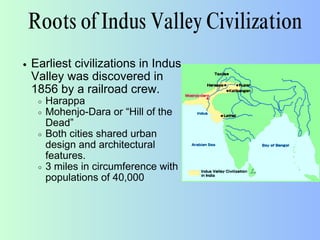
Earliest civilizations in Indus
Valley was discovered in
1856 by a railroad crew.
Harappa
Mohenjo-Dara or “Hill of the
Dead”
Both cities shared urban
design and architectural
features.
3 miles in circumference with
populations of 40,000
Page: 92
Roots of Indus Valley Civilization
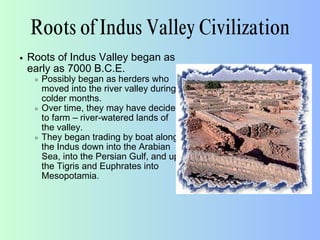
Roots of Indus Valley began as
early as 7000 B.C.E.
Possibly began as herders who
moved into the river valley during
colder months.
Over time, they may have decided
to farm – river-watered lands of
the valley.
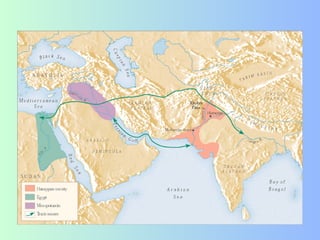
They began trading by boat along
the Indus down into the Arabian
Sea, into the Persian Gulf, and up
the Tigris and Euphrates into
Mesopotamia.
The Artifacts: Crafts and the Arts
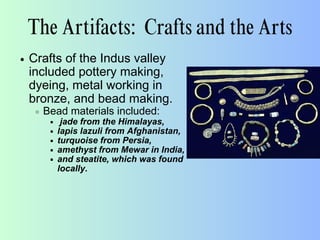
Crafts of the Indus valley
included pottery making,
dyeing, metal working in
bronze, and bead making.
Bead materials included:
jade from the Himalayas,
lapis lazuli from Afghanistan,
turquoise from Persia,
amethyst from Mewar in India,
and steatite, which was found
locally.
The Artifacts: Crafts and the Arts
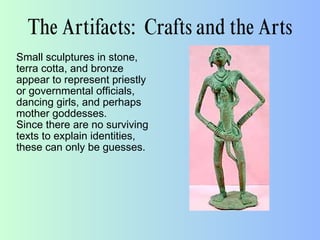
Small sculptures in stone,
terra cotta, and bronze
appear to represent priestly
or governmental officials,
dancing girls, and perhaps
mother goddesses.
Since there are no surviving
texts to explain identities,
these can only be guesses.
The Artifacts: Crafts and the Arts
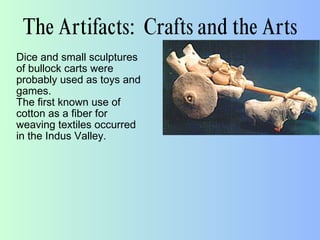
Dice and small sculptures
of bullock carts were
probably used as toys and
games.
The first known use of
cotton as a fiber for
weaving textiles occurred
in the Indus Valley.
Carefully Planned Cities
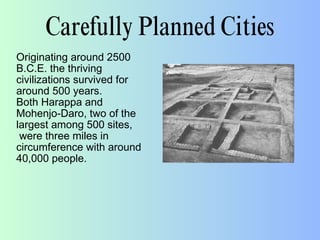
Originating around 2500
B.C.E. the thriving
civilizations survived for
around 500 years.
Both Harappa and
Mohenjo-Daro, two of the
largest among 500 sites,
were three miles in
circumference with around
40,000 people.
Mohenjo-Daro and Harappa
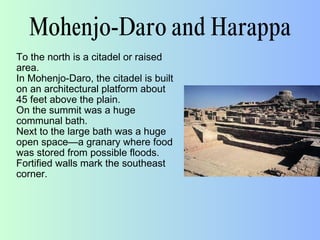
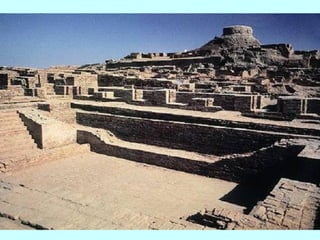
To the north is a citadel or raised
area.
In Mohenjo-Daro, the citadel is built
on an architectural platform about
45 feet above the plain.
On the summit was a huge
communal bath.
Next to the large bath was a huge
open space—a granary where food
was stored from possible floods.
Fortified walls mark the southeast
corner.
Mohenjo-Daro and Harappa
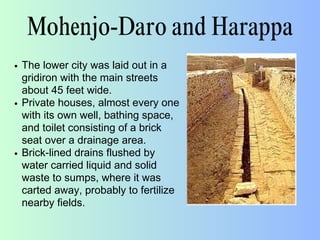
The lower city was laid out in a
gridiron with the main streets
about 45 feet wide.
Private houses, almost every one
with its own well, bathing space,
and toilet consisting of a brick
seat over a drainage area.
Brick-lined drains flushed by
water carried liquid and solid
waste to sumps, where it was
carted away, probably to fertilize
nearby fields.
Mohenjo-Daro and Harappa
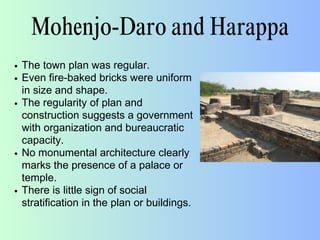
The town plan was regular.
Even fire-baked bricks were uniform
in size and shape.
The regularity of plan and
construction suggests a government
with organization and bureaucratic
capacity.
No monumental architecture clearly
marks the presence of a palace or
temple.
There is little sign of social
stratification in the plan or buildings.
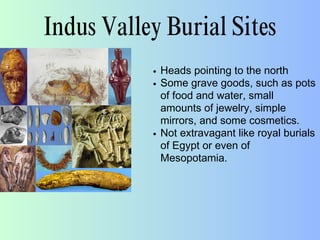
Indus Valley Burial Sites
Heads pointing to the north
Some grave goods, such as pots
of food and water, small
amounts of jewelry, simple
mirrors, and some cosmetics.
Not extravagant like royal burials
of Egypt or even of
Mesopotamia.
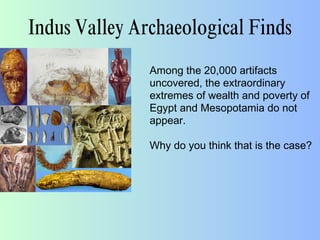
Indus Valley Archaeological Finds
Among the 20,000 artifacts
uncovered, the extraordinary
extremes of wealth and poverty of
Egypt and Mesopotamia do not
appear.
Why do you think that is the case?
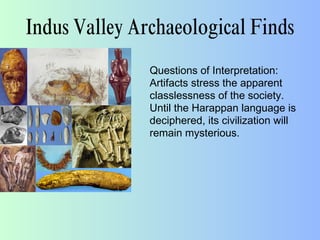
Indus Valley Archaeological Finds
Questions of Interpretation:
Artifacts stress the apparent
classlessness of the society.
Until the Harappan language is
deciphered, its civilization will
remain mysterious.
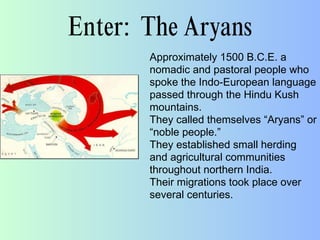
Enter: The Aryans
Approximately 1500 B.C.E. a
nomadic and pastoral people who
spoke the Indo-European language
passed through the Hindu Kush
mountains.
They called themselves “Aryans” or
“noble people.”
They established small herding
and agricultural communities
throughout northern India.
Their migrations took place over
several centuries.
Aryan Influence on Harappan
Society
Aryan migrations took place over several centuries.
Their arrival was not an invasion or organized military
campaign.
It is likely that Indo-European migrants clashed with
Dravidians (people settled in the Harappan area.)
By the time Aryans entered India, internal problems had
already brought Harappan society to the point of collapse.
During the centuries after 1500 B.C.E., Dravidian and Indo-
European peoples intermarried and laid social and cultural
foundations that influenced Indian society to present day.
Aryan Influence on Harappan
Society
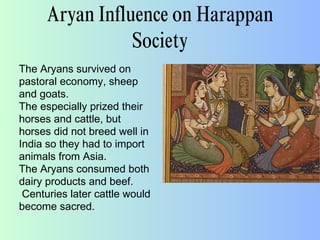
The Aryans survived on
pastoral economy, sheep
and goats.
The especially prized their
horses and cattle, but
horses did not breed well in
India so they had to import
animals from Asia.
The Aryans consumed both
dairy products and beef.
Centuries later cattle would
become sacred.
Aryan Influence on Harappan
Religion
The Vedas were collections of religious and literary
poems and songs transmitted orally.
There were four parts.
The most important part was the Rig Veda, a collection
of 1,028 hymns addressed to the Aryan gods.
Aryan priests compiled the Rig Veda between 1400 and
900 B.C.E.
It wasn’t put into writing until about 600 B.C.E.
The Vedic Age 1500 to 500
B.C.E.
The Vedas refer often to conflicts
between Aryans and the Dravidians
and other people already living in
India.
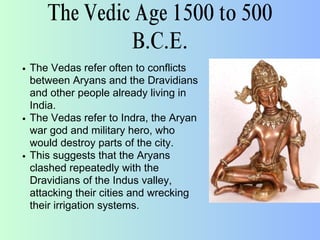
The Vedas refer to Indra, the Aryan
war god and military hero, who
would destroy parts of the city.
This suggests that the Aryans
clashed repeatedly with the
Dravidians of the Indus valley,
attacking their cities and wrecking
their irrigation systems.
The Vedic Age 1500 to 500
B.C.E.
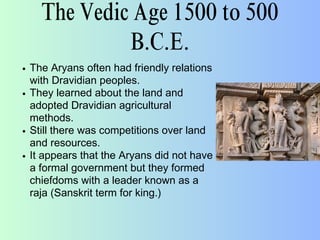
The Aryans often had friendly relations
with Dravidian peoples.
They learned about the land and
adopted Dravidian agricultural
methods.
Still there was competitions over land
and resources.
It appears that the Aryans did not have
a formal government but they formed
chiefdoms with a leader known as a
raja (Sanskrit term for king.)
Aryan Migrations in India
Aryans first settled in the Punjab, the upper Indus River
valley that straddles modern-day border between
northern India and Pakistan.
They spread east and south and established
communities throughout much of the subcontinent.
They learned to make iron tools and with axes and plow
they cleared forests and established agricultural
communities in the Ganges valley.
The Aryans gradually lost the tribal political
organization they had brought into India and evolved
into small kingdoms with formal governments.
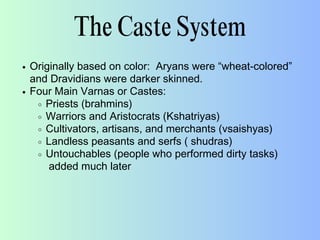
The Caste System
Originally based on color: Aryans were “wheat-colored”
and Dravidians were darker skinned.
Four Main Varnas or Castes:
Priests (brahmins)
Warriors and Aristocrats (Kshatriyas)
Cultivators, artisans, and merchants (vsaishyas)
Landless peasants and serfs ( shudras)
Untouchables (people who performed dirty tasks)
added much later
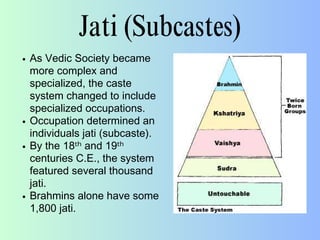
Jati (Subcastes)
As Vedic Society became
more complex and
specialized, the caste
system changed to include
specialized occupations.
Occupation determined an
individuals jati (subcaste).
By the 18ᵗʰ and 19ᵗʰ
centuries C.E., the system
featured several thousand
jati.
Brahmins alone have some
1,800 jati.
The Development of a Patriarch
Society
Aryan Society had a strong patriarchal social order at
the time of their migration into India.
All priests, warriors and tribal chiefs were men.
Women influenced affairs within their families but had
no public authority.
Women rarely learned the Vedas and were denied
formal education.
Sati, the practice of a wife sacrificing herself on her
husband’s funeral pyre, was considered noble.
Religion in Vedic Age
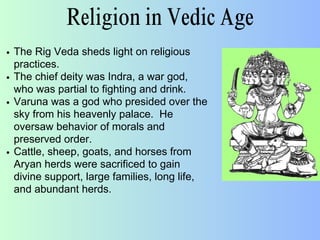
The Rig Veda sheds light on religious
practices.
The chief deity was Indra, a war god,
who was partial to fighting and drink.
Varuna was a god who presided over the
sky from his heavenly palace. He
oversaw behavior of morals and
preserved order.
Cattle, sheep, goats, and horses from
Aryan herds were sacrificed to gain
divine support, large families, long life,
and abundant herds.
Religion in Vedic Age
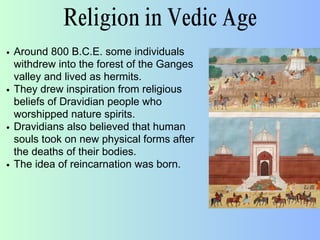
Around 800 B.C.E. some individuals
withdrew into the forest of the Ganges
valley and lived as hermits.
They drew inspiration from religious
beliefs of Dravidian people who
worshipped nature spirits.
Dravidians also believed that human
souls took on new physical forms after
the deaths of their bodies.
The idea of reincarnation was born.
The Upanishads
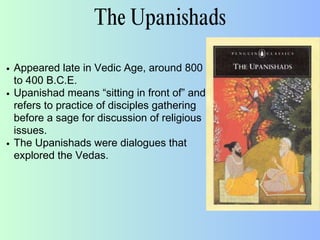
Appeared late in Vedic Age, around 800
to 400 B.C.E.
Upanishad means “sitting in front of” and
refers to practice of disciples gathering
before a sage for discussion of religious
issues.
The Upanishads were dialogues that
explored the Vedas.
The Upanishads
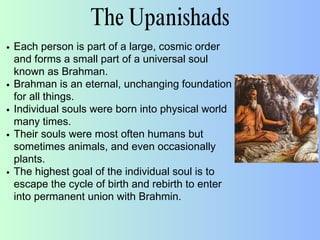
Each person is part of a large, cosmic order
and forms a small part of a universal soul
known as Brahman.
Brahman is an eternal, unchanging foundation
for all things.
Individual souls were born into physical world
many times.
Their souls were most often humans but
sometimes animals, and even occasionally
plants.
The highest goal of the individual soul is to
escape the cycle of birth and rebirth to enter
into permanent union with Brahmin.
Doctrines of the Upanishads
Samsara – Upon death, individuals go temporarily to the
World of the Fathers and then return to earth in a new form.
Karma – “…a man of good acts will become good, a man of
bad acts, bad. He becomes pure by pure deeds, bad by bad
deeds.”
Suffering – A certain amount of pain and suffering is
inevitable in human existence.
Moksha is a deep endless sleep that comes with permanent
liberation from physical incarnation.
Brahmin – You can achieve Brahmin through meditation and
asceticism, leading extremely simple lives and denying all
pleasure.
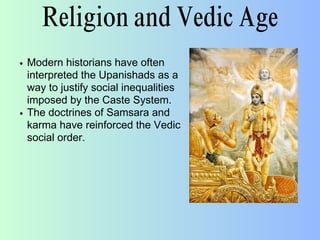
Religion and Vedic Age
Modern historians have often
interpreted the Upanishads as a
way to justify social inequalities
imposed by the Caste System.
The doctrines of Samsara and
karma have reinforced the Vedic
social order.
pdf_20230625_200914_0000.pdf

pdf_20230625_200914_0000.pdf

  • 1.
  • 2.
    Roots of IndusValley Civilization Earliest civilizations in Indus Valley was discovered in 1856 by a railroad crew. Harappa Mohenjo-Dara or “Hill of the Dead” Both cities shared urban design and architectural features. 3 miles in circumference with populations of 40,000
  • 3.
  • 4.
    Roots of IndusValley Civilization Roots of Indus Valley began as early as 7000 B.C.E. Possibly began as herders who moved into the river valley during colder months. Over time, they may have decided to farm – river-watered lands of the valley. They began trading by boat along the Indus down into the Arabian Sea, into the Persian Gulf, and up the Tigris and Euphrates into Mesopotamia.
  • 5.
    The Artifacts: Craftsand the Arts Crafts of the Indus valley included pottery making, dyeing, metal working in bronze, and bead making. Bead materials included: jade from the Himalayas, lapis lazuli from Afghanistan, turquoise from Persia, amethyst from Mewar in India, and steatite, which was found locally.
  • 6.
    The Artifacts: Craftsand the Arts Small sculptures in stone, terra cotta, and bronze appear to represent priestly or governmental officials, dancing girls, and perhaps mother goddesses. Since there are no surviving texts to explain identities, these can only be guesses.
  • 7.
    The Artifacts: Craftsand the Arts Dice and small sculptures of bullock carts were probably used as toys and games. The first known use of cotton as a fiber for weaving textiles occurred in the Indus Valley.
  • 8.
    Carefully Planned Cities Originatingaround 2500 B.C.E. the thriving civilizations survived for around 500 years. Both Harappa and Mohenjo-Daro, two of the largest among 500 sites, were three miles in circumference with around 40,000 people.
  • 9.
    Mohenjo-Daro and Harappa Tothe north is a citadel or raised area. In Mohenjo-Daro, the citadel is built on an architectural platform about 45 feet above the plain. On the summit was a huge communal bath. Next to the large bath was a huge open space—a granary where food was stored from possible floods. Fortified walls mark the southeast corner.
  • 11.
    Mohenjo-Daro and Harappa Thelower city was laid out in a gridiron with the main streets about 45 feet wide. Private houses, almost every one with its own well, bathing space, and toilet consisting of a brick seat over a drainage area. Brick-lined drains flushed by water carried liquid and solid waste to sumps, where it was carted away, probably to fertilize nearby fields.
  • 12.
    Mohenjo-Daro and Harappa Thetown plan was regular. Even fire-baked bricks were uniform in size and shape. The regularity of plan and construction suggests a government with organization and bureaucratic capacity. No monumental architecture clearly marks the presence of a palace or temple. There is little sign of social stratification in the plan or buildings.
  • 13.
    Indus Valley BurialSites Heads pointing to the north Some grave goods, such as pots of food and water, small amounts of jewelry, simple mirrors, and some cosmetics. Not extravagant like royal burials of Egypt or even of Mesopotamia.
  • 14.
    Indus Valley ArchaeologicalFinds Among the 20,000 artifacts uncovered, the extraordinary extremes of wealth and poverty of Egypt and Mesopotamia do not appear. Why do you think that is the case?
  • 15.
    Indus Valley ArchaeologicalFinds Questions of Interpretation: Artifacts stress the apparent classlessness of the society. Until the Harappan language is deciphered, its civilization will remain mysterious.
  • 16.
    Enter: The Aryans Approximately1500 B.C.E. a nomadic and pastoral people who spoke the Indo-European language passed through the Hindu Kush mountains. They called themselves “Aryans” or “noble people.” They established small herding and agricultural communities throughout northern India. Their migrations took place over several centuries.
  • 17.
    Aryan Influence onHarappan Society Aryan migrations took place over several centuries. Their arrival was not an invasion or organized military campaign. It is likely that Indo-European migrants clashed with Dravidians (people settled in the Harappan area.) By the time Aryans entered India, internal problems had already brought Harappan society to the point of collapse. During the centuries after 1500 B.C.E., Dravidian and Indo- European peoples intermarried and laid social and cultural foundations that influenced Indian society to present day.
  • 18.
    Aryan Influence onHarappan Society The Aryans survived on pastoral economy, sheep and goats. The especially prized their horses and cattle, but horses did not breed well in India so they had to import animals from Asia. The Aryans consumed both dairy products and beef. Centuries later cattle would become sacred.
  • 19.
    Aryan Influence onHarappan Religion The Vedas were collections of religious and literary poems and songs transmitted orally. There were four parts. The most important part was the Rig Veda, a collection of 1,028 hymns addressed to the Aryan gods. Aryan priests compiled the Rig Veda between 1400 and 900 B.C.E. It wasn’t put into writing until about 600 B.C.E.
  • 20.
    The Vedic Age1500 to 500 B.C.E. The Vedas refer often to conflicts between Aryans and the Dravidians and other people already living in India. The Vedas refer to Indra, the Aryan war god and military hero, who would destroy parts of the city. This suggests that the Aryans clashed repeatedly with the Dravidians of the Indus valley, attacking their cities and wrecking their irrigation systems.
  • 21.
    The Vedic Age1500 to 500 B.C.E. The Aryans often had friendly relations with Dravidian peoples. They learned about the land and adopted Dravidian agricultural methods. Still there was competitions over land and resources. It appears that the Aryans did not have a formal government but they formed chiefdoms with a leader known as a raja (Sanskrit term for king.)
  • 22.
    Aryan Migrations inIndia Aryans first settled in the Punjab, the upper Indus River valley that straddles modern-day border between northern India and Pakistan. They spread east and south and established communities throughout much of the subcontinent. They learned to make iron tools and with axes and plow they cleared forests and established agricultural communities in the Ganges valley. The Aryans gradually lost the tribal political organization they had brought into India and evolved into small kingdoms with formal governments.
  • 23.
    The Caste System Originallybased on color: Aryans were “wheat-colored” and Dravidians were darker skinned. Four Main Varnas or Castes: Priests (brahmins) Warriors and Aristocrats (Kshatriyas) Cultivators, artisans, and merchants (vsaishyas) Landless peasants and serfs ( shudras) Untouchables (people who performed dirty tasks) added much later
  • 24.
    Jati (Subcastes) As VedicSociety became more complex and specialized, the caste system changed to include specialized occupations. Occupation determined an individuals jati (subcaste). By the 18ᵗʰ and 19ᵗʰ centuries C.E., the system featured several thousand jati. Brahmins alone have some 1,800 jati.
  • 25.
    The Development ofa Patriarch Society Aryan Society had a strong patriarchal social order at the time of their migration into India. All priests, warriors and tribal chiefs were men. Women influenced affairs within their families but had no public authority. Women rarely learned the Vedas and were denied formal education. Sati, the practice of a wife sacrificing herself on her husband’s funeral pyre, was considered noble.
  • 26.
    Religion in VedicAge The Rig Veda sheds light on religious practices. The chief deity was Indra, a war god, who was partial to fighting and drink. Varuna was a god who presided over the sky from his heavenly palace. He oversaw behavior of morals and preserved order. Cattle, sheep, goats, and horses from Aryan herds were sacrificed to gain divine support, large families, long life, and abundant herds.
  • 27.
    Religion in VedicAge Around 800 B.C.E. some individuals withdrew into the forest of the Ganges valley and lived as hermits. They drew inspiration from religious beliefs of Dravidian people who worshipped nature spirits. Dravidians also believed that human souls took on new physical forms after the deaths of their bodies. The idea of reincarnation was born.
  • 28.
    The Upanishads Appeared latein Vedic Age, around 800 to 400 B.C.E. Upanishad means “sitting in front of” and refers to practice of disciples gathering before a sage for discussion of religious issues. The Upanishads were dialogues that explored the Vedas.
  • 29.
    The Upanishads Each personis part of a large, cosmic order and forms a small part of a universal soul known as Brahman. Brahman is an eternal, unchanging foundation for all things. Individual souls were born into physical world many times. Their souls were most often humans but sometimes animals, and even occasionally plants. The highest goal of the individual soul is to escape the cycle of birth and rebirth to enter into permanent union with Brahmin.
  • 30.
    Doctrines of theUpanishads Samsara – Upon death, individuals go temporarily to the World of the Fathers and then return to earth in a new form. Karma – “…a man of good acts will become good, a man of bad acts, bad. He becomes pure by pure deeds, bad by bad deeds.” Suffering – A certain amount of pain and suffering is inevitable in human existence. Moksha is a deep endless sleep that comes with permanent liberation from physical incarnation. Brahmin – You can achieve Brahmin through meditation and asceticism, leading extremely simple lives and denying all pleasure.
  • 31.
    Religion and VedicAge Modern historians have often interpreted the Upanishads as a way to justify social inequalities imposed by the Caste System. The doctrines of Samsara and karma have reinforced the Vedic social order.