SLIDESMANIA.COM
SLIDESMANIA.COM
Connectors
Note:
There are two types of words that can be
used as connectors at the beginning of an
independent clause: coordinating
conjunctions and independent marker
words.
SLIDESMANIA.COM
SLIDESMANIA.COM
Coordinating Conjunctions
A. Coordinating conjunctions coordinate or join
two or more sentences, main clauses, words, or
other parts of speech which are of the same
syntactic importance.
Also known as coordinators, coordinating
conjunctions are used to give equal emphasis to a
pair of main clauses.
Coordinating conjunctions always connect
phrases, words, and clauses.
SLIDESMANIA.COM
SLIDESMANIA.COM
Coordinating Conjunctions
For example:
This batch of mushroom stew is
savory and delicious.
SLIDESMANIA.COM
SLIDESMANIA.COM
Coordinating Conjunctions
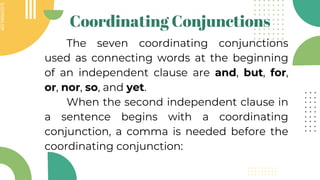
The seven coordinating conjunctions
used as connecting words at the beginning
of an independent clause are and, but, for,
or, nor, so, and yet.
When the second independent clause in
a sentence begins with a coordinating
conjunction, a comma is needed before the
coordinating conjunction:
SLIDESMANIA.COM
SLIDESMANIA.COM
Coordinating Conjunctions
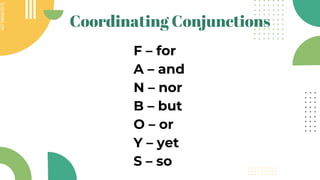
F – for
A – and
N – nor
B – but
O – or
Y – yet
S – so
SLIDESMANIA.COM
SLIDESMANIA.COM
Coordinating Conjunctions
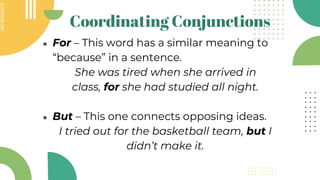
● For – This word has a similar meaning to
“because” in a sentence.
She was tired when she arrived in
class, for she had studied all night.
● But – This one connects opposing ideas.
I tried out for the basketball team, but I
didn’t make it.
SLIDESMANIA.COM
SLIDESMANIA.COM
Coordinating Conjunctions
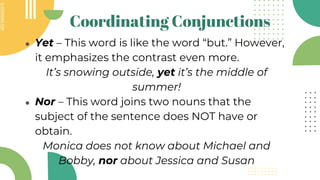
● Yet – This word is like the word “but.” However,
it emphasizes the contrast even more.
It’s snowing outside, yet it’s the middle of
summer!
● Nor – This word joins two nouns that the
subject of the sentence does NOT have or
obtain.
Monica does not know about Michael and
Bobby, nor about Jessica and Susan
SLIDESMANIA.COM
SLIDESMANIA.COM
Coordinating Conjunctions
● So/Yet – These words suggest time and
continuation depending on the context.
So far, he hasn’t told her the truth.
They love football, yet they gave up their tickets
to someone less fortunate.
SLIDESMANIA.COM
SLIDESMANIA.COM
Coordinating Conjunctions
Examples:
1. You can eat your cake with a spoon or fork.
2. My dog enjoys being bathed but hates
getting his nails trimmed.
3. Bill refuses to eat peas, nor will he touch
carrots.
SLIDESMANIA.COM
SLIDESMANIA.COM
Coordinating Conjunctions
Examples:
4. I hate to waste a drop of gas, for it is very
expensive these days.
5. Jim studied in the Sweet Shop for his
chemistry quiz, but it was hard to
concentrate because of the noise.
SLIDESMANIA.COM
SLIDESMANIA.COM
Independent Marker Word
B. Independent Marker Word
An independent marker word is a connecting
word used at the beginning of an independent
clause. These words can always begin a sentence
that can stand alone.
When the second independent clause in a
sentence has an independent marker word, a
semicolon is needed before the independent
marker word.
SLIDESMANIA.COM
SLIDESMANIA.COM
Independent Marker Word
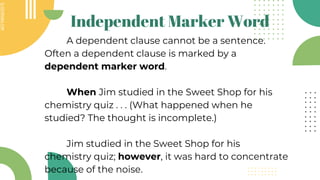
A dependent clause cannot be a sentence.
Often a dependent clause is marked by a
dependent marker word.
When Jim studied in the Sweet Shop for his
chemistry quiz . . . (What happened when he
studied? The thought is incomplete.)
Jim studied in the Sweet Shop for his
chemistry quiz; however, it was hard to concentrate
because of the noise.
SLIDESMANIA.COM
SLIDESMANIA.COM
Independent Marker Word
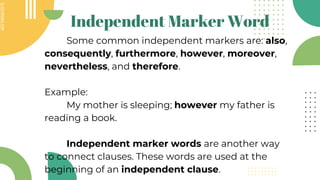
Some common independent markers are: also,
consequently, furthermore, however, moreover,
nevertheless, and therefore.
Example:
My mother is sleeping; however my father is
reading a book.
Independent marker words are another way
to connect clauses. These words are used at the
beginning of an independent clause.
SLIDESMANIA.COM
SLIDESMANIA.COM
Subordinating Conjunction
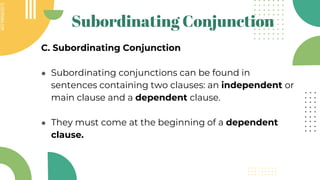
C. Subordinating Conjunction
● Subordinating conjunctions can be found in
sentences containing two clauses: an independent or
main clause and a dependent clause.
● They must come at the beginning of a dependent
clause.
SLIDESMANIA.COM
SLIDESMANIA.COM
Subordinating Conjunction
● Subordinators help lend meaning to a sentence
by linking two ideas. Time, concession,
comparison, cause, condition, and place are the
types of subordinating conjunctions, categorized
by meaning.
● In most sentences, as long as the subordinating
conjunction precedes the dependent clause,
clause order does not matter.
SLIDESMANIA.COM
SLIDESMANIA.COM
Subordinating Conjunction
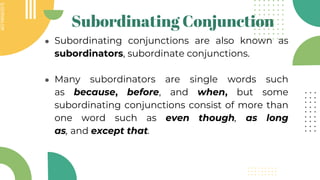
● Subordinating conjunctions are also known as
subordinators, subordinate conjunctions.
● Many subordinators are single words such
as because, before, and when, but some
subordinating conjunctions consist of more than
one word such as even though, as long
as, and except that.
SLIDESMANIA.COM
SLIDESMANIA.COM
Subordinating Conjunction
Subordinating conjunctions that show
Cause and Effect
Few commonly used subordinating
conjunctions that show cause and effect are
because, since, though, as, hence, as a result of,
in order that, so that, even though, although,
unless, because of, unless, provided that etc.
These conjunctions are used to show the cause
and effect of something. Let us see some examples
SLIDESMANIA.COM
SLIDESMANIA.COM
Subordinating Conjunction
Subordinating conjunctions that show
Cause and Effect examples:
● I am not going to work because I am sick.
● I will not release her payment unless she
completes her work.
● Although she is petite, she has a lot of strength.
SLIDESMANIA.COM
SLIDESMANIA.COM
Subordinating Conjunction
Subordinating conjunctions that show the
Significance of Time or Place
Few subordinating conjunctions are used to
show the transition of place or time. Examples of
this type of conjunctions are where, wherever, as
soon as, as long as, once, when, till, until, while,
whenever etc.
SLIDESMANIA.COM
SLIDESMANIA.COM
Subordinating Conjunction
Subordinating conjunctions that show the
Significance of Time or Place examples:
● Whenever his wife was out working, he would
take care of the house.
● As long as she lived, she took care of the
orphanage.
● I won’t be back in Mumbai until early next week.
● The child ran to her mother as soon as she saw
her.
SLIDESMANIA.COM
SLIDESMANIA.COM
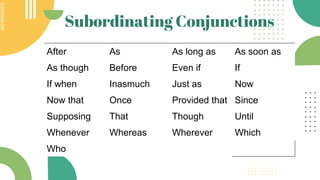
Subordinating Conjunctions
After As As long as As soon as
As though Before Even if If
If when Inasmuch Just as Now
Now that Once Provided that Since
Supposing That Though Until
Whenever Whereas Wherever Which
Who
SLIDESMANIA.COM
SLIDESMANIA.COM
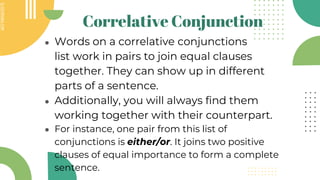
Correlative Conjunction
● Words on a correlative conjunctions
list work in pairs to join equal clauses
together. They can show up in different
parts of a sentence.
● Additionally, you will always find them
working together with their counterpart.
● For instance, one pair from this list of
conjunctions is either/or. It joins two positive
clauses of equal importance to form a complete
sentence.
SLIDESMANIA.COM
SLIDESMANIA.COM
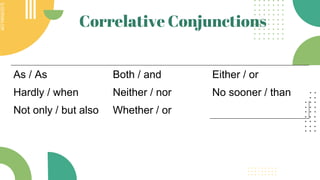
Correlative Conjunctions
As / As Both / and Either / or
Hardly / when Neither / nor No sooner / than
Not only / but also Whether / or
SLIDESMANIA.COM
SLIDESMANIA.COM
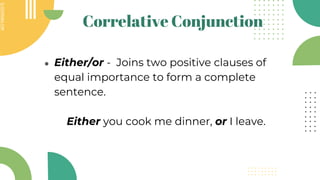
Correlative Conjunction
● Either/or - Joins two positive clauses of
equal importance to form a complete
sentence.
Either you cook me dinner, or I leave.
SLIDESMANIA.COM
SLIDESMANIA.COM
Correlative Conjunction
● Whether/Or – This pair functions like the
word if by bringing up hypothetical
situations and joins the two options.
I’m wearing my new swimsuit whether I go
to the beach or to the swimming pool.
SLIDESMANIA.COM
SLIDESMANIA.COM
Correlative Conjunction
● As/As – You can compare two things
together using these words from a
conjunctions list.
Her sneeze was as loud as a helicopter.

Q1_L7_Connectors.pdf