The International Journal Of Engineering And Science (IJES) 
|| Volume || 3 || Issue || 8 || Pages || 45-50 || 2014 || 
ISSN (e): 2319 – 1813 ISSN (p): 2319 – 1805 
www.theijes.com The IJES Page 45 
 Single Channel Speech De-noising Using Kernel Independent Component Analysis (KICA) 1, Miss.Kamble Madhu, 2, Prof. S.L.Sahare 1, 2, Department of Electronics and Tele-Communication, CCOEW pune. ---------------------------------------------------------ABSTRACT---------------------------------------------------------- In this paper, a single channel speech De-noising algorithm is proposed by adding a noisy signal to the observed signal for single channel De-noising using independent component analysis and further the signals are separated. We illustrate Simulation result gives us better De-noising using ICA. 
Keywords – Independent component analysis, Framing, de-framing, Blind source separation. 
------------------------------------------------------------------------------------------------------------------------------------- Date of Submission: 26 July 2014 Date of Publication: 10 August 2014 ------------------------------------------------------------------------------------------------------------------------------------- 
I. INTRODUCTION 
Speech communication plays an important role in communication system. But, in practice speech signals are distorted by background such as train noise, car noise, etc. De-noising of speech signals plays an important role to increase the quality and intelligibility of received speech signals.[7] In the past few decades number of speech de-noising methods has been proposed. Most of the methods work on multi channel speech de-noising where one of the channels is taken as primary input and others as a reference noisy signal. But, in practice for speech communication system only one channel is available, example mobile, hearing aid, tele - conferencing etc, thus single channel speech De-noising becomes a challenging task. Our work tends towards development of single channel speech enhancement. There are various methods of speech de-noising like spectral subtraction based on estimation of noise, wavelet transform based on soft threshold parameters, etc [1] In this paper we are proposing speech de-noising method based on kernel ICA (Independent Component Analysis). ICA basically is a blind separation of statistically independent sources, assuming the linear mixing of the sources at the sensors. Normally ICA works on the multi-channel signals but here we are suppose to work on a single channel to perform the operation of ICA it is quite challenging one with a single channel to perform on ICA. It is possible to transform one dimensional time series signal to multi dimensional time series by using a delay embedding technique. So that single channel can be converted to multi channel signal to perform ICA often. This transform of delay embedding technique produces non-linearity. ICA is a linear transformation technique so to overcome this non-linearity we introduce kernel tricks. Kernel tricks are used for mapping non- linear input space to linear feature space. This paper is arranged as follows:- Section 1- covers introduction to need of speech de-noising. Section 2- is the review of ICA (Independent Component Analysis). Section 3- is brief detailed information about kernel independent component analysis. Section 4- covers the proposed methodology of our paper. Section 5- gives us the simulation results and finally Section 6- is the conclusion of our paper. 
II. REVIEW OF ICA 
The problem of Blind Source separation boils down to finding a linear representation were components are statistically independent. ICA is recently invented method in which the goal is to find a linear representation of non-Gaussian data so that the components are statistically independent as possible. ICA differs from other method that it looks for the components that are both statistically independent and non- Gaussian.[2].
Single Channel Speech De-noising Using Kernel Independent Component Analysis (KICA) 
www.theijes.com The IJES Page 46 
The basic ICA model, consist of mixed signals where x ( t ) can be expressed as 
x ( t )  As ( t )......... .(1) 
Where A is unknown mixing matrix, and s ( t ) represents source signals which are assumed to be 
statistically independent. ICA model describes that how the observed mixture signals x ( t ) are generated by a 
process that uses the mixing matrix A to mix the source signals s ( t ) . 
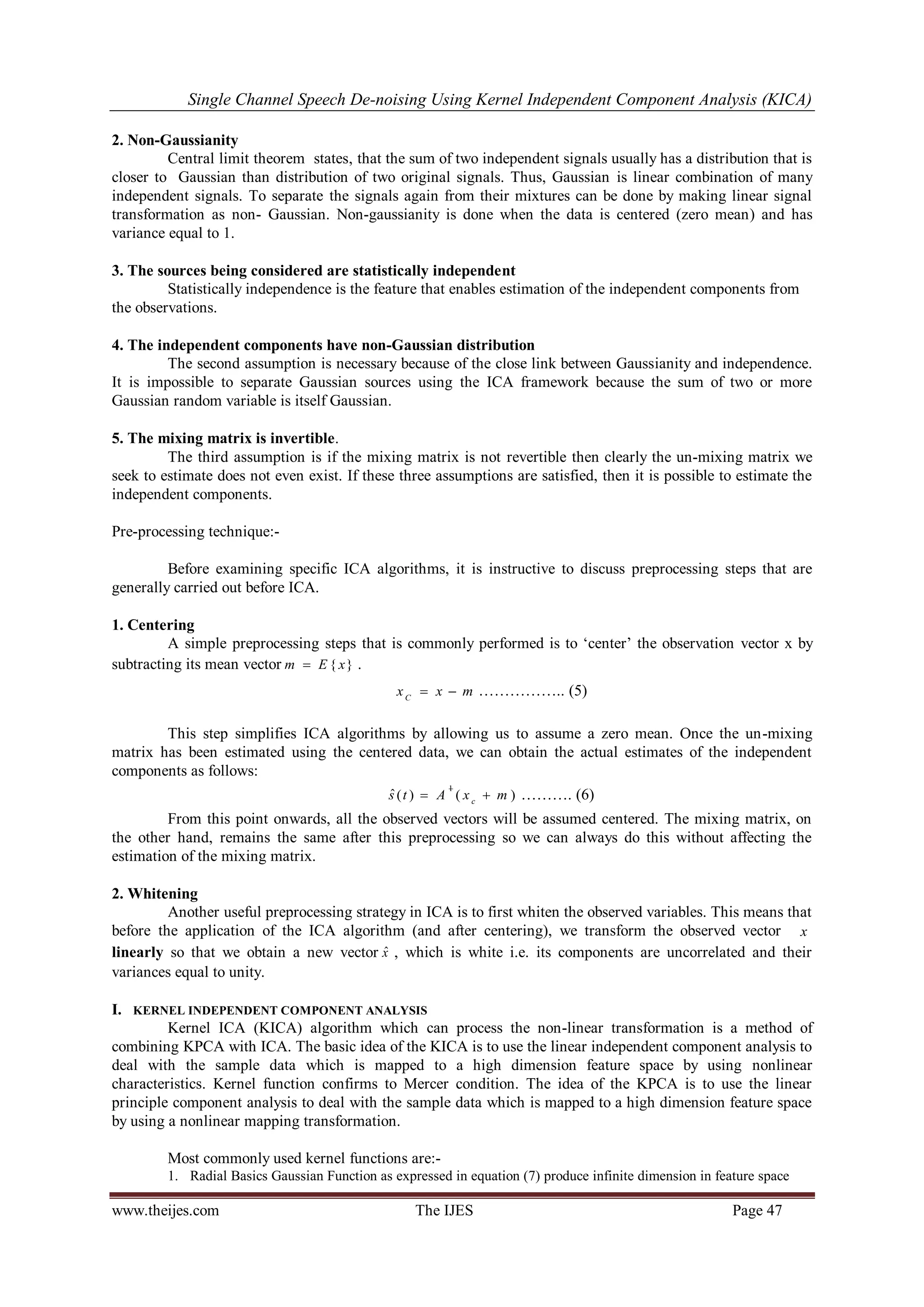
B.S.S of signal can be achieved by finding a de-mixing matrix W as shown in Figure 1. 
sˆ ( t )  Wx ( t )......... .( 2 ) 
Signal sˆ ( t ) is the estimation of source signals s ( t ) . 
The recovered signals sˆ ( t ) are almost equal to that of original signals s ( t ) if 1 
W  A and sˆ ( t ) 
are called as independent components. 
Figure 1:- Blind source separation (BSS) block diagram. s ( t ) are the sources. x ( t ) are the recordings, sˆ ( t ) 
are the estimated sources A is mixing matrix and W is un-mixing matrix. 
Before performing ICA some assumptions has to be considered. 
III. STATISTICAL INDEPENDENCE 
Defined in terms of probability density of the signals. Consider the joint probability density function 
(pdf) of s1 and s2 be P(s1,s2). Let the marginal pdf of s1 and s2 be denoted by P1(s1) andPp2(s2) respectively. 
s1 and s2 are said to be independent if and only if the joint pdf can be expressed as; 
( 1, 2 ) 1 2 ( ) s1, s 2 ( s1) s 2 P s s  P P ….... (3) 
1. Un-correlatedness and Independence 
s1 and s2 are un-correlatedness if their covariance C(s1,s2) is zero. 
C(s1, s2) = E{(s1−ms1)(s2−ms2)} 
= E{s1s2−s1ms2−s2ms1+ms1ms2} 
= E{s1s2}−E{s1}E{s2} 
= 0 … ….……………….. (4) 
Where ms1 is mean of the signal. Hence independent variables are always uncorrelated. But inverse is not true.
Single Channel Speech De-noising Using Kernel Independent Component Analysis (KICA) 
www.theijes.com The IJES Page 47 
2. Non-Gaussianity 
Central limit theorem states, that the sum of two independent signals usually has a distribution that is 
closer to Gaussian than distribution of two original signals. Thus, Gaussian is linear combination of many 
independent signals. To separate the signals again from their mixtures can be done by making linear signal 
transformation as non- Gaussian. Non-gaussianity is done when the data is centered (zero mean) and has 
variance equal to 1. 
3. The sources being considered are statistically independent 
Statistically independence is the feature that enables estimation of the independent components from 
the observations. 
4. The independent components have non-Gaussian distribution 
The second assumption is necessary because of the close link between Gaussianity and independence. 
It is impossible to separate Gaussian sources using the ICA framework because the sum of two or more 
Gaussian random variable is itself Gaussian. 
5. The mixing matrix is invertible. 
The third assumption is if the mixing matrix is not revertible then clearly the un-mixing matrix we 
seek to estimate does not even exist. If these three assumptions are satisfied, then it is possible to estimate the 
independent components. 
Pre-processing technique:- 
Before examining specific ICA algorithms, it is instructive to discuss preprocessing steps that are 
generally carried out before ICA. 
1. Centering 
A simple preprocessing steps that is commonly performed is to „center‟ the observation vector x by 
subtracting its mean vector m  E { x} . 
x x m C   …………….. (5) 
This step simplifies ICA algorithms by allowing us to assume a zero mean. Once the un-mixing 
matrix has been estimated using the centered data, we can obtain the actual estimates of the independent 
components as follows: 
ˆ ( ) ( ) 1 
s t A x m c   
 ………. (6) 
From this point onwards, all the observed vectors will be assumed centered. The mixing matrix, on 
the other hand, remains the same after this preprocessing so we can always do this without affecting the 
estimation of the mixing matrix. 
2. Whitening 
Another useful preprocessing strategy in ICA is to first whiten the observed variables. This means that 
before the application of the ICA algorithm (and after centering), we transform the observed vector x 
linearly so that we obtain a new vector xˆ , which is white i.e. its components are uncorrelated and their 
variances equal to unity. 
I. KERNEL INDEPENDENT COMPONENT ANALYSIS 
Kernel ICA (KICA) algorithm which can process the non-linear transformation is a method of 
combining KPCA with ICA. The basic idea of the KICA is to use the linear independent component analysis to 
deal with the sample data which is mapped to a high dimension feature space by using nonlinear 
characteristics. Kernel function confirms to Mercer condition. The idea of the KPCA is to use the linear 
principle component analysis to deal with the sample data which is mapped to a high dimension feature space 
by using a nonlinear mapping transformation. 
Most commonly used kernel functions are:- 
1. Radial Basics Gaussian Function as expressed in equation (7) produce infinite dimension in feature space
Single Channel Speech De-noising Using Kernel Independent Component Analysis (KICA) 
www.theijes.com The IJES Page 48 
) 
2 
' 
( , ' ) exp( 
2 
2 
 
x x 
k x x 
 
  …………… (7) 
And simplest 
2. Polynomial Kernel Function as expressed in equation (8) having finite dimensions 
( , ) (( . ) ) .......... .......... .....( 8) 
2 
k x y  x y  c 
II. PROPOSED METHODOLOGY 
The proposed method for de-noising of single channel speech signal is shown in the Fig. no 2. 
Figure 2- Principal Block Diagram of the ICA algorithm. 
Assume that x ( t ) is input speech having clean speech s ( t ) and additive noise n ( t ) . Therefore the 
input signal would be presented as 
x ( t )  s ( t )  n ( t )......... .......... ..( 9 ) 
x ( t ) Consist of N observation obtain by windowing x ( t ) having hamming window. Now we transfer 
one dimensional signal to multi dimensional by using Delay embedding.[3]. 
 . .  .........( 10 ) 1 2 
T 
M X  x x x 
Can be expressed as 
 
 
 
 
 
 
 
 
 
 
 
 
 
 
 
. 
. 
. . . . 
. 
. 
1 
2 3 1 
1 2 
D D K 
N 
N 
x x x 
x x x 
x x x 
X ……….. (11) 
X  D  N .......... .......... .......... .......... .(12 ) 
And 
K  D  N  1 
Where D is the dimension and N is the number of observations.
Single Channel Speech De-noising Using Kernel Independent Component Analysis (KICA) 
www.theijes.com The IJES Page 49 
IV. SIMULATION RESULTS 
We perform a simulation to confirm the windowing and de-windowing concept practically. A speech signal in .wav format is taken as input signal (i.e. sp01.wav) with the help of windowing and de-windowing i.e. (framing and de-framing) is done on that speech signal of its over-sampled signaled and again the original speech signal is been obtained. Fig 3 shows the results of framing, de-framing, windowing and de-windowing. Figure 3 Simulation results. 
III. CONCLUSION 
In this paper, a single channel speech de-noising which is based on ICA is proposed to reconstruct original speech from noisy speech. Up to certain length of the speech a framing and de-framing is done to again get back the original single channel speech. 
ACKNOWLEDGEMENTS 
I am grateful to the department of Electronics and Communication Engineering for giving a lot of freedom, encouragement and guidance. I am also thankful to the Technical Staff of the DSP Laboratory, CCOEW, Pune for helping me during the experimental work. 
REFERENCES 
Journal Papers: 
[1] Journal of Machine Learning Research 3 (2002) 1-48 Submitted 11/01; Published 07/02 “Kernel Independent Component Analysis” Francis R. Bach fbach@cs.berkeley.edu Computer Science Division University of California Berkeley, CA 94720, USA Michael I. Jordan jordan@cs.berkeley.edu Computer Science Division and Department of Statistics University of California Berkeley, CA 94720, USA. [2] 49th IEEE Conference on Decision and Control December 15-17, 2010 Hilton Atlanta Hotel, Atlanta, GA, USA “ Stable Takens’ Embedding for Linear Dynamical Systems” Han Lun Yap and Christopher J. Rozell 
[3] 2012 4th International Conference on Intelligent Human-Machine Systems and Cybernetics “Independent Component Analysis without Preprocessing” Zhong Wang Computer Science Department City Colledge, enzhou University Wenzhou, China e-mail: ramon.wzhong@139.com Hongyuan Zhang Computer Science Department City Colledge, Wenzhou University Wenzhou, China e-mail: zhanghongyuan@163.com Books: [1] Aapo Hyvarinen, Juha Karhunen and Erkki Oja “INDEPENDENT COMPONENT ANALYSIS” (.(source: central library) 
[1] Philipos. C.Loizou “Speech enhancement:theory and practice” CRC Press.07-Jun-2007-computers-608 Pages 
Theses: 
[1]. Speech Enhancement Algorithm Based on Independent Component Analysis, Hong-yan Li Qing-hua Zhao Guang-long Ren Bao-jin Xiao college of information Engineering of Taiyuan University of Technology Taiyuan, China. 
[2]. Implementation of PCA & ICA for Voice ecognition and Separation of Speech Author A. Nitin Kandpal Sost Department 121T Pune, India Author B. B. Madhusudan Rao Embedded Department 121T Pune, India savera.2020@gmail.com 
[3]. Takens‟ embedding theorem for infinite-dimensional dynamical systems James C. Robinson Mathematics Institute, University of Warwick, Coventry, CV4 7AL, U.K. E-mail: jcr@maths.warwick.ac.ukTE Won Lee, Kluwer : Independent component analysis publication 
[4]. Audio Denoising by Time-Frequency Block Thresholding Guoshen Yu, Stéphane Mallat, Fellow, IEEE, and Emmanuel Bacry 
[5]. The Cocktail Party Problem Simon Haykin haykin@mcmaster.ca ZheChen zhechen@soma.crl.mcmaster.ca Adaptive Systems Lab, McMaster University, Hamilton, Ontario, Canada L8S 4K1.
Single Channel Speech De-noising Using Kernel Independent Component Analysis (KICA) 
www.theijes.com The IJES Page 50 
Biographies and Photographs Miss. Kamble Madhu R I am a student pursuing my Masters in Electronics and Tele-communication from CCOEW Pune,(Pune university) under the Guidance of Prof. S.L.Sahare. Obtained B.E degree in Electronics and Tele-communication from shivaji university. Research interest is in signal processing. Prof. S.L.Sahare He is an Assistant Professor at Department of Electronics and Tele-Communication in CCOEW Pune. He has obtained M.TECH degree in Electronics Design and Technology from CEDTI, B. E. degree in Electronics Engineering from Nagpur and research scholar of Sathyabama University, Chennai. His area of interest is signal processing and electronics design.

Single Channel Speech De-noising Using Kernel Independent Component Analysis (KICA)

  • 1.
    The International JournalOf Engineering And Science (IJES) || Volume || 3 || Issue || 8 || Pages || 45-50 || 2014 || ISSN (e): 2319 – 1813 ISSN (p): 2319 – 1805 www.theijes.com The IJES Page 45  Single Channel Speech De-noising Using Kernel Independent Component Analysis (KICA) 1, Miss.Kamble Madhu, 2, Prof. S.L.Sahare 1, 2, Department of Electronics and Tele-Communication, CCOEW pune. ---------------------------------------------------------ABSTRACT---------------------------------------------------------- In this paper, a single channel speech De-noising algorithm is proposed by adding a noisy signal to the observed signal for single channel De-noising using independent component analysis and further the signals are separated. We illustrate Simulation result gives us better De-noising using ICA. Keywords – Independent component analysis, Framing, de-framing, Blind source separation. ------------------------------------------------------------------------------------------------------------------------------------- Date of Submission: 26 July 2014 Date of Publication: 10 August 2014 ------------------------------------------------------------------------------------------------------------------------------------- I. INTRODUCTION Speech communication plays an important role in communication system. But, in practice speech signals are distorted by background such as train noise, car noise, etc. De-noising of speech signals plays an important role to increase the quality and intelligibility of received speech signals.[7] In the past few decades number of speech de-noising methods has been proposed. Most of the methods work on multi channel speech de-noising where one of the channels is taken as primary input and others as a reference noisy signal. But, in practice for speech communication system only one channel is available, example mobile, hearing aid, tele - conferencing etc, thus single channel speech De-noising becomes a challenging task. Our work tends towards development of single channel speech enhancement. There are various methods of speech de-noising like spectral subtraction based on estimation of noise, wavelet transform based on soft threshold parameters, etc [1] In this paper we are proposing speech de-noising method based on kernel ICA (Independent Component Analysis). ICA basically is a blind separation of statistically independent sources, assuming the linear mixing of the sources at the sensors. Normally ICA works on the multi-channel signals but here we are suppose to work on a single channel to perform the operation of ICA it is quite challenging one with a single channel to perform on ICA. It is possible to transform one dimensional time series signal to multi dimensional time series by using a delay embedding technique. So that single channel can be converted to multi channel signal to perform ICA often. This transform of delay embedding technique produces non-linearity. ICA is a linear transformation technique so to overcome this non-linearity we introduce kernel tricks. Kernel tricks are used for mapping non- linear input space to linear feature space. This paper is arranged as follows:- Section 1- covers introduction to need of speech de-noising. Section 2- is the review of ICA (Independent Component Analysis). Section 3- is brief detailed information about kernel independent component analysis. Section 4- covers the proposed methodology of our paper. Section 5- gives us the simulation results and finally Section 6- is the conclusion of our paper. II. REVIEW OF ICA The problem of Blind Source separation boils down to finding a linear representation were components are statistically independent. ICA is recently invented method in which the goal is to find a linear representation of non-Gaussian data so that the components are statistically independent as possible. ICA differs from other method that it looks for the components that are both statistically independent and non- Gaussian.[2].
  • 2.
    Single Channel SpeechDe-noising Using Kernel Independent Component Analysis (KICA) www.theijes.com The IJES Page 46 The basic ICA model, consist of mixed signals where x ( t ) can be expressed as x ( t )  As ( t )......... .(1) Where A is unknown mixing matrix, and s ( t ) represents source signals which are assumed to be statistically independent. ICA model describes that how the observed mixture signals x ( t ) are generated by a process that uses the mixing matrix A to mix the source signals s ( t ) . B.S.S of signal can be achieved by finding a de-mixing matrix W as shown in Figure 1. sˆ ( t )  Wx ( t )......... .( 2 ) Signal sˆ ( t ) is the estimation of source signals s ( t ) . The recovered signals sˆ ( t ) are almost equal to that of original signals s ( t ) if 1 W  A and sˆ ( t ) are called as independent components. Figure 1:- Blind source separation (BSS) block diagram. s ( t ) are the sources. x ( t ) are the recordings, sˆ ( t ) are the estimated sources A is mixing matrix and W is un-mixing matrix. Before performing ICA some assumptions has to be considered. III. STATISTICAL INDEPENDENCE Defined in terms of probability density of the signals. Consider the joint probability density function (pdf) of s1 and s2 be P(s1,s2). Let the marginal pdf of s1 and s2 be denoted by P1(s1) andPp2(s2) respectively. s1 and s2 are said to be independent if and only if the joint pdf can be expressed as; ( 1, 2 ) 1 2 ( ) s1, s 2 ( s1) s 2 P s s  P P ….... (3) 1. Un-correlatedness and Independence s1 and s2 are un-correlatedness if their covariance C(s1,s2) is zero. C(s1, s2) = E{(s1−ms1)(s2−ms2)} = E{s1s2−s1ms2−s2ms1+ms1ms2} = E{s1s2}−E{s1}E{s2} = 0 … ….……………….. (4) Where ms1 is mean of the signal. Hence independent variables are always uncorrelated. But inverse is not true.
  • 3.
    Single Channel SpeechDe-noising Using Kernel Independent Component Analysis (KICA) www.theijes.com The IJES Page 47 2. Non-Gaussianity Central limit theorem states, that the sum of two independent signals usually has a distribution that is closer to Gaussian than distribution of two original signals. Thus, Gaussian is linear combination of many independent signals. To separate the signals again from their mixtures can be done by making linear signal transformation as non- Gaussian. Non-gaussianity is done when the data is centered (zero mean) and has variance equal to 1. 3. The sources being considered are statistically independent Statistically independence is the feature that enables estimation of the independent components from the observations. 4. The independent components have non-Gaussian distribution The second assumption is necessary because of the close link between Gaussianity and independence. It is impossible to separate Gaussian sources using the ICA framework because the sum of two or more Gaussian random variable is itself Gaussian. 5. The mixing matrix is invertible. The third assumption is if the mixing matrix is not revertible then clearly the un-mixing matrix we seek to estimate does not even exist. If these three assumptions are satisfied, then it is possible to estimate the independent components. Pre-processing technique:- Before examining specific ICA algorithms, it is instructive to discuss preprocessing steps that are generally carried out before ICA. 1. Centering A simple preprocessing steps that is commonly performed is to „center‟ the observation vector x by subtracting its mean vector m  E { x} . x x m C   …………….. (5) This step simplifies ICA algorithms by allowing us to assume a zero mean. Once the un-mixing matrix has been estimated using the centered data, we can obtain the actual estimates of the independent components as follows: ˆ ( ) ( ) 1 s t A x m c    ………. (6) From this point onwards, all the observed vectors will be assumed centered. The mixing matrix, on the other hand, remains the same after this preprocessing so we can always do this without affecting the estimation of the mixing matrix. 2. Whitening Another useful preprocessing strategy in ICA is to first whiten the observed variables. This means that before the application of the ICA algorithm (and after centering), we transform the observed vector x linearly so that we obtain a new vector xˆ , which is white i.e. its components are uncorrelated and their variances equal to unity. I. KERNEL INDEPENDENT COMPONENT ANALYSIS Kernel ICA (KICA) algorithm which can process the non-linear transformation is a method of combining KPCA with ICA. The basic idea of the KICA is to use the linear independent component analysis to deal with the sample data which is mapped to a high dimension feature space by using nonlinear characteristics. Kernel function confirms to Mercer condition. The idea of the KPCA is to use the linear principle component analysis to deal with the sample data which is mapped to a high dimension feature space by using a nonlinear mapping transformation. Most commonly used kernel functions are:- 1. Radial Basics Gaussian Function as expressed in equation (7) produce infinite dimension in feature space
  • 4.
    Single Channel SpeechDe-noising Using Kernel Independent Component Analysis (KICA) www.theijes.com The IJES Page 48 ) 2 ' ( , ' ) exp( 2 2  x x k x x    …………… (7) And simplest 2. Polynomial Kernel Function as expressed in equation (8) having finite dimensions ( , ) (( . ) ) .......... .......... .....( 8) 2 k x y  x y  c II. PROPOSED METHODOLOGY The proposed method for de-noising of single channel speech signal is shown in the Fig. no 2. Figure 2- Principal Block Diagram of the ICA algorithm. Assume that x ( t ) is input speech having clean speech s ( t ) and additive noise n ( t ) . Therefore the input signal would be presented as x ( t )  s ( t )  n ( t )......... .......... ..( 9 ) x ( t ) Consist of N observation obtain by windowing x ( t ) having hamming window. Now we transfer one dimensional signal to multi dimensional by using Delay embedding.[3].  . .  .........( 10 ) 1 2 T M X  x x x Can be expressed as                . . . . . . . . 1 2 3 1 1 2 D D K N N x x x x x x x x x X ……….. (11) X  D  N .......... .......... .......... .......... .(12 ) And K  D  N  1 Where D is the dimension and N is the number of observations.
  • 5.
    Single Channel SpeechDe-noising Using Kernel Independent Component Analysis (KICA) www.theijes.com The IJES Page 49 IV. SIMULATION RESULTS We perform a simulation to confirm the windowing and de-windowing concept practically. A speech signal in .wav format is taken as input signal (i.e. sp01.wav) with the help of windowing and de-windowing i.e. (framing and de-framing) is done on that speech signal of its over-sampled signaled and again the original speech signal is been obtained. Fig 3 shows the results of framing, de-framing, windowing and de-windowing. Figure 3 Simulation results. III. CONCLUSION In this paper, a single channel speech de-noising which is based on ICA is proposed to reconstruct original speech from noisy speech. Up to certain length of the speech a framing and de-framing is done to again get back the original single channel speech. ACKNOWLEDGEMENTS I am grateful to the department of Electronics and Communication Engineering for giving a lot of freedom, encouragement and guidance. I am also thankful to the Technical Staff of the DSP Laboratory, CCOEW, Pune for helping me during the experimental work. REFERENCES Journal Papers: [1] Journal of Machine Learning Research 3 (2002) 1-48 Submitted 11/01; Published 07/02 “Kernel Independent Component Analysis” Francis R. Bach fbach@cs.berkeley.edu Computer Science Division University of California Berkeley, CA 94720, USA Michael I. Jordan jordan@cs.berkeley.edu Computer Science Division and Department of Statistics University of California Berkeley, CA 94720, USA. [2] 49th IEEE Conference on Decision and Control December 15-17, 2010 Hilton Atlanta Hotel, Atlanta, GA, USA “ Stable Takens’ Embedding for Linear Dynamical Systems” Han Lun Yap and Christopher J. Rozell [3] 2012 4th International Conference on Intelligent Human-Machine Systems and Cybernetics “Independent Component Analysis without Preprocessing” Zhong Wang Computer Science Department City Colledge, enzhou University Wenzhou, China e-mail: ramon.wzhong@139.com Hongyuan Zhang Computer Science Department City Colledge, Wenzhou University Wenzhou, China e-mail: zhanghongyuan@163.com Books: [1] Aapo Hyvarinen, Juha Karhunen and Erkki Oja “INDEPENDENT COMPONENT ANALYSIS” (.(source: central library) [1] Philipos. C.Loizou “Speech enhancement:theory and practice” CRC Press.07-Jun-2007-computers-608 Pages Theses: [1]. Speech Enhancement Algorithm Based on Independent Component Analysis, Hong-yan Li Qing-hua Zhao Guang-long Ren Bao-jin Xiao college of information Engineering of Taiyuan University of Technology Taiyuan, China. [2]. Implementation of PCA & ICA for Voice ecognition and Separation of Speech Author A. Nitin Kandpal Sost Department 121T Pune, India Author B. B. Madhusudan Rao Embedded Department 121T Pune, India savera.2020@gmail.com [3]. Takens‟ embedding theorem for infinite-dimensional dynamical systems James C. Robinson Mathematics Institute, University of Warwick, Coventry, CV4 7AL, U.K. E-mail: jcr@maths.warwick.ac.ukTE Won Lee, Kluwer : Independent component analysis publication [4]. Audio Denoising by Time-Frequency Block Thresholding Guoshen Yu, Stéphane Mallat, Fellow, IEEE, and Emmanuel Bacry [5]. The Cocktail Party Problem Simon Haykin haykin@mcmaster.ca ZheChen zhechen@soma.crl.mcmaster.ca Adaptive Systems Lab, McMaster University, Hamilton, Ontario, Canada L8S 4K1.
  • 6.
    Single Channel SpeechDe-noising Using Kernel Independent Component Analysis (KICA) www.theijes.com The IJES Page 50 Biographies and Photographs Miss. Kamble Madhu R I am a student pursuing my Masters in Electronics and Tele-communication from CCOEW Pune,(Pune university) under the Guidance of Prof. S.L.Sahare. Obtained B.E degree in Electronics and Tele-communication from shivaji university. Research interest is in signal processing. Prof. S.L.Sahare He is an Assistant Professor at Department of Electronics and Tele-Communication in CCOEW Pune. He has obtained M.TECH degree in Electronics Design and Technology from CEDTI, B. E. degree in Electronics Engineering from Nagpur and research scholar of Sathyabama University, Chennai. His area of interest is signal processing and electronics design.