Conditional Random Fields: Probabilistic Models for Segmenting and Labeling Sequence DataJohn Lafferty, Andrew McCallum, Fernando PereiraSpeaker : Shu-Ying Li1
OutlineIntroductionConditional Random FieldsParameter Estimated for CRFsExperimentsConclusions2
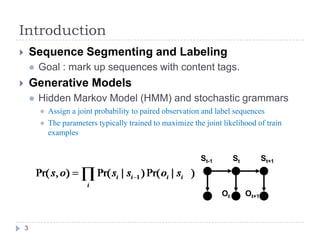
IntroductionSequence Segmenting and LabelingGoal : mark up sequences with content tags.Generative ModelsHidden Markov Model (HMM) and stochastic grammars
Assign a joint probability to paired observation and label sequences
The parameters typically trained to maximize the joint likelihood of train examplesSt-1StSt+1OtOt+13
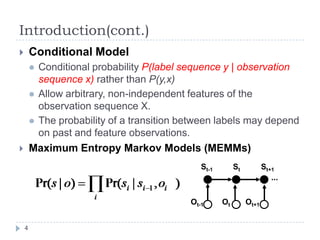
Introduction(cont.)Conditional ModelConditional probability P(label sequence y | observation sequence x)rather than P(y,x)
Allow arbitrary, non-independent features of the observation sequence X.
The probability of a transition between labels may depend on past and feature observations.Maximum Entropy Markov Models (MEMMs)St-1StSt+1...OtOt+1Ot-14
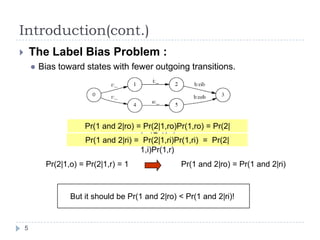
Introduction(cont.)The Label Bias Problem:Bias toward states with fewer outgoing transitions.Pr(1 and 2|ro) = Pr(2|1,ro)Pr(1,ro) = Pr(2| 1,o)Pr(1,r)Pr(1 and 2|ri) =  Pr(2|1,ri)Pr(1,ri)  =  Pr(2| 1,i)Pr(1,r)Pr(2|1,o) = Pr(2|1,r) = 1Pr(1 and 2|ro) = Pr(1 and 2|ri) But it should be Pr(1 and 2|ro) < Pr(1 and 2|ri)! 5
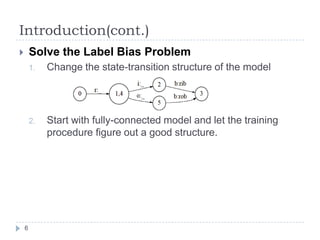
Introduction(cont.)Solve the Label Bias ProblemChange the state-transition structure of the modelStart with fully-connected model and let the training procedure figure out a good structure.6
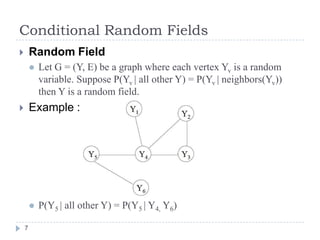
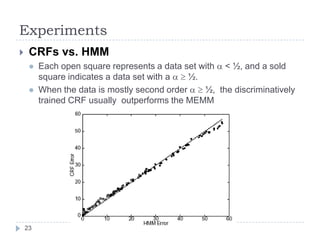
Conditional Random FieldsRandom FieldLet G = (Y, E) be a graph where each vertex Yv is a random variable. Suppose P(Yv| all other Y) = P(Yv| neighbors(Yv)) then Y is a random field.Example :P(Y5 | all other Y) = P(Y5 | Y4, Y6)7
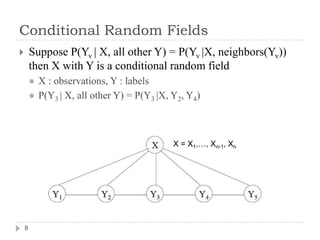
Conditional Random FieldsSuppose P(Yv| X, all other Y) = P(Yv|X, neighbors(Yv)) then X with Y is a conditional random fieldX : observations, Y : labels
P(Y3 | X, all other Y) = P(Y3 |X, Y2, Y4)X = X1,…, Xn-1, Xn8
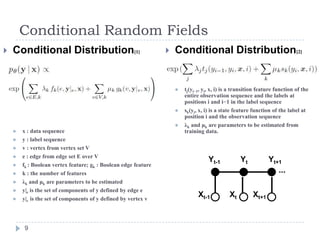
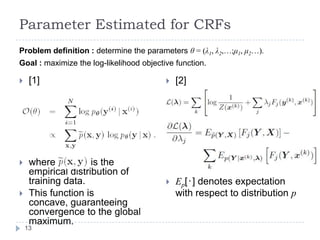
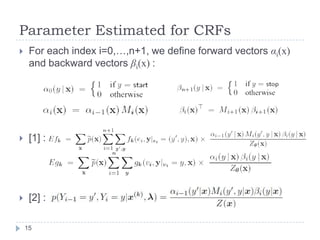
Conditional Random Fields9Conditional Distribution[2]tj(yi−1, yi, x, i) is a transition feature function of the entire observation sequence and the labels at positions i and i−1 in the label sequence
sk(yi, x, i) is a state feature function of the label at position i and the observation sequence
λkand μkare parameters to be estimated from training data.Conditional Distribution[1]x : data sequence
y : label sequence
v : vertex from vertex set V
e : edge from edge set E over V
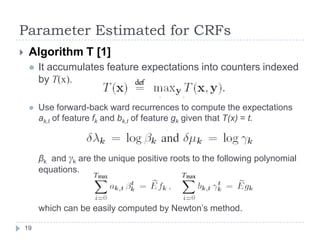
fk: Boolean vertex feature; gk : Boolean edge feature
k : the number of features
λk and μk are parameters to be estimated
y|e is the set of components of y defined by edge e
y|v is the set of components of y defined by vertex vYt-1YtYt+1...XtXt+1Xt-1
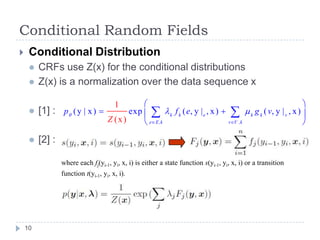
Conditional Random FieldsConditional DistributionCRFs use Z(x) for the conditional distributions
Z(x) is a normalization over the data sequence x

Conditional Random Fields