Ind AS 115
Adoption of New
Revenue Recognition Standard
IFRS 15/ Ind AS 115
and Its
Implementation Challenges
1
Adoption of New Revenue Recognition Standard –
IFRS 15/ Ind AS 115 and Its Implementation
Challenges
 Ministry of Corporate Affairs (MCA) notified the roadmap for
implementation of converged IFRS (i.e. Ind-AS) and India opted
for early adoption of the newly issued revenue standard IFRS 15
effective from 1st
April, 2015.
 Implementation of the new revenue standard would require
numerous organisational and business changes, and a robust
internal control backed by strong IT environment is the key for
successful migration towards the new revenue recognition
regime.
2
Adoption of New Revenue Recognition Standard –
IFRS 15/ Ind AS 115 and Its Implementation
Challenges IASB has issued IFRS 15 “Revenue from Contract with
Customers” which will be applicable from accounting period
commencing on or after 1st January 2018. The newly issued
standard will replace IAS 11 (Construction Contracts), IAS 18
(Revenue), IFRIC 13 (Customer Loyalty Programmes), IFRIC 15
(Agreements for the Construction of Real Estate), IFRIC 18
(Transfers of Assets from Customers) and SIC-31 (Revenue—
BarterTransactions Involving Advertising Services).
 IFRS 15 will replace AS 7 (Construction Contracts), AS 9 (Revenue
Recognition) and Guidance Notes issued by the ICAI. Core
principle of IFRS 15 is that revenue should be recognised for
transferred goods or services for the consideration which the
entity is entitled.
3
Adoption of New Revenue Recognition Standard – IFRS 15/
Ind AS 115 and Its Implementation Challenges
Revenue should be recognised for transferred goods and services
for the consideration which the entity is entitled.
The following steps should be followed for Revenue Recognition:
4
Steps need to be followed
 Identify the contract with the customer–
 A contract is an agreement between two or more parties which creates an
enforceable right.
 Identify the performance obligation of the contract
 Performance obligation can be in the form of transfer of goods and services
to the customer.
 Determine the transaction price
 Transaction price is the amount of consideration in a contract to which an
entity expects to be entitled in exchange for transferring promised goods
or services to a customer. Transaction price can be fixed, variable, a
combination of both or non-cash consideration. In case there is a financing
element in the contract then transaction price has to be adjusted for this
factor.
 This Standard provides detail guidance for all the situations.
5
Ind AS 115
 Allocate the transaction price to the performance obligations in the contract–
 In case multiple goods or services are promised in a single contract (called as
bundled contract), entire transaction price is allocated on the basis of relative
stand-alone selling price of each good or service. Relative fair value method is
prescribed by the standard for allocating the transaction price but residual value
method is also permitted in certain circumstances. The standard provides guidance
on allocation of discount or variable consideration to the distinct goods or services.
 Recognise revenue when the entity satisfies a performance obligation–
An entity recognises revenue when it satisfies a performance obligation in the
contract. The performance obligation is satisfied when the entity transfers the control
of the promised goods or services. In case performance obligation is satisfied over a
period of time then the entity can recognise revenue based on output method or input
method provided the entity has a right to payment for performance completed till
date. This is the significant change as compared to the prevailing accounting guidance
where obligation is deemed to be satisfied when the entity transfers the risks and
rewards to the customer.
6
Ind AS 115 / IFRS 15 Significant changes
 Timing of Revenue Recognition-
 Under AS 9, the timing of revenue recognition from the sale of
goods is based primarily on the transfer of risks and rewards.
IFRS 15, instead, focuses on when control of those goods has
been transferred to the customer.
 This difference may change the timing of revenue recognition as
it may happen that the legal title of the goods remains with the
seller but the necessary control to obtain economic benefit has
been transferred to the customer.
 If the control of a good or service is transferred over a period
then revenue shall be recognised over the period.
 This change may impact real estate companies in a big way.
7
Ind AS 115 / IFRS 15 Significant changes
Different performance obligations under single contract–
 In certain circumstances, recognition criteria are to be applied
separately on identifiable components of the contract.
 This would be going to impact industries like telecom, software
development, infrastructure, etc. where long term contracts are
entered.
8
Ind AS 115 / IFRS 15 Significant changes Example
 A Telecom Company launches a scheme in which it will provide
free handsets to its customers and will charge a fixed monthly
fee of Rs 1,000 for 12 months.
 Company sells the same handset to other customers at Rs.4,000
and monthly payment plan without handset is Rs.800.
 Prevailing revenue recognition standards do not provide
guidance on how to identify the components and how to allocate
selling price and most of the telecom companies recognise
service revenue and treat the cost of handset as cost of acquiring
the customer.
9
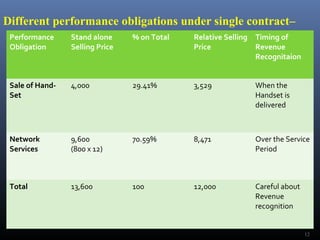
Different performance obligations under single contract–
 In certain circumstances, recognition criteria are to be applied separately on identifiable
components of the contract. This is going to impact industries like telecom, software
development, infrastructure, Etc. where long term contracts are entered.
 Illustration
 A Telecom Company launches a scheme in which it will provide free handsets to its
customers and will charge a fixed monthly fee of Rs 1,000 for 12 months. Company
sells the same handset to other customers at Rs.4,000 and monthly payment plan without
handset is Rs.800.
Prevailing revenue recognition standards do not provide guidance on how to identify the
components and how to allocate selling price and most of the telecom companies
recognise service revenue and treat the cost of handset as cost of acquiring the customer.
Under IFRS 15, the company has to identify the obligations under the contract i.e. to
deliver the handset and provide network services for 12 months.
Transaction price of Rs.12,000 is allocated between these components (refer table
below)-
10
Ind AS 115 / IFRS 15 Significant changes Example
 Under IFRS 15, the company has to identify the obligations
under the contract i.e. to deliver the handset and provide network
services for 12 months. Transaction price of Rs.12,000 is
allocated between these components; as follows :
11
Different performance obligations under single contract–
Performance
Obligation
Stand alone
Selling Price
% on Total Relative Selling
Price
Timing of
Revenue
Recognitaion
Sale of Hand-
Set
4,000 29.41% 3,529 When the
Handset is
delivered
Network
Services
9,600
(800 x 12)
70.59% 8,471 Over the Service
Period
Total 13,600 100 12,000 Careful about
Revenue
recognition
12
Ind AS 115 / IFRS 15 Significant changes Example
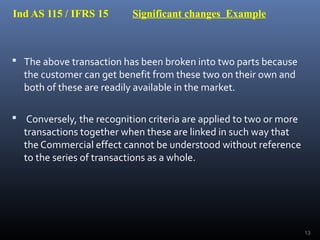
 The above transaction has been broken into two parts because
the customer can get benefit from these two on their own and
both of these are readily available in the market.
 Conversely, the recognition criteria are applied to two or more
transactions together when these are linked in such way that
the Commercial effect cannot be understood without reference
to the series of transactions as a whole.
13
Ind AS 115
14
Contract modification-
 A contract modification is a change in the scope or price (or both) of a contract
that is approved by the parties to the contract. A contract modification can be
either accounted as a separate contract or otherwise.
 A modification shall be accounted as separate contract if scope of the contract
increases due to addition of promised goods services and the contract price
increases by the amount which reflects the stand-alone price of additional
promises made in the contract. If the contract modification is not treated as a
separate contract as described above and remaining goods or services to be
delivered after modification of the contracts are different from goods/services
already delivered then the amount of consideration shall be allocated to the
remaining performance obligation
 Revenue should be recognised segment wise
15
Ind AS 115 / IFRS 15 Significant changes Example
Under AS 9, the timing of revenue recognition from the sale of
goods is based primarily on the transfer of risks and rewards.
IFRS 15, instead, focuses on when control of those goods has
been transferred to the customer.
This difference may change the timing of revenue recognition as
it may happen that the legal title of the goods remains with the
seller but the necessary control to obtain economic benefit has
been transferred to the customer.
16
Ind AS 115 / IFRS 15 Significant changes Example
 The basic fundamental under IFRS is that every transaction has
a value if the goods or services are distinct.
 Based on this principle, revenue recognition for some entities
will change which provide certain goods/services as free (as
nothing is accounted as free under IFRS).
 In such kind of transactions, relative fair value of goods/services
offered is to be determined and it has to be deferred until these
goods/services are delivered.
17
Ind AS 115 / IFRS 15 Significant changes Example
Transactions containing financing element-
 There are certain transactions which are technically sale of
goods/services but the substance of the contract contain
significant financing component.
 E.g, A sells goods to B for Rs.10,000 and at the same time it
agrees to buy the same goods after a period of six months at
Rs.12,000. In this case, if on the basis of criteria mentioned in
the standard it is concluded that the transaction contains
significant financing component, then Rs.2,000 will be treated as
finance cost over six months period and no revenue will be
recognised (assuming that the cash selling price in normal
course is also Rs.10,000.)
18
Ind AS 115 / IFRS 15 Significant changes Example
Contract modification-
 Change in the scope or price (or both) of a contract which would
either be accounted as a separate contract or otherwise.
 A modification shall be accounted as separate contract if scope
of the contract increases due to addition of promised goods
services and the contract price increases by the amount which
reflects the stand-alone price of additional promises made in the
contract.
19
Ind AS 115 / IFRS 15 Significant changes Example
 If the contract modification is not treated as a separate contract,
remaining goods or services to be delivered after modification of
the contracts are different from goods/services already delivered
then the amount of consideration shall be allocated to the
remaining performance obligation.
 In case the remaining goods or services to be delivered after
modification of the contracts are not distinct, then it shall be
treated as part of the existing contract.
 Industry implications in certain industries, like
Telecommunication, where the customers frequently change the
bill plan and an entity must determine whether the modification
creates a new contract or whether it will be accounted for as part
of the existing contract.
20
Ind AS 115 / IFRS 15 Significant changes Example
 Variable Consideration–
 Variable consideration can be in the form of discounts, rebates, refunds,
price concessions, incentives, etc. and can also vary due to occurrence or
non-occurrence of future events.
 Variable consideration may arise out of the contractual terms or
customary business practices.
 For accounting, an entity shall estimate the amount of variable
consideration by using the probability techniques and historical data and
recognise a refund liability.
 An entity shall reassess the variable consideration at each balance sheet
period. Customer’s right to return the goods is treated as variable
consideration as per this standard and the entity has to ensure the
expected return at each reporting period.

21
Ind AS 115 / IFRS 15 Significant changes Example
 Incremental cost for obtaining contract-
The incremental costs of obtaining a contract are those costs that
an entity incurs to obtain a contract with a customer that it would
not have incurred if the contract had not been obtained (like sales
commission).
An entity shall recognise the incremental costs of obtaining a
contract with a customer as an asset if the entity expects to recover
those costs. The recognised asset shall be amortised on a
systematic basis that is consistent with the transfer to the customer
of the goods or services to which the asset relates. Costs to obtain
a contract that would have been incurred regardless of whether
the contract was obtained shall be recognised as an expense when
incurred, unless those costs are explicitly chargeable to the
customer regardless of whether the contract is obtained.
22
Ind AS 115 / IFRS 15 Significant changes Example
 Right to return–
 Entities transfer the control of the goods to the customer and also
grant the customer the right to return the product for various
reasons (such as dissatisfaction with the product).
 The right to return can be in the form of full or partial refund,
credit of amount that can be applied by the customer or exchange
of the product.
 Accounting Treatment in such case
23
Ind AS 115 / IFRS 15 Significant changes Example
Accounting Treatment in such case
 Entity shall recognise the revenue for the transferred products in
the amount of consideration to which the entity expects to be
entitled
 (therefore, revenue would not be recognised for the products
expected to be returned);
 i) A refund liability shall be recognised; and
 ii) . An asset (and corresponding adjustment to cost of sales) shall
be recognised for entity’s right to recover products from customers
on settling the refund liability.
24
Ind AS 115 / IFRS 15 Significant changes Example
Warranty–
 Warranty can either be for the performance of the product or a
service obligation may also be present in addition to the
performance of the product.
 If the warranty includes service obligation along with the
performance of the product, then the transaction price shall be
allocated between product and service.
 In case cannot be accounted separately, the entity shall account for
both of the warranties together as a single performance obligation.
25
Ind AS 115 / IFRS 15 Significant changes Example
 Warranty–
 If a customer has the option to purchase a warranty separately, the
warranty is a distinct service and the transaction price shall be
allocated between product and warranty.
 If a customer does not have the option to purchase a warranty
separately then an entity shall create a provision for warranty
liability in accordance with IAS 37 Provisions, Contingent
Liabilities and Contingent Assets.
26
Ind AS 115 / IFRS 15 Significant changes Example
Consideration payable to customer–
 At times, customer incurs expenses on behalf of the company (say,
distributor incurring advertisement expenses, display charges, etc.
for the company’s products) and claims reimbursement from the
Company. Currently, these expenses are charged as selling and
advertisement expenses in the profit and loss account.
 Under IFRS 115, consideration payable to customer is accounted
as deduction from revenue unless the payment is for a distinct
good or service from the customer in which case an entity shall
account for the purchase of the good or service in the same way
that it accounts for other purchases from suppliers.
27
New Revenue Recognition Standard –
Ind AS 115 / IFRS 15
 IASB has issued IFRS 15 “Revenue from Contract with
Customers” which will be applicable from accounting period
commencing on or after 1st January 2018.
 The newly issued standard will replace IAS 11 (Construction
Contracts), IAS 18 (Revenue), IFRIC 13 (Customer Loyalty
Programmes), IFRIC 15 (Agreements for the Construction of
Real Estate), IFRIC 18 (Transfers of Assets from Customers)
and SIC-31 (Revenue—Barter Transactions Involving
Advertising Services).
28
New Revenue Recognition Standard – Ind AS 115
/ IFRS 15
 IFRS 15 will replace AS 7 (Construction Contracts), AS 9
(Revenue Recognition) and Guidance Notes issued by the
ICAI.
 Core principle of IFRS 15 is that revenue should be recognised
for transferred goods or services for the consideration which the
entity is entitled.
29
New Revenue Recognition Standard – Ind AS 115 / IFRS 15
Steps Identify the contract with the customer
 A contract is an agreement between two or more parties which
creates an enforceable right. It provides details for contract
modification and combination of contracts.
 Determine the transaction price
 Transaction price is the amount of consideration in a contract
to which an entity expects to be entitled in exchange for
transferring promised goods or services to a customer.
 Transaction price can be fixed, variable, a combination of both
or non-cash consideration. In case there is a financing element
in the contract then transaction price has to be adjusted for this
factor.
30
New Revenue Recognition Standard – Ind AS 115 / IFRS 15
Steps Allocate the transaction price to the performance obligations
in the contract–
 In case multiple goods or services are promised in a single
contract (called as bundled contract), entire transaction price is
allocated on the basis of relative stand-alone selling price of each
good or service.
 Relative fair value method is prescribed by the standard for
allocating the transaction price but residual value method is also
permitted in certain circumstances.
 The standard provides guidance on allocation of discount or
variable consideration to the distinct goods or services.
31
New Revenue Recognition Standard – Ind AS 115 / IFRS 15
Steps
Recognise revenue when entity satisfies a performance
obligation–
 An entity recognises revenue when it satisfies a performance
obligation in the contract. The performance obligation is satisfied
when the entity transfers the control of the promised goods or
services. In case performance obligation is satisfied over a period
of time then the entity can recognise revenue based on output
method or input method provided the entity has a right to
payment for performance completed till date.
 This is the significant change as compared to the prevailing
accounting guidance where obligation is deemed to be satisfied
when the entity transfers the risks and rewards to the customer.
32

Ind as bbsr (cma m.acharya)

  • 1.
    Ind AS 115 Adoptionof New Revenue Recognition Standard IFRS 15/ Ind AS 115 and Its Implementation Challenges 1
  • 2.
    Adoption of NewRevenue Recognition Standard – IFRS 15/ Ind AS 115 and Its Implementation Challenges  Ministry of Corporate Affairs (MCA) notified the roadmap for implementation of converged IFRS (i.e. Ind-AS) and India opted for early adoption of the newly issued revenue standard IFRS 15 effective from 1st April, 2015.  Implementation of the new revenue standard would require numerous organisational and business changes, and a robust internal control backed by strong IT environment is the key for successful migration towards the new revenue recognition regime. 2
  • 3.
    Adoption of NewRevenue Recognition Standard – IFRS 15/ Ind AS 115 and Its Implementation Challenges IASB has issued IFRS 15 “Revenue from Contract with Customers” which will be applicable from accounting period commencing on or after 1st January 2018. The newly issued standard will replace IAS 11 (Construction Contracts), IAS 18 (Revenue), IFRIC 13 (Customer Loyalty Programmes), IFRIC 15 (Agreements for the Construction of Real Estate), IFRIC 18 (Transfers of Assets from Customers) and SIC-31 (Revenue— BarterTransactions Involving Advertising Services).  IFRS 15 will replace AS 7 (Construction Contracts), AS 9 (Revenue Recognition) and Guidance Notes issued by the ICAI. Core principle of IFRS 15 is that revenue should be recognised for transferred goods or services for the consideration which the entity is entitled. 3
  • 4.
    Adoption of NewRevenue Recognition Standard – IFRS 15/ Ind AS 115 and Its Implementation Challenges Revenue should be recognised for transferred goods and services for the consideration which the entity is entitled. The following steps should be followed for Revenue Recognition: 4
  • 5.
    Steps need tobe followed  Identify the contract with the customer–  A contract is an agreement between two or more parties which creates an enforceable right.  Identify the performance obligation of the contract  Performance obligation can be in the form of transfer of goods and services to the customer.  Determine the transaction price  Transaction price is the amount of consideration in a contract to which an entity expects to be entitled in exchange for transferring promised goods or services to a customer. Transaction price can be fixed, variable, a combination of both or non-cash consideration. In case there is a financing element in the contract then transaction price has to be adjusted for this factor.  This Standard provides detail guidance for all the situations. 5
  • 6.
    Ind AS 115 Allocate the transaction price to the performance obligations in the contract–  In case multiple goods or services are promised in a single contract (called as bundled contract), entire transaction price is allocated on the basis of relative stand-alone selling price of each good or service. Relative fair value method is prescribed by the standard for allocating the transaction price but residual value method is also permitted in certain circumstances. The standard provides guidance on allocation of discount or variable consideration to the distinct goods or services.  Recognise revenue when the entity satisfies a performance obligation– An entity recognises revenue when it satisfies a performance obligation in the contract. The performance obligation is satisfied when the entity transfers the control of the promised goods or services. In case performance obligation is satisfied over a period of time then the entity can recognise revenue based on output method or input method provided the entity has a right to payment for performance completed till date. This is the significant change as compared to the prevailing accounting guidance where obligation is deemed to be satisfied when the entity transfers the risks and rewards to the customer. 6
  • 7.
    Ind AS 115/ IFRS 15 Significant changes  Timing of Revenue Recognition-  Under AS 9, the timing of revenue recognition from the sale of goods is based primarily on the transfer of risks and rewards. IFRS 15, instead, focuses on when control of those goods has been transferred to the customer.  This difference may change the timing of revenue recognition as it may happen that the legal title of the goods remains with the seller but the necessary control to obtain economic benefit has been transferred to the customer.  If the control of a good or service is transferred over a period then revenue shall be recognised over the period.  This change may impact real estate companies in a big way. 7
  • 8.
    Ind AS 115/ IFRS 15 Significant changes Different performance obligations under single contract–  In certain circumstances, recognition criteria are to be applied separately on identifiable components of the contract.  This would be going to impact industries like telecom, software development, infrastructure, etc. where long term contracts are entered. 8
  • 9.
    Ind AS 115/ IFRS 15 Significant changes Example  A Telecom Company launches a scheme in which it will provide free handsets to its customers and will charge a fixed monthly fee of Rs 1,000 for 12 months.  Company sells the same handset to other customers at Rs.4,000 and monthly payment plan without handset is Rs.800.  Prevailing revenue recognition standards do not provide guidance on how to identify the components and how to allocate selling price and most of the telecom companies recognise service revenue and treat the cost of handset as cost of acquiring the customer. 9
  • 10.
    Different performance obligationsunder single contract–  In certain circumstances, recognition criteria are to be applied separately on identifiable components of the contract. This is going to impact industries like telecom, software development, infrastructure, Etc. where long term contracts are entered.  Illustration  A Telecom Company launches a scheme in which it will provide free handsets to its customers and will charge a fixed monthly fee of Rs 1,000 for 12 months. Company sells the same handset to other customers at Rs.4,000 and monthly payment plan without handset is Rs.800. Prevailing revenue recognition standards do not provide guidance on how to identify the components and how to allocate selling price and most of the telecom companies recognise service revenue and treat the cost of handset as cost of acquiring the customer. Under IFRS 15, the company has to identify the obligations under the contract i.e. to deliver the handset and provide network services for 12 months. Transaction price of Rs.12,000 is allocated between these components (refer table below)- 10
  • 11.
    Ind AS 115/ IFRS 15 Significant changes Example  Under IFRS 15, the company has to identify the obligations under the contract i.e. to deliver the handset and provide network services for 12 months. Transaction price of Rs.12,000 is allocated between these components; as follows : 11
  • 12.
    Different performance obligationsunder single contract– Performance Obligation Stand alone Selling Price % on Total Relative Selling Price Timing of Revenue Recognitaion Sale of Hand- Set 4,000 29.41% 3,529 When the Handset is delivered Network Services 9,600 (800 x 12) 70.59% 8,471 Over the Service Period Total 13,600 100 12,000 Careful about Revenue recognition 12
  • 13.
    Ind AS 115/ IFRS 15 Significant changes Example  The above transaction has been broken into two parts because the customer can get benefit from these two on their own and both of these are readily available in the market.  Conversely, the recognition criteria are applied to two or more transactions together when these are linked in such way that the Commercial effect cannot be understood without reference to the series of transactions as a whole. 13
  • 14.
  • 15.
    Contract modification-  Acontract modification is a change in the scope or price (or both) of a contract that is approved by the parties to the contract. A contract modification can be either accounted as a separate contract or otherwise.  A modification shall be accounted as separate contract if scope of the contract increases due to addition of promised goods services and the contract price increases by the amount which reflects the stand-alone price of additional promises made in the contract. If the contract modification is not treated as a separate contract as described above and remaining goods or services to be delivered after modification of the contracts are different from goods/services already delivered then the amount of consideration shall be allocated to the remaining performance obligation  Revenue should be recognised segment wise 15
  • 16.
    Ind AS 115/ IFRS 15 Significant changes Example Under AS 9, the timing of revenue recognition from the sale of goods is based primarily on the transfer of risks and rewards. IFRS 15, instead, focuses on when control of those goods has been transferred to the customer. This difference may change the timing of revenue recognition as it may happen that the legal title of the goods remains with the seller but the necessary control to obtain economic benefit has been transferred to the customer. 16
  • 17.
    Ind AS 115/ IFRS 15 Significant changes Example  The basic fundamental under IFRS is that every transaction has a value if the goods or services are distinct.  Based on this principle, revenue recognition for some entities will change which provide certain goods/services as free (as nothing is accounted as free under IFRS).  In such kind of transactions, relative fair value of goods/services offered is to be determined and it has to be deferred until these goods/services are delivered. 17
  • 18.
    Ind AS 115/ IFRS 15 Significant changes Example Transactions containing financing element-  There are certain transactions which are technically sale of goods/services but the substance of the contract contain significant financing component.  E.g, A sells goods to B for Rs.10,000 and at the same time it agrees to buy the same goods after a period of six months at Rs.12,000. In this case, if on the basis of criteria mentioned in the standard it is concluded that the transaction contains significant financing component, then Rs.2,000 will be treated as finance cost over six months period and no revenue will be recognised (assuming that the cash selling price in normal course is also Rs.10,000.) 18
  • 19.
    Ind AS 115/ IFRS 15 Significant changes Example Contract modification-  Change in the scope or price (or both) of a contract which would either be accounted as a separate contract or otherwise.  A modification shall be accounted as separate contract if scope of the contract increases due to addition of promised goods services and the contract price increases by the amount which reflects the stand-alone price of additional promises made in the contract. 19
  • 20.
    Ind AS 115/ IFRS 15 Significant changes Example  If the contract modification is not treated as a separate contract, remaining goods or services to be delivered after modification of the contracts are different from goods/services already delivered then the amount of consideration shall be allocated to the remaining performance obligation.  In case the remaining goods or services to be delivered after modification of the contracts are not distinct, then it shall be treated as part of the existing contract.  Industry implications in certain industries, like Telecommunication, where the customers frequently change the bill plan and an entity must determine whether the modification creates a new contract or whether it will be accounted for as part of the existing contract. 20
  • 21.
    Ind AS 115/ IFRS 15 Significant changes Example  Variable Consideration–  Variable consideration can be in the form of discounts, rebates, refunds, price concessions, incentives, etc. and can also vary due to occurrence or non-occurrence of future events.  Variable consideration may arise out of the contractual terms or customary business practices.  For accounting, an entity shall estimate the amount of variable consideration by using the probability techniques and historical data and recognise a refund liability.  An entity shall reassess the variable consideration at each balance sheet period. Customer’s right to return the goods is treated as variable consideration as per this standard and the entity has to ensure the expected return at each reporting period.  21
  • 22.
    Ind AS 115/ IFRS 15 Significant changes Example  Incremental cost for obtaining contract- The incremental costs of obtaining a contract are those costs that an entity incurs to obtain a contract with a customer that it would not have incurred if the contract had not been obtained (like sales commission). An entity shall recognise the incremental costs of obtaining a contract with a customer as an asset if the entity expects to recover those costs. The recognised asset shall be amortised on a systematic basis that is consistent with the transfer to the customer of the goods or services to which the asset relates. Costs to obtain a contract that would have been incurred regardless of whether the contract was obtained shall be recognised as an expense when incurred, unless those costs are explicitly chargeable to the customer regardless of whether the contract is obtained. 22
  • 23.
    Ind AS 115/ IFRS 15 Significant changes Example  Right to return–  Entities transfer the control of the goods to the customer and also grant the customer the right to return the product for various reasons (such as dissatisfaction with the product).  The right to return can be in the form of full or partial refund, credit of amount that can be applied by the customer or exchange of the product.  Accounting Treatment in such case 23
  • 24.
    Ind AS 115/ IFRS 15 Significant changes Example Accounting Treatment in such case  Entity shall recognise the revenue for the transferred products in the amount of consideration to which the entity expects to be entitled  (therefore, revenue would not be recognised for the products expected to be returned);  i) A refund liability shall be recognised; and  ii) . An asset (and corresponding adjustment to cost of sales) shall be recognised for entity’s right to recover products from customers on settling the refund liability. 24
  • 25.
    Ind AS 115/ IFRS 15 Significant changes Example Warranty–  Warranty can either be for the performance of the product or a service obligation may also be present in addition to the performance of the product.  If the warranty includes service obligation along with the performance of the product, then the transaction price shall be allocated between product and service.  In case cannot be accounted separately, the entity shall account for both of the warranties together as a single performance obligation. 25
  • 26.
    Ind AS 115/ IFRS 15 Significant changes Example  Warranty–  If a customer has the option to purchase a warranty separately, the warranty is a distinct service and the transaction price shall be allocated between product and warranty.  If a customer does not have the option to purchase a warranty separately then an entity shall create a provision for warranty liability in accordance with IAS 37 Provisions, Contingent Liabilities and Contingent Assets. 26
  • 27.
    Ind AS 115/ IFRS 15 Significant changes Example Consideration payable to customer–  At times, customer incurs expenses on behalf of the company (say, distributor incurring advertisement expenses, display charges, etc. for the company’s products) and claims reimbursement from the Company. Currently, these expenses are charged as selling and advertisement expenses in the profit and loss account.  Under IFRS 115, consideration payable to customer is accounted as deduction from revenue unless the payment is for a distinct good or service from the customer in which case an entity shall account for the purchase of the good or service in the same way that it accounts for other purchases from suppliers. 27
  • 28.
    New Revenue RecognitionStandard – Ind AS 115 / IFRS 15  IASB has issued IFRS 15 “Revenue from Contract with Customers” which will be applicable from accounting period commencing on or after 1st January 2018.  The newly issued standard will replace IAS 11 (Construction Contracts), IAS 18 (Revenue), IFRIC 13 (Customer Loyalty Programmes), IFRIC 15 (Agreements for the Construction of Real Estate), IFRIC 18 (Transfers of Assets from Customers) and SIC-31 (Revenue—Barter Transactions Involving Advertising Services). 28
  • 29.
    New Revenue RecognitionStandard – Ind AS 115 / IFRS 15  IFRS 15 will replace AS 7 (Construction Contracts), AS 9 (Revenue Recognition) and Guidance Notes issued by the ICAI.  Core principle of IFRS 15 is that revenue should be recognised for transferred goods or services for the consideration which the entity is entitled. 29
  • 30.
    New Revenue RecognitionStandard – Ind AS 115 / IFRS 15 Steps Identify the contract with the customer  A contract is an agreement between two or more parties which creates an enforceable right. It provides details for contract modification and combination of contracts.  Determine the transaction price  Transaction price is the amount of consideration in a contract to which an entity expects to be entitled in exchange for transferring promised goods or services to a customer.  Transaction price can be fixed, variable, a combination of both or non-cash consideration. In case there is a financing element in the contract then transaction price has to be adjusted for this factor. 30
  • 31.
    New Revenue RecognitionStandard – Ind AS 115 / IFRS 15 Steps Allocate the transaction price to the performance obligations in the contract–  In case multiple goods or services are promised in a single contract (called as bundled contract), entire transaction price is allocated on the basis of relative stand-alone selling price of each good or service.  Relative fair value method is prescribed by the standard for allocating the transaction price but residual value method is also permitted in certain circumstances.  The standard provides guidance on allocation of discount or variable consideration to the distinct goods or services. 31
  • 32.
    New Revenue RecognitionStandard – Ind AS 115 / IFRS 15 Steps Recognise revenue when entity satisfies a performance obligation–  An entity recognises revenue when it satisfies a performance obligation in the contract. The performance obligation is satisfied when the entity transfers the control of the promised goods or services. In case performance obligation is satisfied over a period of time then the entity can recognise revenue based on output method or input method provided the entity has a right to payment for performance completed till date.  This is the significant change as compared to the prevailing accounting guidance where obligation is deemed to be satisfied when the entity transfers the risks and rewards to the customer. 32