How to present Revenue/ Sales
Amount in FS (IFRS-15 & IAS-1,
IFRS Conceptual Framework)
Welcome to the Presentation On
Revenue from Contracts with
Customers!
A Practical Approach (IFRS15)
Md. Shafiqul Alam LLB., FCS, FCMA, FCA
Chairman, Bizz Solutions PLC.
Managing Partner and CEO,
Shafiqul Alam & Co., Chartered accountants
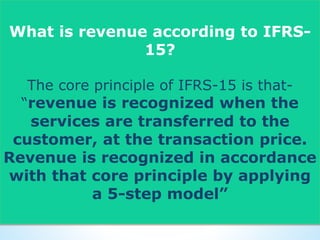
What is revenue according to IFRS-
15?
The core principle of IFRS-15 is that-
“revenue is recognized when the
services are transferred to the
customer, at the transaction price.
Revenue is recognized in accordance
with that core principle by applying
a 5-step model”
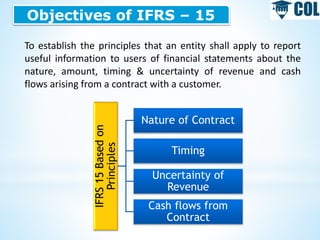
Objectives of IFRS – 15
To establish the principles that an entity shall apply to report
useful information to users of financial statements about the
nature, amount, timing & uncertainty of revenue and cash
flows arising from a contract with a customer.
IFRS
15
Based
on
Principles
Nature of Contract
Timing
Uncertainty of
Revenue
Cash flows from
Contract
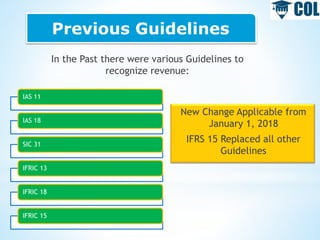
In the Past there were various Guidelines to
recognize revenue:
Previous Guidelines
New Change Applicable from
January 1, 2018
IFRS 15 Replaced all other
Guidelines
IAS 11
IAS 18
SIC 31
IFRIC 13
IFRIC 18
IFRIC 15
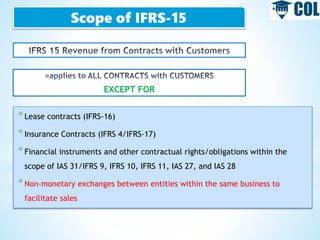
Scope of IFRS-15
*Lease contracts (IFRS-16)
*Insurance Contracts (IFRS 4/IFRS-17)
*Financial instruments and other contractual rights/obligations within the
scope of IAS 31/IFRS 9, IFRS 10, IFRS 11, IAS 27, and IAS 28
*Non-monetary exchanges between entities within the same business to
facilitate sales
EXCEPT FOR
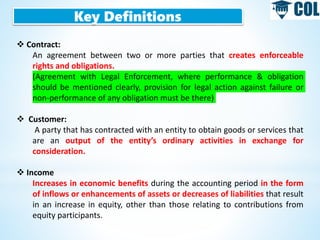
Key Definitions
 Contract:
An agreement between two or more parties that creates enforceable
rights and obligations.
(Agreement with Legal Enforcement, where performance & obligation
should be mentioned clearly, provision for legal action against failure or
non-performance of any obligation must be there)
 Customer:
A party that has contracted with an entity to obtain goods or services that
are an output of the entity’s ordinary activities in exchange for
consideration.
 Income
Increases in economic benefits during the accounting period in the form
of inflows or enhancements of assets or decreases of liabilities that result
in an increase in equity, other than those relating to contributions from
equity participants.
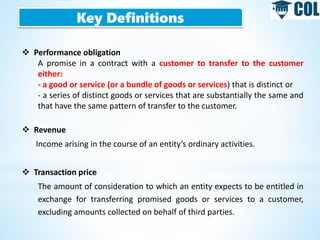
 Performance obligation
A promise in a contract with a customer to transfer to the customer
either:
- a good or service (or a bundle of goods or services) that is distinct or
- a series of distinct goods or services that are substantially the same and
that have the same pattern of transfer to the customer.
 Revenue
Income arising in the course of an entity’s ordinary activities.
 Transaction price
The amount of consideration to which an entity expects to be entitled in
exchange for transferring promised goods or services to a customer,
excluding amounts collected on behalf of third parties.
Key Definitions
Revenue Recognition
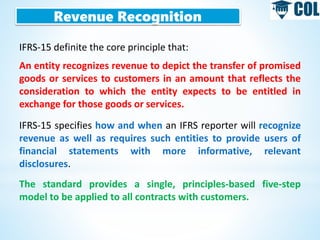
IFRS-15 definite the core principle that:
An entity recognizes revenue to depict the transfer of promised
goods or services to customers in an amount that reflects the
consideration to which the entity expects to be entitled in
exchange for those goods or services.
IFRS-15 specifies how and when an IFRS reporter will recognize
revenue as well as requires such entities to provide users of
financial statements with more informative, relevant
disclosures.
The standard provides a single, principles-based five-step
model to be applied to all contracts with customers.
Revenue Recognition Model
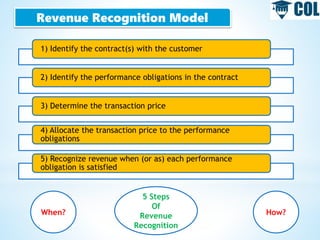
1) Identify the contract(s) with the customer
2) Identify the performance obligations in the contract
3) Determine the transaction price
4) Allocate the transaction price to the performance
obligations
5) Recognize revenue when (or as) each performance
obligation is satisfied
When? How?
5 Steps
Of
Revenue
Recognition
Contract
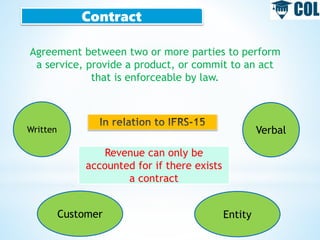
Agreement between two or more parties to perform
a service, provide a product, or commit to an act
that is enforceable by law.
Written Verbal
Customer Entity
Revenue can only be
accounted for if there exists
a contract
Revenue Recognition Model
Contract Conditions
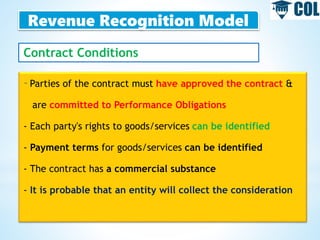
-Parties of the contract must have approved the contract &
are committed to Performance Obligations
- Each party's rights to goods/services can be identified
- Payment terms for goods/services can be identified
- The contract has a commercial substance
- It is probable that an entity will collect the consideration
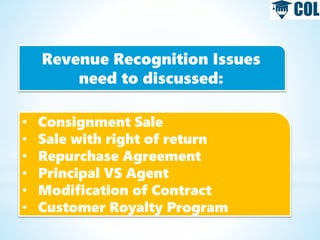
• Consignment Sale
• Sale with right of return
• Repurchase Agreement
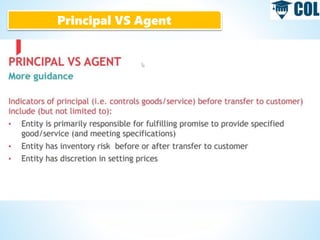
• Principal VS Agent
• Modification of Contract
• Customer Royalty Program
Revenue Recognition Issues
need to discussed:
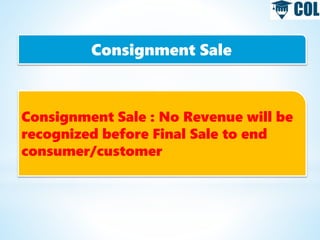
Consignment Sale : No Revenue will be
recognized before Final Sale to end
consumer/customer
Consignment Sale
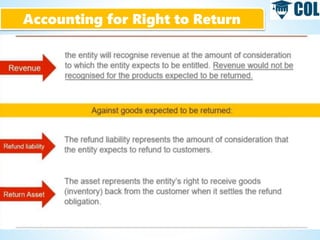
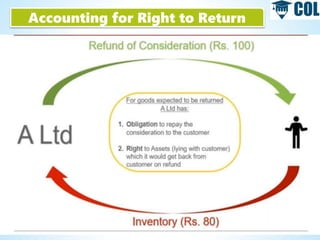
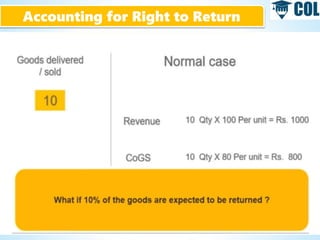
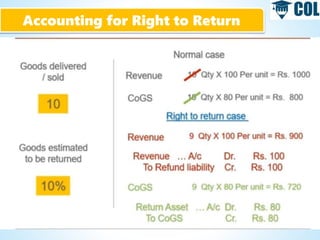
Accounting for Right to Return as per
IFRS-15
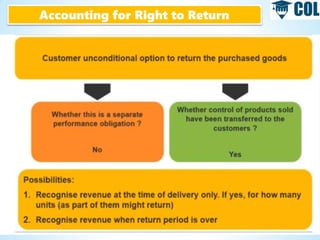
Accounting for Right to Return
IFRS-15 additional issues:
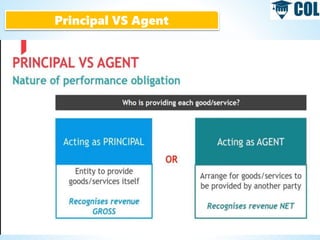
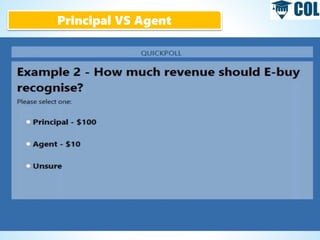
Principal VS Agent
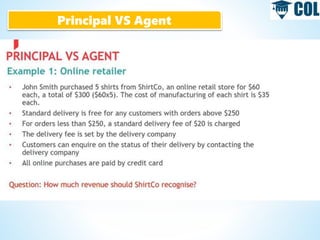
Principal VS Agent
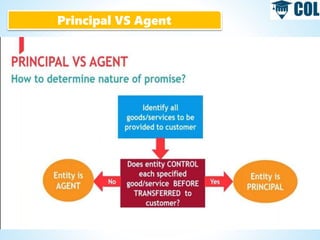
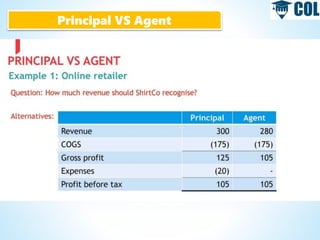
Principal VS Agent
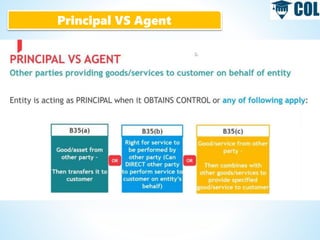
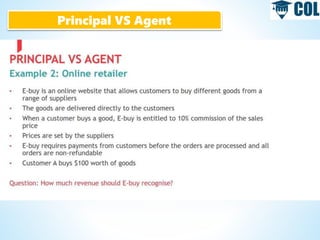
Principal VS Agent
Principal VS Agent
Principal VS Agent
Principal VS Agent
Principal VS Agent
Principal VS Agent
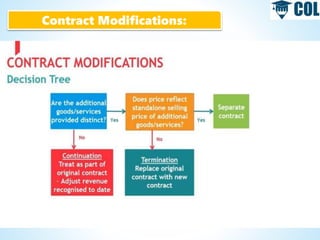
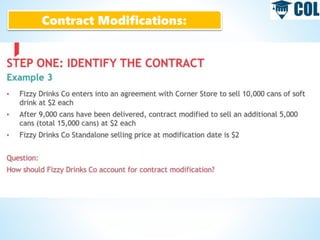
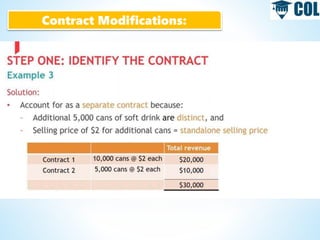
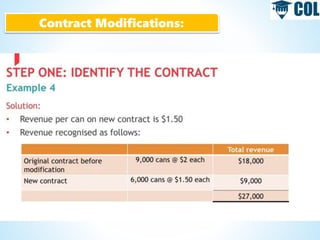
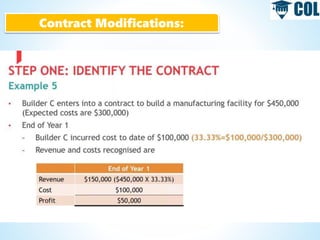
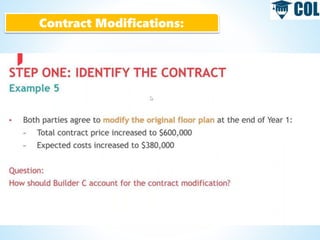
Contract Modifications:
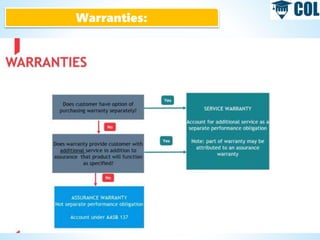
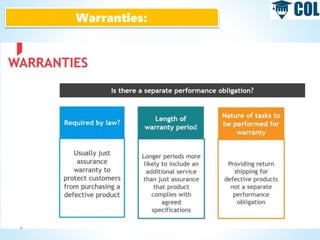
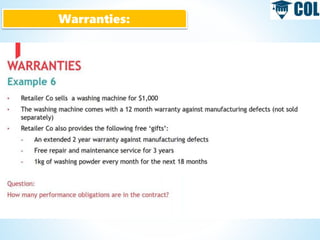
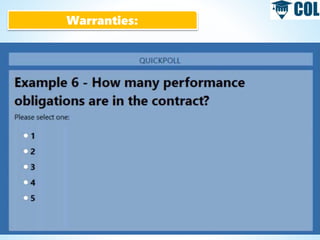
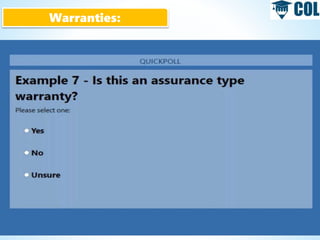
Warranties:
Warranties:
Warranties:
Warranties:
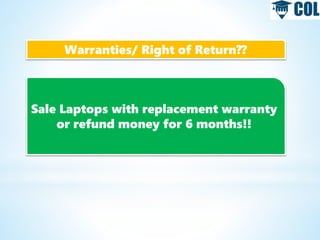
Warranties/ Right of Return??
Sale Laptops with replacement warranty
or refund money for 6 months!!
Warranties:
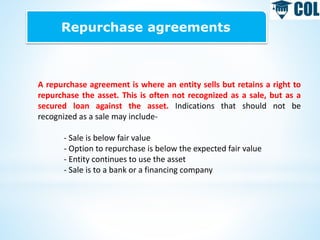
Repurchase agreements
A repurchase agreement is where an entity sells but retains a right to
repurchase the asset. This is often not recognized as a sale, but as a
secured loan against the asset. Indications that should not be
recognized as a sale may include-
- Sale is below fair value
- Option to repurchase is below the expected fair value
- Entity continues to use the asset
- Sale is to a bank or a financing company
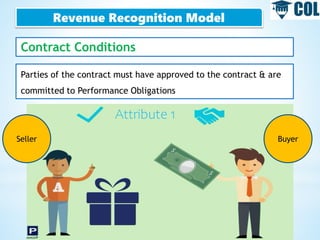
Revenue Recognition Model
Contract Conditions
Parties of the contract must have approved to the contract & are
committed to Performance Obligations
Attribute 1
Seller Buyer
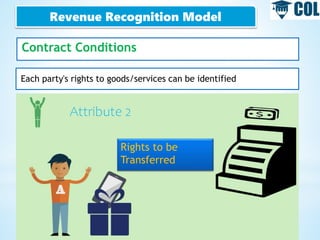
Revenue Recognition Model
Contract Conditions
Each party's rights to goods/services can be identified
Attribute 2
Rights to be
Transferred
Revenue Recognition Model
Contract Conditions
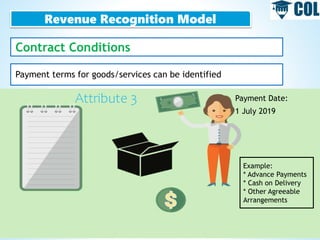
Payment terms for goods/services can be identified
Example:
* Advance Payments
* Cash on Delivery
* Other Agreeable
Arrangements
Payment Date:
1 July 2019
Attribute 3
Revenue Recognition Model
Contract Conditions
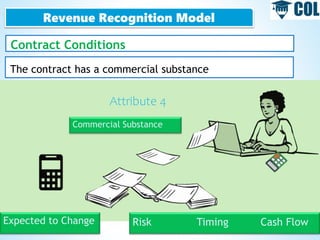
The contract has a commercial substance
Attribute 4
Risk Timing Cash Flow
Commercial Substance
Expected to Change
Revenue Recognition Model
Contract Conditions
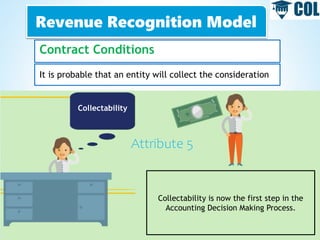
It is probable that an entity will collect the consideration
Collectability
Attribute 5
Collectability is now the first step in the
Accounting Decision Making Process.
Revenue Recognition Model
Step 1
- Parties have approved the contract and are committed to
perform
- Each party's rights to goods/services can be identified
- The payment terns for goods/services can be identified
- The contract has commercial substance
- It is probable that an entity will collect the consideration
(evaluate customer's ability and intention to pay).
- Non-monetary exchanges between entities within the same
business to Facilitate sales
Attributes
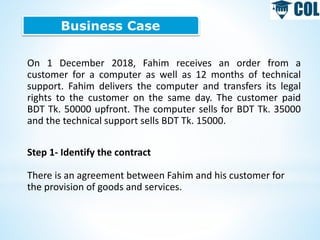
Business Case
On 1 December 2018, Fahim receives an order from a
customer for a computer as well as 12 months of technical
support. Fahim delivers the computer and transfers its legal
rights to the customer on the same day. The customer paid
BDT Tk. 50000 upfront. The computer sells for BDT Tk. 35000
and the technical support sells BDT Tk. 15000.
Step 1- Identify the contract
There is an agreement between Fahim and his customer for
the provision of goods and services.
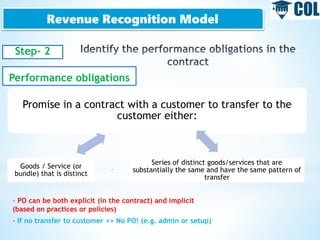
Revenue Recognition Model
Step- 2
Promise in a contract with a customer to transfer to the
customer either:
Series of distinct goods/services that are
substantially the same and have the same pattern of
transfer
Goods / Service (or
bundle) that is distinct
- PO can be both explicit (in the contract) and implicit
(based on practices or policies)
- If no transfer to customer => No PO! (e.g. admin or setup)
Performance obligations
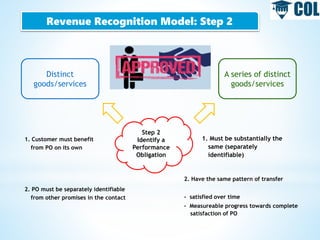
Revenue Recognition Model: Step 2
Step 2
Identify a
Performance
Obligation
Distinct
goods/services
A series of distinct
goods/services
1. Customer must benefit
from PO on its own
2. PO must be separately identifiable
from other promises in the contact
1. Must be substantially the
same (separately
identifiable)
2. Have the same pattern of transfer
- satisfied over time
- Measureable progress towards complete
satisfaction of PO
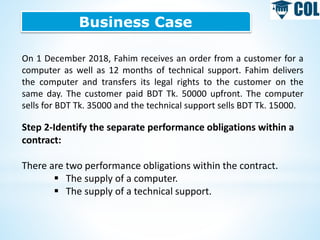
Business Case
On 1 December 2018, Fahim receives an order from a customer for a
computer as well as 12 months of technical support. Fahim delivers
the computer and transfers its legal rights to the customer on the
same day. The customer paid BDT Tk. 50000 upfront. The computer
sells for BDT Tk. 35000 and the technical support sells BDT Tk. 15000.
Step 2-Identify the separate performance obligations within a
contract:
There are two performance obligations within the contract.
 The supply of a computer.
 The supply of a technical support.
Revenue Recognition Model
Step – 3 Determining the Transaction price
 Amount of consideration that an entity expects to receive from a
customer.
 In a contract is often easily determined because customer agrees to pay a
fixed amount.
 Other issues entities must consider in case of determining transaction
price:
 Variable consideration
 Time value of money
 Noncash consideration
 Consideration paid or payable to customers
Revenue Recognition Model
 Variable Consideration
 Price dependent on future events-
May include discounts, rebates, credits, performance bonuses or royalties.
 Companies estimate amount of revenue to recognize-
Expected value
Most likely amount
 Companies only recognize variable consideration if –
- They have experience with similar contracts and are able to estimate the
cumulative amount of revenue.
- Based on experience they do not expect a significant reversal of revenue
previously recognized.
 If these criteria are not met, revenue recognition is constrained.
Revenue Recognition Model
 Time Value of Money
When contract involves a significant financing component-
• Interest accrued on consideration to be paid over time
• Fair value determine' either by measuring the consideration received
or by discounting the payment using an imputed interest rate.
• Company reports as interest expense or interest revenue
 Non-Cash Consideration
• Customers sometimes contribute goods or services, such as equipment
or labor.
• Companies generally recognize revenue on the basis of the fair value of
what is received.
 Consideration paid or payable to Customers
May include discounts, volume rebates, coupons, free products these
elements reduce the consideration received and the revenue to be
recognized.
Revenue Recognition Model
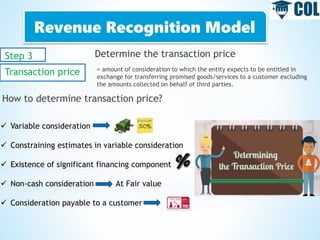
Step 3
Transaction price
Determine the transaction price
= amount of consideration to which the entity expects to be entitled in
exchange for transferring promised goods/services to a customer excluding
the amounts collected on behalf of third parties.
How to determine transaction price?
 Variable consideration
 Constraining estimates in variable consideration
 Existence of significant financing component
 Non-cash consideration → At Fair value
 Consideration payable to a customer
Business Case
On 1 December 2018, Fahim receives an order from a
customer for a computer as well as 12 months of technical
support. Fahim delivers the computer and transfers its legal
rights to the customer on the same day. The customer paid
BDT Tk. 50000 upfront. The computer sells for BDT Tk. 35000
and the technical support sells BDT Tk. 15000.
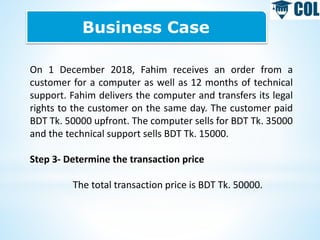
Step 3- Determine the transaction price
The total transaction price is BDT Tk. 50000.
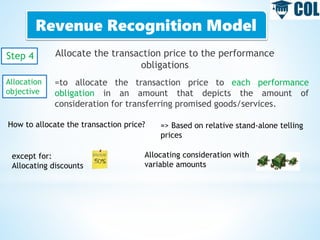
Revenue Recognition Model
Step 4 Allocate the transaction price to the performance
obligations
Allocation
objective
=to allocate the transaction price to each performance
obligation in an amount that depicts the amount of
consideration for transferring promised goods/services.
How to allocate the transaction price? => Based on relative stand-alone telling
prices
except for:
Allocating discounts
Allocating consideration with
variable amounts
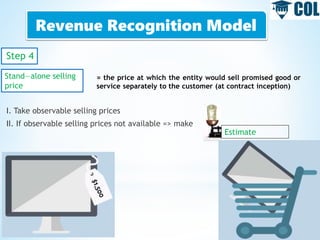
Revenue Recognition Model
Step 4
Stand—alone selling
price
= the price at which the entity would sell promised good or
service separately to the customer (at contract inception)
I. Take observable selling prices
II. If observable selling prices not available => make
Estimate
Business Case
On 1 December 2018, Fahim receives an order from a
customer for a computer as well as 12 months of technical
support. Fahim delivers the computer and transfers its legal
rights to the customer on the same day. The customer paid
BDT Tk. 50000 upfront. The computer sells for BDT Tk. 35000
and the technical support sells BDT Tk. 15000.
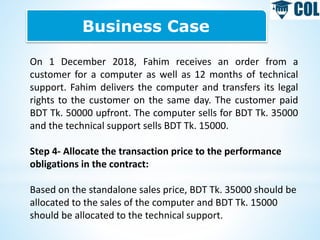
Step 4- Allocate the transaction price to the performance
obligations in the contract:
Based on the standalone sales price, BDT Tk. 35000 should be
allocated to the sales of the computer and BDT Tk. 15000
should be allocated to the technical support.
Revenue Recognition Model
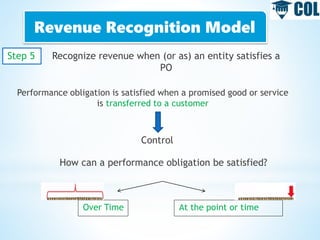
Step 5 Recognize revenue when (or as) an entity satisfies a
PO
Performance obligation is satisfied when a promised good or service
is transferred to a customer
Control
How can a performance obligation be satisfied?
Over Time At the point or time
Business Case
On 1 December 2018, Fahim receives an order from a customer for a
computer as well as 12 months of technical support. Fahim delivers the
computer and transfers its legal rights to the customer on the same day. The
customer paid BDT Tk. 50000 upfront. The computer sells for BDT Tk. 35000
and the technical support sells BDT Tk. 15000.
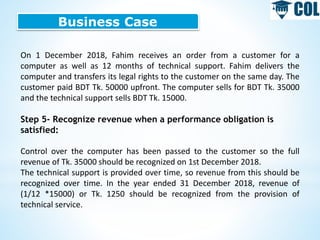
Step 5- Recognize revenue when a performance obligation is
satisfied:
Control over the computer has been passed to the customer so the full
revenue of Tk. 35000 should be recognized on 1st December 2018.
The technical support is provided over time, so revenue from this should be
recognized over time. In the year ended 31 December 2018, revenue of
(1/12 *15000) or Tk. 1250 should be recognized from the provision of
technical service.
Revenue Recognition Over Time
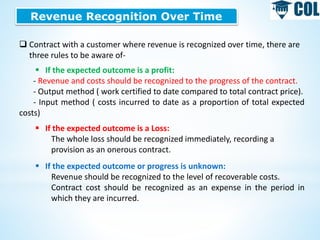
 Contract with a customer where revenue is recognized over time, there are
three rules to be aware of-
 If the expected outcome is a profit:
- Revenue and costs should be recognized to the progress of the contract.
- Output method ( work certified to date compared to total contract price).
- Input method ( costs incurred to date as a proportion of total expected
costs)
 If the expected outcome is a Loss:
The whole loss should be recognized immediately, recording a
provision as an onerous contract.
 If the expected outcome or progress is unknown:
Revenue should be recognized to the level of recoverable costs.
Contract cost should be recognized as an expense in the period in
which they are incurred.
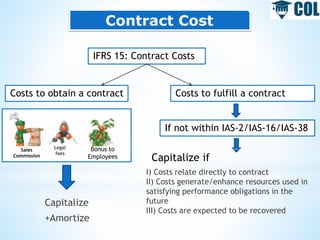
Contract Cost
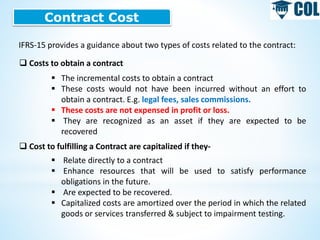
IFRS-15 provides a guidance about two types of costs related to the contract:
 Costs to obtain a contract
 The incremental costs to obtain a contract
 These costs would not have been incurred without an effort to
obtain a contract. E.g. legal fees, sales commissions.
 These costs are not expensed in profit or loss.
 They are recognized as an asset if they are expected to be
recovered
 Cost to fulfilling a Contract are capitalized if they-
 Relate directly to a contract
 Enhance resources that will be used to satisfy performance
obligations in the future.
 Are expected to be recovered.
 Capitalized costs are amortized over the period in which the related
goods or services transferred & subject to impairment testing.
Contract Cost
IFRS 15: Contract Costs
Costs to obtain a contract Costs to fulfill a contract
If not within IAS-2/IAS-16/IAS-38
Capitalize if
I) Costs relate directly to contract
II) Costs generate/enhance resources used in
satisfying performance obligations in the
future
III) Costs are expected to be recovered
Capitalize
+Amortize
Sales
Commission
Legal
fees
Bonus to
Employees
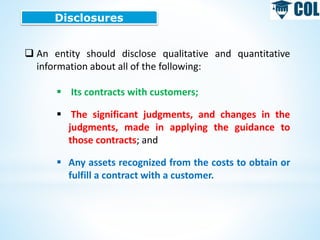
Disclosures
 An entity should disclose qualitative and quantitative
information about all of the following:
 Its contracts with customers;
 The significant judgments, and changes in the
judgments, made in applying the guidance to
those contracts; and
 Any assets recognized from the costs to obtain or
fulfill a contract with a customer.
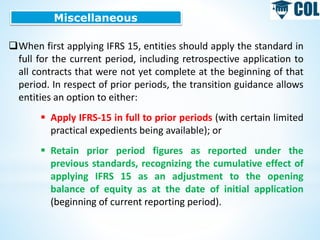
Miscellaneous
When first applying IFRS 15, entities should apply the standard in
full for the current period, including retrospective application to
all contracts that were not yet complete at the beginning of that
period. In respect of prior periods, the transition guidance allows
entities an option to either:
 Apply IFRS-15 in full to prior periods (with certain limited
practical expedients being available); or
 Retain prior period figures as reported under the
previous standards, recognizing the cumulative effect of
applying IFRS 15 as an adjustment to the opening
balance of equity as at the date of initial application
(beginning of current reporting period).
Thanks
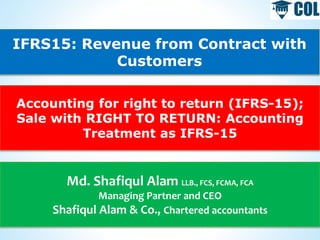
IFRS15: Revenue from Contract with
Customers
Accounting for right to return (IFRS-15);
Sale with RIGHT TO RETURN: Accounting
Treatment as IFRS-15
Md. Shafiqul Alam LLB., FCS, FCMA, FCA
Managing Partner and CEO
Shafiqul Alam & Co., Chartered accountants

IFRS-15 Updated(Amendment in 2020) .pptx

  • 1.
    How to presentRevenue/ Sales Amount in FS (IFRS-15 & IAS-1, IFRS Conceptual Framework) Welcome to the Presentation On
  • 2.
    Revenue from Contractswith Customers! A Practical Approach (IFRS15) Md. Shafiqul Alam LLB., FCS, FCMA, FCA Chairman, Bizz Solutions PLC. Managing Partner and CEO, Shafiqul Alam & Co., Chartered accountants
  • 3.
    What is revenueaccording to IFRS- 15? The core principle of IFRS-15 is that- “revenue is recognized when the services are transferred to the customer, at the transaction price. Revenue is recognized in accordance with that core principle by applying a 5-step model”
  • 4.
    Objectives of IFRS– 15 To establish the principles that an entity shall apply to report useful information to users of financial statements about the nature, amount, timing & uncertainty of revenue and cash flows arising from a contract with a customer. IFRS 15 Based on Principles Nature of Contract Timing Uncertainty of Revenue Cash flows from Contract
  • 5.
    In the Pastthere were various Guidelines to recognize revenue: Previous Guidelines New Change Applicable from January 1, 2018 IFRS 15 Replaced all other Guidelines IAS 11 IAS 18 SIC 31 IFRIC 13 IFRIC 18 IFRIC 15
  • 6.
    Scope of IFRS-15 *Leasecontracts (IFRS-16) *Insurance Contracts (IFRS 4/IFRS-17) *Financial instruments and other contractual rights/obligations within the scope of IAS 31/IFRS 9, IFRS 10, IFRS 11, IAS 27, and IAS 28 *Non-monetary exchanges between entities within the same business to facilitate sales EXCEPT FOR
  • 7.
    Key Definitions  Contract: Anagreement between two or more parties that creates enforceable rights and obligations. (Agreement with Legal Enforcement, where performance & obligation should be mentioned clearly, provision for legal action against failure or non-performance of any obligation must be there)  Customer: A party that has contracted with an entity to obtain goods or services that are an output of the entity’s ordinary activities in exchange for consideration.  Income Increases in economic benefits during the accounting period in the form of inflows or enhancements of assets or decreases of liabilities that result in an increase in equity, other than those relating to contributions from equity participants.
  • 8.
     Performance obligation Apromise in a contract with a customer to transfer to the customer either: - a good or service (or a bundle of goods or services) that is distinct or - a series of distinct goods or services that are substantially the same and that have the same pattern of transfer to the customer.  Revenue Income arising in the course of an entity’s ordinary activities.  Transaction price The amount of consideration to which an entity expects to be entitled in exchange for transferring promised goods or services to a customer, excluding amounts collected on behalf of third parties. Key Definitions
  • 9.
    Revenue Recognition IFRS-15 definitethe core principle that: An entity recognizes revenue to depict the transfer of promised goods or services to customers in an amount that reflects the consideration to which the entity expects to be entitled in exchange for those goods or services. IFRS-15 specifies how and when an IFRS reporter will recognize revenue as well as requires such entities to provide users of financial statements with more informative, relevant disclosures. The standard provides a single, principles-based five-step model to be applied to all contracts with customers.
  • 10.
    Revenue Recognition Model 1)Identify the contract(s) with the customer 2) Identify the performance obligations in the contract 3) Determine the transaction price 4) Allocate the transaction price to the performance obligations 5) Recognize revenue when (or as) each performance obligation is satisfied When? How? 5 Steps Of Revenue Recognition
  • 11.
    Contract Agreement between twoor more parties to perform a service, provide a product, or commit to an act that is enforceable by law. Written Verbal Customer Entity Revenue can only be accounted for if there exists a contract
  • 12.
    Revenue Recognition Model ContractConditions -Parties of the contract must have approved the contract & are committed to Performance Obligations - Each party's rights to goods/services can be identified - Payment terms for goods/services can be identified - The contract has a commercial substance - It is probable that an entity will collect the consideration
  • 13.
    • Consignment Sale •Sale with right of return • Repurchase Agreement • Principal VS Agent • Modification of Contract • Customer Royalty Program Revenue Recognition Issues need to discussed:
  • 14.
    Consignment Sale :No Revenue will be recognized before Final Sale to end consumer/customer Consignment Sale
  • 15.
    Accounting for Rightto Return as per IFRS-15
  • 16.
  • 17.
  • 18.
  • 19.
  • 20.
  • 21.
  • 22.
  • 23.
  • 24.
  • 25.
  • 26.
  • 27.
  • 28.
  • 29.
  • 31.
  • 32.
  • 33.
  • 34.
  • 35.
  • 36.
  • 37.
  • 38.
  • 39.
  • 41.
  • 42.
  • 43.
  • 44.
  • 45.
    Warranties/ Right ofReturn?? Sale Laptops with replacement warranty or refund money for 6 months!!
  • 46.
  • 47.
    Repurchase agreements A repurchaseagreement is where an entity sells but retains a right to repurchase the asset. This is often not recognized as a sale, but as a secured loan against the asset. Indications that should not be recognized as a sale may include- - Sale is below fair value - Option to repurchase is below the expected fair value - Entity continues to use the asset - Sale is to a bank or a financing company
  • 48.
    Revenue Recognition Model ContractConditions Parties of the contract must have approved to the contract & are committed to Performance Obligations Attribute 1 Seller Buyer
  • 49.
    Revenue Recognition Model ContractConditions Each party's rights to goods/services can be identified Attribute 2 Rights to be Transferred
  • 50.
    Revenue Recognition Model ContractConditions Payment terms for goods/services can be identified Example: * Advance Payments * Cash on Delivery * Other Agreeable Arrangements Payment Date: 1 July 2019 Attribute 3
  • 51.
    Revenue Recognition Model ContractConditions The contract has a commercial substance Attribute 4 Risk Timing Cash Flow Commercial Substance Expected to Change
  • 52.
    Revenue Recognition Model ContractConditions It is probable that an entity will collect the consideration Collectability Attribute 5 Collectability is now the first step in the Accounting Decision Making Process.
  • 53.
    Revenue Recognition Model Step1 - Parties have approved the contract and are committed to perform - Each party's rights to goods/services can be identified - The payment terns for goods/services can be identified - The contract has commercial substance - It is probable that an entity will collect the consideration (evaluate customer's ability and intention to pay). - Non-monetary exchanges between entities within the same business to Facilitate sales Attributes
  • 54.
    Business Case On 1December 2018, Fahim receives an order from a customer for a computer as well as 12 months of technical support. Fahim delivers the computer and transfers its legal rights to the customer on the same day. The customer paid BDT Tk. 50000 upfront. The computer sells for BDT Tk. 35000 and the technical support sells BDT Tk. 15000. Step 1- Identify the contract There is an agreement between Fahim and his customer for the provision of goods and services.
  • 55.
    Revenue Recognition Model Step-2 Promise in a contract with a customer to transfer to the customer either: Series of distinct goods/services that are substantially the same and have the same pattern of transfer Goods / Service (or bundle) that is distinct - PO can be both explicit (in the contract) and implicit (based on practices or policies) - If no transfer to customer => No PO! (e.g. admin or setup) Performance obligations
  • 56.
    Revenue Recognition Model:Step 2 Step 2 Identify a Performance Obligation Distinct goods/services A series of distinct goods/services 1. Customer must benefit from PO on its own 2. PO must be separately identifiable from other promises in the contact 1. Must be substantially the same (separately identifiable) 2. Have the same pattern of transfer - satisfied over time - Measureable progress towards complete satisfaction of PO
  • 57.
    Business Case On 1December 2018, Fahim receives an order from a customer for a computer as well as 12 months of technical support. Fahim delivers the computer and transfers its legal rights to the customer on the same day. The customer paid BDT Tk. 50000 upfront. The computer sells for BDT Tk. 35000 and the technical support sells BDT Tk. 15000. Step 2-Identify the separate performance obligations within a contract: There are two performance obligations within the contract.  The supply of a computer.  The supply of a technical support.
  • 58.
    Revenue Recognition Model Step– 3 Determining the Transaction price  Amount of consideration that an entity expects to receive from a customer.  In a contract is often easily determined because customer agrees to pay a fixed amount.  Other issues entities must consider in case of determining transaction price:  Variable consideration  Time value of money  Noncash consideration  Consideration paid or payable to customers
  • 59.
    Revenue Recognition Model Variable Consideration  Price dependent on future events- May include discounts, rebates, credits, performance bonuses or royalties.  Companies estimate amount of revenue to recognize- Expected value Most likely amount  Companies only recognize variable consideration if – - They have experience with similar contracts and are able to estimate the cumulative amount of revenue. - Based on experience they do not expect a significant reversal of revenue previously recognized.  If these criteria are not met, revenue recognition is constrained.
  • 60.
    Revenue Recognition Model Time Value of Money When contract involves a significant financing component- • Interest accrued on consideration to be paid over time • Fair value determine' either by measuring the consideration received or by discounting the payment using an imputed interest rate. • Company reports as interest expense or interest revenue  Non-Cash Consideration • Customers sometimes contribute goods or services, such as equipment or labor. • Companies generally recognize revenue on the basis of the fair value of what is received.  Consideration paid or payable to Customers May include discounts, volume rebates, coupons, free products these elements reduce the consideration received and the revenue to be recognized.
  • 61.
    Revenue Recognition Model Step3 Transaction price Determine the transaction price = amount of consideration to which the entity expects to be entitled in exchange for transferring promised goods/services to a customer excluding the amounts collected on behalf of third parties. How to determine transaction price?  Variable consideration  Constraining estimates in variable consideration  Existence of significant financing component  Non-cash consideration → At Fair value  Consideration payable to a customer
  • 62.
    Business Case On 1December 2018, Fahim receives an order from a customer for a computer as well as 12 months of technical support. Fahim delivers the computer and transfers its legal rights to the customer on the same day. The customer paid BDT Tk. 50000 upfront. The computer sells for BDT Tk. 35000 and the technical support sells BDT Tk. 15000. Step 3- Determine the transaction price The total transaction price is BDT Tk. 50000.
  • 63.
    Revenue Recognition Model Step4 Allocate the transaction price to the performance obligations Allocation objective =to allocate the transaction price to each performance obligation in an amount that depicts the amount of consideration for transferring promised goods/services. How to allocate the transaction price? => Based on relative stand-alone telling prices except for: Allocating discounts Allocating consideration with variable amounts
  • 64.
    Revenue Recognition Model Step4 Stand—alone selling price = the price at which the entity would sell promised good or service separately to the customer (at contract inception) I. Take observable selling prices II. If observable selling prices not available => make Estimate
  • 65.
    Business Case On 1December 2018, Fahim receives an order from a customer for a computer as well as 12 months of technical support. Fahim delivers the computer and transfers its legal rights to the customer on the same day. The customer paid BDT Tk. 50000 upfront. The computer sells for BDT Tk. 35000 and the technical support sells BDT Tk. 15000. Step 4- Allocate the transaction price to the performance obligations in the contract: Based on the standalone sales price, BDT Tk. 35000 should be allocated to the sales of the computer and BDT Tk. 15000 should be allocated to the technical support.
  • 66.
    Revenue Recognition Model Step5 Recognize revenue when (or as) an entity satisfies a PO Performance obligation is satisfied when a promised good or service is transferred to a customer Control How can a performance obligation be satisfied? Over Time At the point or time
  • 67.
    Business Case On 1December 2018, Fahim receives an order from a customer for a computer as well as 12 months of technical support. Fahim delivers the computer and transfers its legal rights to the customer on the same day. The customer paid BDT Tk. 50000 upfront. The computer sells for BDT Tk. 35000 and the technical support sells BDT Tk. 15000. Step 5- Recognize revenue when a performance obligation is satisfied: Control over the computer has been passed to the customer so the full revenue of Tk. 35000 should be recognized on 1st December 2018. The technical support is provided over time, so revenue from this should be recognized over time. In the year ended 31 December 2018, revenue of (1/12 *15000) or Tk. 1250 should be recognized from the provision of technical service.
  • 68.
    Revenue Recognition OverTime  Contract with a customer where revenue is recognized over time, there are three rules to be aware of-  If the expected outcome is a profit: - Revenue and costs should be recognized to the progress of the contract. - Output method ( work certified to date compared to total contract price). - Input method ( costs incurred to date as a proportion of total expected costs)  If the expected outcome is a Loss: The whole loss should be recognized immediately, recording a provision as an onerous contract.  If the expected outcome or progress is unknown: Revenue should be recognized to the level of recoverable costs. Contract cost should be recognized as an expense in the period in which they are incurred.
  • 69.
    Contract Cost IFRS-15 providesa guidance about two types of costs related to the contract:  Costs to obtain a contract  The incremental costs to obtain a contract  These costs would not have been incurred without an effort to obtain a contract. E.g. legal fees, sales commissions.  These costs are not expensed in profit or loss.  They are recognized as an asset if they are expected to be recovered  Cost to fulfilling a Contract are capitalized if they-  Relate directly to a contract  Enhance resources that will be used to satisfy performance obligations in the future.  Are expected to be recovered.  Capitalized costs are amortized over the period in which the related goods or services transferred & subject to impairment testing.
  • 70.
    Contract Cost IFRS 15:Contract Costs Costs to obtain a contract Costs to fulfill a contract If not within IAS-2/IAS-16/IAS-38 Capitalize if I) Costs relate directly to contract II) Costs generate/enhance resources used in satisfying performance obligations in the future III) Costs are expected to be recovered Capitalize +Amortize Sales Commission Legal fees Bonus to Employees
  • 71.
    Disclosures  An entityshould disclose qualitative and quantitative information about all of the following:  Its contracts with customers;  The significant judgments, and changes in the judgments, made in applying the guidance to those contracts; and  Any assets recognized from the costs to obtain or fulfill a contract with a customer.
  • 72.
    Miscellaneous When first applyingIFRS 15, entities should apply the standard in full for the current period, including retrospective application to all contracts that were not yet complete at the beginning of that period. In respect of prior periods, the transition guidance allows entities an option to either:  Apply IFRS-15 in full to prior periods (with certain limited practical expedients being available); or  Retain prior period figures as reported under the previous standards, recognizing the cumulative effect of applying IFRS 15 as an adjustment to the opening balance of equity as at the date of initial application (beginning of current reporting period).
  • 73.
  • 74.
    IFRS15: Revenue fromContract with Customers Accounting for right to return (IFRS-15); Sale with RIGHT TO RETURN: Accounting Treatment as IFRS-15 Md. Shafiqul Alam LLB., FCS, FCMA, FCA Managing Partner and CEO Shafiqul Alam & Co., Chartered accountants