Chapter 16 Revenue recognition issues
Objectives Understand some of the concepts of income and  revenue Understand the points of an organisation’s operating cycle at which income can be recognised Appreciate that the amount of income recognised in a particular period will relate directly to the accounting measurement model that has been adopted Understand how the existence of particular conditions associated with a sale (such as attached put and call options, or the right of return) will affect the timing of revenue recognition Understand the issues associated with recognising revenues for long-term construction projects and be aware of  the requirements of AASB 111 ‘Construction Contracts’
Definition of income and revenue Income defined (par. 70 of the AASB Framework) as Increases in economic benefits during the accounting period in the form of inflows or enhancements of assets or decreases in liabilities that result in an increase in equity, other than those relating to contributions from equity participants Income is divided into ‘revenues’ and ‘gains’
Definition of income and  revenue (cont.) Revenues and gains (par. 74 of the AASB Framework) Revenue arises  in the course of the ordinary activities  of an entity and is referred to by a variety of different names, including sales, fees, interest, dividends, royalties and rent Gains (pars 74 and 75, AASB Framework) Other items that meet the definition of income and may or may not arise in the course of the ordinary activities of an entity.  Gains represent increases in economic benefits and as such are not different in nature from revenue.
Definition of income and  revenue (cont.) Revenues and gains (par. 75, AASB Framework) Gains include, for example, those arising on the disposal of non- current assets. The definition of income also includes unrealised gains, for example those arising on the revaluation of marketable securities and those resulting from increases in the carrying amount of long-term assets. When gains are recognised in the income statement, they are usually displayed separately because knowledge of them is useful in making economic decisions. Gains are often reported net of related expenses.
Definition of income and  revenue (cont.) Generally speaking, revenues relate to the ordinary income-generating activities of an entity, e.g. sales or rental receipts Gains relate to ‘other income’ — not necessarily part of the ordinary activities of an entity Differentiation based on some degree of professional judgment What is an ‘ordinary’ activity for one business may not be ‘ordinary’ for another —so the benefits might be  deemed ‘revenue’ in one entity and a ‘gain’ in another
Definition of income and  revenue (cont.) Differentiation between revenue and gains also embraced by AASB 118 ‘Revenue’ (par. 7) the gross inflow of economic benefits during the period arising in the course of the ordinary activities of an entity when those inflows result in increases in equity, other than increases relating to contributions from equity participants
Definition of income and  revenue (cont.) Scope of AASB 118 ‘Revenue’ is fairly restricted — applies to accounting for revenue arising from transactions and events relating to (par. 1) the sale of goods the rendering of services the use by others of entity assets yielding interest, royalties and dividends Recognition criteria provided for each of the above categories of revenue, e.g. sale of goods (par. 14)
Definition of income and  revenue (cont.) Revenue from the sale of goods is to be recognised when all of the following conditions have been satisfied: the entity has transferred to the buyer the significant risks and rewards of ownership of the goods the entity retains neither continuing managerial involvement to the degree usually associated with ownership nor effective control over the goods the amount of revenue can be measured reliably it is probable that the economic benefits associated with the transaction will flow to the entity the costs incurred or to be incurred in respect of the transaction can be measured reliably
Definition of income and revenue (cont.) Where revenue has been recognised, AASB 118 requires that the revenue be measured at the  fair value  of the consideration or contributions received or receivable (par. 9) if cash is not to be received for some period of time the future amount to be received would need to be discounted to its present value and the present value recognised as revenue (refer to AASB 118, par. 11) if cash is received for goods and services provided the revenue recorded is equal to the cash received
Income and revenue recognition — current practice AASB 118 (Appendix A) provides guidance in relation to the recognition of different types of revenues. In relation to the sale of goods, guidance is provided in relation to goods sold subject to conditions lay-by sales orders when partial payment received in advance subscriptions to publications instalment sales real estate sales
Income and revenue recognition — current practice (cont.) Traditionally, revenue has been recognised at several points in the earnings cycle (refer to Figure 16.1 on page 560 —The earnings cycle ), for example (i)  at point 5 (progressively throughout production) in the building industry for long-term construction contracts (ii)  at point 7 (receipt of orders after completing production) where it is the responsibility of the purchaser to collect the goods (iii) at point 8 (delivery of goods to customers)—in most cases (iv) at point 9 (receipt of cash) by some professional practices and for instalment credit sales
Income and revenue recognition — current practice (cont.) Rarely, if ever, recognised prior to point 5 (progressively throughout production) - uncertainty surrounding the ultimate irrevocable and unconditional claim to cash (or its equivalent) prior to this point In practice, point 9 (receipt of cash) is considered too conservative to be the general criterion At point 8 (delivery of goods to customers) any uncertainty remaining is accounted for by creating a ‘provision for doubtful debts’
Income and revenue recognition — current practice (cont.) Currently, we have a system of accounting based predominantly on a historical cost, transaction-based system of accounting We also make use of other approaches to valuation (e.g. market values) Increases in market values of marketable securities are recognised as part of income — a departure from traditional historical accounting but still consistent with the definition of income provided in the AASB Framework Note Different measurement models of assets and liabilities, e.g. historical cost vs the modified historical cost system, will generate different calculations of income and hence profits
Income and revenue recognition — according to the AASB Framework Paragraph 83 of the AASB Framework An item that meets the definition of an element (e.g. income) should be recognised if the item has a cost or value that can be measured with reliability it is probable that any future economic benefit associated with the item will flow to or from the entity
Income and revenue recognition — according to the AASB Framework (cont.) Note Probable refers to more likely than less likely AASB 118 ‘Revenue’ provides recognition criteria for revenue items revenue that relates to sale of goods, rendering of services, and interest, royalties and dividends revenue from sales of goods and services is to be recognised when the entity has transferred to the buyer the significant risks and rewards of ownership of the goods (refer to pars 16 and 17 AASB 118 for additional guidance)
Income and revenue recognition — at completion of production At times, revenue may be recognised at the completion of production, even when no sale has been made Examples of such cases include the production of precious metals or agricultural products
Income and revenue recognition — at the time of sale The two conditions (probable economic benefits and reliable measurement) for recognising revenue are usually met by the time the product or merchandise is delivered, or the services are rendered to customers Normally determined by shipping terms, i.e. time of sale is commonly interpreted as when title passes
Income and revenue recognition — at the time of sale (cont.) F.O.B. shipping point title passes to the buyer (and revenue is recognised) when the seller delivers goods to a common carrier who acts as an agent for the buyer F.O.B. destination title does not pass (and revenue is not recognised) until the buyer receives the goods from the carrier
Income and revenue recognition — at the time of sale (cont.) In advance of cash receipt When revenue is recognised in advance of receipt of cash, it is common to recognise a ‘provision for doubtful debts’ determined on basis of past experience and industry averages journal entry Dr Doubtful debts expense Cr Provision for doubtful debts provision for doubtful debts is contra account to debtors
Income and revenue recognition — at the time of sale (cont.) In advance of cash receipt (cont.) If goods are sold or services provided on credit terms, not all amounts due from debtors will ultimately be collected To ignore this fact would lead to an overstatement of receivables and assets in the balance sheet This is consistent with the general principle provided in par. 18 of AASB 118
Income and revenue recognition — at the time of sale (cont.) In advance of cash receipt (cont.) Accounting for bad and doubtful debts When actual debtor is identified as unlikely to pay when amount was previously anticipated Dr Provision for doubtful debts Cr Debtors When debtor is identified as unlikely to pay and amount was not previously anticipated Dr Bad debts expense Cr Debtors
Accounting for sales with associated conditions Transactions involving the sale of assets with conditions attached should be reviewed to assess whether control of the future economic benefits has passed from the seller to the purchaser; and it is probable that the inflow of economic benefits to the seller has occurred
Accounting for sales with associated  conditions — call and put options Call option Provides the holder of the option with the right to buy an asset at a specified exercise price on or before a specified date The party that writes the call option agrees to deliver a particular asset to the call-option buyer, if that buyer instructs the other party to do so A call option is considered to have value when the value of the underlying asset exceeds the option’s exercise price If at exercise date the exercise price is above or equal to the market value of the asset, the option has no value and a sale could be recorded However, if something is sold to another party, but as part of the sales conditions, the seller has a call option which enables them to buy back the asset at a future date, then to the extent that the market price is greater than, or likely to be greater than, the option’s exercise price, then no sale should be recorded
Accounting for sales with associated  conditions — call and put options (cont.) Put option Operates in reverse manner to a call option Holder has the right to sell an asset at a specified exercise price on or before a specified date The writer or the seller of the put option agrees to buy the asset at a future date for the exercise price if the put option holder (buyer) so requests The holder of the put option would typically exercise the option (require the other party to buy the asset) only if the exercise price is above the market price Guarantees holders a minimum price for their assets If an asset is sold to another party, and the buyer has a put option which enables that party to sell the asset back to the original seller, then a sale should not be recognised if the exercise price is, or is likely to be, above the market price
Accounting for sales with associated  conditions — call and put options (cont.) Where a transaction involves concurrent use of a financial instrument, it is necessary to evaluate the conditions attaching to the transaction to establish whether, in substance, the transaction is a financial arrangement rather than a sale Probability of the exercise of the options must be considered in recognising revenue
Accounting for sales with associated conditions — revenue recognition when right of return exists Alternative treatments available when the seller is exposed to continued risks of ownership through return of the product not recording the sale until all return privileges have expired recording the sale but reducing sales by an estimate of future returns recording the sale and accounting for the returns as they occur
Accounting for sales with associated conditions — revenue recognition when right of return exists (cont.) If a company sells its product but gives the buyer the right to return the product, revenue from the sales transaction may be recognised at the time of sale if all of the following conditions have been met the seller’s price to the buyer is substantially fixed or determinable at the date of sale the buyer has paid the seller, or the buyer is obligated to pay the seller and the obligation is not contingent on the resale of the product the buyer’s obligation to the seller would not be changed in the event of theft or physical destruction or damage of the product the buyer acquiring the product for resale has economic substance apart from that provided by the seller the seller does not have significant obligations for future performance to directly bring about the resale of the product by the buyer the amount of future returns can be reasonably estimated
Accounting for sales with associated conditions —s ale and leaseback Although ownership of the leased property has been transferred to the purchaser/lessor, the vendor/lessee normally retains control The vendor/lessee has in effect entered into a financing arrangement — leased property used as collateral for a loan Transaction does not constitute a sale and does not give rise to  revenue inflow of economic benefits (proceeds from disposal) have resulted in an equivalent liability (lease payable) result is no increase in equity
Interest and dividends — interest revenue Interest revenue is recognised over time as the borrower has the benefit of the borrowings and the lender establishes claims for interest earned Prepayment of interest not regarded as revenue to lender as lender has present obligation to provide finance for the period to which the prepayment relates Interest revenue might be implicit in the terms of a transaction for example, where goods are sold on extended credit, vendor is effectively financing the purchaser transaction gives rise to two forms of revenue Sales revenue—present value of future payments Interest revenue from financing activities
Interest and dividends — interest  revenue (cont.) To estimate the present value of the proceeds, an applicable interest rate inherent in the agreement must be determined AASB 118 (par. 11) when the arrangement effectively constitutes a financing transaction, the fair value of the consideration is determined by discounting all future receipts using an imputed rate of interest.  The imputed rate of interest is the more clearly determinable of either (a) the prevailing rate for a similar instrument of an issuer with a similar credit rating; or (b) a rate of interest that discounts the nominal amount of the instrument to the current cash sales price of the goods or services
Interest and dividends — interest  revenue (cont.) The difference between the fair value and the nominal amount of the consideration is recognised as interest revenue  Rate used for valuation purposes will normally be at least equal to the rate at which the debtor can obtain financing of a similar nature from other sources at the date of the transaction Objective is to approximate the rate that would have resulted if an independent borrower and an independent lender had negotiated a similar transaction on comparable terms and conditions Refer to Worked Example 16.1 on pp. 571 —R ecognition of interest inherent in a sales transaction
Interest and dividends — dividend revenue Dividends do not accrue over time but usually result from a decision of the board of directors Dividend revenue should be recorded once it is considered probable that inflow of future economic benefits has occurred and when these benefits can be measured reliably in most cases this will be at the time the board of directors or other governing body proposed the dividend
Unearned revenue Recorded when payment is received in advance of services or resources being provided The receipts have not been earned Considered to be liabilities under present obligation to transfer future economic benefits at a future date Refer to Worked Example 16.2 on page 573 —R evenue received in advance
Accounting for  construction contracts Accounting issues result from some construction projects taking a number of financial periods to complete should revenue be recognised progressively throughout the contract? if so, how would the amount of revenue be determined? Deferral of  revenue recognition until completion of project would result in greater volatility of reported revenues and of related profits or losses
Accounting for  construction contracts (cont.) Governed by AASB 111 ‘Construction Contracts’ Applies to the accounting methods adopted by a contractor for all construction contracts Construction contract defined (AASB 111, par. 3) a contract specifically negotiated for the construction of an asset or a combination of assets that are closely interrelated or interdependent in terms of their design, technology and function of their ultimate purpose or use Refer also to AASB 111 (par. 4)
Accounting for  construction contracts (cont.) Accounting requirements Individual construction contracts must be accounted for separately and the requirements of the standard must be applied separately to each contract AASB 111 (par. 9) a group of contracts, whether with a single customer or with several customers, is to be treated as a single contract when (a) the group of contracts is negotiated as a single package; (b) the contracts are so closely interrelated that they are, in effect, part of a single project with an overall profit margin; and (c) the contracts are performed concurrently or in a continuous sequence
Accounting for  construction contracts (cont.) Accounting requirements (cont.) AASB 111 requires (if certain criteria are satisfied) that contractors use the percentage-of-completion method to account for construction contracts Profit on construction contract is recognised in proportion to the work performed in each reporting period in which construction occurs
Accounting for  construction contracts (cont.) Construction costs plus gross profit earned to date accumulated in inventory account (construction in progress) Progress billings accumulated in contra inventory account (billings on construction in progress account)
Accounting for  construction contracts (cont.) Percentage-of-completion method should be used provided that certain conditions are met that enable the outcome of the contract to be reliably estimated AASB 111 (par. 22) When the outcome of a construction contract can be estimated reliably, contract revenue and contract costs associated with the construction contract are to be recognised as revenue and expenses respectively by reference to the stage of completion of the contract activity at the reporting date
Accounting for  construction contracts (cont.) Types of construction contracts Fixed-price contracts Cost-plus contracts Type of contract determines the conditions that must be satisfied to use the percentage-of-completion method Defined in par. 3 of AASB 111
Accounting for  construction contracts (cont.) Conditions of use of percentage-of-completion method (AASB 111, par. 23) With fixed-price contract total contract revenue can be measured reliably; it is probable that economic benefits arising from the contract will flow to the contractor; both the contract costs to complete the contract and stage of contract completion as at reporting date can be measured reliably; and the contract costs attributable to the contract can be clearly identified and measured reliably so that actual costs can be compared with prior estimates
Accounting for  construction contracts (cont.) Conditions of use of percentage-of-completion method (AASB 111, par. 24) With cost-plus contract it is probable that the economic benefits arising from the contract will flow to the contractor; and  the contract costs attributable to the contract, whether or not specifically reimbursable can be clearly identified and measured reliably
Accounting for  construction contracts (cont.) If conditions are not satisfied - no profit is to be brought to account until they are satisfied - at the extreme, no profit to be recognised until project completion Note When outcome of construction contract cannot be estimated reliably (AASB 111, par. 32) revenue is to be recognised only to the extent of contract costs incurred that it is probable will be recoverable; and contract costs are to be recognised as an expense in the period in which they are incurred
Accounting for  construction contracts (cont.) Measuring progress towards completion Percentage of completion can be measured in a number of ways (per AASB 111, par. 30) the entity uses the method that measures reliably the work performed. Depending on the nature of the contract, the methods may include the proportion that contract costs incurred for work performed to date bear to the estimated total contract costs; surveys of work performed; or completion of physical proportion of the contract work. Progress payments and advances received from customers often do not reflect the work performed
Accounting for  construction contracts (cont.) Measuring progress towards completion Cost basis The percentage of completion is measured by comparing costs incurred to date with the most recent estimate of the total costs to complete the contract Only those contract costs that reflect the work performed are included in costs incurred to date.  Examples of contract costs excluded are contract costs that relate to future activity on the contract, such as costs of materials delivered or set aside but as yet not installed, used or applied payments made to subcontractors in advance of work performed
Accounting for construction contracts (cont.) Types of costs incurred by contractors Costs related directly to a specific contract, e.g. direct materials, direct labour, depreciation of equipment, costs of moving plant and equipment, expected warranty costs, costs of design and technical assistance directly related to contract, costs of securing contract, costs of hiring plant and equipment Costs that are attributable to contract activity in general and capable of being allocated on a reasonable basis to specific contracts, e.g. tender preparation, insurance, design and technical assistance Costs that relate to the activities of the reporting entity generally or that relate to contract activity generally and are not normally related to specific contracts, e.g. general administration and selling costs, finance costs and research and development costs not directly related to contract  Note Costs (a) and (b) are normally included in accumulated contract costs Costs (c) are usually excluded from accumulated contract costs because they do not relate to reaching the present stage of completion of a specific contract
Accounting for  construction contracts (cont.) Calculation of percentage of completion (cost method) Costs incurred to the end of the current period Most recent estimate of total costs Current period revenue or gross profit - estimated total revenue or gross profit from the contract  multiplied  by percentage complete  less  total revenue or gross profit recognised in prior periods
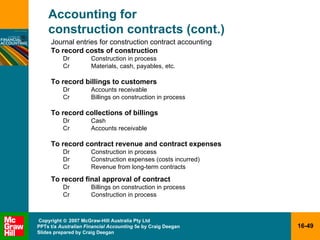
Accounting for  construction contracts (cont.) Journal entries for construction contract accounting To record costs of construction Dr Construction in process Cr Materials, cash, payables, etc. To record billings to customers Dr Accounts receivable Cr Billings on construction in process To record collections of billings Dr Cash Cr Accounts receivable To record contract revenue and contract expenses Dr Construction in process Dr Construction expenses (costs incurred) Cr Revenue from long-term contracts To record final approval of contract Dr Billings on construction in process Cr Construction in process
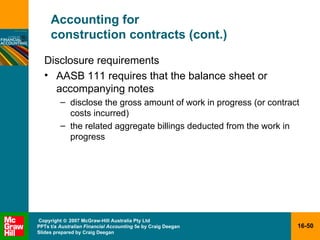
Accounting for  construction contracts (cont.) Disclosure requirements AASB 111 requires that the balance sheet or accompanying notes disclose the gross amount of work in progress (or contract costs incurred) the related aggregate billings deducted from the work in progress
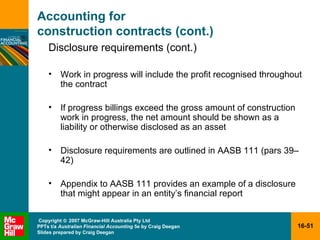
Accounting for  construction contracts (cont.) Disclosure requirements (cont.) Work in progress will include the profit recognised throughout the contract If progress billings exceed the gross amount of construction work in progress, the net amount should be shown as a liability or otherwise disclosed as an asset Disclosure requirements are outlined in AASB 111 (pars 39 – 42) Appendix to AASB 111 provides an example of a disclosure that might appear in an entity’s financial report
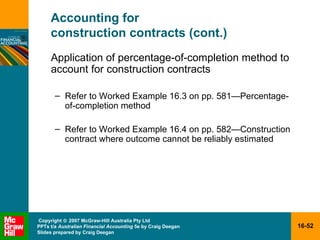
Accounting for  construction contracts (cont.) Application of percentage-of-completion method to account for construction contracts Refer to Worked Example 16.3 on pp. 581 —Percentage-of-completion method Refer to Worked Example 16.4 on pp. 582 —C onstruction contract where outcome cannot be reliably estimated
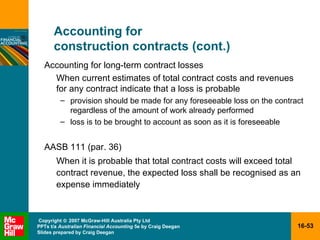
Accounting for  construction contracts (cont.) Accounting for long-term contract losses When current estimates of total contract costs and revenues for any contract indicate that a loss is probable provision should be made for any foreseeable loss on the contract regardless of the amount of work already performed loss is to be brought to account as soon as it is foreseeable AASB 111 (par. 36) When it is probable that total contract costs will exceed total contract revenue, the expected loss shall be recognised as an expense immediately
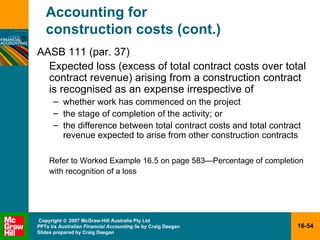
Accounting for  construction costs (cont.) AASB 111 (par. 37) Expected loss (excess of total contract costs over total contract revenue) arising from a construction contract is recognised as an expense irrespective of whether work has commenced on the project the stage of completion of the activity; or the difference between total contract costs and total contract revenue expected to arise from other construction contracts Refer to Worked Example 16.5 on page 583 —P ercentage of completion with recognition of a loss
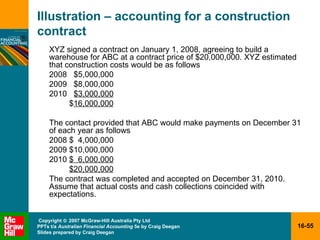
Illustration – accounting for a construction contract XYZ signed a contract on January 1, 2008, agreeing to build a warehouse for ABC at a contract price of $20,000,000. XYZ estimated that construction costs would be as follows 2008   $5,000,000 2009   $8,000,000 2010   $3,000,000 $ 16,000,000 The contact provided that ABC would make payments on December 31 of each year as follows 2008 $  4,000,000 2009 $10,000,000 2010 $  6,000,000 $20,000,000 The contract was completed and accepted on December 31, 2010.  Assume that actual costs and cash collections coincided with expectations.
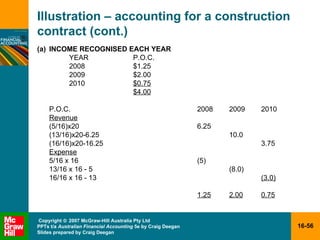
Illustration – accounting for a construction contract (cont.) (a) INCOME RECOGNISED EACH YEAR YEAR P.O.C. 2008 $1.25 2009 $2.00 2010 $0.75 $4.00 P.O.C. 2008 2009 2010 Revenue (5/16)x20 6.25 (13/16)x20-6.25 10.0 (16/16)x20-16.25 3.75 Expense 5/16 x 16 (5) 13/16 x 16 - 5 (8.0) 16/16 x 16 - 13 (3.0) 1.25 2.00 0.75
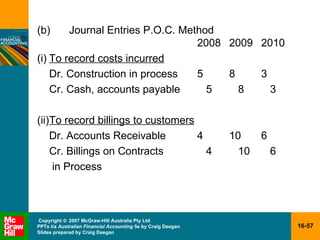
(b) Journal Entries P.O.C. Method 2008 2009 2010 (i) To record costs incurred Dr. Construction in process 5 8 3 Cr. Cash, accounts payable   5   8   3 (ii) To record billings to customers Dr. Accounts Receivable 4 10 6 Cr. Billings on Contracts   4   10   6    in Process
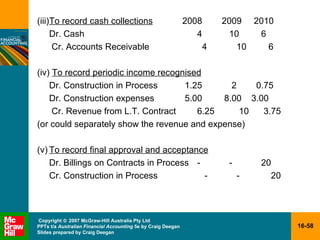
(iii) To record cash collections   2008  2009  2010 Dr. Cash 4 10 6   Cr. Accounts Receivable   4   10   6 (iv)  To record periodic income recognised Dr. Construction in Process    1.25  2  0.75 Dr. Construction expenses   5.00  8.00  3.00   Cr. Revenue from L.T. Contract 6.25   10  3.75 (or could separately show the revenue and expense) (v) To record final approval and acceptance Dr. Billings on Contracts in Process - - 20 Cr. Construction in Process   -   -   20
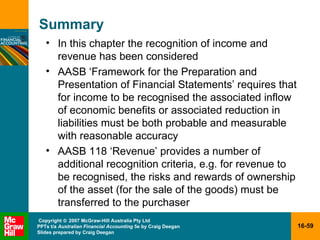
Summary In this chapter the recognition of income and revenue has been considered AASB ‘Framework for the Preparation and Presentation of Financial Statements’ requires that for income to be recognised the associated inflow of economic benefits or associated reduction in liabilities must be both probable and measurable with reasonable accuracy AASB 118 ‘Revenue’ provides a number of additional recognition criteria, e.g. for revenue to be recognised, the risks and rewards of ownership of the asset (for the sale of the goods) must be transferred to the purchaser
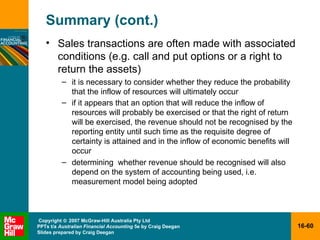
Summary (cont.) Sales transactions are often made with associated conditions (e.g. call and put options or a right to return the assets) it is necessary to consider whether they reduce the probability that the inflow of resources will ultimately occur if it appears that an option that will reduce the inflow of resources will probably be exercised or that the right of return will be exercised, the revenue should not be recognised by the reporting entity until such time as the requisite degree of certainty is attained and in the inflow of economic benefits will occur   determining  whether revenue should be recognised will also depend on the system of accounting being used, i.e. measurement model being adopted
Summary (cont.) Under historical-cost accounting the increase in the value of marketable securities would not be considered as revenue until such time as the securitiies are sold If a market values-based system is used increased market prices of assets could be treated as part of the period’s income  Revenue and expenses related to a construction contract are to be recognised by applying the percentage-of-completion method if the outcome and stage of completion of the construction contract can be reliably estimated Where percentage-of-completion method is applied, revenue is brought to account with a corresponding increase in construction in progress on the basis of percentage of completion
Summary (cont.) Percentage of completion is measured typically by comparing costs incurred to date with the most recent estimate of the total costs to complete the contract Revenue will be recognised throughout the life of the contract, but if the percentage-of-completion method is used and it becomes apparent that a loss will be made, the entire loss must be recognised as soon as it is foreseeable For disclosure purposes, billings on construction in progress account is shown in the balance sheet as a deduction from construction in progress account — if billings account balance exceeds construction in progress account the net amount represents a liability

Deegan5e Ch16

  • 1.
    Chapter 16 Revenuerecognition issues
  • 2.
    Objectives Understand someof the concepts of income and revenue Understand the points of an organisation’s operating cycle at which income can be recognised Appreciate that the amount of income recognised in a particular period will relate directly to the accounting measurement model that has been adopted Understand how the existence of particular conditions associated with a sale (such as attached put and call options, or the right of return) will affect the timing of revenue recognition Understand the issues associated with recognising revenues for long-term construction projects and be aware of the requirements of AASB 111 ‘Construction Contracts’
  • 3.
    Definition of incomeand revenue Income defined (par. 70 of the AASB Framework) as Increases in economic benefits during the accounting period in the form of inflows or enhancements of assets or decreases in liabilities that result in an increase in equity, other than those relating to contributions from equity participants Income is divided into ‘revenues’ and ‘gains’
  • 4.
    Definition of incomeand revenue (cont.) Revenues and gains (par. 74 of the AASB Framework) Revenue arises in the course of the ordinary activities of an entity and is referred to by a variety of different names, including sales, fees, interest, dividends, royalties and rent Gains (pars 74 and 75, AASB Framework) Other items that meet the definition of income and may or may not arise in the course of the ordinary activities of an entity. Gains represent increases in economic benefits and as such are not different in nature from revenue.
  • 5.
    Definition of incomeand revenue (cont.) Revenues and gains (par. 75, AASB Framework) Gains include, for example, those arising on the disposal of non- current assets. The definition of income also includes unrealised gains, for example those arising on the revaluation of marketable securities and those resulting from increases in the carrying amount of long-term assets. When gains are recognised in the income statement, they are usually displayed separately because knowledge of them is useful in making economic decisions. Gains are often reported net of related expenses.
  • 6.
    Definition of incomeand revenue (cont.) Generally speaking, revenues relate to the ordinary income-generating activities of an entity, e.g. sales or rental receipts Gains relate to ‘other income’ — not necessarily part of the ordinary activities of an entity Differentiation based on some degree of professional judgment What is an ‘ordinary’ activity for one business may not be ‘ordinary’ for another —so the benefits might be deemed ‘revenue’ in one entity and a ‘gain’ in another
  • 7.
    Definition of incomeand revenue (cont.) Differentiation between revenue and gains also embraced by AASB 118 ‘Revenue’ (par. 7) the gross inflow of economic benefits during the period arising in the course of the ordinary activities of an entity when those inflows result in increases in equity, other than increases relating to contributions from equity participants
  • 8.
    Definition of incomeand revenue (cont.) Scope of AASB 118 ‘Revenue’ is fairly restricted — applies to accounting for revenue arising from transactions and events relating to (par. 1) the sale of goods the rendering of services the use by others of entity assets yielding interest, royalties and dividends Recognition criteria provided for each of the above categories of revenue, e.g. sale of goods (par. 14)
  • 9.
    Definition of incomeand revenue (cont.) Revenue from the sale of goods is to be recognised when all of the following conditions have been satisfied: the entity has transferred to the buyer the significant risks and rewards of ownership of the goods the entity retains neither continuing managerial involvement to the degree usually associated with ownership nor effective control over the goods the amount of revenue can be measured reliably it is probable that the economic benefits associated with the transaction will flow to the entity the costs incurred or to be incurred in respect of the transaction can be measured reliably
  • 10.
    Definition of incomeand revenue (cont.) Where revenue has been recognised, AASB 118 requires that the revenue be measured at the fair value of the consideration or contributions received or receivable (par. 9) if cash is not to be received for some period of time the future amount to be received would need to be discounted to its present value and the present value recognised as revenue (refer to AASB 118, par. 11) if cash is received for goods and services provided the revenue recorded is equal to the cash received
  • 11.
    Income and revenuerecognition — current practice AASB 118 (Appendix A) provides guidance in relation to the recognition of different types of revenues. In relation to the sale of goods, guidance is provided in relation to goods sold subject to conditions lay-by sales orders when partial payment received in advance subscriptions to publications instalment sales real estate sales
  • 12.
    Income and revenuerecognition — current practice (cont.) Traditionally, revenue has been recognised at several points in the earnings cycle (refer to Figure 16.1 on page 560 —The earnings cycle ), for example (i) at point 5 (progressively throughout production) in the building industry for long-term construction contracts (ii) at point 7 (receipt of orders after completing production) where it is the responsibility of the purchaser to collect the goods (iii) at point 8 (delivery of goods to customers)—in most cases (iv) at point 9 (receipt of cash) by some professional practices and for instalment credit sales
  • 13.
    Income and revenuerecognition — current practice (cont.) Rarely, if ever, recognised prior to point 5 (progressively throughout production) - uncertainty surrounding the ultimate irrevocable and unconditional claim to cash (or its equivalent) prior to this point In practice, point 9 (receipt of cash) is considered too conservative to be the general criterion At point 8 (delivery of goods to customers) any uncertainty remaining is accounted for by creating a ‘provision for doubtful debts’
  • 14.
    Income and revenuerecognition — current practice (cont.) Currently, we have a system of accounting based predominantly on a historical cost, transaction-based system of accounting We also make use of other approaches to valuation (e.g. market values) Increases in market values of marketable securities are recognised as part of income — a departure from traditional historical accounting but still consistent with the definition of income provided in the AASB Framework Note Different measurement models of assets and liabilities, e.g. historical cost vs the modified historical cost system, will generate different calculations of income and hence profits
  • 15.
    Income and revenuerecognition — according to the AASB Framework Paragraph 83 of the AASB Framework An item that meets the definition of an element (e.g. income) should be recognised if the item has a cost or value that can be measured with reliability it is probable that any future economic benefit associated with the item will flow to or from the entity
  • 16.
    Income and revenuerecognition — according to the AASB Framework (cont.) Note Probable refers to more likely than less likely AASB 118 ‘Revenue’ provides recognition criteria for revenue items revenue that relates to sale of goods, rendering of services, and interest, royalties and dividends revenue from sales of goods and services is to be recognised when the entity has transferred to the buyer the significant risks and rewards of ownership of the goods (refer to pars 16 and 17 AASB 118 for additional guidance)
  • 17.
    Income and revenuerecognition — at completion of production At times, revenue may be recognised at the completion of production, even when no sale has been made Examples of such cases include the production of precious metals or agricultural products
  • 18.
    Income and revenuerecognition — at the time of sale The two conditions (probable economic benefits and reliable measurement) for recognising revenue are usually met by the time the product or merchandise is delivered, or the services are rendered to customers Normally determined by shipping terms, i.e. time of sale is commonly interpreted as when title passes
  • 19.
    Income and revenuerecognition — at the time of sale (cont.) F.O.B. shipping point title passes to the buyer (and revenue is recognised) when the seller delivers goods to a common carrier who acts as an agent for the buyer F.O.B. destination title does not pass (and revenue is not recognised) until the buyer receives the goods from the carrier
  • 20.
    Income and revenuerecognition — at the time of sale (cont.) In advance of cash receipt When revenue is recognised in advance of receipt of cash, it is common to recognise a ‘provision for doubtful debts’ determined on basis of past experience and industry averages journal entry Dr Doubtful debts expense Cr Provision for doubtful debts provision for doubtful debts is contra account to debtors
  • 21.
    Income and revenuerecognition — at the time of sale (cont.) In advance of cash receipt (cont.) If goods are sold or services provided on credit terms, not all amounts due from debtors will ultimately be collected To ignore this fact would lead to an overstatement of receivables and assets in the balance sheet This is consistent with the general principle provided in par. 18 of AASB 118
  • 22.
    Income and revenuerecognition — at the time of sale (cont.) In advance of cash receipt (cont.) Accounting for bad and doubtful debts When actual debtor is identified as unlikely to pay when amount was previously anticipated Dr Provision for doubtful debts Cr Debtors When debtor is identified as unlikely to pay and amount was not previously anticipated Dr Bad debts expense Cr Debtors
  • 23.
    Accounting for saleswith associated conditions Transactions involving the sale of assets with conditions attached should be reviewed to assess whether control of the future economic benefits has passed from the seller to the purchaser; and it is probable that the inflow of economic benefits to the seller has occurred
  • 24.
    Accounting for saleswith associated conditions — call and put options Call option Provides the holder of the option with the right to buy an asset at a specified exercise price on or before a specified date The party that writes the call option agrees to deliver a particular asset to the call-option buyer, if that buyer instructs the other party to do so A call option is considered to have value when the value of the underlying asset exceeds the option’s exercise price If at exercise date the exercise price is above or equal to the market value of the asset, the option has no value and a sale could be recorded However, if something is sold to another party, but as part of the sales conditions, the seller has a call option which enables them to buy back the asset at a future date, then to the extent that the market price is greater than, or likely to be greater than, the option’s exercise price, then no sale should be recorded
  • 25.
    Accounting for saleswith associated conditions — call and put options (cont.) Put option Operates in reverse manner to a call option Holder has the right to sell an asset at a specified exercise price on or before a specified date The writer or the seller of the put option agrees to buy the asset at a future date for the exercise price if the put option holder (buyer) so requests The holder of the put option would typically exercise the option (require the other party to buy the asset) only if the exercise price is above the market price Guarantees holders a minimum price for their assets If an asset is sold to another party, and the buyer has a put option which enables that party to sell the asset back to the original seller, then a sale should not be recognised if the exercise price is, or is likely to be, above the market price
  • 26.
    Accounting for saleswith associated conditions — call and put options (cont.) Where a transaction involves concurrent use of a financial instrument, it is necessary to evaluate the conditions attaching to the transaction to establish whether, in substance, the transaction is a financial arrangement rather than a sale Probability of the exercise of the options must be considered in recognising revenue
  • 27.
    Accounting for saleswith associated conditions — revenue recognition when right of return exists Alternative treatments available when the seller is exposed to continued risks of ownership through return of the product not recording the sale until all return privileges have expired recording the sale but reducing sales by an estimate of future returns recording the sale and accounting for the returns as they occur
  • 28.
    Accounting for saleswith associated conditions — revenue recognition when right of return exists (cont.) If a company sells its product but gives the buyer the right to return the product, revenue from the sales transaction may be recognised at the time of sale if all of the following conditions have been met the seller’s price to the buyer is substantially fixed or determinable at the date of sale the buyer has paid the seller, or the buyer is obligated to pay the seller and the obligation is not contingent on the resale of the product the buyer’s obligation to the seller would not be changed in the event of theft or physical destruction or damage of the product the buyer acquiring the product for resale has economic substance apart from that provided by the seller the seller does not have significant obligations for future performance to directly bring about the resale of the product by the buyer the amount of future returns can be reasonably estimated
  • 29.
    Accounting for saleswith associated conditions —s ale and leaseback Although ownership of the leased property has been transferred to the purchaser/lessor, the vendor/lessee normally retains control The vendor/lessee has in effect entered into a financing arrangement — leased property used as collateral for a loan Transaction does not constitute a sale and does not give rise to revenue inflow of economic benefits (proceeds from disposal) have resulted in an equivalent liability (lease payable) result is no increase in equity
  • 30.
    Interest and dividends— interest revenue Interest revenue is recognised over time as the borrower has the benefit of the borrowings and the lender establishes claims for interest earned Prepayment of interest not regarded as revenue to lender as lender has present obligation to provide finance for the period to which the prepayment relates Interest revenue might be implicit in the terms of a transaction for example, where goods are sold on extended credit, vendor is effectively financing the purchaser transaction gives rise to two forms of revenue Sales revenue—present value of future payments Interest revenue from financing activities
  • 31.
    Interest and dividends— interest revenue (cont.) To estimate the present value of the proceeds, an applicable interest rate inherent in the agreement must be determined AASB 118 (par. 11) when the arrangement effectively constitutes a financing transaction, the fair value of the consideration is determined by discounting all future receipts using an imputed rate of interest. The imputed rate of interest is the more clearly determinable of either (a) the prevailing rate for a similar instrument of an issuer with a similar credit rating; or (b) a rate of interest that discounts the nominal amount of the instrument to the current cash sales price of the goods or services
  • 32.
    Interest and dividends— interest revenue (cont.) The difference between the fair value and the nominal amount of the consideration is recognised as interest revenue Rate used for valuation purposes will normally be at least equal to the rate at which the debtor can obtain financing of a similar nature from other sources at the date of the transaction Objective is to approximate the rate that would have resulted if an independent borrower and an independent lender had negotiated a similar transaction on comparable terms and conditions Refer to Worked Example 16.1 on pp. 571 —R ecognition of interest inherent in a sales transaction
  • 33.
    Interest and dividends— dividend revenue Dividends do not accrue over time but usually result from a decision of the board of directors Dividend revenue should be recorded once it is considered probable that inflow of future economic benefits has occurred and when these benefits can be measured reliably in most cases this will be at the time the board of directors or other governing body proposed the dividend
  • 34.
    Unearned revenue Recordedwhen payment is received in advance of services or resources being provided The receipts have not been earned Considered to be liabilities under present obligation to transfer future economic benefits at a future date Refer to Worked Example 16.2 on page 573 —R evenue received in advance
  • 35.
    Accounting for construction contracts Accounting issues result from some construction projects taking a number of financial periods to complete should revenue be recognised progressively throughout the contract? if so, how would the amount of revenue be determined? Deferral of revenue recognition until completion of project would result in greater volatility of reported revenues and of related profits or losses
  • 36.
    Accounting for construction contracts (cont.) Governed by AASB 111 ‘Construction Contracts’ Applies to the accounting methods adopted by a contractor for all construction contracts Construction contract defined (AASB 111, par. 3) a contract specifically negotiated for the construction of an asset or a combination of assets that are closely interrelated or interdependent in terms of their design, technology and function of their ultimate purpose or use Refer also to AASB 111 (par. 4)
  • 37.
    Accounting for construction contracts (cont.) Accounting requirements Individual construction contracts must be accounted for separately and the requirements of the standard must be applied separately to each contract AASB 111 (par. 9) a group of contracts, whether with a single customer or with several customers, is to be treated as a single contract when (a) the group of contracts is negotiated as a single package; (b) the contracts are so closely interrelated that they are, in effect, part of a single project with an overall profit margin; and (c) the contracts are performed concurrently or in a continuous sequence
  • 38.
    Accounting for construction contracts (cont.) Accounting requirements (cont.) AASB 111 requires (if certain criteria are satisfied) that contractors use the percentage-of-completion method to account for construction contracts Profit on construction contract is recognised in proportion to the work performed in each reporting period in which construction occurs
  • 39.
    Accounting for construction contracts (cont.) Construction costs plus gross profit earned to date accumulated in inventory account (construction in progress) Progress billings accumulated in contra inventory account (billings on construction in progress account)
  • 40.
    Accounting for construction contracts (cont.) Percentage-of-completion method should be used provided that certain conditions are met that enable the outcome of the contract to be reliably estimated AASB 111 (par. 22) When the outcome of a construction contract can be estimated reliably, contract revenue and contract costs associated with the construction contract are to be recognised as revenue and expenses respectively by reference to the stage of completion of the contract activity at the reporting date
  • 41.
    Accounting for construction contracts (cont.) Types of construction contracts Fixed-price contracts Cost-plus contracts Type of contract determines the conditions that must be satisfied to use the percentage-of-completion method Defined in par. 3 of AASB 111
  • 42.
    Accounting for construction contracts (cont.) Conditions of use of percentage-of-completion method (AASB 111, par. 23) With fixed-price contract total contract revenue can be measured reliably; it is probable that economic benefits arising from the contract will flow to the contractor; both the contract costs to complete the contract and stage of contract completion as at reporting date can be measured reliably; and the contract costs attributable to the contract can be clearly identified and measured reliably so that actual costs can be compared with prior estimates
  • 43.
    Accounting for construction contracts (cont.) Conditions of use of percentage-of-completion method (AASB 111, par. 24) With cost-plus contract it is probable that the economic benefits arising from the contract will flow to the contractor; and the contract costs attributable to the contract, whether or not specifically reimbursable can be clearly identified and measured reliably
  • 44.
    Accounting for construction contracts (cont.) If conditions are not satisfied - no profit is to be brought to account until they are satisfied - at the extreme, no profit to be recognised until project completion Note When outcome of construction contract cannot be estimated reliably (AASB 111, par. 32) revenue is to be recognised only to the extent of contract costs incurred that it is probable will be recoverable; and contract costs are to be recognised as an expense in the period in which they are incurred
  • 45.
    Accounting for construction contracts (cont.) Measuring progress towards completion Percentage of completion can be measured in a number of ways (per AASB 111, par. 30) the entity uses the method that measures reliably the work performed. Depending on the nature of the contract, the methods may include the proportion that contract costs incurred for work performed to date bear to the estimated total contract costs; surveys of work performed; or completion of physical proportion of the contract work. Progress payments and advances received from customers often do not reflect the work performed
  • 46.
    Accounting for construction contracts (cont.) Measuring progress towards completion Cost basis The percentage of completion is measured by comparing costs incurred to date with the most recent estimate of the total costs to complete the contract Only those contract costs that reflect the work performed are included in costs incurred to date. Examples of contract costs excluded are contract costs that relate to future activity on the contract, such as costs of materials delivered or set aside but as yet not installed, used or applied payments made to subcontractors in advance of work performed
  • 47.
    Accounting for constructioncontracts (cont.) Types of costs incurred by contractors Costs related directly to a specific contract, e.g. direct materials, direct labour, depreciation of equipment, costs of moving plant and equipment, expected warranty costs, costs of design and technical assistance directly related to contract, costs of securing contract, costs of hiring plant and equipment Costs that are attributable to contract activity in general and capable of being allocated on a reasonable basis to specific contracts, e.g. tender preparation, insurance, design and technical assistance Costs that relate to the activities of the reporting entity generally or that relate to contract activity generally and are not normally related to specific contracts, e.g. general administration and selling costs, finance costs and research and development costs not directly related to contract Note Costs (a) and (b) are normally included in accumulated contract costs Costs (c) are usually excluded from accumulated contract costs because they do not relate to reaching the present stage of completion of a specific contract
  • 48.
    Accounting for construction contracts (cont.) Calculation of percentage of completion (cost method) Costs incurred to the end of the current period Most recent estimate of total costs Current period revenue or gross profit - estimated total revenue or gross profit from the contract multiplied by percentage complete less total revenue or gross profit recognised in prior periods
  • 49.
    Accounting for construction contracts (cont.) Journal entries for construction contract accounting To record costs of construction Dr Construction in process Cr Materials, cash, payables, etc. To record billings to customers Dr Accounts receivable Cr Billings on construction in process To record collections of billings Dr Cash Cr Accounts receivable To record contract revenue and contract expenses Dr Construction in process Dr Construction expenses (costs incurred) Cr Revenue from long-term contracts To record final approval of contract Dr Billings on construction in process Cr Construction in process
  • 50.
    Accounting for construction contracts (cont.) Disclosure requirements AASB 111 requires that the balance sheet or accompanying notes disclose the gross amount of work in progress (or contract costs incurred) the related aggregate billings deducted from the work in progress
  • 51.
    Accounting for construction contracts (cont.) Disclosure requirements (cont.) Work in progress will include the profit recognised throughout the contract If progress billings exceed the gross amount of construction work in progress, the net amount should be shown as a liability or otherwise disclosed as an asset Disclosure requirements are outlined in AASB 111 (pars 39 – 42) Appendix to AASB 111 provides an example of a disclosure that might appear in an entity’s financial report
  • 52.
    Accounting for construction contracts (cont.) Application of percentage-of-completion method to account for construction contracts Refer to Worked Example 16.3 on pp. 581 —Percentage-of-completion method Refer to Worked Example 16.4 on pp. 582 —C onstruction contract where outcome cannot be reliably estimated
  • 53.
    Accounting for construction contracts (cont.) Accounting for long-term contract losses When current estimates of total contract costs and revenues for any contract indicate that a loss is probable provision should be made for any foreseeable loss on the contract regardless of the amount of work already performed loss is to be brought to account as soon as it is foreseeable AASB 111 (par. 36) When it is probable that total contract costs will exceed total contract revenue, the expected loss shall be recognised as an expense immediately
  • 54.
    Accounting for construction costs (cont.) AASB 111 (par. 37) Expected loss (excess of total contract costs over total contract revenue) arising from a construction contract is recognised as an expense irrespective of whether work has commenced on the project the stage of completion of the activity; or the difference between total contract costs and total contract revenue expected to arise from other construction contracts Refer to Worked Example 16.5 on page 583 —P ercentage of completion with recognition of a loss
  • 55.
    Illustration – accountingfor a construction contract XYZ signed a contract on January 1, 2008, agreeing to build a warehouse for ABC at a contract price of $20,000,000. XYZ estimated that construction costs would be as follows 2008 $5,000,000 2009 $8,000,000 2010 $3,000,000 $ 16,000,000 The contact provided that ABC would make payments on December 31 of each year as follows 2008 $ 4,000,000 2009 $10,000,000 2010 $ 6,000,000 $20,000,000 The contract was completed and accepted on December 31, 2010. Assume that actual costs and cash collections coincided with expectations.
  • 56.
    Illustration – accountingfor a construction contract (cont.) (a) INCOME RECOGNISED EACH YEAR YEAR P.O.C. 2008 $1.25 2009 $2.00 2010 $0.75 $4.00 P.O.C. 2008 2009 2010 Revenue (5/16)x20 6.25 (13/16)x20-6.25 10.0 (16/16)x20-16.25 3.75 Expense 5/16 x 16 (5) 13/16 x 16 - 5 (8.0) 16/16 x 16 - 13 (3.0) 1.25 2.00 0.75
  • 57.
    (b) Journal EntriesP.O.C. Method 2008 2009 2010 (i) To record costs incurred Dr. Construction in process 5 8 3 Cr. Cash, accounts payable 5 8 3 (ii) To record billings to customers Dr. Accounts Receivable 4 10 6 Cr. Billings on Contracts 4 10 6 in Process
  • 58.
    (iii) To recordcash collections 2008 2009 2010 Dr. Cash 4 10 6 Cr. Accounts Receivable 4 10 6 (iv) To record periodic income recognised Dr. Construction in Process 1.25 2 0.75 Dr. Construction expenses 5.00 8.00 3.00 Cr. Revenue from L.T. Contract 6.25 10 3.75 (or could separately show the revenue and expense) (v) To record final approval and acceptance Dr. Billings on Contracts in Process - - 20 Cr. Construction in Process - - 20
  • 59.
    Summary In thischapter the recognition of income and revenue has been considered AASB ‘Framework for the Preparation and Presentation of Financial Statements’ requires that for income to be recognised the associated inflow of economic benefits or associated reduction in liabilities must be both probable and measurable with reasonable accuracy AASB 118 ‘Revenue’ provides a number of additional recognition criteria, e.g. for revenue to be recognised, the risks and rewards of ownership of the asset (for the sale of the goods) must be transferred to the purchaser
  • 60.
    Summary (cont.) Salestransactions are often made with associated conditions (e.g. call and put options or a right to return the assets) it is necessary to consider whether they reduce the probability that the inflow of resources will ultimately occur if it appears that an option that will reduce the inflow of resources will probably be exercised or that the right of return will be exercised, the revenue should not be recognised by the reporting entity until such time as the requisite degree of certainty is attained and in the inflow of economic benefits will occur determining whether revenue should be recognised will also depend on the system of accounting being used, i.e. measurement model being adopted
  • 61.
    Summary (cont.) Underhistorical-cost accounting the increase in the value of marketable securities would not be considered as revenue until such time as the securitiies are sold If a market values-based system is used increased market prices of assets could be treated as part of the period’s income Revenue and expenses related to a construction contract are to be recognised by applying the percentage-of-completion method if the outcome and stage of completion of the construction contract can be reliably estimated Where percentage-of-completion method is applied, revenue is brought to account with a corresponding increase in construction in progress on the basis of percentage of completion
  • 62.
    Summary (cont.) Percentageof completion is measured typically by comparing costs incurred to date with the most recent estimate of the total costs to complete the contract Revenue will be recognised throughout the life of the contract, but if the percentage-of-completion method is used and it becomes apparent that a loss will be made, the entire loss must be recognised as soon as it is foreseeable For disclosure purposes, billings on construction in progress account is shown in the balance sheet as a deduction from construction in progress account — if billings account balance exceeds construction in progress account the net amount represents a liability