www.pwc.com/ifrs
IFRS 17:
Redefining
insurance
accounting
June 2017
PwC | IFRS 17 – Redefining insurance accounting 1
Introduction
In May 2017, the IASB finished its long-standing project to develop an accounting standard on insurance contracts
and published IFRS 17, ‘Insurance Contracts’. IFRS 17 replaces IFRS 4, which currently permits a wide variety of
practices. IFRS 17 will fundamentally change the accounting by all entities that issue insurance contracts and
investment contracts with discretionary participation features.
The standard applies to annual periods beginning on or after 1 January 2021, with earlier application permitted if
IFRS 15, ‘Revenue from Contracts with Customers’, and IFRS 9, ‘Financial Instruments’, are also applied.
Scope
IFRS 17 applies to insurance contracts issued, to all reinsurance contracts and to investment contracts with
discretionary participating features if an entity also issues insurance contracts. For fixed-fee service contracts
whose primary purpose is the provision of services, entities have an accounting policy choice to account for them in
accordance with either IFRS 17 or IFRS 15. Similar to the position under IFRS 4, financial guarantee contracts are
allowed to be within the scope of IFRS 17 if the entity previously asserted explicitly that it regarded them as
insurance contracts. Insurance contracts (other than reinsurance) where the entity is a policyholder are not within
the scope of IFRS 17.
Embedded derivatives and distinct investment and service components should be ‘unbundled’ and accounted for
separately in accordance with the related IFRSs. Voluntary unbundling of other components is prohibited.
The measurement model
IFRS 17 requires a current measurement model, where estimates are remeasured in each reporting period. The
measurement is based on the building blocks of discounted, probability-weighted cash flows, a risk adjustment and
a contractual service margin (‘CSM’) representing the unearned profit of the contract.
For presentation and measurement, entities are required at initial recognition to disaggregate a portfolio (that is,
contracts that are subject to similar risks and managed together as a single pool) into three groups of contracts:
onerous; no significant risk of becoming onerous; and remaining contracts. Contracts that are issued more than one
year apart should not be in the same group.
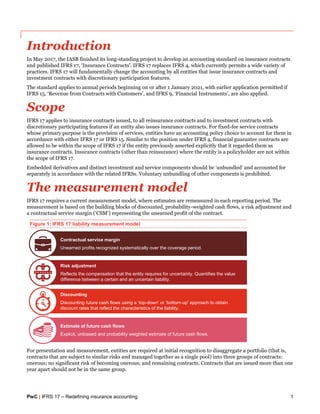
Figure 1: IFRS 17 liability measurement model
Contractual service margin
Unearned profits recognized systematically over the coverage period.
Risk adjustment
Reflects the compensation that the entity requires for uncertainty. Quantifies the value
difference between a certain and an uncertain liability.
Discounting
Discounting future cash flows using a ‘top-down’ or ‘bottom-up’ approach to obtain
discount rates that reflect the characteristics of the liability.
Estimate of future cash flows
Explicit, unbiased and probability weighted estimate of future cash flows.
PwC | IFRS 17 – Redefining insurance accounting 2
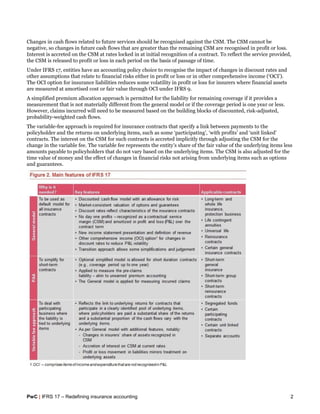
Changes in cash flows related to future services should be recognised against the CSM. The CSM cannot be
negative, so changes in future cash flows that are greater than the remaining CSM are recognised in profit or loss.
Interest is accreted on the CSM at rates locked in at initial recognition of a contract. To reflect the service provided,
the CSM is released to profit or loss in each period on the basis of passage of time.
Under IFRS 17, entities have an accounting policy choice to recognise the impact of changes in discount rates and
other assumptions that relate to financial risks either in profit or loss or in other comprehensive income (‘OCI’).
The OCI option for insurance liabilities reduces some volatility in profit or loss for insurers where financial assets
are measured at amortised cost or fair value through OCI under IFRS 9.
A simplified premium allocation approach is permitted for the liability for remaining coverage if it provides a
measurement that is not materially different from the general model or if the coverage period is one year or less.
However, claims incurred will need to be measured based on the building blocks of discounted, risk-adjusted,
probability-weighted cash flows.
The variable-fee approach is required for insurance contracts that specify a link between payments to the
policyholder and the returns on underlying items, such as some ‘participating’, ‘with profits’ and ‘unit linked’
contracts. The interest on the CSM for such contracts is accreted implicitly through adjusting the CSM for the
change in the variable fee. The variable fee represents the entity’s share of the fair value of the underlying items less
amounts payable to policyholders that do not vary based on the underlying items. The CSM is also adjusted for the
time value of money and the effect of changes in financial risks not arising from underlying items such as options
and guarantees.
PwC | IFRS 17 – Redefining insurance accounting 3
Presentation and Disclosure
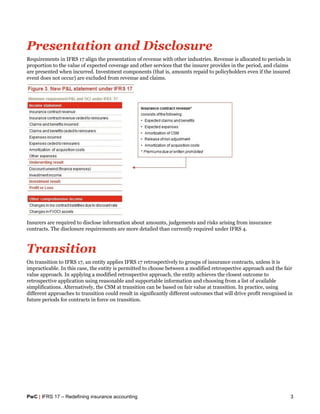
Requirements in IFRS 17 align the presentation of revenue with other industries. Revenue is allocated to periods in
proportion to the value of expected coverage and other services that the insurer provides in the period, and claims
are presented when incurred. Investment components (that is, amounts repaid to policyholders even if the insured
event does not occur) are excluded from revenue and claims.
Insurers are required to disclose information about amounts, judgements and risks arising from insurance
contracts. The disclosure requirements are more detailed than currently required under IFRS 4.
Transition
On transition to IFRS 17, an entity applies IFRS 17 retrospectively to groups of insurance contracts, unless it is
impracticable. In this case, the entity is permitted to choose between a modified retrospective approach and the fair
value approach. In applying a modified retrospective approach, the entity achieves the closest outcome to
retrospective application using reasonable and supportable information and choosing from a list of available
simplifications. Alternatively, the CSM at transition can be based on fair value at transition. In practice, using
different approaches to transition could result in significantly different outcomes that will drive profit recognised in
future periods for contracts in force on transition.
PwC | IFRS 17 – Redefining insurance accounting 4
Impact and insights
IFRS 17 will impact businesses well beyond the finance, actuarial and systems development areas (for example,
product design and distribution, development of revised incentive and wider remuneration policies and
reconfigured budgeting and forecasting methodologies feeding into business planning). There could also be an
impact on the cash tax position and dividends, both on transition and going forward.
IFRS 17 might require more than three years to implement. Gap analysis and impact assessments to develop an
implementation roadmap will enable entities to begin the detailed implementation project. A fundamental shift
might be required in the way in which data is collected, stored and analysed, changing the emphasis from a
prospective to a retrospective basis of analysis and introducing a more granular level of measurement and
additional disclosures. Before the effective date, insurers will need to carefully consider their ‘IFRS 17 story’ for
investors and analysts, as well as the key metrics that they will apply in the new world.
PwC | IFRS 17 – Redefining insurance accounting 5
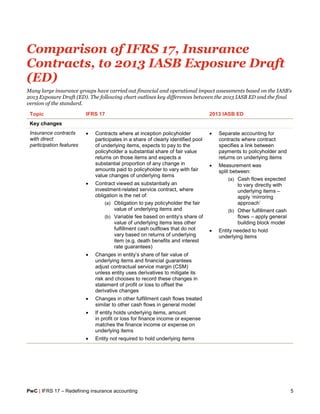
Comparison of IFRS 17, Insurance
Contracts, to 2013 IASB Exposure Draft
(ED)
Many large insurance groups have carried out financial and operational impact assessments based on the IASB’s
2013 Exposure Draft (ED). The following chart outlines key differences between the 2013 IASB ED and the final
version of the standard.
Topic IFRS 17 2013 IASB ED
Key changes
Insurance contracts
with direct
participation features
 Contracts where at inception policyholder
participates in a share of clearly identified pool
of underlying items, expects to pay to the
policyholder a substantial share of fair value
returns on those items and expects a
substantial proportion of any change in
amounts paid to policyholder to vary with fair
value changes of underlying items
 Contract viewed as substantially an
investment-related service contract, where
obligation is the net of:
(a) Obligation to pay policyholder the fair
value of underlying items and
(b) Variable fee based on entity’s share of
value of underlying items less other
fulfillment cash outflows that do not
vary based on returns of underlying
item (e.g. death benefits and interest
rate guarantees)
 Changes in entity’s share of fair value of
underlying items and financial guarantees
adjust contractual service margin (CSM)
unless entity uses derivatives to mitigate its
risk and chooses to record these changes in
statement of profit or loss to offset the
derivative changes
 Changes in other fulfillment cash flows treated
similar to other cash flows in general model
 If entity holds underlying items, amount
in profit or loss for finance income or expense
matches the finance income or expense on
underlying items
 Entity not required to hold underlying items
 Separate accounting for
contracts where contract
specifies a link between
payments to policyholder and
returns on underlying items
 Measurement was
split between:
(a) Cash flows expected
to vary directly with
underlying items –
apply ‘mirroring
approach’
(b) Other fulfillment cash
flows – apply general
building block model
 Entity needed to hold
underlying items
PwC | IFRS 17 – Redefining insurance accounting 6
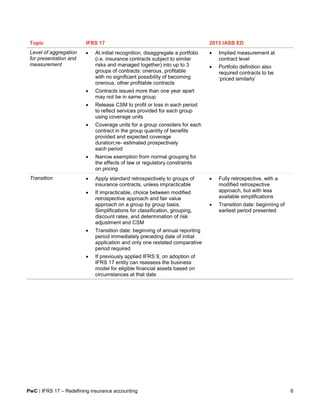
Topic IFRS 17 2013 IASB ED
Level of aggregation
for presentation and
measurement
 At initial recognition, disaggregate a portfolio
(i.e. insurance contracts subject to similar
risks and managed together) into up to 3
groups of contracts: onerous, profitable
with no significant possibility of becoming
onerous, other profitable contracts
 Contracts issued more than one year apart
may not be in same group
 Release CSM to profit or loss in each period
to reflect services provided for each group
using coverage units
 Coverage units for a group considers for each
contract in the group quantity of benefits
provided and expected coverage
duration;re- estimated prospectively
each period
 Narrow exemption from normal grouping for
the effects of law or regulatory constraints
on pricing
 Implied measurement at
contract level
 Portfolio definition also
required contracts to be
‘priced similarly’
Transition  Apply standard retrospectively to groups of
insurance contracts, unless impracticable
 If impracticable, choice between modified
retrospective approach and fair value
approach on a group by group basis.
Simplifications for classification, grouping,
discount rates, and determination of risk
adjustment and CSM
 Transition date: beginning of annual reporting
period immediately preceding date of initial
application and only one restated comparative
period required
 If previously applied IFRS 9, on adoption of
IFRS 17 entity can reassess the business
model for eligible financial assets based on
circumstances at that date
 Fully retrospective, with a
modified retrospective
approach, but with less
available simplifications
 Transition date: beginning of
earliest period presented
PwC | IFRS 17 – Redefining insurance accounting 7
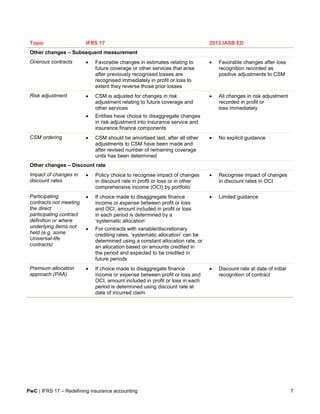
Topic IFRS 17 2013 IASB ED
Other changes – Subsequent measurement
Onerous contracts  Favorable changes in estimates relating to
future coverage or other services that arise
after previously recognised losses are
recognised immediately in profit or loss to
extent they reverse those prior losses
 Favorable changes after loss
recognition recorded as
positive adjustments to CSM
Risk adjustment  CSM is adjusted for changes in risk
adjustment relating to future coverage and
other services
 Entities have choice to disaggregate changes
in risk adjustment into insurance service and
insurance finance components
 All changes in risk adjustment
recorded in profit or
loss immediately
CSM ordering  CSM should be amortised last, after all other
adjustments to CSM have been made and
after revised number of remaining coverage
units has been determined
 No explicit guidance
Other changes – Discount rate
Impact of changes in
discount rates
 Policy choice to recognise impact of changes
in discount rate in profit or loss or in other
comprehensive income (OCI) by portfolio
 Recognise impact of changes
in discount rates in OCI
Participating
contracts not meeting
the direct
participating contract
definition or where
underlying items not
held (e.g. some
Universal-life
contracts)
 If choice made to disaggregate finance
income or expense between profit or loss
and OCI, amount included in profit or loss
in each period is determined by a
‘systematic allocation’
 For contracts with variable/discretionary
crediting rates, ‘systematic allocation’ can be
determined using a constant allocation rate, or
an allocation based on amounts credited in
the period and expected to be credited in
future periods
 Limited guidance
Premium allocation
approach (PAA)
 If choice made to disaggregate finance
income or expense between profit or loss and
OCI, amount included in profit or loss in each
period is determined using discount rate at
date of incurred claim
 Discount rate at date of initial
recognition of contract
PwC | IFRS 17 – Redefining insurance accounting 8
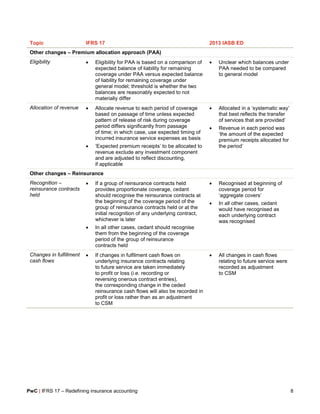
Topic IFRS 17 2013 IASB ED
Other changes – Premium allocation approach (PAA)
Eligibility  Eligibility for PAA is based on a comparison of
expected balance of liability for remaining
coverage under PAA versus expected balance
of liability for remaining coverage under
general model; threshold is whether the two
balances are reasonably expected to not
materially differ
 Unclear which balances under
PAA needed to be compared
to general model
Allocation of revenue  Allocate revenue to each period of coverage
based on passage of time unless expected
pattern of release of risk during coverage
period differs significantly from passage
of time; in which case, use expected timing of
incurred insurance service expenses as basis
 ‘Expected premium receipts’ to be allocated to
revenue exclude any investment component
and are adjusted to reflect discounting,
if applicable
 Allocated in a ‘systematic way’
that best reflects the transfer
of services that are provided’
 Revenue in each period was
‘the amount of the expected
premium receipts allocated for
the period’
Other changes – Reinsurance
Recognition –
reinsurance contracts
held
 If a group of reinsurance contracts held
provides proportionate coverage, cedant
should recognise the reinsurance contracts at
the beginning of the coverage period of the
group of reinsurance contracts held or at the
initial recognition of any underlying contract,
whichever is later
 In all other cases, cedant should recognise
them from the beginning of the coverage
period of the group of reinsurance
contracts held
 Recognised at beginning of
coverage period for
‘aggregate covers’
 In all other cases, cedant
would have recognised as
each underlying contract
was recognised
Changes in fulfillment
cash flows
 If changes in fulfilment cash flows on
underlying insurance contracts relating
to future service are taken immediately
to profit or loss (i.e. recording or
reversing onerous contract entries),
the corresponding change in the ceded
reinsurance cash flows will also be recorded in
profit or loss rather than as an adjustment
to CSM
 All changes in cash flows
relating to future service were
recorded as adjustment
to CSM
This publication has been prepared for general guidance on matters of interest only, and does not constitute professional advice. You should
not act upon the information contained in this publication without obtaining specific professional advice. No representation or warranty (express
or implied) is given as to the accuracy or completeness of the information contained in this publication, and, to the extent permitted by law,
PricewaterhouseCoopers LLP, its members, employees and agents do not accept or assume any liability, responsibility or duty of care for any
consequences of you or anyone else acting, or refraining to act, in reliance on the information contained in this publication or for any decision
based on it.
© 2017 PricewaterhouseCoopers LLP. All rights reserved. In this document, “PwC” refers to the UK member firm, and may sometimes refer to
the PwC network. Each member firm is a separate legal entity. Please see www.pwc.com/structure for further details.
170608-112502-PS-OS
For more information, please contact:
Chen Voon Hoe
Accounting Advisory Leader
+65 6236 7488
voon.hoe.chen@sg.pwc.com
Ang Sock Sun
Insurance Accounting and Regulatory Advisory Leader
+65 6236 3638
sock.sun.ang@sg.pwc.com

ifrs17-redefining-insurance-accounting.pdf

  • 1.
  • 2.
    PwC | IFRS17 – Redefining insurance accounting 1 Introduction In May 2017, the IASB finished its long-standing project to develop an accounting standard on insurance contracts and published IFRS 17, ‘Insurance Contracts’. IFRS 17 replaces IFRS 4, which currently permits a wide variety of practices. IFRS 17 will fundamentally change the accounting by all entities that issue insurance contracts and investment contracts with discretionary participation features. The standard applies to annual periods beginning on or after 1 January 2021, with earlier application permitted if IFRS 15, ‘Revenue from Contracts with Customers’, and IFRS 9, ‘Financial Instruments’, are also applied. Scope IFRS 17 applies to insurance contracts issued, to all reinsurance contracts and to investment contracts with discretionary participating features if an entity also issues insurance contracts. For fixed-fee service contracts whose primary purpose is the provision of services, entities have an accounting policy choice to account for them in accordance with either IFRS 17 or IFRS 15. Similar to the position under IFRS 4, financial guarantee contracts are allowed to be within the scope of IFRS 17 if the entity previously asserted explicitly that it regarded them as insurance contracts. Insurance contracts (other than reinsurance) where the entity is a policyholder are not within the scope of IFRS 17. Embedded derivatives and distinct investment and service components should be ‘unbundled’ and accounted for separately in accordance with the related IFRSs. Voluntary unbundling of other components is prohibited. The measurement model IFRS 17 requires a current measurement model, where estimates are remeasured in each reporting period. The measurement is based on the building blocks of discounted, probability-weighted cash flows, a risk adjustment and a contractual service margin (‘CSM’) representing the unearned profit of the contract. For presentation and measurement, entities are required at initial recognition to disaggregate a portfolio (that is, contracts that are subject to similar risks and managed together as a single pool) into three groups of contracts: onerous; no significant risk of becoming onerous; and remaining contracts. Contracts that are issued more than one year apart should not be in the same group. Figure 1: IFRS 17 liability measurement model Contractual service margin Unearned profits recognized systematically over the coverage period. Risk adjustment Reflects the compensation that the entity requires for uncertainty. Quantifies the value difference between a certain and an uncertain liability. Discounting Discounting future cash flows using a ‘top-down’ or ‘bottom-up’ approach to obtain discount rates that reflect the characteristics of the liability. Estimate of future cash flows Explicit, unbiased and probability weighted estimate of future cash flows.
  • 3.
    PwC | IFRS17 – Redefining insurance accounting 2 Changes in cash flows related to future services should be recognised against the CSM. The CSM cannot be negative, so changes in future cash flows that are greater than the remaining CSM are recognised in profit or loss. Interest is accreted on the CSM at rates locked in at initial recognition of a contract. To reflect the service provided, the CSM is released to profit or loss in each period on the basis of passage of time. Under IFRS 17, entities have an accounting policy choice to recognise the impact of changes in discount rates and other assumptions that relate to financial risks either in profit or loss or in other comprehensive income (‘OCI’). The OCI option for insurance liabilities reduces some volatility in profit or loss for insurers where financial assets are measured at amortised cost or fair value through OCI under IFRS 9. A simplified premium allocation approach is permitted for the liability for remaining coverage if it provides a measurement that is not materially different from the general model or if the coverage period is one year or less. However, claims incurred will need to be measured based on the building blocks of discounted, risk-adjusted, probability-weighted cash flows. The variable-fee approach is required for insurance contracts that specify a link between payments to the policyholder and the returns on underlying items, such as some ‘participating’, ‘with profits’ and ‘unit linked’ contracts. The interest on the CSM for such contracts is accreted implicitly through adjusting the CSM for the change in the variable fee. The variable fee represents the entity’s share of the fair value of the underlying items less amounts payable to policyholders that do not vary based on the underlying items. The CSM is also adjusted for the time value of money and the effect of changes in financial risks not arising from underlying items such as options and guarantees.
  • 4.
    PwC | IFRS17 – Redefining insurance accounting 3 Presentation and Disclosure Requirements in IFRS 17 align the presentation of revenue with other industries. Revenue is allocated to periods in proportion to the value of expected coverage and other services that the insurer provides in the period, and claims are presented when incurred. Investment components (that is, amounts repaid to policyholders even if the insured event does not occur) are excluded from revenue and claims. Insurers are required to disclose information about amounts, judgements and risks arising from insurance contracts. The disclosure requirements are more detailed than currently required under IFRS 4. Transition On transition to IFRS 17, an entity applies IFRS 17 retrospectively to groups of insurance contracts, unless it is impracticable. In this case, the entity is permitted to choose between a modified retrospective approach and the fair value approach. In applying a modified retrospective approach, the entity achieves the closest outcome to retrospective application using reasonable and supportable information and choosing from a list of available simplifications. Alternatively, the CSM at transition can be based on fair value at transition. In practice, using different approaches to transition could result in significantly different outcomes that will drive profit recognised in future periods for contracts in force on transition.
  • 5.
    PwC | IFRS17 – Redefining insurance accounting 4 Impact and insights IFRS 17 will impact businesses well beyond the finance, actuarial and systems development areas (for example, product design and distribution, development of revised incentive and wider remuneration policies and reconfigured budgeting and forecasting methodologies feeding into business planning). There could also be an impact on the cash tax position and dividends, both on transition and going forward. IFRS 17 might require more than three years to implement. Gap analysis and impact assessments to develop an implementation roadmap will enable entities to begin the detailed implementation project. A fundamental shift might be required in the way in which data is collected, stored and analysed, changing the emphasis from a prospective to a retrospective basis of analysis and introducing a more granular level of measurement and additional disclosures. Before the effective date, insurers will need to carefully consider their ‘IFRS 17 story’ for investors and analysts, as well as the key metrics that they will apply in the new world.
  • 6.
    PwC | IFRS17 – Redefining insurance accounting 5 Comparison of IFRS 17, Insurance Contracts, to 2013 IASB Exposure Draft (ED) Many large insurance groups have carried out financial and operational impact assessments based on the IASB’s 2013 Exposure Draft (ED). The following chart outlines key differences between the 2013 IASB ED and the final version of the standard. Topic IFRS 17 2013 IASB ED Key changes Insurance contracts with direct participation features  Contracts where at inception policyholder participates in a share of clearly identified pool of underlying items, expects to pay to the policyholder a substantial share of fair value returns on those items and expects a substantial proportion of any change in amounts paid to policyholder to vary with fair value changes of underlying items  Contract viewed as substantially an investment-related service contract, where obligation is the net of: (a) Obligation to pay policyholder the fair value of underlying items and (b) Variable fee based on entity’s share of value of underlying items less other fulfillment cash outflows that do not vary based on returns of underlying item (e.g. death benefits and interest rate guarantees)  Changes in entity’s share of fair value of underlying items and financial guarantees adjust contractual service margin (CSM) unless entity uses derivatives to mitigate its risk and chooses to record these changes in statement of profit or loss to offset the derivative changes  Changes in other fulfillment cash flows treated similar to other cash flows in general model  If entity holds underlying items, amount in profit or loss for finance income or expense matches the finance income or expense on underlying items  Entity not required to hold underlying items  Separate accounting for contracts where contract specifies a link between payments to policyholder and returns on underlying items  Measurement was split between: (a) Cash flows expected to vary directly with underlying items – apply ‘mirroring approach’ (b) Other fulfillment cash flows – apply general building block model  Entity needed to hold underlying items
  • 7.
    PwC | IFRS17 – Redefining insurance accounting 6 Topic IFRS 17 2013 IASB ED Level of aggregation for presentation and measurement  At initial recognition, disaggregate a portfolio (i.e. insurance contracts subject to similar risks and managed together) into up to 3 groups of contracts: onerous, profitable with no significant possibility of becoming onerous, other profitable contracts  Contracts issued more than one year apart may not be in same group  Release CSM to profit or loss in each period to reflect services provided for each group using coverage units  Coverage units for a group considers for each contract in the group quantity of benefits provided and expected coverage duration;re- estimated prospectively each period  Narrow exemption from normal grouping for the effects of law or regulatory constraints on pricing  Implied measurement at contract level  Portfolio definition also required contracts to be ‘priced similarly’ Transition  Apply standard retrospectively to groups of insurance contracts, unless impracticable  If impracticable, choice between modified retrospective approach and fair value approach on a group by group basis. Simplifications for classification, grouping, discount rates, and determination of risk adjustment and CSM  Transition date: beginning of annual reporting period immediately preceding date of initial application and only one restated comparative period required  If previously applied IFRS 9, on adoption of IFRS 17 entity can reassess the business model for eligible financial assets based on circumstances at that date  Fully retrospective, with a modified retrospective approach, but with less available simplifications  Transition date: beginning of earliest period presented
  • 8.
    PwC | IFRS17 – Redefining insurance accounting 7 Topic IFRS 17 2013 IASB ED Other changes – Subsequent measurement Onerous contracts  Favorable changes in estimates relating to future coverage or other services that arise after previously recognised losses are recognised immediately in profit or loss to extent they reverse those prior losses  Favorable changes after loss recognition recorded as positive adjustments to CSM Risk adjustment  CSM is adjusted for changes in risk adjustment relating to future coverage and other services  Entities have choice to disaggregate changes in risk adjustment into insurance service and insurance finance components  All changes in risk adjustment recorded in profit or loss immediately CSM ordering  CSM should be amortised last, after all other adjustments to CSM have been made and after revised number of remaining coverage units has been determined  No explicit guidance Other changes – Discount rate Impact of changes in discount rates  Policy choice to recognise impact of changes in discount rate in profit or loss or in other comprehensive income (OCI) by portfolio  Recognise impact of changes in discount rates in OCI Participating contracts not meeting the direct participating contract definition or where underlying items not held (e.g. some Universal-life contracts)  If choice made to disaggregate finance income or expense between profit or loss and OCI, amount included in profit or loss in each period is determined by a ‘systematic allocation’  For contracts with variable/discretionary crediting rates, ‘systematic allocation’ can be determined using a constant allocation rate, or an allocation based on amounts credited in the period and expected to be credited in future periods  Limited guidance Premium allocation approach (PAA)  If choice made to disaggregate finance income or expense between profit or loss and OCI, amount included in profit or loss in each period is determined using discount rate at date of incurred claim  Discount rate at date of initial recognition of contract
  • 9.
    PwC | IFRS17 – Redefining insurance accounting 8 Topic IFRS 17 2013 IASB ED Other changes – Premium allocation approach (PAA) Eligibility  Eligibility for PAA is based on a comparison of expected balance of liability for remaining coverage under PAA versus expected balance of liability for remaining coverage under general model; threshold is whether the two balances are reasonably expected to not materially differ  Unclear which balances under PAA needed to be compared to general model Allocation of revenue  Allocate revenue to each period of coverage based on passage of time unless expected pattern of release of risk during coverage period differs significantly from passage of time; in which case, use expected timing of incurred insurance service expenses as basis  ‘Expected premium receipts’ to be allocated to revenue exclude any investment component and are adjusted to reflect discounting, if applicable  Allocated in a ‘systematic way’ that best reflects the transfer of services that are provided’  Revenue in each period was ‘the amount of the expected premium receipts allocated for the period’ Other changes – Reinsurance Recognition – reinsurance contracts held  If a group of reinsurance contracts held provides proportionate coverage, cedant should recognise the reinsurance contracts at the beginning of the coverage period of the group of reinsurance contracts held or at the initial recognition of any underlying contract, whichever is later  In all other cases, cedant should recognise them from the beginning of the coverage period of the group of reinsurance contracts held  Recognised at beginning of coverage period for ‘aggregate covers’  In all other cases, cedant would have recognised as each underlying contract was recognised Changes in fulfillment cash flows  If changes in fulfilment cash flows on underlying insurance contracts relating to future service are taken immediately to profit or loss (i.e. recording or reversing onerous contract entries), the corresponding change in the ceded reinsurance cash flows will also be recorded in profit or loss rather than as an adjustment to CSM  All changes in cash flows relating to future service were recorded as adjustment to CSM
  • 10.
    This publication hasbeen prepared for general guidance on matters of interest only, and does not constitute professional advice. You should not act upon the information contained in this publication without obtaining specific professional advice. No representation or warranty (express or implied) is given as to the accuracy or completeness of the information contained in this publication, and, to the extent permitted by law, PricewaterhouseCoopers LLP, its members, employees and agents do not accept or assume any liability, responsibility or duty of care for any consequences of you or anyone else acting, or refraining to act, in reliance on the information contained in this publication or for any decision based on it. © 2017 PricewaterhouseCoopers LLP. All rights reserved. In this document, “PwC” refers to the UK member firm, and may sometimes refer to the PwC network. Each member firm is a separate legal entity. Please see www.pwc.com/structure for further details. 170608-112502-PS-OS For more information, please contact: Chen Voon Hoe Accounting Advisory Leader +65 6236 7488 voon.hoe.chen@sg.pwc.com Ang Sock Sun Insurance Accounting and Regulatory Advisory Leader +65 6236 3638 sock.sun.ang@sg.pwc.com