Incremental View Maintenance
with Coral, DBT, and Iceberg
May 2023
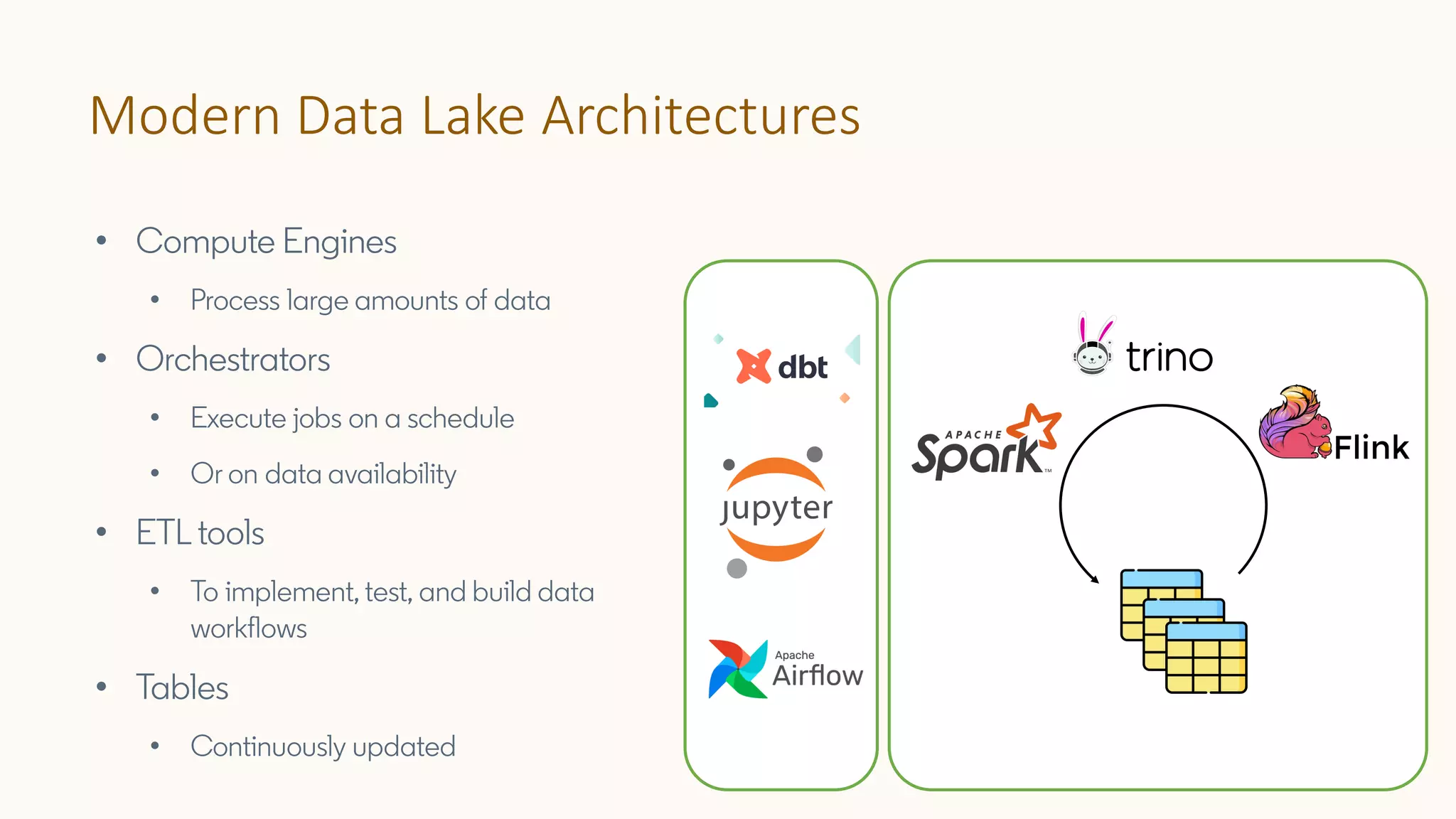
Modern Data Lake Architectures
• Compute Engines
• Process large amounts of data
• Orchestrators
• Execute jobs on a schedule
• Or on data availability
• ETL tools
• To implement, test, and build data
workflows
• Tables
• Continuously updated
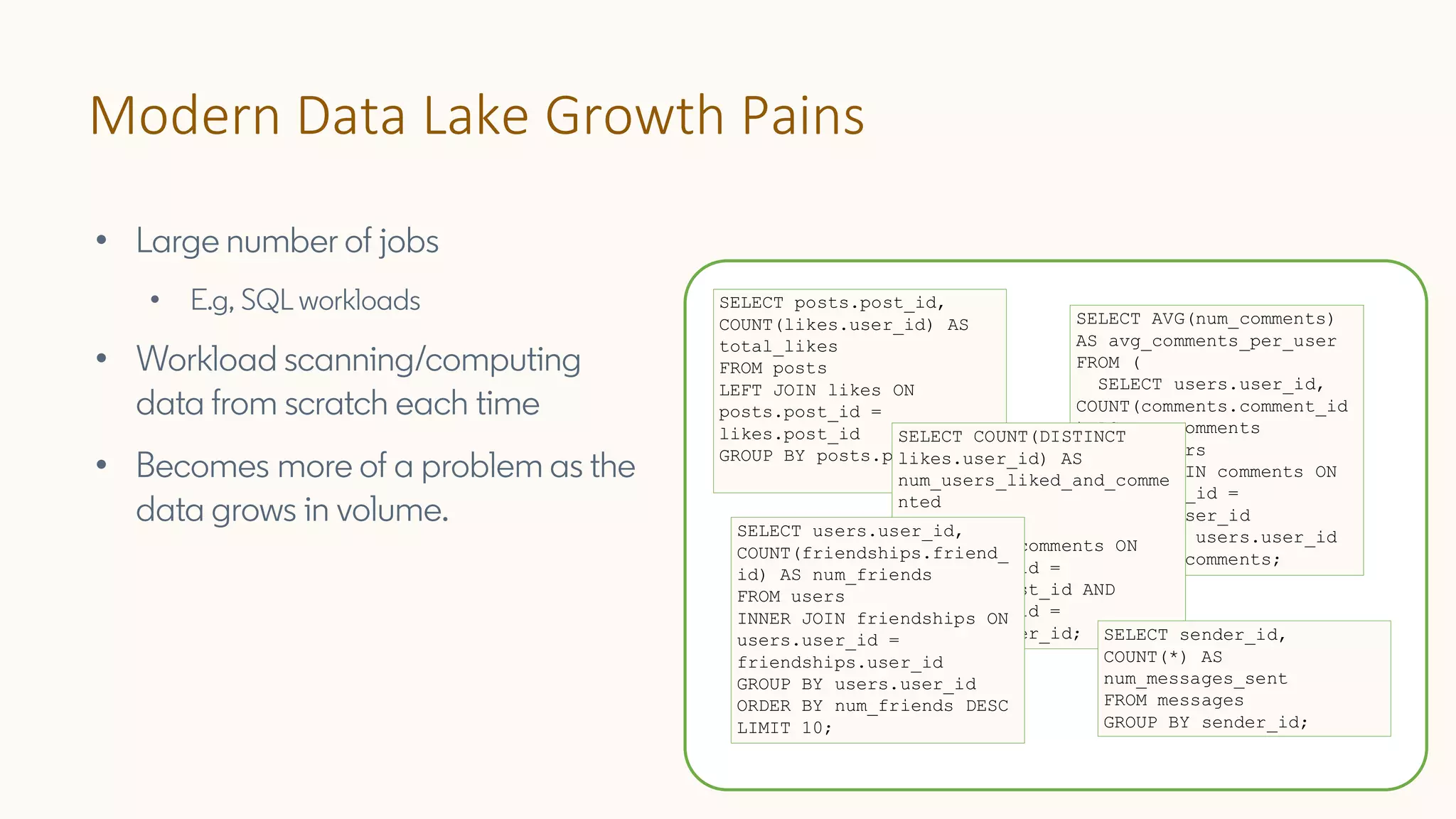
Modern Data Lake Growth Pains
• Large number of jobs
• E.g, SQL workloads
• Workload scanning/computing
data from scratch each time
• Becomes more of a problem as the
data grows in volume.
SELECT posts.post_id,
COUNT(likes.user_id) AS
total_likes
FROM posts
LEFT JOIN likes ON
posts.post_id =
likes.post_id
GROUP BY posts.post_id;
SELECT AVG(num_comments)
AS avg_comments_per_user
FROM (
SELECT users.user_id,
COUNT(comments.comment_id
) AS num_comments
FROM users
INNER JOIN comments ON
users.user_id =
comments.user_id
GROUP BY users.user_id
) AS user_comments;
SELECT COUNT(DISTINCT
likes.user_id) AS
num_users_liked_and_comme
nted
FROM likes
INNER JOIN comments ON
likes.post_id =
comments.post_id AND
likes.user_id =
comments.user_id; SELECT sender_id,
COUNT(*) AS
num_messages_sent
FROM messages
GROUP BY sender_id;
SELECT users.user_id,
COUNT(friendships.friend_
id) AS num_friends
FROM users
INNER JOIN friendships ON
users.user_id =
friendships.user_id
GROUP BY users.user_id
ORDER BY num_friends DESC
LIMIT 10;
What if we can maintain tables incrementally?
Update tables only with the changes!
• Lower compute cost
• Lower latency
• More update-to-date insights/models
• Improved UX
• Focus on writing the logic, not the
incremental mechanics
• Declare full DAG using just SQL
Incremental Compute Made Easy
With Coral, Iceberg, and DBT
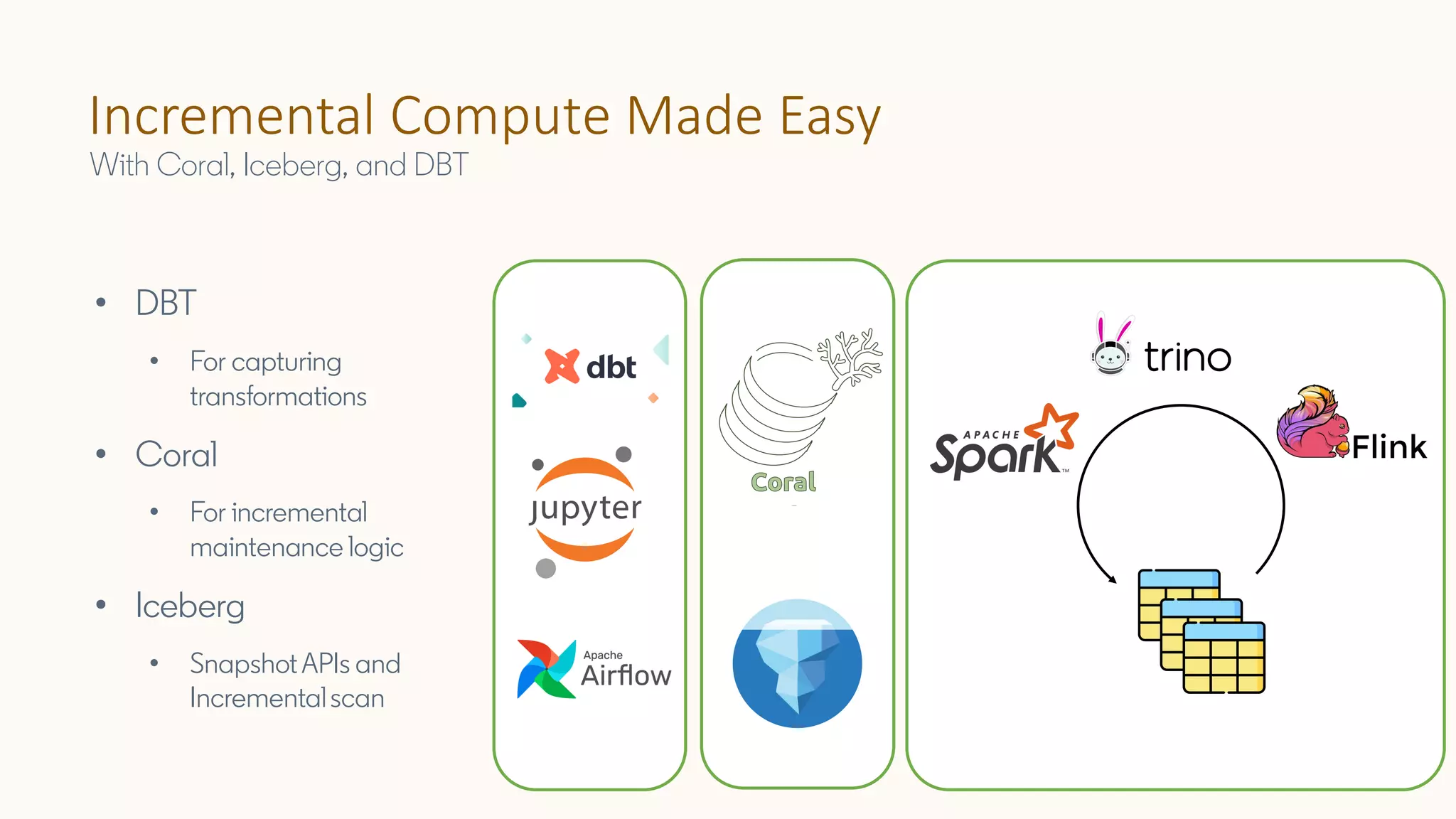
• DBT
• For capturing
transformations
• Coral
• For incremental
maintenance logic
• Iceberg
• SnapshotAPIs and
Incrementalscan
DBT Overview
What is DBT?
• Open-source data transformation tool (ETL) that enables teams to quickly build
complex data pipelines
Image from getdbt.com
DBT Overview
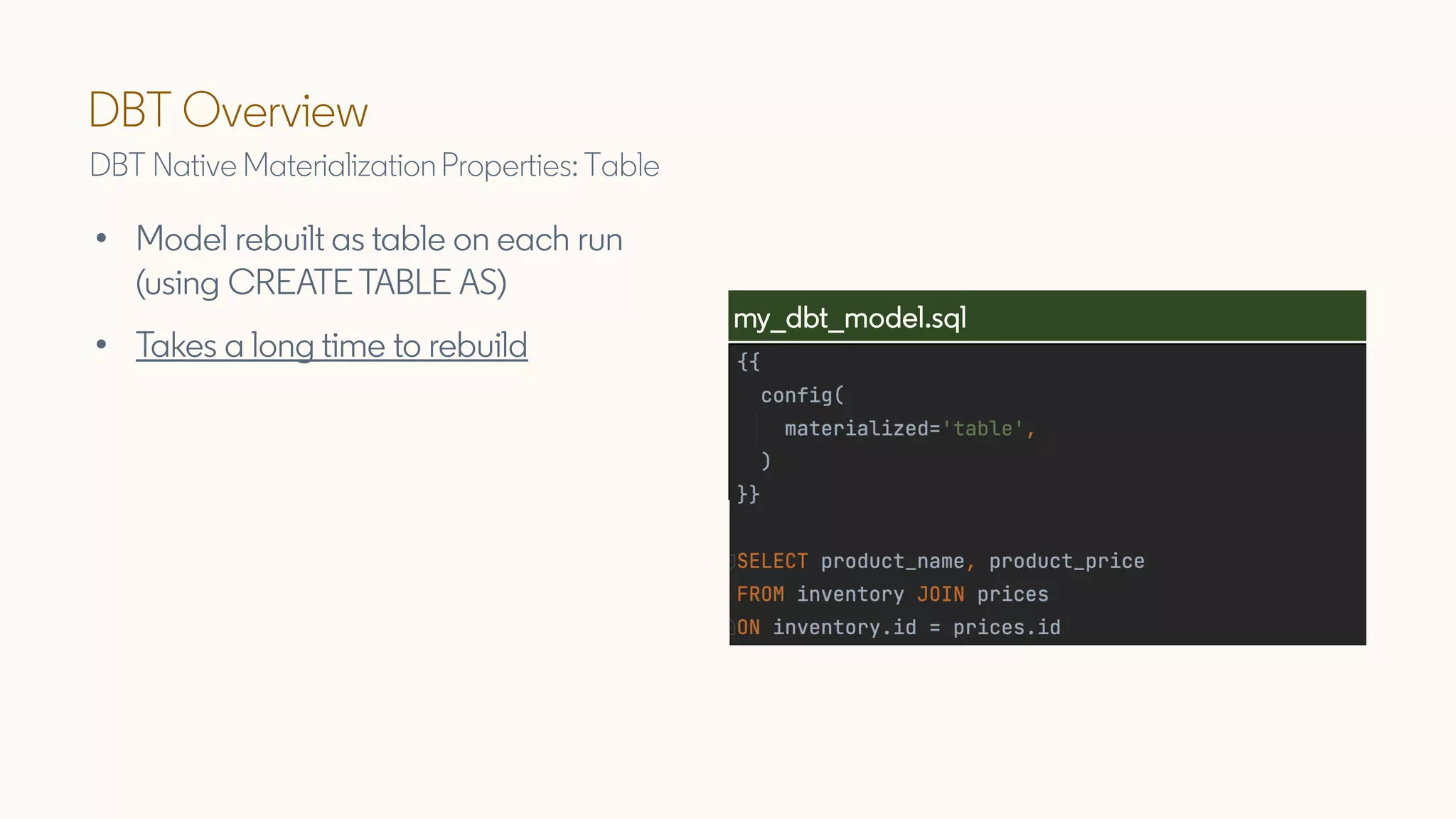
DBT Native MaterializationProperties: Table
• Model rebuilt as table on each run
(using CREATE TABLE AS)
• Takes a long time to rebuild
my_dbt_model.sql
DBT Overview
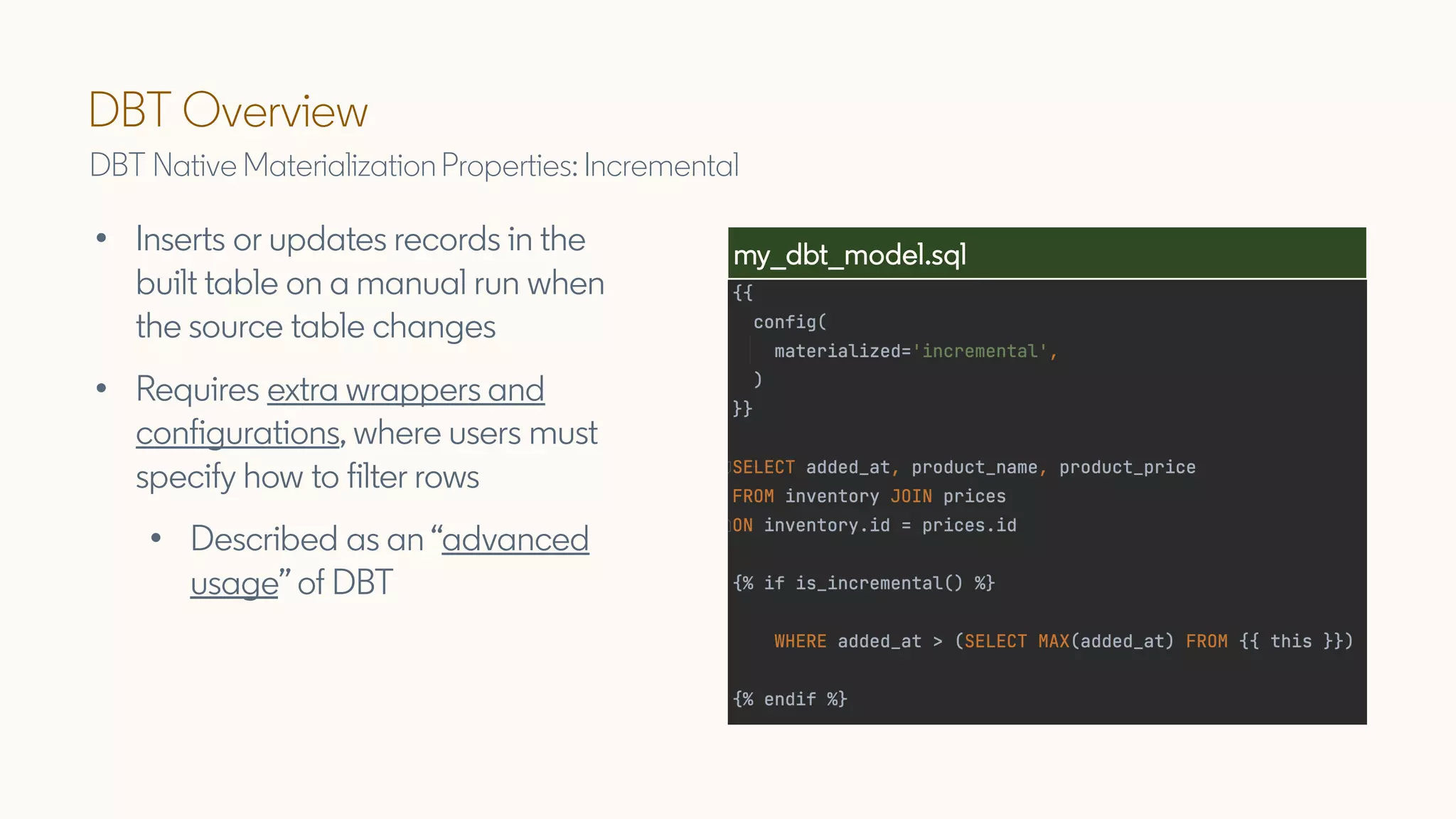
DBT Native MaterializationProperties: Incremental
• Inserts or updates records in the
built table on a manual run when
the source table changes
• Requires extra wrappers and
configurations, where users must
specify how to filter rows
• Described as an “advanced
usage” of DBT
my_dbt_model.sql
DBT Overview
DBT Native MaterializationProperties: Incremental
• Inserts or updates records in the
built table when the source table
changes
• Requires extra wrappers and
configurations, where users must
specify how to filter rows
• Described as an “advanced
usage” of DBT
my_dbt_model.sql
Desired User Experience
New MaterializationMode: Incremental Maintenance
• Incremental maintenance
functionality with no extra code
necessary
• One simple configuration
change from `table`
materialization mode
my_dbt_model.sql
Incremental View Maintenance
Calculating Incremental Queries
Simple Join Example
id product_name
1 LinkedIn Learning
2 LinkedIn Premium
id product_price
2 $6
inventory prices
SELECT product_name, product_price
FROM inventory JOIN prices
ON inventory.id = prices.id
Calculating Incremental Queries
Simple Join Example
id product_name
1 LinkedIn Learning
2 LinkedIn Premium
id product_price
2 $6
inventory prices
SELECT product_name, product_price
FROM inventory JOIN prices
ON inventory.id = prices.id
product_name product_price
LinkedIn Premium $6
t1
Calculating Incremental Queries
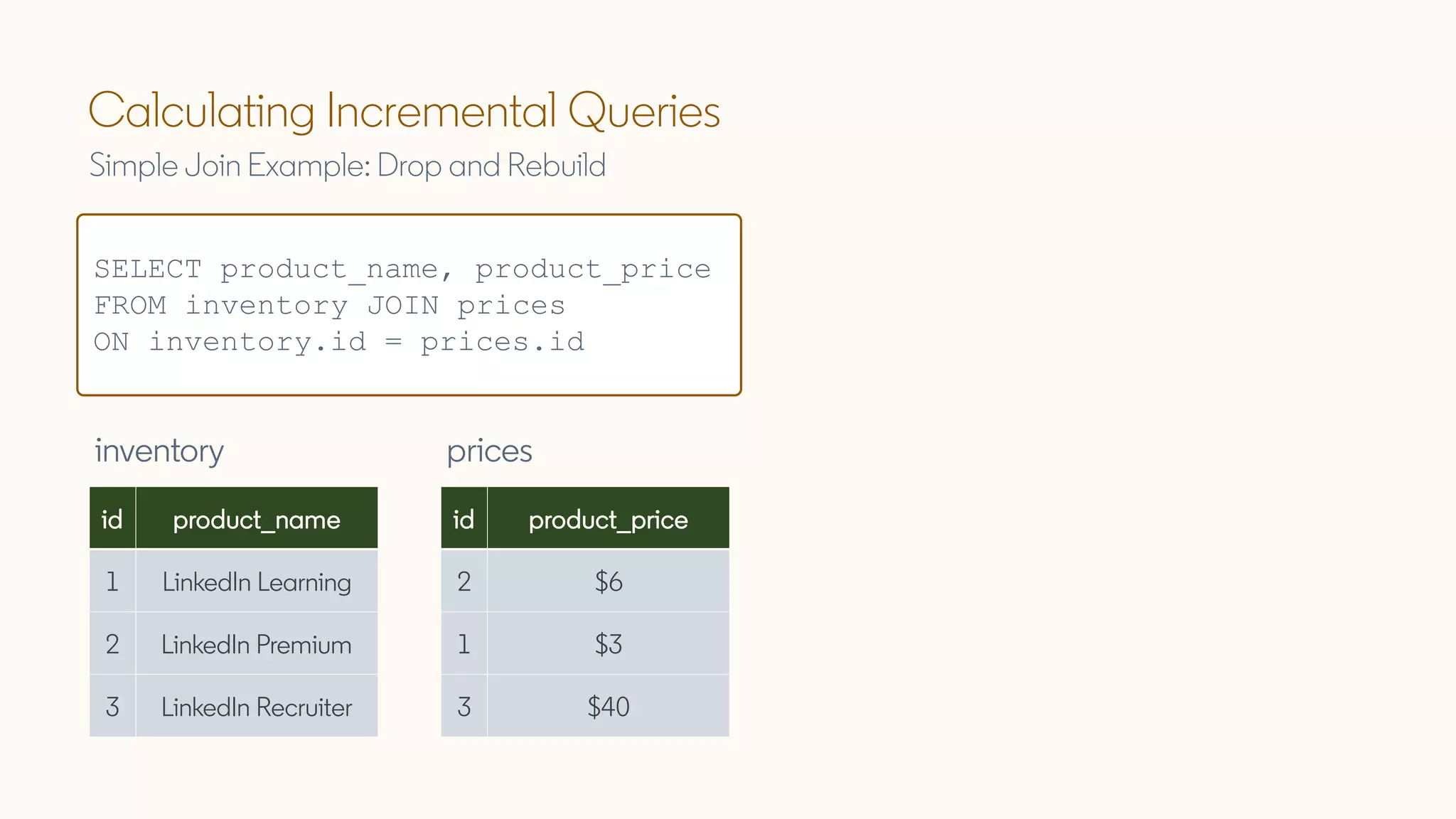
Simple Join Example: Drop and Rebuild
id product_name
1 LinkedIn Learning
2 LinkedIn Premium
3 LinkedIn Recruiter
id product_price
2 $6
1 $3
3 $40
inventory prices
SELECT product_name, product_price
FROM inventory JOIN prices
ON inventory.id = prices.id
product_name product_price
LinkedIn Premium $6
t1
Calculating Incremental Queries
Simple Join Example: Drop and Rebuild
inventory prices
SELECT product_name, product_price
FROM inventory JOIN prices
ON inventory.id = prices.id
id product_name
1 LinkedIn Learning
2 LinkedIn Premium
3 LinkedIn Recruiter
id product_price
2 $6
1 $3
3 $40
Calculating Incremental Queries
Simple Join Example: Drop and Rebuild
inventory prices
SELECT product_name, product_price
FROM inventory JOIN prices
ON inventory.id = prices.id
t2
product_name product_price
LinkedIn Premium $6
LinkedIn Learning $3
LinkedIn Recruiter $40
id product_name
1 LinkedIn Learning
2 LinkedIn Premium
3 LinkedIn Recruiter
id product_price
2 $6
1 $3
3 $40
Calculating Incremental Queries
Simple Join Example: Incremental Maintenance
SELECT product_name, product_price
FROM inventory JOIN prices
ON inventory.id = prices.id
product_name product_price
LinkedIn Premium $6
t1
inventory prices
id product_name
1 LinkedIn Learning
2 LinkedIn Premium
id product_price
2 $6
Calculating Incremental Queries
Simple Join Example: Incremental Maintenance
SELECT product_name, product_price
FROM inventory JOIN prices_delta
ON inventory.id = prices_delta.id
product_name product_price
LinkedIn Premium $6
t1
id product_name
1 LinkedIn Learning
2 LinkedIn Premium
3 LinkedIn Recruiter
id product_price
2 $6
1 $3
3 $40
inventory prices Δt𝛼
product_name product_price
LinkedIn Learning $3
Calculating Incremental Queries
Simple Join Example: Incremental Maintenance
SELECT product_name, product_price
FROM inventory_delta JOIN prices
ON inventory_delta.id = prices.id
product_name product_price
LinkedIn Premium $6
LinkedIn Learning $3
t1 + Δt𝛼
Δtβ
id product_name
1 LinkedIn Learning
2 LinkedIn Premium
3 LinkedIn Recruiter
id product_price
2 $6
1 $3
3 $40
inventory prices
product_name product_price
Calculating Incremental Queries
Simple Join Example: Incremental Maintenance
product_name product_price
LinkedIn Premium $6
LinkedIn Learning $3
t1 + Δt𝛼 + Δtβ
Δt𝛄
id product_name
1 LinkedIn Learning
2 LinkedIn Premium
3 LinkedIn Recruiter
id product_price
2 $6
1 $3
3 $40
inventory prices
product_name product_price
LinkedIn Recruiter $40
SELECT product_name, product_price
FROM inventory_delta JOIN prices_delta
ON inventory_delta.id = prices_delta.id
Calculating Incremental Queries
Simple Join Example: Incremental Maintenance
INSERT INTO t1
(SELECT product_name, product_price
FROM inventory JOIN prices_delta
ON inventory.id = prices_delta.id
UNION ALL
SELECT product_name, product_price
FROM inventory_delta JOIN prices
ON inventory_delta.id = prices.id
UNION ALL
SELECT product_name, product_price
FROM inventory_delta JOIN prices_delta
ON inventory_delta.id = prices_delta.id)
product_name product_price
LinkedIn Premium $6
LinkedIn Learning $3
LinkedIn Recruiter $40
t1 + Δt𝛼 + Δtβ + Δt𝛄
Incremental Query
Δt𝛼
Δtβ
Δt𝛄
Coral
Overview
What is Coral?
• Translation, analysis, and query rewrite engine
• Open source since 2020
WIP
Future Dialect Future Dialect
Coral IR
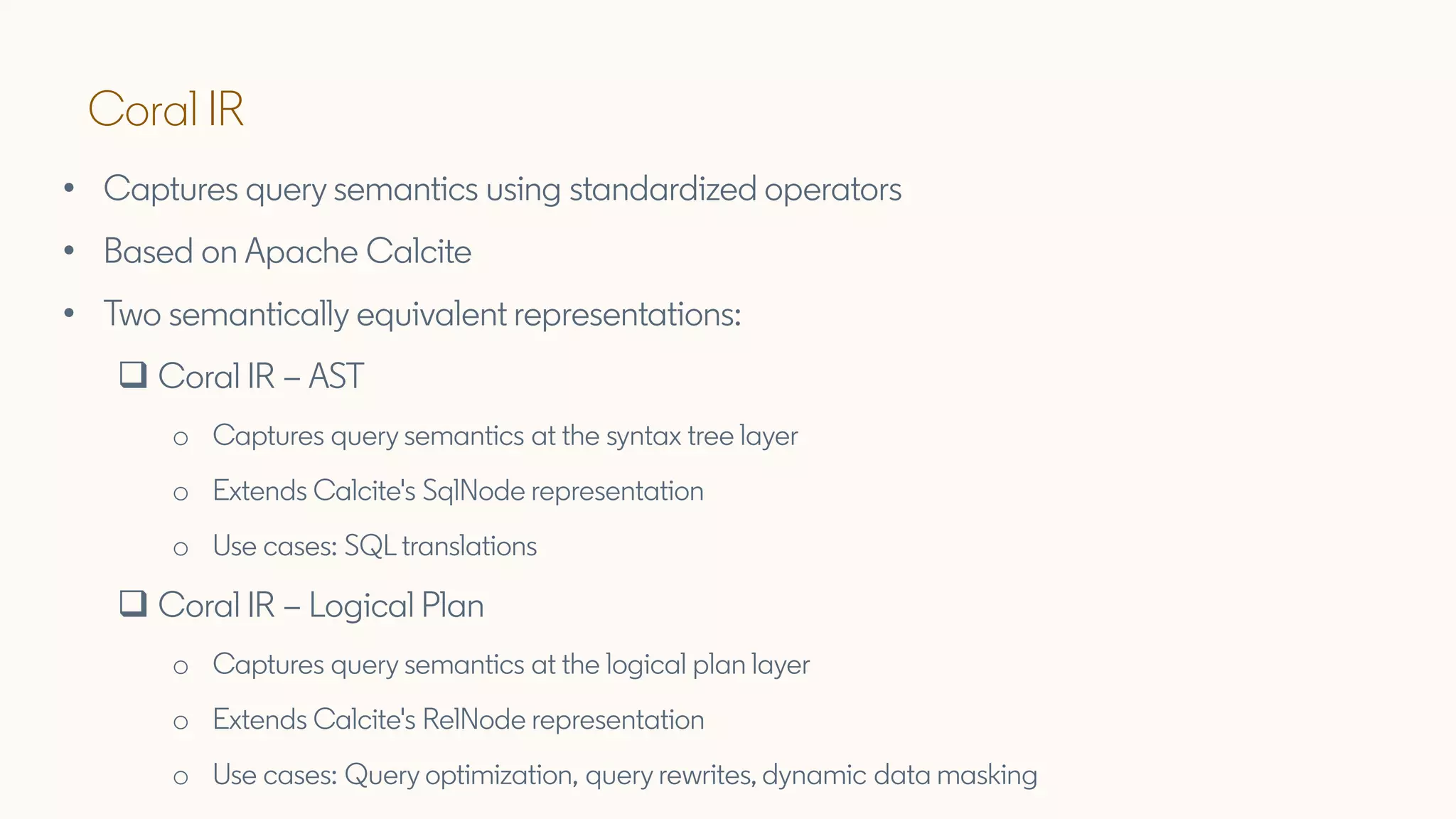
• Captures query semantics using standardized operators
• Based on Apache Calcite
• Two semantically equivalent representations:
❑ Coral IR – AST
o Captures query semantics at the syntax tree layer
o Extends Calcite's SqlNode representation
o Use cases: SQL translations
❑ Coral IR – Logical Plan
o Captures query semantics at the logical plan layer
o Extends Calcite's RelNode representation
o Use cases: Query optimization, query rewrites, dynamic data masking
Coral IR - AST
• Captures query semantics using standardized operators at syntax tree level
Image generatedby Coral-Visualization
Trino SQL:
SELECT *
FROM test.foo JOIN test.
bar ON a = c WHERE
array_element[1] = 1
AND strpos(a, 'foo') > 0
Spark SQL:
SELECT *
FROM test.foo JOIN test.
bar ON a = c WHERE b[0]
= 1 AND instr(a, 'foo')
> 0
Coral IR – Logical Plan
• Extends Apache Calcite’s Relational Algebra Expressions
• Captures query semantics using standardized operators at logical plan level
Image generatedby Coral-Visualization
Trino SQL:
SELECT *
FROM test.foo JOIN test.
bar ON a = c WHERE
array_element[1] = 1
AND strpos(a, 'foo') > 0
Spark SQL:
SELECT *
FROM test.foo JOIN test.
bar ON a = c WHERE b[0]
= 1 AND instr(a, 'foo')
> 0
Incremental Maintenance with
Coral
Coral IR Transformation
TransformationOverview
Input
Representation
Output
Representation
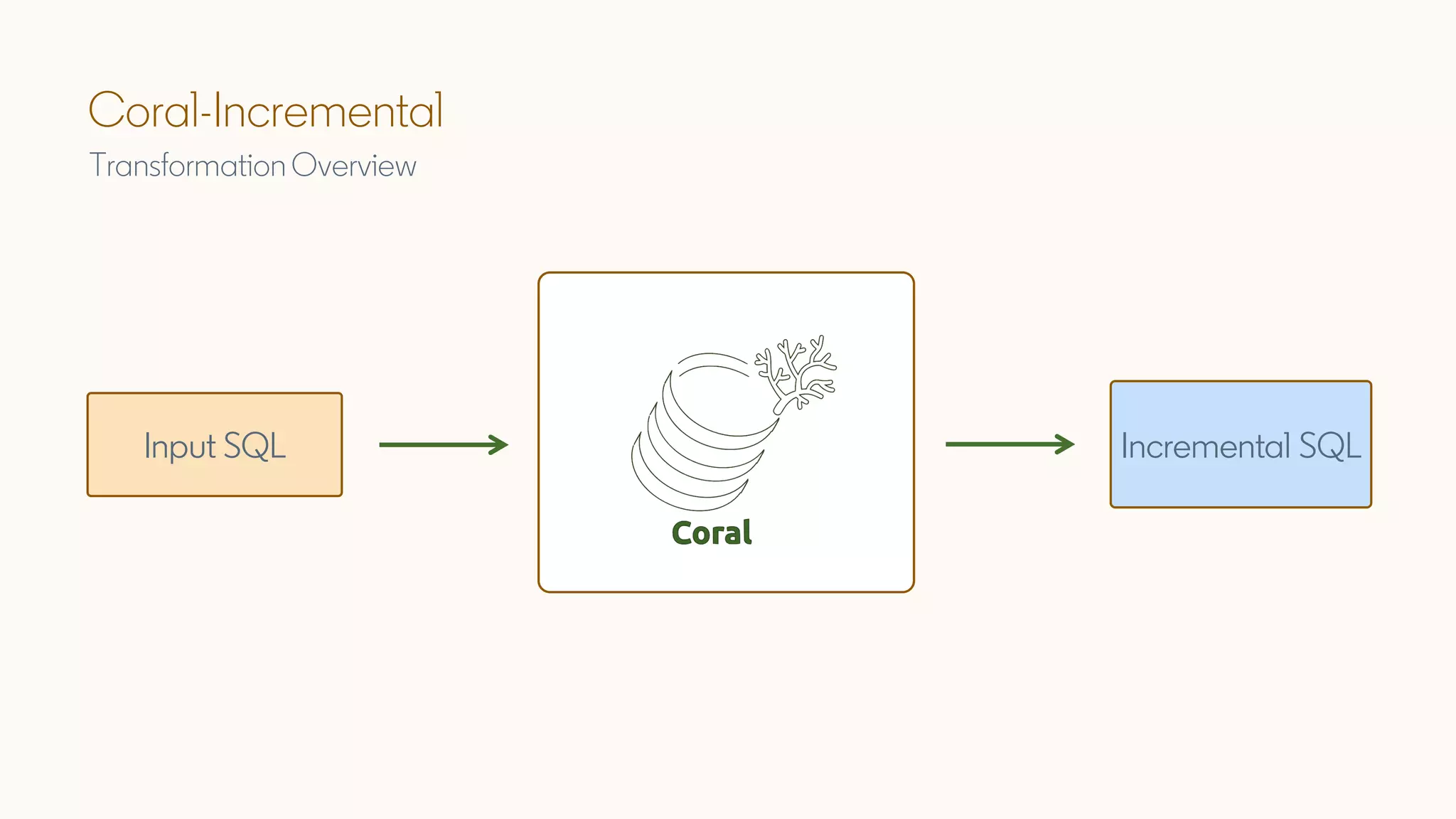
Coral-Incremental
TransformationOverview
Input SQL Incremental SQL
Coral-Incremental
TransformationOverview
SELECT product_name, product_price
FROM inventory JOIN prices
ON inventory.id = prices.id
SELECT product_name, product_price
FROM inventory JOIN prices_delta
ON inventory.id = prices_delta.id
UNION ALL
SELECT product_name, product_price
FROM inventory_delta JOIN prices
ON inventory_delta.id = prices.id
UNION ALL
SELECT product_name, product_price
FROM inventory_delta JOIN prices_delta
ON inventory_delta.id = prices_delta.id
Coral-Incremental
SQL to Coral IR
Input Query
SELECT product_name, product_price
FROM inventory JOIN prices
ON inventory.id = prices.id
Coral-Incremental
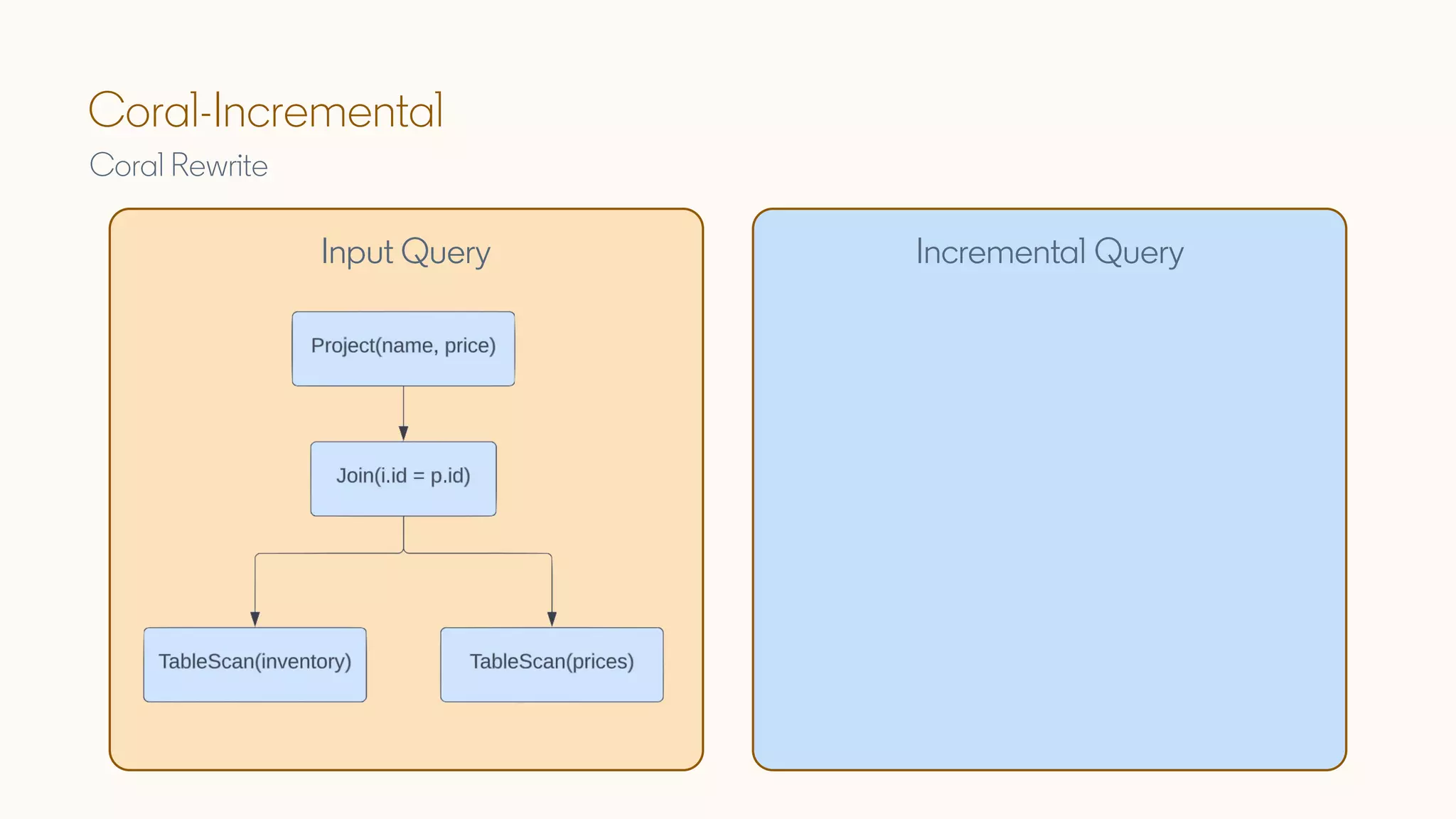
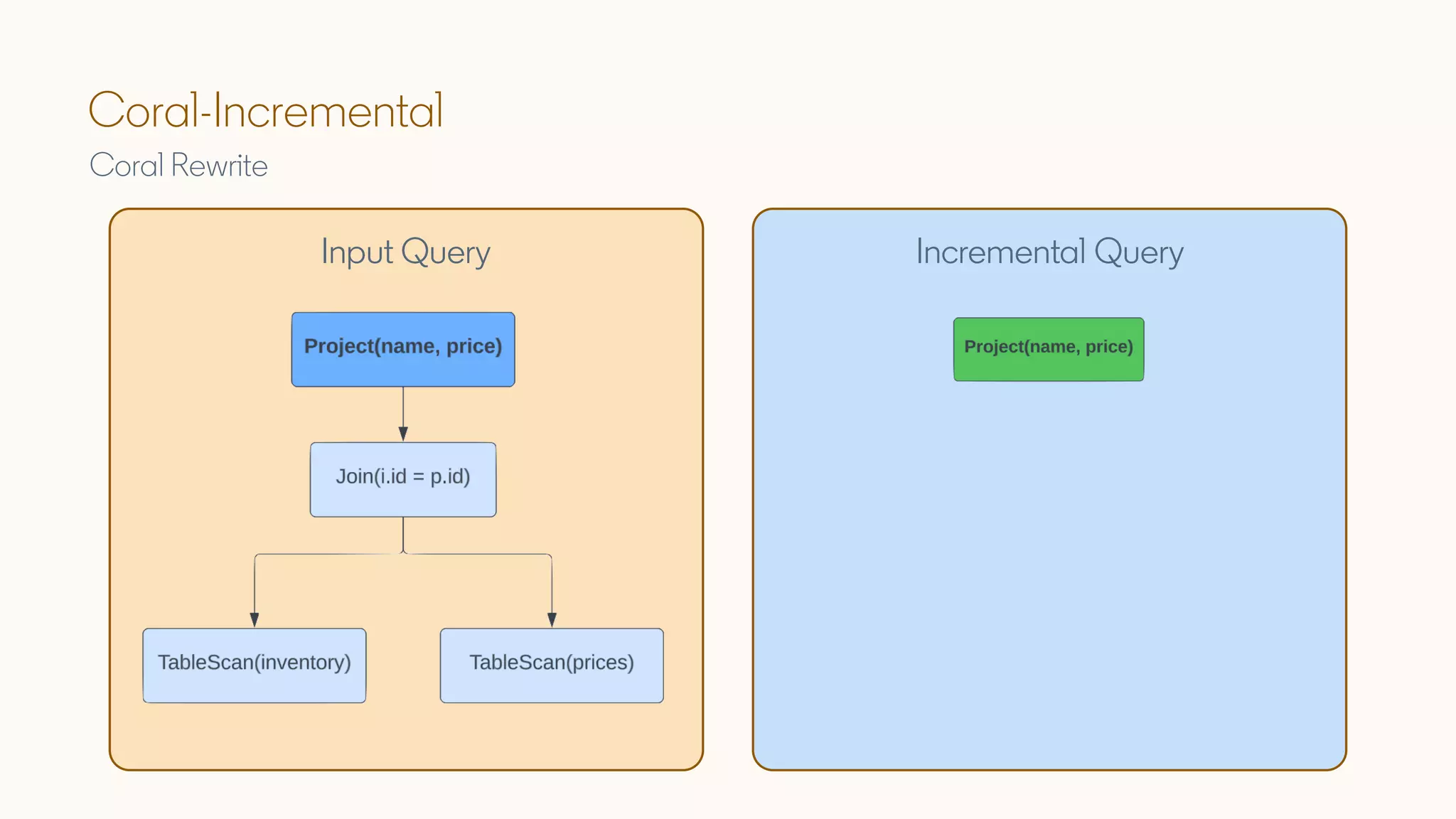
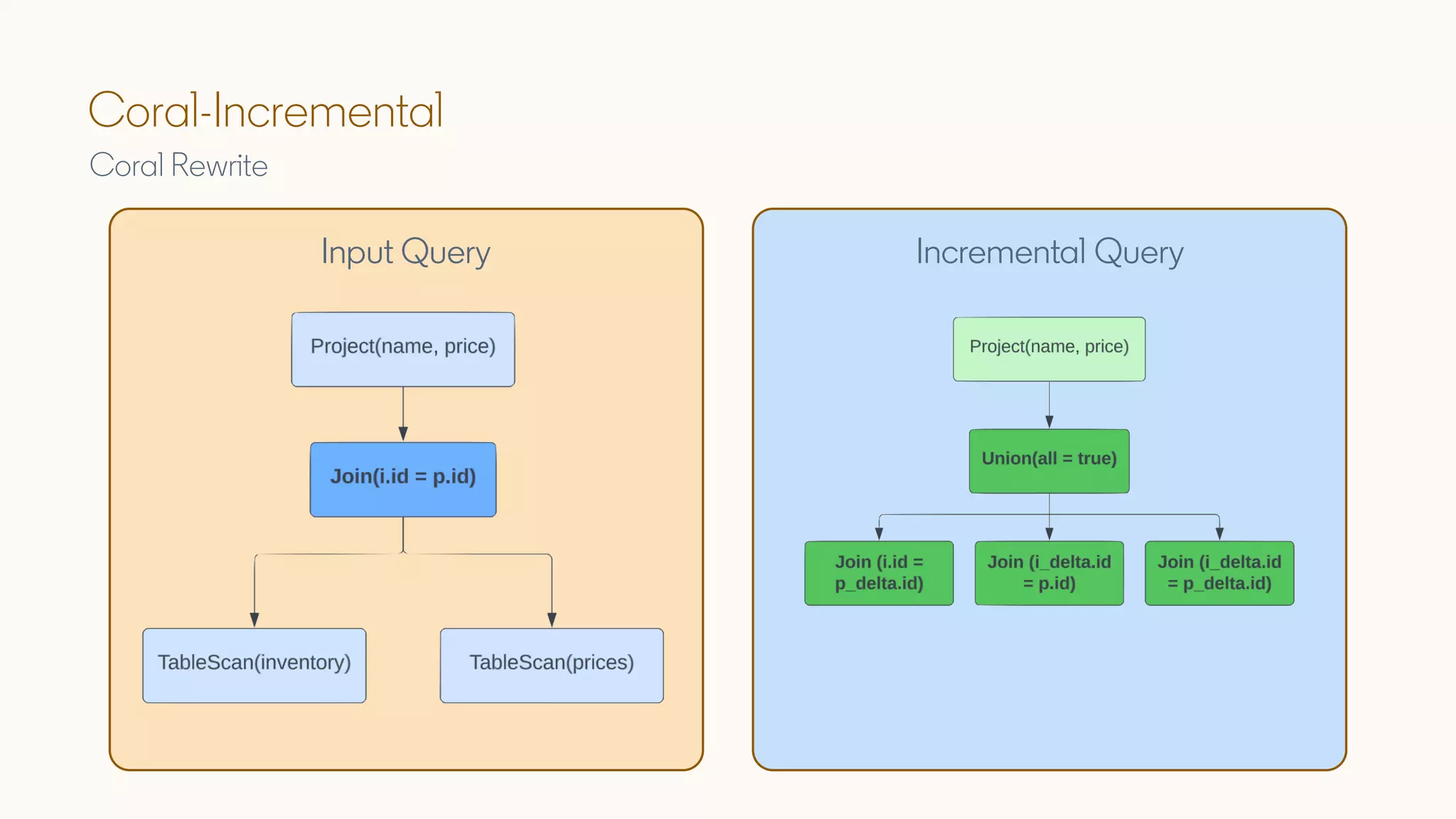
Coral Rewrite
Input Query Incremental Query
Coral-Incremental
Coral Rewrite
Input Query Incremental Query
Coral-Incremental
Coral Rewrite
Input Query Incremental Query
Coral-Incremental
Coral Rewrite
Input Query Incremental Query
Coral-Incremental
Coral IR to SQL
Incremental Query
SELECT product_name, product_price
FROM inventory JOIN prices_delta
ON inventory.id = prices_delta.id
UNION ALL
SELECT product_name, product_price
FROM inventory_delta JOIN prices
ON inventory_delta.id = prices.id
UNION ALL
SELECT product_name, product_price
FROM inventory_delta JOIN prices_delta
ON inventory_delta.id = prices_delta.id
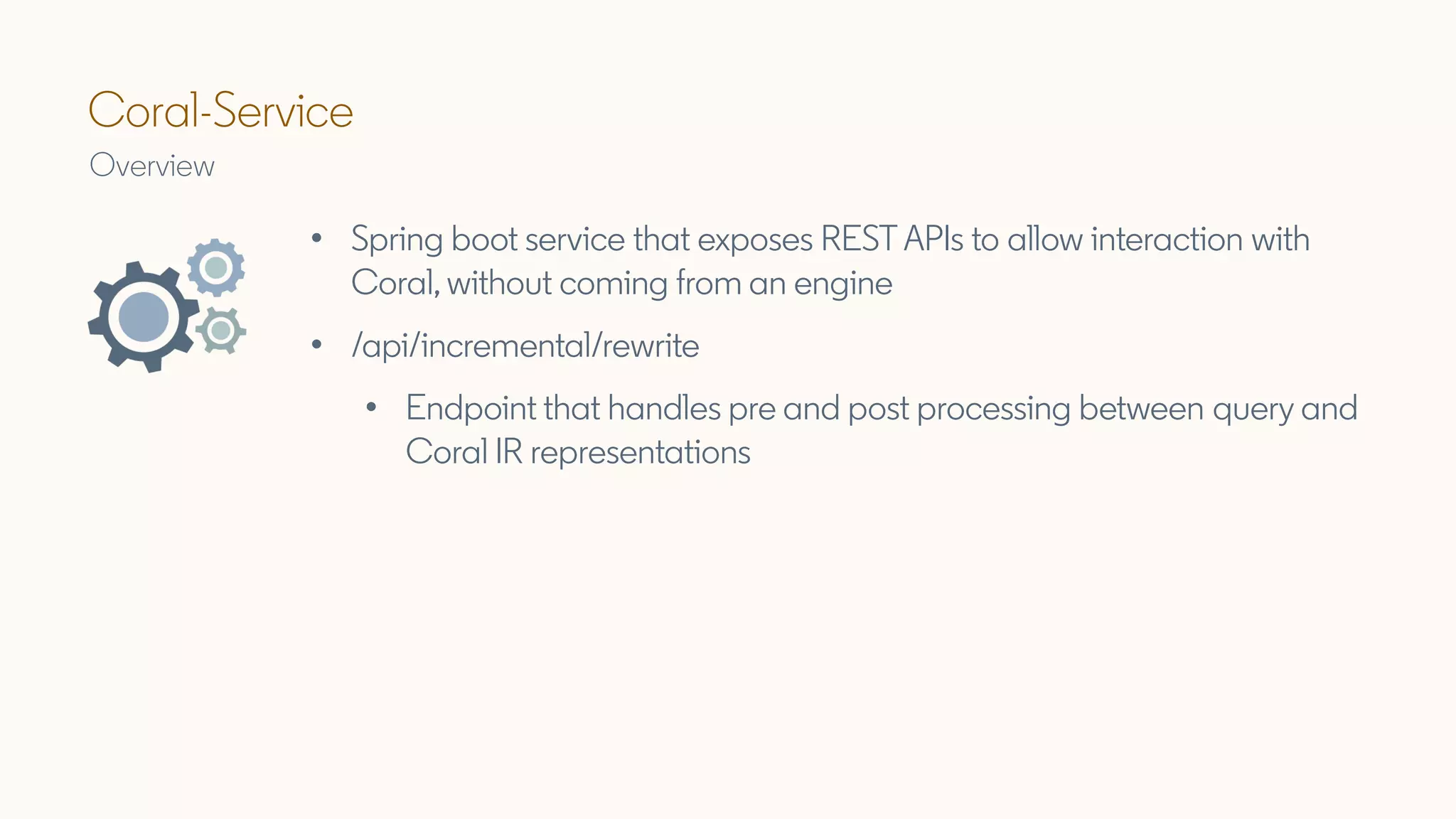
Coral-Service
Overview
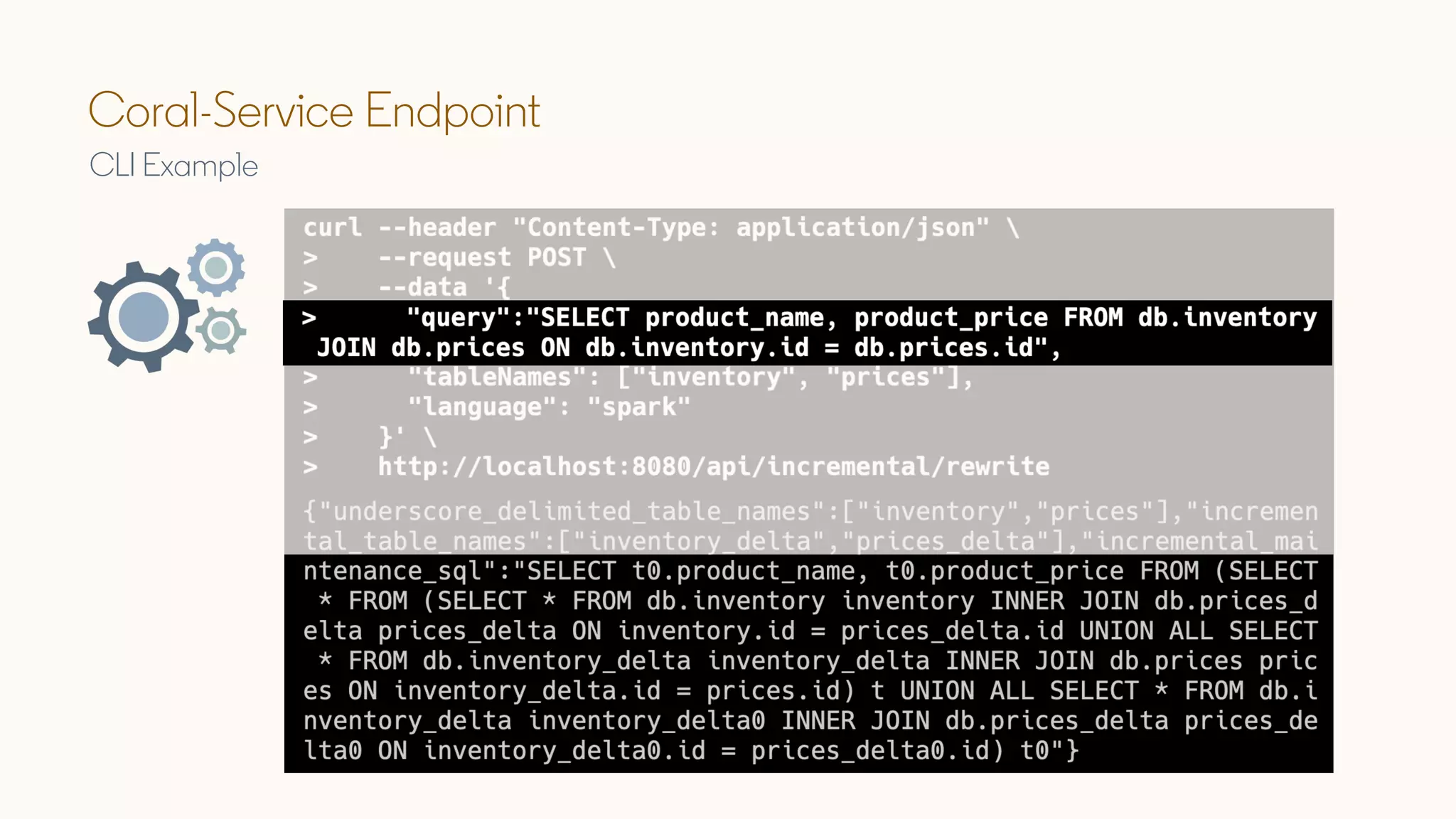
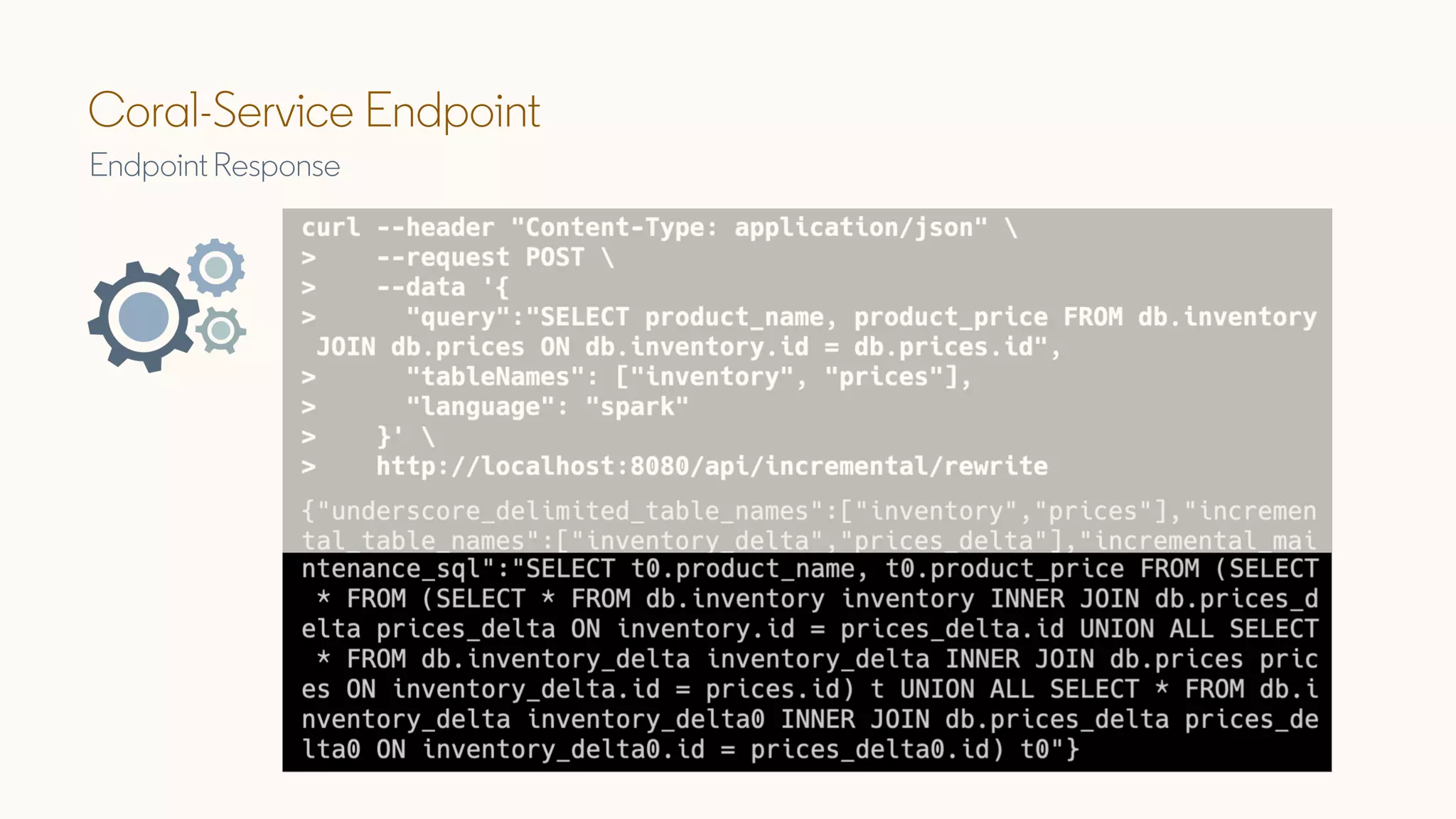
• Spring boot service that exposes REST APIs to allow interaction with
Coral, without coming from an engine
• /api/incremental/rewrite
• Endpoint that handles pre and post processing between query and
Coral IR representations
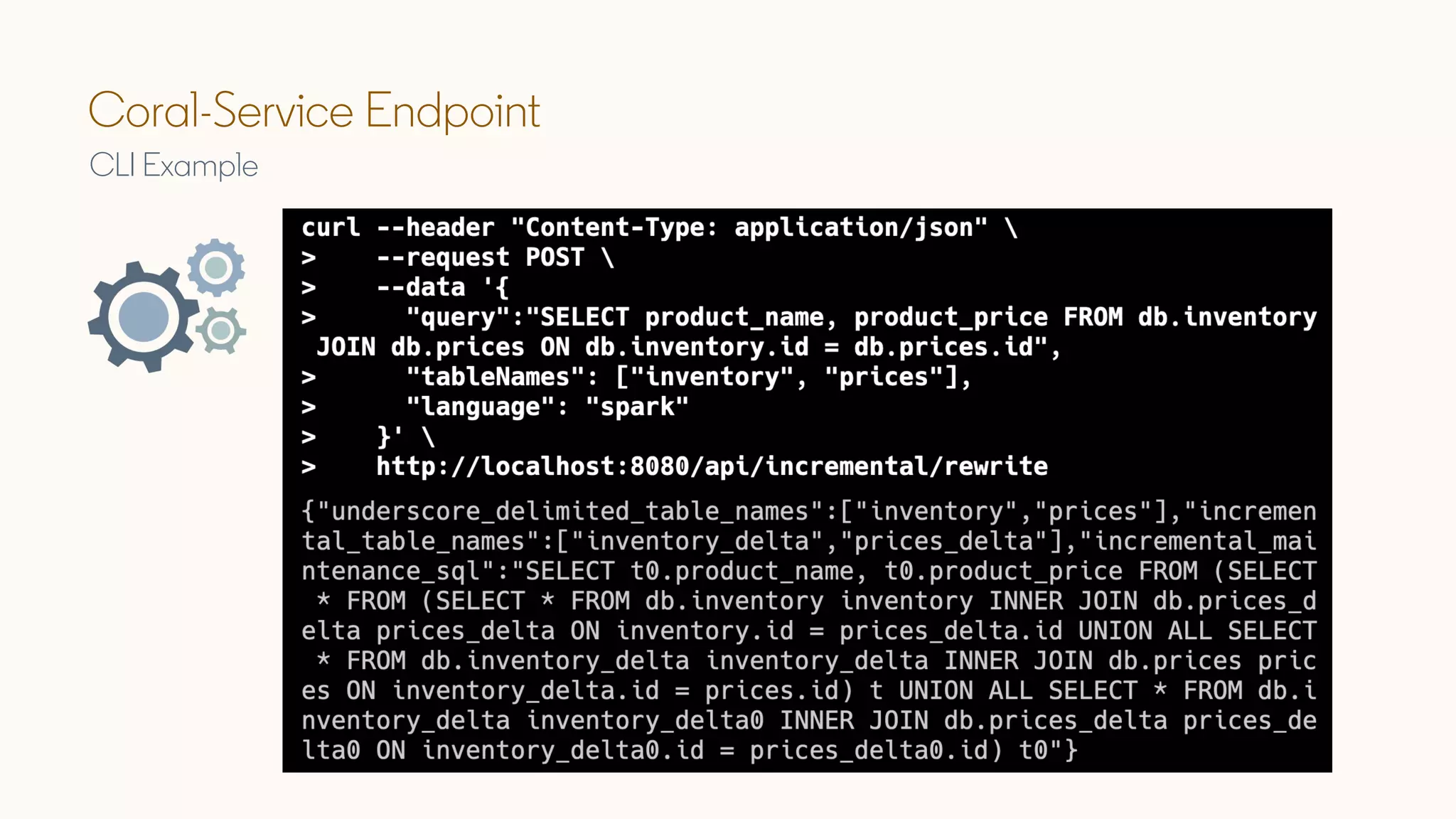
Coral-Service Endpoint
CLI Example
Coral-Service Endpoint
Post Request
Coral-Service Endpoint
CLI Example
Coral-Service Endpoint
Endpoint Response
Coral-Service Endpoint
Endpoint Response
Desired State
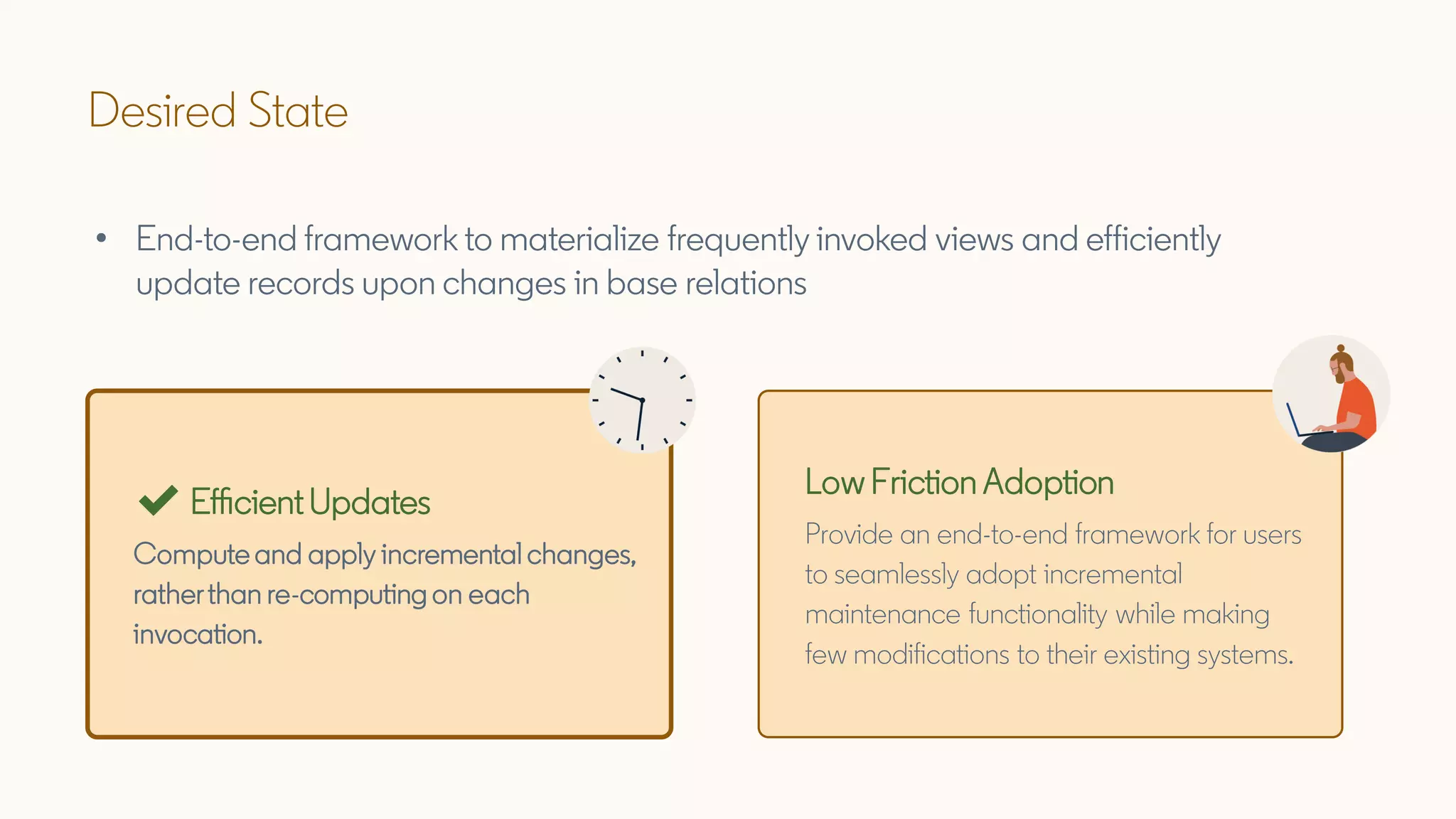
• End-to-end framework to materialize frequently invoked views and efficiently
update records upon changes in base relations
✔️ Efficient Updates
Compute and apply incremental changes,
ratherthan re-computing on each
invocation.
Low Friction Adoption
Provide an end-to-end framework for users
to seamlessly adopt incremental
maintenance functionality while making
few modifications to their existing systems.
DBT Integration
Coral-Dbt
User Perspective
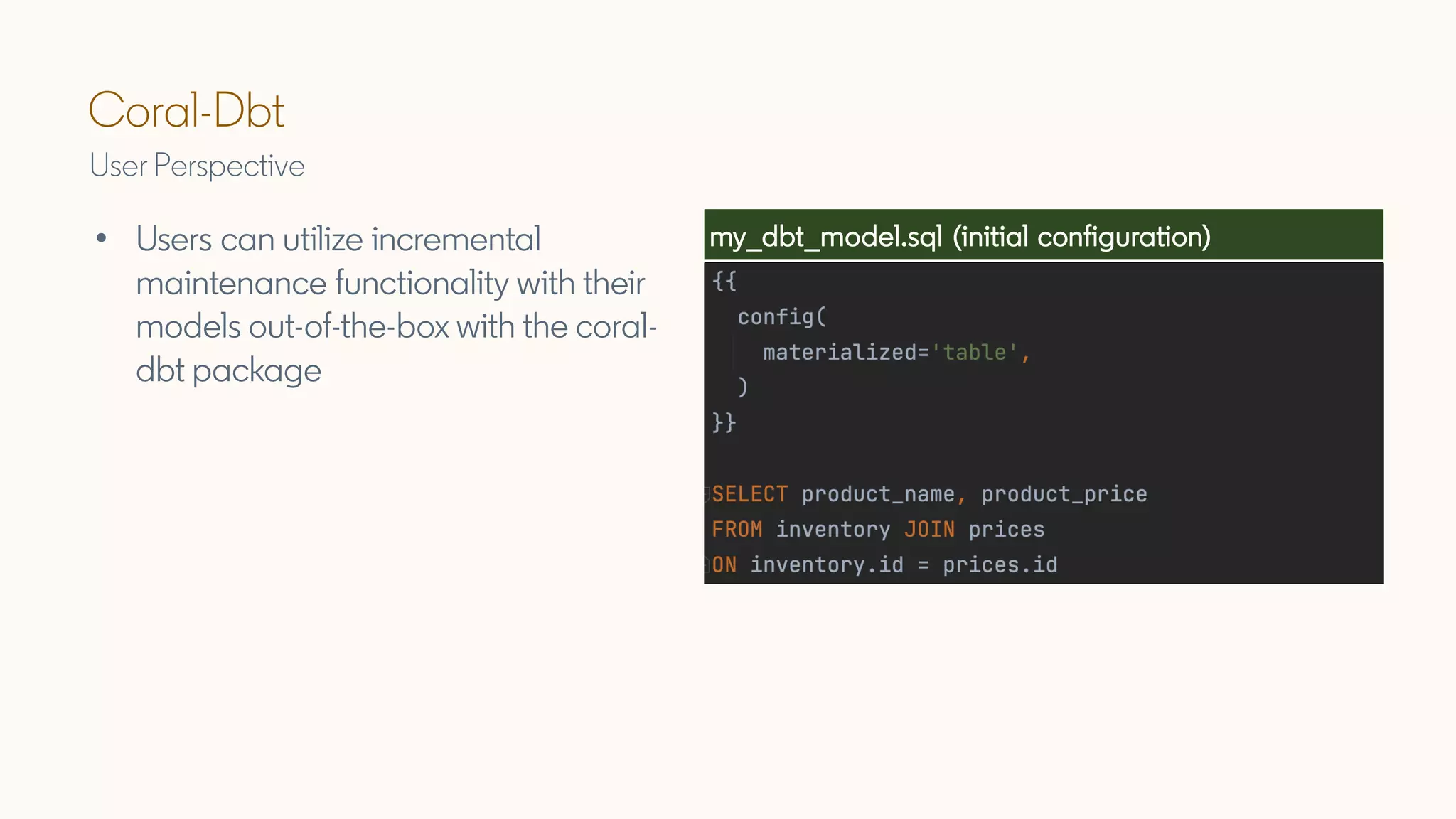
• Users can utilize incremental
maintenance functionality with their
models out-of-the-box with the coral-
dbt package
my_dbt_model.sql (initial configuration)
Coral-Dbt
User Perspective
• Users can utilize incremental
maintenance functionality with their
models out-of-the-box with the coral-
dbt package
my_dbt_model.sql (with incremental maintenance)
Coral-Dbt
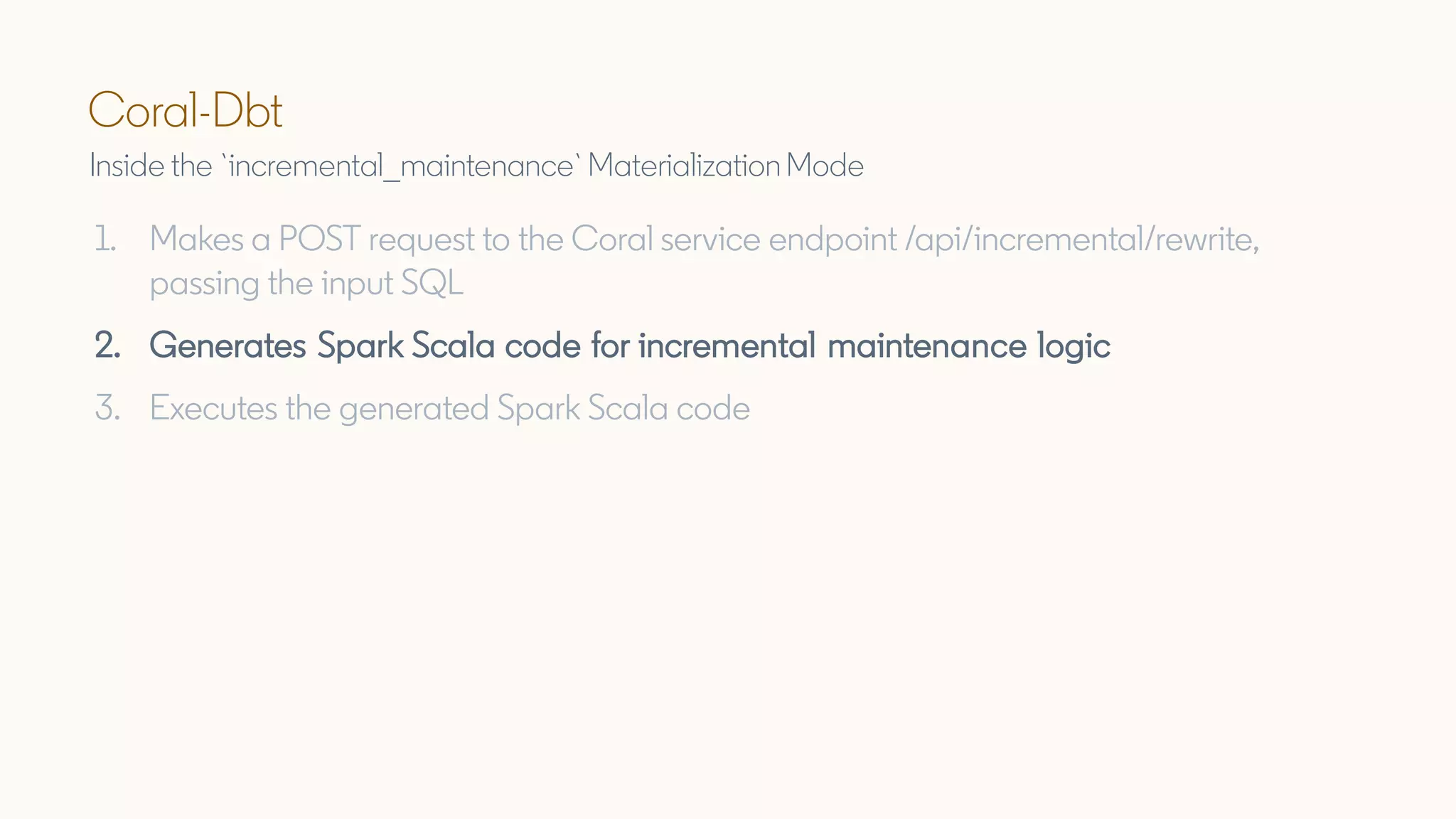
Inside the `incremental_maintenance` MaterializationMode
1. Makes a POST request to the Coral service endpoint /api/incremental/rewrite,
passing the input SQL
2. Generates Scala code for incremental maintenance logic
3. Executes the generated Spark Scala code
Coral-Dbt
Inside the `incremental_maintenance` MaterializationMode
1. Makes a POST request to the Coral service endpoint /api/incremental/rewrite,
passing the input SQL
2. Generates Spark Scala code for incremental maintenance logic
3. Executes the generated Spark Scala code
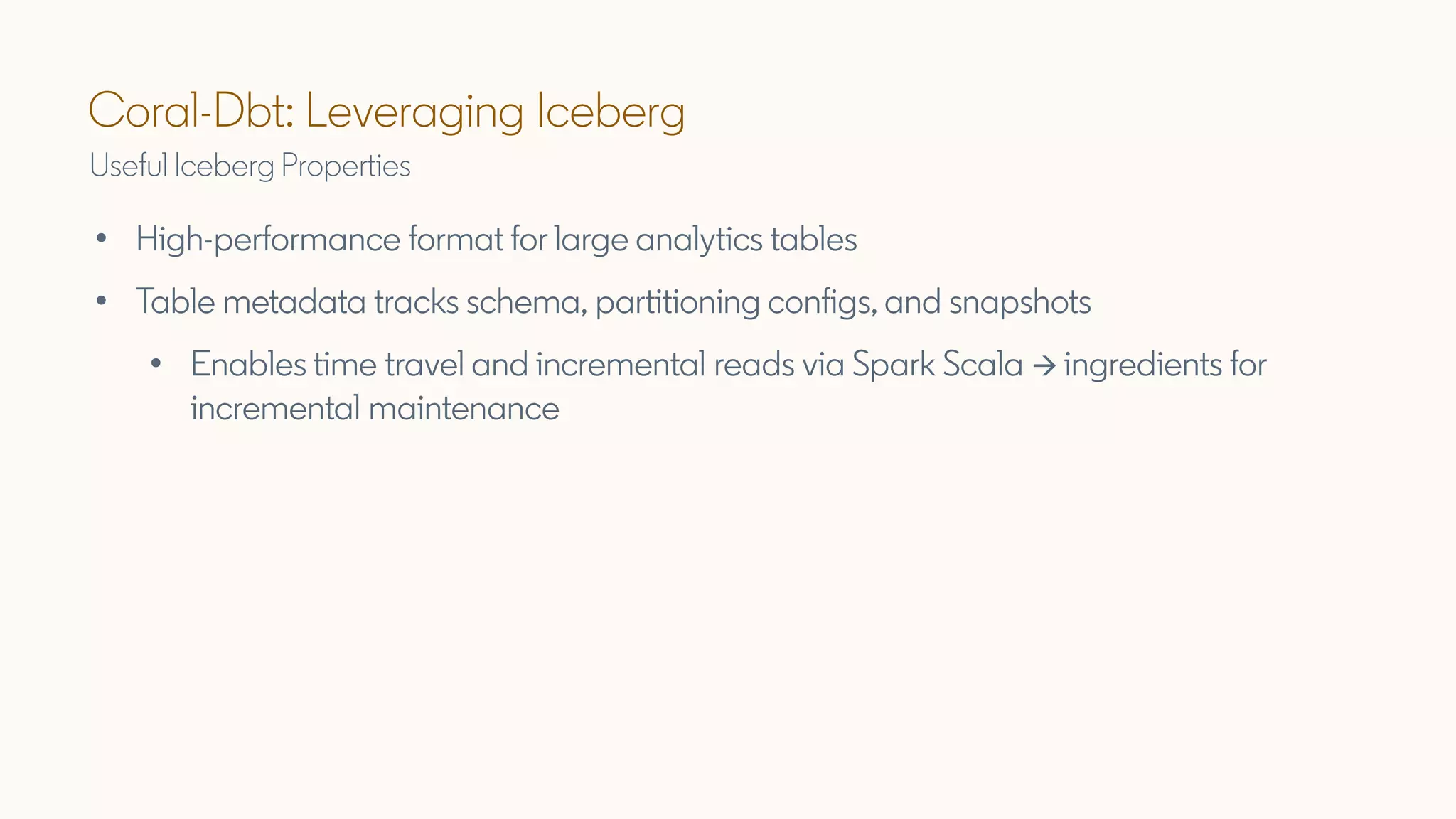
Coral-Dbt: Leveraging Iceberg
Useful Iceberg Properties
• High-performance format for large analytics tables
• Table metadata tracks schema, partitioning configs, and snapshots
• Enables time travel and incremental reads via Spark Scala → ingredients for
incremental maintenance
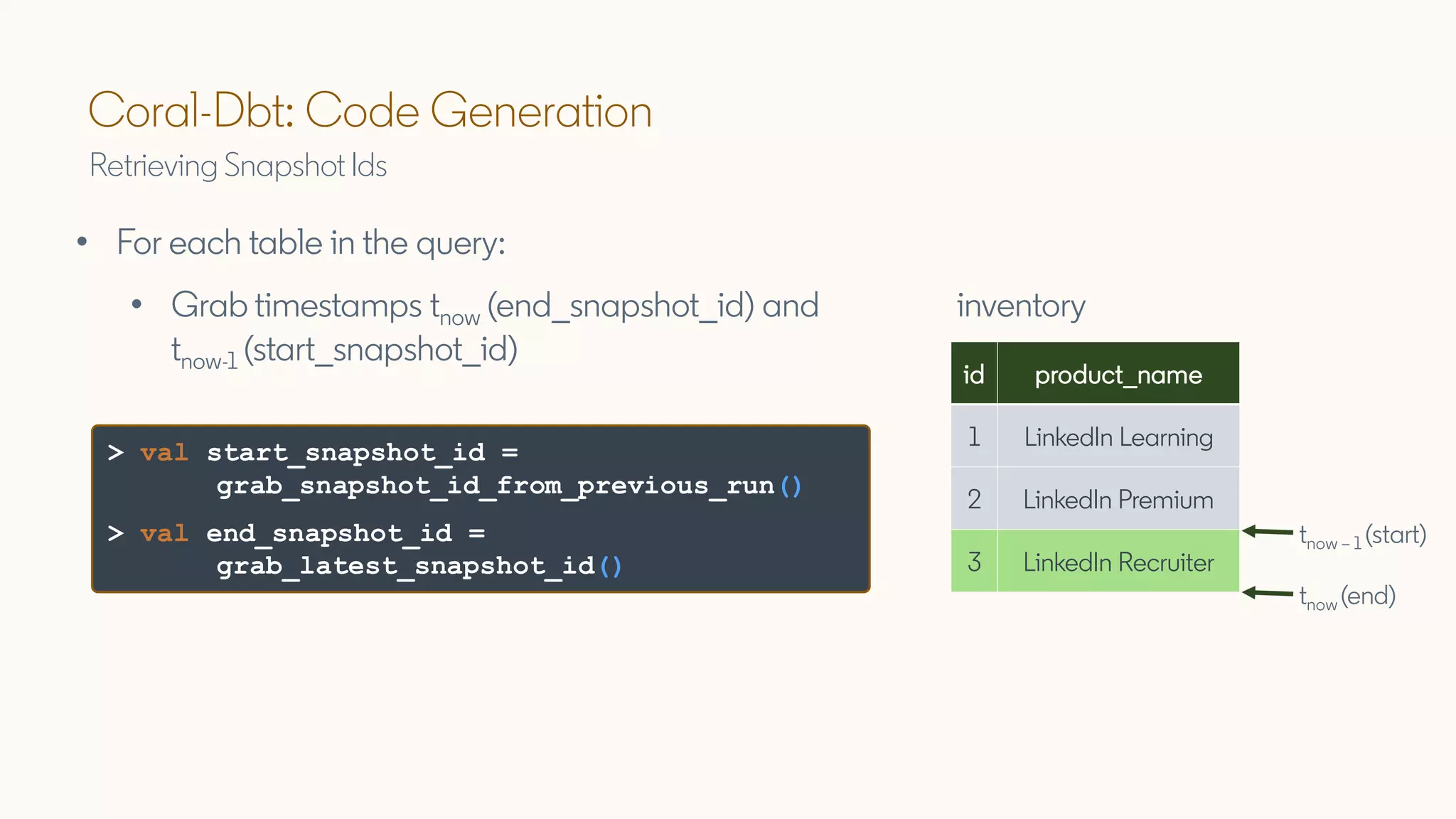
Coral-Dbt: Code Generation
Retrieving Snapshot Ids
id product_name
1 LinkedIn Learning
2 LinkedIn Premium
3 LinkedIn Recruiter
inventory
tnow (end)
tnow – 1 (start)
> val start_snapshot_id =
grab_snapshot_id_from_previous_run()
> val end_snapshot_id =
grab_latest_snapshot_id()
• For each table in the query:
• Grab timestamps tnow (end_snapshot_id) and
tnow-1 (start_snapshot_id)
Coral-Dbt: Code Generation
Creating Temp Views
• For each table in the query:
• Create temporary views representing the
original table and the additions
inventory
inventory_delta
inventory
> val df = load("inventory")
> val inventory =
df.snapshotTo(start_snapshot_id)
.createTempView()
> val inventory_delta =
df.snapshotFrom(start_snapshot_id)
.snapshotTo(end_snapshot_id)
.createTempView()
id product_name
1 LinkedIn Learning
2 LinkedIn Premium
3 LinkedIn Recruiter
Coral-Dbt: Code Generation
Executing Incremental Query and Updating MaterializedTable
> val query_response = spark.sql(incremental_maintenance_sql)
> query_response.appendToTable("my_join_output")
product_name product_price
LinkedIn Premium $6
LinkedIn Learning $3
LinkedIn Recruiter $40
t2 = t1 + query_response
product_name product_price
LinkedIn Premium $6
t1
Desired State
• End-to-end framework to materialize frequently invoked views and efficiently
update records upon changes in base relations
✔️ Efficient Updates
Compute and apply incremental changes,
ratherthan re-computing on each
invocation.
✔️ Low FrictionAdoption
Provide an end-to-end framework for users
to seamlessly adopt incremental
maintenance functionalitywhile making
few modifications to theirexisting systems.
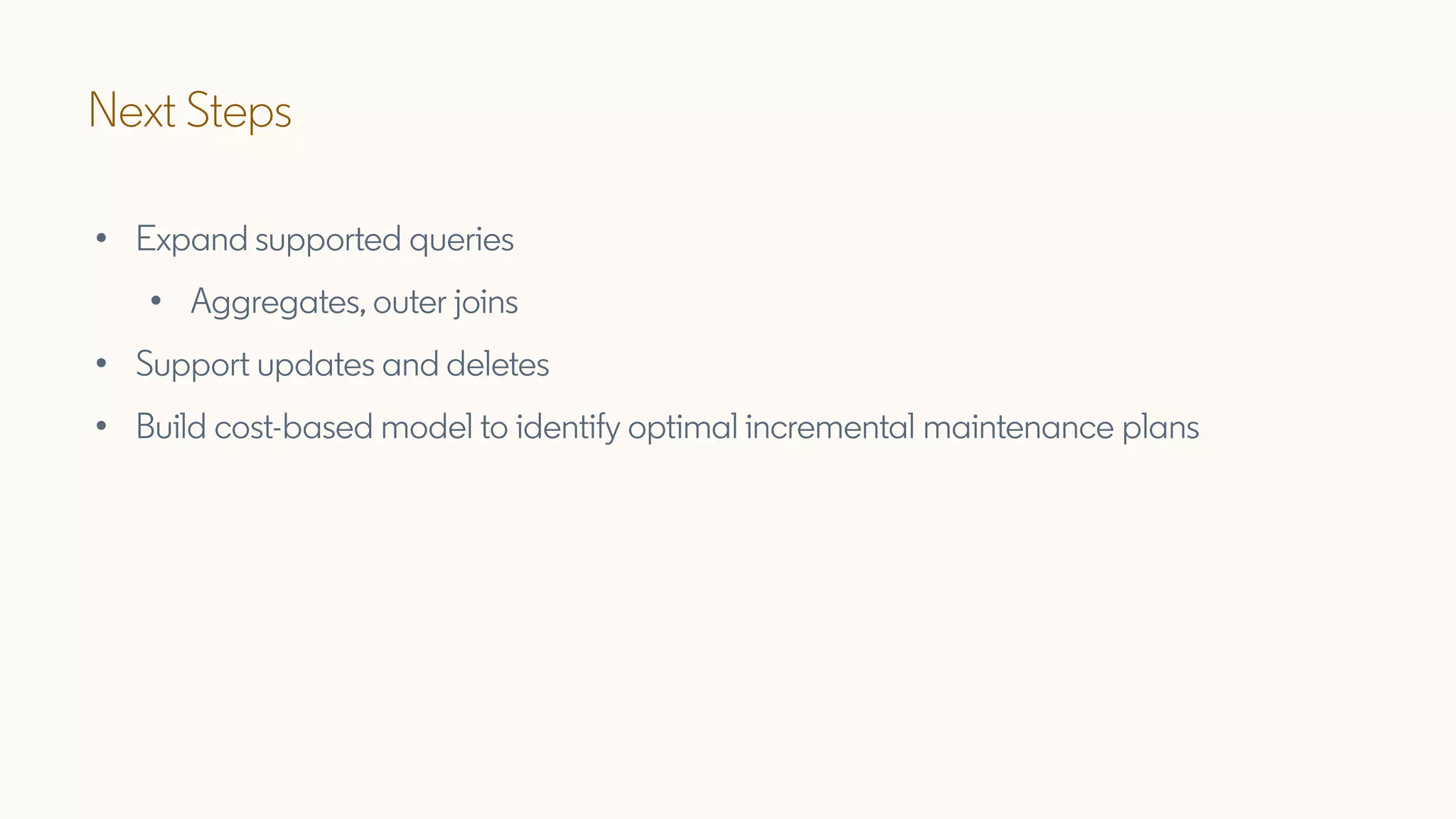
Next Steps
• Expand supported queries
• Aggregates, outer joins
• Support updates and deletes
• Build cost-based model to identify optimal incremental maintenance plans
References
• Coral: https://github.com/linkedin/coral
• Incremental Maintenance Materialization
Mode: https://github.com/linkedin/coral/tree/master/coral-dbt
• Incremental rewrite: https://github.com/linkedin/coral/tree/master/coral-incremental
Contributors
Thank you!

Incremental View Maintenance with Coral, DBT, and Iceberg

  • 1.
    Incremental View Maintenance withCoral, DBT, and Iceberg May 2023
  • 2.
    Modern Data LakeArchitectures • Compute Engines • Process large amounts of data • Orchestrators • Execute jobs on a schedule • Or on data availability • ETL tools • To implement, test, and build data workflows • Tables • Continuously updated
  • 3.
    Modern Data LakeGrowth Pains • Large number of jobs • E.g, SQL workloads • Workload scanning/computing data from scratch each time • Becomes more of a problem as the data grows in volume. SELECT posts.post_id, COUNT(likes.user_id) AS total_likes FROM posts LEFT JOIN likes ON posts.post_id = likes.post_id GROUP BY posts.post_id; SELECT AVG(num_comments) AS avg_comments_per_user FROM ( SELECT users.user_id, COUNT(comments.comment_id ) AS num_comments FROM users INNER JOIN comments ON users.user_id = comments.user_id GROUP BY users.user_id ) AS user_comments; SELECT COUNT(DISTINCT likes.user_id) AS num_users_liked_and_comme nted FROM likes INNER JOIN comments ON likes.post_id = comments.post_id AND likes.user_id = comments.user_id; SELECT sender_id, COUNT(*) AS num_messages_sent FROM messages GROUP BY sender_id; SELECT users.user_id, COUNT(friendships.friend_ id) AS num_friends FROM users INNER JOIN friendships ON users.user_id = friendships.user_id GROUP BY users.user_id ORDER BY num_friends DESC LIMIT 10;
  • 4.
    What if wecan maintain tables incrementally? Update tables only with the changes! • Lower compute cost • Lower latency • More update-to-date insights/models • Improved UX • Focus on writing the logic, not the incremental mechanics • Declare full DAG using just SQL
  • 5.
    Incremental Compute MadeEasy With Coral, Iceberg, and DBT • DBT • For capturing transformations • Coral • For incremental maintenance logic • Iceberg • SnapshotAPIs and Incrementalscan
  • 6.
    DBT Overview What isDBT? • Open-source data transformation tool (ETL) that enables teams to quickly build complex data pipelines Image from getdbt.com
  • 7.
    DBT Overview DBT NativeMaterializationProperties: Table • Model rebuilt as table on each run (using CREATE TABLE AS) • Takes a long time to rebuild my_dbt_model.sql
  • 8.
    DBT Overview DBT NativeMaterializationProperties: Incremental • Inserts or updates records in the built table on a manual run when the source table changes • Requires extra wrappers and configurations, where users must specify how to filter rows • Described as an “advanced usage” of DBT my_dbt_model.sql
  • 9.
    DBT Overview DBT NativeMaterializationProperties: Incremental • Inserts or updates records in the built table when the source table changes • Requires extra wrappers and configurations, where users must specify how to filter rows • Described as an “advanced usage” of DBT my_dbt_model.sql
  • 10.
    Desired User Experience NewMaterializationMode: Incremental Maintenance • Incremental maintenance functionality with no extra code necessary • One simple configuration change from `table` materialization mode my_dbt_model.sql
  • 11.
  • 12.
    Calculating Incremental Queries SimpleJoin Example id product_name 1 LinkedIn Learning 2 LinkedIn Premium id product_price 2 $6 inventory prices SELECT product_name, product_price FROM inventory JOIN prices ON inventory.id = prices.id
  • 13.
    Calculating Incremental Queries SimpleJoin Example id product_name 1 LinkedIn Learning 2 LinkedIn Premium id product_price 2 $6 inventory prices SELECT product_name, product_price FROM inventory JOIN prices ON inventory.id = prices.id product_name product_price LinkedIn Premium $6 t1
  • 14.
    Calculating Incremental Queries SimpleJoin Example: Drop and Rebuild id product_name 1 LinkedIn Learning 2 LinkedIn Premium 3 LinkedIn Recruiter id product_price 2 $6 1 $3 3 $40 inventory prices SELECT product_name, product_price FROM inventory JOIN prices ON inventory.id = prices.id product_name product_price LinkedIn Premium $6 t1
  • 15.
    Calculating Incremental Queries SimpleJoin Example: Drop and Rebuild inventory prices SELECT product_name, product_price FROM inventory JOIN prices ON inventory.id = prices.id id product_name 1 LinkedIn Learning 2 LinkedIn Premium 3 LinkedIn Recruiter id product_price 2 $6 1 $3 3 $40
  • 16.
    Calculating Incremental Queries SimpleJoin Example: Drop and Rebuild inventory prices SELECT product_name, product_price FROM inventory JOIN prices ON inventory.id = prices.id t2 product_name product_price LinkedIn Premium $6 LinkedIn Learning $3 LinkedIn Recruiter $40 id product_name 1 LinkedIn Learning 2 LinkedIn Premium 3 LinkedIn Recruiter id product_price 2 $6 1 $3 3 $40
  • 17.
    Calculating Incremental Queries SimpleJoin Example: Incremental Maintenance SELECT product_name, product_price FROM inventory JOIN prices ON inventory.id = prices.id product_name product_price LinkedIn Premium $6 t1 inventory prices id product_name 1 LinkedIn Learning 2 LinkedIn Premium id product_price 2 $6
  • 18.
    Calculating Incremental Queries SimpleJoin Example: Incremental Maintenance SELECT product_name, product_price FROM inventory JOIN prices_delta ON inventory.id = prices_delta.id product_name product_price LinkedIn Premium $6 t1 id product_name 1 LinkedIn Learning 2 LinkedIn Premium 3 LinkedIn Recruiter id product_price 2 $6 1 $3 3 $40 inventory prices Δt𝛼 product_name product_price LinkedIn Learning $3
  • 19.
    Calculating Incremental Queries SimpleJoin Example: Incremental Maintenance SELECT product_name, product_price FROM inventory_delta JOIN prices ON inventory_delta.id = prices.id product_name product_price LinkedIn Premium $6 LinkedIn Learning $3 t1 + Δt𝛼 Δtβ id product_name 1 LinkedIn Learning 2 LinkedIn Premium 3 LinkedIn Recruiter id product_price 2 $6 1 $3 3 $40 inventory prices product_name product_price
  • 20.
    Calculating Incremental Queries SimpleJoin Example: Incremental Maintenance product_name product_price LinkedIn Premium $6 LinkedIn Learning $3 t1 + Δt𝛼 + Δtβ Δt𝛄 id product_name 1 LinkedIn Learning 2 LinkedIn Premium 3 LinkedIn Recruiter id product_price 2 $6 1 $3 3 $40 inventory prices product_name product_price LinkedIn Recruiter $40 SELECT product_name, product_price FROM inventory_delta JOIN prices_delta ON inventory_delta.id = prices_delta.id
  • 21.
    Calculating Incremental Queries SimpleJoin Example: Incremental Maintenance INSERT INTO t1 (SELECT product_name, product_price FROM inventory JOIN prices_delta ON inventory.id = prices_delta.id UNION ALL SELECT product_name, product_price FROM inventory_delta JOIN prices ON inventory_delta.id = prices.id UNION ALL SELECT product_name, product_price FROM inventory_delta JOIN prices_delta ON inventory_delta.id = prices_delta.id) product_name product_price LinkedIn Premium $6 LinkedIn Learning $3 LinkedIn Recruiter $40 t1 + Δt𝛼 + Δtβ + Δt𝛄 Incremental Query Δt𝛼 Δtβ Δt𝛄
  • 22.
  • 23.
    Overview What is Coral? •Translation, analysis, and query rewrite engine • Open source since 2020 WIP Future Dialect Future Dialect
  • 24.
    Coral IR • Capturesquery semantics using standardized operators • Based on Apache Calcite • Two semantically equivalent representations: ❑ Coral IR – AST o Captures query semantics at the syntax tree layer o Extends Calcite's SqlNode representation o Use cases: SQL translations ❑ Coral IR – Logical Plan o Captures query semantics at the logical plan layer o Extends Calcite's RelNode representation o Use cases: Query optimization, query rewrites, dynamic data masking
  • 25.
    Coral IR -AST • Captures query semantics using standardized operators at syntax tree level Image generatedby Coral-Visualization Trino SQL: SELECT * FROM test.foo JOIN test. bar ON a = c WHERE array_element[1] = 1 AND strpos(a, 'foo') > 0 Spark SQL: SELECT * FROM test.foo JOIN test. bar ON a = c WHERE b[0] = 1 AND instr(a, 'foo') > 0
  • 26.
    Coral IR –Logical Plan • Extends Apache Calcite’s Relational Algebra Expressions • Captures query semantics using standardized operators at logical plan level Image generatedby Coral-Visualization Trino SQL: SELECT * FROM test.foo JOIN test. bar ON a = c WHERE array_element[1] = 1 AND strpos(a, 'foo') > 0 Spark SQL: SELECT * FROM test.foo JOIN test. bar ON a = c WHERE b[0] = 1 AND instr(a, 'foo') > 0
  • 27.
  • 28.
  • 29.
  • 30.
    Coral-Incremental TransformationOverview SELECT product_name, product_price FROMinventory JOIN prices ON inventory.id = prices.id SELECT product_name, product_price FROM inventory JOIN prices_delta ON inventory.id = prices_delta.id UNION ALL SELECT product_name, product_price FROM inventory_delta JOIN prices ON inventory_delta.id = prices.id UNION ALL SELECT product_name, product_price FROM inventory_delta JOIN prices_delta ON inventory_delta.id = prices_delta.id
  • 31.
    Coral-Incremental SQL to CoralIR Input Query SELECT product_name, product_price FROM inventory JOIN prices ON inventory.id = prices.id
  • 32.
  • 33.
  • 34.
  • 35.
  • 36.
    Coral-Incremental Coral IR toSQL Incremental Query SELECT product_name, product_price FROM inventory JOIN prices_delta ON inventory.id = prices_delta.id UNION ALL SELECT product_name, product_price FROM inventory_delta JOIN prices ON inventory_delta.id = prices.id UNION ALL SELECT product_name, product_price FROM inventory_delta JOIN prices_delta ON inventory_delta.id = prices_delta.id
  • 37.
    Coral-Service Overview • Spring bootservice that exposes REST APIs to allow interaction with Coral, without coming from an engine • /api/incremental/rewrite • Endpoint that handles pre and post processing between query and Coral IR representations
  • 38.
  • 39.
  • 40.
  • 41.
  • 42.
  • 43.
    Desired State • End-to-endframework to materialize frequently invoked views and efficiently update records upon changes in base relations ✔️ Efficient Updates Compute and apply incremental changes, ratherthan re-computing on each invocation. Low Friction Adoption Provide an end-to-end framework for users to seamlessly adopt incremental maintenance functionality while making few modifications to their existing systems.
  • 44.
  • 45.
    Coral-Dbt User Perspective • Userscan utilize incremental maintenance functionality with their models out-of-the-box with the coral- dbt package my_dbt_model.sql (initial configuration)
  • 46.
    Coral-Dbt User Perspective • Userscan utilize incremental maintenance functionality with their models out-of-the-box with the coral- dbt package my_dbt_model.sql (with incremental maintenance)
  • 47.
    Coral-Dbt Inside the `incremental_maintenance`MaterializationMode 1. Makes a POST request to the Coral service endpoint /api/incremental/rewrite, passing the input SQL 2. Generates Scala code for incremental maintenance logic 3. Executes the generated Spark Scala code
  • 48.
    Coral-Dbt Inside the `incremental_maintenance`MaterializationMode 1. Makes a POST request to the Coral service endpoint /api/incremental/rewrite, passing the input SQL 2. Generates Spark Scala code for incremental maintenance logic 3. Executes the generated Spark Scala code
  • 49.
    Coral-Dbt: Leveraging Iceberg UsefulIceberg Properties • High-performance format for large analytics tables • Table metadata tracks schema, partitioning configs, and snapshots • Enables time travel and incremental reads via Spark Scala → ingredients for incremental maintenance
  • 50.
    Coral-Dbt: Code Generation RetrievingSnapshot Ids id product_name 1 LinkedIn Learning 2 LinkedIn Premium 3 LinkedIn Recruiter inventory tnow (end) tnow – 1 (start) > val start_snapshot_id = grab_snapshot_id_from_previous_run() > val end_snapshot_id = grab_latest_snapshot_id() • For each table in the query: • Grab timestamps tnow (end_snapshot_id) and tnow-1 (start_snapshot_id)
  • 51.
    Coral-Dbt: Code Generation CreatingTemp Views • For each table in the query: • Create temporary views representing the original table and the additions inventory inventory_delta inventory > val df = load("inventory") > val inventory = df.snapshotTo(start_snapshot_id) .createTempView() > val inventory_delta = df.snapshotFrom(start_snapshot_id) .snapshotTo(end_snapshot_id) .createTempView() id product_name 1 LinkedIn Learning 2 LinkedIn Premium 3 LinkedIn Recruiter
  • 52.
    Coral-Dbt: Code Generation ExecutingIncremental Query and Updating MaterializedTable > val query_response = spark.sql(incremental_maintenance_sql) > query_response.appendToTable("my_join_output") product_name product_price LinkedIn Premium $6 LinkedIn Learning $3 LinkedIn Recruiter $40 t2 = t1 + query_response product_name product_price LinkedIn Premium $6 t1
  • 53.
    Desired State • End-to-endframework to materialize frequently invoked views and efficiently update records upon changes in base relations ✔️ Efficient Updates Compute and apply incremental changes, ratherthan re-computing on each invocation. ✔️ Low FrictionAdoption Provide an end-to-end framework for users to seamlessly adopt incremental maintenance functionalitywhile making few modifications to theirexisting systems.
  • 54.
    Next Steps • Expandsupported queries • Aggregates, outer joins • Support updates and deletes • Build cost-based model to identify optimal incremental maintenance plans
  • 55.
    References • Coral: https://github.com/linkedin/coral •Incremental Maintenance Materialization Mode: https://github.com/linkedin/coral/tree/master/coral-dbt • Incremental rewrite: https://github.com/linkedin/coral/tree/master/coral-incremental
  • 56.
  • 57.