Master Product Manager
Oracle Database
February 2020
Maria Colgan
Understanding the Oracle Optimizer
@SQLMaria
Part 1
Safe harbor statement
The following is intended to outline our general product direction. It is intended for information purposes
only, and may not be incorporated into any contract. It is not a commitment to deliver any material,
code, or functionality, and should not be relied upon in making purchasing decisions.
The development, release, timing, and pricing of any features or functionality described for Oracle’s
products may change and remains at the sole discretion of Oracle Corporation.
2
Confidential – © 2020 Oracle
3
5
4
3
2
1
SQL Tuning
Harnessing the Power of Optimizer Hints
Explain the Explain Plan
Best Practices for Managing Optimizer Statistics
Understanding the Oracle Optimizer
Agenda
4
How the
Oracle
Optimizer
Operates
5
1979 – 1991
RIP
“ In the beginning
there were rules …”
6
• Rule Based Optimizer (RBO) is a heuristic based Optimizer
- Uses a ranked list of access paths (rules)
- 17 possible access paths
- Lower ranked access paths assumed to operate more efficiently
• Plans chosen based on access paths available and their rank
- If multiple access paths exist, path with the lowest rank is chosen
• Only very simple physical optimizations done automatically
- OR Expansion: multiple OR predicates rewritten as UNION ALL
Oracle Version 6 and earlier
Rule Based Optimizer
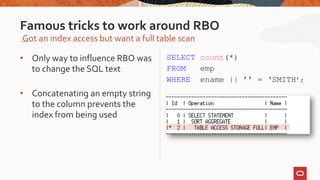
SELECT count(*)
FROM emp
WHERE ename || ’’ = ‘SMITH’;
• Only way to influence RBO was
to change the SQL text
• Concatenating an empty string
to the column prevents the
index from being used
Famous tricks to work around RBO
Got an index access but want a full table scan
Dawn of a new era:
“ .. there is cost ..
“
1992
• Database features become more and more complex
• Partitioning
• Parallel execution
• No easy way to extend Rule Based Optimizer to accommodate so
many additional access paths
• Having only one plan per statement regardless of the objects size or
structure was no longer the best approach
Oracle 7 - dawn of a new era
Cost Based Optimizer
Optimizer must evolve to become cost based
• Initial design based on IBM research paper
• Access Path Selection in a Relational Database Management System (1979)
• Approach outlined in the paper was
• Multiple execution plans are generated for a statement
• Estimated cost is computed for each plan
• Optimizer selects the plan with the lowest estimated cost
Oracle 7 - dawn of a new era
Cost Based Optimizer
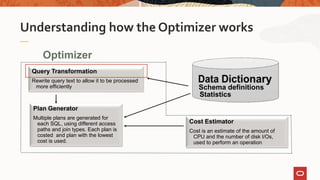
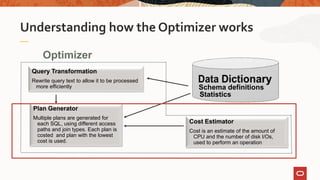
Understanding how the Optimizer works
Query Transformation
Rewrite query text to allow it to be processed
more efficiently
Plan Generator
Multiple plans are generated for
each SQL, using different access
paths and join types. Each plan is
costed and plan with the lowest
cost is used.
Cost Estimator
Cost is an estimate of the amount of
CPU and the number of disk I/Os,
used to perform an operation
Optimizer
Statistics
Schema definitions
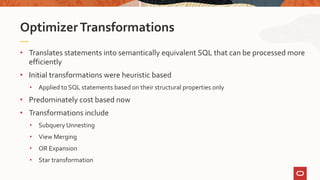
• Translates statements into semantically equivalent SQL that can be processed more
efficiently
• Initial transformations were heuristic based
• Applied to SQL statements based on their structural properties only
• Predominately cost based now
• Transformations include
• Subquery Unnesting
• View Merging
• OR Expansion
• Star transformation
OptimizerTransformations
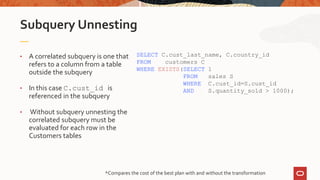
Subquery Unnesting
*Compares the cost of the best plan with and without the transformation
SELECT C.cust_last_name, C.country_id
FROM customers C
WHERE EXISTS(SELECT 1
FROM sales S
WHERE C.cust_id=S.cust_id
AND S.quantity_sold > 1000);
• A correlated subquery is one that
refers to a column from a table
outside the subquery
• In this case C.cust_id is
referenced in the subquery
• Without subquery unnesting the
correlated subquery must be
evaluated for each row in the
Customers tables
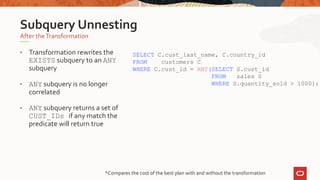
After theTransformation
Subquery Unnesting
*Compares the cost of the best plan with and without the transformation
• Transformation rewrites the
EXISTS subquery to an ANY
subquery
• ANY subquery is no longer
correlated
• ANY subquery returns a set of
CUST_IDs if any match the
predicate will return true
SELECT C.cust_last_name, C.country_id
FROM customers C
WHERE C.cust_id = ANY(SELECT S.cust_id
FROM sales S
WHERE S.quantity_sold > 1000);
After theTransformation
Subquery Unnesting
*Compares the cost of the best plan with and without the transformation
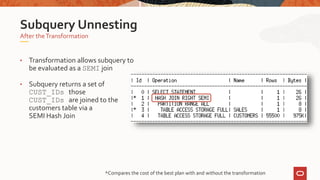
• Transformation allows subquery to
be evaluated as a SEMI join
• Subquery returns a set of
CUST_IDs those
CUST_IDs are joined to the
customers table via a
SEMI Hash Join
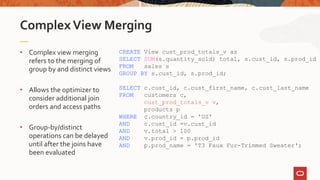
• Complex view merging
refers to the merging of
group by and distinct views
• Allows the optimizer to
consider additional join
orders and access paths
• Group-by/distinct
operations can be delayed
until after the joins have
been evaluated
ComplexView Merging
CREATE View cust_prod_totals_v as
SELECT SUM(s.quantity_sold) total, s.cust_id, s.prod_id
FROM sales s
GROUP BY s.cust_id, s.prod_id;
SELECT c.cust_id, c.cust_first_name, c.cust_last_name
FROM customers c,
cust_prod_totals_v v,
products p
WHERE c.country_id = 'US'
AND c.cust_id =v.cust_id
AND v.total > 100
AND v.prod_id = p.prod_id
AND p.prod_name = 'T3 Faux Fur-Trimmed Sweater';
• After transformation
GROUP BY operation
occurs after SALES is joined
to CUSTOMERS and
PRODUCTS
• Number of rows in GROUP
BY greatly reduced after
join
• May not always be best to
delay the GROUP BY or
DISTINCT operation
After theTransformation
ComplexView Merging
SELECT c.cust_id, c.cust_first_name, c.cust_last_name
FROM customers c,
products p,
sales s
WHERE c.country_id = 'US'
AND c.cust_id =s.cust_id
AND s.prod_id = p.prod_id
AND p.prod_name = 'T3 Faux Fur-Trimmed Sweater’
GROUP BY s.cust_id, s.prod_id, s.cust_id, s.prod_id,
p.rowid, c.rowid, c.cust_last_name,
c.cust_first_name, c.cust_id
HAVING SUM(s.quantity_sold) > 100
;
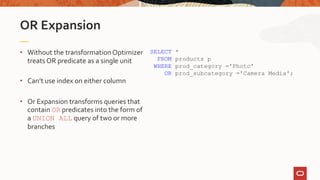
• Without the transformation Optimizer
treats OR predicate as a single unit
• Can’t use index on either column
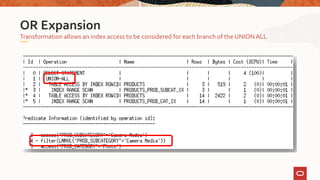
• Or Expansion transforms queries that
contain OR predicates into the form of
a UNION ALL query of two or more
branches
OR Expansion
SELECT *
FROM products p
WHERE prod_category ='Photo'
OR prod_subcategory ='Camera Media';
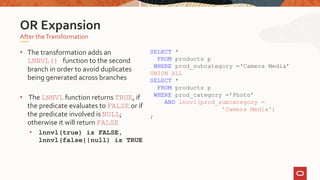
• The transformation adds an
LNNVL() function to the second
branch in order to avoid duplicates
being generated across branches
• The LNNVL function returns TRUE, if
the predicate evaluates to FALSE or if
the predicate involved is NULL;
otherwise it will return FALSE
• lnnvl(true) is FALSE,
lnnvl(false||null) is TRUE
After theTransformation
OR Expansion
SELECT *
FROM products p
WHERE prod_subcategory ='Camera Media’
UNION ALL
SELECT *
FROM products p
WHERE prod_category ='Photo’
AND lnnvl(prod_subcategory =
'Camera Media')
;
Transformation allows an index access to be considered for each branch of the UNIONALL
OR Expansion
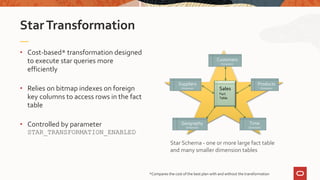
• Cost-based* transformation designed
to execute star queries more
efficiently
• Relies on bitmap indexes on foreign
key columns to access rows in the fact
table
• Controlled by parameter
STAR_TRANSFORMATION_ENABLED
StarTransformation
Sales
Fact
Table
Products
Dimension
Time
Dimension
Geography
Dimension
Suppliers
Dimension
Customers
Dimension
Star Schema - one or more large fact table
and many smaller dimension tables
*Compares the cost of the best plan with and without the transformation
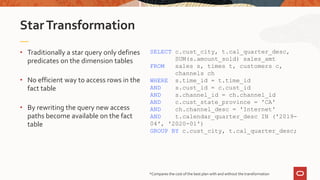
• Traditionally a star query only defines
predicates on the dimension tables
• No efficient way to access rows in the
fact table
• By rewriting the query new access
paths become available on the fact
table
StarTransformation
*Compares the cost of the best plan with and without the transformation
SELECT c.cust_city, t.cal_quarter_desc,
SUM(s.amount_sold) sales_amt
FROM sales s, times t, customers c,
channels ch
WHERE s.time_id = t.time_id
AND s.cust_id = c.cust_id
AND s.channel_id = ch.channel_id
AND c.cust_state_province = 'CA'
AND ch.channel_desc = 'Internet'
AND t.calendar_quarter_desc IN ('2019-
04', '2020-01')
GROUP BY c.cust_city, t.cal_quarter_desc;
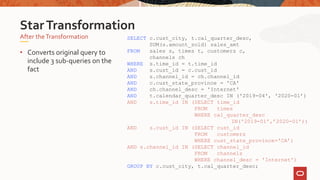
• Converts original query to
include 3 sub-queries on the
fact
After theTransformation
StarTransformation
SELECT c.cust_city, t.cal_quarter_desc,
SUM(s.amount_sold) sales_amt
FROM sales s, times t, customers c,
channels ch
WHERE s.time_id = t.time_id
AND s.cust_id = c.cust_id
AND s.channel_id = ch.channel_id
AND c.cust_state_province = 'CA'
AND ch.channel_desc = 'Internet'
AND t.calendar_quarter_desc IN ('2019-04', '2020-01’)
AND s.time_id IN (SELECT time_id
FROM times
WHERE cal_quarter_desc
IN('2019-01’,’2020-01’))
AND s.cust_id IN (SELECT cust_id
FROM customers
WHERE cust_state_province='CA’)
AND s.channel_id IN (SELECT channel_id
FROM channels
WHERE channel_desc = 'Internet')
GROUP BY c.cust_city, t.cal_quarter_desc;
--------------------------------------------------------------
| Id | Operation | Name |
--------------------------------------------------------------
| 0 | SELECT STATEMENT | |
| 1 | HASH GROUP BY | |
|* 2 | HASH JOIN | |
|* 3 | TABLE ACCESS FULL | CUSTOMERS |
|* 4 | HASH JOIN | |
|* 5 | TABLE ACCESS FULL | TIMES |
| 6 | VIEW | VW_ST_B1772830|
| 7 | NESTED LOOPS | |
| 8 | PARTITION RANGE SUBQUERY | |
| 9 | BITMAP CONVERSION TO ROWIDS | |
| 10 | BITMAP AND | |
| 11 | BITMAP MERGE | |
| 12 | BITMAP KEY ITERATION | |
| 13 | BUFFER SORT | |
|* 14 | TABLE ACCESS FULL | CHANNELS |
|* 15 | BITMAP INDEX RANGE SCAN | SALES_CHANNEL_BIX|
| 16 | BITMAP MERGE | |
| 17 | BITMAP KEY ITERATION | |
| 18 | BUFFER SORT | |
|* 19 | TABLE ACCESS FULL | TIMES |
|* 20 | BITMAP INDEX RANGE SCAN | SALES_TIME_BIX |
| 21 | BITMAP MERGE | |
| 22 | BITMAP KEY ITERATION | |
| 23 | BUFFER SORT | |
|* 24 | TABLE ACCESS FULL | CUSTOMERS |
|* 25 | BITMAP INDEX RANGE SCAN | SALES_CUST_BIX |
| 26 | TABLE ACCESS BY USER ROWID | SALES |
--------------------------------------------------------------
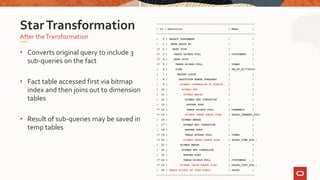
After theTransformation
StarTransformation
• Converts original query to include 3
sub-queries on the fact
• Fact table accessed first via bitmap
index and then joins out to dimension
tables
• Result of sub-queries may be saved in
temp tables
Understanding how the Optimizer works
Query Transformation
Rewrite query text to allow it to be processed
more efficiently
Plan Generator
Multiple plans are generated for
each SQL, using different access
paths and join types. Each plan is
costed and plan with the lowest
cost is used.
Cost Estimator
Cost is an estimate of the amount of
CPU and the number of disk I/Os,
used to perform an operation
Optimizer
Statistics
Schema definitions
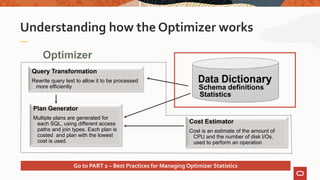
Understanding how the Optimizer works
Query Transformation
Rewrite query text to allow it to be processed
more efficiently
Plan Generator
Multiple plans are generated for
each SQL, using different access
paths and join types. Each plan is
costed and plan with the lowest
cost is used.
Cost Estimator
Cost is an estimate of the amount of
CPU and the number of disk I/Os,
used to perform an operation
Optimizer
Statistics
Schema definitions
Go to PART 2 – Best Practices for Managing Optimizer Statistics
27
Related Information
• White paper on Cost-Based Query
Transformation in Oracle
http://dl.acm.org/citation.cfm?id=1164215
Join the Conversation
https://twitter.com/SQLMaria
https://blogs.oracle.com/optimizer/
https://sqlmaria.com
https://www.facebook.com/SQLMaria

Part1 of SQL Tuning Workshop - Understanding the Optimizer

  • 1.
    Master Product Manager OracleDatabase February 2020 Maria Colgan Understanding the Oracle Optimizer @SQLMaria Part 1
  • 2.
    Safe harbor statement Thefollowing is intended to outline our general product direction. It is intended for information purposes only, and may not be incorporated into any contract. It is not a commitment to deliver any material, code, or functionality, and should not be relied upon in making purchasing decisions. The development, release, timing, and pricing of any features or functionality described for Oracle’s products may change and remains at the sole discretion of Oracle Corporation. 2 Confidential – © 2020 Oracle
  • 3.
    3 5 4 3 2 1 SQL Tuning Harnessing thePower of Optimizer Hints Explain the Explain Plan Best Practices for Managing Optimizer Statistics Understanding the Oracle Optimizer Agenda
  • 4.
  • 5.
    5 1979 – 1991 RIP “In the beginning there were rules …”
  • 6.
    6 • Rule BasedOptimizer (RBO) is a heuristic based Optimizer - Uses a ranked list of access paths (rules) - 17 possible access paths - Lower ranked access paths assumed to operate more efficiently • Plans chosen based on access paths available and their rank - If multiple access paths exist, path with the lowest rank is chosen • Only very simple physical optimizations done automatically - OR Expansion: multiple OR predicates rewritten as UNION ALL Oracle Version 6 and earlier Rule Based Optimizer
  • 7.
    SELECT count(*) FROM emp WHEREename || ’’ = ‘SMITH’; • Only way to influence RBO was to change the SQL text • Concatenating an empty string to the column prevents the index from being used Famous tricks to work around RBO Got an index access but want a full table scan
  • 8.
    Dawn of anew era: “ .. there is cost .. “ 1992
  • 9.
    • Database featuresbecome more and more complex • Partitioning • Parallel execution • No easy way to extend Rule Based Optimizer to accommodate so many additional access paths • Having only one plan per statement regardless of the objects size or structure was no longer the best approach Oracle 7 - dawn of a new era Cost Based Optimizer Optimizer must evolve to become cost based
  • 10.
    • Initial designbased on IBM research paper • Access Path Selection in a Relational Database Management System (1979) • Approach outlined in the paper was • Multiple execution plans are generated for a statement • Estimated cost is computed for each plan • Optimizer selects the plan with the lowest estimated cost Oracle 7 - dawn of a new era Cost Based Optimizer
  • 11.
    Understanding how theOptimizer works Query Transformation Rewrite query text to allow it to be processed more efficiently Plan Generator Multiple plans are generated for each SQL, using different access paths and join types. Each plan is costed and plan with the lowest cost is used. Cost Estimator Cost is an estimate of the amount of CPU and the number of disk I/Os, used to perform an operation Optimizer Statistics Schema definitions
  • 12.
    • Translates statementsinto semantically equivalent SQL that can be processed more efficiently • Initial transformations were heuristic based • Applied to SQL statements based on their structural properties only • Predominately cost based now • Transformations include • Subquery Unnesting • View Merging • OR Expansion • Star transformation OptimizerTransformations
  • 13.
    Subquery Unnesting *Compares thecost of the best plan with and without the transformation SELECT C.cust_last_name, C.country_id FROM customers C WHERE EXISTS(SELECT 1 FROM sales S WHERE C.cust_id=S.cust_id AND S.quantity_sold > 1000); • A correlated subquery is one that refers to a column from a table outside the subquery • In this case C.cust_id is referenced in the subquery • Without subquery unnesting the correlated subquery must be evaluated for each row in the Customers tables
  • 14.
    After theTransformation Subquery Unnesting *Comparesthe cost of the best plan with and without the transformation • Transformation rewrites the EXISTS subquery to an ANY subquery • ANY subquery is no longer correlated • ANY subquery returns a set of CUST_IDs if any match the predicate will return true SELECT C.cust_last_name, C.country_id FROM customers C WHERE C.cust_id = ANY(SELECT S.cust_id FROM sales S WHERE S.quantity_sold > 1000);
  • 15.
    After theTransformation Subquery Unnesting *Comparesthe cost of the best plan with and without the transformation • Transformation allows subquery to be evaluated as a SEMI join • Subquery returns a set of CUST_IDs those CUST_IDs are joined to the customers table via a SEMI Hash Join
  • 16.
    • Complex viewmerging refers to the merging of group by and distinct views • Allows the optimizer to consider additional join orders and access paths • Group-by/distinct operations can be delayed until after the joins have been evaluated ComplexView Merging CREATE View cust_prod_totals_v as SELECT SUM(s.quantity_sold) total, s.cust_id, s.prod_id FROM sales s GROUP BY s.cust_id, s.prod_id; SELECT c.cust_id, c.cust_first_name, c.cust_last_name FROM customers c, cust_prod_totals_v v, products p WHERE c.country_id = 'US' AND c.cust_id =v.cust_id AND v.total > 100 AND v.prod_id = p.prod_id AND p.prod_name = 'T3 Faux Fur-Trimmed Sweater';
  • 17.
    • After transformation GROUPBY operation occurs after SALES is joined to CUSTOMERS and PRODUCTS • Number of rows in GROUP BY greatly reduced after join • May not always be best to delay the GROUP BY or DISTINCT operation After theTransformation ComplexView Merging SELECT c.cust_id, c.cust_first_name, c.cust_last_name FROM customers c, products p, sales s WHERE c.country_id = 'US' AND c.cust_id =s.cust_id AND s.prod_id = p.prod_id AND p.prod_name = 'T3 Faux Fur-Trimmed Sweater’ GROUP BY s.cust_id, s.prod_id, s.cust_id, s.prod_id, p.rowid, c.rowid, c.cust_last_name, c.cust_first_name, c.cust_id HAVING SUM(s.quantity_sold) > 100 ;
  • 18.
    • Without thetransformation Optimizer treats OR predicate as a single unit • Can’t use index on either column • Or Expansion transforms queries that contain OR predicates into the form of a UNION ALL query of two or more branches OR Expansion SELECT * FROM products p WHERE prod_category ='Photo' OR prod_subcategory ='Camera Media';
  • 19.
    • The transformationadds an LNNVL() function to the second branch in order to avoid duplicates being generated across branches • The LNNVL function returns TRUE, if the predicate evaluates to FALSE or if the predicate involved is NULL; otherwise it will return FALSE • lnnvl(true) is FALSE, lnnvl(false||null) is TRUE After theTransformation OR Expansion SELECT * FROM products p WHERE prod_subcategory ='Camera Media’ UNION ALL SELECT * FROM products p WHERE prod_category ='Photo’ AND lnnvl(prod_subcategory = 'Camera Media') ;
  • 20.
    Transformation allows anindex access to be considered for each branch of the UNIONALL OR Expansion
  • 21.
    • Cost-based* transformationdesigned to execute star queries more efficiently • Relies on bitmap indexes on foreign key columns to access rows in the fact table • Controlled by parameter STAR_TRANSFORMATION_ENABLED StarTransformation Sales Fact Table Products Dimension Time Dimension Geography Dimension Suppliers Dimension Customers Dimension Star Schema - one or more large fact table and many smaller dimension tables *Compares the cost of the best plan with and without the transformation
  • 22.
    • Traditionally astar query only defines predicates on the dimension tables • No efficient way to access rows in the fact table • By rewriting the query new access paths become available on the fact table StarTransformation *Compares the cost of the best plan with and without the transformation SELECT c.cust_city, t.cal_quarter_desc, SUM(s.amount_sold) sales_amt FROM sales s, times t, customers c, channels ch WHERE s.time_id = t.time_id AND s.cust_id = c.cust_id AND s.channel_id = ch.channel_id AND c.cust_state_province = 'CA' AND ch.channel_desc = 'Internet' AND t.calendar_quarter_desc IN ('2019- 04', '2020-01') GROUP BY c.cust_city, t.cal_quarter_desc;
  • 23.
    • Converts originalquery to include 3 sub-queries on the fact After theTransformation StarTransformation SELECT c.cust_city, t.cal_quarter_desc, SUM(s.amount_sold) sales_amt FROM sales s, times t, customers c, channels ch WHERE s.time_id = t.time_id AND s.cust_id = c.cust_id AND s.channel_id = ch.channel_id AND c.cust_state_province = 'CA' AND ch.channel_desc = 'Internet' AND t.calendar_quarter_desc IN ('2019-04', '2020-01’) AND s.time_id IN (SELECT time_id FROM times WHERE cal_quarter_desc IN('2019-01’,’2020-01’)) AND s.cust_id IN (SELECT cust_id FROM customers WHERE cust_state_province='CA’) AND s.channel_id IN (SELECT channel_id FROM channels WHERE channel_desc = 'Internet') GROUP BY c.cust_city, t.cal_quarter_desc;
  • 24.
    -------------------------------------------------------------- | Id |Operation | Name | -------------------------------------------------------------- | 0 | SELECT STATEMENT | | | 1 | HASH GROUP BY | | |* 2 | HASH JOIN | | |* 3 | TABLE ACCESS FULL | CUSTOMERS | |* 4 | HASH JOIN | | |* 5 | TABLE ACCESS FULL | TIMES | | 6 | VIEW | VW_ST_B1772830| | 7 | NESTED LOOPS | | | 8 | PARTITION RANGE SUBQUERY | | | 9 | BITMAP CONVERSION TO ROWIDS | | | 10 | BITMAP AND | | | 11 | BITMAP MERGE | | | 12 | BITMAP KEY ITERATION | | | 13 | BUFFER SORT | | |* 14 | TABLE ACCESS FULL | CHANNELS | |* 15 | BITMAP INDEX RANGE SCAN | SALES_CHANNEL_BIX| | 16 | BITMAP MERGE | | | 17 | BITMAP KEY ITERATION | | | 18 | BUFFER SORT | | |* 19 | TABLE ACCESS FULL | TIMES | |* 20 | BITMAP INDEX RANGE SCAN | SALES_TIME_BIX | | 21 | BITMAP MERGE | | | 22 | BITMAP KEY ITERATION | | | 23 | BUFFER SORT | | |* 24 | TABLE ACCESS FULL | CUSTOMERS | |* 25 | BITMAP INDEX RANGE SCAN | SALES_CUST_BIX | | 26 | TABLE ACCESS BY USER ROWID | SALES | -------------------------------------------------------------- After theTransformation StarTransformation • Converts original query to include 3 sub-queries on the fact • Fact table accessed first via bitmap index and then joins out to dimension tables • Result of sub-queries may be saved in temp tables
  • 25.
    Understanding how theOptimizer works Query Transformation Rewrite query text to allow it to be processed more efficiently Plan Generator Multiple plans are generated for each SQL, using different access paths and join types. Each plan is costed and plan with the lowest cost is used. Cost Estimator Cost is an estimate of the amount of CPU and the number of disk I/Os, used to perform an operation Optimizer Statistics Schema definitions
  • 26.
    Understanding how theOptimizer works Query Transformation Rewrite query text to allow it to be processed more efficiently Plan Generator Multiple plans are generated for each SQL, using different access paths and join types. Each plan is costed and plan with the lowest cost is used. Cost Estimator Cost is an estimate of the amount of CPU and the number of disk I/Os, used to perform an operation Optimizer Statistics Schema definitions Go to PART 2 – Best Practices for Managing Optimizer Statistics
  • 27.
    27 Related Information • Whitepaper on Cost-Based Query Transformation in Oracle http://dl.acm.org/citation.cfm?id=1164215 Join the Conversation https://twitter.com/SQLMaria https://blogs.oracle.com/optimizer/ https://sqlmaria.com https://www.facebook.com/SQLMaria