www.msafdie.com

PRIYADARSHINI NANDA(2010UAR157)
JAGBIR SINGH(2010UAR134)
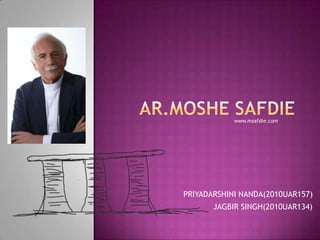
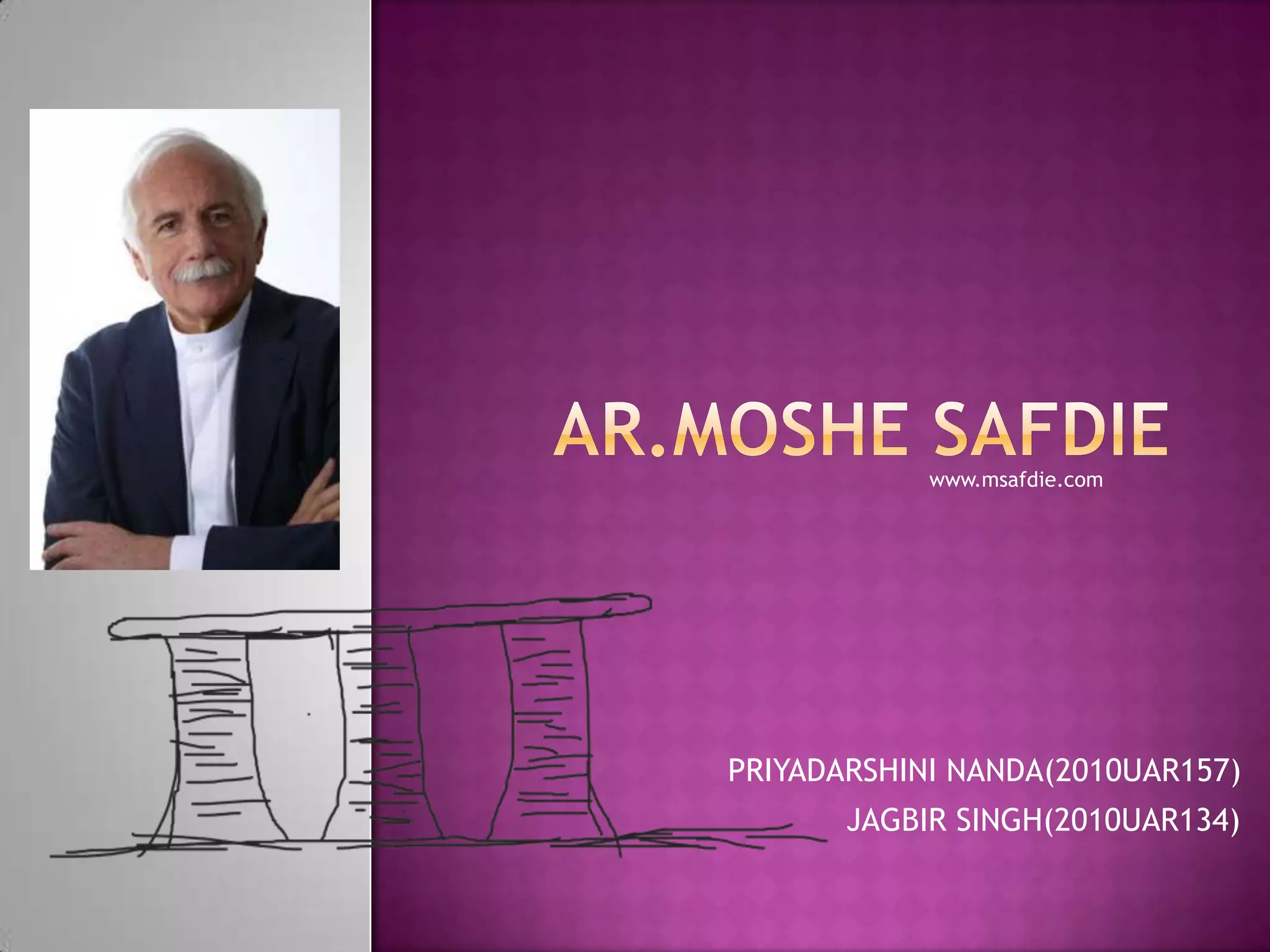
Moshe Safdie is an architect, urban
planner, educator, theorist, and author. Embracing a
comprehensive and humane design philosophy, Safdie is
committed to architecture that supports and enhances a
project‟s program; that is informed by the
geographic, social, and cultural elements that define a
place; and that responds to human needs and aspirations.

Safdie has completed a wide range of projects, such as
cultural, educational, and civic institutions; neighbourhoods
and public parks; mixed-use urban centres and airports; and
master plans for existing communities and entirely new
cities around the world.
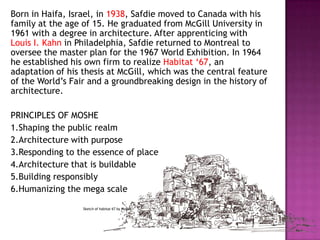
Born in Haifa, Israel, in 1938, Safdie moved to Canada with his
family at the age of 15. He graduated from McGill University in
1961 with a degree in architecture. After apprenticing with
Louis I. Kahn in Philadelphia, Safdie returned to Montreal to
oversee the master plan for the 1967 World Exhibition. In 1964
he established his own firm to realize Habitat „67, an
adaptation of his thesis at McGill, which was the central feature
of the World‟s Fair and a groundbreaking design in the history of
architecture.
PRINCIPLES OF MOSHE
1.Shaping the public realm
2.Architecture with purpose
3.Responding to the essence of place
4.Architecture that is buildable
5.Building responsibly
6.Humanizing the mega scale
Sketch of habitat 67 by Moshe
HISTORY
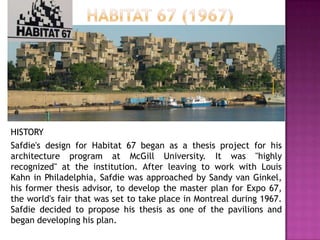
Safdie's design for Habitat 67 began as a thesis project for his
architecture program at McGill University. It was "highly
recognized" at the institution. After leaving to work with Louis
Kahn in Philadelphia, Safdie was approached by Sandy van Ginkel,
his former thesis advisor, to develop the master plan for Expo 67,
the world's fair that was set to take place in Montreal during 1967.
Safdie decided to propose his thesis as one of the pavilions and
began developing his plan.
CONCEPT AND DESIGN
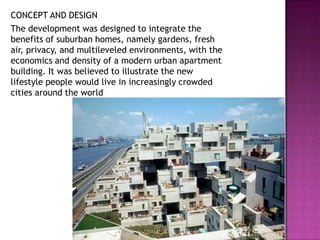
The development was designed to integrate the
benefits of suburban homes, namely gardens, fresh
air, privacy, and multileveled environments, with the
economics and density of a modern urban apartment
building. It was believed to illustrate the new
lifestyle people would live in increasingly crowded
cities around the world
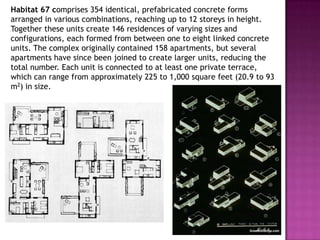
Habitat 67 comprises 354 identical, prefabricated concrete forms
arranged in various combinations, reaching up to 12 storeys in height.
Together these units create 146 residences of varying sizes and
configurations, each formed from between one to eight linked concrete
units. The complex originally contained 158 apartments, but several
apartments have since been joined to create larger units, reducing the
total number. Each unit is connected to at least one private terrace,
which can range from approximately 225 to 1,000 square feet (20.9 to 93
m2) in size.
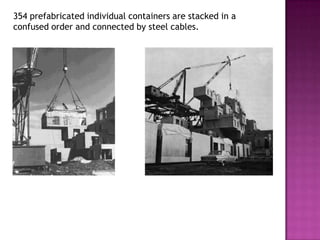
354 prefabricated individual containers are stacked in a
confused order and connected by steel cables.
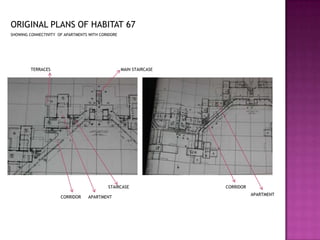
ORIGINAL PLANS OF HABITAT 67
SHOWING CONNECTIVITY OF APARTMENTS WITH CORIDORE

TERRACES

MAIN STAIRCASE

STAIRCASE
CORRIDOR

APARTMENT

CORRIDOR
APARTMENT
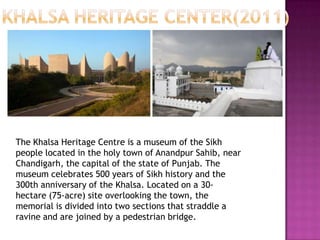
The Khalsa Heritage Centre is a museum of the Sikh
people located in the holy town of Anandpur Sahib, near
Chandigarh, the capital of the state of Punjab. The
museum celebrates 500 years of Sikh history and the
300th anniversary of the Khalsa. Located on a 30hectare (75-acre) site overlooking the town, the
memorial is divided into two sections that straddle a
ravine and are joined by a pedestrian bridge.
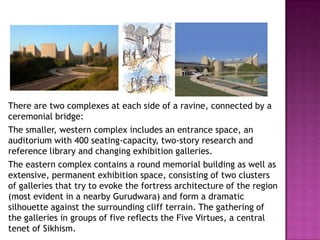
There are two complexes at each side of a ravine, connected by a
ceremonial bridge:
The smaller, western complex includes an entrance space, an
auditorium with 400 seating-capacity, two-story research and
reference library and changing exhibition galleries.
The eastern complex contains a round memorial building as well as
extensive, permanent exhibition space, consisting of two clusters
of galleries that try to evoke the fortress architecture of the region
(most evident in a nearby Gurudwara) and form a dramatic
silhouette against the surrounding cliff terrain. The gathering of
the galleries in groups of five reflects the Five Virtues, a central
tenet of Sikhism.
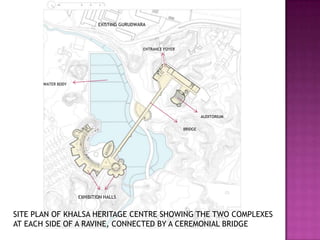
EXISTING GURUDWARA

ENTRANCE FOYER

WATER BODY

AUDITORIUM
BRIDGE

EXHIBITION HALLS

SITE PLAN OF KHALSA HERITAGE CENTRE SHOWING THE TWO COMPLEXES
AT EACH SIDE OF A RAVINE, CONNECTED BY A CEREMONIAL BRIDGE
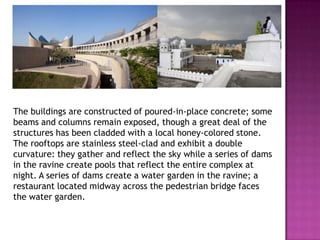
The buildings are constructed of poured-in-place concrete; some
beams and columns remain exposed, though a great deal of the
structures has been cladded with a local honey-colored stone.
The rooftops are stainless steel-clad and exhibit a double
curvature: they gather and reflect the sky while a series of dams
in the ravine create pools that reflect the entire complex at
night. A series of dams create a water garden in the ravine; a
restaurant located midway across the pedestrian bridge faces
the water garden.
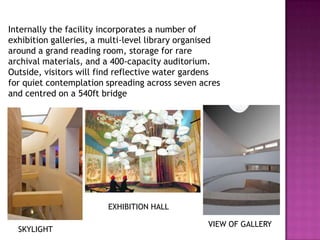
Internally the facility incorporates a number of
exhibition galleries, a multi-level library organised
around a grand reading room, storage for rare
archival materials, and a 400-capacity auditorium.
Outside, visitors will find reflective water gardens
for quiet contemplation spreading across seven acres
and centred on a 540ft bridge

EXHIBITION HALL
SKYLIGHT

VIEW OF GALLERY
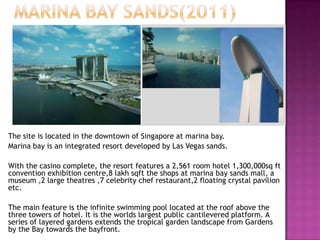
The site is located in the downtown of Singapore at marina bay.
Marina bay is an integrated resort developed by Las Vegas sands.
With the casino complete, the resort features a 2,561 room hotel 1,300,000sq ft
convention exhibition centre,8 lakh sqft the shops at marina bay sands mall, a
museum ,2 large theatres ,7 celebrity chef restaurant,2 floating crystal pavilion
etc.
The main feature is the infinite swimming pool located at the roof above the
three towers of hotel. It is the worlds largest public cantilevered platform. A
series of layered gardens extends the tropical garden landscape from Gardens
by the Bay towards the bayfront.
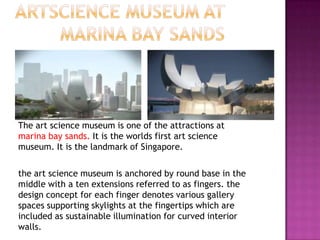
The art science museum is one of the attractions at
marina bay sands. It is the worlds first art science
museum. It is the landmark of Singapore.
the art science museum is anchored by round base in the
middle with a ten extensions referred to as fingers. the
design concept for each finger denotes various gallery
spaces supporting skylights at the fingertips which are
included as sustainable illumination for curved interior
walls.
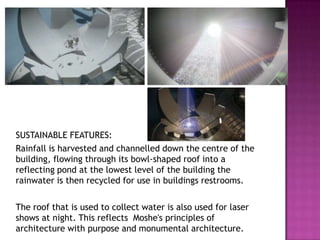
SUSTAINABLE FEATURES:
Rainfall is harvested and channelled down the centre of the
building, flowing through its bowl-shaped roof into a
reflecting pond at the lowest level of the building the
rainwater is then recycled for use in buildings restrooms.
The roof that is used to collect water is also used for laser
shows at night. This reflects Moshe's principles of
architecture with purpose and monumental architecture.
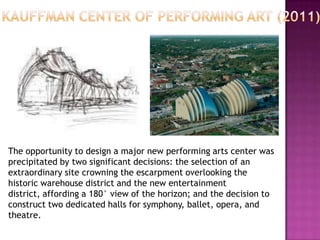
The opportunity to design a major new performing arts center was
precipitated by two significant decisions: the selection of an
extraordinary site crowning the escarpment overlooking the
historic warehouse district and the new entertainment
district, affording a 180° view of the horizon; and the decision to
construct two dedicated halls for symphony, ballet, opera, and
theatre.
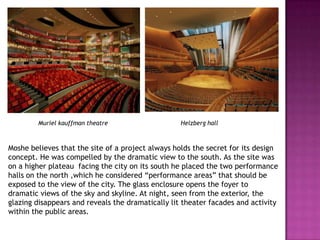
Muriel kauffman theatre

Helzberg hall

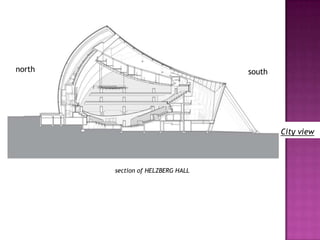
Moshe believes that the site of a project always holds the secret for its design
concept. He was compelled by the dramatic view to the south. As the site was
on a higher plateau facing the city on its south he placed the two performance
halls on the north ,which he considered “performance areas” that should be
exposed to the view of the city. The glass enclosure opens the foyer to
dramatic views of the sky and skyline. At night, seen from the exterior, the
glazing disappears and reveals the dramatically lit theater facades and activity
within the public areas.
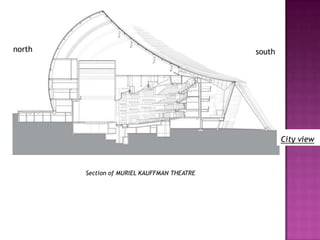
north

south

City view

Section of MURIEL KAUFFMAN THEATRE
north

south

City view

section of HELZBERG HALL
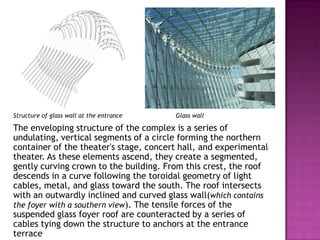
Structure of glass wall at the entrance

Glass wall

The enveloping structure of the complex is a series of
undulating, vertical segments of a circle forming the northern
container of the theater's stage, concert hall, and experimental
theater. As these elements ascend, they create a segmented,
gently curving crown to the building. From this crest, the roof
descends in a curve following the toroidal geometry of light
cables, metal, and glass toward the south. The roof intersects
with an outwardly inclined and curved glass wall(which contains
the foyer with a southern view). The tensile forces of the
suspended glass foyer roof are counteracted by a series of
cables tying down the structure to anchors at the entrance
terrace
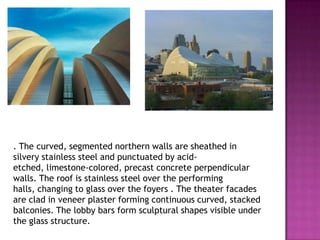
. The curved, segmented northern walls are sheathed in
silvery stainless steel and punctuated by acidetched, limestone-colored, precast concrete perpendicular
walls. The roof is stainless steel over the performing
halls, changing to glass over the foyers . The theater facades
are clad in veneer plaster forming continuous curved, stacked
balconies. The lobby bars form sculptural shapes visible under
the glass structure.
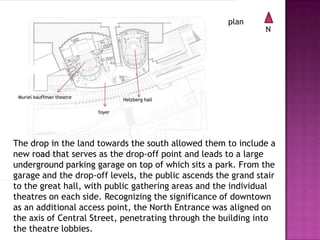
plan

Muriel kauffman theatre

N

Helzberg hall
foyer

The drop in the land towards the south allowed them to include a
new road that serves as the drop-off point and leads to a large
underground parking garage on top of which sits a park. From the
garage and the drop-off levels, the public ascends the grand stair
to the great hall, with public gathering areas and the individual
theatres on each side. Recognizing the significance of downtown
as an additional access point, the North Entrance was aligned on
the axis of Central Street, penetrating through the building into
the theatre lobbies.
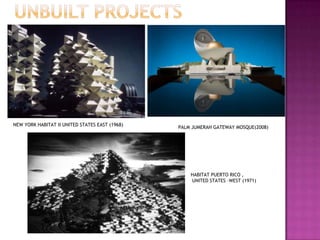
NEW YORK HABITAT II UNITED STATES EAST (1968)

PALM JUMERAH GATEWAY MOSQUE(2008)

HABITAT PUERTO RICO ,
UNITED STATES –WEST (1971)
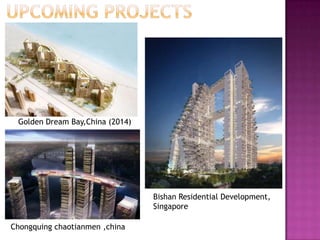
Golden Dream Bay,China (2014)

Bishan Residential Development,
Singapore
Chongquing chaotianmen ,china
Moshe safdie

Moshe safdie

  • 1.
  • 2.
    Moshe Safdie isan architect, urban planner, educator, theorist, and author. Embracing a comprehensive and humane design philosophy, Safdie is committed to architecture that supports and enhances a project‟s program; that is informed by the geographic, social, and cultural elements that define a place; and that responds to human needs and aspirations. Safdie has completed a wide range of projects, such as cultural, educational, and civic institutions; neighbourhoods and public parks; mixed-use urban centres and airports; and master plans for existing communities and entirely new cities around the world.
  • 3.
    Born in Haifa,Israel, in 1938, Safdie moved to Canada with his family at the age of 15. He graduated from McGill University in 1961 with a degree in architecture. After apprenticing with Louis I. Kahn in Philadelphia, Safdie returned to Montreal to oversee the master plan for the 1967 World Exhibition. In 1964 he established his own firm to realize Habitat „67, an adaptation of his thesis at McGill, which was the central feature of the World‟s Fair and a groundbreaking design in the history of architecture. PRINCIPLES OF MOSHE 1.Shaping the public realm 2.Architecture with purpose 3.Responding to the essence of place 4.Architecture that is buildable 5.Building responsibly 6.Humanizing the mega scale Sketch of habitat 67 by Moshe
  • 4.
    HISTORY Safdie's design forHabitat 67 began as a thesis project for his architecture program at McGill University. It was "highly recognized" at the institution. After leaving to work with Louis Kahn in Philadelphia, Safdie was approached by Sandy van Ginkel, his former thesis advisor, to develop the master plan for Expo 67, the world's fair that was set to take place in Montreal during 1967. Safdie decided to propose his thesis as one of the pavilions and began developing his plan.
  • 5.
    CONCEPT AND DESIGN Thedevelopment was designed to integrate the benefits of suburban homes, namely gardens, fresh air, privacy, and multileveled environments, with the economics and density of a modern urban apartment building. It was believed to illustrate the new lifestyle people would live in increasingly crowded cities around the world
  • 6.
    Habitat 67 comprises354 identical, prefabricated concrete forms arranged in various combinations, reaching up to 12 storeys in height. Together these units create 146 residences of varying sizes and configurations, each formed from between one to eight linked concrete units. The complex originally contained 158 apartments, but several apartments have since been joined to create larger units, reducing the total number. Each unit is connected to at least one private terrace, which can range from approximately 225 to 1,000 square feet (20.9 to 93 m2) in size.
  • 7.
    354 prefabricated individualcontainers are stacked in a confused order and connected by steel cables.
  • 8.
    ORIGINAL PLANS OFHABITAT 67 SHOWING CONNECTIVITY OF APARTMENTS WITH CORIDORE TERRACES MAIN STAIRCASE STAIRCASE CORRIDOR APARTMENT CORRIDOR APARTMENT
  • 9.
    The Khalsa HeritageCentre is a museum of the Sikh people located in the holy town of Anandpur Sahib, near Chandigarh, the capital of the state of Punjab. The museum celebrates 500 years of Sikh history and the 300th anniversary of the Khalsa. Located on a 30hectare (75-acre) site overlooking the town, the memorial is divided into two sections that straddle a ravine and are joined by a pedestrian bridge.
  • 10.
    There are twocomplexes at each side of a ravine, connected by a ceremonial bridge: The smaller, western complex includes an entrance space, an auditorium with 400 seating-capacity, two-story research and reference library and changing exhibition galleries. The eastern complex contains a round memorial building as well as extensive, permanent exhibition space, consisting of two clusters of galleries that try to evoke the fortress architecture of the region (most evident in a nearby Gurudwara) and form a dramatic silhouette against the surrounding cliff terrain. The gathering of the galleries in groups of five reflects the Five Virtues, a central tenet of Sikhism.
  • 11.
    EXISTING GURUDWARA ENTRANCE FOYER WATERBODY AUDITORIUM BRIDGE EXHIBITION HALLS SITE PLAN OF KHALSA HERITAGE CENTRE SHOWING THE TWO COMPLEXES AT EACH SIDE OF A RAVINE, CONNECTED BY A CEREMONIAL BRIDGE
  • 12.
    The buildings areconstructed of poured-in-place concrete; some beams and columns remain exposed, though a great deal of the structures has been cladded with a local honey-colored stone. The rooftops are stainless steel-clad and exhibit a double curvature: they gather and reflect the sky while a series of dams in the ravine create pools that reflect the entire complex at night. A series of dams create a water garden in the ravine; a restaurant located midway across the pedestrian bridge faces the water garden.
  • 13.
    Internally the facilityincorporates a number of exhibition galleries, a multi-level library organised around a grand reading room, storage for rare archival materials, and a 400-capacity auditorium. Outside, visitors will find reflective water gardens for quiet contemplation spreading across seven acres and centred on a 540ft bridge EXHIBITION HALL SKYLIGHT VIEW OF GALLERY
  • 14.
    The site islocated in the downtown of Singapore at marina bay. Marina bay is an integrated resort developed by Las Vegas sands. With the casino complete, the resort features a 2,561 room hotel 1,300,000sq ft convention exhibition centre,8 lakh sqft the shops at marina bay sands mall, a museum ,2 large theatres ,7 celebrity chef restaurant,2 floating crystal pavilion etc. The main feature is the infinite swimming pool located at the roof above the three towers of hotel. It is the worlds largest public cantilevered platform. A series of layered gardens extends the tropical garden landscape from Gardens by the Bay towards the bayfront.
  • 15.
    The art sciencemuseum is one of the attractions at marina bay sands. It is the worlds first art science museum. It is the landmark of Singapore. the art science museum is anchored by round base in the middle with a ten extensions referred to as fingers. the design concept for each finger denotes various gallery spaces supporting skylights at the fingertips which are included as sustainable illumination for curved interior walls.
  • 16.
    SUSTAINABLE FEATURES: Rainfall isharvested and channelled down the centre of the building, flowing through its bowl-shaped roof into a reflecting pond at the lowest level of the building the rainwater is then recycled for use in buildings restrooms. The roof that is used to collect water is also used for laser shows at night. This reflects Moshe's principles of architecture with purpose and monumental architecture.
  • 17.
    The opportunity todesign a major new performing arts center was precipitated by two significant decisions: the selection of an extraordinary site crowning the escarpment overlooking the historic warehouse district and the new entertainment district, affording a 180° view of the horizon; and the decision to construct two dedicated halls for symphony, ballet, opera, and theatre.
  • 18.
    Muriel kauffman theatre Helzberghall Moshe believes that the site of a project always holds the secret for its design concept. He was compelled by the dramatic view to the south. As the site was on a higher plateau facing the city on its south he placed the two performance halls on the north ,which he considered “performance areas” that should be exposed to the view of the city. The glass enclosure opens the foyer to dramatic views of the sky and skyline. At night, seen from the exterior, the glazing disappears and reveals the dramatically lit theater facades and activity within the public areas.
  • 19.
    north south City view Section ofMURIEL KAUFFMAN THEATRE
  • 20.
  • 21.
    Structure of glasswall at the entrance Glass wall The enveloping structure of the complex is a series of undulating, vertical segments of a circle forming the northern container of the theater's stage, concert hall, and experimental theater. As these elements ascend, they create a segmented, gently curving crown to the building. From this crest, the roof descends in a curve following the toroidal geometry of light cables, metal, and glass toward the south. The roof intersects with an outwardly inclined and curved glass wall(which contains the foyer with a southern view). The tensile forces of the suspended glass foyer roof are counteracted by a series of cables tying down the structure to anchors at the entrance terrace
  • 22.
    . The curved,segmented northern walls are sheathed in silvery stainless steel and punctuated by acidetched, limestone-colored, precast concrete perpendicular walls. The roof is stainless steel over the performing halls, changing to glass over the foyers . The theater facades are clad in veneer plaster forming continuous curved, stacked balconies. The lobby bars form sculptural shapes visible under the glass structure.
  • 23.
    plan Muriel kauffman theatre N Helzberghall foyer The drop in the land towards the south allowed them to include a new road that serves as the drop-off point and leads to a large underground parking garage on top of which sits a park. From the garage and the drop-off levels, the public ascends the grand stair to the great hall, with public gathering areas and the individual theatres on each side. Recognizing the significance of downtown as an additional access point, the North Entrance was aligned on the axis of Central Street, penetrating through the building into the theatre lobbies.
  • 24.
    NEW YORK HABITATII UNITED STATES EAST (1968) PALM JUMERAH GATEWAY MOSQUE(2008) HABITAT PUERTO RICO , UNITED STATES –WEST (1971)
  • 25.
    Golden Dream Bay,China(2014) Bishan Residential Development, Singapore Chongquing chaotianmen ,china