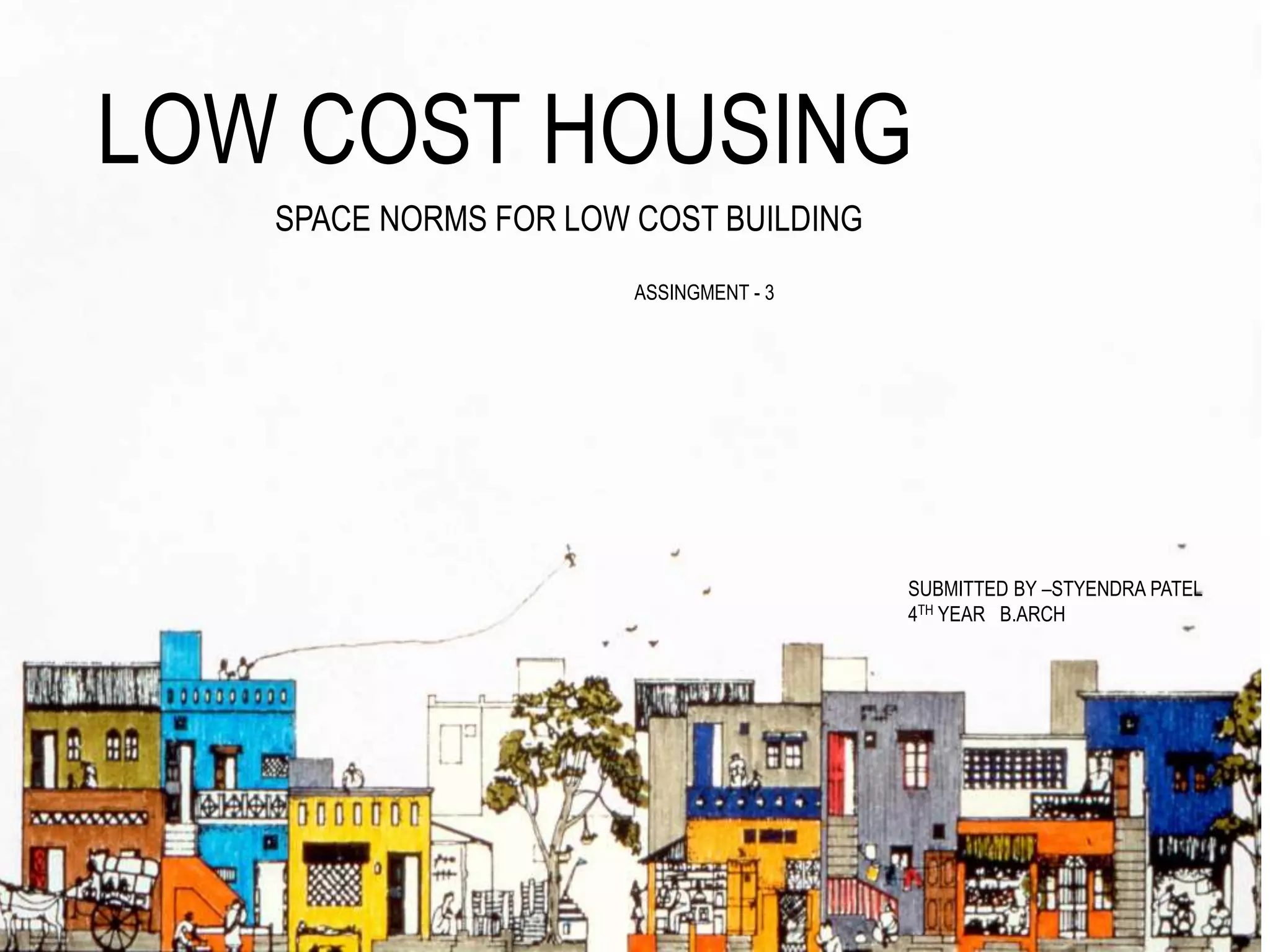
SPACE NORMS FOR LOW COST BUILDING
LOW COST HOUSING
ASSINGMENT - 3
SUBMITTED BY –STYENDRA PATEL
4TH YEAR B.ARCH
INTRODUCTION
Residential housing is the basic need of the civilized living. Despite various efforts to solve the housing problem, there is
an increasing gap between the supply and the demand for the housing. Millions of people of our country, either have no
place to live or living under highly unhygienic, inhuman conditions and deprivations. Overcrowding, lack of privacy,
total absence of adequate & basic amenities, use of substandard building materials and unhygienic surroundings
dominates the scene of settlements. This chapter includes the various issues relating to housing with reference to standard
housing norms. Standard housing means the adequate housing which is defined as per the norms of “UNITED NATIONS
CENTRE FOR HUMAN SETTLEMENT” (UNCHS) in particular. The housing scenario in Assam vis-a vis India shown
and discussed in this chapter in general.
1. Different concepts on Housing
The housing in different terms appears to be similar in meaning even though there may be considerable differences
among them. Therefore, it is relevant to define these commonly used terms in today’s context; HOUSE In the context of
planning, ‘House’ means a building for human habitation. It can take many forms from a mud-hut with single room to
palace with 500 rooms. For modem planning, the majority of houses are either one, two or three storied single family
dwellings and are either detached, semi-detached or terraced. 16 Except in housing statistics, the term ‘House’ is not
usually applied to single family dwellings in multi-storied buildings. These are rather called ‘Apartments' in USA and
most European Countries and ‘Flats’ in Great Britain,
(Ref: Whit tick A, - Encyclopedia o f Urban Planning 1974)
The term ‘Housing’ refers to a package of services : land, public facilities, access to employment and to other social
services, as well as to the dwelling structure itself. Access, space, tenure, on-site services and shelter are the attributes
which combine to define housing. Access refers to contact with employment and income generating opportunities, with
off-site services such as health and education and with the community. Space determines agriculture, commercial and
recreational activities as well as privacy. The attributes of tenure have two dimensions - security of tenure and ownership
rights. Security of tenure gives protection from being evicted.
HOUSING
It encourages low income households to maintain and improve their shelter. And ownership rights include such benefits as
the ability to let out all or part of the lot or house, the right to carry out commercial activities and to benefit from any
increase in property value. On-site services include water and energy supply, waste disposal drainage and protection from
fires and rains. Housing provides protection from the hazardous elements and offers privacy, conveniences, domestic living
space and aesthetic pleasure. It may also provide an opportunity to earn an income by renting. (Ref: Richards P.J. and
Thomson A.M.-Basic Needs the Urban Poor: London) HOME : It refers to a dwelling , a house or an apartment, that is the
fixed residence of a person and a family or household in an accustomed or familiar neighborhood.
Household refers to the group of persons who dwell under the same roof but they need not necessarily comprise a family.
The persons who share a common kitchen in a house represent one household according to the census definition.
HOUSEHOLD :-
In relation to a building or a portion of a building , a dwelling unit means a unit of accommodation, in such building or
portion used solely for the purpose of residence as defined in the urban Land (Ceiling and Regulations ) Act, 1976.
CONCEPT OF A HOUSE : The concept of a house has never remained constant. Over the times, it has been viewed and
conceived in different ways. It is relevant to refer as to how it has been looked at by Census Reports
DWELLING UNIT :
1.Census Definition:
1881- The dwelling place of one or more families with their servants, having a separate principal entrance from the
Public way.
1891 -The dwelling place of one or more families with their resident servants, having a separate principal entrance from
the common way. OR
1892 -‘House’ consists of the buildings, one or many, inhabited by one family
1901- The dwelling place of one or more families having a separate principal entrance from the common way. OR
‘House’ consists of the buildings, one or many, inhabited by one family..
1911- The residence of one or more families having a separate independent entrance from the common way. OR ‘House’
is defined as consisting of the buildings, one or many, inhabited by one or many or inhabited by one family.
1921 -The residence of one or more families having a separate entrance from the common way. OR ‘House’ is the
building or part of a building occupied by one family.
1931 – “House’ is defined as consisting of the building, one or many, inhabited by one family
Every dwelling with a separate main entrance. OR ‘Census House’ means the dwelling place of single commercial family.
1951 ‘Census House’ is a dwelling house with a separate main entrance. Explanation: A ‘House’ is structure while a
‘Household’ is a human group.
1961 ‘Census House’ is a structure or part of structure inhabited or vacant or a dwelling, a shop, a shop-cum-dwelling or a
place of business, workshop, school .
Housing is a basic Human Right:
1. The right to adequate housing is one of the economic, social and cultural rights to have gained increasing
attention and promotion among the human rights bodies.
2. For instance, Article 11(1) of the International Covenant on Economic, Social and Cultural Rights (CESCR)
recognizes, the right of everyone to “an adequate standard of living for himself and his family, including food, clothing
and housing, and the continuous improvement of living conditions”.3
3. The United Nation Centre in Human Settlement (habitat) estimates that throughout World, over one billion
people live in inadequate housing, with an excess of 100 million people living in conditions classified as homelessness'.4
Concept of Adequate Housing:
Adequate housing refers to adequate privacy, adequate space, adequate security, adequate lighting and
ventilation, adequate basic infrastructure and adequate location with regards to work and basic facilities all at
reasonable cost.
It is an extremely difficult thing for a Government to make housing available to all it’s citizens. 'The Centre for
Housing Rights and Evictions, an affiliate of Habitat
International Coalition (HIC), a Netherland based Centre has sought to address this issue on the occasion of the World
Habitat Day (WHD) in 1994, by emphasizing that housing rights have more to do with political will than with the
logistics o f actually providing housing to people",5
The Centre says that while the physical structure of the house, the infrastructural facilities around it and
security o f tenure are important issues, they are largely dependent on some conditions, which has to be made possible
by the Government.
It is true that economic factors play a large part in determining whether or not housing rights are realized. Rates
o f inflation, interest rates, structural readjustment
Definition of Adequate Housing:
UNCHS (habitat) Nairobi has defined clearly about an adequate house. Further Director, (Housing) Ministry of
Urban Development and Director, National Building Organization has referred and explained the same on occasion of
World Habitat Day (WHD) .
Year Population (in million)
Rural Urban Total Growth rate in
urban areas in
%
1 2 3 4 5 (3/4X100)
1901 212.54 25.85 238.39 10.84
1941 274.50 44.15 318.66 13.86
1951 298.64 62.44 361.08 17.29
1961 360.29 78.93 438.23 21.37
1971 439.04 109.11 548.15 19.91
1981 523.86 159.46 683.32 23.34
1991 628.69 217.61 846.30 25.72
2001 703.20 318.90 1022.01 31.20
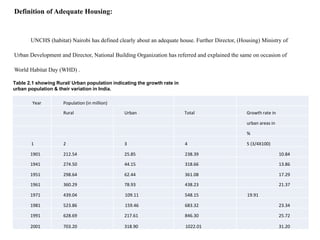
Table 2.1 showing Rural/ Urban population indicating the growth rate in
urban population & their variation in India.
Housing Stock in India:
The housing stock in India in 1991 was 147 million units. In the Rural areas, the stock was 107.9 million units,
which was 42.7 million units higher than the level obtaining in 1961. In the urban areas the stock increased by 25
million units during the same period, reaching a figure of 39.1 million units by 1991.The total increase in housing
stock of 67.7 million units during the period 1961-1991, fell just short of the increase in number of households of
68.5 million units. In monetized terms the value of National housing stock aggregate to Rs.32.58 billion with rural
housing accounting to 49.5% of the total housing wealth in the country. Thus during this period the total housing
effort (private and public put together) just kept pace with the increase in the number of households and could not
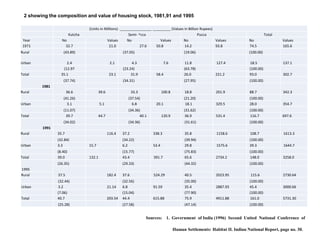
make a dent on the backlog. As per the National report, the estimated housing stock was presented for 1971, 1981
and 1995 in three categories of housing typology, namely Kutcha, Semi-pucca and Pucca. The estimates for the
rural and urban components of housing market are presented and shown in the Table 2.2. It includes the physical
inventory of housing stock and their financial value. The housing sector has, on the average, contributed 10-12 P/c
annual gross capital formation in the country and income from housing in GDP has averaged 5 percent.
(Units in Millions) ________________ _________ (Values in Billion Rupees)
Kutcha Semi- ^cca Pucca Total
Year No Values No Values No Values No Values
1971 32.7 21.0 27.6 50.8 14.2 93.8 74.5 165.6
Rural (43.89) (37.05) (19.06) (100.00)
Urban 2.4 2.1 4.3 7.6 11.8 127.4 18.5 137.1
(12.97 (23.24) (63.78) (100.00)
302.7Total 35.1 23.1 31.9 58.4 26.0 221.2 93.0
1981
(37.74) (34.31) (27.95) (100.00)
36.6 18.8 201.9 88.7 342.3Rural 39.6 33.3 100.8
(41.26) (37.54) (21.20) (100.00)
354.7Urban 3.1 5.1 6.8 20.1 18.1 329.5 28.0
(11.07) (34.36) (31.62) (100.00)
Total 39.7 44.7 40.1 120.9 36.9 531.4 116.7 697.6
1991
(34.02) (34.36) (31.61) (100.00)
108.7 1613.3Rural 35.7 116.4 37.2 338.3 35.8 1158.6
(32.84) (34.22) (39.94) (100.00)
1644.7Urban 3.3 15.7 6.2 53.4 29.8 1575.6 39.3
(8.40) (15.77) (75.83) (100.00)
Total 39.0 132.1 43.4 391.7 65.6 2734.2 148.0 3258.0
1995
(26.35) (29.33) (44.32) (100.00)
37.5 182.4 524.29 2023.95 115.6 2730.64Rural 37.6 40.5
(32.44) (32.56) (35.00) (100.00)
Urban 3.2 21.14 6.8 91.59 35.4 2887.93 45.4 3000.66
(7.06) (15.04) (77.90) (100.00)
Total 40.7 203.54 44.4 615.88 75.9 4911.88 161.0 5731.30
(25.28) (27.58) (47.14) (100.00)
2 showing the composition and value of housing stock, 1981,91 and 1995
Sources: 1. Government of India (1996) Second United National Conference of
Human Settlements: Habitat II. Indian National Report, page no. 30.
Housing Shortage in India
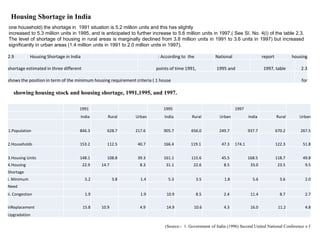
2.9 Housing Shortage in India : According to the National report housing
shortage estimated in three different points of time 1991, 1995 and 1997, table 2.3
shows the position in term of the minimum housing requirement criteria ( 1 house for
one household) the shortage in 1991 situation is 5.2 million units and this has slightly
increased to 5.3 million units in 1995, and is anticipated to further increase to 5.6 million units in 1997.( See SI. No. 4(i) of the table 2.3.
The level of shortage of housing in rural areas is marginally declined from 3.8 million units in 1991 to 3.6 units in 1997) but increased
significantly in urban areas (1.4 million units in 1991 to 2.0 million units in 1997).
showing housing stock and housing shortage, 1991,1995, and 1997.
1991 1995 1997
UrbanIndia Rural Urban India Rural Urban India Rural
1.Population 846.3 628.7 217.6 905.7 656.0 249.7 937.7 670.2 267.5
2.Households 153.2 112.5 40.7 166.4 119.1 47.3 174.1 122.3 51.8
3.Housing Units 148.1 108.8 39.3 161.1 115.6 45.5 168.5 118.7 49.8
4.Housing 22.9 14.7 8.3 31.1 22.6 8.5 33.0 23.5 9.5
Shortage
i. Minimum 5.2 3.8 1.4 5.3 3.5 1.8 5.6 3.6 2.0
Need
ii. Congestion 1.9 - 1.9 10.9 8.5 2.4 11.4 8.7 2.7
iiiReplacement 15.8 10.9 4.9 14.9 10.6 4.3 16.0 11.2 4.8
Upgradation
(Source:- 1. Government of India (1996) Second United National Conference o f
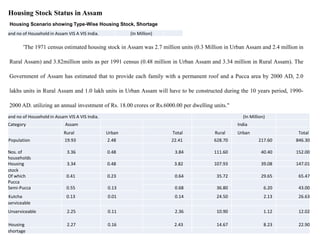
and no of Household in Assam VIS A VIS India. (In Million)
Housing Scenario showing Type-Wise Housing Stock, Shortage
Housing Stock Status in Assam
'The 1971 census estimated housing stock in Assam was 2.7 million units (0.3 Million in Urban Assam and 2.4 million in
Rural Assam) and 3.82million units as per 1991 census (0.48 million in Urban Assam and 3.34 million in Rural Assam). The
Government of Assam has estimated that to provide each family with a permanent roof and a Pucca area by 2000 AD, 2.0
lakhs units in Rural Assam and 1.0 lakh units in Urban Assam will have to be constructed during the 10 years period, 1990-
2000 AD. utilizing an annual investment of Rs. 18.00 crores or Rs.6000.00 per dwelling units."
and no of Household in Assam VIS A VIS India. (In Million)
Category Assam India
Rural Urban Total Rural Urban Total
Population 19.93 2.48 22.41 628.70 217.60 846.30
Nos. of 3.36 0.48 3.84 111.60 40.40 152.00
households
Housing 3.34 0.48 3.82 107.93 39.08 147.01
stock
65.47Of which 0.41 0.23 0.64 35.72 29.65
Pucca
0.55 0.13 6.20 43.00Semi-Pucca 0.68 36.80
Kutcha 0.13 0.01 0.14 24.50 2.13 26.63
serviceable
Unserviceable 2.25 0.11 2.36 10.90 1.12 12.02
Housing 2.27 0.16 2.43 14.67 8.23 22.90
shortage
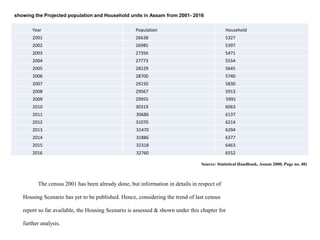
showing the Projected population and Household units in Assam from 2001- 2016
Year Population Household
2001 26638 5327
2002 26985 5397
2003 27356 5471
2004 27773 5554
2005 28229 5645
2006 28700 5740
2007 29150 5830
2008 29567 5913
2009 29955 5991
2010 30319 6063
2011 30686 6137
2012 31070 6214
2013 31470 6294
2014 31886 6377
2015 32318 6463
2016 32760 6552
The census 2001 has been already done, but information in details in respect of
Housing Scenario has yet to be published. Hence, considering the trend of last census
report so far available, the Housing Scenario is assessed & shown under this chapter for
further analysis.
Source: Statistical Handbook, Assam 2000, Page no. 40)
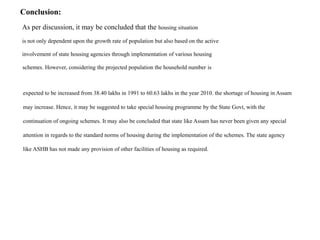
Conclusion:
As per discussion, it may be concluded that the housing situation
is not only dependent upon the growth rate of population but also based on the active
involvement of state housing agencies through implementation of various housing
schemes. However, considering the projected population the household number is
expected to be increased from 38.40 lakhs in 1991 to 60.63 lakhs in the year 2010. the shortage of housing in Assam
may increase. Hence, it may be suggested to take special housing programme by the State Govt, with the
continuation of ongoing schemes. It may also be concluded that state like Assam has never been given any special
attention in regards to the standard norms of housing during the implementation of the schemes. The state agency
like ASHB has not made any provision of other facilities of housing as required.

Space norms for low cost building

  • 1.
    SPACE NORMS FORLOW COST BUILDING LOW COST HOUSING ASSINGMENT - 3 SUBMITTED BY –STYENDRA PATEL 4TH YEAR B.ARCH
  • 2.
    INTRODUCTION Residential housing isthe basic need of the civilized living. Despite various efforts to solve the housing problem, there is an increasing gap between the supply and the demand for the housing. Millions of people of our country, either have no place to live or living under highly unhygienic, inhuman conditions and deprivations. Overcrowding, lack of privacy, total absence of adequate & basic amenities, use of substandard building materials and unhygienic surroundings dominates the scene of settlements. This chapter includes the various issues relating to housing with reference to standard housing norms. Standard housing means the adequate housing which is defined as per the norms of “UNITED NATIONS CENTRE FOR HUMAN SETTLEMENT” (UNCHS) in particular. The housing scenario in Assam vis-a vis India shown and discussed in this chapter in general. 1. Different concepts on Housing The housing in different terms appears to be similar in meaning even though there may be considerable differences among them. Therefore, it is relevant to define these commonly used terms in today’s context; HOUSE In the context of planning, ‘House’ means a building for human habitation. It can take many forms from a mud-hut with single room to palace with 500 rooms. For modem planning, the majority of houses are either one, two or three storied single family dwellings and are either detached, semi-detached or terraced. 16 Except in housing statistics, the term ‘House’ is not usually applied to single family dwellings in multi-storied buildings. These are rather called ‘Apartments' in USA and most European Countries and ‘Flats’ in Great Britain, (Ref: Whit tick A, - Encyclopedia o f Urban Planning 1974) The term ‘Housing’ refers to a package of services : land, public facilities, access to employment and to other social services, as well as to the dwelling structure itself. Access, space, tenure, on-site services and shelter are the attributes which combine to define housing. Access refers to contact with employment and income generating opportunities, with off-site services such as health and education and with the community. Space determines agriculture, commercial and recreational activities as well as privacy. The attributes of tenure have two dimensions - security of tenure and ownership rights. Security of tenure gives protection from being evicted. HOUSING
  • 3.
    It encourages lowincome households to maintain and improve their shelter. And ownership rights include such benefits as the ability to let out all or part of the lot or house, the right to carry out commercial activities and to benefit from any increase in property value. On-site services include water and energy supply, waste disposal drainage and protection from fires and rains. Housing provides protection from the hazardous elements and offers privacy, conveniences, domestic living space and aesthetic pleasure. It may also provide an opportunity to earn an income by renting. (Ref: Richards P.J. and Thomson A.M.-Basic Needs the Urban Poor: London) HOME : It refers to a dwelling , a house or an apartment, that is the fixed residence of a person and a family or household in an accustomed or familiar neighborhood. Household refers to the group of persons who dwell under the same roof but they need not necessarily comprise a family. The persons who share a common kitchen in a house represent one household according to the census definition. HOUSEHOLD :- In relation to a building or a portion of a building , a dwelling unit means a unit of accommodation, in such building or portion used solely for the purpose of residence as defined in the urban Land (Ceiling and Regulations ) Act, 1976. CONCEPT OF A HOUSE : The concept of a house has never remained constant. Over the times, it has been viewed and conceived in different ways. It is relevant to refer as to how it has been looked at by Census Reports DWELLING UNIT : 1.Census Definition: 1881- The dwelling place of one or more families with their servants, having a separate principal entrance from the Public way. 1891 -The dwelling place of one or more families with their resident servants, having a separate principal entrance from the common way. OR 1892 -‘House’ consists of the buildings, one or many, inhabited by one family 1901- The dwelling place of one or more families having a separate principal entrance from the common way. OR ‘House’ consists of the buildings, one or many, inhabited by one family..
  • 4.
    1911- The residenceof one or more families having a separate independent entrance from the common way. OR ‘House’ is defined as consisting of the buildings, one or many, inhabited by one or many or inhabited by one family. 1921 -The residence of one or more families having a separate entrance from the common way. OR ‘House’ is the building or part of a building occupied by one family. 1931 – “House’ is defined as consisting of the building, one or many, inhabited by one family Every dwelling with a separate main entrance. OR ‘Census House’ means the dwelling place of single commercial family. 1951 ‘Census House’ is a dwelling house with a separate main entrance. Explanation: A ‘House’ is structure while a ‘Household’ is a human group. 1961 ‘Census House’ is a structure or part of structure inhabited or vacant or a dwelling, a shop, a shop-cum-dwelling or a place of business, workshop, school . Housing is a basic Human Right: 1. The right to adequate housing is one of the economic, social and cultural rights to have gained increasing attention and promotion among the human rights bodies. 2. For instance, Article 11(1) of the International Covenant on Economic, Social and Cultural Rights (CESCR) recognizes, the right of everyone to “an adequate standard of living for himself and his family, including food, clothing and housing, and the continuous improvement of living conditions”.3 3. The United Nation Centre in Human Settlement (habitat) estimates that throughout World, over one billion people live in inadequate housing, with an excess of 100 million people living in conditions classified as homelessness'.4
  • 5.
    Concept of AdequateHousing: Adequate housing refers to adequate privacy, adequate space, adequate security, adequate lighting and ventilation, adequate basic infrastructure and adequate location with regards to work and basic facilities all at reasonable cost. It is an extremely difficult thing for a Government to make housing available to all it’s citizens. 'The Centre for Housing Rights and Evictions, an affiliate of Habitat International Coalition (HIC), a Netherland based Centre has sought to address this issue on the occasion of the World Habitat Day (WHD) in 1994, by emphasizing that housing rights have more to do with political will than with the logistics o f actually providing housing to people",5 The Centre says that while the physical structure of the house, the infrastructural facilities around it and security o f tenure are important issues, they are largely dependent on some conditions, which has to be made possible by the Government. It is true that economic factors play a large part in determining whether or not housing rights are realized. Rates o f inflation, interest rates, structural readjustment
  • 6.
    Definition of AdequateHousing: UNCHS (habitat) Nairobi has defined clearly about an adequate house. Further Director, (Housing) Ministry of Urban Development and Director, National Building Organization has referred and explained the same on occasion of World Habitat Day (WHD) . Year Population (in million) Rural Urban Total Growth rate in urban areas in % 1 2 3 4 5 (3/4X100) 1901 212.54 25.85 238.39 10.84 1941 274.50 44.15 318.66 13.86 1951 298.64 62.44 361.08 17.29 1961 360.29 78.93 438.23 21.37 1971 439.04 109.11 548.15 19.91 1981 523.86 159.46 683.32 23.34 1991 628.69 217.61 846.30 25.72 2001 703.20 318.90 1022.01 31.20 Table 2.1 showing Rural/ Urban population indicating the growth rate in urban population & their variation in India.
  • 7.
    Housing Stock inIndia: The housing stock in India in 1991 was 147 million units. In the Rural areas, the stock was 107.9 million units, which was 42.7 million units higher than the level obtaining in 1961. In the urban areas the stock increased by 25 million units during the same period, reaching a figure of 39.1 million units by 1991.The total increase in housing stock of 67.7 million units during the period 1961-1991, fell just short of the increase in number of households of 68.5 million units. In monetized terms the value of National housing stock aggregate to Rs.32.58 billion with rural housing accounting to 49.5% of the total housing wealth in the country. Thus during this period the total housing effort (private and public put together) just kept pace with the increase in the number of households and could not make a dent on the backlog. As per the National report, the estimated housing stock was presented for 1971, 1981 and 1995 in three categories of housing typology, namely Kutcha, Semi-pucca and Pucca. The estimates for the rural and urban components of housing market are presented and shown in the Table 2.2. It includes the physical inventory of housing stock and their financial value. The housing sector has, on the average, contributed 10-12 P/c annual gross capital formation in the country and income from housing in GDP has averaged 5 percent.
  • 8.
    (Units in Millions)________________ _________ (Values in Billion Rupees) Kutcha Semi- ^cca Pucca Total Year No Values No Values No Values No Values 1971 32.7 21.0 27.6 50.8 14.2 93.8 74.5 165.6 Rural (43.89) (37.05) (19.06) (100.00) Urban 2.4 2.1 4.3 7.6 11.8 127.4 18.5 137.1 (12.97 (23.24) (63.78) (100.00) 302.7Total 35.1 23.1 31.9 58.4 26.0 221.2 93.0 1981 (37.74) (34.31) (27.95) (100.00) 36.6 18.8 201.9 88.7 342.3Rural 39.6 33.3 100.8 (41.26) (37.54) (21.20) (100.00) 354.7Urban 3.1 5.1 6.8 20.1 18.1 329.5 28.0 (11.07) (34.36) (31.62) (100.00) Total 39.7 44.7 40.1 120.9 36.9 531.4 116.7 697.6 1991 (34.02) (34.36) (31.61) (100.00) 108.7 1613.3Rural 35.7 116.4 37.2 338.3 35.8 1158.6 (32.84) (34.22) (39.94) (100.00) 1644.7Urban 3.3 15.7 6.2 53.4 29.8 1575.6 39.3 (8.40) (15.77) (75.83) (100.00) Total 39.0 132.1 43.4 391.7 65.6 2734.2 148.0 3258.0 1995 (26.35) (29.33) (44.32) (100.00) 37.5 182.4 524.29 2023.95 115.6 2730.64Rural 37.6 40.5 (32.44) (32.56) (35.00) (100.00) Urban 3.2 21.14 6.8 91.59 35.4 2887.93 45.4 3000.66 (7.06) (15.04) (77.90) (100.00) Total 40.7 203.54 44.4 615.88 75.9 4911.88 161.0 5731.30 (25.28) (27.58) (47.14) (100.00) 2 showing the composition and value of housing stock, 1981,91 and 1995 Sources: 1. Government of India (1996) Second United National Conference of Human Settlements: Habitat II. Indian National Report, page no. 30.
  • 9.
    Housing Shortage inIndia 2.9 Housing Shortage in India : According to the National report housing shortage estimated in three different points of time 1991, 1995 and 1997, table 2.3 shows the position in term of the minimum housing requirement criteria ( 1 house for one household) the shortage in 1991 situation is 5.2 million units and this has slightly increased to 5.3 million units in 1995, and is anticipated to further increase to 5.6 million units in 1997.( See SI. No. 4(i) of the table 2.3. The level of shortage of housing in rural areas is marginally declined from 3.8 million units in 1991 to 3.6 units in 1997) but increased significantly in urban areas (1.4 million units in 1991 to 2.0 million units in 1997). showing housing stock and housing shortage, 1991,1995, and 1997. 1991 1995 1997 UrbanIndia Rural Urban India Rural Urban India Rural 1.Population 846.3 628.7 217.6 905.7 656.0 249.7 937.7 670.2 267.5 2.Households 153.2 112.5 40.7 166.4 119.1 47.3 174.1 122.3 51.8 3.Housing Units 148.1 108.8 39.3 161.1 115.6 45.5 168.5 118.7 49.8 4.Housing 22.9 14.7 8.3 31.1 22.6 8.5 33.0 23.5 9.5 Shortage i. Minimum 5.2 3.8 1.4 5.3 3.5 1.8 5.6 3.6 2.0 Need ii. Congestion 1.9 - 1.9 10.9 8.5 2.4 11.4 8.7 2.7 iiiReplacement 15.8 10.9 4.9 14.9 10.6 4.3 16.0 11.2 4.8 Upgradation (Source:- 1. Government of India (1996) Second United National Conference o f
  • 10.
    and no ofHousehold in Assam VIS A VIS India. (In Million) Housing Scenario showing Type-Wise Housing Stock, Shortage Housing Stock Status in Assam 'The 1971 census estimated housing stock in Assam was 2.7 million units (0.3 Million in Urban Assam and 2.4 million in Rural Assam) and 3.82million units as per 1991 census (0.48 million in Urban Assam and 3.34 million in Rural Assam). The Government of Assam has estimated that to provide each family with a permanent roof and a Pucca area by 2000 AD, 2.0 lakhs units in Rural Assam and 1.0 lakh units in Urban Assam will have to be constructed during the 10 years period, 1990- 2000 AD. utilizing an annual investment of Rs. 18.00 crores or Rs.6000.00 per dwelling units." and no of Household in Assam VIS A VIS India. (In Million) Category Assam India Rural Urban Total Rural Urban Total Population 19.93 2.48 22.41 628.70 217.60 846.30 Nos. of 3.36 0.48 3.84 111.60 40.40 152.00 households Housing 3.34 0.48 3.82 107.93 39.08 147.01 stock 65.47Of which 0.41 0.23 0.64 35.72 29.65 Pucca 0.55 0.13 6.20 43.00Semi-Pucca 0.68 36.80 Kutcha 0.13 0.01 0.14 24.50 2.13 26.63 serviceable Unserviceable 2.25 0.11 2.36 10.90 1.12 12.02 Housing 2.27 0.16 2.43 14.67 8.23 22.90 shortage
  • 11.
    showing the Projectedpopulation and Household units in Assam from 2001- 2016 Year Population Household 2001 26638 5327 2002 26985 5397 2003 27356 5471 2004 27773 5554 2005 28229 5645 2006 28700 5740 2007 29150 5830 2008 29567 5913 2009 29955 5991 2010 30319 6063 2011 30686 6137 2012 31070 6214 2013 31470 6294 2014 31886 6377 2015 32318 6463 2016 32760 6552 The census 2001 has been already done, but information in details in respect of Housing Scenario has yet to be published. Hence, considering the trend of last census report so far available, the Housing Scenario is assessed & shown under this chapter for further analysis. Source: Statistical Handbook, Assam 2000, Page no. 40)
  • 12.
    Conclusion: As per discussion,it may be concluded that the housing situation is not only dependent upon the growth rate of population but also based on the active involvement of state housing agencies through implementation of various housing schemes. However, considering the projected population the household number is expected to be increased from 38.40 lakhs in 1991 to 60.63 lakhs in the year 2010. the shortage of housing in Assam may increase. Hence, it may be suggested to take special housing programme by the State Govt, with the continuation of ongoing schemes. It may also be concluded that state like Assam has never been given any special attention in regards to the standard norms of housing during the implementation of the schemes. The state agency like ASHB has not made any provision of other facilities of housing as required.