Towards a More Equal City
Mobilizing For Post-Quito Implementation
Towards a More Equal City:
Confronting the Urban Housing Crisis in the Global south:
Adequate, Secure and Affordable Housing
SREE KUMAR KUMARASWAMY, WRI ROSS CENTER FOR SUSTAINABLE CITIES
Asia Pacific Housing Forum 6, Quezon City
RAPID GROWTH IN CITIES
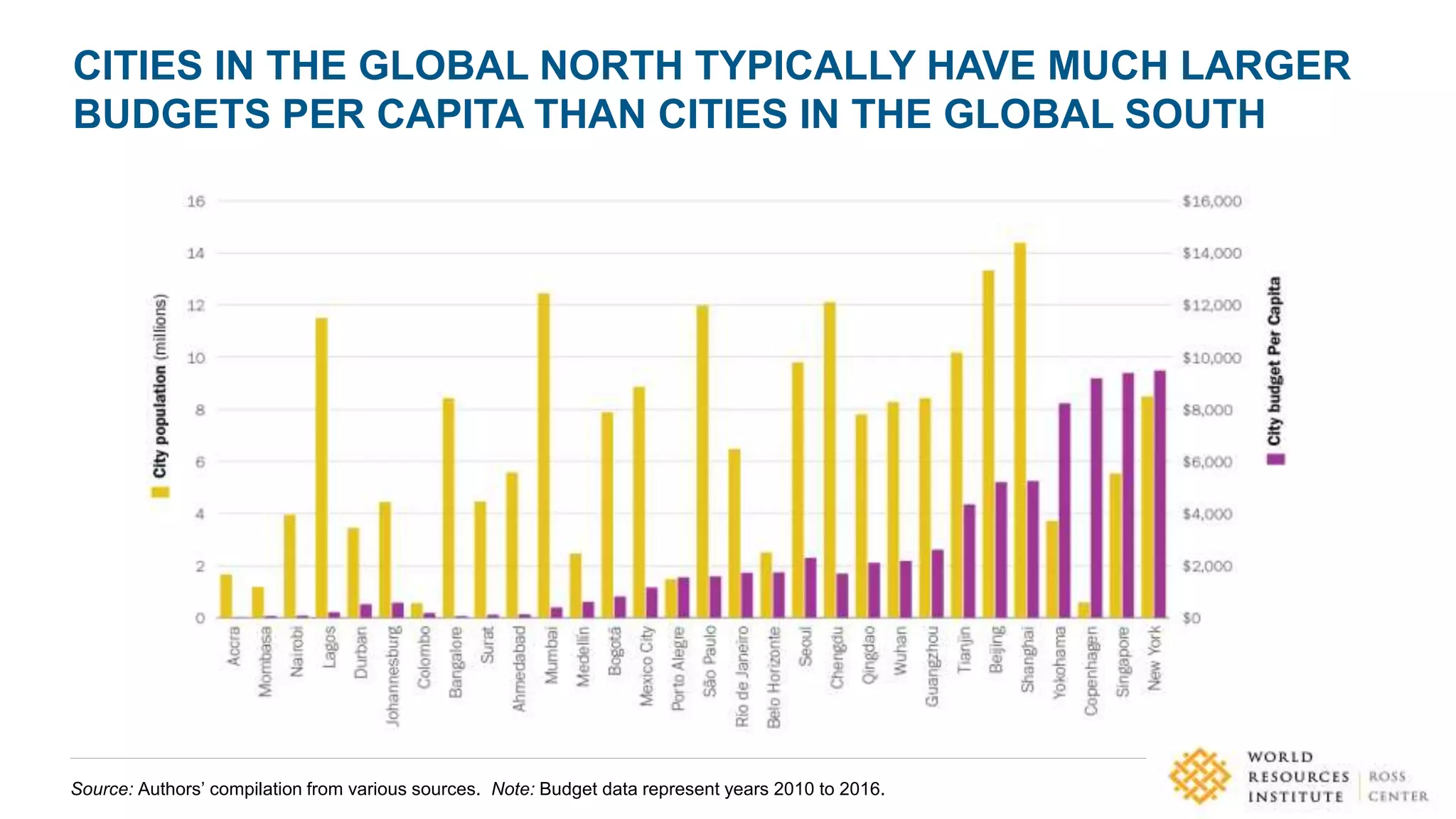
CITIES IN THE GLOBAL NORTH TYPICALLY HAVE MUCH LARGER
BUDGETS PER CAPITA THAN CITIES IN THE GLOBAL SOUTH
Source: Authors’ compilation from various sources. Note: Budget data represent years 2010 to 2016.
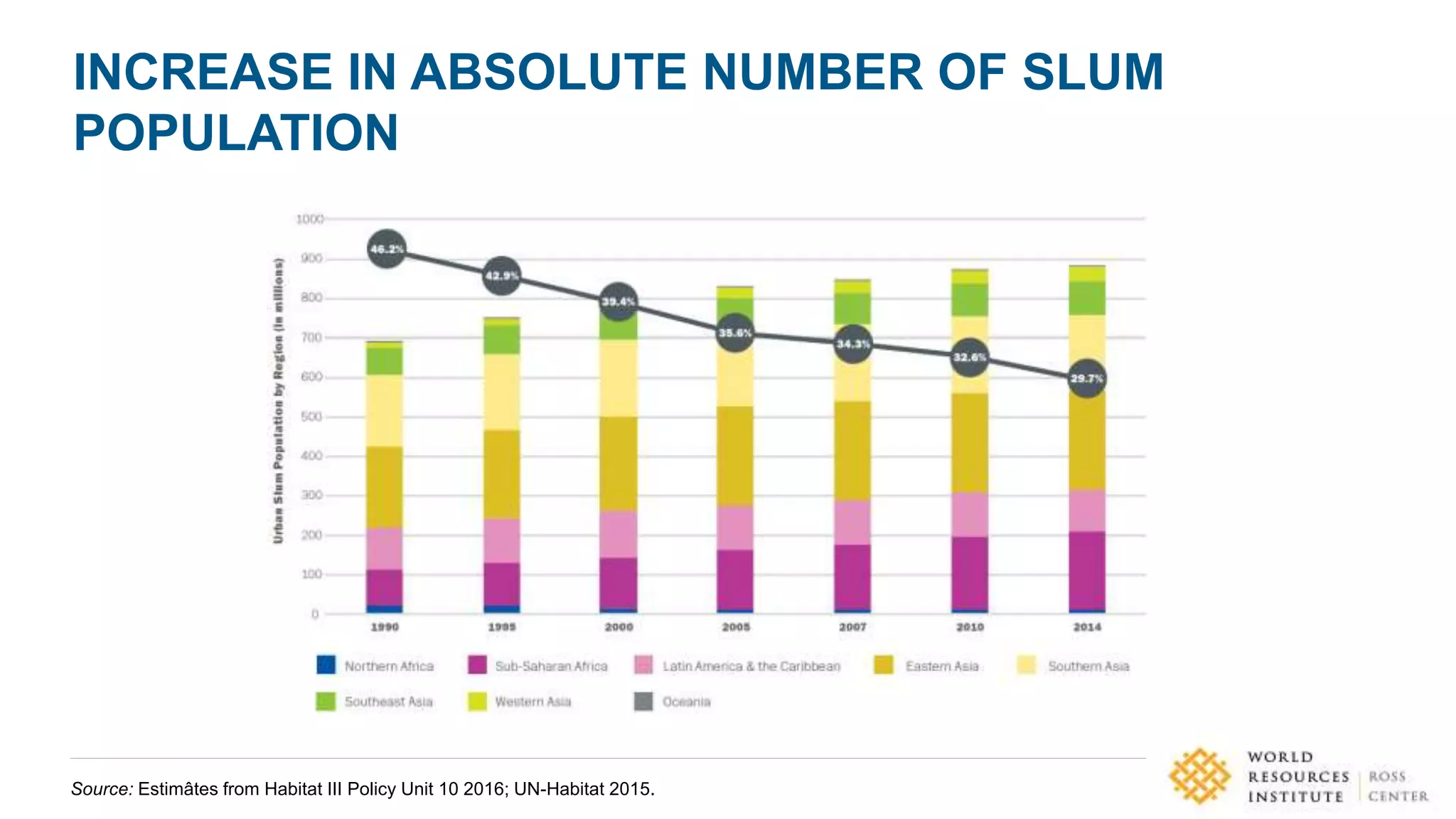
INCREASE IN ABSOLUTE NUMBER OF SLUM
POPULATION
Source: Estimâtes from Habitat III Policy Unit 10 2016; UN-Habitat 2015.
THREE TRANSFORMATIONS ARE NEEDED
SUSTAINABLE
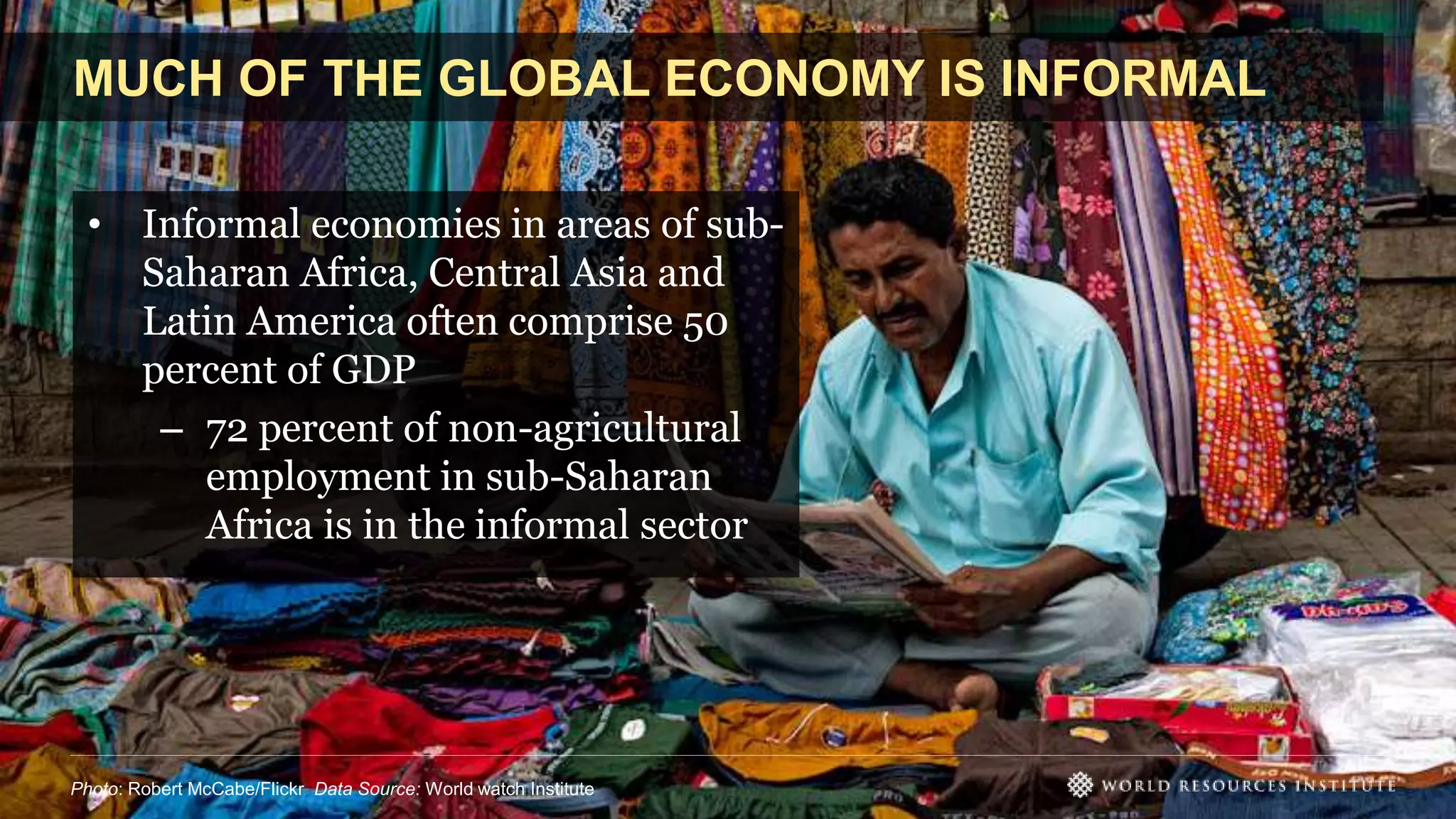
MUCH OF THE GLOBAL ECONOMY IS INFORMAL
• Informal economies in areas of sub-
Saharan Africa, Central Asia and
Latin America often comprise 50
percent of GDP
– 72 percent of non-agricultural
employment in sub-Saharan
Africa is in the informal sector
Photo: Robert McCabe/Flickr Data Source: World watch Institute
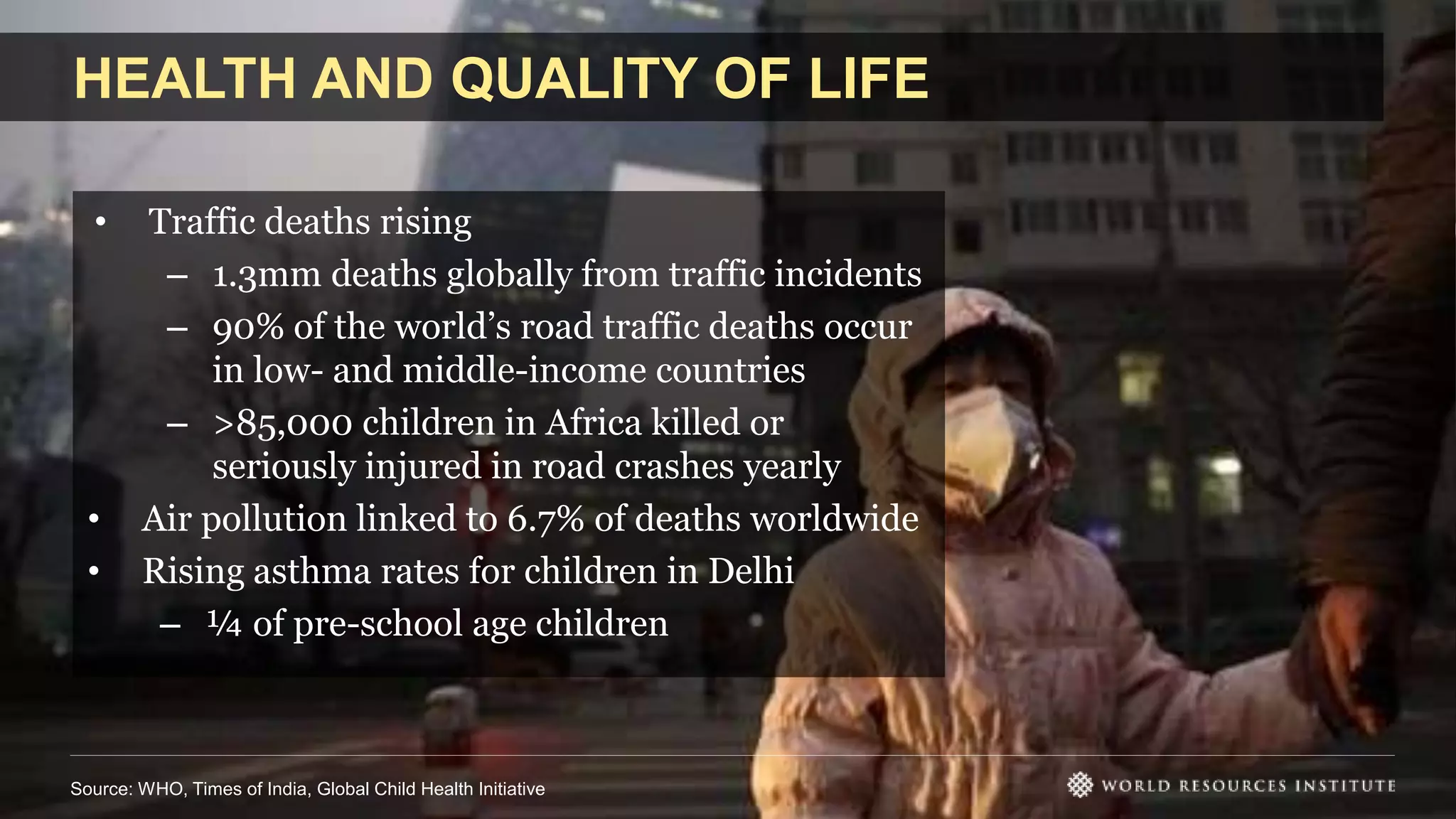
HEALTH AND QUALITY OF LIFE
• Traffic deaths rising
– 1.3mm deaths globally from traffic incidents
– 90% of the world’s road traffic deaths occur
in low- and middle-income countries
– >85,000 children in Africa killed or
seriously injured in road crashes yearly
• Air pollution linked to 6.7% of deaths worldwide
• Rising asthma rates for children in Delhi
– ¼ of pre-school age children
Source: WHO, Times of India, Global Child Health Initiative
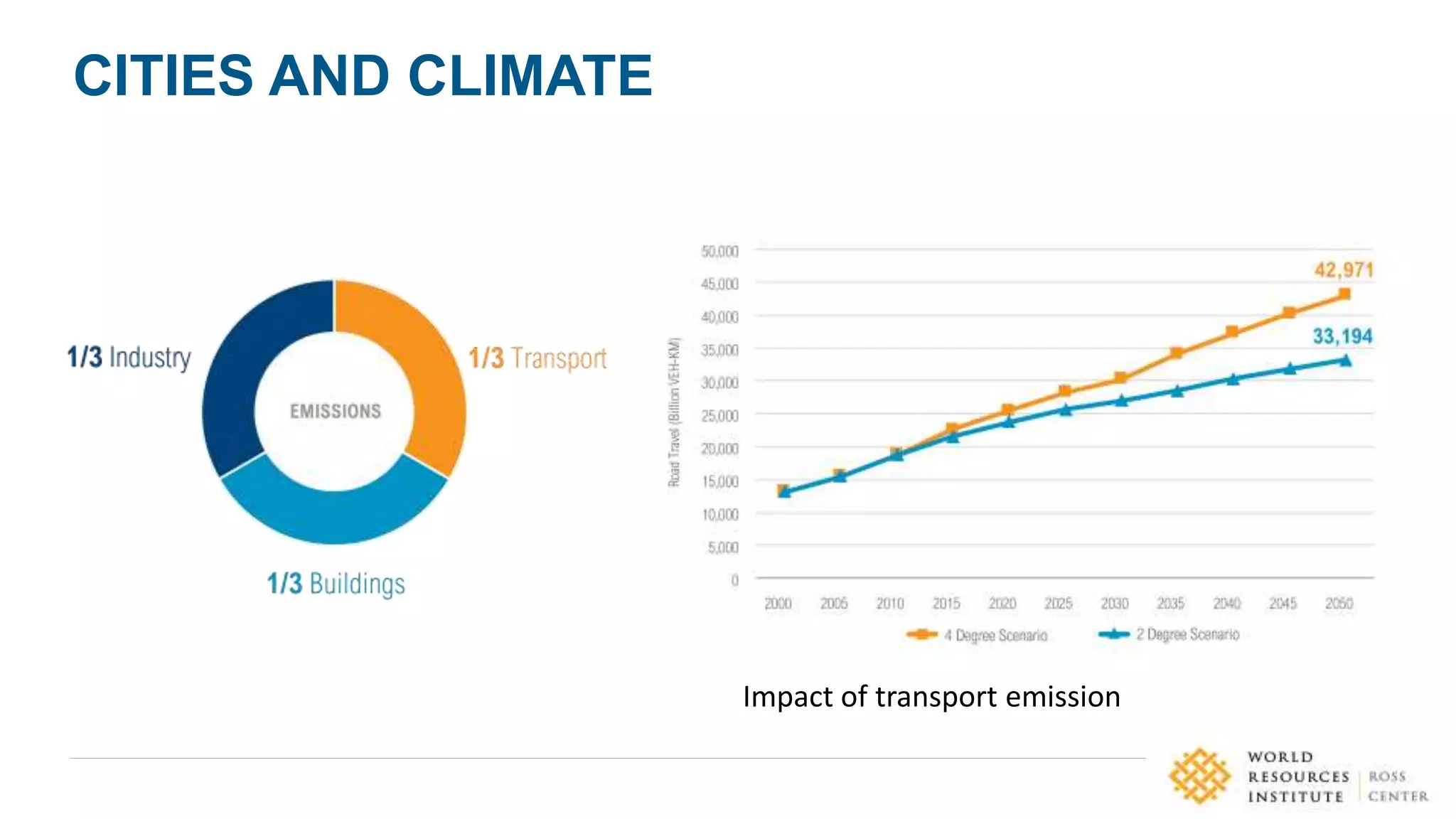
CITIES AND CLIMATE
Impact of transport emission
WATER AND SANITATION
• 2% of human waste is
treated
• As a result, Dhaka pumps
water from aquifers at
rapid rates
Photo: Ben Sutherland, Flickr
STRATEGIES TO AVOID LOCK-IN
Source: World Bank
Short-Term Capital Stock
Long-Term Capital Stock
Infrastructure
Land Use and Urban Form
10-15 years
15-40 years
30-75+ years
100+
years
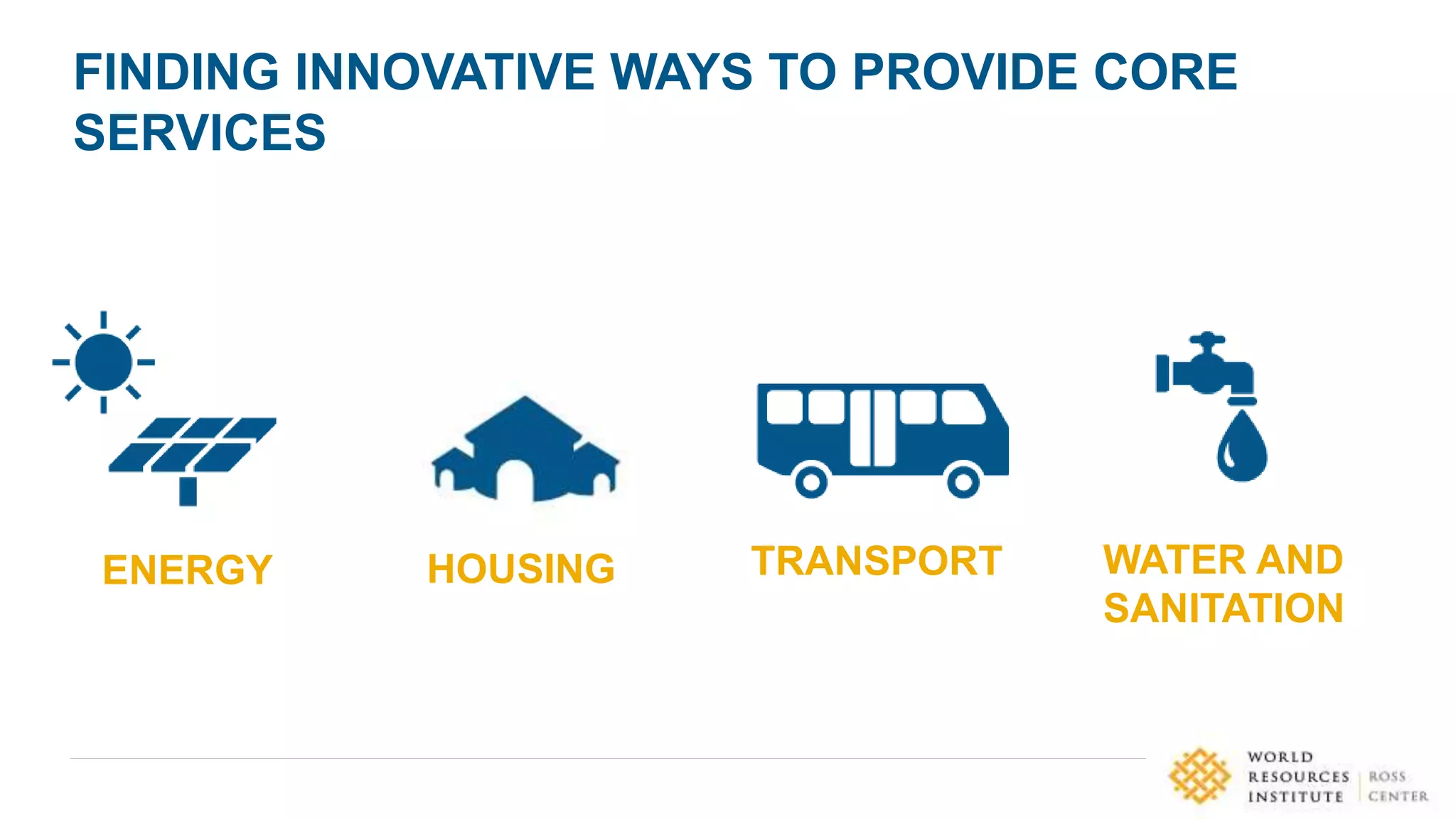
FINDING INNOVATIVE WAYS TO PROVIDE CORE
SERVICES
TRANSPORTHOUSINGENERGY WATER AND
SANITATION
WHAT IS THE ENTRY POINT TO MORE SUSTAINABLE CITIES?
EXAMPLES OF TRANSFORMATIVE URBAN CHANGE
Photo Credits: Deutsche Welle/Patrick Benning/Flickr; GFDL (http://www.gnu.org/copyleft/fdl.html)], via Wikimedia Commons
Medellín, Colombia Surat, India
WHAT IS THE ENTRY POINT TO MORE SUSTAINABLE CITIES?
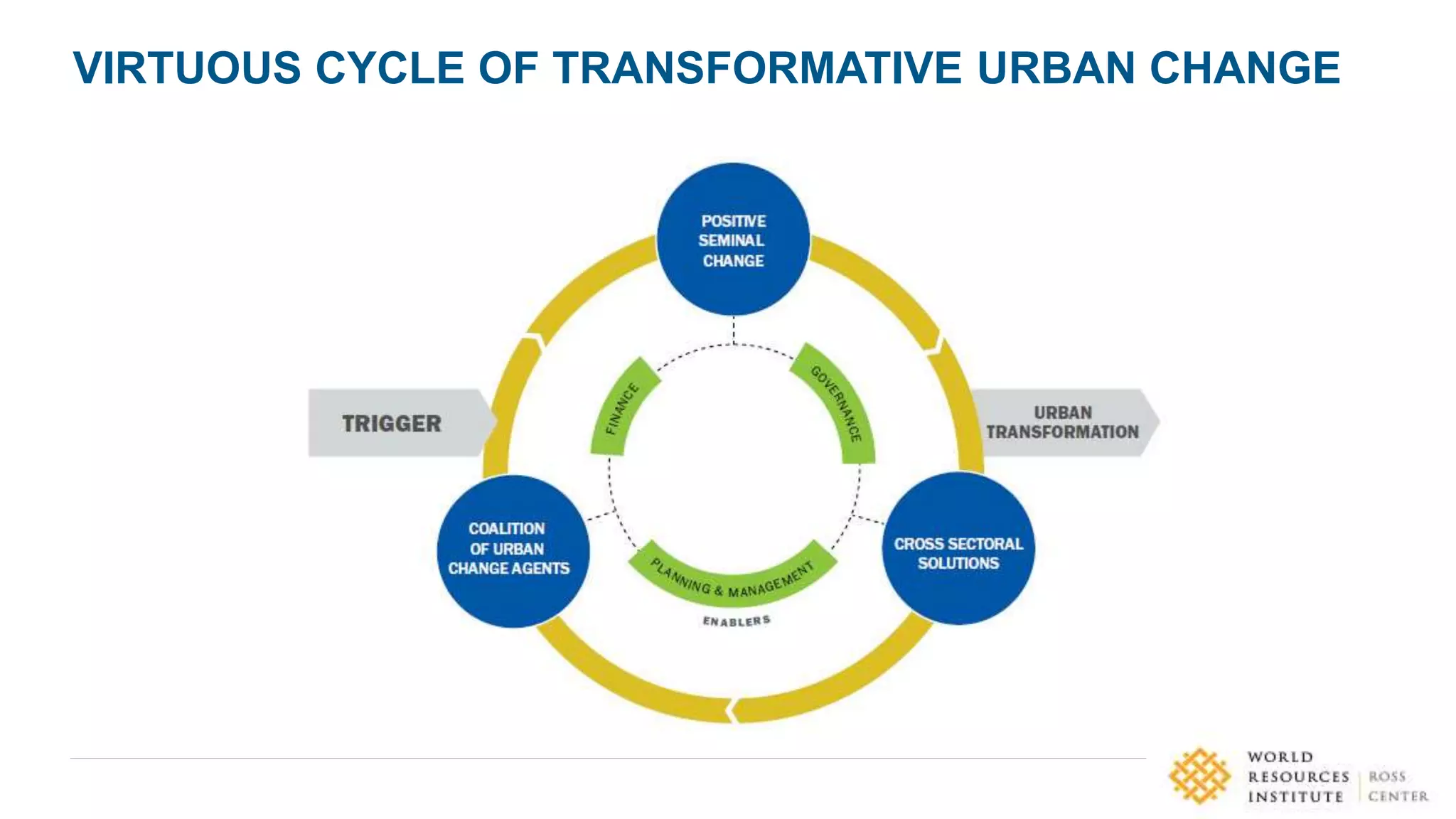
VIRTUOUS CYCLE OF TRANSFORMATIVE URBAN CHANGE
What cities can do to face
The Housing Challenge
Adequate, Secure, and Affordable Homes For All
THERE IS A LACK OF AFFORDABLE, ADEQUATE, SECURE
HOUSING IN WELL-LOCATED URBAN AREAS.
• Current global housing gap 330 million in 2014 &
expected to be 440 by 2025, a 1/3 increase
• Thresholds for housing affordability fail to take
transportation costs into account.
• Women, children, and ethnic minorities are
particularly affected by insufficient housing – link to
the future and overall productivity of city.
Photo: Robin King
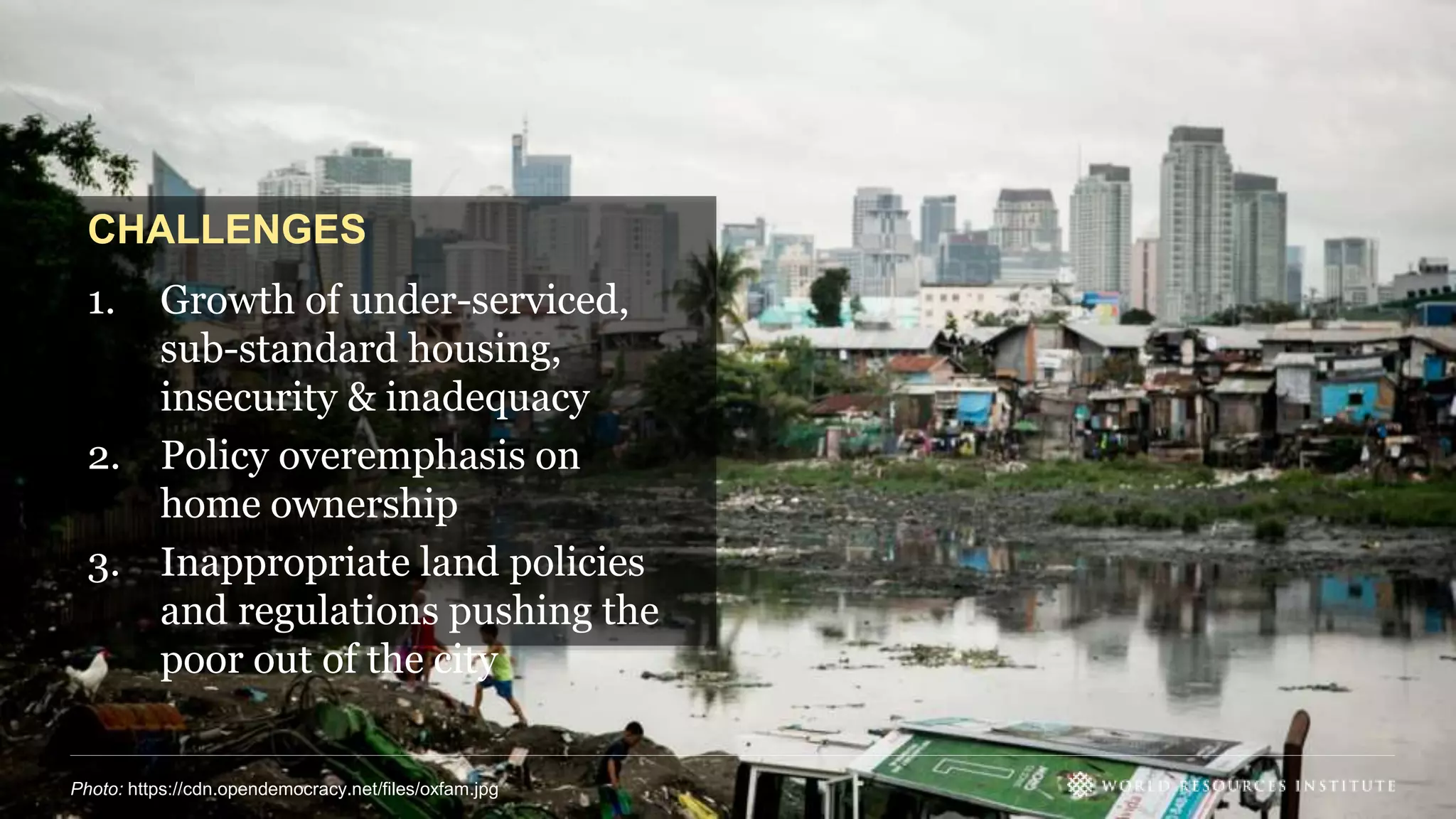
CHALLENGES
1. Growth of under-serviced,
sub-standard housing,
insecurity & inadequacy
2. Policy overemphasis on
home ownership
3. Inappropriate land policies
and regulations pushing the
poor out of the city
Photo: https://cdn.opendemocracy.net/files/oxfam.jpg
APPROACHES
1. In situ participatory
upgrading , except where
there are location -based
risks
2. Development of rental
housing
3. Conversion of underutilized
urban land to affordable
housing
Photo: http://archinect.com/features/article/25485248/decoding-bangkok-s-pocket-
urbanization-social-housing-provision-and-the-role-of-community-architects
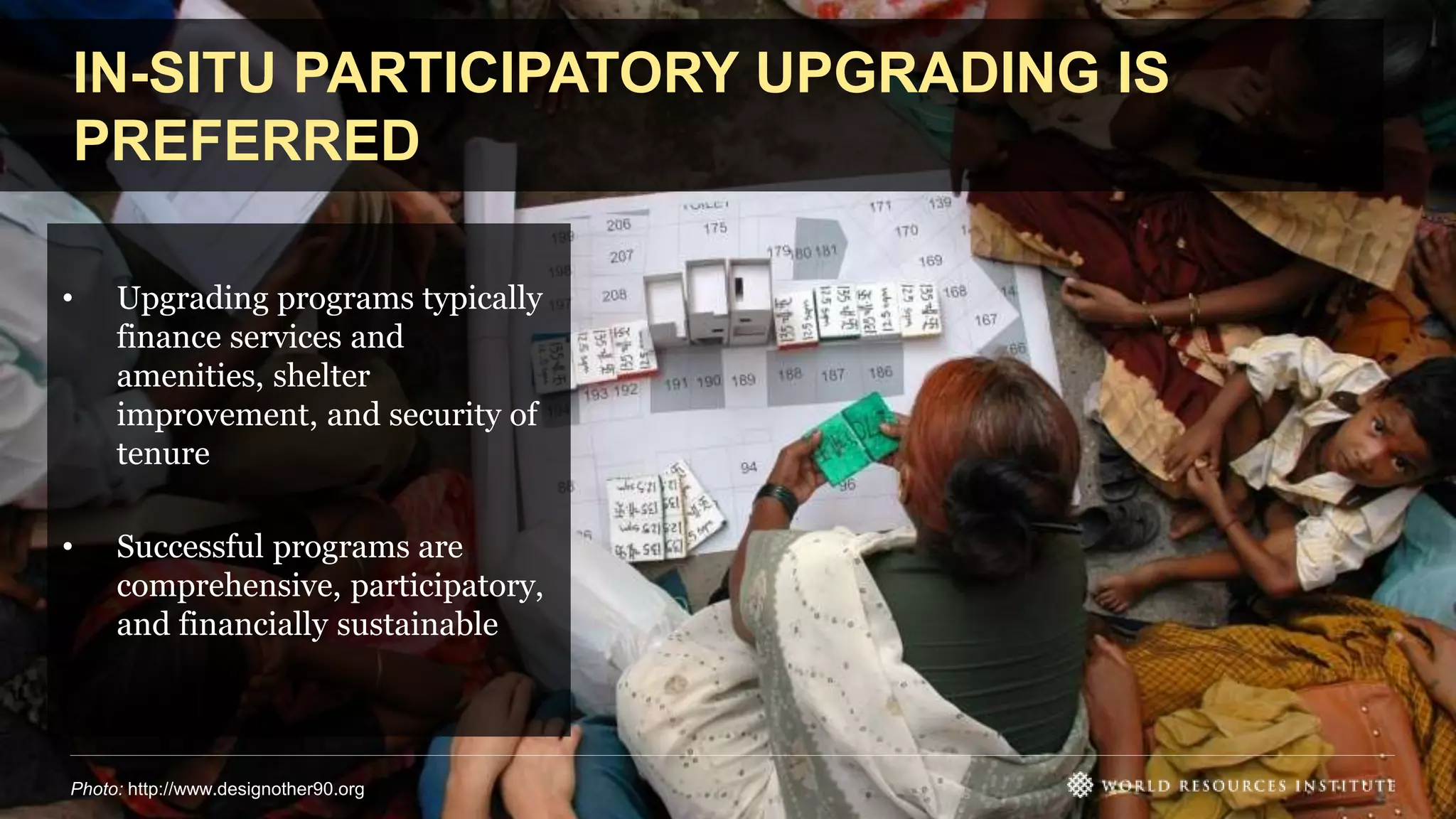
IN-SITU PARTICIPATORY UPGRADING IS
PREFERRED
• Upgrading programs typically
finance services and
amenities, shelter
improvement, and security of
tenure
• Successful programs are
comprehensive, participatory,
and financially sustainable
Photo: http://www.designother90.org
EXAMPLE OF IN SITU UPGRADING:
BAAN MANKONG: THAILAND
• In 2003, the Thai government launched it
based on collective ownership
• Nation-wide program is implemented by the
Community Organizations Development
Institute (CODI), bridges with community
savings groups for upgrading purposes
• As of 2014, Baan Mankong has improved
around 100,000 households
Source: www.archinect.com/features/article/25485248/decoding-bangkok-s-pocket-urbanization-social-
housing-provision-and-the-role-of-community-architects
COMMUNITY ORGANISATIONS AT CENTRE
• Poor people are main actors and solution finders, land tenure is
agreed and plans are prepared by people
• CODI- a public organization, channels government funds,
infrastructure subsidies, soft housing & land loans directly to poor
communities
• People-driven - savings groups, collective enrolment for upgrading
program, horizontal exchange with peers and technical support by
professionals and academicians.
Source: Community Organizations Development Institute, Thailand.
http://www.codi.or.th/housing/aboutBaanmankong.html
UNIQUENESS OF BAAN MANKONG APPROACH
• Community organisations are the key actors
• Demand driven as it supports who are ready to implement
• It enables associational value
• Upgrading is done within city development framework
• Government agencies are only facilitators
• Secure tenure is negotiated locally in each case
Source: Community Organizations Development Institute, Thailand.
http://www.codi.or.th/housing/aboutBaanmankong.html
TYPES OF UPGRADATION
Source: Community Organizations Development Institute, Thailand.
http://www.codi.or.th/housing/aboutBaanmankong.html
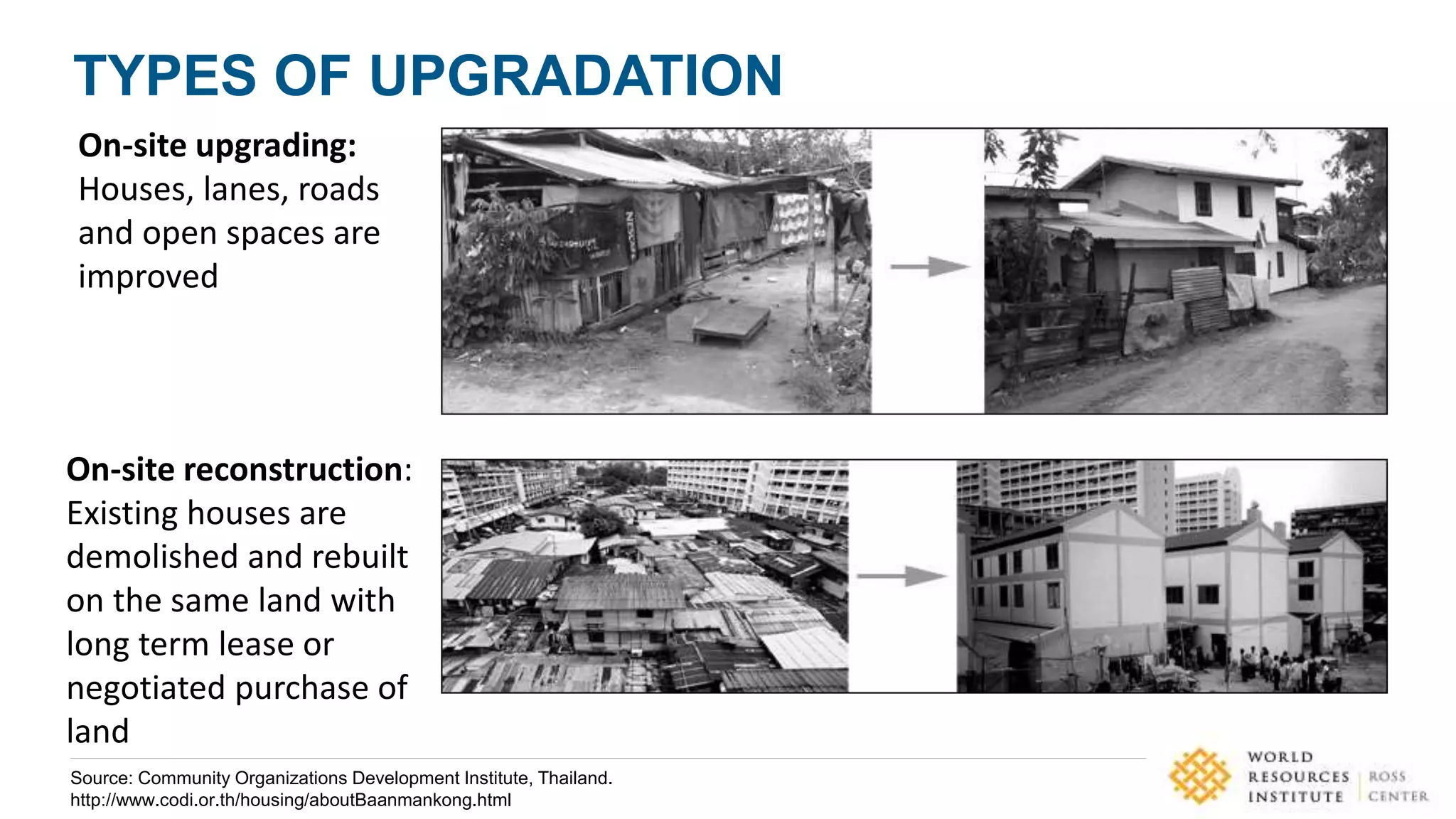
On-site upgrading:
Houses, lanes, roads
and open spaces are
improved
On-site reconstruction:
Existing houses are
demolished and rebuilt
on the same land with
long term lease or
negotiated purchase of
land
TYPES OF UPGRADATION
On-site re-blocking:
Systematic re-
blocking, to increase
penetration of
infrastructure
Land sharing:
Sharing of land
through negotiation
between the
community and land
owner to secure
legal tenure
Source: Community Organizations Development Institute, Thailand.
http://www.codi.or.th/housing/aboutBaanmankong.html
WHY BAAN MANKONG’S APPROACH WORKS?
• Financial capacities and social support networks are enabled
by community organizations as cooperatives saving & providing loans
• Managing funds unites the community as loans are provided to
entire community
• Subsidized loans allows cooperatives to earn savings by
lending money helps to create reserve funding for welfare programs
• Community keeps the land for 15 years after upgrading hence
prevents sale in the market
Source: http://thecityfix.com/blog/thailands-inclusive-upgrading-informal-settlements-terra-virsilas-emily-norford/
COMMUNITY BASED ENUMERATIONS AS TOOL TO
ORGANIZE COMMUNITIES
Shack/ Slum Dwellers International (SDI):
• Community managed censuses, surveys, community profiles &
mapping as tool for organizing communities
• Collecting of unconventional data – example: dangerous areas in
settlement
• Data as anchor to engage with media and local government
• Spread of practice of self-enumeration by peer to peer exchange
PROJECTS WITH CLOSE COMMUNITY INVOLVEMENT
ARE MORE LIKELY TO ACHIEVE ITS GOALS
Pune, Basic Services for Urban Poor, program options:
• Relocation to new sites with government-constructed mass housing
and without community involvement,
• In-situ slum upgrading without community participation &
• Redevelopment with community participation.
Projects with close community involvement were more likely to achieve
the program’s goals.
Main reasons were - upgrading led to engaged communities with high
degree of self reliance to address continued problems
DEVELOPMENT OF RENTAL HOUSING FOR ALL INCOME LEVELS
TO OVERCOME EMPHASIS ON OWNERSHIPS
Rental policies to address:
• Improving legal frameworks
• Avoiding financial biases
• Well-structured subsidies
• Rental for all income levels
Photo: seier+seier/Flickr
Emphasis on house
ownership
Support rental housing
EXAMPLE OF RENTALS: BACKYARD RENTALS: GAUTENG
PROVINCE, SOUTH AFRICA
• Backyard rental units are
typically constructed behind
primary residences. In Gauteng
(mainly Johannesburg)
712,000 households lived them
(2011 data)
• Recognizing inability to meet
housing demand, province
introduced policy that legalized
and encouraged backyard
rentals in 2015
Source: http://informalcity.co.za/sites/default/files/exhibition/backyard/img1-04.gif
WHAT CITIES CAN DO?
INSTEAD OF PUSHING THE POOR OUT, INCENTIVIZE
UNDERUTILIZED LAND FOR AFFORDABLE HOUSING
Photo: Asunción – Electrizante/Flickr
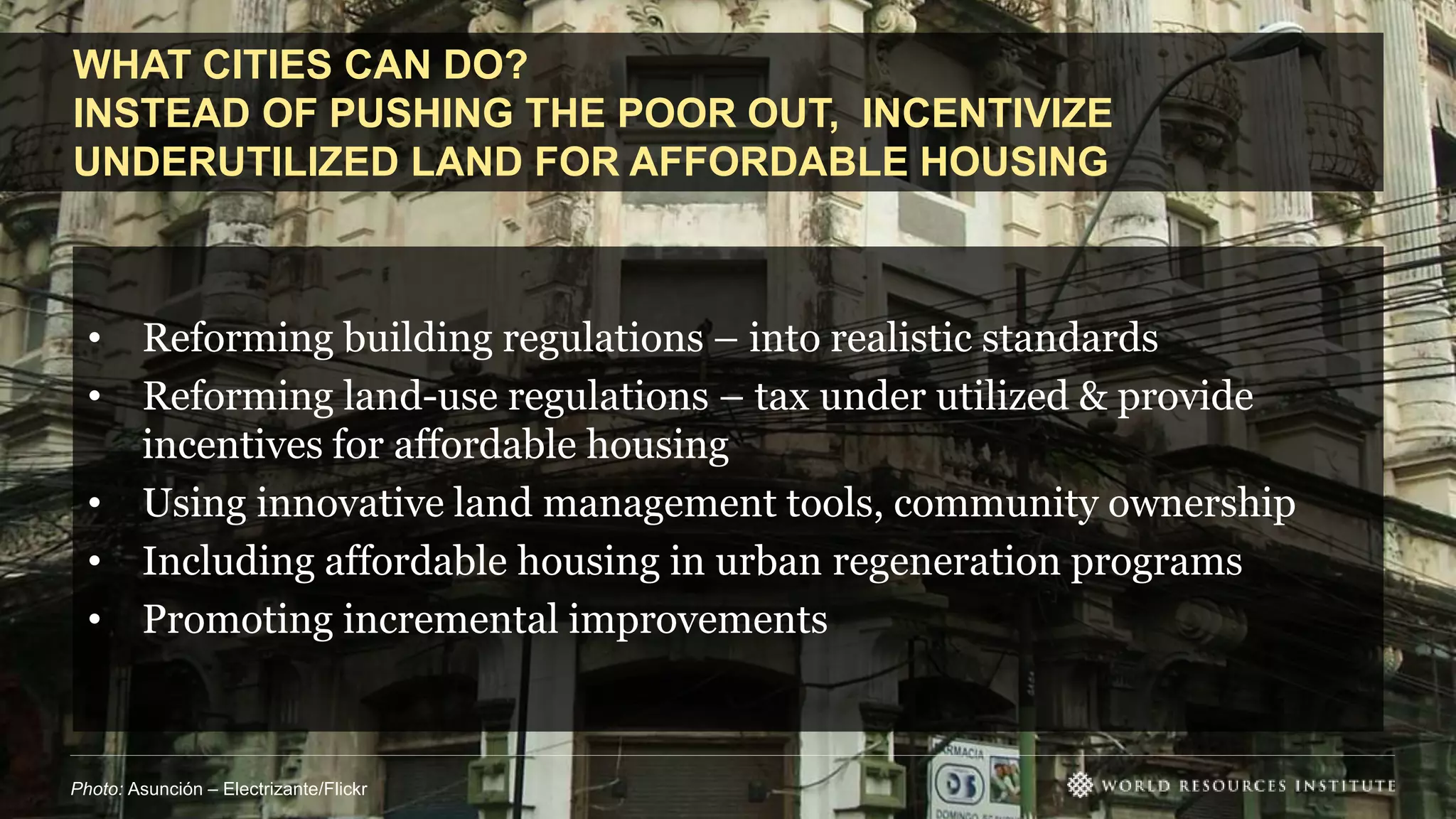
• Reforming building regulations – into realistic standards
• Reforming land-use regulations – tax under utilized & provide
incentives for affordable housing
• Using innovative land management tools, community ownership
• Including affordable housing in urban regeneration programs
• Promoting incremental improvements
INCREMENTAL HOUSING: “HALF GOOD HOUSE”
QUINTA MONROY: IQUIQUE, CHILE
• Chile-Barrio program
incremental housing
approach: physical
foundations of each house with
walls, floors, kitchen,
bathroom constructed, while
rest left unfinished
• Families allowed to
incrementally develop and
expand rest of house
Photo:
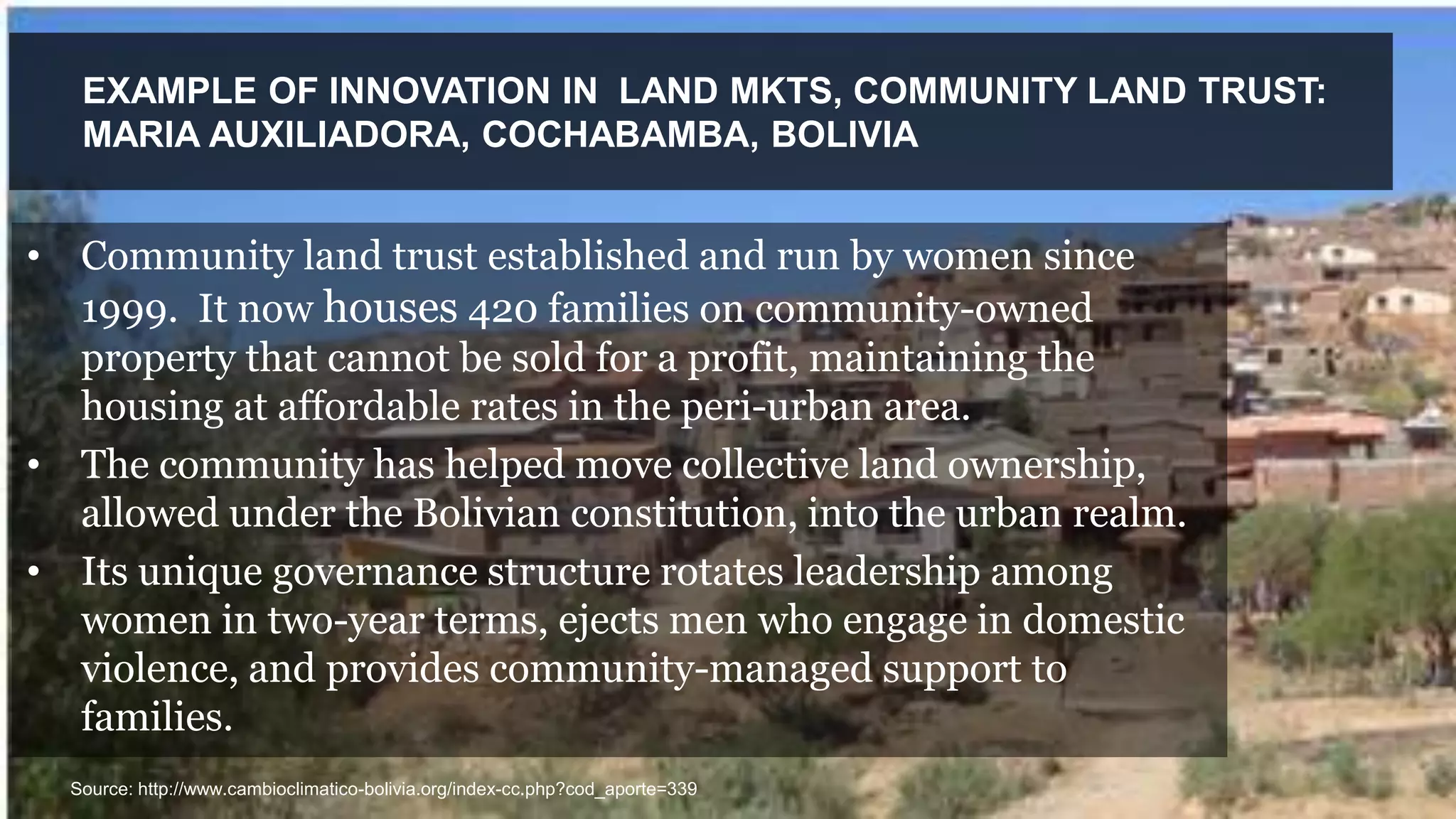
EXAMPLE OF INNOVATION IN LAND MKTS, COMMUNITY LAND TRUST:
MARIA AUXILIADORA, COCHABAMBA, BOLIVIA
Source: http://www.cambioclimatico-bolivia.org/index-cc.php?cod_aporte=339
• Community land trust established and run by women since
1999. It now houses 420 families on community-owned
property that cannot be sold for a profit, maintaining the
housing at affordable rates in the peri-urban area.
• The community has helped move collective land ownership,
allowed under the Bolivian constitution, into the urban realm.
• Its unique governance structure rotates leadership among
women in two-year terms, ejects men who engage in domestic
violence, and provides community-managed support to
families.
SUMMARY OF CHALLENGES
• Growth of under-serviced, sub-
standard housing, disconnected from
livelihood possibilities
• Policy overemphasis on home
ownership
• Inappropriate land policies and
regulations pushing the poor out of the
city
SUMMARY OF APPROACHES
• In situ participatory upgrading , except
where there are located-based risks
• Development of rental housing
• Conversion of underutilized urban
land to affordable housing
Photo: https://cdn.opendemocracy.net/files/oxfam.jpg
Towards a More Equal City
Mobilizing For Post-Quito Implementation
Working paper:
TOWARDS A MORE EQUAL CITY, Confronting the Urban Housing Crisis in the
Global South: Adequate, Secure, and Affordable Housing.
https://www.wri.org/publication/towards-more-equal-city-confronting-urban-
housing-crisis-global-south

Towards a More Equal City

  • 1.
    Towards a MoreEqual City Mobilizing For Post-Quito Implementation
  • 2.
    Towards a MoreEqual City: Confronting the Urban Housing Crisis in the Global south: Adequate, Secure and Affordable Housing SREE KUMAR KUMARASWAMY, WRI ROSS CENTER FOR SUSTAINABLE CITIES Asia Pacific Housing Forum 6, Quezon City
  • 6.
  • 7.
    CITIES IN THEGLOBAL NORTH TYPICALLY HAVE MUCH LARGER BUDGETS PER CAPITA THAN CITIES IN THE GLOBAL SOUTH Source: Authors’ compilation from various sources. Note: Budget data represent years 2010 to 2016.
  • 8.
    INCREASE IN ABSOLUTENUMBER OF SLUM POPULATION Source: Estimâtes from Habitat III Policy Unit 10 2016; UN-Habitat 2015.
  • 9.
    THREE TRANSFORMATIONS ARENEEDED SUSTAINABLE
  • 10.
    MUCH OF THEGLOBAL ECONOMY IS INFORMAL • Informal economies in areas of sub- Saharan Africa, Central Asia and Latin America often comprise 50 percent of GDP – 72 percent of non-agricultural employment in sub-Saharan Africa is in the informal sector Photo: Robert McCabe/Flickr Data Source: World watch Institute
  • 11.
    HEALTH AND QUALITYOF LIFE • Traffic deaths rising – 1.3mm deaths globally from traffic incidents – 90% of the world’s road traffic deaths occur in low- and middle-income countries – >85,000 children in Africa killed or seriously injured in road crashes yearly • Air pollution linked to 6.7% of deaths worldwide • Rising asthma rates for children in Delhi – ¼ of pre-school age children Source: WHO, Times of India, Global Child Health Initiative
  • 12.
    CITIES AND CLIMATE Impactof transport emission
  • 13.
    WATER AND SANITATION •2% of human waste is treated • As a result, Dhaka pumps water from aquifers at rapid rates Photo: Ben Sutherland, Flickr
  • 14.
    STRATEGIES TO AVOIDLOCK-IN Source: World Bank Short-Term Capital Stock Long-Term Capital Stock Infrastructure Land Use and Urban Form 10-15 years 15-40 years 30-75+ years 100+ years
  • 15.
    FINDING INNOVATIVE WAYSTO PROVIDE CORE SERVICES TRANSPORTHOUSINGENERGY WATER AND SANITATION
  • 16.
    WHAT IS THEENTRY POINT TO MORE SUSTAINABLE CITIES?
  • 17.
    EXAMPLES OF TRANSFORMATIVEURBAN CHANGE Photo Credits: Deutsche Welle/Patrick Benning/Flickr; GFDL (http://www.gnu.org/copyleft/fdl.html)], via Wikimedia Commons Medellín, Colombia Surat, India
  • 18.
    WHAT IS THEENTRY POINT TO MORE SUSTAINABLE CITIES?
  • 19.
    VIRTUOUS CYCLE OFTRANSFORMATIVE URBAN CHANGE
  • 20.
    What cities cando to face The Housing Challenge Adequate, Secure, and Affordable Homes For All
  • 21.
    THERE IS ALACK OF AFFORDABLE, ADEQUATE, SECURE HOUSING IN WELL-LOCATED URBAN AREAS. • Current global housing gap 330 million in 2014 & expected to be 440 by 2025, a 1/3 increase • Thresholds for housing affordability fail to take transportation costs into account. • Women, children, and ethnic minorities are particularly affected by insufficient housing – link to the future and overall productivity of city. Photo: Robin King
  • 22.
    CHALLENGES 1. Growth ofunder-serviced, sub-standard housing, insecurity & inadequacy 2. Policy overemphasis on home ownership 3. Inappropriate land policies and regulations pushing the poor out of the city Photo: https://cdn.opendemocracy.net/files/oxfam.jpg
  • 23.
    APPROACHES 1. In situparticipatory upgrading , except where there are location -based risks 2. Development of rental housing 3. Conversion of underutilized urban land to affordable housing Photo: http://archinect.com/features/article/25485248/decoding-bangkok-s-pocket- urbanization-social-housing-provision-and-the-role-of-community-architects
  • 24.
    IN-SITU PARTICIPATORY UPGRADINGIS PREFERRED • Upgrading programs typically finance services and amenities, shelter improvement, and security of tenure • Successful programs are comprehensive, participatory, and financially sustainable Photo: http://www.designother90.org
  • 25.
    EXAMPLE OF INSITU UPGRADING: BAAN MANKONG: THAILAND • In 2003, the Thai government launched it based on collective ownership • Nation-wide program is implemented by the Community Organizations Development Institute (CODI), bridges with community savings groups for upgrading purposes • As of 2014, Baan Mankong has improved around 100,000 households Source: www.archinect.com/features/article/25485248/decoding-bangkok-s-pocket-urbanization-social- housing-provision-and-the-role-of-community-architects
  • 26.
    COMMUNITY ORGANISATIONS ATCENTRE • Poor people are main actors and solution finders, land tenure is agreed and plans are prepared by people • CODI- a public organization, channels government funds, infrastructure subsidies, soft housing & land loans directly to poor communities • People-driven - savings groups, collective enrolment for upgrading program, horizontal exchange with peers and technical support by professionals and academicians. Source: Community Organizations Development Institute, Thailand. http://www.codi.or.th/housing/aboutBaanmankong.html
  • 27.
    UNIQUENESS OF BAANMANKONG APPROACH • Community organisations are the key actors • Demand driven as it supports who are ready to implement • It enables associational value • Upgrading is done within city development framework • Government agencies are only facilitators • Secure tenure is negotiated locally in each case Source: Community Organizations Development Institute, Thailand. http://www.codi.or.th/housing/aboutBaanmankong.html
  • 28.
    TYPES OF UPGRADATION Source:Community Organizations Development Institute, Thailand. http://www.codi.or.th/housing/aboutBaanmankong.html On-site upgrading: Houses, lanes, roads and open spaces are improved On-site reconstruction: Existing houses are demolished and rebuilt on the same land with long term lease or negotiated purchase of land
  • 29.
    TYPES OF UPGRADATION On-sitere-blocking: Systematic re- blocking, to increase penetration of infrastructure Land sharing: Sharing of land through negotiation between the community and land owner to secure legal tenure Source: Community Organizations Development Institute, Thailand. http://www.codi.or.th/housing/aboutBaanmankong.html
  • 30.
    WHY BAAN MANKONG’SAPPROACH WORKS? • Financial capacities and social support networks are enabled by community organizations as cooperatives saving & providing loans • Managing funds unites the community as loans are provided to entire community • Subsidized loans allows cooperatives to earn savings by lending money helps to create reserve funding for welfare programs • Community keeps the land for 15 years after upgrading hence prevents sale in the market Source: http://thecityfix.com/blog/thailands-inclusive-upgrading-informal-settlements-terra-virsilas-emily-norford/
  • 31.
    COMMUNITY BASED ENUMERATIONSAS TOOL TO ORGANIZE COMMUNITIES Shack/ Slum Dwellers International (SDI): • Community managed censuses, surveys, community profiles & mapping as tool for organizing communities • Collecting of unconventional data – example: dangerous areas in settlement • Data as anchor to engage with media and local government • Spread of practice of self-enumeration by peer to peer exchange
  • 32.
    PROJECTS WITH CLOSECOMMUNITY INVOLVEMENT ARE MORE LIKELY TO ACHIEVE ITS GOALS Pune, Basic Services for Urban Poor, program options: • Relocation to new sites with government-constructed mass housing and without community involvement, • In-situ slum upgrading without community participation & • Redevelopment with community participation. Projects with close community involvement were more likely to achieve the program’s goals. Main reasons were - upgrading led to engaged communities with high degree of self reliance to address continued problems
  • 33.
    DEVELOPMENT OF RENTALHOUSING FOR ALL INCOME LEVELS TO OVERCOME EMPHASIS ON OWNERSHIPS Rental policies to address: • Improving legal frameworks • Avoiding financial biases • Well-structured subsidies • Rental for all income levels Photo: seier+seier/Flickr Emphasis on house ownership Support rental housing
  • 34.
    EXAMPLE OF RENTALS:BACKYARD RENTALS: GAUTENG PROVINCE, SOUTH AFRICA • Backyard rental units are typically constructed behind primary residences. In Gauteng (mainly Johannesburg) 712,000 households lived them (2011 data) • Recognizing inability to meet housing demand, province introduced policy that legalized and encouraged backyard rentals in 2015 Source: http://informalcity.co.za/sites/default/files/exhibition/backyard/img1-04.gif
  • 35.
    WHAT CITIES CANDO? INSTEAD OF PUSHING THE POOR OUT, INCENTIVIZE UNDERUTILIZED LAND FOR AFFORDABLE HOUSING Photo: Asunción – Electrizante/Flickr • Reforming building regulations – into realistic standards • Reforming land-use regulations – tax under utilized & provide incentives for affordable housing • Using innovative land management tools, community ownership • Including affordable housing in urban regeneration programs • Promoting incremental improvements
  • 36.
    INCREMENTAL HOUSING: “HALFGOOD HOUSE” QUINTA MONROY: IQUIQUE, CHILE • Chile-Barrio program incremental housing approach: physical foundations of each house with walls, floors, kitchen, bathroom constructed, while rest left unfinished • Families allowed to incrementally develop and expand rest of house Photo:
  • 37.
    EXAMPLE OF INNOVATIONIN LAND MKTS, COMMUNITY LAND TRUST: MARIA AUXILIADORA, COCHABAMBA, BOLIVIA Source: http://www.cambioclimatico-bolivia.org/index-cc.php?cod_aporte=339 • Community land trust established and run by women since 1999. It now houses 420 families on community-owned property that cannot be sold for a profit, maintaining the housing at affordable rates in the peri-urban area. • The community has helped move collective land ownership, allowed under the Bolivian constitution, into the urban realm. • Its unique governance structure rotates leadership among women in two-year terms, ejects men who engage in domestic violence, and provides community-managed support to families.
  • 38.
    SUMMARY OF CHALLENGES •Growth of under-serviced, sub- standard housing, disconnected from livelihood possibilities • Policy overemphasis on home ownership • Inappropriate land policies and regulations pushing the poor out of the city SUMMARY OF APPROACHES • In situ participatory upgrading , except where there are located-based risks • Development of rental housing • Conversion of underutilized urban land to affordable housing Photo: https://cdn.opendemocracy.net/files/oxfam.jpg
  • 39.
    Towards a MoreEqual City Mobilizing For Post-Quito Implementation Working paper: TOWARDS A MORE EQUAL CITY, Confronting the Urban Housing Crisis in the Global South: Adequate, Secure, and Affordable Housing. https://www.wri.org/publication/towards-more-equal-city-confronting-urban- housing-crisis-global-south

Editor's Notes

  • #3 With the world’s urban population expected to increase by about 60 percent by 2050, we have an opportunity to build cities where everyone can live, move, and thrive.
  • #4 General approach discussed in urban debates is that we need a new urban agenda to make cities that work more effeciently
  • #5 Whereas there is a need to look at cities that work for all, for all the vulnerable sections of the society also
  • #7 Urbanization has been occurring in many countries where incomes have remained stagnant. In 1960, very few low-income countries were highly urbanized. In contrast, by 2014, more low-income countries had been added to the ranks of the highly urbanized countries, and the relationship between national income and urbanization was weaker, though it remains significant.
  • #8 Cities with the Greatest Challenges, the Global South, have the fewest resources per capita
  • #10 United Nations Sustainable Development Goals and the United Nations Framework Convention on Climate Change (UNFCCC) Paris Agreement on climate change adopted that and everyone agrees now that: Cities cannot achieve and sustain progress in any one of them without simultaneously addressing the other two.
  • #11 Informal economies in areas of sub-Saharan Africa, Central Asia and Latin America often comprise 50 percent of GDP
  • #12 Alarming: 90% of the world’s road traffic deaths occur in low- and middle-income countries 1/4th of children in Delhi has asthma due to air pollution
  • #13 Cities are at the centre of solutions to mitigate climate change risk
  • #15 Many struggling and emerging cities are grappling with ways to meet the urgent needs of residents without locking cities into patterns of development that will have negative long-term consequences.
  • #16 Providing basic services in innovative ways so that the cities are effective for all is sustainability
  • #17 What is the main thing we could do for a more sustainable cities, what is the entry point towards sustainable city?
  • #18 Cities of Surat, India From public health crisis to a model of urban cleanliness and governance. Governance and public finance Coalition of urban change agents Extensive reforms in sanitation and solid waste management New bus rapid transit system City climate resilience planning Public health data collection and monitoring E-governance initiatives Medellín, Colombia From the “murder capital of the world” in the 1990s to one of the most progressive cities in Latin America today. Governance and public finance Coalition of urban change agents Urban Development Projects Metrocable car system Shelter and legalizing comunas
  • #19 Inducing transformative change which provides core services and helps for higher economic productivity and environmental quality
  • #20 Success breeds more success, we need to start working for a successful improvement, build partnerships, make cross sectoral solutions. These would trigger transformation. For these we need to enable through governance, planning and management, innovative financing
  • #22 In 2010, more than 828 million people were living in informal settlements in the Global South, expected to increase to 889 million people by 2025. In 2014, the global affordable housing gap affected 330 million urban households worldwide. Expected to be 440 million by 2025. Those most impacted by the lack of well-located affordable, adequate housing are residents of informal settlements Current numbers generally understate the extent of the problem both quantitatively and qualitatively With current and projected rates of urbanization, informal settlements, are expected to continue to grow in population although proportion of urban population living in slums reported to have fallen Women, children, ethnic minorities are also particularly affected by insufficient housing Notes for presentation: Thresholds for housing affordability fail to take into account transportation costs Women, children, and ethnic minorities are particularly affected by insufficient housing – this especially important for thinking about this issue. Not just this generation, also the future. Kids don’t have a place to do their homework, where to keep their notebooks, or where to get a good night’s sleep. Workers don’t rest, so aren’t able to be as productive, physically or mentally. Families aren’t able to access services to achieve a higher standard of life, or often, to be fully engaged citizens.
  • #23 Main challenges are Growth of under-serviced, sub-standard housing, disconnected from livelihood possibilities Policy overemphasis on home ownership Inappropriate land policies and regulations pushing the poor out of the city
  • #24 Approaches are In situ participatory upgrading , except where there are located-based risks Development of rental housing Conversion of underutilized urban land to affordable housing
  • #25 In situ upgrading of informal settlements preferred over relocation programs Upgrading programs typically finance: Provision of basic services and amenities Improvement to and/or construction of shelter Security of land occupancy rights Successful programs for in situ upgrading of informal settlements are: Comprehensive: upgrading programs should encompass provision of infrastructure upgrades and social programs Supported by community stakeholders, political will, and institutional capacity Participatory: local community participation is critical to project sustainability Financially sustainable: project standards and must reflect what community members are able to afford
  • #26 In 2003, the Thai government launched the Baan Mankong upgrading program, a program designed to upgrade informal settlements Nation-wide program is implemented by the Community Organizations Development Institute (CODI) CODI directs flexible government subsidies and loans to community savings groups for upgrading purposes With institutional support, community architects, planners design process for upgrading, land redistribution, tenure formalization, and service provision
  • #27 Poor people are main actors and solution finders, land tenure is agreed and plans are prepared by people Community Organizations Development Institute (CODI)- a public organization, channels government funds, infrastructure subsidies, soft housing & land loans directly to poor communities People-driven upgrading process – form savings groups, collective enrolment for upgrading program, horizontal exchange with peers and technical support by professionals and academicians.
  • #28 Community organisations are the key actors in funding & managing Demand driven as it supports communities who are ready to implement improvement projects & allows a great variety It promotes more than physical upgrading due to associational value Urban poor communities as integrated part of city as upgrading is done within city development framework  Government agencies are no longer the planners, implementers and managers of improvement Secure tenure is negotiated locally in each case – such as cooperative land purchase, long-term lease contracts, land swaps or user rights
  • #29 On-site upgrading: Houses, lanes, roads and open spaces are improved On-site reconstruction: Existing houses are demolished and rebuilt on the same land with long term lease or negotiated purchase of land
  • #30 On-site re-blocking: Systematic re-blocking, to increase penetration of infrastructure Negotiation with land owner to leave a portion of the land to land owner and rest of the land is shared among the community with secure legal tenure
  • #31 Financial capacities and social support networks are enabled by community organizations as cooperatives saving & providing loans   Managing funds unites the community as loans are provided to entire community Subsidized loans allows cooperatives to earn savings by lending money helps to create reserve funding for welfare programs Community keeps the land for 15 years after upgrading hence prevents sale in the market
  • #32 Community managed censuses, surveys, community profiles & mapping as tool for organizing communities Collecting of unconventional data – example: dangerous areas in settlement Data as anchor to engage with media and local government Spread of practice of self-enumeration by peer to peer exchange SDI has done such enumerations for 450 cities in 30 countries
  • #33 Relocated communities found the houses were unacceptable located far away, isolated, did not match needs, with insufficient infrastructure while also left with major financial burden. Many also did not get financial support as they were not eligible for loans. Participatory projects not only yielded improved living conditions and more functional neighbourhoods but also led to more engaged communities with high degrees of self-governance, which minimized dependence on government support and provided the organizational basis for addressing continued problems such as security, access to services, and continued links to livelihood options and social networks
  • #34 Promote a wide range of housing possibilities to ensure that rental housing is affordable for all income levels, including cooperative housing options To meet increased housing demands, cities can support rental housing for tenants of different of income levels by: Creating formal rental policies Municipalities need to improve legal frameworks to support rights of both tenants and landlords, deposits & screening processes & alternate dispute resolution. Example In South Africa the Rental Housing Tribunal serves legal counsel, property inspection & eviction Avoiding financial biases that incentivize home ownership over rentals this – government, banking systems need to do Providing well-structured & coordinated supply and demand side subsidies to incentivize home rentals Demand side subsidies –housing vouchers tied to income, family size & rent for affordable housing Supply side subsidies such as assistance in up-front construction costs, long term recurring costs A wide range of rental housing possibilities to ensure that rental housing is affordable for all income levels
  • #35  In South Africa’s Gauteng Province, demand for housing is, in part, met through backyard rental units They are typically constructed behind primary residences; many are constructed informally by the tenants themselves, mostly new migrants who cannot afford formal market rents In 2011, 712,000 households lived in backyard rentals throughout Gauteng; most of these households were located in Johannesburg Recognizing inability to meet housing demand, province introduced policy that legalized and encouraged backyard rentals in 2015 This resulted in higher quality backyard structures as landlord and tenant are more confident are in investing Provincial rental housing tribunal includes tenants and landlords of backyard rental to build confidence in tenure security Role of city: Need for more services to support increased density is also a concern
  • #36 What cities can do to transform their cities? Instead of pushing the poor out, reform regulations to incentivize conversion of underutilized urban land to affordable housing Housing has moved from public supply to market driven Considering the scale of affordable housing requirement – cities need to deal with current shortage and unlock land at right locations to cater the growth for instance setting land for right of way is essential to ensure penetration of transport and infrastructure for labor markets Reform building regulations – as in Namibia Windhoek – established levels of development from informal to formal. Communal services and upgraded progressively in service provisioning to more formal standards Incentives of higher floor space for affordable housing, mixed uses & inclusionary zoning will reduce need to travel far, Higher densities will help land and infrastructure cost to support more people and reduce unserviceable sprawl Right to the city – the city constitute in constitution of Brazil though difficult to implement, it has triggered debates around social and use value and function over exchange value
  • #37 The government contacted celebrated architect Alejandro Aravena’s not for profit firm firm and given subsidy to rehouse the community in same place and pay for the land, construct house and infrastructure. Through public participation solution emerged “half a good house” approach Physical foundations, concrete walls and floors, stairs, kitchen and bathrooms were built. Rest largely unfinished Ample open space between each house allows family to grow incrementally over time 1/3 space of plot’s land as open communal space Property value increased phenomenally.
  • #38 Started by people who do not qualify for government loans or cannot afford to mortgage Community collectively owns the land & cannot be sold for profit. Collective land also used as mortgage to borrow loans All homes have are built by the community through a mutual help of labour Community facilities  such as a day nursery, playground, library, neighbourhood committee office, recycling centre and a football pitch are also built by collective labour Strong gender focus only women can own property, empowerment and decrease in domestic violence Funding: Combination of residents’ savings, loans and a revolving community fund Price is kept low to allow affordability