Increase Your Luck
Enhancing your Return of
Luck (ROL)
Roshan Thiran
roshan.thiran@leaderonomics.com
Is LUCK important in
business?
Question
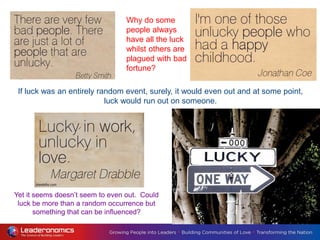
If luck was an entirely random event, surely, it would even out and at some point,
luck would run out on someone.
Why do some
people always
have all the luck
whilst others are
plagued with bad
fortune?
Yet it seems doesn’t seem to even out. Could
luck be more than a random occurrence but
something that can be influenced?
Idris Jala – 6 keys to leadership success: Luck = “Divine Intervention”
- You could control about 40% of things you were working on.
- Remaining 60% are things beyond your control but if you were a good human
being you could ‘influence’ the divine to be on your side and bring yourself good
‘luck’.
Are the “world’s best” leaders
born lucky or developed? Is
leadership genetic (born lucky)
or learned?
Question
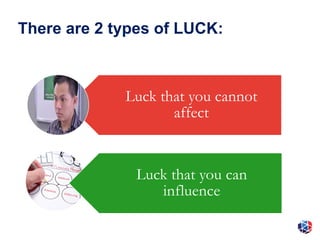
Luck that you cannot
affect
Luck that you can
influence
There are 2 types of LUCK:
Growth
Time
My “lucky” Experience
10. Johnson & Johnson
Industry : Healthcare
Function: HR
Global Role
9. GE Asia Pacific
Industry : Multi
Function: HR
Asia Role
7. GE Aircraft
Industry : Aviation
Function: Finance
CFO & ED 8. GE Crotonville
Industry : Multi
Function: HR
Learning Role
6. GE CIG
Industry : Multi
Function: IT
Project Mgmt Global
5. GE Capital
Industry : Financial Service
Function: Finance/Sourcing
Europe Leader
4. NBC Universal
Industry : Media
Function: Finance
Product Leader
1. GE Investments
Industry : Investment Banking
Function: Business Dev
Individual Contributor
3. GE GCS
Industry : Oil & Gas
Function: Finance
Inventory Mgmt
2. GE International
Industry : Multi
Function: Finance
Analyst Global
12. Leaderonomics
Industry : Multi
Function: CEO
Business leader
11. Star Media Group
Industry : Media
Function: CEO
Business leader
Key question: How did they become best?
Was it Luck?
But is a different leadership required for the 21st century?
Clearly,
because of high performance leadership
So how did they become
leaders? Were they lucky?
Question
Leadership is . . .
Attentiveness
Assertiveness
Responsibility
Diligence
Dependability
Obedience
Loyalty
Thoroughness
Truthfulness
Initiative
Hospitality
Humility
Forgiveness
Tolerance
Compassion
Sincerity
CReativity
Having followers
Persuasiveness
Virtue
Vision
Deference
Discretion
BOLDNESS
Determination
Gratefulness
Self-Control
Sensitivity
Thriftiness
Generosity
Punctuality
Proactiviness
Purpose
Enthusiasm
Availability
Orderliness
Resourcefulness
Flexibility
Wisdomped
Innovation
Execution
If we invested in people and
taught every single skill listed on
the previous slide, would we be
able to “create” leaders?
Question
14
How do great leaders
just know when and what
decisions to make?
Was It Luck?
motherteresa
Her story in India
The Research
In past 30 years scientists have looked into top-level performance in a
wide variety of fields. Findings:
- Natural talent doesn’t explain top-level performance – if talent even exists.
- In fields such as chess, music, business, and medicine, high IQ doesn’t necessarily
correlate with top-level performance.
 Some chess masters have below average IQ, for example.
Deliberate practice is the key.
- In England researchers studied music students. The only difference in the top
performing group and other students was not talent, but the amount of practice.
- Talent is an innate ability to do something better than others.
 If it does exist, it is irrelevant to superior performance.
 Practice is what counts – deliberate practice.
Time
Current Reality – Self Awareness
Ability/Achievement
Decision-making
GAP
Purpose/Vision
The Essence of Leadership is . . .
Learning/
Execution/
Action
GAP
Fuels our energy
Ensures reality
Study on luck by researchers
• Outcome: Luck is as much about attitude as it is
about probability.
The key difference between lucky people and the
‘unlucky’ ones is the ability to recognise these
opportunities and leverage them
Lucky People have . . .
High ROL
Bette Nesmith
Graham
• Secretary
• Single mom
• Always making mistakes
• Created liquid Paper
• Was she Lucky?
• Or made her own luck?
story…
Was it luck?
wayne rooney
the
Principle
Talent needs to be MANAGED
& DEVELOPED. This includes
enabling talents to maximize
potential and grow
Process and Tools
Succession Planning
Performance Mgmt
Career Paths
Talent Pools
Leadership Development
Programmes
Learning Curriculum
Talent Acceleration
Programmes
Feedback & Reflection
Principle
Identify & select leaders that
have the passion, desire and
ability to make a difference
in your organisation
Process and Tools
Entry Level Leadership
Program
Competency Model/Values
Enterprise Assessment
System
Interviews & Assessments
On-boarding
Cultural Assimilation
Principle
To retain talent, 2 key factors:
1. Internal motivations (comp/ben,
engagement
2. External factors (company brand
& mktg perception)
Process and Tools
External Branding initiatives
Mentoring Programmes
Engagement Programmes
Total Rewards Structure (Comp &
Ben)
External Perception of the
Organisation & Leadership
Culture of Organisation
Organisational Responsibility – are we
building your “luck” factors?
Talent
Acquisition
Talent
Development
Talent
Retention
An Infrastructure to Enable
Leadership Development
Talent development is A PROCESS
Leadership is A PROCESS
(not Luck!)
Leaders and companies in the 1980s
Jack Welch (GE) –
internal
Andrew Grove (Intel)
– internal
Roger Enrico (Pepsi)
– internal
P&G, Hindustan
Unilever
The Success Stories in 80’s
IBM – external CEO in
80s
Apple – new external
CEO replaced Steve
Jobs
Motorola – no
succession planning
Atari, and numerous
other tech companies
The Failures Stories in the 80’s
I'm a great believer
in luck, and I find
the harder I work,
the more I have of
it.“
– Thomas
Jefferson
Pygmalion Effect states that you get what you expect. Most ‘lucky’ people expect the best,
confident that their future is going to be great. Somehow, these expectations become self-
fulfilling prophecies. Ask around and you’ll find that “lucky” and “unlucky” people have
astoundingly different expectations.
www.leaderonomics.org
www.leaderonomics.com
www.facebook.com/roshanthiran.leaderonomics
www.leaderonomics.com

Increasing Your Return on Luck

  • 1.
    Increase Your Luck Enhancingyour Return of Luck (ROL) Roshan Thiran roshan.thiran@leaderonomics.com
  • 2.
    Is LUCK importantin business? Question
  • 3.
    If luck wasan entirely random event, surely, it would even out and at some point, luck would run out on someone. Why do some people always have all the luck whilst others are plagued with bad fortune? Yet it seems doesn’t seem to even out. Could luck be more than a random occurrence but something that can be influenced?
  • 4.
    Idris Jala –6 keys to leadership success: Luck = “Divine Intervention” - You could control about 40% of things you were working on. - Remaining 60% are things beyond your control but if you were a good human being you could ‘influence’ the divine to be on your side and bring yourself good ‘luck’.
  • 5.
    Are the “world’sbest” leaders born lucky or developed? Is leadership genetic (born lucky) or learned? Question
  • 6.
    Luck that youcannot affect Luck that you can influence There are 2 types of LUCK:
  • 7.
    Growth Time My “lucky” Experience 10.Johnson & Johnson Industry : Healthcare Function: HR Global Role 9. GE Asia Pacific Industry : Multi Function: HR Asia Role 7. GE Aircraft Industry : Aviation Function: Finance CFO & ED 8. GE Crotonville Industry : Multi Function: HR Learning Role 6. GE CIG Industry : Multi Function: IT Project Mgmt Global 5. GE Capital Industry : Financial Service Function: Finance/Sourcing Europe Leader 4. NBC Universal Industry : Media Function: Finance Product Leader 1. GE Investments Industry : Investment Banking Function: Business Dev Individual Contributor 3. GE GCS Industry : Oil & Gas Function: Finance Inventory Mgmt 2. GE International Industry : Multi Function: Finance Analyst Global 12. Leaderonomics Industry : Multi Function: CEO Business leader 11. Star Media Group Industry : Media Function: CEO Business leader
  • 8.
    Key question: Howdid they become best?
  • 9.
  • 10.
    But is adifferent leadership required for the 21st century? Clearly, because of high performance leadership
  • 11.
    So how didthey become leaders? Were they lucky? Question
  • 12.
    Leadership is .. . Attentiveness Assertiveness Responsibility Diligence Dependability Obedience Loyalty Thoroughness Truthfulness Initiative Hospitality Humility Forgiveness Tolerance Compassion Sincerity CReativity Having followers Persuasiveness Virtue Vision Deference Discretion BOLDNESS Determination Gratefulness Self-Control Sensitivity Thriftiness Generosity Punctuality Proactiviness Purpose Enthusiasm Availability Orderliness Resourcefulness Flexibility Wisdomped Innovation Execution
  • 13.
    If we investedin people and taught every single skill listed on the previous slide, would we be able to “create” leaders? Question
  • 14.
    14 How do greatleaders just know when and what decisions to make? Was It Luck?
  • 15.
  • 16.
    The Research In past30 years scientists have looked into top-level performance in a wide variety of fields. Findings: - Natural talent doesn’t explain top-level performance – if talent even exists. - In fields such as chess, music, business, and medicine, high IQ doesn’t necessarily correlate with top-level performance.  Some chess masters have below average IQ, for example. Deliberate practice is the key. - In England researchers studied music students. The only difference in the top performing group and other students was not talent, but the amount of practice. - Talent is an innate ability to do something better than others.  If it does exist, it is irrelevant to superior performance.  Practice is what counts – deliberate practice.
  • 17.
    Time Current Reality –Self Awareness Ability/Achievement Decision-making GAP Purpose/Vision The Essence of Leadership is . . . Learning/ Execution/ Action GAP Fuels our energy Ensures reality
  • 18.
    Study on luckby researchers • Outcome: Luck is as much about attitude as it is about probability.
  • 19.
    The key differencebetween lucky people and the ‘unlucky’ ones is the ability to recognise these opportunities and leverage them
  • 20.
    Lucky People have. . . High ROL
  • 21.
    Bette Nesmith Graham • Secretary •Single mom • Always making mistakes • Created liquid Paper • Was she Lucky? • Or made her own luck?
  • 23.
  • 24.
    Principle Talent needs tobe MANAGED & DEVELOPED. This includes enabling talents to maximize potential and grow Process and Tools Succession Planning Performance Mgmt Career Paths Talent Pools Leadership Development Programmes Learning Curriculum Talent Acceleration Programmes Feedback & Reflection Principle Identify & select leaders that have the passion, desire and ability to make a difference in your organisation Process and Tools Entry Level Leadership Program Competency Model/Values Enterprise Assessment System Interviews & Assessments On-boarding Cultural Assimilation Principle To retain talent, 2 key factors: 1. Internal motivations (comp/ben, engagement 2. External factors (company brand & mktg perception) Process and Tools External Branding initiatives Mentoring Programmes Engagement Programmes Total Rewards Structure (Comp & Ben) External Perception of the Organisation & Leadership Culture of Organisation Organisational Responsibility – are we building your “luck” factors? Talent Acquisition Talent Development Talent Retention An Infrastructure to Enable Leadership Development
  • 25.
    Talent development isA PROCESS Leadership is A PROCESS (not Luck!)
  • 26.
    Leaders and companiesin the 1980s Jack Welch (GE) – internal Andrew Grove (Intel) – internal Roger Enrico (Pepsi) – internal P&G, Hindustan Unilever The Success Stories in 80’s IBM – external CEO in 80s Apple – new external CEO replaced Steve Jobs Motorola – no succession planning Atari, and numerous other tech companies The Failures Stories in the 80’s
  • 31.
    I'm a greatbeliever in luck, and I find the harder I work, the more I have of it.“ – Thomas Jefferson
  • 37.
    Pygmalion Effect statesthat you get what you expect. Most ‘lucky’ people expect the best, confident that their future is going to be great. Somehow, these expectations become self- fulfilling prophecies. Ask around and you’ll find that “lucky” and “unlucky” people have astoundingly different expectations.
  • 41.