BABA FARID COLLEGE OF EDUCATION
Accredited ‘A’ Grade by NAAC, Cycle-II
Topic: Inclusive Education
Presented By: Nitika
Lovepreet Sharma
(B.Ed-2nd Year)
When Learning is Purposeful,
Creativity Blossoms,
When Creativity Blossoms,
Thinking Emanates,
When Thinking Emanates,
Knowledge is fully Lit,
When Knowledge is fully Lit,
Economy Flourishes.
:- By Dr. APJ Abdul Kalam
INCLUSIVE EDUCATION
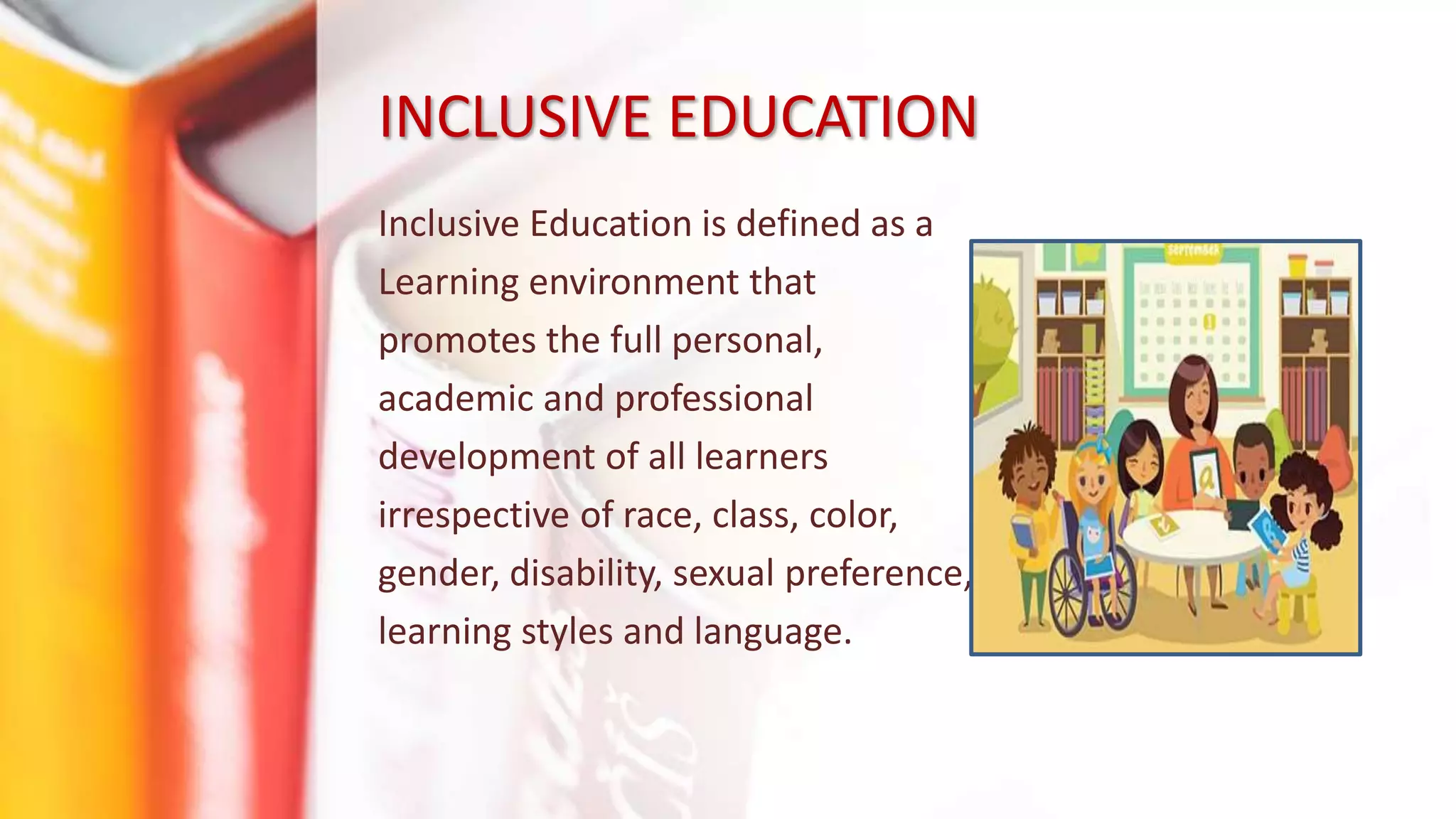
Inclusive Education is defined as a
Learning environment that
promotes the full personal,
academic and professional
development of all learners
irrespective of race, class, color,
gender, disability, sexual preference,
learning styles and language.
COMPARISON
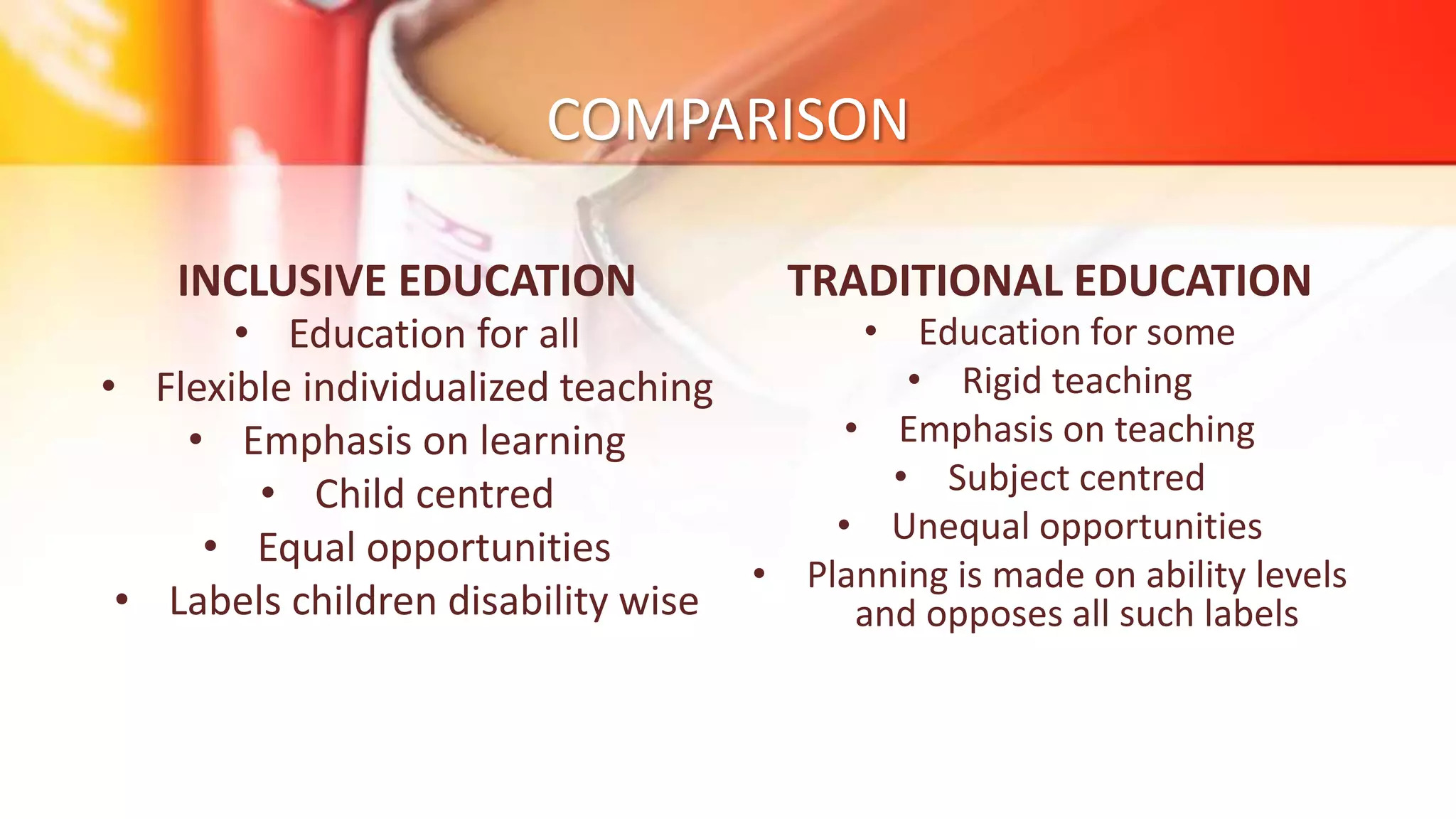
INCLUSIVE EDUCATION
• Education for all
• Flexible individualized teaching
• Emphasis on learning
• Child centred
• Equal opportunities
• Labels children disability wise
TRADITIONAL EDUCATION
• Education for some
• Rigid teaching
• Emphasis on teaching
• Subject centred
• Unequal opportunities
• Planning is made on ability levels
and opposes all such labels
PRINCIPLES OF INCLUSIVE EDUCATION
• No discrimination with students.
• Equal educational opportunity to all.
• School adapt to the need of student.
• Equal educational benefits for all students.
• The student’s views are listened to and
taken seriously.
• Individual differences between students are
a source of richness and diversity, and not a
problem.
Scope of
Inclusive
Education
Working
children.
Children in
remote tribal
areas.
Children
with
disabilities.
Girls living in
difficult
circumstances.
Children with
HIV/AIDS and
other chronic
illness.
Children of
migrant
labourers.
Street
children.
And all
other
children.
AIMS AND OBJECTIVES OF INCLUSIVE EDUCATION
• Education for all.
• Protection of rights.
• Identification of skills.
• Development of social consciousness.
• To prepare for new challenges.
• Development of brotherhood.
• To improve quality of education.
NEED AND IMPORTANCE
• For achieving the universalisation.
• For the development of healthy
citizenship.
• To enable children to stay with their
families.
• To develop feeling of self respect.
• For social equality.
• Self reliant.
• Use of modern technology.
Poor Quality Training
Teacher’s attitude
Teachers/schools not Rigid
supported curriculum
Parents are not involved
Seeing
system as
a
problem
PROBLEMS FACED BY STUDENTS
• Inferiority complex.
• Lack of understanding.
• Adjustment problem.
• Lag behind.
• Insecurity.
• Lack of expression.
• Introvert nature
• Isolated and segregated.
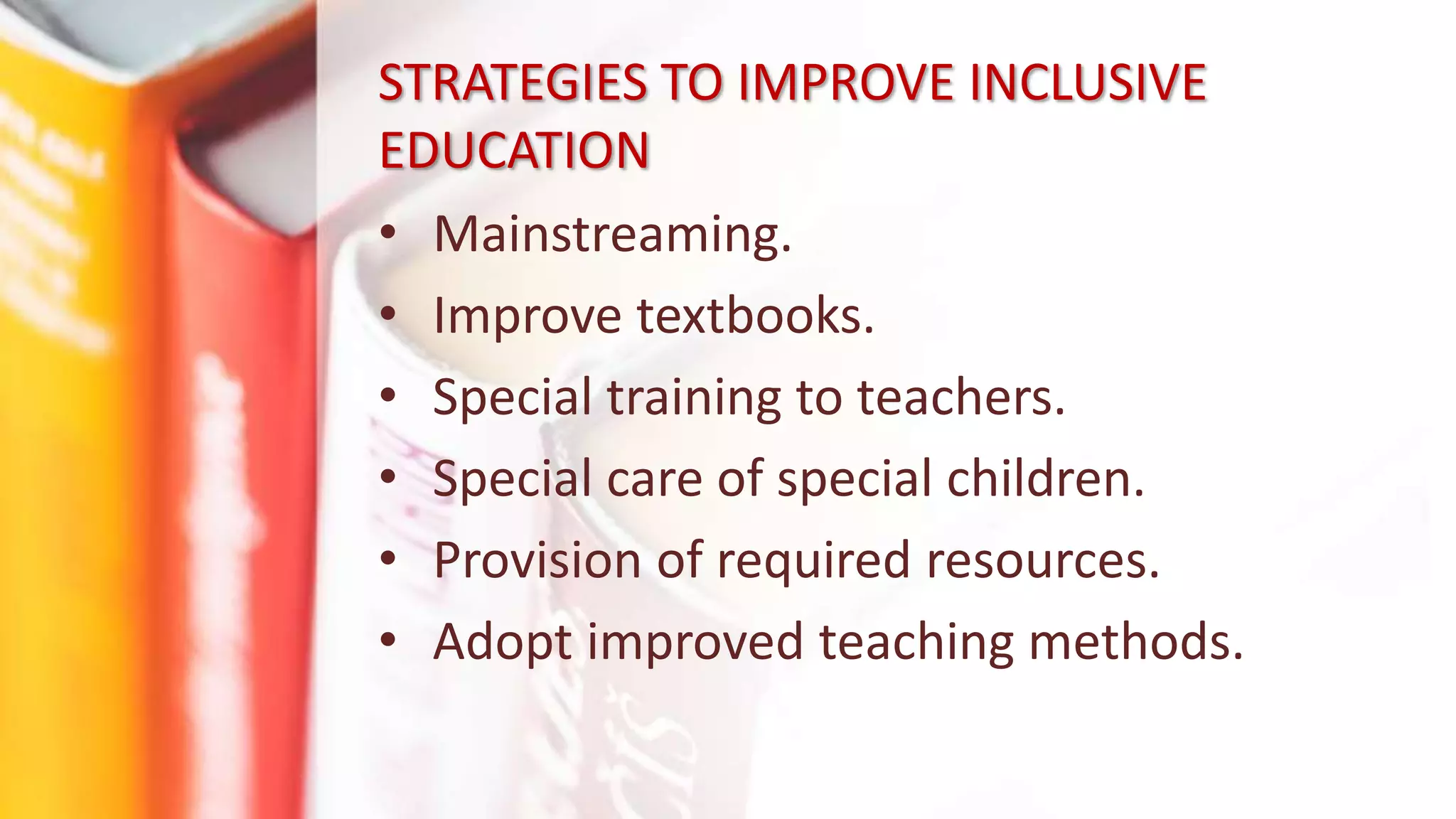
STRATEGIES TO IMPROVE INCLUSIVE
EDUCATION
• Mainstreaming.
• Improve textbooks.
• Special training to teachers.
• Special care of special children.
• Provision of required resources.
• Adopt improved teaching methods.
Acknowledgement
I would like to thank Baba Farid College of Engineering &
Technology for providing me golden opportunity to present
the PPT over here. Furthermore I would also like to
acknowledge with much appreciation the crucial role of the
staff members of Baba Farid College of Education, who gave
the permission to use all required equipment and the
necessary material to complete the task. A special thanks goes
to my team mate Lovepreet Sharma who helped me at every
step.
Any Question
inclusive education (1).pptx

inclusive education (1).pptx

  • 1.
    BABA FARID COLLEGEOF EDUCATION Accredited ‘A’ Grade by NAAC, Cycle-II Topic: Inclusive Education Presented By: Nitika Lovepreet Sharma (B.Ed-2nd Year)
  • 2.
    When Learning isPurposeful, Creativity Blossoms, When Creativity Blossoms, Thinking Emanates, When Thinking Emanates, Knowledge is fully Lit, When Knowledge is fully Lit, Economy Flourishes. :- By Dr. APJ Abdul Kalam
  • 3.
    INCLUSIVE EDUCATION Inclusive Educationis defined as a Learning environment that promotes the full personal, academic and professional development of all learners irrespective of race, class, color, gender, disability, sexual preference, learning styles and language.
  • 4.
    COMPARISON INCLUSIVE EDUCATION • Educationfor all • Flexible individualized teaching • Emphasis on learning • Child centred • Equal opportunities • Labels children disability wise TRADITIONAL EDUCATION • Education for some • Rigid teaching • Emphasis on teaching • Subject centred • Unequal opportunities • Planning is made on ability levels and opposes all such labels
  • 5.
    PRINCIPLES OF INCLUSIVEEDUCATION • No discrimination with students. • Equal educational opportunity to all. • School adapt to the need of student. • Equal educational benefits for all students. • The student’s views are listened to and taken seriously. • Individual differences between students are a source of richness and diversity, and not a problem.
  • 6.
    Scope of Inclusive Education Working children. Children in remotetribal areas. Children with disabilities. Girls living in difficult circumstances. Children with HIV/AIDS and other chronic illness. Children of migrant labourers. Street children. And all other children.
  • 7.
    AIMS AND OBJECTIVESOF INCLUSIVE EDUCATION • Education for all. • Protection of rights. • Identification of skills. • Development of social consciousness. • To prepare for new challenges. • Development of brotherhood. • To improve quality of education.
  • 8.
    NEED AND IMPORTANCE •For achieving the universalisation. • For the development of healthy citizenship. • To enable children to stay with their families. • To develop feeling of self respect. • For social equality. • Self reliant. • Use of modern technology.
  • 9.
    Poor Quality Training Teacher’sattitude Teachers/schools not Rigid supported curriculum Parents are not involved Seeing system as a problem
  • 10.
    PROBLEMS FACED BYSTUDENTS • Inferiority complex. • Lack of understanding. • Adjustment problem. • Lag behind. • Insecurity. • Lack of expression. • Introvert nature • Isolated and segregated.
  • 11.
    STRATEGIES TO IMPROVEINCLUSIVE EDUCATION • Mainstreaming. • Improve textbooks. • Special training to teachers. • Special care of special children. • Provision of required resources. • Adopt improved teaching methods.
  • 12.
    Acknowledgement I would liketo thank Baba Farid College of Engineering & Technology for providing me golden opportunity to present the PPT over here. Furthermore I would also like to acknowledge with much appreciation the crucial role of the staff members of Baba Farid College of Education, who gave the permission to use all required equipment and the necessary material to complete the task. A special thanks goes to my team mate Lovepreet Sharma who helped me at every step.
  • 13.