Planning the Transition to
Employment
Tips, Tools, and Strategies
Dr. Wendy Parent-Johnson | Dr. Laura Owens | Dr. Richard Parent-Johnson
• Close other applications that use bandwidth or resources on your device.
• For audio issues you can switch to phone by clicking the telephone icon at the top of
your screen.
• Ask a question by clicking the question mark at the top of your screen.
• Post in the chat to join the live discussion.
• For a larger view of the slides or to hide the chat, click the full screen icon on the
upper right of your screen.
• If you’re on Twitter tweet using #edWebinar
Here are some edWebinar tips …
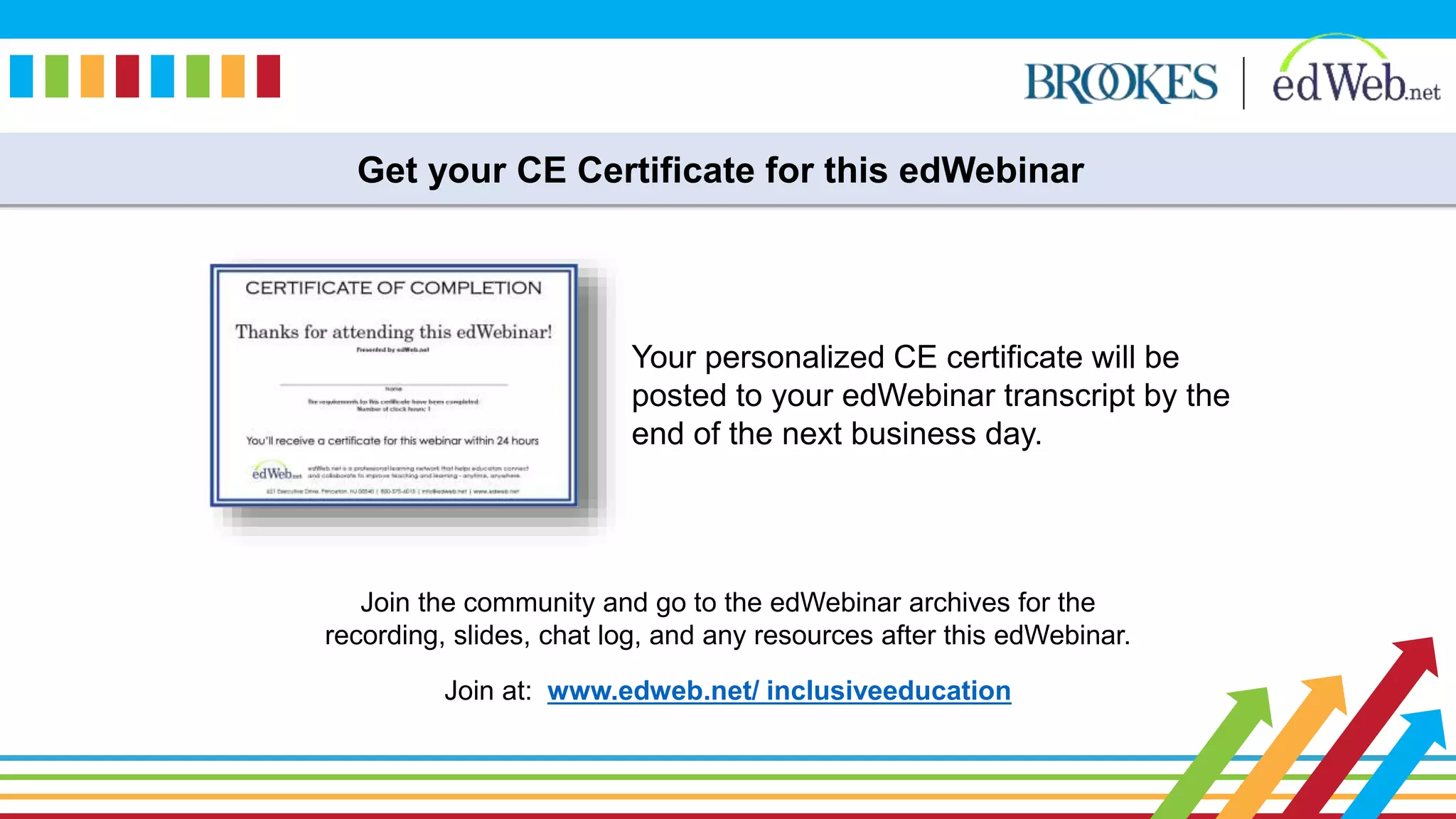
Get your CE Certificate for this edWebinar
Your personalized CE certificate will be
posted to your edWebinar transcript by the
end of the next business day.
Join at: www.edweb.net/ inclusiveeducation
Join the community and go to the edWebinar archives for the
recording, slides, chat log, and any resources after this edWebinar.
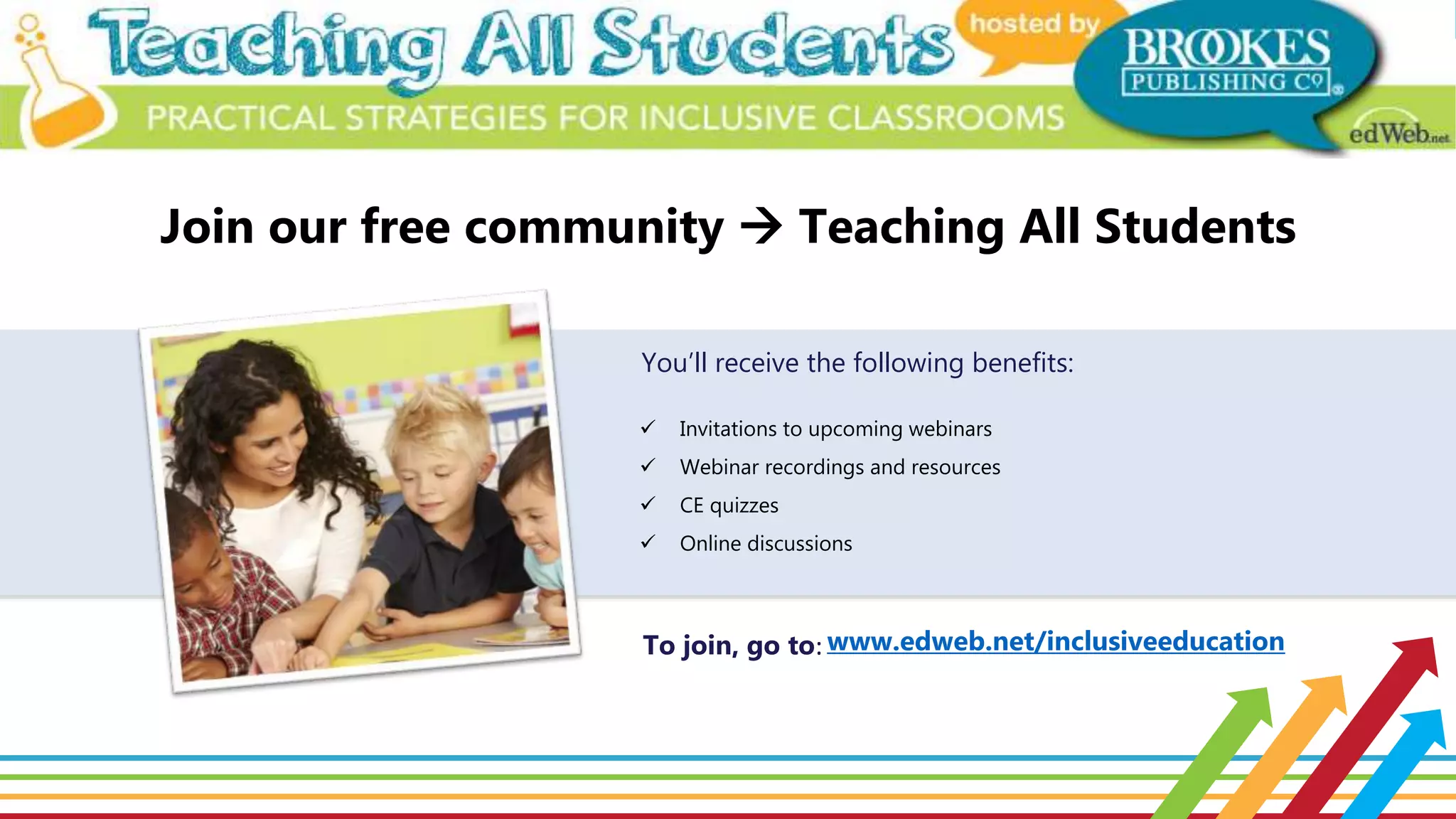
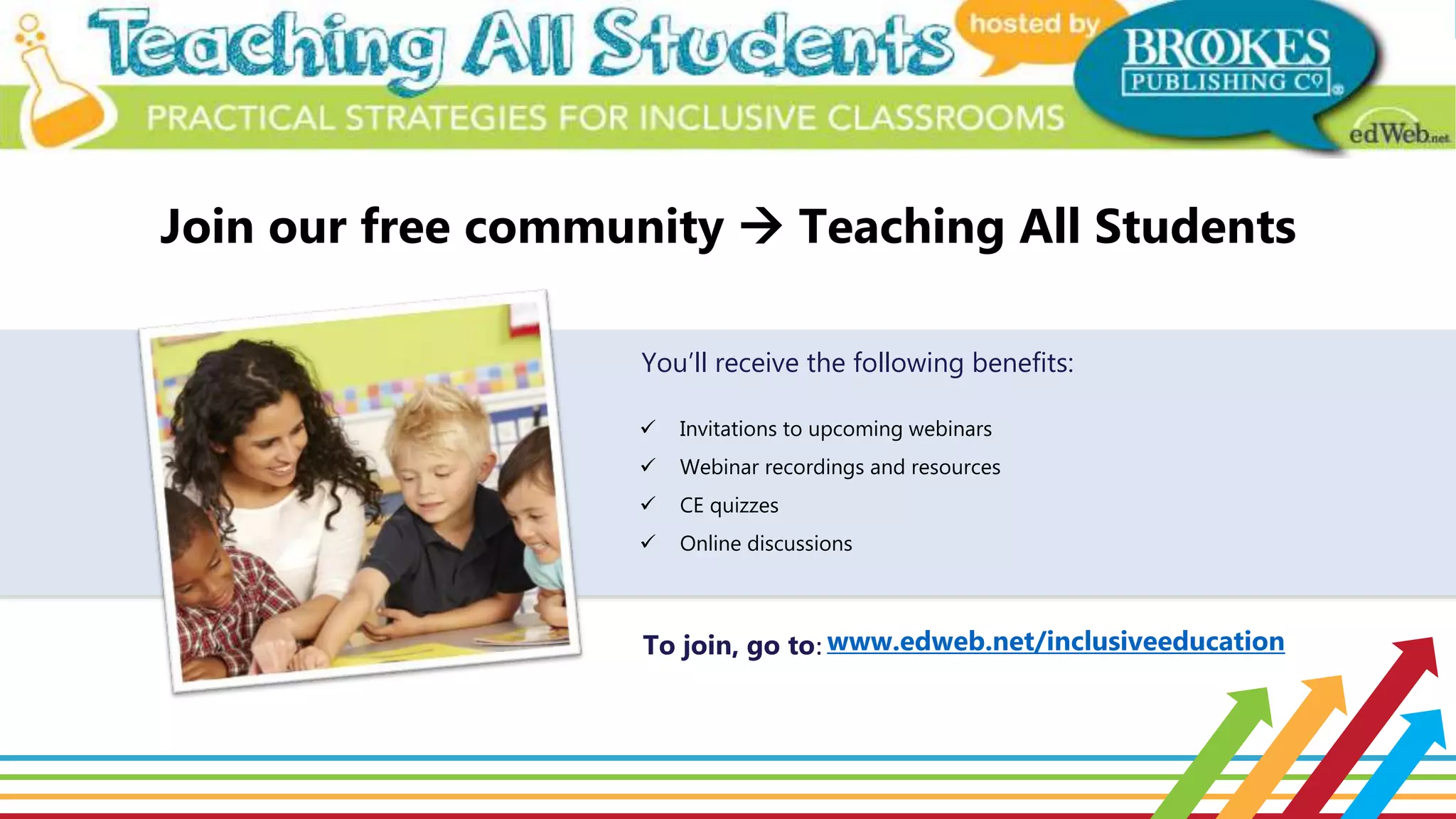
 Invitations to upcoming webinars
 Webinar recordings and resources
 CE quizzes
 Online discussions
www.edweb.net/inclusiveeducation
You’ll receive the following benefits:
Join our free community  Teaching All Students
To join, go to:
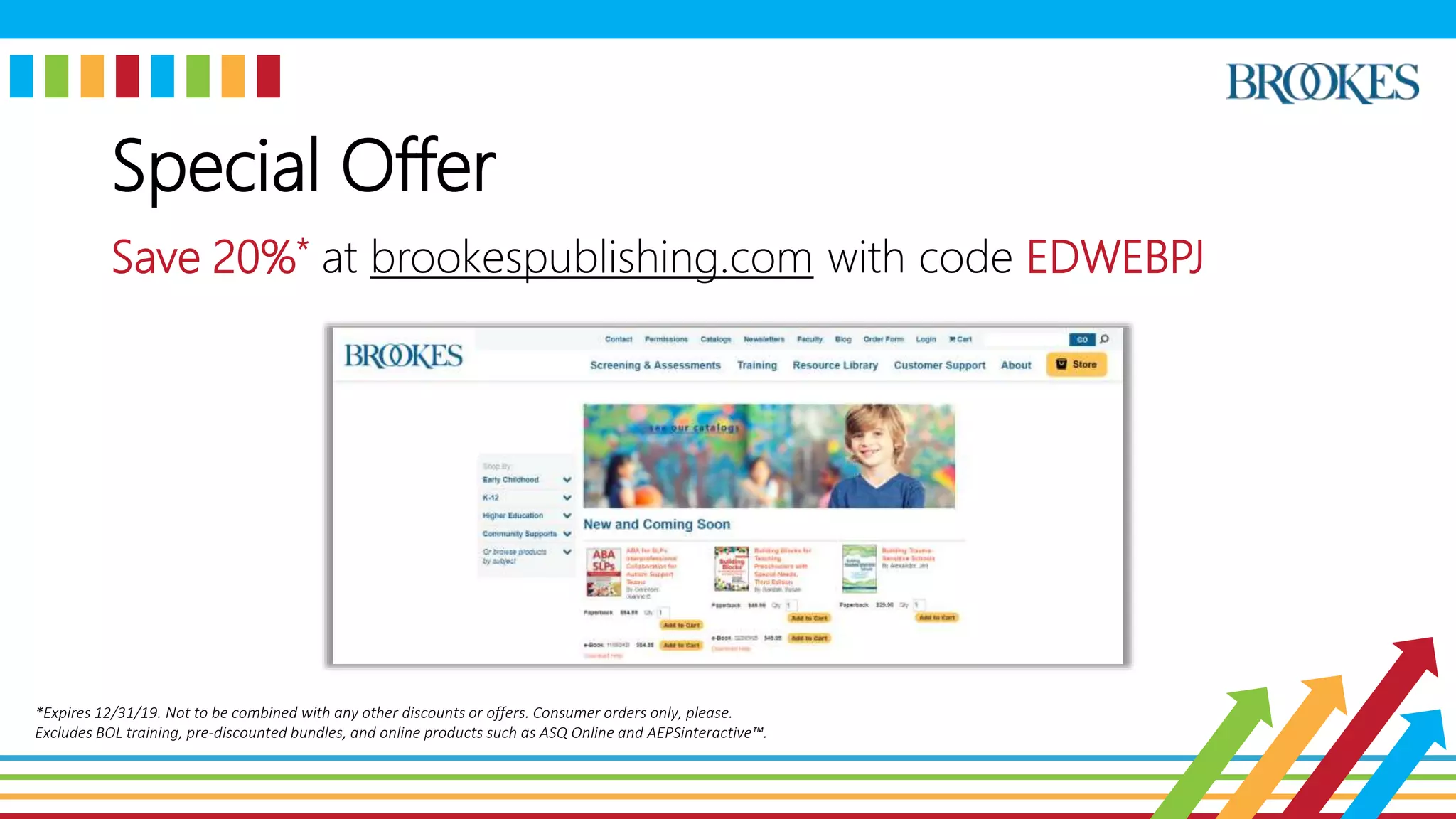
Special Offer
Save 20%* at brookespublishing.com with code EDWEBPJ
*Expires 12/31/19. Not to be combined with any other discounts or offers. Consumer orders only, please.
Excludes BOL training, pre-discounted bundles, and online products such as ASQ Online and AEPSinteractive™.
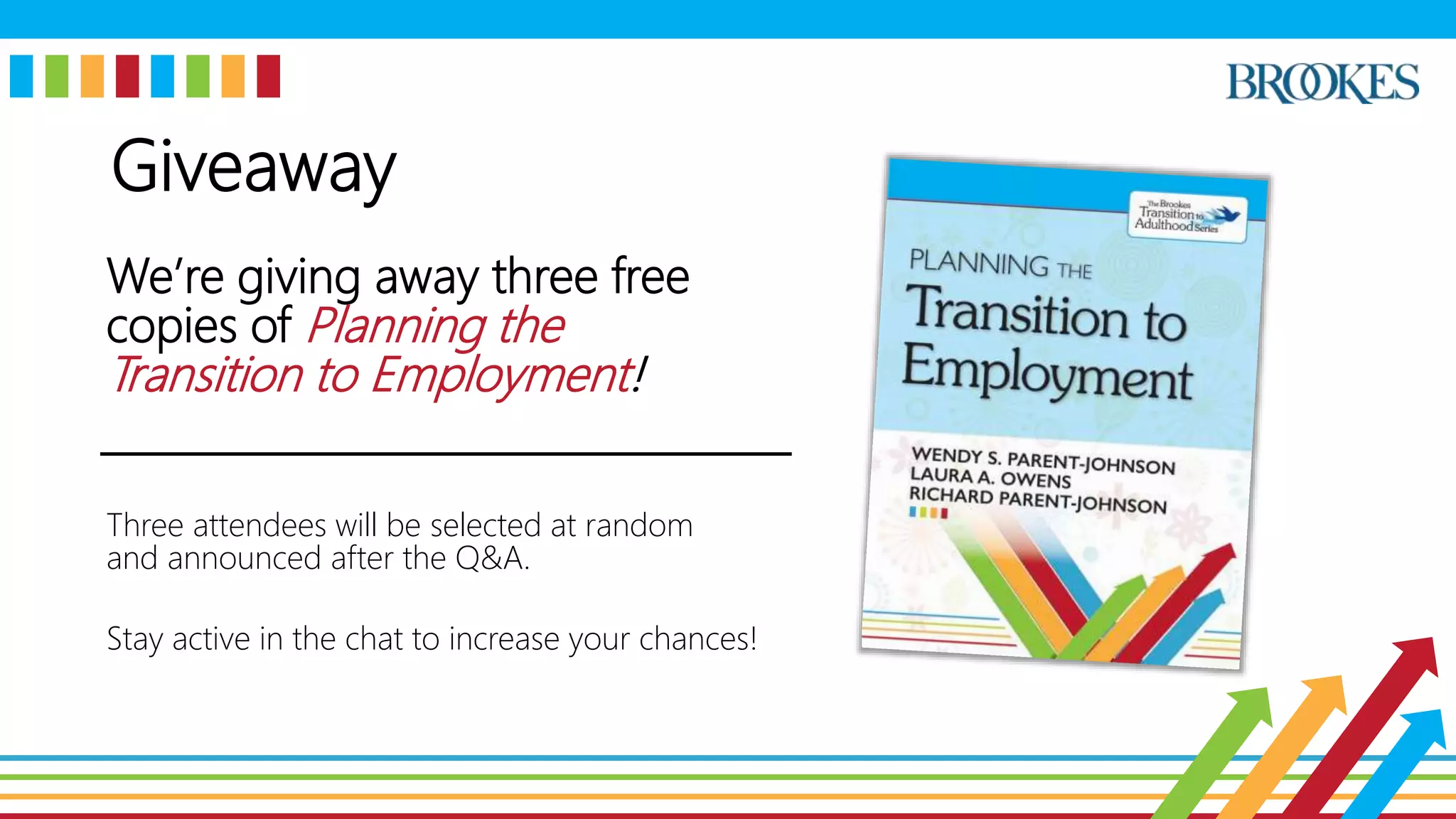
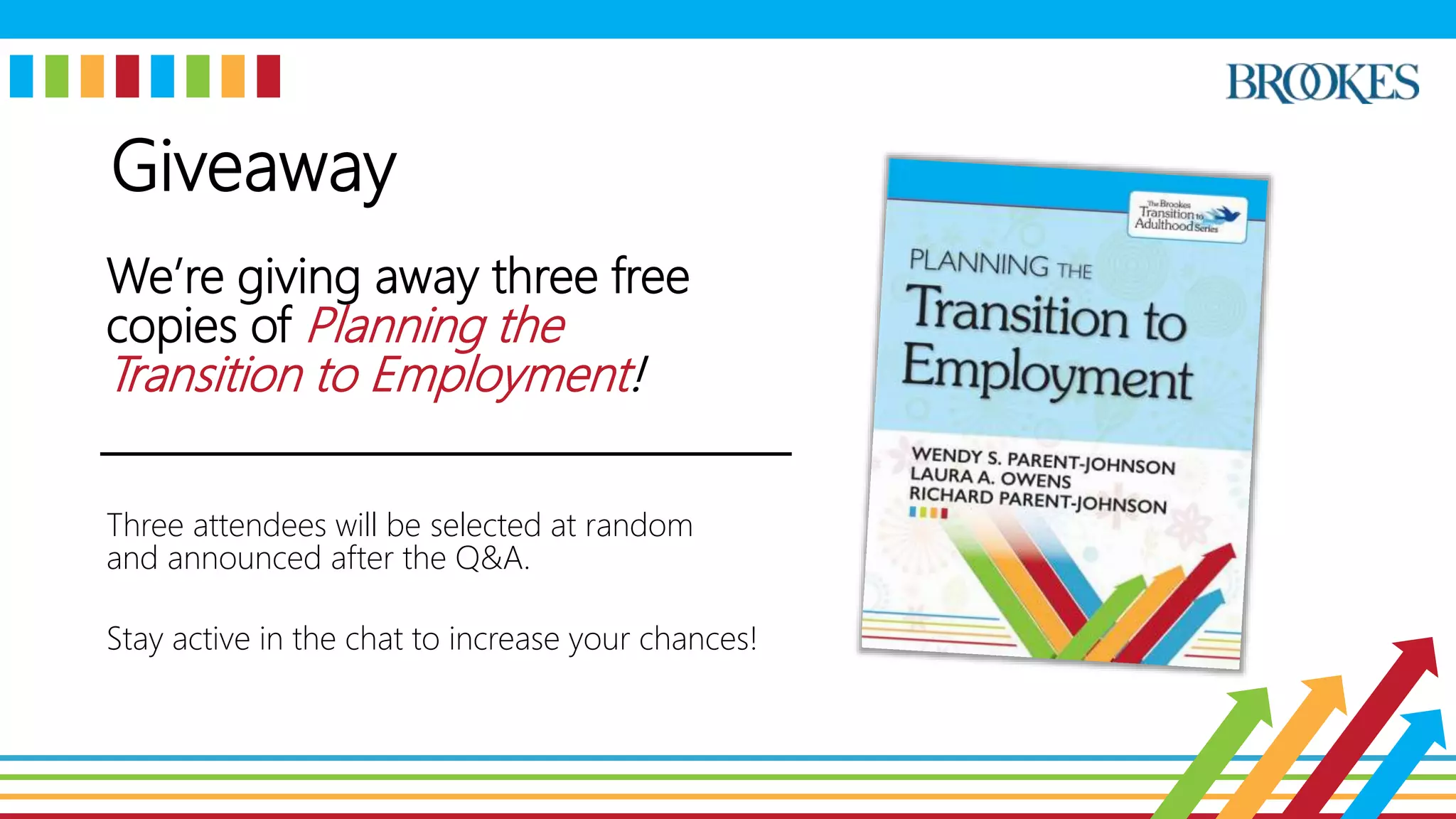
Giveaway
We’re giving away three free
copies of Planning the
Transition to Employment!
Three attendees will be selected at random
and announced after the Q&A.
Stay active in the chat to increase your chances!
Dr. Wendy Parent-Johnson is Executive Director of the Sonoran UCEDD, a Center for Excellence in Developmental Disabilities and
Professor, Department of Family & Community Medicine, College of Medicine at the University of Arizona. She has 37 years’ experience in
areas of supported and customized employment, transition from school to work, and Employment First policy and practice. Additionally,
research, teaching, and grant development has focused on health care transition, health disparities, interdisciplinary health science
and the integration of health and employment. Dr. Parent-Johnson has conducted presentations and trainings; produced journal articles,
book chapters, and other written products; and developed practical tools related to enhancing inclusion, healthcare access, and
outcomes. She is Editor of the Journal of Rehabilitation and a member of the Editorial Board of the Journal of Vocational Rehabilitation.
Dr. Laura Owens-Johnson is currently a professor in the Department of Teaching and Learning at the University of Wisconsin – Milwaukee
(UWM) and the president of TransCen, Inc. (TCI). TCI is an organization based in Maryland that provides direct placement services to
individuals with disabilities, develops and evaluates new service models through research of evidenced-based practices leading to
improved employment outcomes, and provides training and technical assistance to organizations and school districts focusing on the
improvement of educational and employment outcomes for individuals with disabilities. She founded Creative Employment Opportunities,
Inc. (CEO), an employment agency for individuals with disabilities, in Milwaukee, Wisconsin in 1991 and ArtWorks for Milwaukee, a non-
profit jobs-training program in the arts for youth with and without disabilities in 2001. She teaches courses focusing on high school
inclusion, transition from school to work, and customized employment, and coordinates the Graduate Transition Certificate program at
UWM.
Dr. Richard Parent-Johnson retired as a Senior Research Associate in Center for Disabilities in the Sanford School of Medicine, University of
South Dakota. Previously he was a Senior Research Associate in the Center for Research on Learning at the University of Kansas. His
doctorate is in sociology from the University of Kansas. He has been PI or Co-PI on multiple state and federal grants. Recent work focuses
on “systems collaboration” and health care transitions for young adults with disabilities, including interprofessional medical education and
clinical practice. He co-designed and led USD’s Center for Disabilities TransitionInAction Clinic. He continues to consult in these areas.
Other work focused on the iterative design and dissemination of “universal” curricular products and processes that serve transition needs
of persons with disabilities [e.g., the Soaring to New Heights curriculum for high school aged students with disabilities]. Dr. Parent-Johnson
has particular expertise in ethnographic research and qualitative analysis.
Planning the Transition to
Employment
Tips, Tools, and Strategies
Dr. Wendy Parent-Johnson | Dr. Laura Owens | Dr. Richard Parent-Johnson
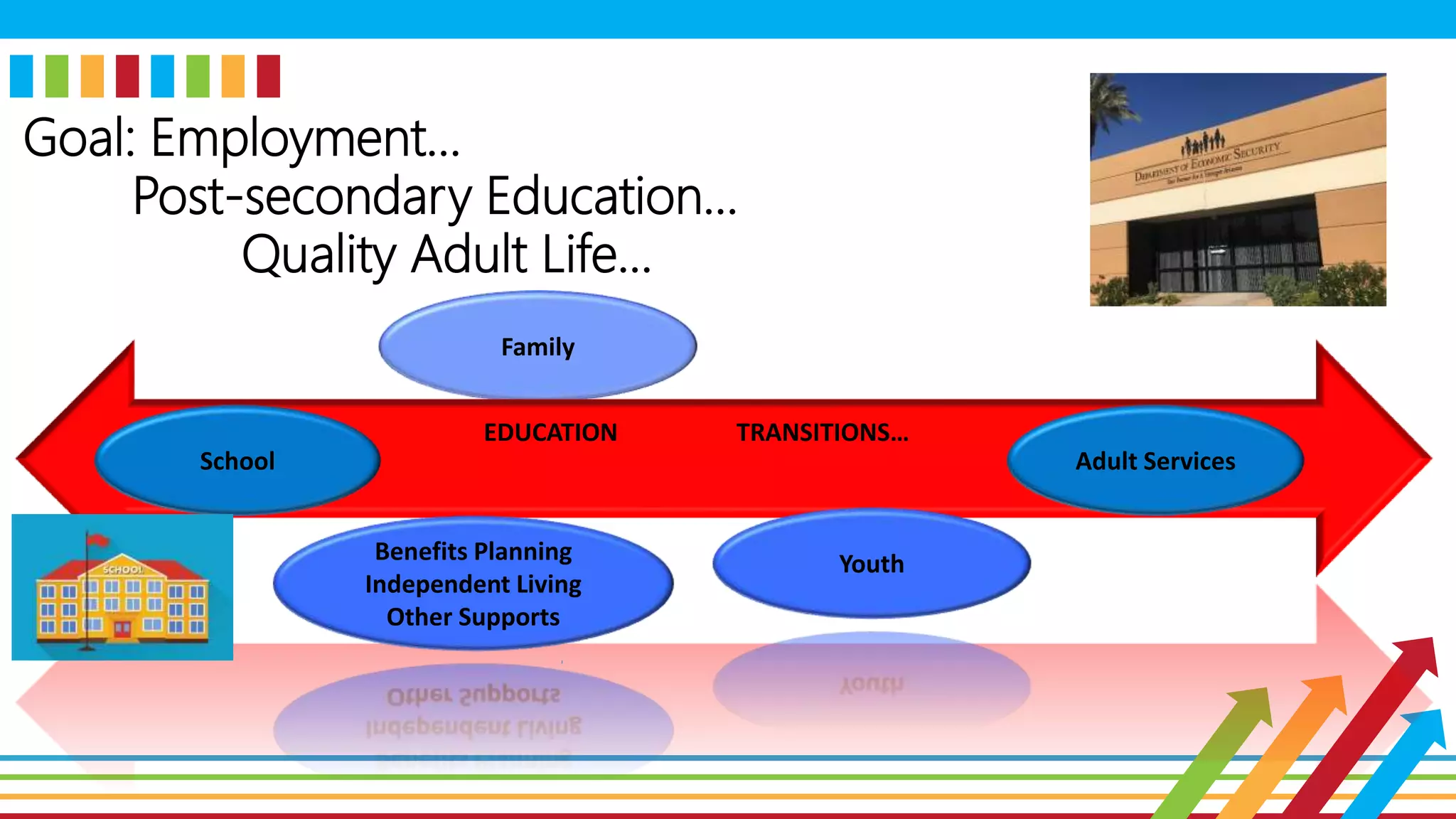
Family
School Adult Services
Benefits Planning
Independent Living
Other Supports
EDUCATION TRANSITIONS…
Youth
Goal: Employment…
Post-secondary Education…
Quality Adult Life…
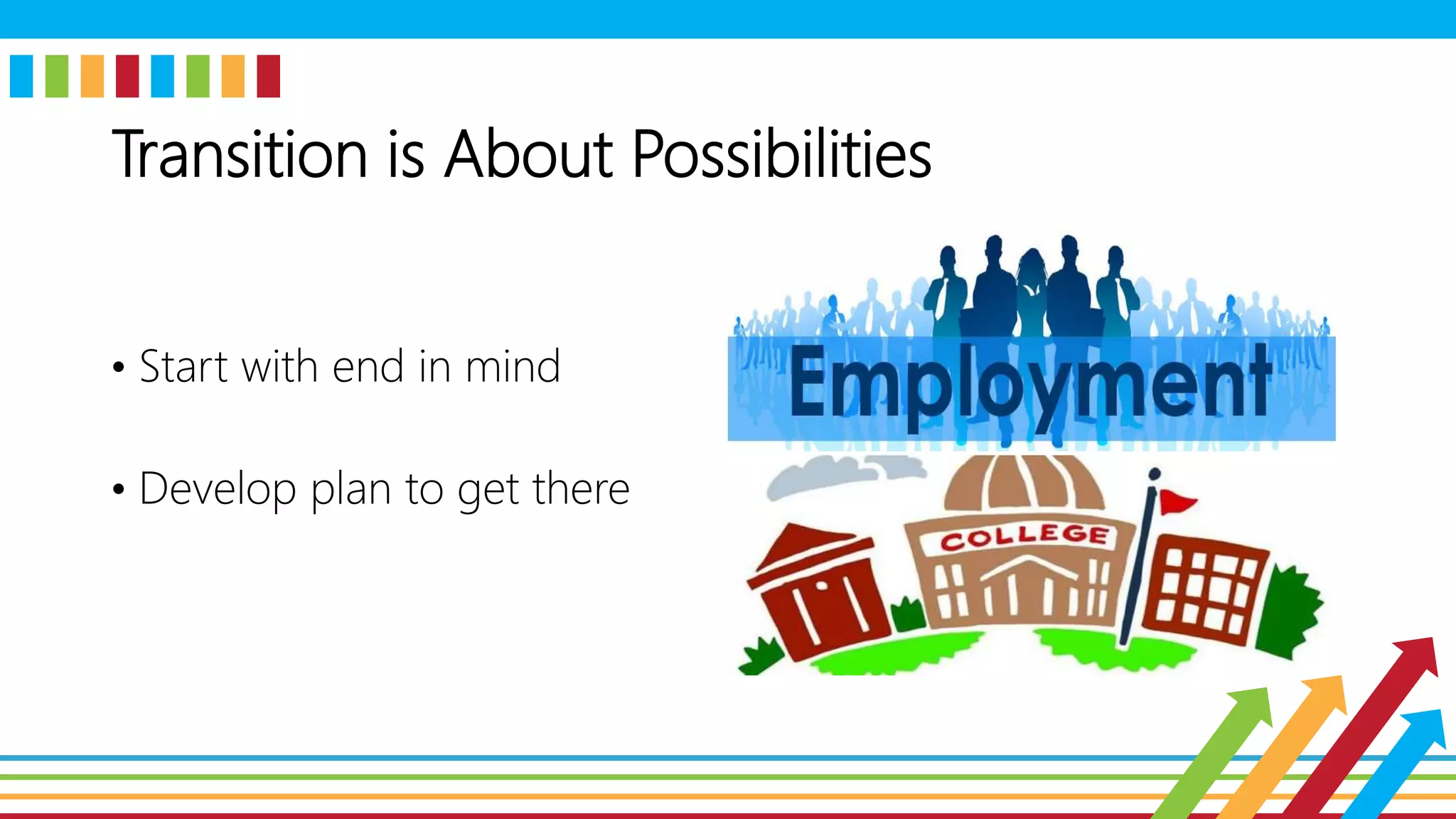
Transition is About Possibilities
• Start with end in mind
• Develop plan to get there
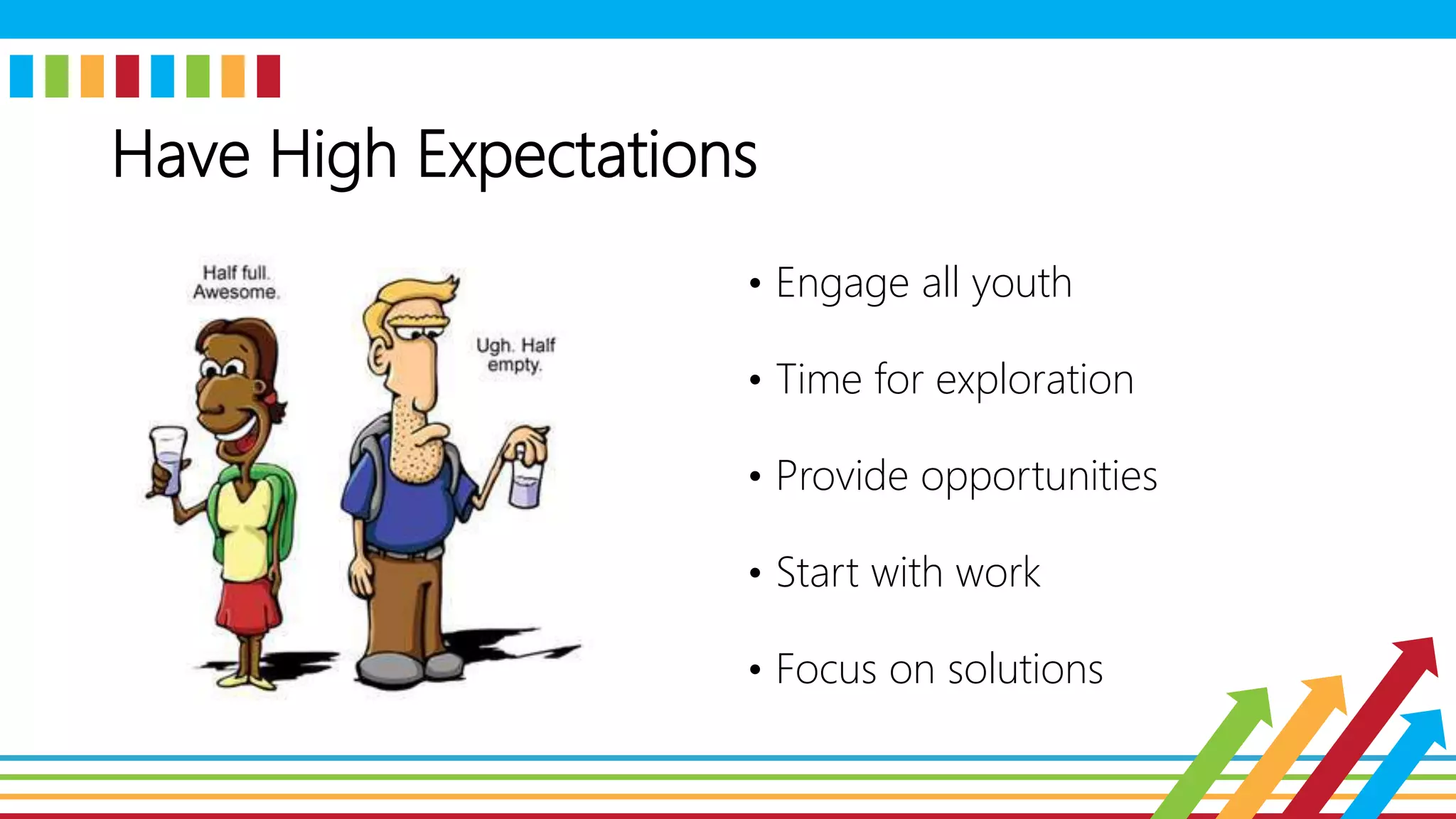
Have High Expectations
• Engage all youth
• Time for exploration
• Provide opportunities
• Start with work
• Focus on solutions
Current
Influences
• Employment First
Initiatives
• Workforce Innovation
& Opportunity Act of
2014
• Centers for Medicaid
& Medicare/HCBS
Regulations
• High Unemployment
Rates
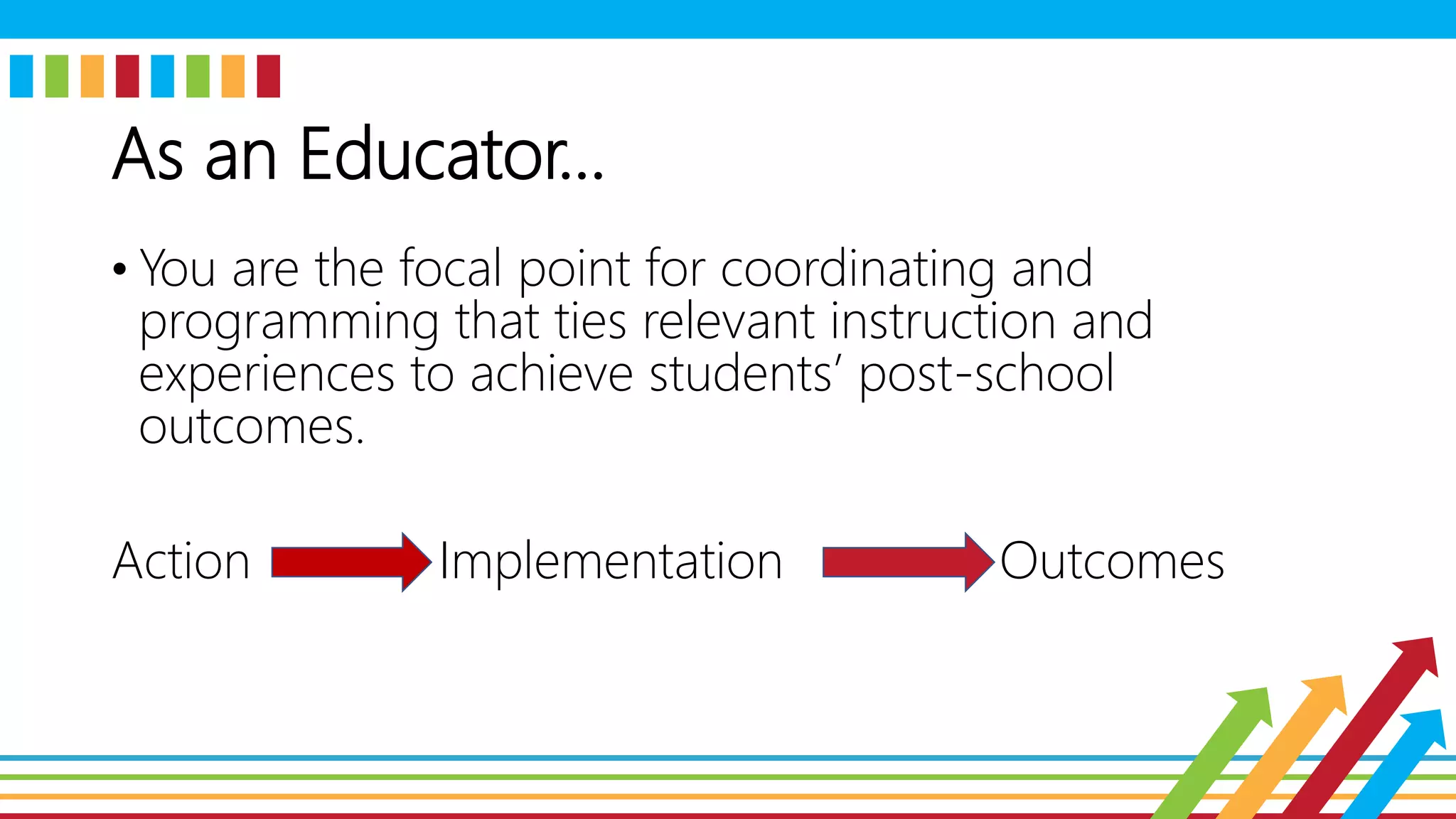
As an Educator…
• You are the focal point for coordinating and
programming that ties relevant instruction and
experiences to achieve students’ post-school
outcomes.
Action Implementation Outcomes
Collaboration and Competence
• We argue for a shift from a “cooperating” model to a
“collaborating” model of professional practice for supporting
transitions.
• Where a small inter-professional team commits to working
“collectively” to build and support a set of teaching and learning
practices that produce effective transitions…
AND…
• Where each student is actively and consistently engaged in activities
that build and support their sense of competence in making
successful transitions.
Collaboration as Collective Effort
• Five elements needed to create and sustain success:
• A common agenda
• Mutually reinforcing activities
• Continuous communication
• Shared measures of success
• A support structure
Putting the Student Front and
Center
Self-Determination requires Self-Efficacy
• Self-efficacy is the “sense of being capable” of actually doing
what is expected of you.
• The key to transition activities is to find ways to support and
enhance each student’s experience of being capable of doing
what is needed to make successful transitions.
• In particular, 1] “modeling” what is expected, 2] providing role-
playing activities, and 3] providing “elaborated feedback on
their performance are valuable strategies.
What is Person Centered Planning?
• Person-centered planning is a process-oriented approach to
empowering students disabilities. It focuses on the individual
and their needs by putting them in charge of defining the
direction for their lives, not on the systems that may or may
not be available to serve them.
• This ultimately leads to greater inclusion as valued members of
both community and society.
Best Practices in Person-Centered
Discovery & Planning
Person-centered planning
does not ignore disability, it
simply shifted the
emphasis to a search for
capacity in the person,
among the person’s friends
and family, in the person’s
community, and among
service workers.
-John O’Brien
•Services and supports are based on dreams;
interests, and preferences; strengths and
capacities
•The person with a disability is included in
planning and empowered to lead and make
informed decisions
•The person with a disability has meaningful
choices
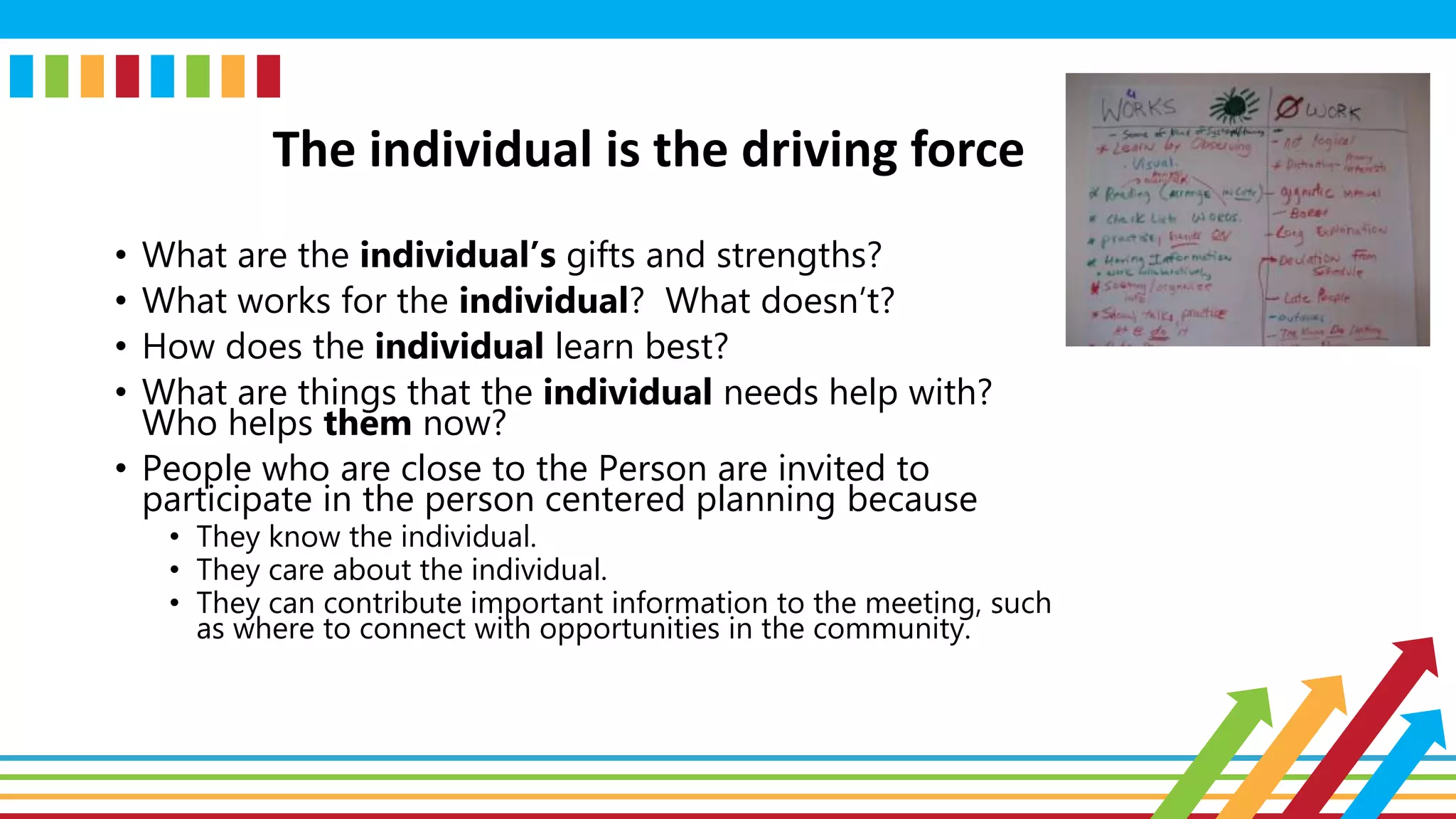
The individual is the driving force
• What are the individual’s gifts and strengths?
• What works for the individual? What doesn’t?
• How does the individual learn best?
• What are things that the individual needs help with?
Who helps them now?
• People who are close to the Person are invited to
participate in the person centered planning because
• They know the individual.
• They care about the individual.
• They can contribute important information to the meeting, such
as where to connect with opportunities in the community.
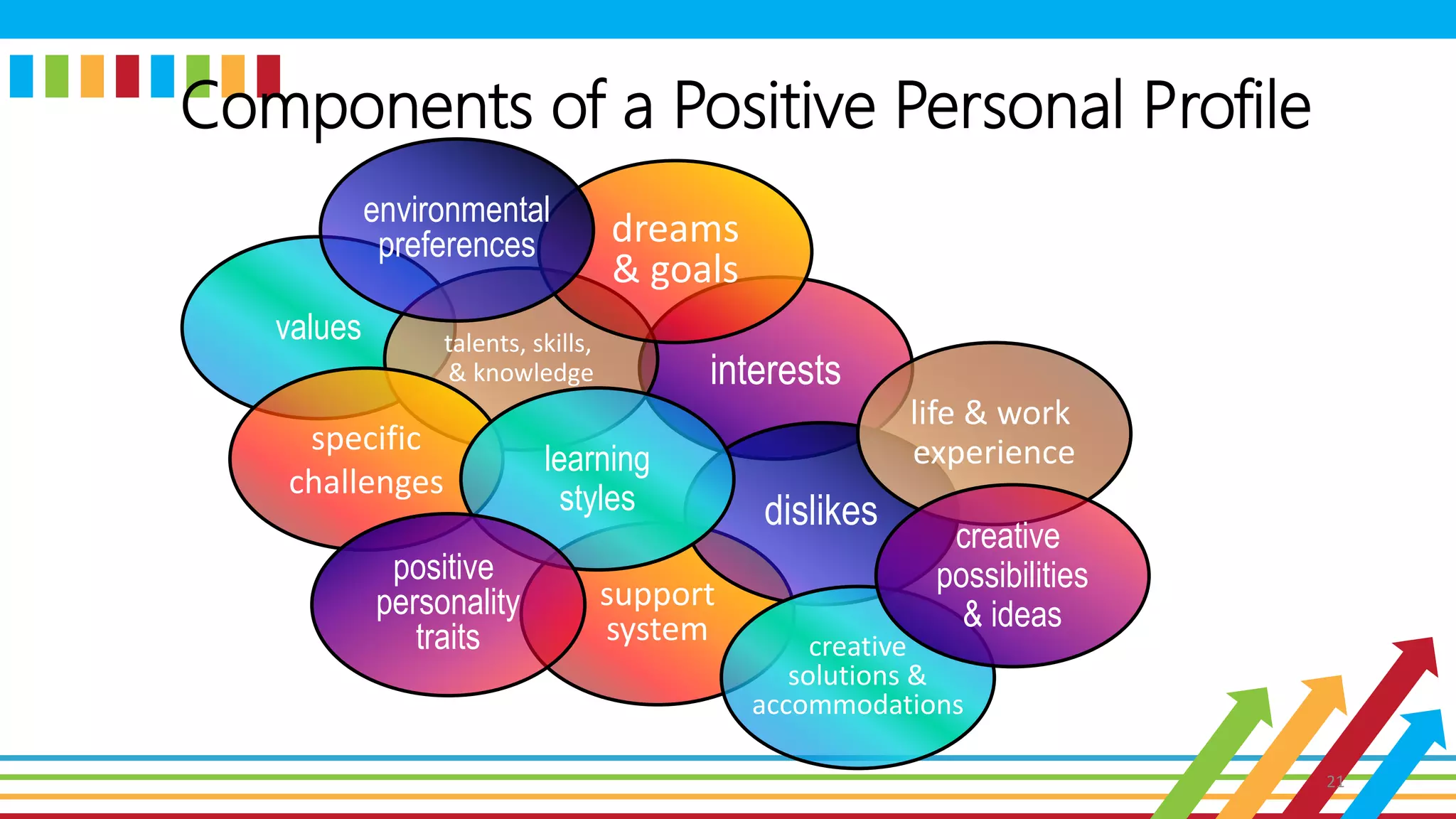
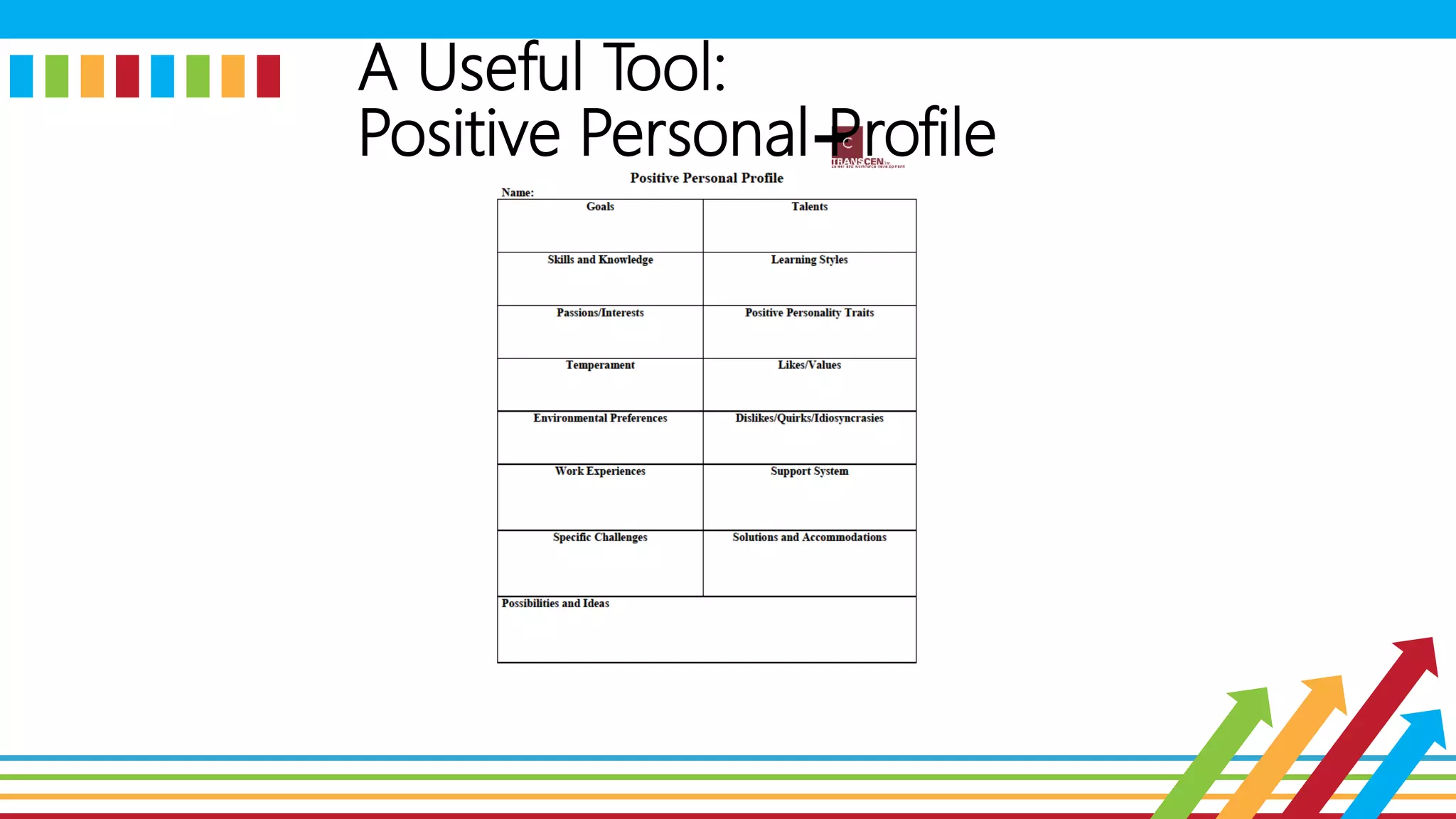
Components of a Positive Personal Profile
values
interests
support
system
talents, skills,
& knowledge
dislikes
creative
solutions &
accommodations
specific
challenges
learning
styles
positive
personality
traits
life & work
experience
dreams
& goals
environmental
preferences
creative
possibilities
& ideas
21
A Useful Tool:
Positive Personal Profile
How Can a PPP be Used?
• Developing resumes
• Preparing for interviews
• Developing goals for an individualized education plan
• Determining further assessments or work experiences
• Determining which businesses to approach
• Develop “features” to “benefits”
23
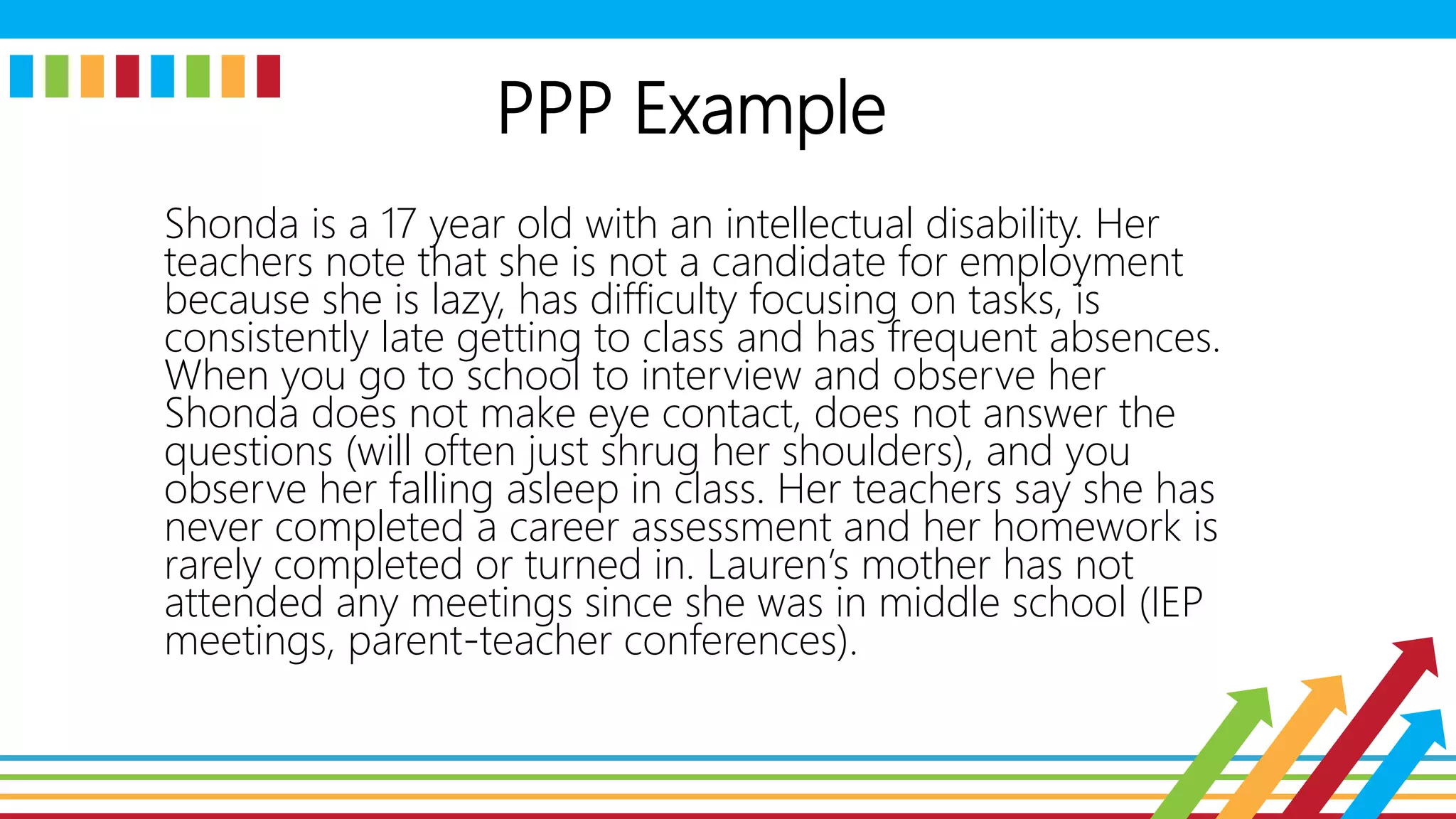
PPP Example
Shonda is a 17 year old with an intellectual disability. Her
teachers note that she is not a candidate for employment
because she is lazy, has difficulty focusing on tasks, is
consistently late getting to class and has frequent absences.
When you go to school to interview and observe her
Shonda does not make eye contact, does not answer the
questions (will often just shrug her shoulders), and you
observe her falling asleep in class. Her teachers say she has
never completed a career assessment and her homework is
rarely completed or turned in. Lauren’s mother has not
attended any meetings since she was in middle school (IEP
meetings, parent-teacher conferences).
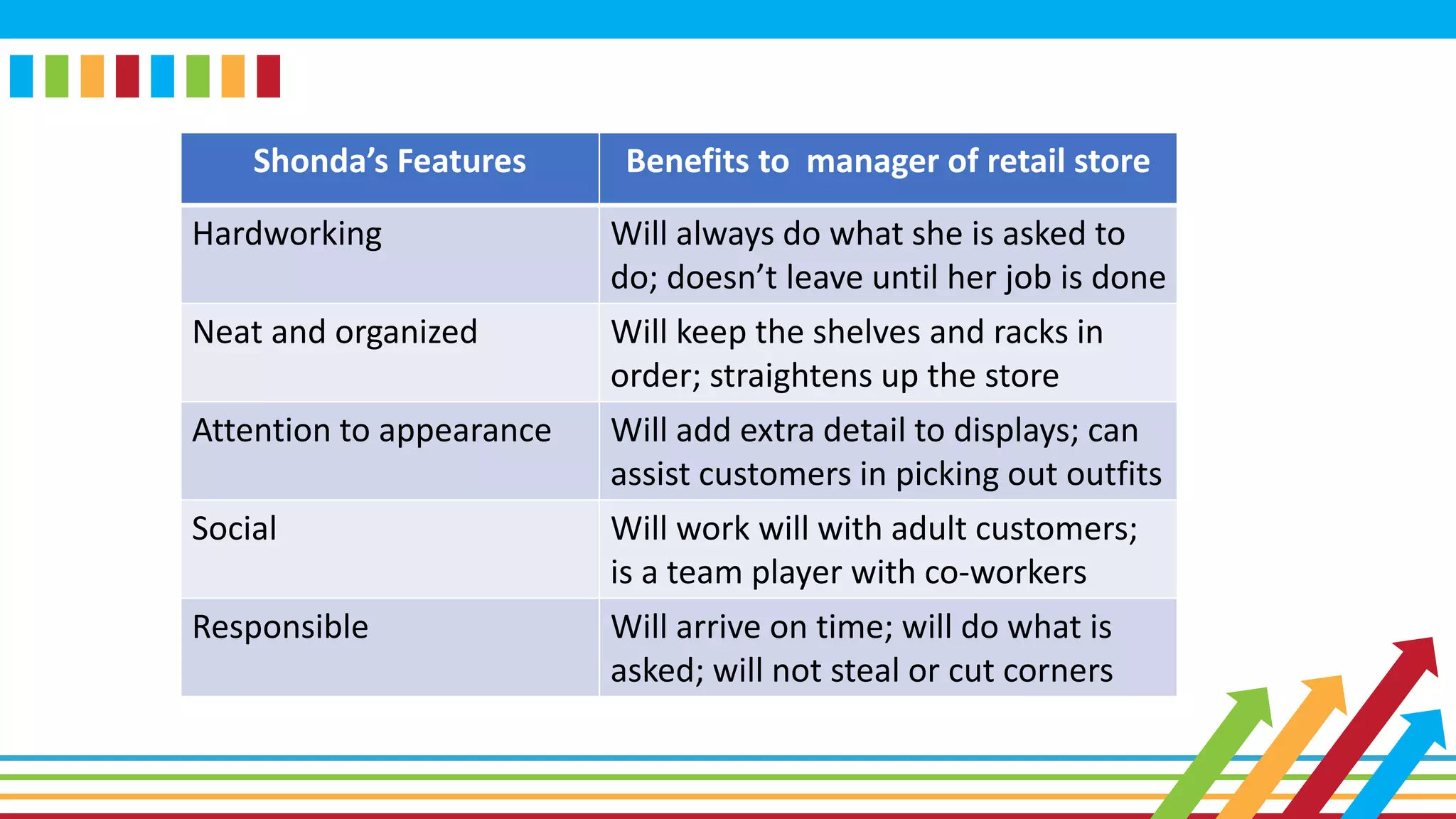
Shonda’s Features Benefits to manager of retail store
Hardworking Will always do what she is asked to
do; doesn’t leave until her job is done
Neat and organized Will keep the shelves and racks in
order; straightens up the store
Attention to appearance Will add extra detail to displays; can
assist customers in picking out outfits
Social Will work will with adult customers;
is a team player with co-workers
Responsible Will arrive on time; will do what is
asked; will not steal or cut corners
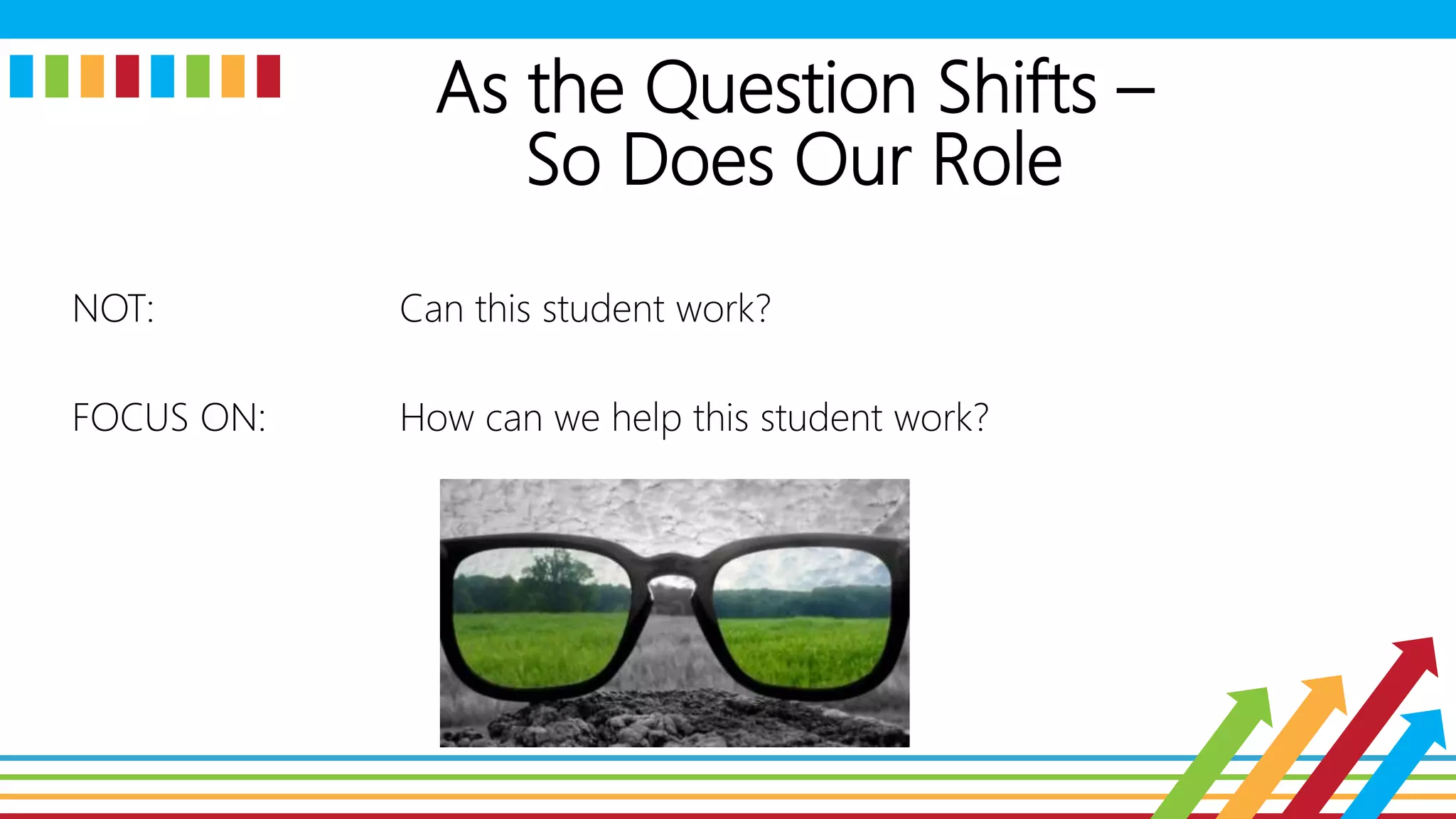
As the Question Shifts –
So Does Our Role
NOT: Can this student work?
FOCUS ON: How can we help this student work?
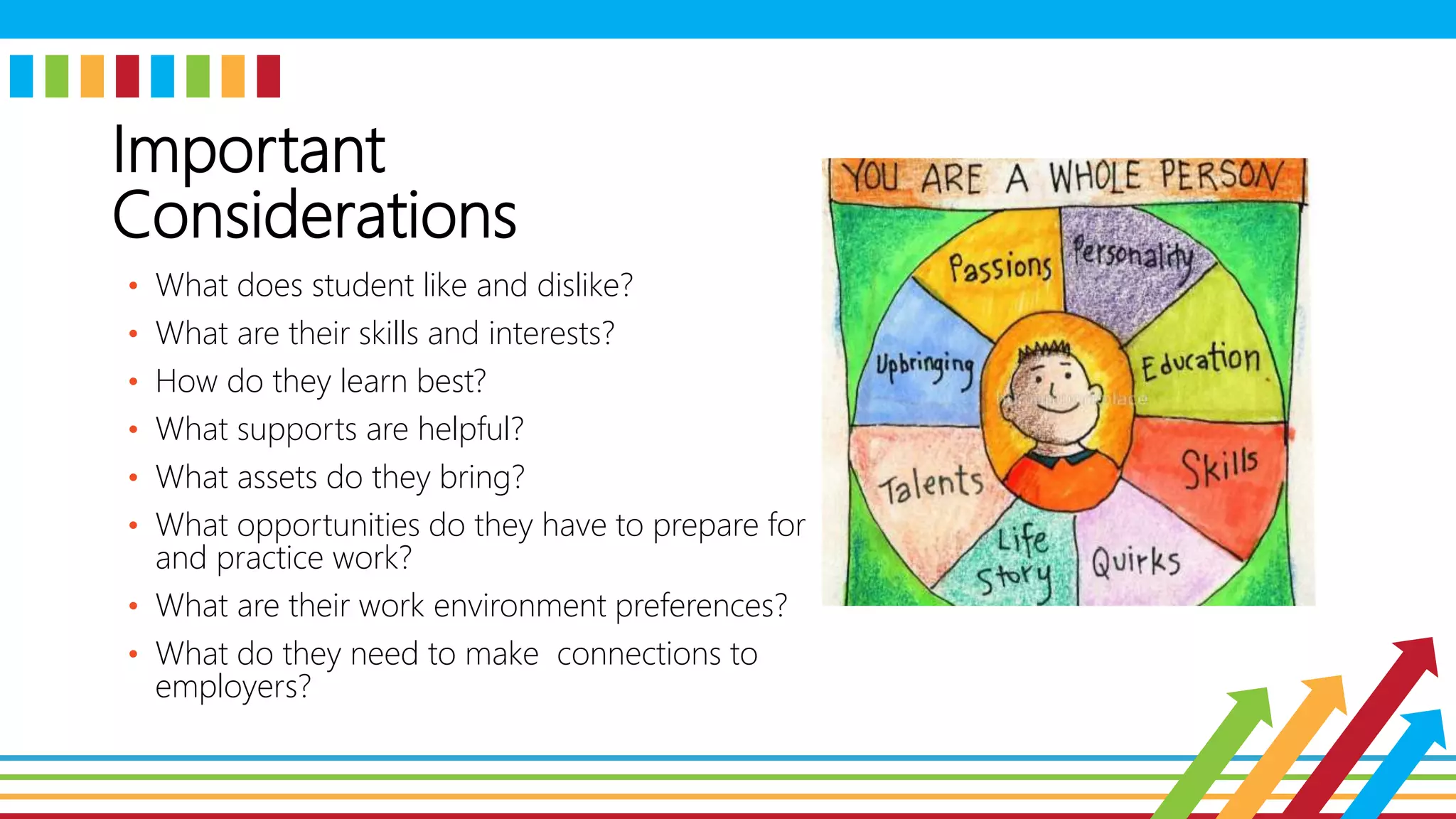
Important
Considerations
• What does student like and dislike?
• What are their skills and interests?
• How do they learn best?
• What supports are helpful?
• What assets do they bring?
• What opportunities do they have to prepare for
and practice work?
• What are their work environment preferences?
• What do they need to make connections to
employers?
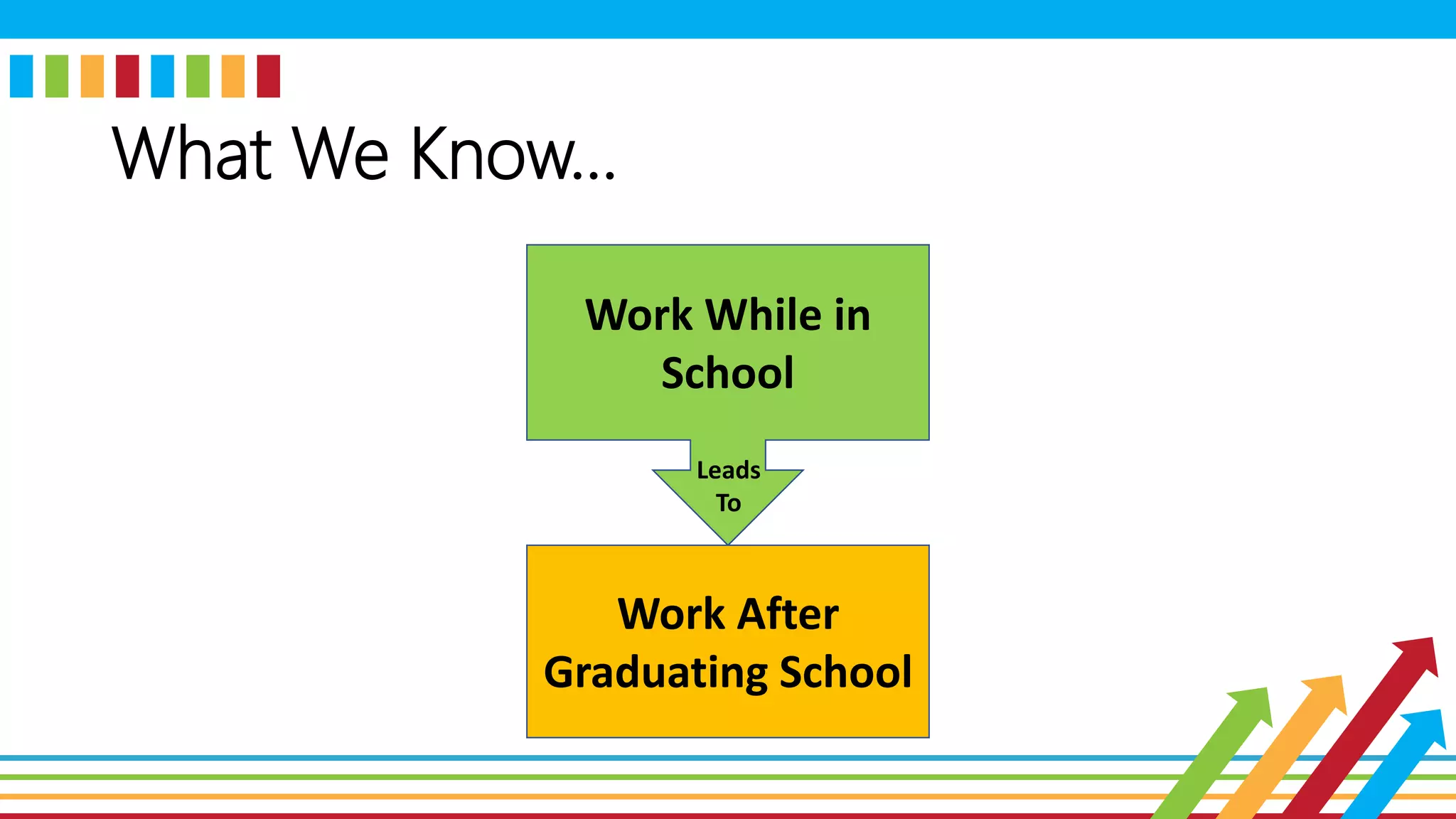
What We Know…
Work While in
School
Work After
Graduating School
Leads
To
Work Based Learning Experiences
• School-based enterprises
• On-the job training
• Job Shadowing
• Internships & Apprenticeships
• Paid employment
• Career & Technical Education
• Summer & After School Employment
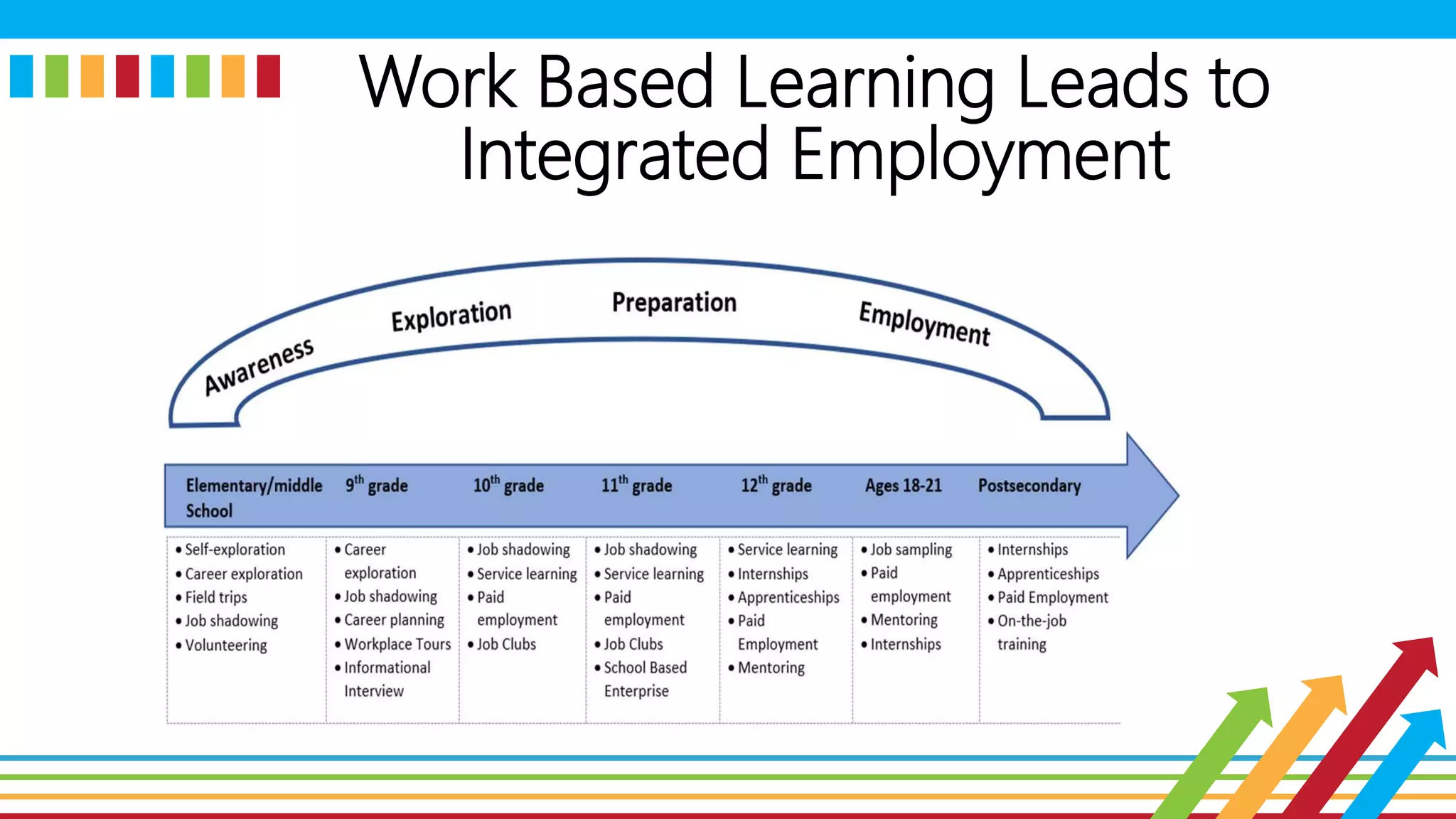
Work Based Learning Leads to
Integrated Employment
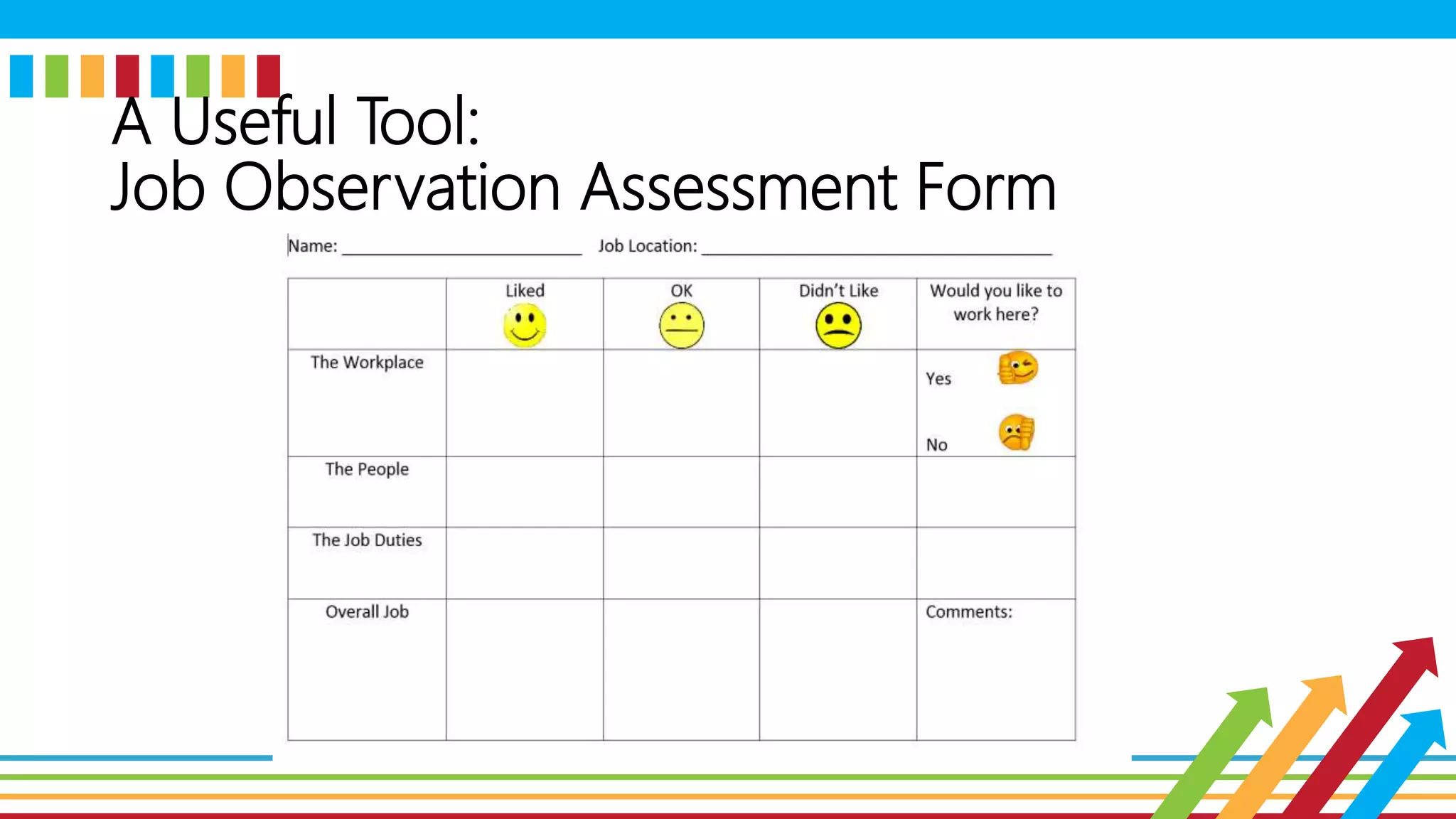
A Useful Tool:
Job Observation Assessment Form
Customized Employment
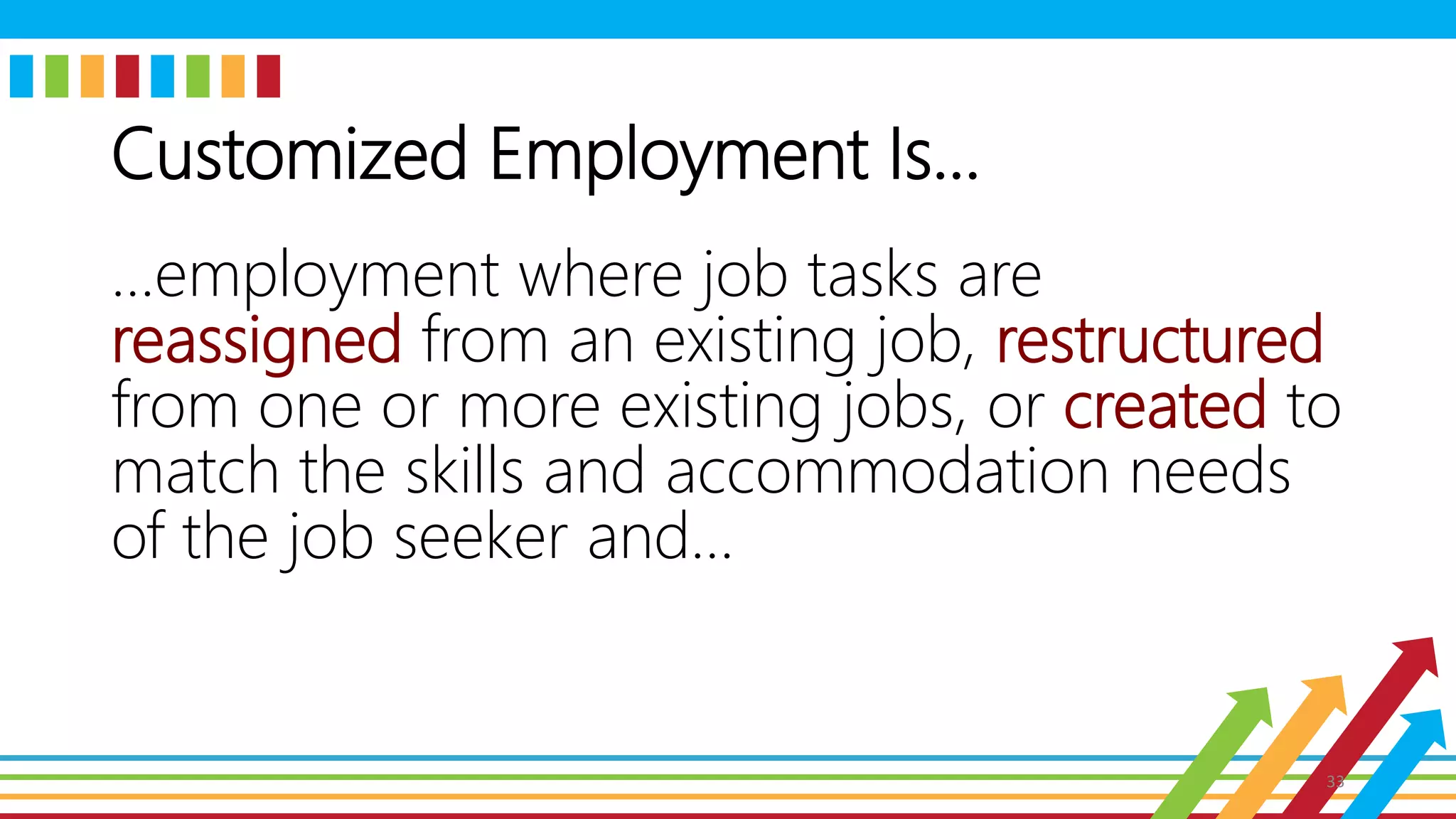
Customized Employment Is…
…employment where job tasks are
reassigned from an existing job, restructured
from one or more existing jobs, or created to
match the skills and accommodation needs
of the job seeker and…
33
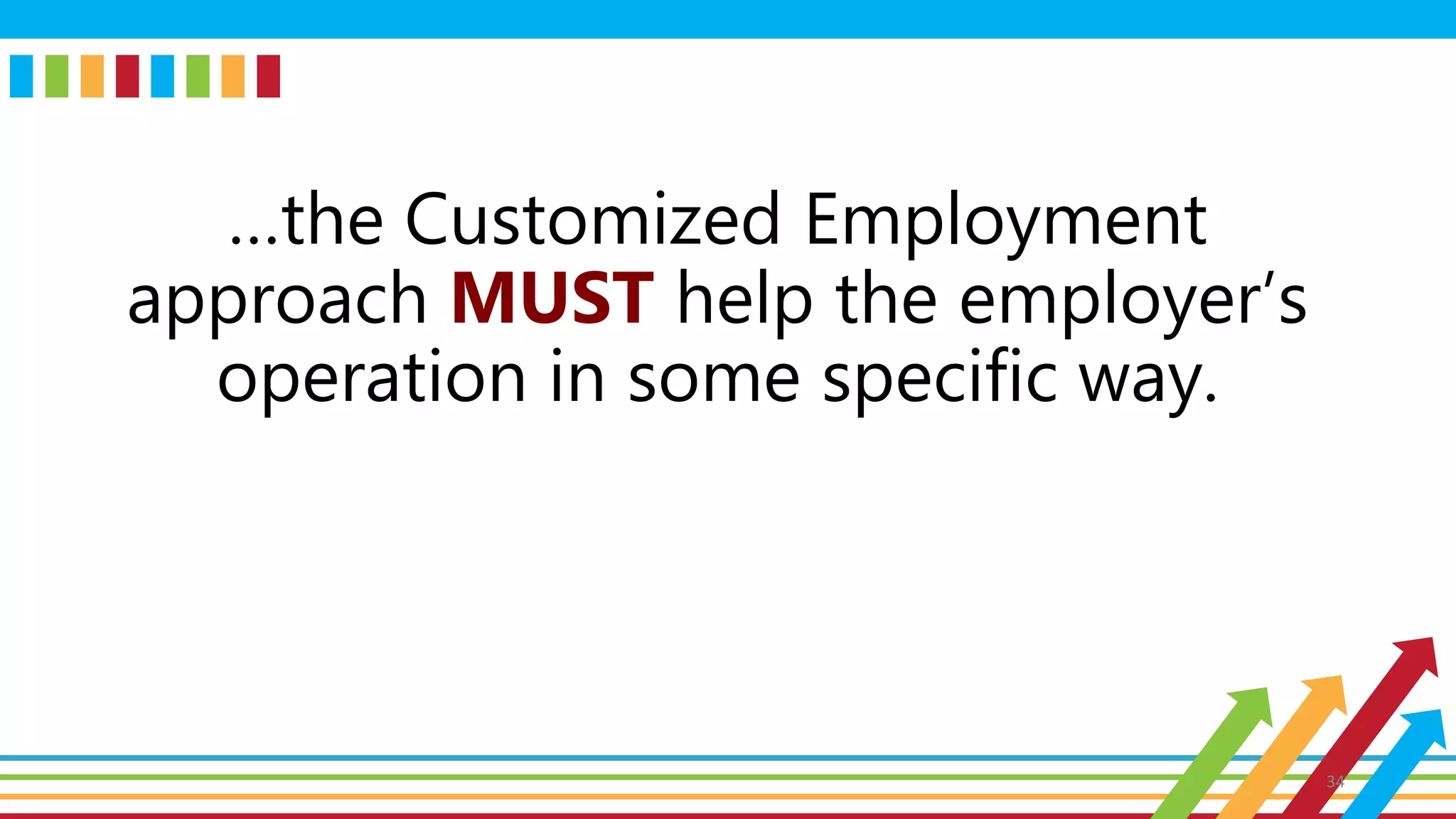
…the Customized Employment
approach MUST help the employer’s
operation in some specific way.
34
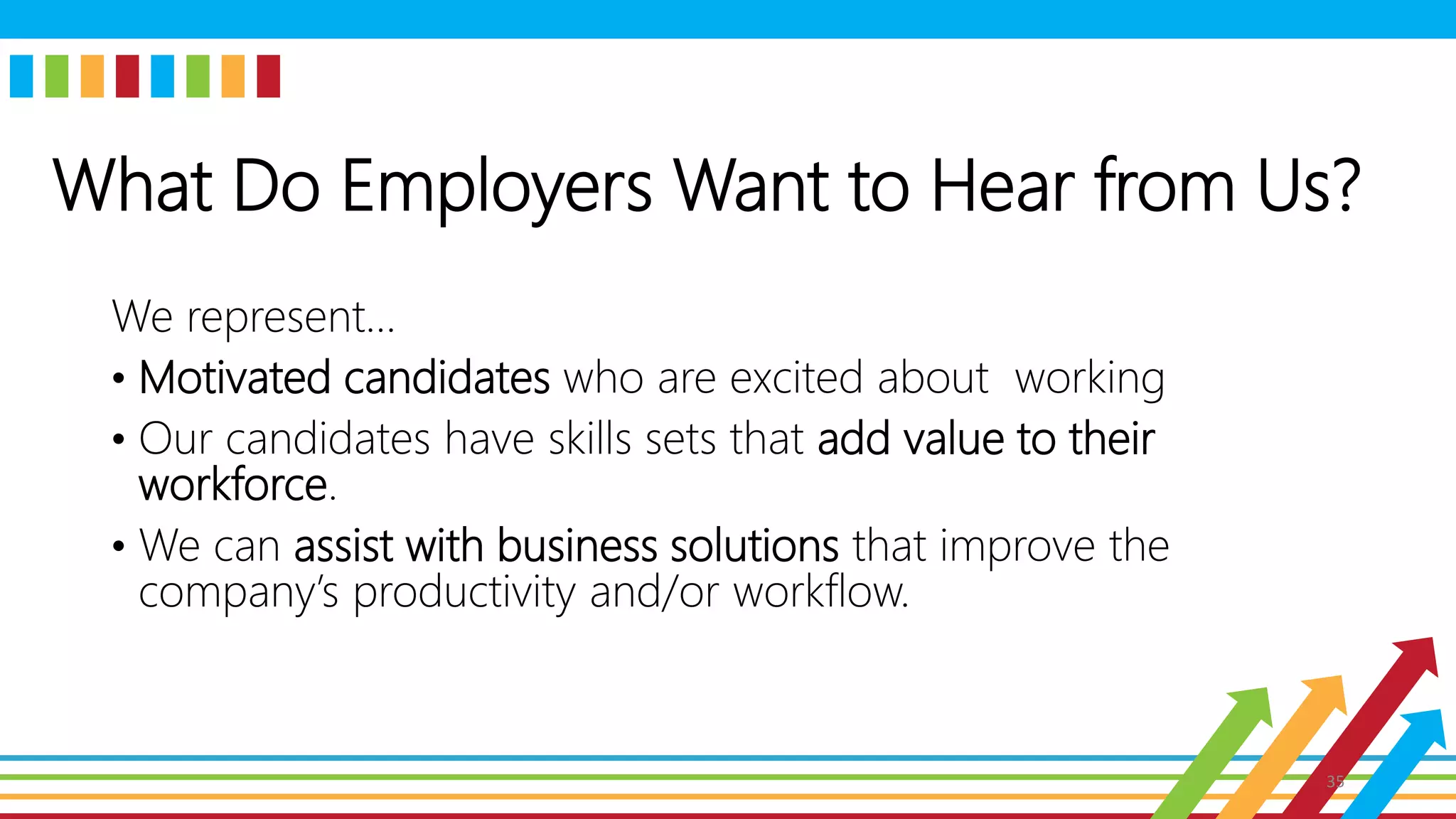
What Do Employers Want to Hear from Us?
We represent…
• Motivated candidates who are excited about working
• Our candidates have skills sets that add value to their
workforce.
• We can assist with business solutions that improve the
company’s productivity and/or workflow.
35
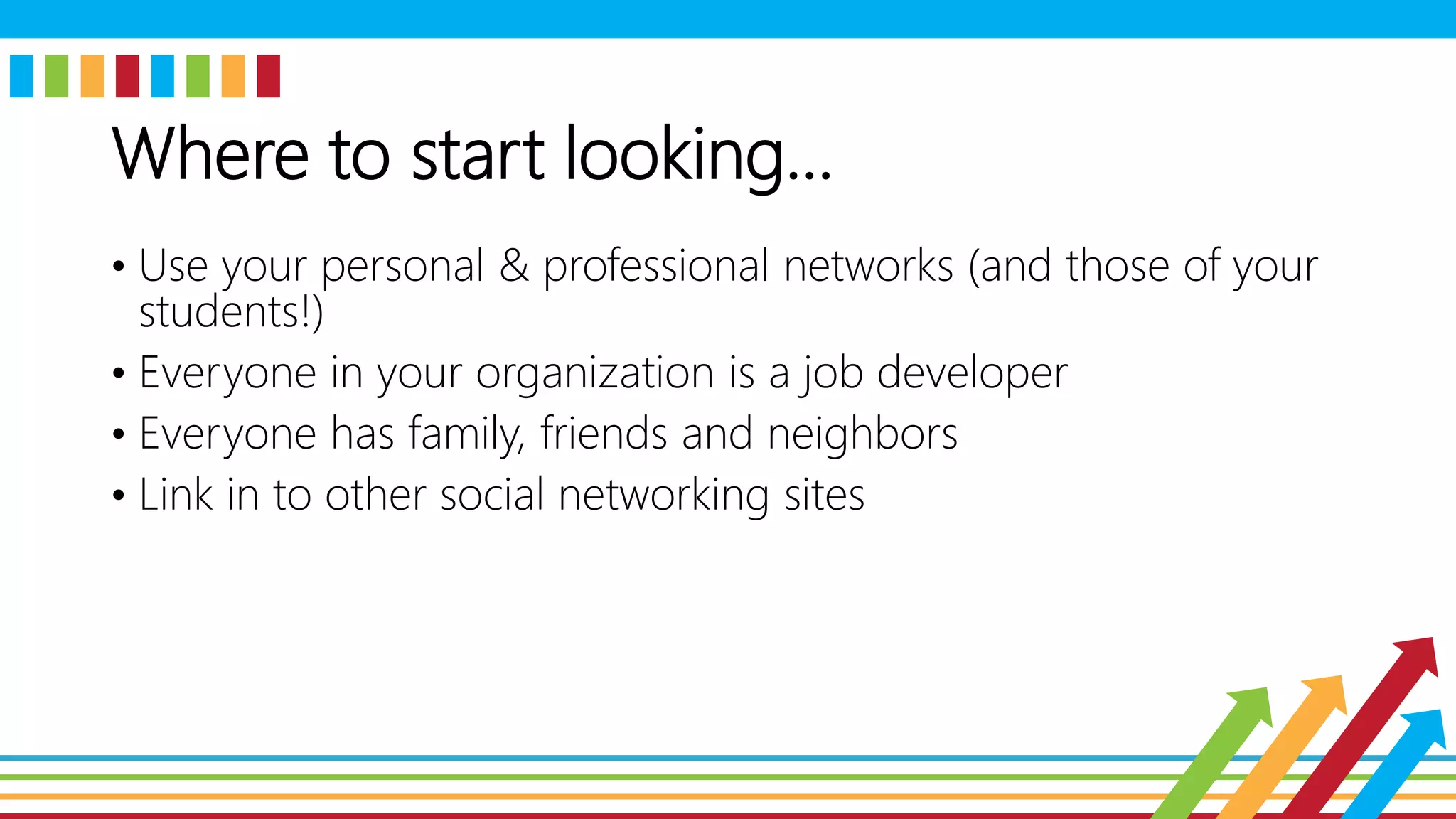
Where to start looking…
• Use your personal & professional networks (and those of your
students!)
• Everyone in your organization is a job developer
• Everyone has family, friends and neighbors
• Link in to other social networking sites
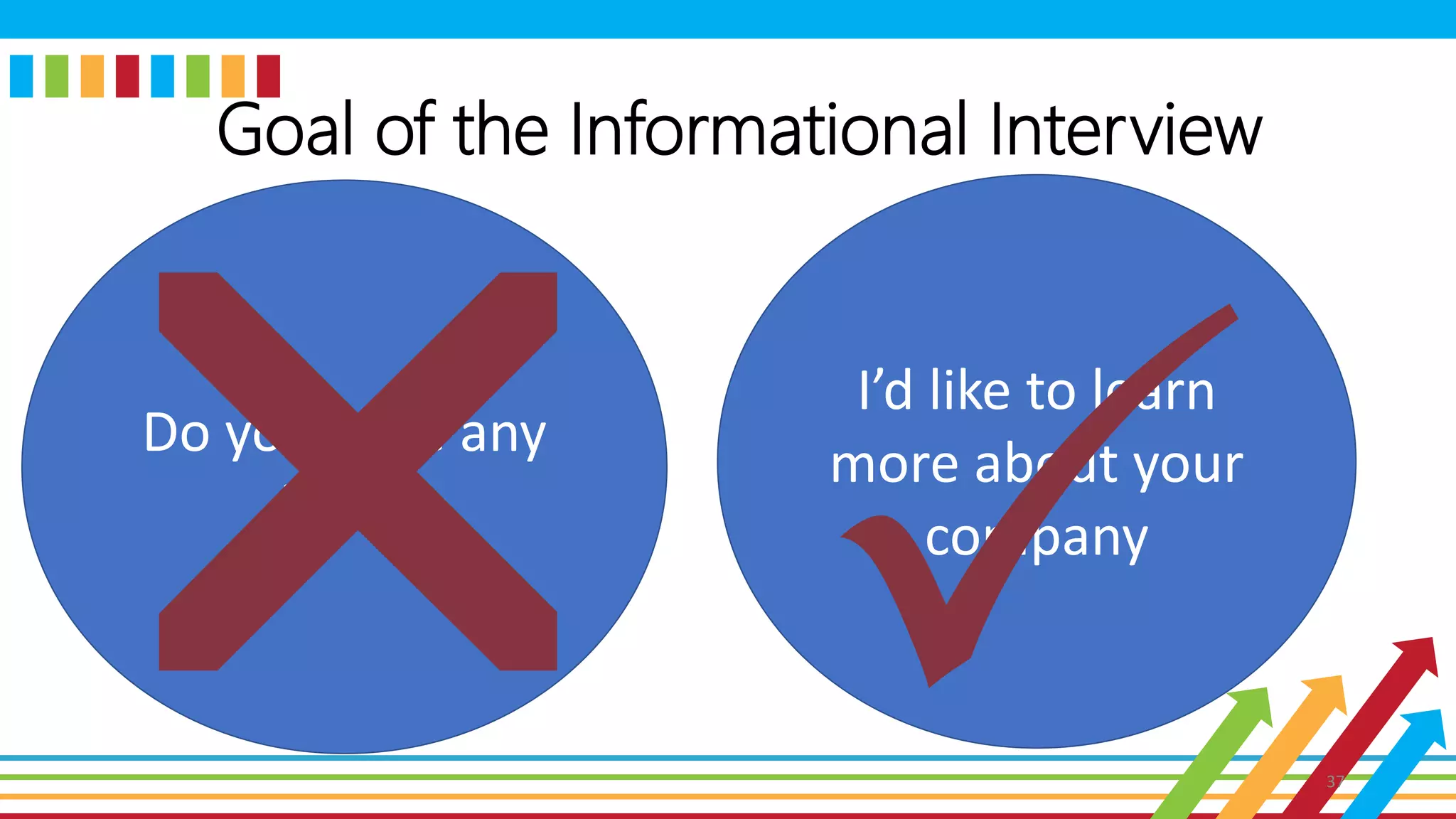
Goal of the Informational Interview
I’d like to learn
more about your
company
Do you have any
jobs?
37
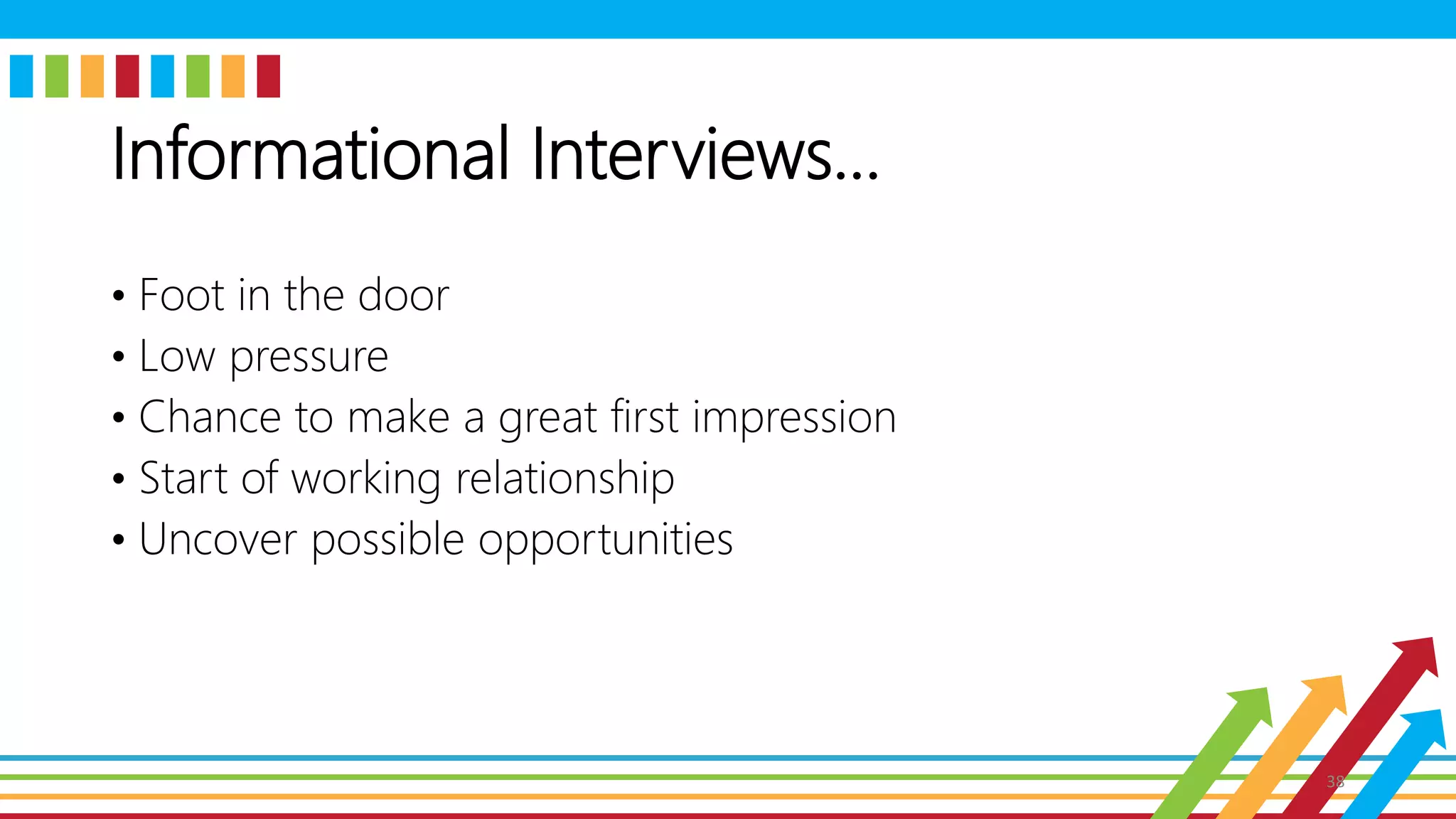
Informational Interviews…
• Foot in the door
• Low pressure
• Chance to make a great first impression
• Start of working relationship
• Uncover possible opportunities
38
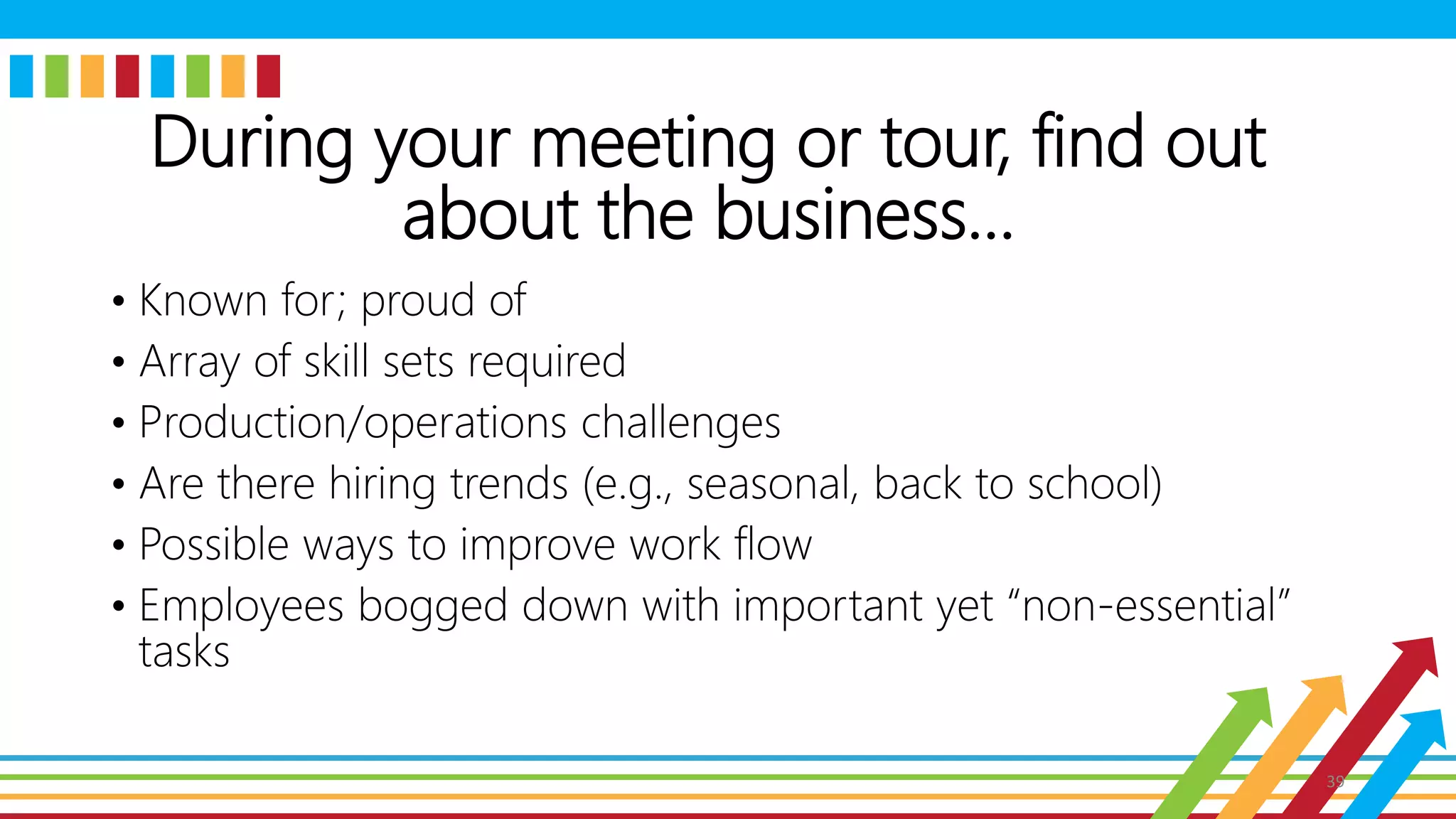
During your meeting or tour, find out
about the business…
• Known for; proud of
• Array of skill sets required
• Production/operations challenges
• Are there hiring trends (e.g., seasonal, back to school)
• Possible ways to improve work flow
• Employees bogged down with important yet “non-essential”
tasks
39
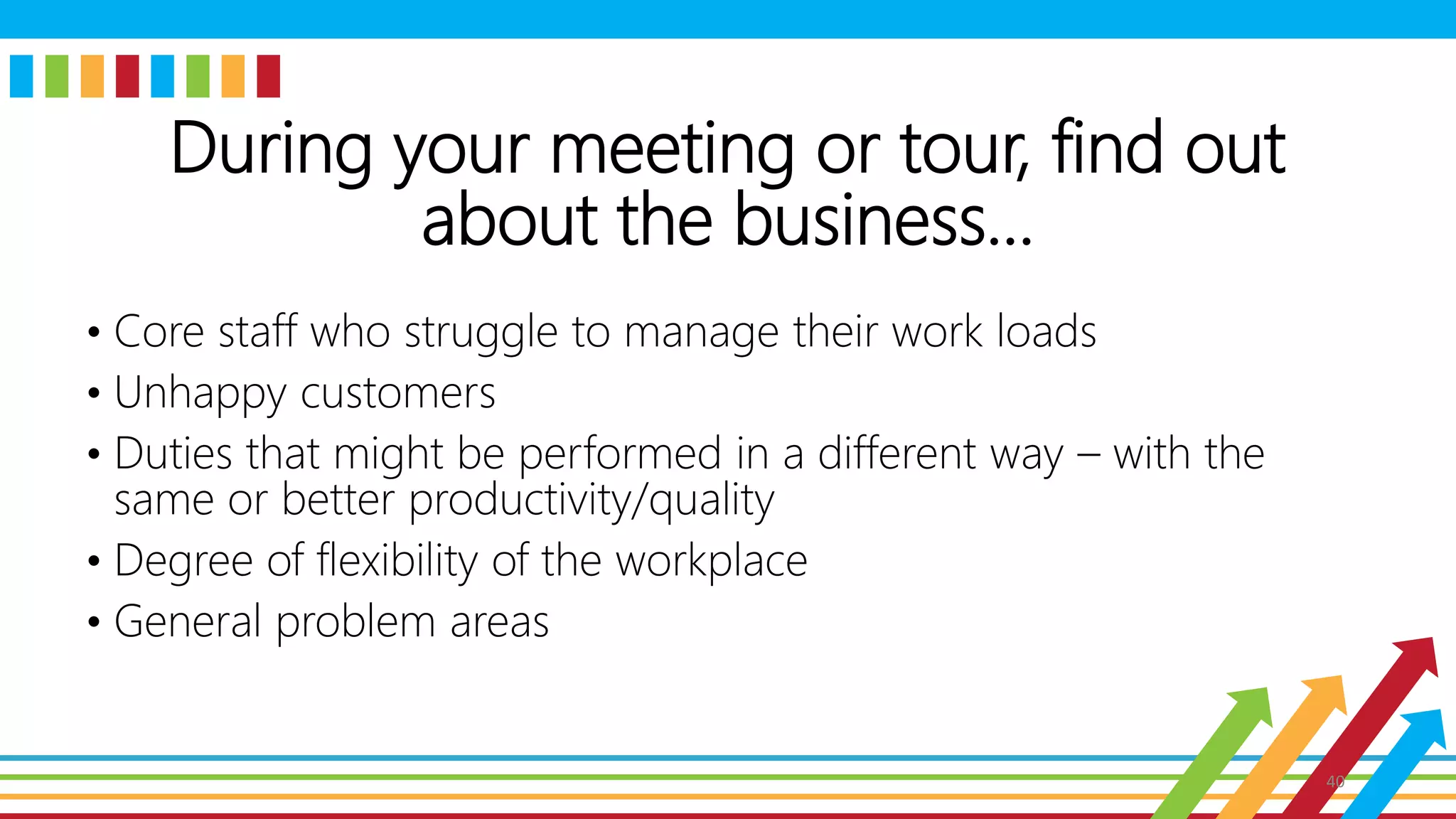
During your meeting or tour, find out
about the business…
• Core staff who struggle to manage their work loads
• Unhappy customers
• Duties that might be performed in a different way – with the
same or better productivity/quality
• Degree of flexibility of the workplace
• General problem areas
40
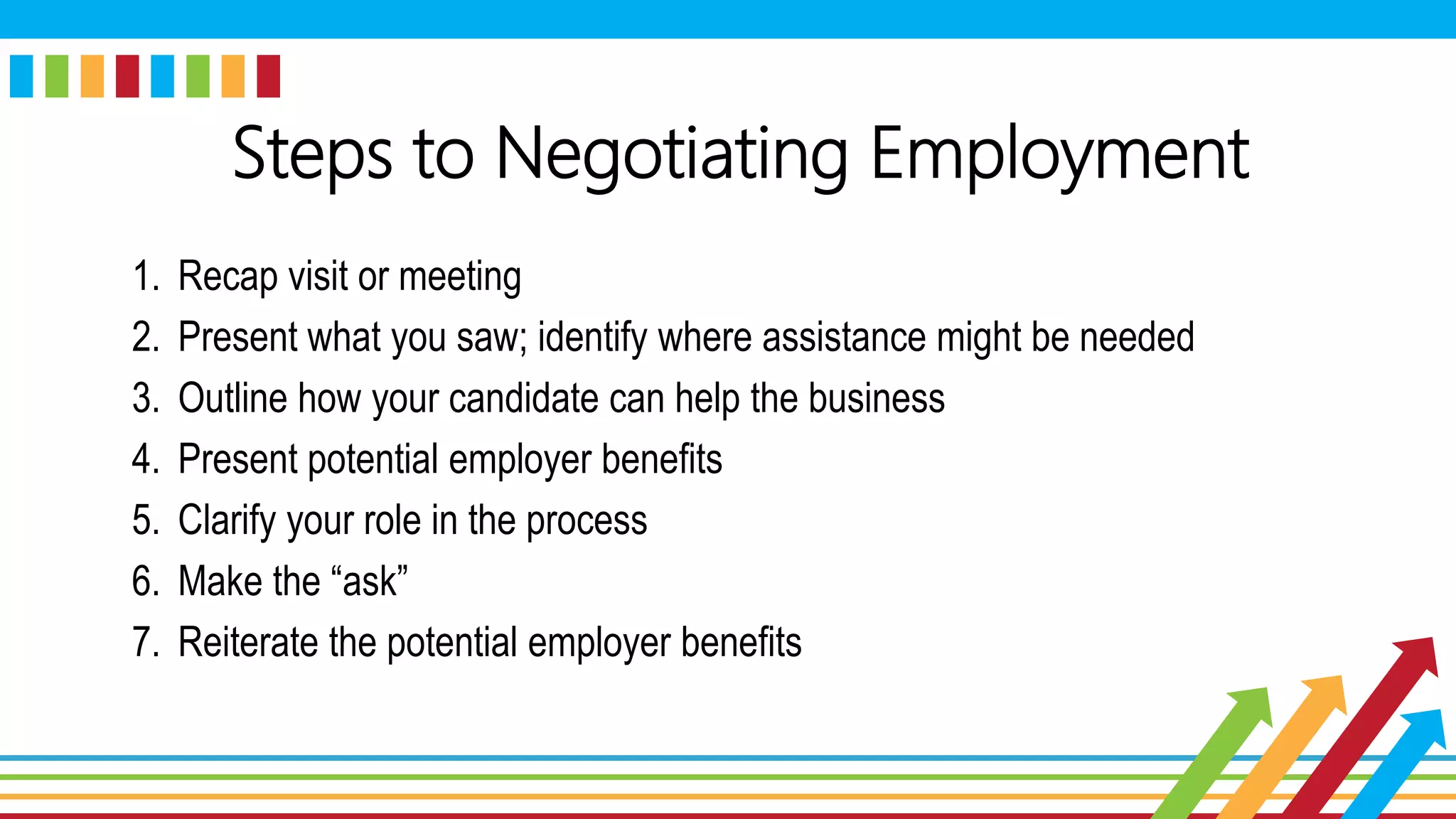
Steps to Negotiating Employment
1. Recap visit or meeting
2. Present what you saw; identify where assistance might be needed
3. Outline how your candidate can help the business
4. Present potential employer benefits
5. Clarify your role in the process
6. Make the “ask”
7. Reiterate the potential employer benefits
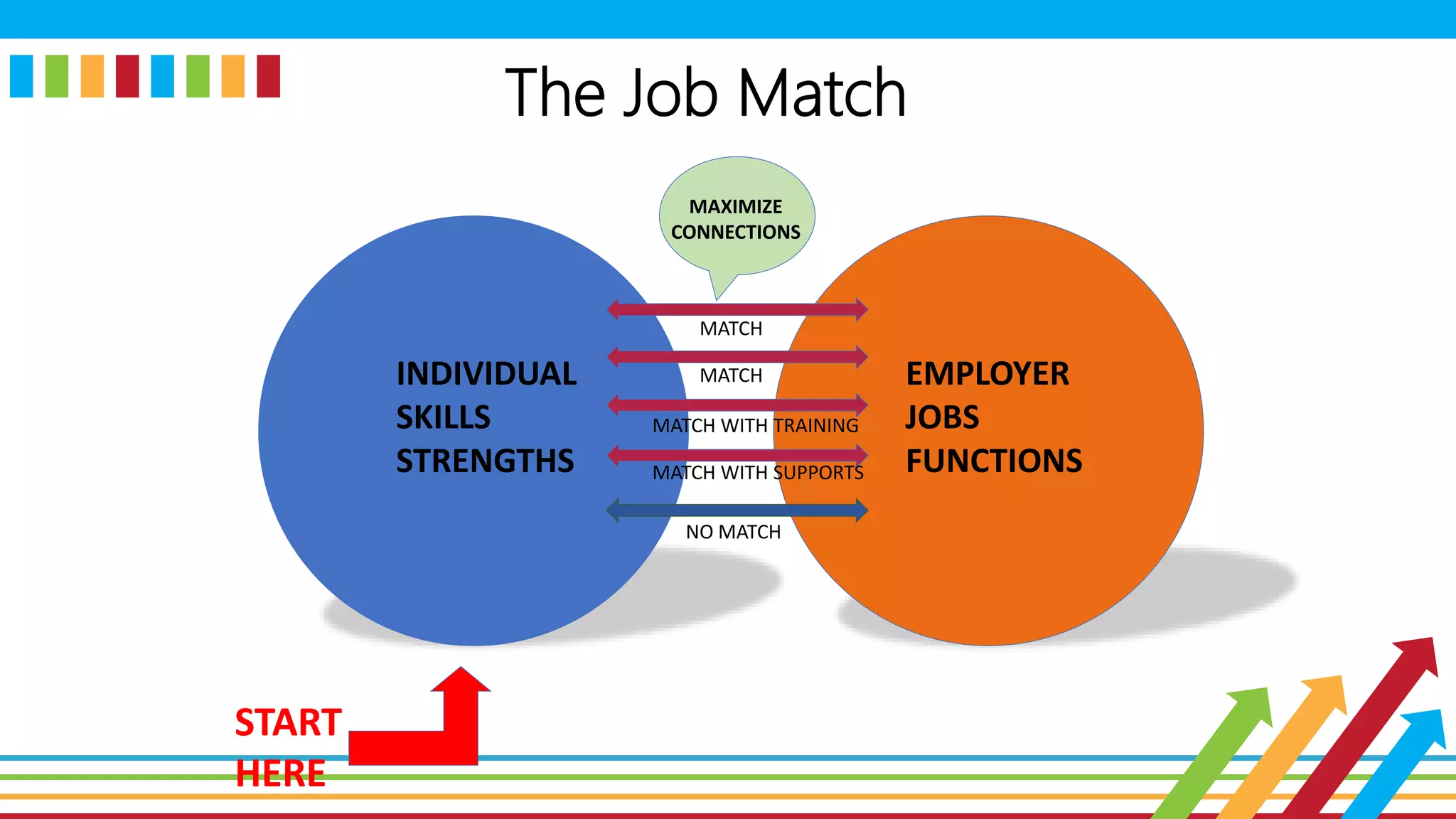
The Job Match
INDIVIDUAL
SKILLS
STRENGTHS
EMPLOYER
JOBS
FUNCTIONS
MAXIMIZE
CONNECTIONS
START
HERE
MATCH WITH SUPPORTS
MATCH WITH TRAINING
MATCH
MATCH
NO MATCH
On the Job…Now What?
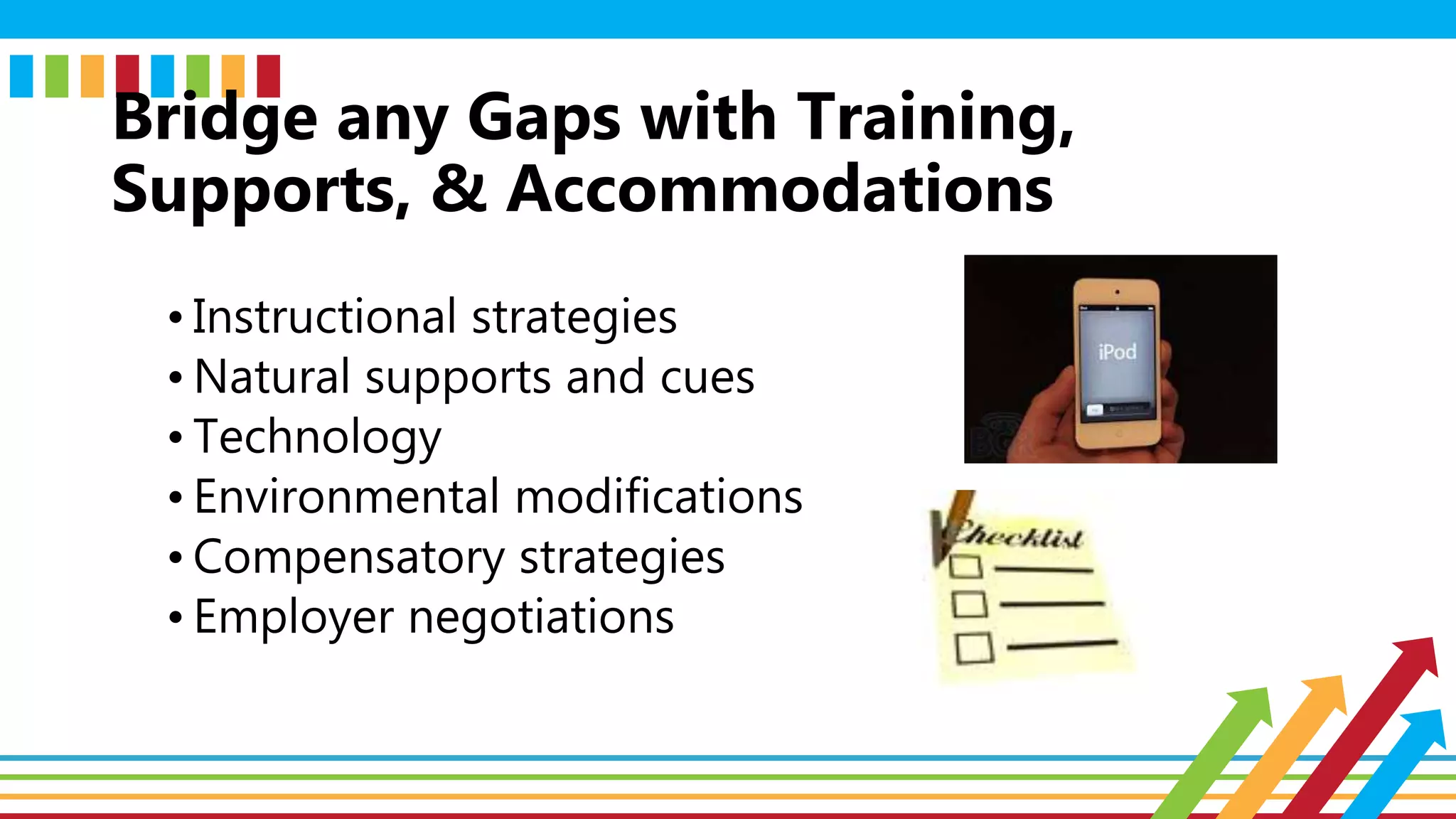
• Instructional strategies
• Natural supports and cues
• Technology
• Environmental modifications
• Compensatory strategies
• Employer negotiations
Bridge any Gaps with Training,
Supports, & Accommodations
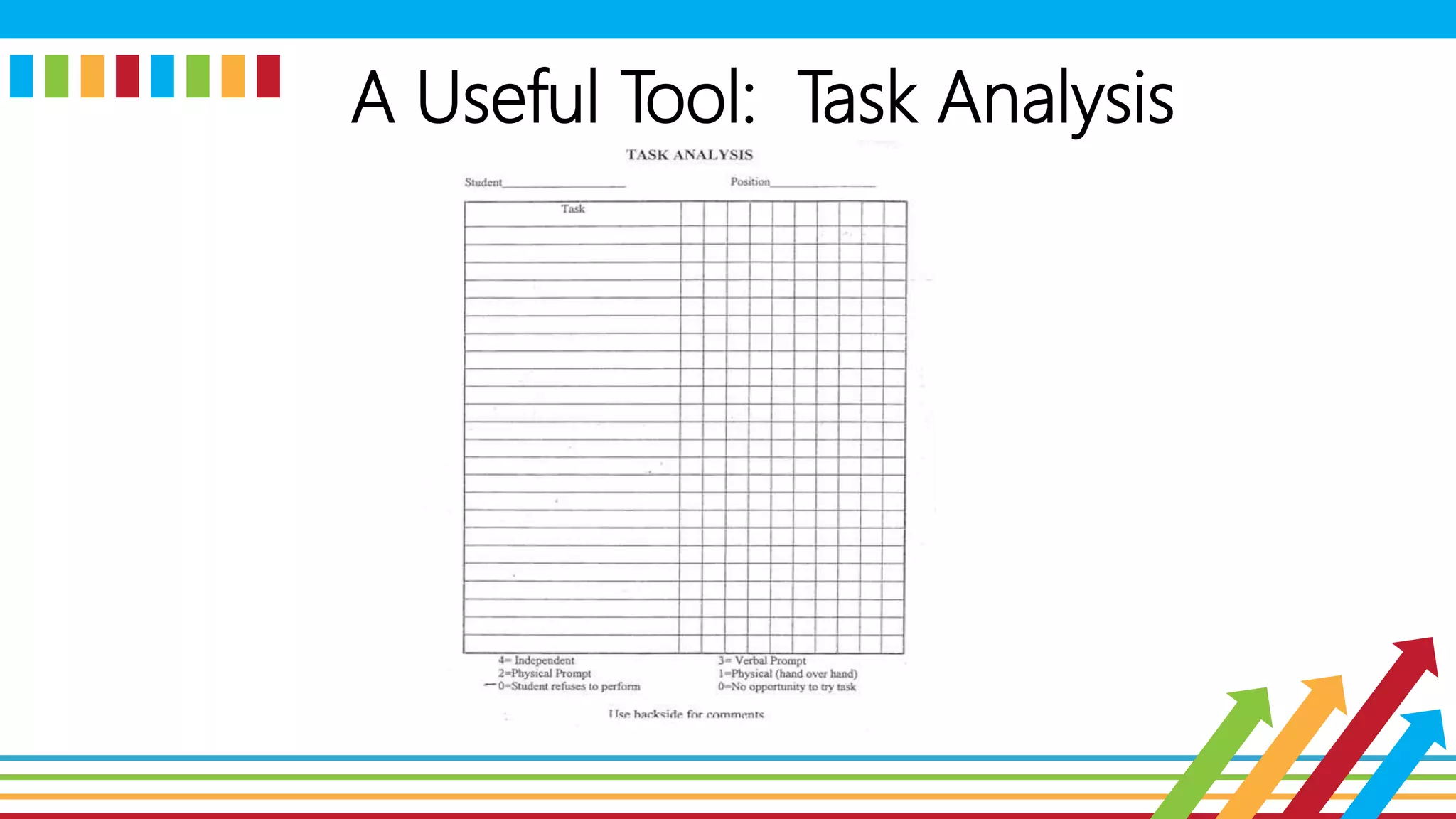
A Useful Tool: Task Analysis
And Don’t Forget…
• Promote a work ethic
• Teach self-determination
• Include workplace culture
• Teach work & work-related skills
• Open doors that enable youth to experience/practice what is
expected of them in adult world
What’s Next?
• Advocate connections with community & adult services and
supports
• Share assessment information and “what works” with others
• Provide assistance and expertise as needed
• Ensure long-term employment assistance, success, and
advancement
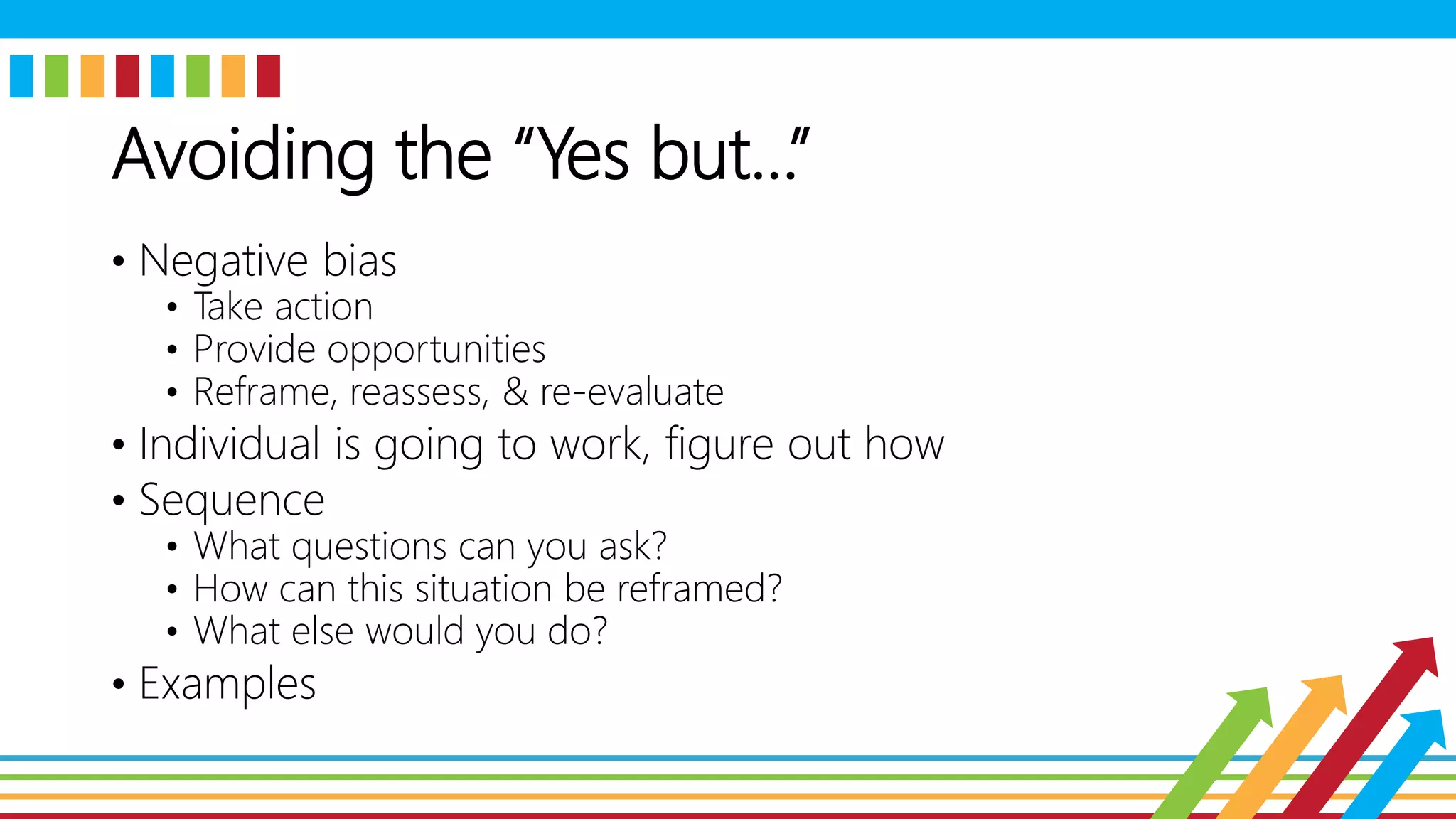
Avoiding the “Yes but…”
• Negative bias
• Take action
• Provide opportunities
• Reframe, reassess, & re-evaluate
• Individual is going to work, figure out how
• Sequence
• What questions can you ask?
• How can this situation be reframed?
• What else would you do?
• Examples
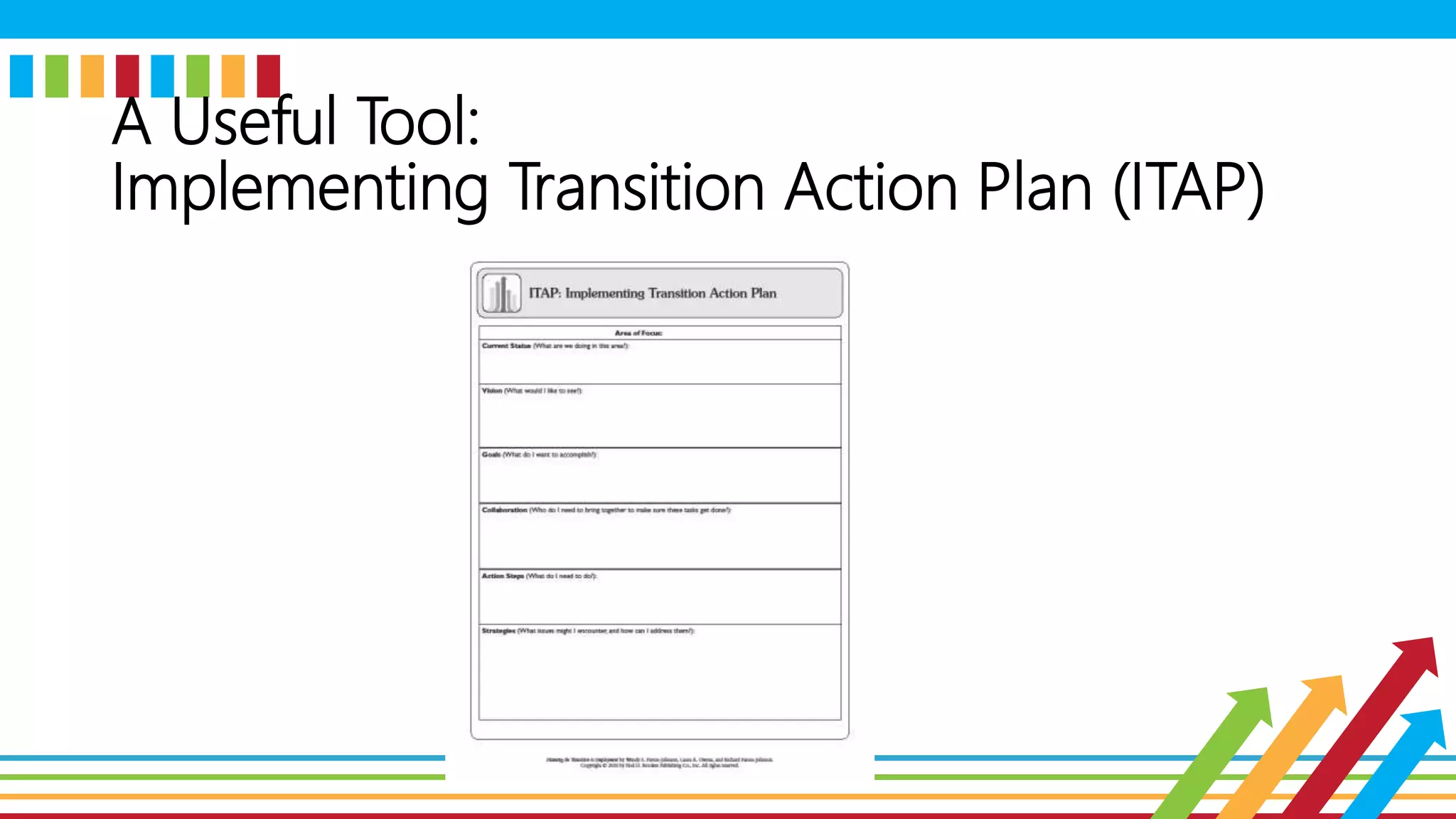
A Useful Tool:
Implementing Transition Action Plan (ITAP)
Giveaway
We’re giving away three free
copies of Planning the
Transition to Employment!
Three attendees will be selected at random
and announced after the Q&A.
Stay active in the chat to increase your chances!
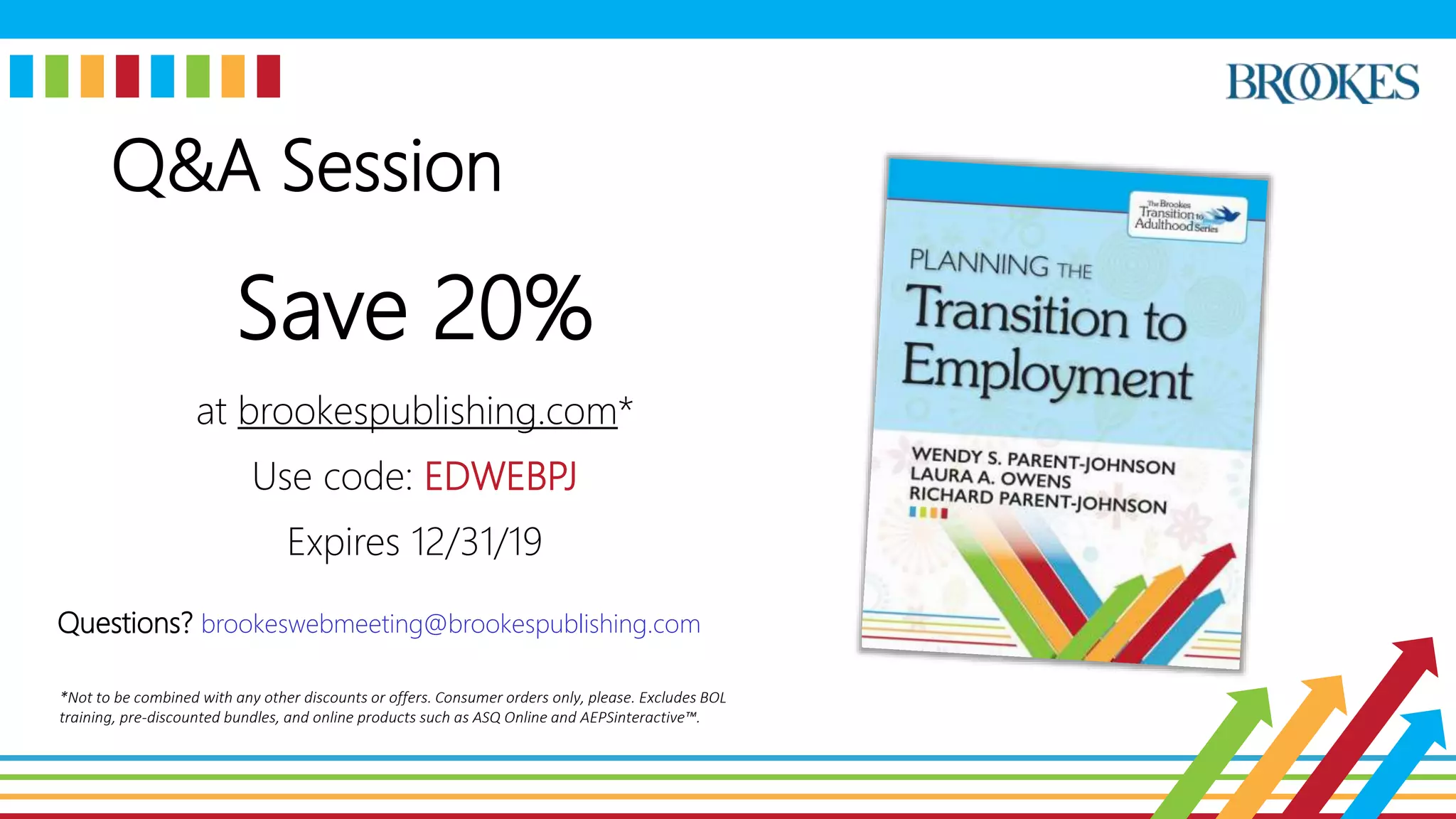
Q&A Session
Save 20%
at brookespublishing.com*
Use code: EDWEBPJ
Expires 12/31/19
Questions? brookeswebmeeting@brookespublishing.com
*Not to be combined with any other discounts or offers. Consumer orders only, please. Excludes BOL
training, pre-discounted bundles, and online products such as ASQ Online and AEPSinteractive™.
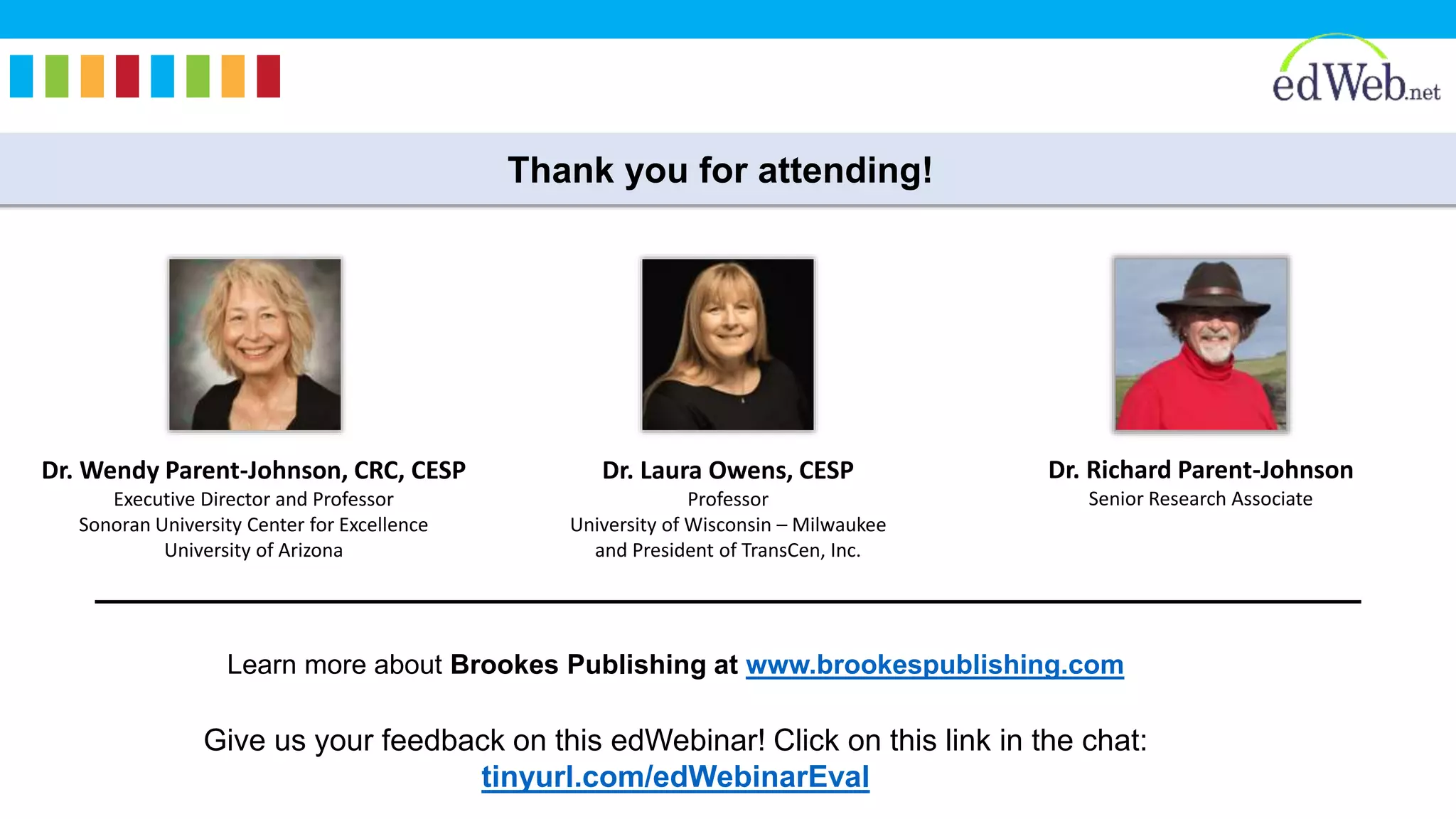
Thank you for attending!
Learn more about Brookes Publishing at www.brookespublishing.com
Give us your feedback on this edWebinar! Click on this link in the chat:
tinyurl.com/edWebinarEval
Dr. Laura Owens, CESP
Professor
University of Wisconsin – Milwaukee
and President of TransCen, Inc.
Dr. Richard Parent-Johnson
Senior Research Associate
Dr. Wendy Parent-Johnson, CRC, CESP
Executive Director and Professor
Sonoran University Center for Excellence
University of Arizona
Get your CE Certificate for this edWebinar
Your personalized CE certificate will be
posted to your edWebinar transcript by the
end of the next business day.
Join at: www.edweb.net/ inclusiveeducation
Join the community and go to the edWebinar archives for the
recording, slides, chat log, and any resources after this edWebinar.
 Invitations to upcoming webinars
 Webinar recordings and resources
 CE quizzes
 Online discussions
www.edweb.net/inclusiveeducation
You’ll receive the following benefits:
Join our free community  Teaching All Students
To join, go to:

Planning the Transition to Employment: Tips, Tools, and Strategies

  • 1.
    Planning the Transitionto Employment Tips, Tools, and Strategies Dr. Wendy Parent-Johnson | Dr. Laura Owens | Dr. Richard Parent-Johnson
  • 2.
    • Close otherapplications that use bandwidth or resources on your device. • For audio issues you can switch to phone by clicking the telephone icon at the top of your screen. • Ask a question by clicking the question mark at the top of your screen. • Post in the chat to join the live discussion. • For a larger view of the slides or to hide the chat, click the full screen icon on the upper right of your screen. • If you’re on Twitter tweet using #edWebinar Here are some edWebinar tips …
  • 3.
    Get your CECertificate for this edWebinar Your personalized CE certificate will be posted to your edWebinar transcript by the end of the next business day. Join at: www.edweb.net/ inclusiveeducation Join the community and go to the edWebinar archives for the recording, slides, chat log, and any resources after this edWebinar.
  • 4.
     Invitations toupcoming webinars  Webinar recordings and resources  CE quizzes  Online discussions www.edweb.net/inclusiveeducation You’ll receive the following benefits: Join our free community  Teaching All Students To join, go to:
  • 5.
    Special Offer Save 20%*at brookespublishing.com with code EDWEBPJ *Expires 12/31/19. Not to be combined with any other discounts or offers. Consumer orders only, please. Excludes BOL training, pre-discounted bundles, and online products such as ASQ Online and AEPSinteractive™.
  • 6.
    Giveaway We’re giving awaythree free copies of Planning the Transition to Employment! Three attendees will be selected at random and announced after the Q&A. Stay active in the chat to increase your chances!
  • 7.
    Dr. Wendy Parent-Johnsonis Executive Director of the Sonoran UCEDD, a Center for Excellence in Developmental Disabilities and Professor, Department of Family & Community Medicine, College of Medicine at the University of Arizona. She has 37 years’ experience in areas of supported and customized employment, transition from school to work, and Employment First policy and practice. Additionally, research, teaching, and grant development has focused on health care transition, health disparities, interdisciplinary health science and the integration of health and employment. Dr. Parent-Johnson has conducted presentations and trainings; produced journal articles, book chapters, and other written products; and developed practical tools related to enhancing inclusion, healthcare access, and outcomes. She is Editor of the Journal of Rehabilitation and a member of the Editorial Board of the Journal of Vocational Rehabilitation. Dr. Laura Owens-Johnson is currently a professor in the Department of Teaching and Learning at the University of Wisconsin – Milwaukee (UWM) and the president of TransCen, Inc. (TCI). TCI is an organization based in Maryland that provides direct placement services to individuals with disabilities, develops and evaluates new service models through research of evidenced-based practices leading to improved employment outcomes, and provides training and technical assistance to organizations and school districts focusing on the improvement of educational and employment outcomes for individuals with disabilities. She founded Creative Employment Opportunities, Inc. (CEO), an employment agency for individuals with disabilities, in Milwaukee, Wisconsin in 1991 and ArtWorks for Milwaukee, a non- profit jobs-training program in the arts for youth with and without disabilities in 2001. She teaches courses focusing on high school inclusion, transition from school to work, and customized employment, and coordinates the Graduate Transition Certificate program at UWM. Dr. Richard Parent-Johnson retired as a Senior Research Associate in Center for Disabilities in the Sanford School of Medicine, University of South Dakota. Previously he was a Senior Research Associate in the Center for Research on Learning at the University of Kansas. His doctorate is in sociology from the University of Kansas. He has been PI or Co-PI on multiple state and federal grants. Recent work focuses on “systems collaboration” and health care transitions for young adults with disabilities, including interprofessional medical education and clinical practice. He co-designed and led USD’s Center for Disabilities TransitionInAction Clinic. He continues to consult in these areas. Other work focused on the iterative design and dissemination of “universal” curricular products and processes that serve transition needs of persons with disabilities [e.g., the Soaring to New Heights curriculum for high school aged students with disabilities]. Dr. Parent-Johnson has particular expertise in ethnographic research and qualitative analysis.
  • 8.
    Planning the Transitionto Employment Tips, Tools, and Strategies Dr. Wendy Parent-Johnson | Dr. Laura Owens | Dr. Richard Parent-Johnson
  • 9.
    Family School Adult Services BenefitsPlanning Independent Living Other Supports EDUCATION TRANSITIONS… Youth Goal: Employment… Post-secondary Education… Quality Adult Life…
  • 10.
    Transition is AboutPossibilities • Start with end in mind • Develop plan to get there
  • 11.
    Have High Expectations •Engage all youth • Time for exploration • Provide opportunities • Start with work • Focus on solutions
  • 12.
    Current Influences • Employment First Initiatives •Workforce Innovation & Opportunity Act of 2014 • Centers for Medicaid & Medicare/HCBS Regulations • High Unemployment Rates
  • 13.
    As an Educator… •You are the focal point for coordinating and programming that ties relevant instruction and experiences to achieve students’ post-school outcomes. Action Implementation Outcomes
  • 14.
    Collaboration and Competence •We argue for a shift from a “cooperating” model to a “collaborating” model of professional practice for supporting transitions. • Where a small inter-professional team commits to working “collectively” to build and support a set of teaching and learning practices that produce effective transitions… AND… • Where each student is actively and consistently engaged in activities that build and support their sense of competence in making successful transitions.
  • 15.
    Collaboration as CollectiveEffort • Five elements needed to create and sustain success: • A common agenda • Mutually reinforcing activities • Continuous communication • Shared measures of success • A support structure
  • 16.
    Putting the StudentFront and Center
  • 17.
    Self-Determination requires Self-Efficacy •Self-efficacy is the “sense of being capable” of actually doing what is expected of you. • The key to transition activities is to find ways to support and enhance each student’s experience of being capable of doing what is needed to make successful transitions. • In particular, 1] “modeling” what is expected, 2] providing role- playing activities, and 3] providing “elaborated feedback on their performance are valuable strategies.
  • 18.
    What is PersonCentered Planning? • Person-centered planning is a process-oriented approach to empowering students disabilities. It focuses on the individual and their needs by putting them in charge of defining the direction for their lives, not on the systems that may or may not be available to serve them. • This ultimately leads to greater inclusion as valued members of both community and society.
  • 19.
    Best Practices inPerson-Centered Discovery & Planning Person-centered planning does not ignore disability, it simply shifted the emphasis to a search for capacity in the person, among the person’s friends and family, in the person’s community, and among service workers. -John O’Brien •Services and supports are based on dreams; interests, and preferences; strengths and capacities •The person with a disability is included in planning and empowered to lead and make informed decisions •The person with a disability has meaningful choices
  • 20.
    The individual isthe driving force • What are the individual’s gifts and strengths? • What works for the individual? What doesn’t? • How does the individual learn best? • What are things that the individual needs help with? Who helps them now? • People who are close to the Person are invited to participate in the person centered planning because • They know the individual. • They care about the individual. • They can contribute important information to the meeting, such as where to connect with opportunities in the community.
  • 21.
    Components of aPositive Personal Profile values interests support system talents, skills, & knowledge dislikes creative solutions & accommodations specific challenges learning styles positive personality traits life & work experience dreams & goals environmental preferences creative possibilities & ideas 21
  • 22.
    A Useful Tool: PositivePersonal Profile
  • 23.
    How Can aPPP be Used? • Developing resumes • Preparing for interviews • Developing goals for an individualized education plan • Determining further assessments or work experiences • Determining which businesses to approach • Develop “features” to “benefits” 23
  • 24.
    PPP Example Shonda isa 17 year old with an intellectual disability. Her teachers note that she is not a candidate for employment because she is lazy, has difficulty focusing on tasks, is consistently late getting to class and has frequent absences. When you go to school to interview and observe her Shonda does not make eye contact, does not answer the questions (will often just shrug her shoulders), and you observe her falling asleep in class. Her teachers say she has never completed a career assessment and her homework is rarely completed or turned in. Lauren’s mother has not attended any meetings since she was in middle school (IEP meetings, parent-teacher conferences).
  • 25.
    Shonda’s Features Benefitsto manager of retail store Hardworking Will always do what she is asked to do; doesn’t leave until her job is done Neat and organized Will keep the shelves and racks in order; straightens up the store Attention to appearance Will add extra detail to displays; can assist customers in picking out outfits Social Will work will with adult customers; is a team player with co-workers Responsible Will arrive on time; will do what is asked; will not steal or cut corners
  • 26.
    As the QuestionShifts – So Does Our Role NOT: Can this student work? FOCUS ON: How can we help this student work?
  • 27.
    Important Considerations • What doesstudent like and dislike? • What are their skills and interests? • How do they learn best? • What supports are helpful? • What assets do they bring? • What opportunities do they have to prepare for and practice work? • What are their work environment preferences? • What do they need to make connections to employers?
  • 28.
    What We Know… WorkWhile in School Work After Graduating School Leads To
  • 29.
    Work Based LearningExperiences • School-based enterprises • On-the job training • Job Shadowing • Internships & Apprenticeships • Paid employment • Career & Technical Education • Summer & After School Employment
  • 30.
    Work Based LearningLeads to Integrated Employment
  • 31.
    A Useful Tool: JobObservation Assessment Form
  • 32.
  • 33.
    Customized Employment Is… …employmentwhere job tasks are reassigned from an existing job, restructured from one or more existing jobs, or created to match the skills and accommodation needs of the job seeker and… 33
  • 34.
    …the Customized Employment approachMUST help the employer’s operation in some specific way. 34
  • 35.
    What Do EmployersWant to Hear from Us? We represent… • Motivated candidates who are excited about working • Our candidates have skills sets that add value to their workforce. • We can assist with business solutions that improve the company’s productivity and/or workflow. 35
  • 36.
    Where to startlooking… • Use your personal & professional networks (and those of your students!) • Everyone in your organization is a job developer • Everyone has family, friends and neighbors • Link in to other social networking sites
  • 37.
    Goal of theInformational Interview I’d like to learn more about your company Do you have any jobs? 37
  • 38.
    Informational Interviews… • Footin the door • Low pressure • Chance to make a great first impression • Start of working relationship • Uncover possible opportunities 38
  • 39.
    During your meetingor tour, find out about the business… • Known for; proud of • Array of skill sets required • Production/operations challenges • Are there hiring trends (e.g., seasonal, back to school) • Possible ways to improve work flow • Employees bogged down with important yet “non-essential” tasks 39
  • 40.
    During your meetingor tour, find out about the business… • Core staff who struggle to manage their work loads • Unhappy customers • Duties that might be performed in a different way – with the same or better productivity/quality • Degree of flexibility of the workplace • General problem areas 40
  • 41.
    Steps to NegotiatingEmployment 1. Recap visit or meeting 2. Present what you saw; identify where assistance might be needed 3. Outline how your candidate can help the business 4. Present potential employer benefits 5. Clarify your role in the process 6. Make the “ask” 7. Reiterate the potential employer benefits
  • 42.
  • 43.
  • 44.
    • Instructional strategies •Natural supports and cues • Technology • Environmental modifications • Compensatory strategies • Employer negotiations Bridge any Gaps with Training, Supports, & Accommodations
  • 45.
    A Useful Tool:Task Analysis
  • 46.
    And Don’t Forget… •Promote a work ethic • Teach self-determination • Include workplace culture • Teach work & work-related skills • Open doors that enable youth to experience/practice what is expected of them in adult world
  • 47.
    What’s Next? • Advocateconnections with community & adult services and supports • Share assessment information and “what works” with others • Provide assistance and expertise as needed • Ensure long-term employment assistance, success, and advancement
  • 48.
    Avoiding the “Yesbut…” • Negative bias • Take action • Provide opportunities • Reframe, reassess, & re-evaluate • Individual is going to work, figure out how • Sequence • What questions can you ask? • How can this situation be reframed? • What else would you do? • Examples
  • 49.
    A Useful Tool: ImplementingTransition Action Plan (ITAP)
  • 52.
    Giveaway We’re giving awaythree free copies of Planning the Transition to Employment! Three attendees will be selected at random and announced after the Q&A. Stay active in the chat to increase your chances!
  • 53.
    Q&A Session Save 20% atbrookespublishing.com* Use code: EDWEBPJ Expires 12/31/19 Questions? brookeswebmeeting@brookespublishing.com *Not to be combined with any other discounts or offers. Consumer orders only, please. Excludes BOL training, pre-discounted bundles, and online products such as ASQ Online and AEPSinteractive™.
  • 54.
    Thank you forattending! Learn more about Brookes Publishing at www.brookespublishing.com Give us your feedback on this edWebinar! Click on this link in the chat: tinyurl.com/edWebinarEval Dr. Laura Owens, CESP Professor University of Wisconsin – Milwaukee and President of TransCen, Inc. Dr. Richard Parent-Johnson Senior Research Associate Dr. Wendy Parent-Johnson, CRC, CESP Executive Director and Professor Sonoran University Center for Excellence University of Arizona
  • 55.
    Get your CECertificate for this edWebinar Your personalized CE certificate will be posted to your edWebinar transcript by the end of the next business day. Join at: www.edweb.net/ inclusiveeducation Join the community and go to the edWebinar archives for the recording, slides, chat log, and any resources after this edWebinar.
  • 56.
     Invitations toupcoming webinars  Webinar recordings and resources  CE quizzes  Online discussions www.edweb.net/inclusiveeducation You’ll receive the following benefits: Join our free community  Teaching All Students To join, go to: