




Welcome to DMI Session 2 Keeping Track of Ten Quietly reflect in your journals on the following: How can we encourage risk taking that will lead to improved learning? *How does this look in a classroom? *What will it look like in your DMI table groups?
BIG IDEA! A child’s struggle and confusion indicates that there is a big idea that they are trying to put together (make sense of).  These are very important moments for us to listen carefully.  They  DO NOT  mean there is something wrong with our teaching!  What is the teacher’s role at these times?
Session 2 Goals Content Process Community Record your initial thoughts in your journals How can we encourage risk taking that will lead to improved learning?
Getting the right answer for the wrong reason…
Case Discussion Chapter 2 Table Groups The cases in chapter 2 provide a window into student thinking. Focus on the child’s thinking you have listed on your groups activity sheet and not on what the teacher should or shouldn’t do. Work with your table groups to read the section listed and work through the activities. Focus on the math.  Model the child’s thinking using the math tools (Base ten, unifix cubes, cuisenaire rods). Devise a new set of numbers…Be ready to demonstrate this student’s technique using these new numbers.
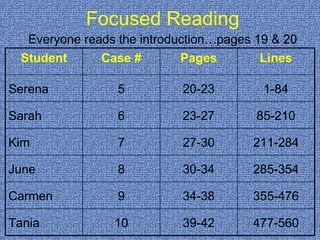
Focused Reading Everyone reads the introduction…pages 19 & 20 477-560 39-42 10 Tania 355-476 34-38 9 Carmen 285-354 30-34 8 June 211-284 27-30 7 Kim 85-210 23-27 6 Sarah 1-84 20-23 5 Serena Lines Pages Case # Student
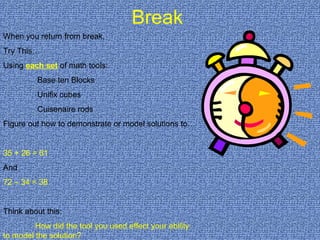
Break When you return from break,  Try This… Using  each set  of math tools:   Base ten Blocks   Unifix cubes   Cuisenaire rods Figure out how to demonstrate or model solutions to… 35 + 26 = 61 And 72 – 34 = 38 Think about this: How did the tool you used effect your ability  to model the solution?
Now On Stage You are the expert!  You’ve uncovered your assigned student’s thinking. Teach the rest of us what is going on inside that student’s mind. Demonstrate this technique with a different set of numbers.
Analysis of Student Work Whole group Think About… If a child is struggling, what does it indicate? What role does confusion play in the learning process? What role did the teacher play in this?
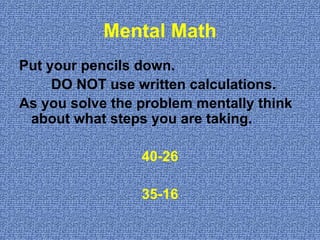
Mental Math Put your pencils down.  DO NOT use written calculations. As you solve the problem mentally think about what steps you are taking. 40-26 35-16
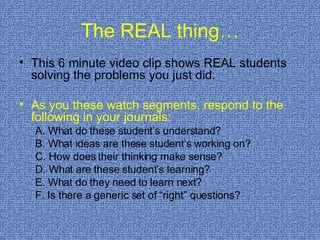
The REAL thing… This 6 minute video clip shows REAL students solving the problems you just did. As you these watch segments, respond to the following in your journals: A. What do these student’s understand? B. What ideas are these student’s working on? C. How does their thinking make sense? D. What are these student’s learning? E. What do they need to learn next? F. Is there a generic set of “right” questions?
Your Experience? Your homework last time was to try to do some mental math with your own students… Share some of the strategies from your students at your table groups. Did any of your students shock or surprise you?  Do you see their thinking mimicked in any of the strategies you’ve seen demonstrated today? What do they need to work on or do they understand based on their strategies?
Exit Tickets “ Out of confusion comes understanding:  Out of discomfort comes comfort!” Have you established the community expectations for mathematical learners in your classroom?  Do you have any insights to share or questions to ask? For Next Week  We meet on the 17 th  from 1:00-3:00 Read Chapter 3 Try one more mental math situation with your students

DMI Session 2

  • 1.
    Welcome to DMISession 2 Keeping Track of Ten Quietly reflect in your journals on the following: How can we encourage risk taking that will lead to improved learning? *How does this look in a classroom? *What will it look like in your DMI table groups?
  • 2.
    BIG IDEA! Achild’s struggle and confusion indicates that there is a big idea that they are trying to put together (make sense of). These are very important moments for us to listen carefully. They DO NOT mean there is something wrong with our teaching! What is the teacher’s role at these times?
  • 3.
    Session 2 GoalsContent Process Community Record your initial thoughts in your journals How can we encourage risk taking that will lead to improved learning?
  • 4.
    Getting the rightanswer for the wrong reason…
  • 5.
    Case Discussion Chapter2 Table Groups The cases in chapter 2 provide a window into student thinking. Focus on the child’s thinking you have listed on your groups activity sheet and not on what the teacher should or shouldn’t do. Work with your table groups to read the section listed and work through the activities. Focus on the math. Model the child’s thinking using the math tools (Base ten, unifix cubes, cuisenaire rods). Devise a new set of numbers…Be ready to demonstrate this student’s technique using these new numbers.
  • 6.
    Focused Reading Everyonereads the introduction…pages 19 & 20 477-560 39-42 10 Tania 355-476 34-38 9 Carmen 285-354 30-34 8 June 211-284 27-30 7 Kim 85-210 23-27 6 Sarah 1-84 20-23 5 Serena Lines Pages Case # Student
  • 7.
    Break When youreturn from break, Try This… Using each set of math tools: Base ten Blocks Unifix cubes Cuisenaire rods Figure out how to demonstrate or model solutions to… 35 + 26 = 61 And 72 – 34 = 38 Think about this: How did the tool you used effect your ability to model the solution?
  • 8.
    Now On StageYou are the expert! You’ve uncovered your assigned student’s thinking. Teach the rest of us what is going on inside that student’s mind. Demonstrate this technique with a different set of numbers.
  • 9.
    Analysis of StudentWork Whole group Think About… If a child is struggling, what does it indicate? What role does confusion play in the learning process? What role did the teacher play in this?
  • 10.
    Mental Math Putyour pencils down. DO NOT use written calculations. As you solve the problem mentally think about what steps you are taking. 40-26 35-16
  • 11.
    The REAL thing…This 6 minute video clip shows REAL students solving the problems you just did. As you these watch segments, respond to the following in your journals: A. What do these student’s understand? B. What ideas are these student’s working on? C. How does their thinking make sense? D. What are these student’s learning? E. What do they need to learn next? F. Is there a generic set of “right” questions?
  • 12.
    Your Experience? Yourhomework last time was to try to do some mental math with your own students… Share some of the strategies from your students at your table groups. Did any of your students shock or surprise you? Do you see their thinking mimicked in any of the strategies you’ve seen demonstrated today? What do they need to work on or do they understand based on their strategies?
  • 13.
    Exit Tickets “Out of confusion comes understanding: Out of discomfort comes comfort!” Have you established the community expectations for mathematical learners in your classroom? Do you have any insights to share or questions to ask? For Next Week We meet on the 17 th from 1:00-3:00 Read Chapter 3 Try one more mental math situation with your students

Editor's Notes

  • #2 Seat participants in groups of four based on card reflections/DMI experience