Change is Here


             9-22-10
     ARIELLA LEHRER, PH.D.
       PRESIDENT AND CEO
      LEGACY INTERACTIVE
ARIELLA@LEGACYINTERACTIVE.COM
Topics

eBook Trends
Hardware
Enhanced eBooks
Cognitive/Learning Issues
The Future
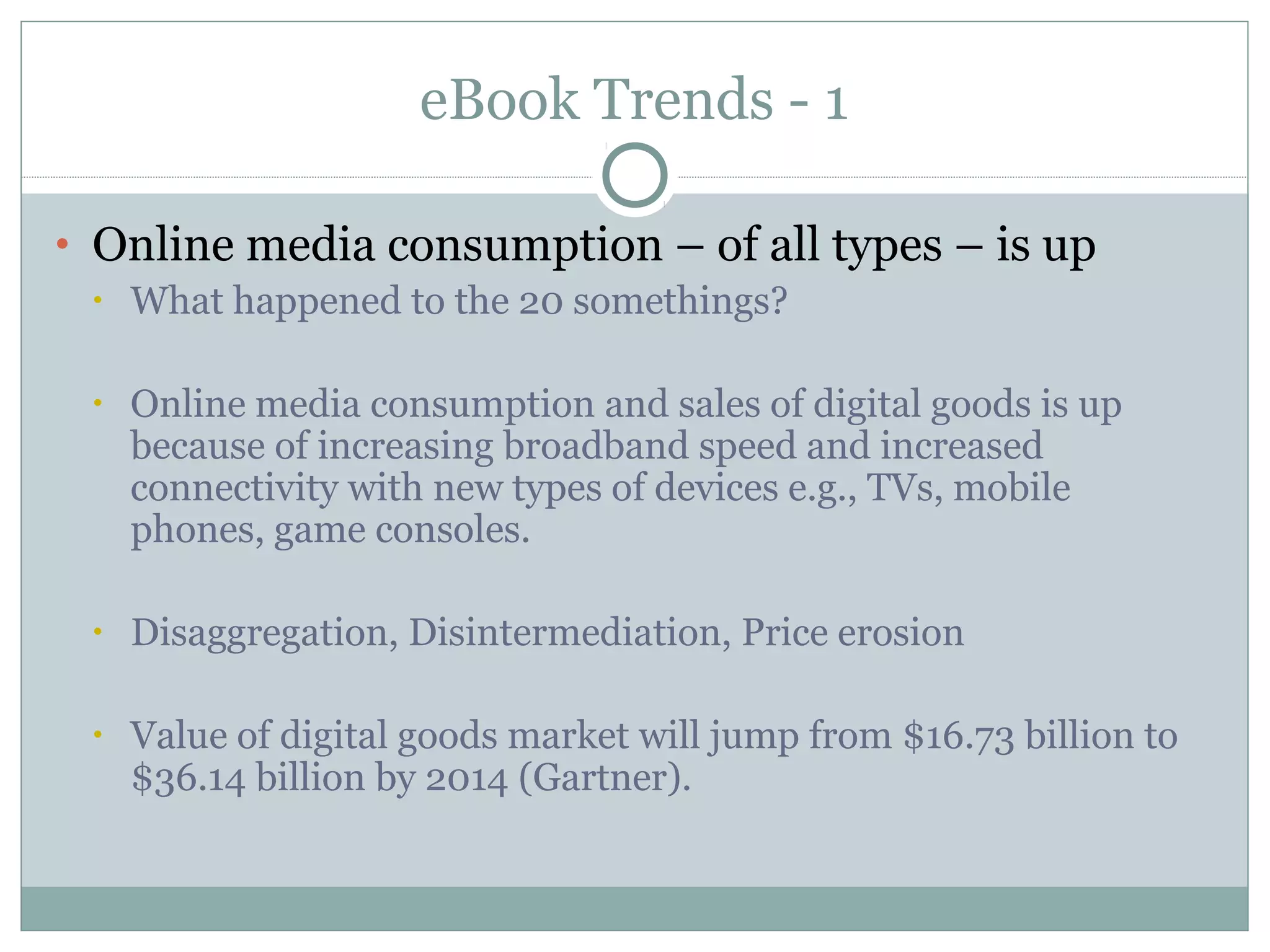
eBook Trends - 1

• Online media consumption – of all types – is up
  • What happened to the 20 somethings?


 •   Online media consumption and sales of digital goods is up
     because of increasing broadband speed and increased
     connectivity with new types of devices e.g., TVs, mobile
     phones, game consoles.

 •   Disaggregation, Disintermediation, Price erosion

 •   Value of digital goods market will jump from $16.73 billion to
     $36.14 billion by 2014 (Gartner).
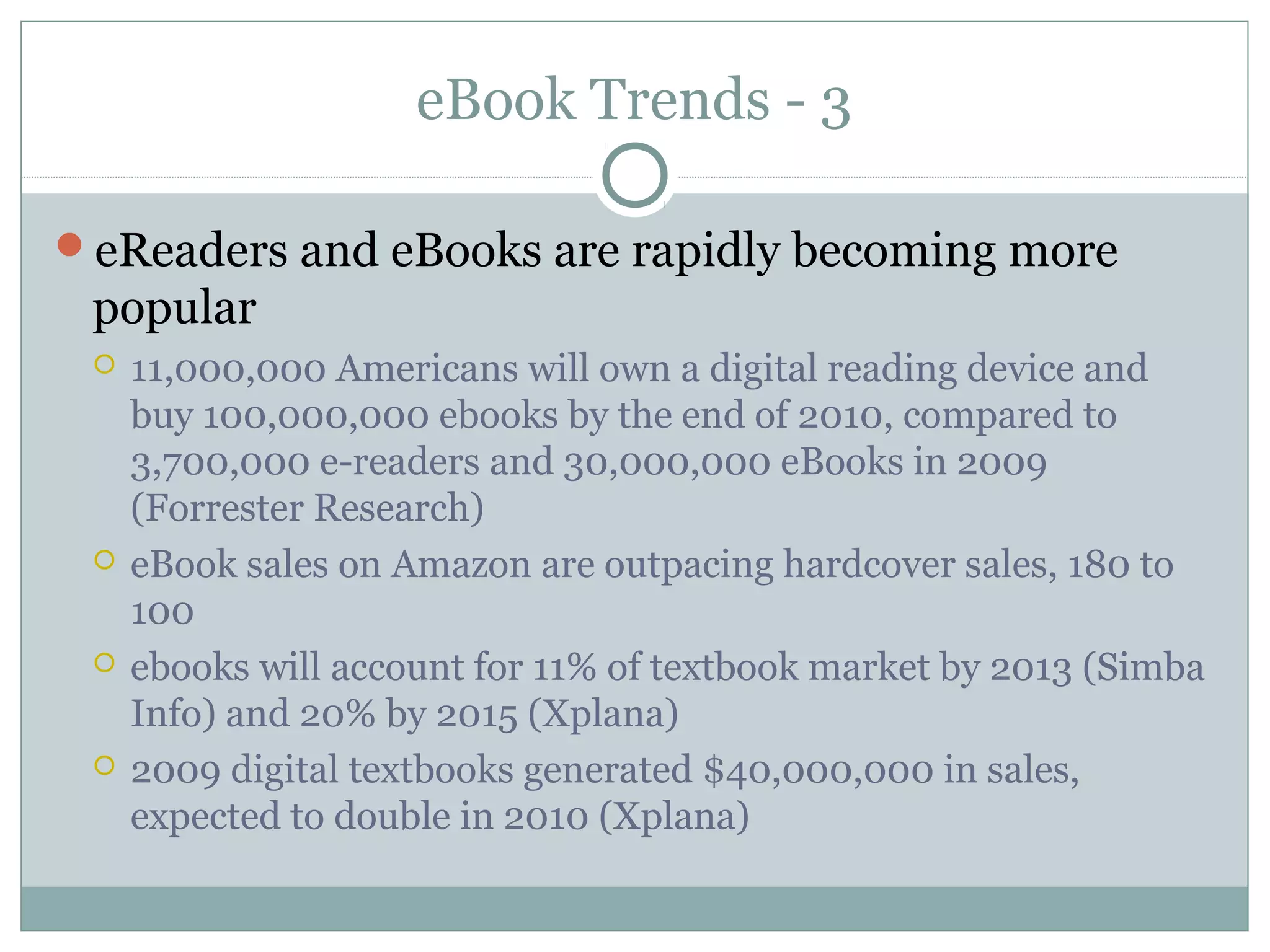
eBook Trends - 3

eReaders and eBooks are rapidly becoming more
 popular
    11,000,000 Americans will own a digital reading device and
     buy 100,000,000 ebooks by the end of 2010, compared to
     3,700,000 e-readers and 30,000,000 eBooks in 2009
     (Forrester Research)
    eBook sales on Amazon are outpacing hardcover sales, 180 to
     100
    ebooks will account for 11% of textbook market by 2013 (Simba
     Info) and 20% by 2015 (Xplana)
    2009 digital textbooks generated $40,000,000 in sales,
     expected to double in 2010 (Xplana)
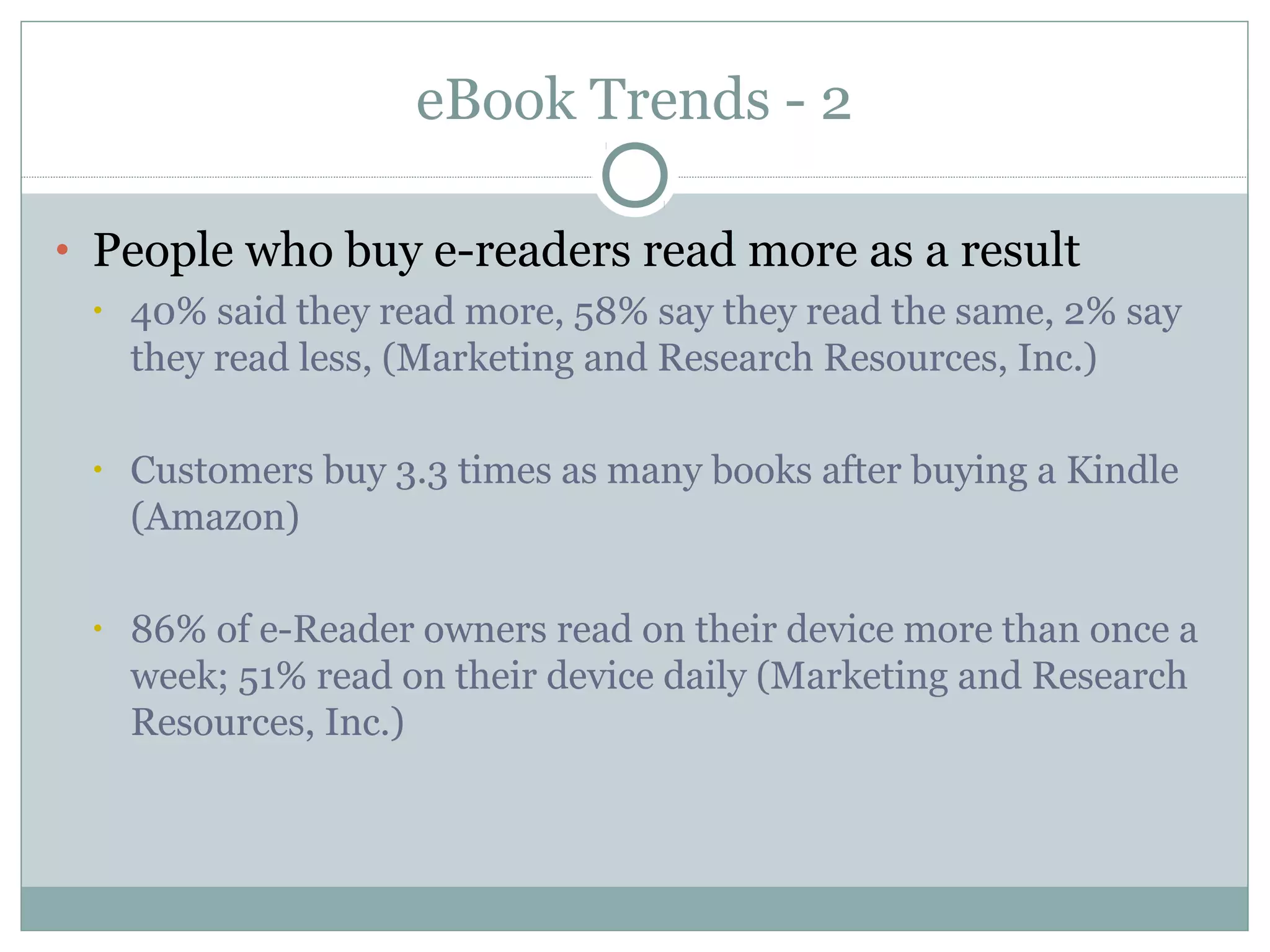
eBook Trends - 2

• People who buy e-readers read more as a result
  • 40% said they read more, 58% say they read the same, 2% say
    they read less, (Marketing and Research Resources, Inc.)

  •   Customers buy 3.3 times as many books after buying a Kindle
      (Amazon)

  •   86% of e-Reader owners read on their device more than once a
      week; 51% read on their device daily (Marketing and Research
      Resources, Inc.)
Hardware Issues

 Amazon Kindle
   Dedicated e-readers to peak in 2014
   Kindle 3 is ingeniously designed to be everything the iPad will never be: small,
    light, inexpensive
   Kindle is outselling the iBooks store 60 to 1 (CrunchBase)

 Mobile
   Books are most widely available type of app on iPhone (22%), but least likely to
    be purchased (3%) (Apptizr)
 Upcoming Tablet Sturm and Drang
   3M zealous iPad owners and the integrated ecosystem (iBookstore carries 46,000
    titles)
   Kno
   Countless models based on Google Android
   Google Chrome OS platform
   Blackberry’s BlackPAD
   HP’s web os powered on PalmPad
   Windows
Enhanced eBooks

Need to develop innovative applications that will push education to
  new levels of pedagogical discovery and engagement

 Currently available for many digital books on Kindle or Apple
  platforms – highlight passages, resize text, change fonts, alter text
  layout, find words or phrases, share notes and bookmarks, synch
  between hardware devices, free samples, dictionary, audio text to
  speech
 Consumer TV/Movie tie-ins: Ken Follett’s The Pillars of the Earth,
  includes sketches, video clips, and original music from Starz
  miniseries, Vooks with video
 Children’s books: Animalia for the iPad includes hidden object
  games, Random House and Smashing Ideas, Dr. Seuss and Ocean
  House Media
 Textbooks: The Elements, A Visual Exploration on iPad includes 3D
  graphics, moving diagrams, instructional videos, audio commentary
Cognitive/Learning Issues

What are the cognitive differences between reading
 on a traditional book, Kindle, and iPad? What is
 important, the medium or the message or both?
    Why does it take longer to read an eBook? Is the reading
     process more or less automatic – Two distinct pathways for
     processing text: ventral (direct) versus dorsal
    Is remembering harder with eBooks? What about missing
     context? What about “emotional attachment” to printed page
     (which also helps memorability)
    Tablet distractions will make us all ADD!
The Future – 1
 More lessons to learn from other media:
     Superiority of one click purchase and integrated ecosystems – Amazon
     Try before you buy/sampling – Legacy Games
     Episodic content – TV shows, House M.D. game
     Subscription based – Always dynamic World of Warcraft
 IoT (Internet of Things) – sensors, UPC codes, tags emitting
  readable data that link objects to servers in the cloud, and vice versa
 Interactive quizzes interspersed throughout, 3D graphics, video,
  audio, games and simulations
 Books that learn and revise themselves, based on dynamic data about
  how students are using and learning from a book
 Purchasing chapters and topics rather than entire books
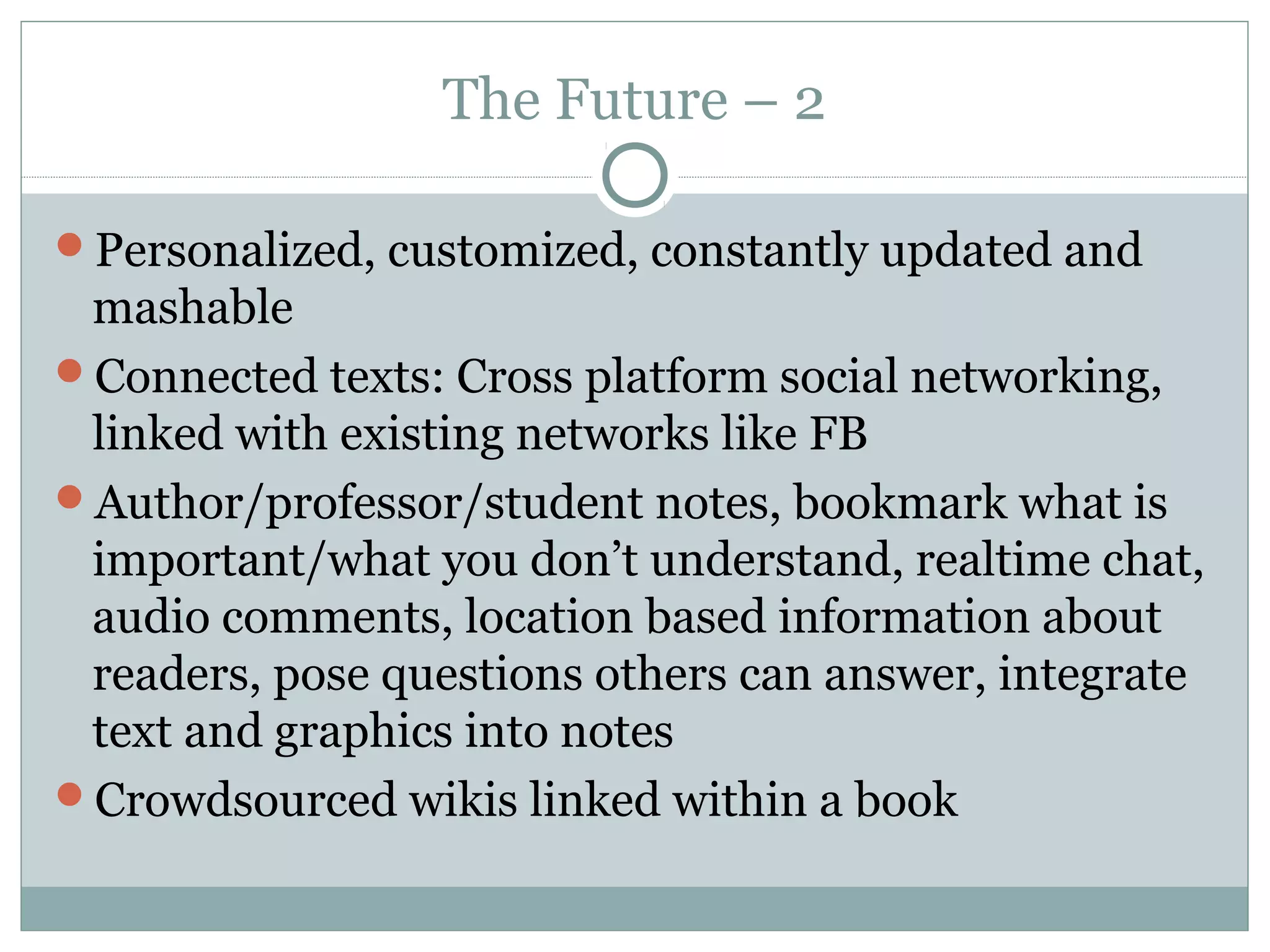
The Future – 2

Personalized, customized, constantly updated and
 mashable
Connected texts: Cross platform social networking,
 linked with existing networks like FB
Author/professor/student notes, bookmark what is
 important/what you don’t understand, realtime chat,
 audio comments, location based information about
 readers, pose questions others can answer, integrate
 text and graphics into notes
Crowdsourced wikis linked within a book
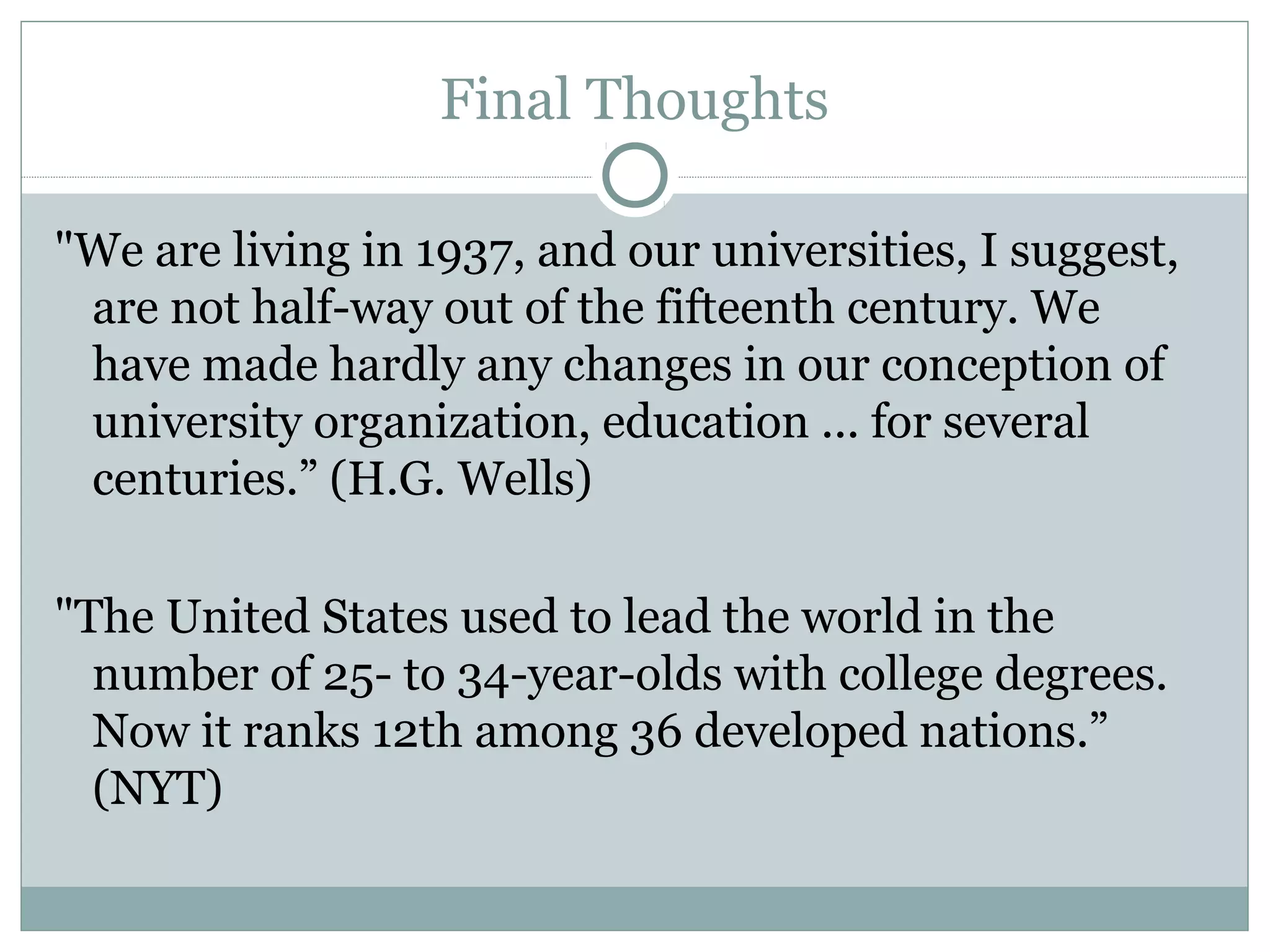
Final Thoughts

"We are living in 1937, and our universities, I suggest,
 are not half-way out of the fifteenth century. We
 have made hardly any changes in our conception of
 university organization, education ... for several
 centuries.” (H.G. Wells)

"The United States used to lead the world in the
  number of 25- to 34-year-olds with college degrees.
  Now it ranks 12th among 36 developed nations.”
  (NYT)

In2010 future ofebook

  • 1.
    Change is Here 9-22-10 ARIELLA LEHRER, PH.D. PRESIDENT AND CEO LEGACY INTERACTIVE ARIELLA@LEGACYINTERACTIVE.COM
  • 2.
  • 3.
    eBook Trends -1 • Online media consumption – of all types – is up • What happened to the 20 somethings? • Online media consumption and sales of digital goods is up because of increasing broadband speed and increased connectivity with new types of devices e.g., TVs, mobile phones, game consoles. • Disaggregation, Disintermediation, Price erosion • Value of digital goods market will jump from $16.73 billion to $36.14 billion by 2014 (Gartner).
  • 4.
    eBook Trends -3 eReaders and eBooks are rapidly becoming more popular  11,000,000 Americans will own a digital reading device and buy 100,000,000 ebooks by the end of 2010, compared to 3,700,000 e-readers and 30,000,000 eBooks in 2009 (Forrester Research)  eBook sales on Amazon are outpacing hardcover sales, 180 to 100  ebooks will account for 11% of textbook market by 2013 (Simba Info) and 20% by 2015 (Xplana)  2009 digital textbooks generated $40,000,000 in sales, expected to double in 2010 (Xplana)
  • 5.
    eBook Trends -2 • People who buy e-readers read more as a result • 40% said they read more, 58% say they read the same, 2% say they read less, (Marketing and Research Resources, Inc.) • Customers buy 3.3 times as many books after buying a Kindle (Amazon) • 86% of e-Reader owners read on their device more than once a week; 51% read on their device daily (Marketing and Research Resources, Inc.)
  • 6.
    Hardware Issues  AmazonKindle  Dedicated e-readers to peak in 2014  Kindle 3 is ingeniously designed to be everything the iPad will never be: small, light, inexpensive  Kindle is outselling the iBooks store 60 to 1 (CrunchBase)  Mobile  Books are most widely available type of app on iPhone (22%), but least likely to be purchased (3%) (Apptizr)  Upcoming Tablet Sturm and Drang  3M zealous iPad owners and the integrated ecosystem (iBookstore carries 46,000 titles)  Kno  Countless models based on Google Android  Google Chrome OS platform  Blackberry’s BlackPAD  HP’s web os powered on PalmPad  Windows
  • 7.
    Enhanced eBooks Need todevelop innovative applications that will push education to new levels of pedagogical discovery and engagement  Currently available for many digital books on Kindle or Apple platforms – highlight passages, resize text, change fonts, alter text layout, find words or phrases, share notes and bookmarks, synch between hardware devices, free samples, dictionary, audio text to speech  Consumer TV/Movie tie-ins: Ken Follett’s The Pillars of the Earth, includes sketches, video clips, and original music from Starz miniseries, Vooks with video  Children’s books: Animalia for the iPad includes hidden object games, Random House and Smashing Ideas, Dr. Seuss and Ocean House Media  Textbooks: The Elements, A Visual Exploration on iPad includes 3D graphics, moving diagrams, instructional videos, audio commentary
  • 8.
    Cognitive/Learning Issues What arethe cognitive differences between reading on a traditional book, Kindle, and iPad? What is important, the medium or the message or both?  Why does it take longer to read an eBook? Is the reading process more or less automatic – Two distinct pathways for processing text: ventral (direct) versus dorsal  Is remembering harder with eBooks? What about missing context? What about “emotional attachment” to printed page (which also helps memorability)  Tablet distractions will make us all ADD!
  • 9.
    The Future –1  More lessons to learn from other media:  Superiority of one click purchase and integrated ecosystems – Amazon  Try before you buy/sampling – Legacy Games  Episodic content – TV shows, House M.D. game  Subscription based – Always dynamic World of Warcraft  IoT (Internet of Things) – sensors, UPC codes, tags emitting readable data that link objects to servers in the cloud, and vice versa  Interactive quizzes interspersed throughout, 3D graphics, video, audio, games and simulations  Books that learn and revise themselves, based on dynamic data about how students are using and learning from a book  Purchasing chapters and topics rather than entire books
  • 10.
    The Future –2 Personalized, customized, constantly updated and mashable Connected texts: Cross platform social networking, linked with existing networks like FB Author/professor/student notes, bookmark what is important/what you don’t understand, realtime chat, audio comments, location based information about readers, pose questions others can answer, integrate text and graphics into notes Crowdsourced wikis linked within a book
  • 11.
    Final Thoughts "We areliving in 1937, and our universities, I suggest, are not half-way out of the fifteenth century. We have made hardly any changes in our conception of university organization, education ... for several centuries.” (H.G. Wells) "The United States used to lead the world in the number of 25- to 34-year-olds with college degrees. Now it ranks 12th among 36 developed nations.” (NYT)