eBooks – tipping points and milestonesTerry O’Brien,				Deputy Librarian,WIT Libraries.IIUG Tralee June 2011
“Without a doubt, the eBook is practically the biggest thing that’s hit the publishing industry since the invention of movable type”(Philip Ruppel, CEO McGraw-Hill, 2011)“inexorable rise of the eBook”(CIBER, UCL)
Increased feesHuge library cutsMore for lessLibrary supplier consolidationReach of Amazon, Apple, GoogleThe iPad and the AppThe CloudRetail damageContext
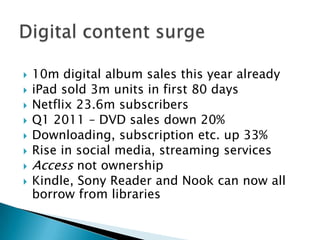
10m digital album sales this year alreadyiPad sold 3m units in first 80 daysNetflix 23.6m subscribersQ1 2011 – DVD sales down 20%Downloading, subscription etc. up 33%Rise in social media, streaming servicesAccess not ownershipKindle, Sony Reader and Nook can now all borrow from librariesDigital content surge
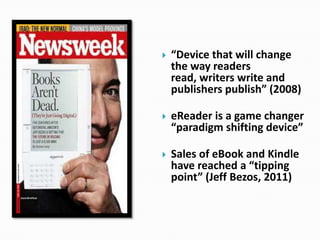
“Device that will change the way readers read, writers write and publishers publish” (2008)eReaderis a game changer“paradigm shifting device”Sales of eBook and Kindle have reached a “tipping point” (Jeff Bezos, 2011)
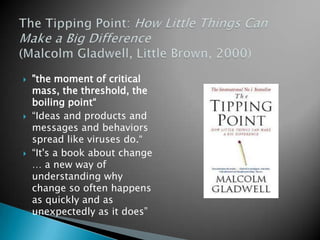
The Tipping Point: How Little Things Can Make a Big Difference (Malcolm Gladwell, Little Brown, 2000)"the moment of critical mass, the threshold, the boiling point““Ideas and products and messages and behaviors spread like viruses do.““It's a book about change … a new way of understanding why change so often happens as quickly and as unexpectedly as it does”
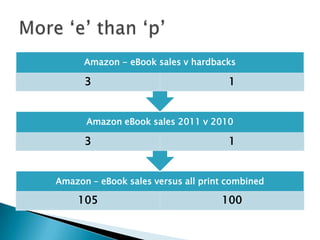
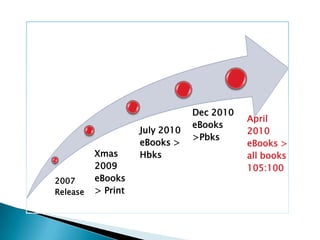
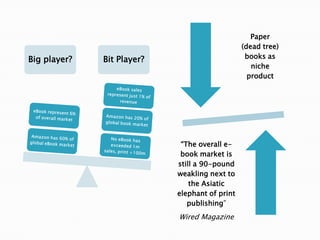
More ‘e’ than ‘p’
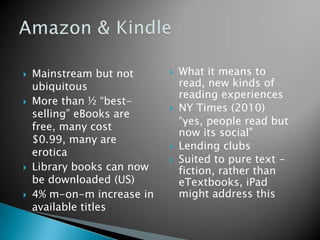
Mainstream but not ubiquitousMore than ½ “best-selling” eBooks are free, many cost $0.99, many are eroticaLibrary books can now be downloaded (US)4% m-on-m increase in available titles What it means to read, new kinds of reading experiencesNY Times (2010) 	“yes, people read but now its social”Lending clubsSuited to pure text - fiction, rather than eTextbooks, iPad might address thisAmazon & Kindle
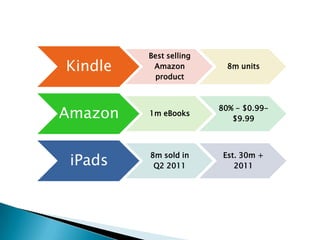
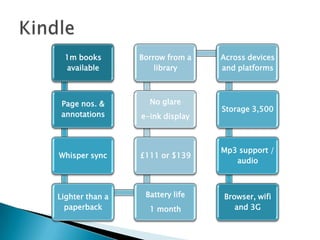
Kindle
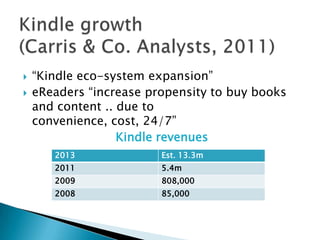
“Kindle eco-system expansion”eReaders “increase propensity to buy books and content .. due to convenience, cost, 24/7”Kindle revenuesKindle growth (Carris & Co. Analysts, 2011)
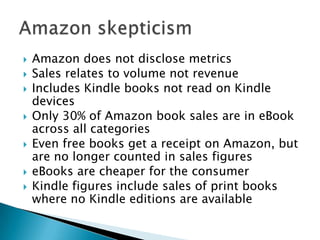
Amazon does not disclose metricsSales relates to volume not revenueIncludes Kindle books not read on Kindle devicesOnly 30% of Amazon book sales are in eBook across all categoriesEven free books get a receipt on Amazon, but are no longer counted in sales figureseBooks are cheaper for the consumerKindle figures include sales of print books where no Kindle editions are availableAmazon skepticism
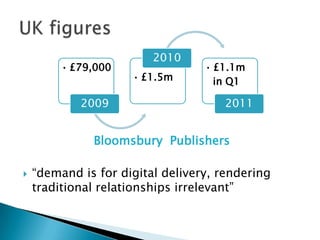
Bloomsbury  Publishers“demand is for digital delivery, rendering traditional relationships irrelevant”UK figures
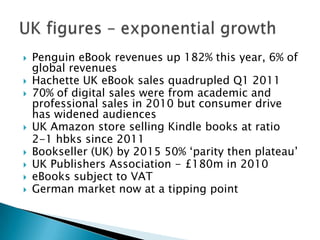
Penguin eBook revenues up 182% this year, 6% of global revenuesHachette UK eBook sales quadrupled Q1 201170% of digital sales were from academic and professional sales in 2010 but consumer drive has widened audiencesUK Amazon store selling Kindle books at ratio 	2-1 hbks since 2011Bookseller (UK) by 2015 50% ‘parity then plateau’UK Publishers Association - £180m in 2010eBooks subject to VATGerman market now at a tipping pointUK figures – exponential growth
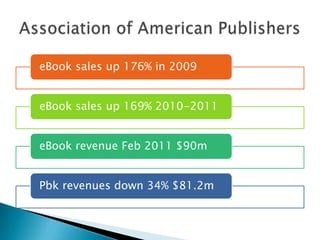
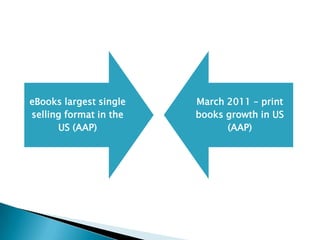
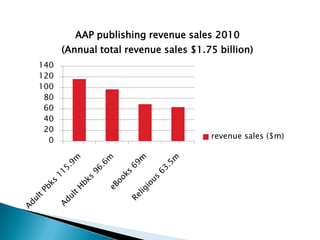
Association of American Publishers
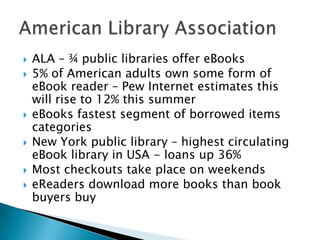
ALA – ¾ public libraries offer eBooks5% of American adults own some form of eBook reader – Pew Internet estimates this will rise to 12% this summereBooks fastest segment of borrowed items categoriesNew York public library – highest circulating eBook library in USA - loans up 36%Most checkouts take place on weekends eReaders download more books than book buyers buy American Library Association
Most popular eBooks Romance, mystery, crime most popular genresShort, quick reads, part of series, read in succession, multiple buysAmazon customers buy 3.3 times as many books after buying a KindleSeasonal buying patterns, post holiday loadingBacklist purchasing and series purchasing popularChildren’s print books remain very strongMen more likely to buy tablets, women more likely to buy eReaders (Forrester Research (2011)eBook trends
eBook trends that may change publishing?Bundled booksSocial readingeBook clubse-first publishingFree e-readers – incentivisation Open access eBooksMonetization experiments – in book advertising, sponsored links etc.Enhanced eBooks coming and will only get betterThe device war is nearly overThe $9.99 model won’t lastPublishers will remain important despite self-publishing“Contextual upsell” a business model to watchPhilip Ruppel, McGraw-HillMichael Hyatt, Thomas Nelson
Digital Book World Conference predict eBooks will reach parity with print in 2014Goldman Sachs est. 13% of all book sales will be eBook format by 2015, representing over £3 billionAmazon share of eBook cake will fall by 50% over next 5 years as Google and Apple eat into market.   “By 2017 eBook will be the default format for textbooks, scholarly  books and reference works” Highwire Librarian survey (2009) – 	50% of all acquisitions will be eBook by 2015A mere 10% of new titles will be available in print alone by 2020 (BL) Next few years ...
Kindle iPad app has increased eBook sales The app - huge impact on digital literature Google Books – “reading unbound” 	mass digitization projectBritish Library / Google projectApple iBooksVertical Integration – Amazon opening a publishing division, controlling all parts of the chaineTextbooks yet to take off – delayed adoptionDevice convergence could shorten eReaders' lifespanSignificant developments
“the next five years will see an explosion of the eReader textbook market, and in 10 years, the market will be driven by businesses going green in government, education, health and other sectors”Forrester Research
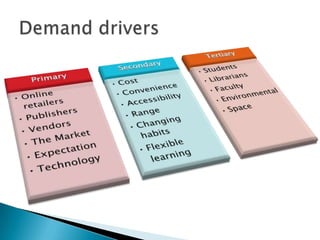
Demand drivers
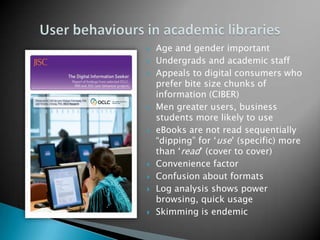
Age and gender importantUndergrads and academic staff Appeals to digital consumers who prefer bite size chunks of information (CIBER)Men greater users, business students more likely to use eBooks are not read sequentially “dipping” for ‘use’ (specific) more than ‘read’ (cover to cover)Convenience factorConfusion about formatsLog analysis shows power browsing, quick usageSkimming is endemicUser behaviours in academic libraries
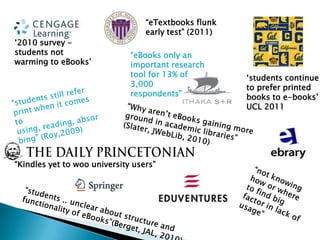
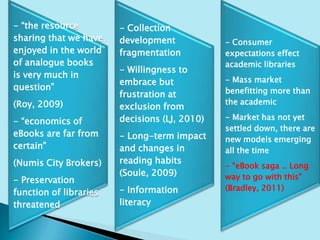
eBooks – academic libraries
“eTextbooks flunk early test” (2011)‘2010 survey - students not warming to eBooks’“eBooks only an important research tool for 13% of 3,000 respondents”‘students continue to prefer printed books to e-books’UCL 2011 “students still refer print when it comes to using, reading, absorbing” (Roy,2009)“Why aren’t eBooks gaining more ground in academic libraries” (Slater, JWebLib, 2010)“Kindles yet to woo university users” “not knowing how or where to find big factor in lack of usage”“students .. unclear about structure and functionality of eBooks”(Berget, JAL, 2010)
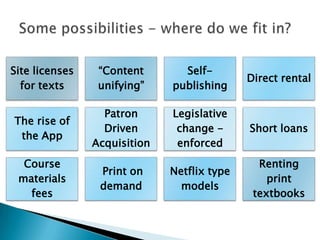
Some possibilities - where do we fit in?
“A university (or an IoT ...)is just a group ofbuildings gathered around a library”Shelby FooteThank you!Terry O’Brien	Deputy Librarian, WIT.				www.wit.ie/library#witlibrariestpobrien@wit.ie

eBooks - Tipping Points and Milestones

  • 1.
    eBooks – tippingpoints and milestonesTerry O’Brien, Deputy Librarian,WIT Libraries.IIUG Tralee June 2011
  • 2.
    “Without a doubt,the eBook is practically the biggest thing that’s hit the publishing industry since the invention of movable type”(Philip Ruppel, CEO McGraw-Hill, 2011)“inexorable rise of the eBook”(CIBER, UCL)
  • 4.
    Increased feesHuge librarycutsMore for lessLibrary supplier consolidationReach of Amazon, Apple, GoogleThe iPad and the AppThe CloudRetail damageContext
  • 6.
    10m digital albumsales this year alreadyiPad sold 3m units in first 80 daysNetflix 23.6m subscribersQ1 2011 – DVD sales down 20%Downloading, subscription etc. up 33%Rise in social media, streaming servicesAccess not ownershipKindle, Sony Reader and Nook can now all borrow from librariesDigital content surge
  • 7.
    “Device that willchange the way readers read, writers write and publishers publish” (2008)eReaderis a game changer“paradigm shifting device”Sales of eBook and Kindle have reached a “tipping point” (Jeff Bezos, 2011)
  • 8.
    The Tipping Point:How Little Things Can Make a Big Difference (Malcolm Gladwell, Little Brown, 2000)"the moment of critical mass, the threshold, the boiling point““Ideas and products and messages and behaviors spread like viruses do.““It's a book about change … a new way of understanding why change so often happens as quickly and as unexpectedly as it does”
  • 11.
  • 14.
    Mainstream but notubiquitousMore than ½ “best-selling” eBooks are free, many cost $0.99, many are eroticaLibrary books can now be downloaded (US)4% m-on-m increase in available titles What it means to read, new kinds of reading experiencesNY Times (2010) “yes, people read but now its social”Lending clubsSuited to pure text - fiction, rather than eTextbooks, iPad might address thisAmazon & Kindle
  • 16.
  • 17.
    “Kindle eco-system expansion”eReaders“increase propensity to buy books and content .. due to convenience, cost, 24/7”Kindle revenuesKindle growth (Carris & Co. Analysts, 2011)
  • 18.
    Amazon does notdisclose metricsSales relates to volume not revenueIncludes Kindle books not read on Kindle devicesOnly 30% of Amazon book sales are in eBook across all categoriesEven free books get a receipt on Amazon, but are no longer counted in sales figureseBooks are cheaper for the consumerKindle figures include sales of print books where no Kindle editions are availableAmazon skepticism
  • 19.
    Bloomsbury Publishers“demandis for digital delivery, rendering traditional relationships irrelevant”UK figures
  • 20.
    Penguin eBook revenuesup 182% this year, 6% of global revenuesHachette UK eBook sales quadrupled Q1 201170% of digital sales were from academic and professional sales in 2010 but consumer drive has widened audiencesUK Amazon store selling Kindle books at ratio 2-1 hbks since 2011Bookseller (UK) by 2015 50% ‘parity then plateau’UK Publishers Association - £180m in 2010eBooks subject to VATGerman market now at a tipping pointUK figures – exponential growth
  • 21.
  • 24.
    ALA – ¾public libraries offer eBooks5% of American adults own some form of eBook reader – Pew Internet estimates this will rise to 12% this summereBooks fastest segment of borrowed items categoriesNew York public library – highest circulating eBook library in USA - loans up 36%Most checkouts take place on weekends eReaders download more books than book buyers buy American Library Association
  • 25.
    Most popular eBooksRomance, mystery, crime most popular genresShort, quick reads, part of series, read in succession, multiple buysAmazon customers buy 3.3 times as many books after buying a KindleSeasonal buying patterns, post holiday loadingBacklist purchasing and series purchasing popularChildren’s print books remain very strongMen more likely to buy tablets, women more likely to buy eReaders (Forrester Research (2011)eBook trends
  • 26.
    eBook trends thatmay change publishing?Bundled booksSocial readingeBook clubse-first publishingFree e-readers – incentivisation Open access eBooksMonetization experiments – in book advertising, sponsored links etc.Enhanced eBooks coming and will only get betterThe device war is nearly overThe $9.99 model won’t lastPublishers will remain important despite self-publishing“Contextual upsell” a business model to watchPhilip Ruppel, McGraw-HillMichael Hyatt, Thomas Nelson
  • 27.
    Digital Book WorldConference predict eBooks will reach parity with print in 2014Goldman Sachs est. 13% of all book sales will be eBook format by 2015, representing over £3 billionAmazon share of eBook cake will fall by 50% over next 5 years as Google and Apple eat into market. “By 2017 eBook will be the default format for textbooks, scholarly books and reference works” Highwire Librarian survey (2009) – 50% of all acquisitions will be eBook by 2015A mere 10% of new titles will be available in print alone by 2020 (BL) Next few years ...
  • 28.
    Kindle iPad apphas increased eBook sales The app - huge impact on digital literature Google Books – “reading unbound” mass digitization projectBritish Library / Google projectApple iBooksVertical Integration – Amazon opening a publishing division, controlling all parts of the chaineTextbooks yet to take off – delayed adoptionDevice convergence could shorten eReaders' lifespanSignificant developments
  • 29.
    “the next fiveyears will see an explosion of the eReader textbook market, and in 10 years, the market will be driven by businesses going green in government, education, health and other sectors”Forrester Research
  • 30.
  • 32.
    Age and genderimportantUndergrads and academic staff Appeals to digital consumers who prefer bite size chunks of information (CIBER)Men greater users, business students more likely to use eBooks are not read sequentially “dipping” for ‘use’ (specific) more than ‘read’ (cover to cover)Convenience factorConfusion about formatsLog analysis shows power browsing, quick usageSkimming is endemicUser behaviours in academic libraries
  • 33.
  • 34.
    “eTextbooks flunk earlytest” (2011)‘2010 survey - students not warming to eBooks’“eBooks only an important research tool for 13% of 3,000 respondents”‘students continue to prefer printed books to e-books’UCL 2011 “students still refer print when it comes to using, reading, absorbing” (Roy,2009)“Why aren’t eBooks gaining more ground in academic libraries” (Slater, JWebLib, 2010)“Kindles yet to woo university users” “not knowing how or where to find big factor in lack of usage”“students .. unclear about structure and functionality of eBooks”(Berget, JAL, 2010)
  • 36.
    Some possibilities -where do we fit in?
  • 38.
    “A university (oran IoT ...)is just a group ofbuildings gathered around a library”Shelby FooteThank you!Terry O’Brien Deputy Librarian, WIT. www.wit.ie/library#witlibrariestpobrien@wit.ie

Editor's Notes

  • #3 The eBook itself is evolving and what constitutes an eBook and what will constitute an eBook or a digital book in the next few yearsHorizon 2011 – compelling, transformative technology – near term horizon
  • #4 Milestones
  • #5 Mix of consumer context and specific acadmic library contextSome trends, forecasts and interesting figuresConsumer market – expectations, changesBlurring of lines between librarieseBook, eReader – “Tipping points”Fees at UK universities, 2 year degree, expectations, digital course materials, pre-loaded ipads and kindles
  • #6 Retail closures, impending closures, new ways of doing business, adapt or dieCorner shops
  • #7 Photography, gaming, tvWider pictureThis is being reflected in academic libraries too
  • #8 Transformative technology
  • #10 Other models – proquest short loans, eBrary usage triggered model for short term loans, only pay if usedEBSCO consolidations – less choice?New iPad books – see TEDSMART phones
  • #11 AmazonHuge publishing deal.35% CommissionVampires and zombies
  • #12 Not just Amazon figures look at wider figures in later slides
  • #14 CounterbalanceIkea shelves
  • #15 Not as versatile as books but better than a pc The book lives onKindle in library removes economic barrier – introduces new socio-economic groups (book buyers) are affluentReading now a social activity – TV ads socialisation of reading
  • #16 You are buying a lifestyle, beautiful people, popularity, intelligence, good looksBut amazon has been brilliant in correcting the some of the issues and problems around previous versions of the Kindle
  • #17 Kindle adoption rates are phenomenal Formats (epub) still an issue but will be embraced by amazon later this year
  • #18 Content – magazines, newspapers all available on Kindle
  • #19 Cost 111 UK, 139 €, 114 $ in april!!FACT!, not academic books or eTextbooksLot of criticism of how amazon presents data - Whether figures are skewed or not, represent exponential growth, a trend, prevalent changes to the marketNo sales – rent or lease!!Crunch the numberSo what!
  • #20 Music, tv etc.
  • #21 INSTANT GRATIFICATION
  • #22 Albeit from a vey low base(3) Up 200% Feb 2010(4) For same period
  • #23 Despite revenues being downInternet has increased book sales across categories
  • #24 Categories
  • #25 Mention Ireland – no longer a question of having, but of the model or how (what) users will accessAt moment pc is primary tool used, but smartphones etc. (reflected in catalogues) growing and public libraries have shown some demand for device lead borrowing (partic Sony readers)
  • #26 Tablets 56% M, eReaders 55% F. Nooks popular will F in US because they are discrete, small, light, fit in a purse
  • #27 Backlist List purchasingThe Cloud
  • #28 Market share currently estimated at around 60-80%CIBER
  • #29 Photography digital shiftGoogle 3m books – huge reach- eTextbooks +400% CourseSmartCRL (2011)Shrimplin at aApp – mobile and iPad – app allows for deep reading – ST – Turning point for digital literature (Faber – The Waste Land, TS Eliot)(but talk about coursesmart)
  • #30 Demand
  • #31 Distance learningPeople now less concerned with ownership more with access. Previously only way to access was by ownership. Access involves recurring cost and revenues!
  • #32 OverwhelmingHarperCollins – placing limits on usage eBooks can only be loaned out 26 timesRemains major issue and barrier across all library typesWhat does ownership mean, concept changing for librariesPerpetuity, platform fees, subscription feesIf library ceases paying a platform fee do they lose rights of accessLicense versus ownership – danger of putting publishers in charge of preservationAmerican Library Association task force 2011In the bustle for market share and ‘ownership’, libraries are being squeezed
  • #33 What we know about BEHAVIOURSpredictors of uptakePrint circulations have not really decreasedAcademic mainstream
  • #34 What we know about USAGEMixed success
  • #35 Please Nicholas carr!! Who believes that not only is Google making us stupid, but that reading from screens and skimming is turning our collective brains to mush! (The Shallows)DRM remians a source of frustration for studentsCalifornia 2011 (2,500 students)that many undergraduates complain that they have trouble "learning, retaining, and concentrating" when reading from screens.students prefer many of the low tech elements of print and paper“more research needed to better understand users interactions”, “students understand conventions of print books but (e.g. index) The most illuminating part of the survey came when respondents were asked to explain their preferences. The answers suggest that while students prefer e-books when they need to search through a book quickly to find a particular fact or passage, they prefer printed books for deep, attentive reading. "E-books divide my attention," said one undergraduate. "Paper ... keeps me focused and away from distractions that may arise from computer usage," said another. "I have some difficulty paying careful attention to long passages on my computer,” said another. "Reading on the computer makes it harder for me to understand the information," said another. Commented a graduate student: "I am a better reader when I have the print copy in front of me."
  • #36 New models – may or may not need libraries. Overdrive – public libraries, Amazon
  • #37 PonD – on campus and commerciallyChegg – renting print textbooksfor individ text similar to software + rental programs, print on demand across campusesProquest – eBrary, SciVerse , EBSCO
  • #38 Implications – some for us to consider
  • #39 Proprietary = ownershipNon-p = ePub