The e-Book Age Arrives
  - VIABLE E-BOOKS ARE EVERYWHERE -
                SO WHAT?


                  KENT R. ANDERSON
                  EXECUTIVE DIRECTOR
     INTERNATIONAL BUSINESS & PRODUCT DEVELOPMENT
         THE NEW ENGLAND JOURNAL OF MEDICINE
                  AND JOURNAL WATCH
Overview of the e-Book Space

— Devices have overcome major usability and
  availability hurdles
— Change is happening rapidly
— MobiPocket, ePub, LRF, and PDF are the major
  standards (PDF and Mobi are biggest)
—“ Book” a misnomer for connected devices
          is
 ¡   Book formats are changing to adapt
 ¡   Information snacking and speed-dating
 ¡   Blogs, magazines, newspapers all exist on these devices
The DP2C3 of e-Books

— Devices are machines that can read e-books
— Platforms are systems that deliver content
— Players are businesses trying to define e-books
— Content is what you read on an e-book
— Consumption is how you absorb the content
— Commercialization is how e-books make money
My Qualifications

— Publisher
— Owner of many e-books over the years
— Author
— Self-publisher
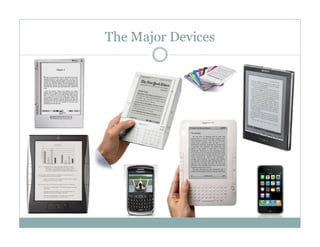
The Major Devices
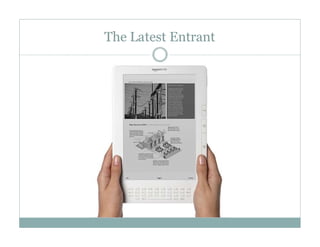
The Latest Entrant
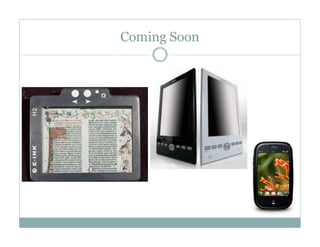
Coming Soon
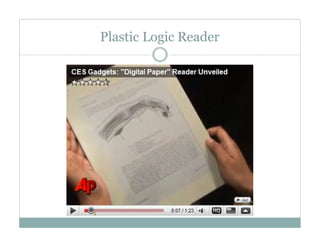
Plastic Logic Reader
Other Devices

— Cell phone (basic, important in Japan)
— Desktop computer
— Laptop computer
— Rumored devices
  ¡ Apple developing some color e-reading device

  ¡ Apple and Verizon collaborating (could be the same rumor)
Wired vs. Wireless

— Kindle and iPhone are both connected via cellular
  networks
  ¡   Major advantage for book purchasing on the fly, updates to
      news and blog sources
— Sony is tethered
  ¡ Rumors of a connected Sony reader just surfaced
PDF Support

— Current Kindle offers some PDF support
  ¡ Users have to email a PDF to themselves and pay a transfer
    charge of $0.25 per
— New Kindle DX offers full PDF support
— Sony e-Reader offers full PDF support
Web Browsing and Linking

— Current Kindle offers rudimentary Web browsing
 and linking
 ¡   Slow, browser is clunky
— New Kindle DX promises better browser and
  faster load times
— Sony e-Reader does not link to the Web
Platforms

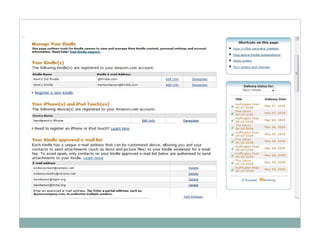
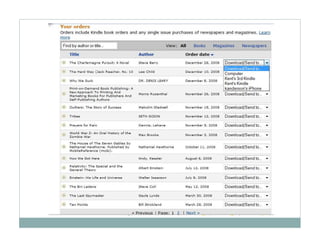
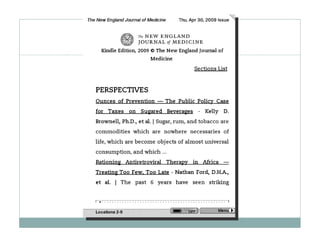
— Amazon Kindle storefront
— Amazon Kindle iPhone application
— Lexcycle’Stanza (now owned by Amazon)
          s
— Smashwords
— Scribd
— Sony eBook Store
A Note About Scribd

— Started as free document-sharing site (2007)
— In May 2009, announced e-book offerings
— Downloads work on multiple devices
— Openness creates threats of piracy
— Authors keep 80% of net revenues
  ¡ Fees reduce this by $0.25, so for me, -5%

  ¡ Fee for DRM-protected documents is $0.40
A Note About Smashwords

— A very slick new entry into the field
— Great conversion tools, great data tools
— Good pricing system, with preview %, coupons, etc.
— Savvy owners who are paying attention
— Authors get 85% of net revenues
Amazon’Big Play
                      s

— Amazon wants to own the e-book storefront
  ¡ Device

  ¡ Kindle application on iPhone

  ¡ Acquisition of Lexcycle’Stanza
                            s
— Neutralize competition on the device front
— Own competition on the store front
— Make a play on the content front
Content

— Plenty of novels on e-books
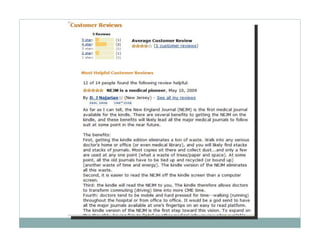
— Technical materials hard to provision
— Blogs and magazines work well
— News sources work well
Content Conversion

— Amazon has great tools for turning a narrative book
  into a Kindle version
— Smashwords has an amazing program (the
  Meatgrinder) for making e-books from native files
— Scribd works OK, but not as good at the Meatgrinder
— Scholarly and technical materials are harder to
  convert to workable formats
Consumption

— Called e-books, but really e-readers
— Once expanded to reading, the devices’
                                       true value
  shines through
— Information speed-dating and snacking behaviors
— Full, immersive reading still a luxury item
— Audio feature of Kindle rather rudimentary, but
  some users find it valuable
 ¡   Audio book while driving, exercising = time-shifting
Commercialization

— E-book publishing can actually be more profitable
  for authors and sellers than traditional publishing
  ¡   Lower price-point for consumers, but less waste in
      manufacturing, shipping, storage, and returns
— Devices expensive, content cheap
  ¡ Multipurpose devices spread the cost (iPhone)

  ¡ Content does preserve its brand, prices should rise

— Royalties to publishers on-par with other licenses
— No costs associated with returns, shipping, storage
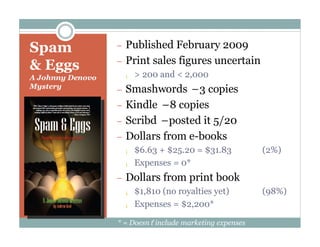
Spam              — Published February 2009
                  — Print sales figures uncertain
& Eggs
A Johnny Denovo     ¡ > 200 and < 2,000
Mystery
                  — Smashwords –3 copies
                  — Kindle –8 copies
                  — Scribd –posted it 5/20
                  — Dollars from e-books
                    ¡ $6.63 + $25.20 = $31.83             (2%)
                    ¡ Expenses = 0*

                  — Dollars from print book
                    ¡ $1,810 (no royalties yet)           (98%)
                    ¡ Expenses = $2,200*

                  * = Doesn’
                           t include marketing expenses
Changes in Book Publishing

—“
 The number of new and revised titles produced by
 traditional production methods fell 3% in 2008, to
 275,232, but the number of on-demand and short
 run titles soared 132%, to 285,394. The on-demand
 and short run segment is the method typically used
 by self-publishers as well as online publishers. With
 the decline in the number of traditional books
 released last year and the jump in on-demand, the
 number of on-demand titles topped those of
 traditional books for the first time.”
                             - Publishers Weekly, May 19, 2009
Changes in STM Publishing

—“
 [the U. of Michigan Press] will shift its scholarly
 publishing from being primarily a traditional print
 operation to one that is primarily digital. Within two
 years, press officials expect well over 50 of the 60-
 plus monographs that the press publishes each year
 —currently in book form —to be released only in
 digital editions. Readers will still be able to use print-
 on-demand systems to produce versions that can be
 held in their hands, but the press will consider
 the digital monograph the norm.”
                              - Inside HigherEd, March 23, 2009
Conclusion

— E-books are for real
— They are evolving rapidly
— Very savvy players are entering the content space
— Devices are too expensive
  ¡ Don’
       t know why Amazon doesn’make a strategic move here
                              t
— E-ink is on an improvement trajectory
— On-demand printing already outstrips traditional
  ¡ Can e-books be far behind?
Thank You

         KENT R. ANDERSON
         EXECUTIVE DIRECTOR
      INTERNATIONAL BUSINESS &
        PRODUCT DEVELOPMENT
THE NEW ENGLAND JOURNAL OF MEDICINE
         AND JOURNAL WATCH

2 c.1

  • 1.
    The e-Book AgeArrives - VIABLE E-BOOKS ARE EVERYWHERE - SO WHAT? KENT R. ANDERSON EXECUTIVE DIRECTOR INTERNATIONAL BUSINESS & PRODUCT DEVELOPMENT THE NEW ENGLAND JOURNAL OF MEDICINE AND JOURNAL WATCH
  • 2.
    Overview of thee-Book Space — Devices have overcome major usability and availability hurdles — Change is happening rapidly — MobiPocket, ePub, LRF, and PDF are the major standards (PDF and Mobi are biggest) —“ Book” a misnomer for connected devices is ¡ Book formats are changing to adapt ¡ Information snacking and speed-dating ¡ Blogs, magazines, newspapers all exist on these devices
  • 3.
    The DP2C3 ofe-Books — Devices are machines that can read e-books — Platforms are systems that deliver content — Players are businesses trying to define e-books — Content is what you read on an e-book — Consumption is how you absorb the content — Commercialization is how e-books make money
  • 4.
    My Qualifications — Publisher —Owner of many e-books over the years — Author — Self-publisher
  • 5.
  • 6.
  • 7.
  • 8.
  • 9.
    Other Devices — Cellphone (basic, important in Japan) — Desktop computer — Laptop computer — Rumored devices ¡ Apple developing some color e-reading device ¡ Apple and Verizon collaborating (could be the same rumor)
  • 10.
    Wired vs. Wireless —Kindle and iPhone are both connected via cellular networks ¡ Major advantage for book purchasing on the fly, updates to news and blog sources — Sony is tethered ¡ Rumors of a connected Sony reader just surfaced
  • 11.
    PDF Support — CurrentKindle offers some PDF support ¡ Users have to email a PDF to themselves and pay a transfer charge of $0.25 per — New Kindle DX offers full PDF support — Sony e-Reader offers full PDF support
  • 12.
    Web Browsing andLinking — Current Kindle offers rudimentary Web browsing and linking ¡ Slow, browser is clunky — New Kindle DX promises better browser and faster load times — Sony e-Reader does not link to the Web
  • 13.
    Platforms — Amazon Kindlestorefront — Amazon Kindle iPhone application — Lexcycle’Stanza (now owned by Amazon) s — Smashwords — Scribd — Sony eBook Store
  • 16.
    A Note AboutScribd — Started as free document-sharing site (2007) — In May 2009, announced e-book offerings — Downloads work on multiple devices — Openness creates threats of piracy — Authors keep 80% of net revenues ¡ Fees reduce this by $0.25, so for me, -5% ¡ Fee for DRM-protected documents is $0.40
  • 17.
    A Note AboutSmashwords — A very slick new entry into the field — Great conversion tools, great data tools — Good pricing system, with preview %, coupons, etc. — Savvy owners who are paying attention — Authors get 85% of net revenues
  • 18.
    Amazon’Big Play s — Amazon wants to own the e-book storefront ¡ Device ¡ Kindle application on iPhone ¡ Acquisition of Lexcycle’Stanza s — Neutralize competition on the device front — Own competition on the store front — Make a play on the content front
  • 19.
    Content — Plenty ofnovels on e-books — Technical materials hard to provision — Blogs and magazines work well — News sources work well
  • 20.
    Content Conversion — Amazonhas great tools for turning a narrative book into a Kindle version — Smashwords has an amazing program (the Meatgrinder) for making e-books from native files — Scribd works OK, but not as good at the Meatgrinder — Scholarly and technical materials are harder to convert to workable formats
  • 23.
    Consumption — Called e-books,but really e-readers — Once expanded to reading, the devices’ true value shines through — Information speed-dating and snacking behaviors — Full, immersive reading still a luxury item — Audio feature of Kindle rather rudimentary, but some users find it valuable ¡ Audio book while driving, exercising = time-shifting
  • 24.
    Commercialization — E-book publishingcan actually be more profitable for authors and sellers than traditional publishing ¡ Lower price-point for consumers, but less waste in manufacturing, shipping, storage, and returns — Devices expensive, content cheap ¡ Multipurpose devices spread the cost (iPhone) ¡ Content does preserve its brand, prices should rise — Royalties to publishers on-par with other licenses — No costs associated with returns, shipping, storage
  • 25.
    Spam — Published February 2009 — Print sales figures uncertain & Eggs A Johnny Denovo ¡ > 200 and < 2,000 Mystery — Smashwords –3 copies — Kindle –8 copies — Scribd –posted it 5/20 — Dollars from e-books ¡ $6.63 + $25.20 = $31.83 (2%) ¡ Expenses = 0* — Dollars from print book ¡ $1,810 (no royalties yet) (98%) ¡ Expenses = $2,200* * = Doesn’ t include marketing expenses
  • 26.
    Changes in BookPublishing —“ The number of new and revised titles produced by traditional production methods fell 3% in 2008, to 275,232, but the number of on-demand and short run titles soared 132%, to 285,394. The on-demand and short run segment is the method typically used by self-publishers as well as online publishers. With the decline in the number of traditional books released last year and the jump in on-demand, the number of on-demand titles topped those of traditional books for the first time.” - Publishers Weekly, May 19, 2009
  • 27.
    Changes in STMPublishing —“ [the U. of Michigan Press] will shift its scholarly publishing from being primarily a traditional print operation to one that is primarily digital. Within two years, press officials expect well over 50 of the 60- plus monographs that the press publishes each year —currently in book form —to be released only in digital editions. Readers will still be able to use print- on-demand systems to produce versions that can be held in their hands, but the press will consider the digital monograph the norm.” - Inside HigherEd, March 23, 2009
  • 28.
    Conclusion — E-books arefor real — They are evolving rapidly — Very savvy players are entering the content space — Devices are too expensive ¡ Don’ t know why Amazon doesn’make a strategic move here t — E-ink is on an improvement trajectory — On-demand printing already outstrips traditional ¡ Can e-books be far behind?
  • 29.
    Thank You KENT R. ANDERSON EXECUTIVE DIRECTOR INTERNATIONAL BUSINESS & PRODUCT DEVELOPMENT THE NEW ENGLAND JOURNAL OF MEDICINE AND JOURNAL WATCH