Digital Revolution
How Consumers use Technology and its
impact on their lives
Introduction
The fast technology development has been changing the society, as well as we behave socially, economically,
politically and culturally. After the World War II, there was an evolution in the areas of communication and
computer science, especially in the telecommunication sector, and this technology has given many improvements
to our daily lives, since it has become an extension of it.
The Technology has largely determined the productive capacity of our society, our living standards, as well as our
economic organization and social forms. The impact of sophisticated media such as television, satellites and the
internet has brought changes in attitudes, standards, habits and trends of the world population.
For many years, technology and science have been dictating the course and alternation of social behaviour,
resulting from the satisfaction of everyday needs in the areas of survival, development, leisure, etc. and with more
or less impact, technology has shaped our lives.
The internet has become one of the most widely dissiminated technologies around the world. It was born in 1969
in the USA and originaly linked to research laboratoires and the US Department of Defense. For decades it was
restricted to the academic and sientific environtments.
In 1992, it was when the network became fashionable and several provider companies began to appear. The web
was the trigger of the internet, designing a unique language that served to interconect computers and its
popularitzation provided an infitnity of contents on the most diverse subjects, facilitating the seach of information.
Since then, the network has grown rapidly and today there are more than 4 billion users worldwide, 90% from
industrialized countries. The presence in schools, colleges and companies and the emergence of new browsers,
as well as the proliferation of websites, chats and social networks, have made the internet the global network of
connected computers, bringing people, cultures, countries and information altogether.
Nowadays it is difficult to imagine life without social channels, emails, e-commerce and search sites. The internet
is a world of great possibilities and there is no doubt a lot more is to come.
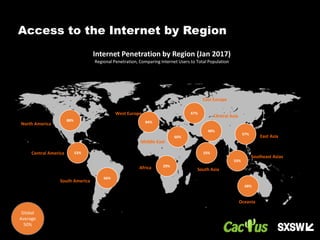
Access to the Internet by Region
88%
53%
84%
66%
29%
60%
67%
48%
33%
68%
53%
57%
North America
Central America
South America
Africa
West Europe
Middle East
East Europe
Central Asia
East Asia
South Asia
Southeast Asias
Oceania
Global
Average
50%
Internet Penetration by Region (Jan 2017)
Regional Penetration, Comparing Internet Users to Total Population
₢
99%
93%
92%
91%
90%
89%
88%
88%
87%
85%
82%
82%
79%
73%
72%
71%
70%
67%
66%
66%
60%
59%
58%
53%
53%
52%
51%
51%
50%
37%
35%
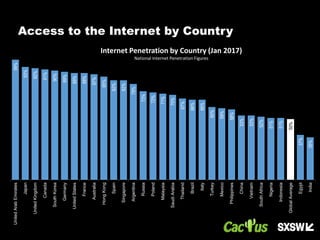
UnitedArabEmirates
Japan
UnitedKingdom
Canada
SouthKorea
Germany
UnitedStates
France
Australia
HongKong
Spain
Singapore
Argentina
Russia
Poland
Malaysia
SaudiArabia
Thailand
Brazil
Italy
Turkey
Mexico
Philippines
China
Vietnam
SouthAfrica
Nigeria
Indonesia
GlobalAverage
Egypt
India
Internet Penetration by Country (Jan 2017)
National Internet Penetration Figures
Access to the Internet by Country
₢
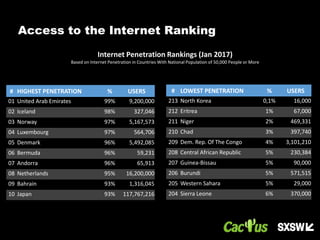
# HIGHEST PENETRATION % USERS
01 United Arab Emirates 99% 9,200,000
02 Iceland 98% 327,046
03 Norway 97% 5,167,573
04 Luxembourg 97% 564,706
05 Denmark 96% 5,492,085
06 Bermuda 96% 59,231
07 Andorra 96% 65,913
08 Netherlands 95% 16,200,000
09 Bahrain 93% 1,316,045
10 Japan 93% 117,767,216
# LOWEST PENETRATION % USERS
213 North Korea 0,1% 16,000
212 Eritrea 1% 67,000
211 Niger 2% 469,331
210 Chad 3% 397,740
209 Dem. Rep. Of The Congo 4% 3,101,210
208 Central African Republic 5% 230,384
207 Guinea-Bissau 5% 90,000
206 Burundi 5% 571,515
205 Western Sahara 5% 29,000
204 Sierra Leone 6% 370,000
Access to the Internet Ranking
Internet Penetration Rankings (Jan 2017)
Based on Internet Penetration in Countries With National Population of 50,000 People or More
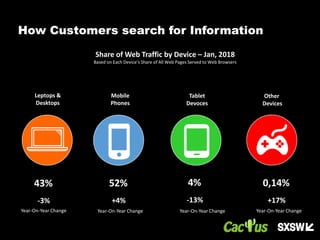
43% 52% 4% 0,14%
-3% +4% -13% +17%
Other
Devices
Tablet
Devoces
Mobile
Phones
Leptops &
Desktops
Share of Web Traffic by Device – Jan, 2018
Based on Each Device’s Share of All Web Pages Served to Web Browsers
Year-On-Year Change Year-On-Year Change Year-On-Year Change Year-On-Year Change
How Customers search for Information
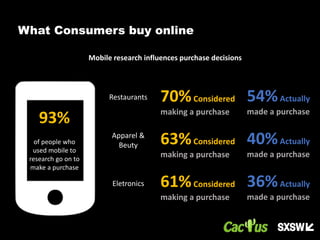
93%
of people who
used mobile to
research go on to
make a purchase
Mobile research influences purchase decisions
70%Considered
making a purchase
63%Considered
making a purchase
61%Considered
making a purchase
54%Actually
made a purchase
40%Actually
made a purchase
36%Actually
made a purchase
Restaurants
Apparel &
Beuty
Eletronics
What Consumers buy online
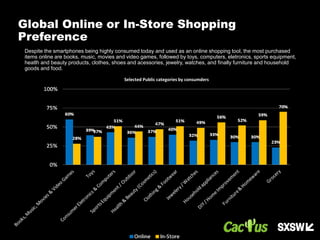
Despite the smartphones being highly consumed today and used as an online shopping tool, the most purchased
items online are books, music, movies and video games, followed by toys, computers, eletronics, sports equipment,
heatlh and beauty products, clothes, shoes and acessories, jewelry, watches, and finally furniture and household
goods and food.
Global Online or In-Store Shopping
Preference
Selected Public categories by consumders
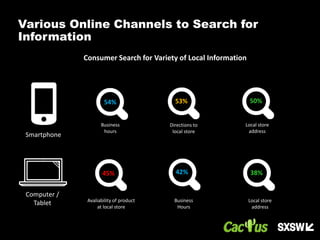
Business
hours
Directions to
local store
Avaliability of product
at local store
Business
Hours
Local store
address
Local store
address
54% 53% 50%
45% 42% 38%
Smartphone
Computer /
Tablet
Consumer Search for Variety of Local Information
Various Online Channels to Search for
Information
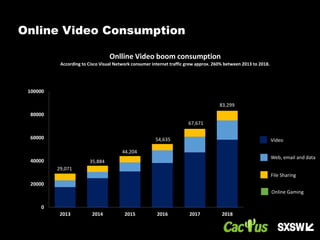
0
20000
40000
60000
80000
100000
2013 2014 2015 2016 2017 2018
35,884
44,204
29,071
54,635
67,671
83,299
Onlline Video boom consumption
According to Cisco Visual Network consumer internet traffic grew approx. 260% between 2013 to 2018.
Online Video Consumption
Vídeo
Web, email and data
File Sharing
Online Gaming
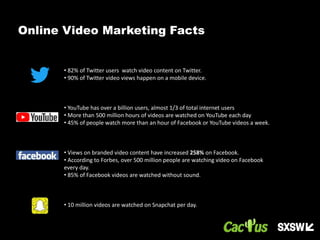
Online Video Marketing Facts
• 82% of Twitter users watch video content on Twitter.
• 90% of Twitter video views happen on a mobile device.
• YouTube has over a billion users, almost 1/3 of total internet users
• More than 500 million hours of videos are watched on YouTube each day
• 45% of people watch more than an hour of Facebook or YouTube videos a week.
• Views on branded video content have increased 258% on Facebook.
• According to Forbes, over 500 million people are watching video on Facebook
every day.
• 85% of Facebook videos are watched without sound.
• 10 million videos are watched on Snapchat per day.
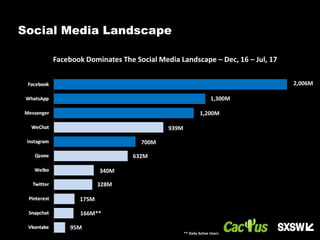
Facebook Dominates The Social Media Landscape – Dec, 16 – Jul, 17
2,006M
1,300M
1,200M
939M
632M
700M
340M
328M
175M
166M**
95M
** Daily Active Users
Social Media Landscape
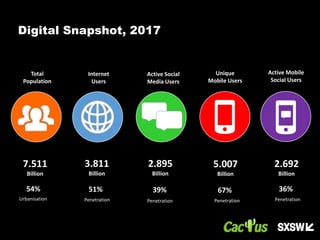
7.511
Billion
3.811
Billion
2.895
Billion
5.007
Billion
54% 51% 39% 67%
Unique
Mobile Users
Active Social
Media Users
Internet
Users
Total
Population
Urbanisation Penetration Penetration Penetration
Active Mobile
Social Users
2.692
Billion
36%
Penetration
Digital Snapshot, 2017
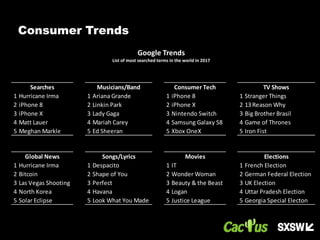
1 Hurricane Irma 1 Ariana Grande 1 iPhone 8 1 Stranger Things
2 iPhone 8 2 Linkin Park 2 iPhone X 2 13 Reason Why
3 iPhone X 3 Lady Gaga 3 Nintendo Switch 3 Big Brother Brasil
4 Matt Lauer 4 Mariah Carey 4 Samsung Galaxy S8 4 Game of Thrones
5 Meghan Markle 5 Ed Sheeran 5 Xbox OneX 5 Iron Fist
1 Hurricane Irma 1 Despacito 1 IT 1 French Election
2 Bitcoin 2 Shape of You 2 Wonder Woman 2 German Federal Election
3 Las Vegas Shooting 3 Perfect 3 Beauty & the Beast 3 UK Election
4 North Korea 4 Havana 4 Logan 4 Uttar Pradesh Election
5 Solar Eclipse 5 Look What You Made 5 Justice League 5 Georgia Special Electon
Searches
Global News
Consumer Tech
Movies
Musicians/Band
Songs/Lyrics
TV Shows
Elections
Google Trends
List of most searched terms in the world in 2017
Consumer Trends
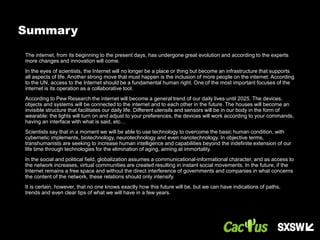
The internet, from its beginning to the present days, has undergone great evolution and according to the experts
more changes and innovation will come.
In the eyes of scientists, the Internet will no longer be a place or thing but become an infrastructure that supports
all aspects of life. Another strong move that must happen is the inclusion of more people on the internet. According
to the UN, access to the Internet should be a fundamental human right. One of the most important focuses of the
internet is its operation as a collaborative tool.
According to Pew Research the internet will become a general trend of our daily lives until 2025. The devices,
objects and systems will be connected to the internet and to each other in the future. The houses will become an
invisible structure that facilitates our daily life. Different utensils and sensors will be in our body in the form of
wearable: the lights will turn on and adjust to your preferences, the devices will work according to your commands,
having an interface with what is said, etc…
Scientists say that in a moment we will be able to use technology to overcome the basic human condition, with
cybernetic implements, biotechnology, neurotechnology and even nanotechnology. In objective terms,
transhumanists are seeking to increase human intelligence and capabilities beyond the indefinite extension of our
life time through technologies for the elimination of aging, aiming at immortality.
In the social and political field, globalization assumes a communicational-informational character, and as access to
the network increases, virtual communities are created resulting in instant social movements. In the future, if the
Internet remains a free space and without the direct interference of governments and companies in what concerns
the content of the network, these relations should only intensify.
It is certain, however, that no one knows exactly how this future will be, but we can have indications of paths,
trends and even clear tips of what we will have in a few years.
Summary
Sources:
Slide 1: https://pixabay.com/pt/escrit%C3%B3rio-em-casa-336377/
Slide 3: https://wearesocial-net.s3.amazonaws.com/uk/wp-content/uploads/sites/2/2017/01/Slide028.png
https://pt.freeimages.com/photo/continents-world-map-1578021
Slide 4: https://wearesocial-net.s3.amazonaws.com/uk/wp-content/uploads/sites/2/2017/01/Slide030.png
Slide 5: https://wearesocial-net.s3.amazonaws.com/uk/wp-content/uploads/sites/2/2017/01/Slide031.png
Slide 6: https://wearesocial.com/blog/2018/01/global-digital-report-2018
Slide 7: http://fabrikbrands.com/create-digital-marketing-strategy-grows-leads-revenue/06-share-of-web-traffic-by-device/
http://www.digitalintervention.com/tag/mobile/
Slide 8: https://www.statista.com/statistics/692871/global-online-shopping-preference-by-category/
Slide 9: http://www.tulsamarketingonline.com/survey-says-half-go-searches-local-intent/
Slide 10: https://www.statista.com/chart/2349/consumer-data-traffic-2013-to-2018/
Slide 11: https://www.wordstream.com/blog/ws/2017/03/08/video-marketing-statistics
Slide 12: https://www.businessinsider.sg/facebook-dominates-most-popular-social-media-apps-chart-2017-7/
Slide 13: https://www.gsmarena.com/more_than_5b_people_use_mobile_devices-news-25631.php
Slide 14: https://www.tecmundo.com.br/internet/125194-google-termos-mais-buscados-2017-brasil-mundo.htm
https://trends.google.com/trends/yis/2017/GLOBAL/
Slide 15: https://www.gsmarena.com/more_than_5b_people_use_mobile_devices-news-25631.php
Thank you!

Assignment 2 Digital Revolution

  • 1.
    Digital Revolution How Consumersuse Technology and its impact on their lives
  • 2.
    Introduction The fast technologydevelopment has been changing the society, as well as we behave socially, economically, politically and culturally. After the World War II, there was an evolution in the areas of communication and computer science, especially in the telecommunication sector, and this technology has given many improvements to our daily lives, since it has become an extension of it. The Technology has largely determined the productive capacity of our society, our living standards, as well as our economic organization and social forms. The impact of sophisticated media such as television, satellites and the internet has brought changes in attitudes, standards, habits and trends of the world population. For many years, technology and science have been dictating the course and alternation of social behaviour, resulting from the satisfaction of everyday needs in the areas of survival, development, leisure, etc. and with more or less impact, technology has shaped our lives. The internet has become one of the most widely dissiminated technologies around the world. It was born in 1969 in the USA and originaly linked to research laboratoires and the US Department of Defense. For decades it was restricted to the academic and sientific environtments. In 1992, it was when the network became fashionable and several provider companies began to appear. The web was the trigger of the internet, designing a unique language that served to interconect computers and its popularitzation provided an infitnity of contents on the most diverse subjects, facilitating the seach of information. Since then, the network has grown rapidly and today there are more than 4 billion users worldwide, 90% from industrialized countries. The presence in schools, colleges and companies and the emergence of new browsers, as well as the proliferation of websites, chats and social networks, have made the internet the global network of connected computers, bringing people, cultures, countries and information altogether. Nowadays it is difficult to imagine life without social channels, emails, e-commerce and search sites. The internet is a world of great possibilities and there is no doubt a lot more is to come.
  • 3.
    Access to theInternet by Region 88% 53% 84% 66% 29% 60% 67% 48% 33% 68% 53% 57% North America Central America South America Africa West Europe Middle East East Europe Central Asia East Asia South Asia Southeast Asias Oceania Global Average 50% Internet Penetration by Region (Jan 2017) Regional Penetration, Comparing Internet Users to Total Population
  • 4.
  • 5.
    ₢ # HIGHEST PENETRATION% USERS 01 United Arab Emirates 99% 9,200,000 02 Iceland 98% 327,046 03 Norway 97% 5,167,573 04 Luxembourg 97% 564,706 05 Denmark 96% 5,492,085 06 Bermuda 96% 59,231 07 Andorra 96% 65,913 08 Netherlands 95% 16,200,000 09 Bahrain 93% 1,316,045 10 Japan 93% 117,767,216 # LOWEST PENETRATION % USERS 213 North Korea 0,1% 16,000 212 Eritrea 1% 67,000 211 Niger 2% 469,331 210 Chad 3% 397,740 209 Dem. Rep. Of The Congo 4% 3,101,210 208 Central African Republic 5% 230,384 207 Guinea-Bissau 5% 90,000 206 Burundi 5% 571,515 205 Western Sahara 5% 29,000 204 Sierra Leone 6% 370,000 Access to the Internet Ranking Internet Penetration Rankings (Jan 2017) Based on Internet Penetration in Countries With National Population of 50,000 People or More
  • 6.
    43% 52% 4%0,14% -3% +4% -13% +17% Other Devices Tablet Devoces Mobile Phones Leptops & Desktops Share of Web Traffic by Device – Jan, 2018 Based on Each Device’s Share of All Web Pages Served to Web Browsers Year-On-Year Change Year-On-Year Change Year-On-Year Change Year-On-Year Change How Customers search for Information
  • 7.
    93% of people who usedmobile to research go on to make a purchase Mobile research influences purchase decisions 70%Considered making a purchase 63%Considered making a purchase 61%Considered making a purchase 54%Actually made a purchase 40%Actually made a purchase 36%Actually made a purchase Restaurants Apparel & Beuty Eletronics What Consumers buy online
  • 8.
    Despite the smartphonesbeing highly consumed today and used as an online shopping tool, the most purchased items online are books, music, movies and video games, followed by toys, computers, eletronics, sports equipment, heatlh and beauty products, clothes, shoes and acessories, jewelry, watches, and finally furniture and household goods and food. Global Online or In-Store Shopping Preference Selected Public categories by consumders
  • 9.
    Business hours Directions to local store Avaliabilityof product at local store Business Hours Local store address Local store address 54% 53% 50% 45% 42% 38% Smartphone Computer / Tablet Consumer Search for Variety of Local Information Various Online Channels to Search for Information
  • 10.
    0 20000 40000 60000 80000 100000 2013 2014 20152016 2017 2018 35,884 44,204 29,071 54,635 67,671 83,299 Onlline Video boom consumption According to Cisco Visual Network consumer internet traffic grew approx. 260% between 2013 to 2018. Online Video Consumption Vídeo Web, email and data File Sharing Online Gaming
  • 11.
    Online Video MarketingFacts • 82% of Twitter users watch video content on Twitter. • 90% of Twitter video views happen on a mobile device. • YouTube has over a billion users, almost 1/3 of total internet users • More than 500 million hours of videos are watched on YouTube each day • 45% of people watch more than an hour of Facebook or YouTube videos a week. • Views on branded video content have increased 258% on Facebook. • According to Forbes, over 500 million people are watching video on Facebook every day. • 85% of Facebook videos are watched without sound. • 10 million videos are watched on Snapchat per day.
  • 12.
    Facebook Dominates TheSocial Media Landscape – Dec, 16 – Jul, 17 2,006M 1,300M 1,200M 939M 632M 700M 340M 328M 175M 166M** 95M ** Daily Active Users Social Media Landscape
  • 13.
    7.511 Billion 3.811 Billion 2.895 Billion 5.007 Billion 54% 51% 39%67% Unique Mobile Users Active Social Media Users Internet Users Total Population Urbanisation Penetration Penetration Penetration Active Mobile Social Users 2.692 Billion 36% Penetration Digital Snapshot, 2017
  • 14.
    1 Hurricane Irma1 Ariana Grande 1 iPhone 8 1 Stranger Things 2 iPhone 8 2 Linkin Park 2 iPhone X 2 13 Reason Why 3 iPhone X 3 Lady Gaga 3 Nintendo Switch 3 Big Brother Brasil 4 Matt Lauer 4 Mariah Carey 4 Samsung Galaxy S8 4 Game of Thrones 5 Meghan Markle 5 Ed Sheeran 5 Xbox OneX 5 Iron Fist 1 Hurricane Irma 1 Despacito 1 IT 1 French Election 2 Bitcoin 2 Shape of You 2 Wonder Woman 2 German Federal Election 3 Las Vegas Shooting 3 Perfect 3 Beauty & the Beast 3 UK Election 4 North Korea 4 Havana 4 Logan 4 Uttar Pradesh Election 5 Solar Eclipse 5 Look What You Made 5 Justice League 5 Georgia Special Electon Searches Global News Consumer Tech Movies Musicians/Band Songs/Lyrics TV Shows Elections Google Trends List of most searched terms in the world in 2017 Consumer Trends
  • 15.
    The internet, fromits beginning to the present days, has undergone great evolution and according to the experts more changes and innovation will come. In the eyes of scientists, the Internet will no longer be a place or thing but become an infrastructure that supports all aspects of life. Another strong move that must happen is the inclusion of more people on the internet. According to the UN, access to the Internet should be a fundamental human right. One of the most important focuses of the internet is its operation as a collaborative tool. According to Pew Research the internet will become a general trend of our daily lives until 2025. The devices, objects and systems will be connected to the internet and to each other in the future. The houses will become an invisible structure that facilitates our daily life. Different utensils and sensors will be in our body in the form of wearable: the lights will turn on and adjust to your preferences, the devices will work according to your commands, having an interface with what is said, etc… Scientists say that in a moment we will be able to use technology to overcome the basic human condition, with cybernetic implements, biotechnology, neurotechnology and even nanotechnology. In objective terms, transhumanists are seeking to increase human intelligence and capabilities beyond the indefinite extension of our life time through technologies for the elimination of aging, aiming at immortality. In the social and political field, globalization assumes a communicational-informational character, and as access to the network increases, virtual communities are created resulting in instant social movements. In the future, if the Internet remains a free space and without the direct interference of governments and companies in what concerns the content of the network, these relations should only intensify. It is certain, however, that no one knows exactly how this future will be, but we can have indications of paths, trends and even clear tips of what we will have in a few years. Summary
  • 16.
    Sources: Slide 1: https://pixabay.com/pt/escrit%C3%B3rio-em-casa-336377/ Slide3: https://wearesocial-net.s3.amazonaws.com/uk/wp-content/uploads/sites/2/2017/01/Slide028.png https://pt.freeimages.com/photo/continents-world-map-1578021 Slide 4: https://wearesocial-net.s3.amazonaws.com/uk/wp-content/uploads/sites/2/2017/01/Slide030.png Slide 5: https://wearesocial-net.s3.amazonaws.com/uk/wp-content/uploads/sites/2/2017/01/Slide031.png Slide 6: https://wearesocial.com/blog/2018/01/global-digital-report-2018 Slide 7: http://fabrikbrands.com/create-digital-marketing-strategy-grows-leads-revenue/06-share-of-web-traffic-by-device/ http://www.digitalintervention.com/tag/mobile/ Slide 8: https://www.statista.com/statistics/692871/global-online-shopping-preference-by-category/ Slide 9: http://www.tulsamarketingonline.com/survey-says-half-go-searches-local-intent/ Slide 10: https://www.statista.com/chart/2349/consumer-data-traffic-2013-to-2018/ Slide 11: https://www.wordstream.com/blog/ws/2017/03/08/video-marketing-statistics Slide 12: https://www.businessinsider.sg/facebook-dominates-most-popular-social-media-apps-chart-2017-7/ Slide 13: https://www.gsmarena.com/more_than_5b_people_use_mobile_devices-news-25631.php Slide 14: https://www.tecmundo.com.br/internet/125194-google-termos-mais-buscados-2017-brasil-mundo.htm https://trends.google.com/trends/yis/2017/GLOBAL/ Slide 15: https://www.gsmarena.com/more_than_5b_people_use_mobile_devices-news-25631.php Thank you!