Third Party Reproduction
Dr Indranil Saha
Dr Sujoy Dasgupta
Panelists
Dr Anindita Singh
Dr Nandini Chakravorty
(Bhattacharyya)
Dr Parnamita
Bhattacharyya
Dr Rohit Gutgutia
Dr Sanjib Dutta
Dr Siuli Chanda
Chakraborty
Dr Suparna
Bandyopadhyay
Dr Swapan Kumar
Kundu
Third Party Reproduction
Involves a third person, other than the couple, in
order to help them reproduce
1. Sperm Donation
2. Egg Donation
3. Embryo Donation
4. Surrogacy
5. Three parent babies- Mitochondrial
transfer
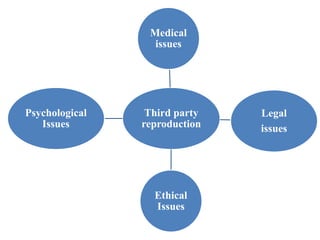
Third party
reproduction
Medical
issues
Legal
issues
Ethical
Issues
Psychological
Issues
Case 1
• Mrs PS, 29-yr-old, trying for pregnancy
for 1 year.
• Cycle regular, no significant medical/
surgical history
• AMH 0.5 ng/ml. FSH 8 IU/L, LH 5
IU/L, B/L tubes patent in HSG
• Husband 33-yr-old, semen analysis
normal.
• How will you counsel the patient
about low AMH
• Options of treatment?
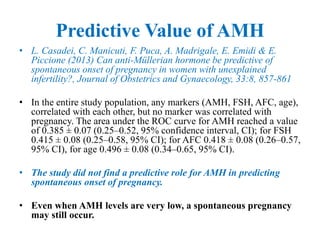
Predictive Value of AMH
• L. Casadei, C. Manicuti, F. Puca, A. Madrigale, E. Emidi & E.
Piccione (2013) Can anti-Müllerian hormone be predictive of
spontaneous onset of pregnancy in women with unexplained
infertility?, Journal of Obstetrics and Gynaecology, 33:8, 857-861
• In the entire study population, any markers (AMH, FSH, AFC, age),
correlated with each other, but no marker was correlated with
pregnancy. The area under the ROC curve for AMH reached a value
of 0.385 ± 0.07 (0.25–0.52, 95% confidence interval, CI); for FSH
0.415 ± 0.08 (0.25–0.58, 95% CI); for AFC 0.418 ± 0.08 (0.26–0.57,
95% CI), for age 0.496 ± 0.08 (0.34–0.65, 95% CI).
• The study did not find a predictive role for AMH in predicting
spontaneous onset of pregnancy.
• Even when AMH levels are very low, a spontaneous pregnancy
may still occur.
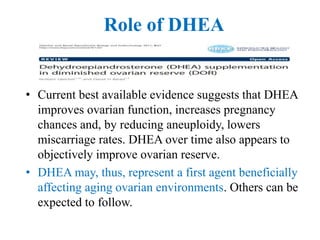
Role of DHEA
• Current best available evidence suggests that DHEA
improves ovarian function, increases pregnancy
chances and, by reducing aneuploidy, lowers
miscarriage rates. DHEA over time also appears to
objectively improve ovarian reserve.
• DHEA may, thus, represent a first agent beneficially
affecting aging ovarian environments. Others can be
expected to follow.
Mrs PS returned to you after 3 years
• Meanwhile she tried several cycles of OI
(Letrozole, CC, Gonadotrophins)
• Underwent 2 cycles of IVF with self-egg
• 1st cycle IVF- one grade B, day-3 embryo
(fresh) transferred, β-hCG negative
• 2nd cycle IVF- 2 M-II oocytes, ICSI done, no
embryo on day-2
• She is now 32, opts for egg donation
Mrs PS demands
• Eggs should be collected from her
younger sister, aged 27, healthy, mother
of a baby girl.
• Husband agreed to it
Will you agree to it as a clinician?
How will you counsel the couple about use of donor egg?
Any psychological, ethical and medical issues you would
like to discuss?
What information can be provided about the donor ?
What success rate will you quote?
ICMR guideline on use of donor eggs?
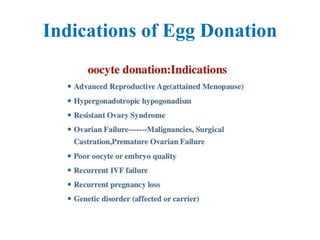
Indications of Egg Donation
Complications in pregnancies
conceived after oocyte donation
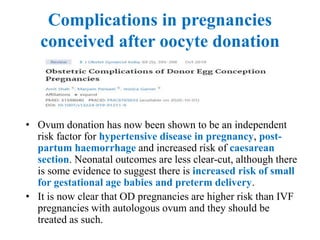
• Ovum donation has now been shown to be an independent
risk factor for hypertensive disease in pregnancy, post-
partum haemorrhage and increased risk of caesarean
section. Neonatal outcomes are less clear-cut, although there
is some evidence to suggest there is increased risk of small
for gestational age babies and preterm delivery.
• It is now clear that OD pregnancies are higher risk than IVF
pregnancies with autologous ovum and they should be
treated as such.
Ethical issues
• Offspring- to disclose or not
• Right of the offspring
• Right of the donor- explotation?
• Right of the intended couple
• Right to confidentiality
ICMR Guideline
• A child born through ART shall be presumed to be the legitimate child of
the couple
• Children born through the use of donor gametes, and their “intended”
parents shall have a right to available medical or genetic information
about the genetic parents that may be relevant to the child’s health.
• Children born through the use of donor gametes shall not have any right
whatsoever to know the identity (such as name, address, parentage, etc.)
of their genetic parent(s).
• A child thus born will, however, be provided all other information about the
donor as and when desired by the child, when the child becomes an
adult.
• While the couple will not be obliged to provide the above “other”
information to the child on their own, no deliberate attempt will be made
by the couple or others concerned to hide this information from the child as
and when asked for by the child.
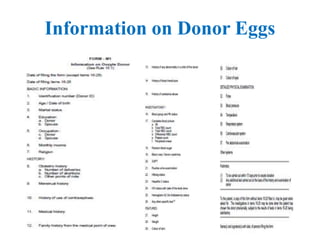
How to select the egg-donor
• Age group- 21-35 (ICMR)
• History- personal, medical, surgical,
gynaecological, obstetric, family, drug allergy
• Examination- General, Gynaecological
• TVS- AFC, accessibility of follicles
• Blood- Serology, blood group, Thalassaemia
• Routine tests for anaesthetic fitness

• Genetic Tests?
Information on Donor Eggs
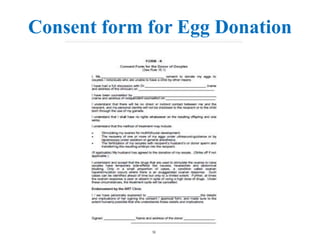
Consent form for Egg Donation
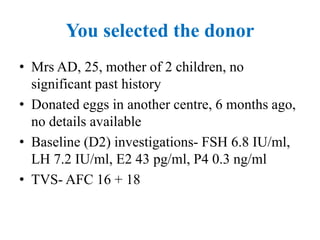
You selected the donor
• Mrs AD, 25, mother of 2 children, no
significant past history
• Donated eggs in another centre, 6 months ago,
no details available
• Baseline (D2) investigations- FSH 6.8 IU/ml,
LH 7.2 IU/ml, E2 43 pg/ml, P4 0.3 ng/ml
• TVS- AFC 16 + 18
Any special precaution?
• Prevention of OHSS
• Pt had OHSS, who pays for the treatment of
the donor
Mrs AD underwent COS
• Antagonist protocol, 225 IU hMG, reduced to
150 IU
• Triptoreline trigger
• 25 oocytes obtained in total, 20 M-II
Mrs AD presented to you 3 days
after OPU
• Vomiting, abdominal distension, mild
dyspnoea, not able to tolerate food
• Line of management
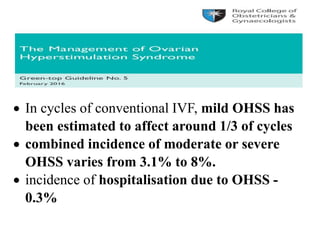
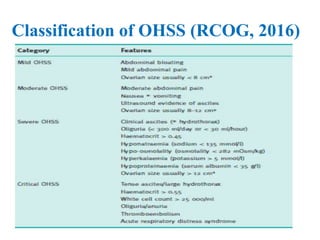
 In cycles of conventional IVF, mild OHSS has
been estimated to affect around 1/3 of cycles
 combined incidence of moderate or severe
OHSS varies from 3.1% to 8%.
 incidence of hospitalisation due to OHSS -
0.3%
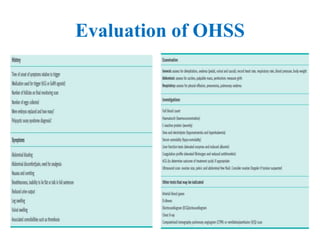
Evaluation of OHSS
Classification of OHSS (RCOG, 2016)
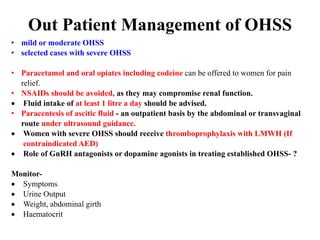
Out Patient Management of OHSS
• mild or moderate OHSS
• selected cases with severe OHSS
• Paracetamol and oral opiates including codeine can be offered to women for pain
relief.
• NSAIDs should be avoided, as they may compromise renal function.
 Fluid intake of at least 1 litre a day should be advised.
• Paracentesis of ascitic fluid - an outpatient basis by the abdominal or transvaginal
route under ultrasound guidance.
 Women with severe OHSS should receive thromboprophylaxis with LMWH (If
contraindicated AED)
 Role of GnRH antagonists or dopamine agonists in treating established OHSS- ?
Monitor-
 Symptoms
 Urine Output
 Weight, abdominal girth
 Haematocrit
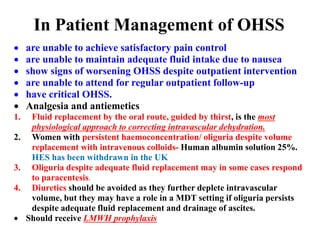
In Patient Management of OHSS
 are unable to achieve satisfactory pain control
 are unable to maintain adequate fluid intake due to nausea
 show signs of worsening OHSS despite outpatient intervention
 are unable to attend for regular outpatient follow-up
 have critical OHSS.
 Analgesia and antiemetics
1. Fluid replacement by the oral route, guided by thirst, is the most
physiological approach to correcting intravascular dehydration.
2. Women with persistent haemoconcentration/ oliguria despite volume
replacement with intravenous colloids- Human albumin solution 25%.
HES has been withdrawn in the UK
3. Oliguria despite adequate fluid replacement may in some cases respond
to paracentesis.
4. Diuretics should be avoided as they further deplete intravascular
volume, but they may have a role in a MDT setting if oliguria persists
despite adequate fluid replacement and drainage of ascites.
 Should receive LMWH prophylaxis
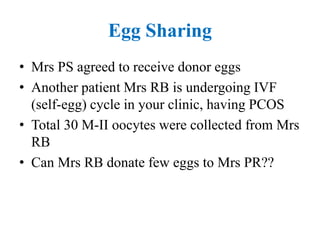
Egg Sharing
• Mrs PS agreed to receive donor eggs
• Another patient Mrs RB is undergoing IVF
(self-egg) cycle in your clinic, having PCOS
• Total 30 M-II oocytes were collected from Mrs
RB
• Can Mrs RB donate few eggs to Mrs PR??
Case 2
Mr JM, 36-yr-old man presented with
number of semen analysis results- all
showing azoospermia.
Wife, 20, all investigations normal
How will you discuss the diagnosis?
Options for this couple?
They decided for TESA-ICSI
• No sperms were obtained from any of the
testicles, even after TESE.
• Offered donor sperms
• Husband requested to use donor sperms,
without informing the wife
• Will you agree?
They moved to another Doctor
• Now both are ready to go for IUI with donor sperm.
• How will you counsel the couple about use of donor
sperm?
• What success rate will you quote?
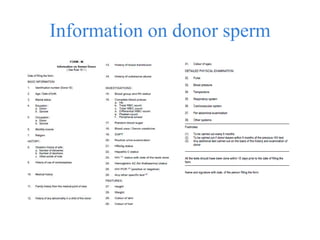
• What information can be provided about the donor ?
• ICMR guideline on use of donor sperm?
Indications for AID
• Azoospermia/ severe OAT- does not want ICSI
• Ejaculatory dysfunction
• Genetic defect
• Rh Isoimmunization
• Single woman
Success Rate of AID
• Most women who pursue therapeutic donor
insemination with no other cause of infertility
conceive within 4-6 IUI cycles, cumulative
conception rates after 12 IUI cycles is 75-80%
Sperm Cryoprervation
• Sperms should be quarantined for at least 6
months before being released for use
• Bringing sperms from the sperm bank to the
clinic for AID?
Consent Form
ICMR guideline
• The accepted age for a sperm donor shall be between 21 and 45 years
• Normal semen analysis according to WHO guideline
• The blood group and the Rh status of the individual must be determined
and placed on record
• Use of sperm donated by a relative or a known friend of either the wife
or the husband shall not be permitted.
• Semen from two individuals must never be mixed before use, under any
circumstance.
• ICMR sets limit of 10 children per donor
• Normally, no ART procedure shall be used on a woman below 20 years
ICMR guideline
• Information about the donor (but excluding information on
individual’s personal identity) should be released by the ART
clinic after appropriate identification, only to the offspring
and only if asked by him/her after he/she reaches the age of
18years, or as and when specified and required for legal
purposes, and never to the parents (except when directed by a
court of law).
• These records must be maintained for at least ten years
• In the case of a divorce during the gestation period, if the
offspring is of a donor programme – be it sperm or ova – the
law of the land as pertaining to a normal conception would
apply
Information on donor sperm
Case 3
• Mrs SR, 28, a case of primary
amenorrhoea for MRKH syndrome,
wants to know about her fertility
options
• How will you counsel Mrs SR?
Indications of Surrogacy
• Absence of uterus- congenital/ surgical
• Medical conditions where pregnancy is
contraindicated (e.g., severe cardiac diseases)
• Some cases of recurrent implantation failure
(RIF)
Surrogacy Types
• Host surrogacy (gestational or full surrogacy)
involves IVF using gametes from the intended
parents and/or donors, and embryo transfer into
the surrogate. The surrogate has no genetic link
to the child.
• Straight or partial surrogacy entails artificial
insemination using either the intended father’s or
donor sperm. The surrogate mother’s egg is
used and she therefore has a genetic link to the
child.
Mrs SR is eager to go for
commercial surrogacy
• Information to be given to her?
• Selection of surrogate?
• Commercial surrogate?
• Success rate you would quote?
• Care during pregnancy?
Surrogacy Bill
• “Altruistic surrogacy” means the surrogacy
in which no charges, expenses, fees,
remuneration or monetary incentive of
whatever nature, except the medical expenses
incurred on surrogate mother and the insurance
coverage for the surrogate mother, are given to
the surrogate mother or her dependents or her
representative;
Screening the surrogate
• no woman, other than an ever married woman
having a child of her own and between the age
of 25 to 35 years on the day of implantation
shall be a surrogate mother or help in surrogacy
by donating her egg or oocyte or otherwise;
• no woman shall act as a surrogate mother by
providing her own gametes;
• no woman shall act as a surrogate mother more
than once in her lifetime
• a certificate of medical and psychological fitness
for surrogacy and surrogacy procedures from a
registered medical practitioner;
Who can seek surrogacy
• an eligibility certificate for intending couple is issued
separately by the appropriate authority on fulfilment
of the following conditions, namely:—
1. the age of the intending couple is between 23 to 50
years in case of female and between 26 to 55 years in
case of male on the day of certification;
2. the intending couple are married for at least five
years
3. Indian citizens;
4. the intending couple have not had any surviving
child biologically or through adoption or through
surrogacy earlier
Close Relative?
• the surrogate mother should be a close
relative of the intending couple
Mrs PR, 26, agreed to become
surrogate
• ET was done, pregnant after first transfer
• Pregnancy was uneventful
• Mrs SR and her husband (Commissioning
couple) want C section
• Mrs PR (Surrogate) is keen to have
vaginal birth, because her two babies
born vaginally
• How to tackle this situation?
Case 4
• Mrs CB, 36-year-old, Anaesthesiologist,
unmarried, plans for pregnancy by AID
• Will you agree?
• Counseling?
• Social issues?
Rights of an unmarried woman to AID
• There is no legal bar on an unmarried woman going for
AID.
• A child born to a single woman through AID would be
deemed to be legitimate.
• However, AID should normally be performed only on a
married woman as a two-parent family would be always
better for the child than a single parent one, and the
child’s interests must outweigh all other interests.
• AID cannot be done in case of lesbian couple (section
377)
Take Home Messages
• All the other possible options should be
discussed before offering third-party-
reproduction
• Non-judgemental manner
• Respect their autonomy and confidentiality
• Legal, Ethical, social issues should never be
ignored
• Audit, quality control, risk management
Third Party Reproduction

Third Party Reproduction

  • 1.
    Third Party Reproduction DrIndranil Saha Dr Sujoy Dasgupta
  • 2.
    Panelists Dr Anindita Singh DrNandini Chakravorty (Bhattacharyya) Dr Parnamita Bhattacharyya Dr Rohit Gutgutia Dr Sanjib Dutta Dr Siuli Chanda Chakraborty Dr Suparna Bandyopadhyay Dr Swapan Kumar Kundu
  • 3.
    Third Party Reproduction Involvesa third person, other than the couple, in order to help them reproduce 1. Sperm Donation 2. Egg Donation 3. Embryo Donation 4. Surrogacy 5. Three parent babies- Mitochondrial transfer
  • 4.
  • 5.
  • 6.
    • Mrs PS,29-yr-old, trying for pregnancy for 1 year. • Cycle regular, no significant medical/ surgical history • AMH 0.5 ng/ml. FSH 8 IU/L, LH 5 IU/L, B/L tubes patent in HSG • Husband 33-yr-old, semen analysis normal.
  • 7.
    • How willyou counsel the patient about low AMH • Options of treatment?
  • 8.
    Predictive Value ofAMH • L. Casadei, C. Manicuti, F. Puca, A. Madrigale, E. Emidi & E. Piccione (2013) Can anti-Müllerian hormone be predictive of spontaneous onset of pregnancy in women with unexplained infertility?, Journal of Obstetrics and Gynaecology, 33:8, 857-861 • In the entire study population, any markers (AMH, FSH, AFC, age), correlated with each other, but no marker was correlated with pregnancy. The area under the ROC curve for AMH reached a value of 0.385 ± 0.07 (0.25–0.52, 95% confidence interval, CI); for FSH 0.415 ± 0.08 (0.25–0.58, 95% CI); for AFC 0.418 ± 0.08 (0.26–0.57, 95% CI), for age 0.496 ± 0.08 (0.34–0.65, 95% CI). • The study did not find a predictive role for AMH in predicting spontaneous onset of pregnancy. • Even when AMH levels are very low, a spontaneous pregnancy may still occur.
  • 9.
    Role of DHEA •Current best available evidence suggests that DHEA improves ovarian function, increases pregnancy chances and, by reducing aneuploidy, lowers miscarriage rates. DHEA over time also appears to objectively improve ovarian reserve. • DHEA may, thus, represent a first agent beneficially affecting aging ovarian environments. Others can be expected to follow.
  • 10.
    Mrs PS returnedto you after 3 years • Meanwhile she tried several cycles of OI (Letrozole, CC, Gonadotrophins) • Underwent 2 cycles of IVF with self-egg • 1st cycle IVF- one grade B, day-3 embryo (fresh) transferred, β-hCG negative • 2nd cycle IVF- 2 M-II oocytes, ICSI done, no embryo on day-2 • She is now 32, opts for egg donation
  • 11.
    Mrs PS demands •Eggs should be collected from her younger sister, aged 27, healthy, mother of a baby girl. • Husband agreed to it
  • 12.
    Will you agreeto it as a clinician? How will you counsel the couple about use of donor egg? Any psychological, ethical and medical issues you would like to discuss? What information can be provided about the donor ? What success rate will you quote? ICMR guideline on use of donor eggs?
  • 13.
  • 14.
    Complications in pregnancies conceivedafter oocyte donation • Ovum donation has now been shown to be an independent risk factor for hypertensive disease in pregnancy, post- partum haemorrhage and increased risk of caesarean section. Neonatal outcomes are less clear-cut, although there is some evidence to suggest there is increased risk of small for gestational age babies and preterm delivery. • It is now clear that OD pregnancies are higher risk than IVF pregnancies with autologous ovum and they should be treated as such.
  • 15.
    Ethical issues • Offspring-to disclose or not • Right of the offspring • Right of the donor- explotation? • Right of the intended couple • Right to confidentiality
  • 16.
    ICMR Guideline • Achild born through ART shall be presumed to be the legitimate child of the couple • Children born through the use of donor gametes, and their “intended” parents shall have a right to available medical or genetic information about the genetic parents that may be relevant to the child’s health. • Children born through the use of donor gametes shall not have any right whatsoever to know the identity (such as name, address, parentage, etc.) of their genetic parent(s). • A child thus born will, however, be provided all other information about the donor as and when desired by the child, when the child becomes an adult. • While the couple will not be obliged to provide the above “other” information to the child on their own, no deliberate attempt will be made by the couple or others concerned to hide this information from the child as and when asked for by the child.
  • 17.
    How to selectthe egg-donor • Age group- 21-35 (ICMR) • History- personal, medical, surgical, gynaecological, obstetric, family, drug allergy • Examination- General, Gynaecological • TVS- AFC, accessibility of follicles • Blood- Serology, blood group, Thalassaemia • Routine tests for anaesthetic fitness • Genetic Tests?
  • 18.
  • 19.
    Consent form forEgg Donation
  • 20.
    You selected thedonor • Mrs AD, 25, mother of 2 children, no significant past history • Donated eggs in another centre, 6 months ago, no details available • Baseline (D2) investigations- FSH 6.8 IU/ml, LH 7.2 IU/ml, E2 43 pg/ml, P4 0.3 ng/ml • TVS- AFC 16 + 18
  • 21.
    Any special precaution? •Prevention of OHSS • Pt had OHSS, who pays for the treatment of the donor
  • 22.
    Mrs AD underwentCOS • Antagonist protocol, 225 IU hMG, reduced to 150 IU • Triptoreline trigger • 25 oocytes obtained in total, 20 M-II
  • 23.
    Mrs AD presentedto you 3 days after OPU • Vomiting, abdominal distension, mild dyspnoea, not able to tolerate food • Line of management
  • 24.
     In cyclesof conventional IVF, mild OHSS has been estimated to affect around 1/3 of cycles  combined incidence of moderate or severe OHSS varies from 3.1% to 8%.  incidence of hospitalisation due to OHSS - 0.3%
  • 25.
  • 26.
  • 27.
    Out Patient Managementof OHSS • mild or moderate OHSS • selected cases with severe OHSS • Paracetamol and oral opiates including codeine can be offered to women for pain relief. • NSAIDs should be avoided, as they may compromise renal function.  Fluid intake of at least 1 litre a day should be advised. • Paracentesis of ascitic fluid - an outpatient basis by the abdominal or transvaginal route under ultrasound guidance.  Women with severe OHSS should receive thromboprophylaxis with LMWH (If contraindicated AED)  Role of GnRH antagonists or dopamine agonists in treating established OHSS- ? Monitor-  Symptoms  Urine Output  Weight, abdominal girth  Haematocrit
  • 28.
    In Patient Managementof OHSS  are unable to achieve satisfactory pain control  are unable to maintain adequate fluid intake due to nausea  show signs of worsening OHSS despite outpatient intervention  are unable to attend for regular outpatient follow-up  have critical OHSS.  Analgesia and antiemetics 1. Fluid replacement by the oral route, guided by thirst, is the most physiological approach to correcting intravascular dehydration. 2. Women with persistent haemoconcentration/ oliguria despite volume replacement with intravenous colloids- Human albumin solution 25%. HES has been withdrawn in the UK 3. Oliguria despite adequate fluid replacement may in some cases respond to paracentesis. 4. Diuretics should be avoided as they further deplete intravascular volume, but they may have a role in a MDT setting if oliguria persists despite adequate fluid replacement and drainage of ascites.  Should receive LMWH prophylaxis
  • 29.
    Egg Sharing • MrsPS agreed to receive donor eggs • Another patient Mrs RB is undergoing IVF (self-egg) cycle in your clinic, having PCOS • Total 30 M-II oocytes were collected from Mrs RB • Can Mrs RB donate few eggs to Mrs PR??
  • 30.
  • 31.
    Mr JM, 36-yr-oldman presented with number of semen analysis results- all showing azoospermia. Wife, 20, all investigations normal How will you discuss the diagnosis? Options for this couple?
  • 32.
    They decided forTESA-ICSI • No sperms were obtained from any of the testicles, even after TESE. • Offered donor sperms • Husband requested to use donor sperms, without informing the wife • Will you agree?
  • 34.
    They moved toanother Doctor • Now both are ready to go for IUI with donor sperm. • How will you counsel the couple about use of donor sperm? • What success rate will you quote? • What information can be provided about the donor ? • ICMR guideline on use of donor sperm?
  • 35.
    Indications for AID •Azoospermia/ severe OAT- does not want ICSI • Ejaculatory dysfunction • Genetic defect • Rh Isoimmunization • Single woman
  • 36.
    Success Rate ofAID • Most women who pursue therapeutic donor insemination with no other cause of infertility conceive within 4-6 IUI cycles, cumulative conception rates after 12 IUI cycles is 75-80%
  • 37.
    Sperm Cryoprervation • Spermsshould be quarantined for at least 6 months before being released for use • Bringing sperms from the sperm bank to the clinic for AID?
  • 38.
  • 39.
    ICMR guideline • Theaccepted age for a sperm donor shall be between 21 and 45 years • Normal semen analysis according to WHO guideline • The blood group and the Rh status of the individual must be determined and placed on record • Use of sperm donated by a relative or a known friend of either the wife or the husband shall not be permitted. • Semen from two individuals must never be mixed before use, under any circumstance. • ICMR sets limit of 10 children per donor • Normally, no ART procedure shall be used on a woman below 20 years
  • 40.
    ICMR guideline • Informationabout the donor (but excluding information on individual’s personal identity) should be released by the ART clinic after appropriate identification, only to the offspring and only if asked by him/her after he/she reaches the age of 18years, or as and when specified and required for legal purposes, and never to the parents (except when directed by a court of law). • These records must be maintained for at least ten years • In the case of a divorce during the gestation period, if the offspring is of a donor programme – be it sperm or ova – the law of the land as pertaining to a normal conception would apply
  • 41.
  • 42.
  • 43.
    • Mrs SR,28, a case of primary amenorrhoea for MRKH syndrome, wants to know about her fertility options • How will you counsel Mrs SR?
  • 44.
    Indications of Surrogacy •Absence of uterus- congenital/ surgical • Medical conditions where pregnancy is contraindicated (e.g., severe cardiac diseases) • Some cases of recurrent implantation failure (RIF)
  • 45.
    Surrogacy Types • Hostsurrogacy (gestational or full surrogacy) involves IVF using gametes from the intended parents and/or donors, and embryo transfer into the surrogate. The surrogate has no genetic link to the child. • Straight or partial surrogacy entails artificial insemination using either the intended father’s or donor sperm. The surrogate mother’s egg is used and she therefore has a genetic link to the child.
  • 46.
    Mrs SR iseager to go for commercial surrogacy • Information to be given to her? • Selection of surrogate? • Commercial surrogate? • Success rate you would quote? • Care during pregnancy?
  • 47.
    Surrogacy Bill • “Altruisticsurrogacy” means the surrogacy in which no charges, expenses, fees, remuneration or monetary incentive of whatever nature, except the medical expenses incurred on surrogate mother and the insurance coverage for the surrogate mother, are given to the surrogate mother or her dependents or her representative;
  • 48.
    Screening the surrogate •no woman, other than an ever married woman having a child of her own and between the age of 25 to 35 years on the day of implantation shall be a surrogate mother or help in surrogacy by donating her egg or oocyte or otherwise; • no woman shall act as a surrogate mother by providing her own gametes; • no woman shall act as a surrogate mother more than once in her lifetime • a certificate of medical and psychological fitness for surrogacy and surrogacy procedures from a registered medical practitioner;
  • 49.
    Who can seeksurrogacy • an eligibility certificate for intending couple is issued separately by the appropriate authority on fulfilment of the following conditions, namely:— 1. the age of the intending couple is between 23 to 50 years in case of female and between 26 to 55 years in case of male on the day of certification; 2. the intending couple are married for at least five years 3. Indian citizens; 4. the intending couple have not had any surviving child biologically or through adoption or through surrogacy earlier
  • 50.
    Close Relative? • thesurrogate mother should be a close relative of the intending couple
  • 51.
    Mrs PR, 26,agreed to become surrogate • ET was done, pregnant after first transfer • Pregnancy was uneventful • Mrs SR and her husband (Commissioning couple) want C section • Mrs PR (Surrogate) is keen to have vaginal birth, because her two babies born vaginally • How to tackle this situation?
  • 52.
  • 53.
    • Mrs CB,36-year-old, Anaesthesiologist, unmarried, plans for pregnancy by AID • Will you agree? • Counseling? • Social issues?
  • 54.
    Rights of anunmarried woman to AID • There is no legal bar on an unmarried woman going for AID. • A child born to a single woman through AID would be deemed to be legitimate. • However, AID should normally be performed only on a married woman as a two-parent family would be always better for the child than a single parent one, and the child’s interests must outweigh all other interests. • AID cannot be done in case of lesbian couple (section 377)
  • 55.
    Take Home Messages •All the other possible options should be discussed before offering third-party- reproduction • Non-judgemental manner • Respect their autonomy and confidentiality • Legal, Ethical, social issues should never be ignored • Audit, quality control, risk management

Editor's Notes

  • #32 Counseling: man may feel guilt, angry ,doubt his potency,lower his self esteem. Woman may feel guilt, anxiety. Confidentiality. How to disclose it to the unborn childernMost women who pursue therapeutic donor insemination with no other cause of infertility conceive within 4-6 IUI cycles, cumulative conception rates after 12 IUI cycles is 75-80%
  • #35 Counseling: man may feel guilt, angry ,doubt his potency,lower his self esteem. Woman may feel guilt, anxiety. Confidentiality. How to disclose it to the unborn childernMost women who pursue therapeutic donor insemination with no other cause of infertility conceive within 4-6 IUI cycles, cumulative conception rates after 12 IUI cycles is 75-80%
  • #41 Anyone born from donated sperm after April 2005 can apply to the central registry(ICMR) to obtain information about the identity of the donor, once they have reached 18 years of age when indicated. Right for unmarried woman to AID