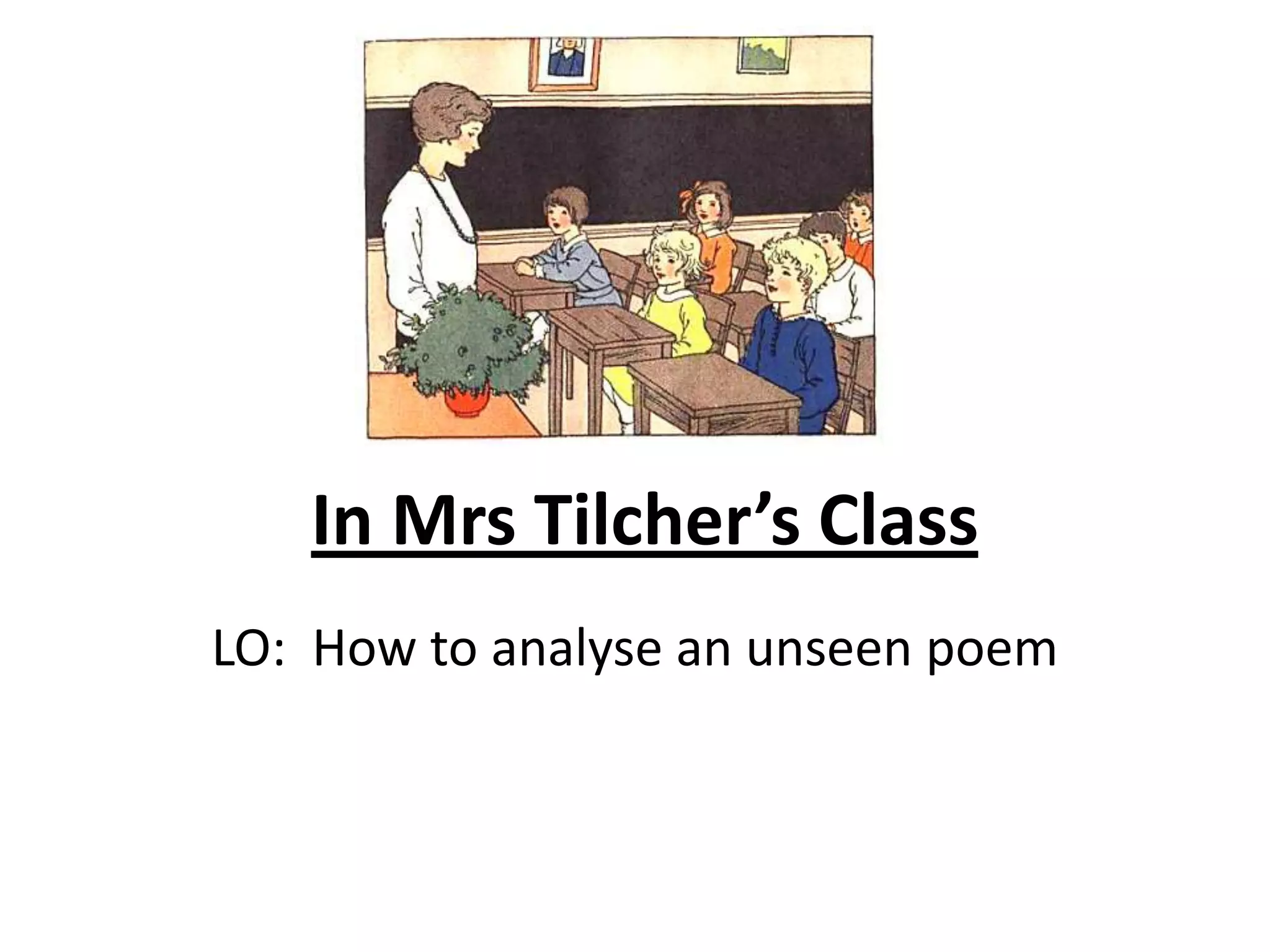
In Mrs Tilcher’s Class
LO: How to analyse an unseen poem
Poetry Terms
    Warm-up
Match the terms to their definitions
 and an example. Use a different
       colour for each term.
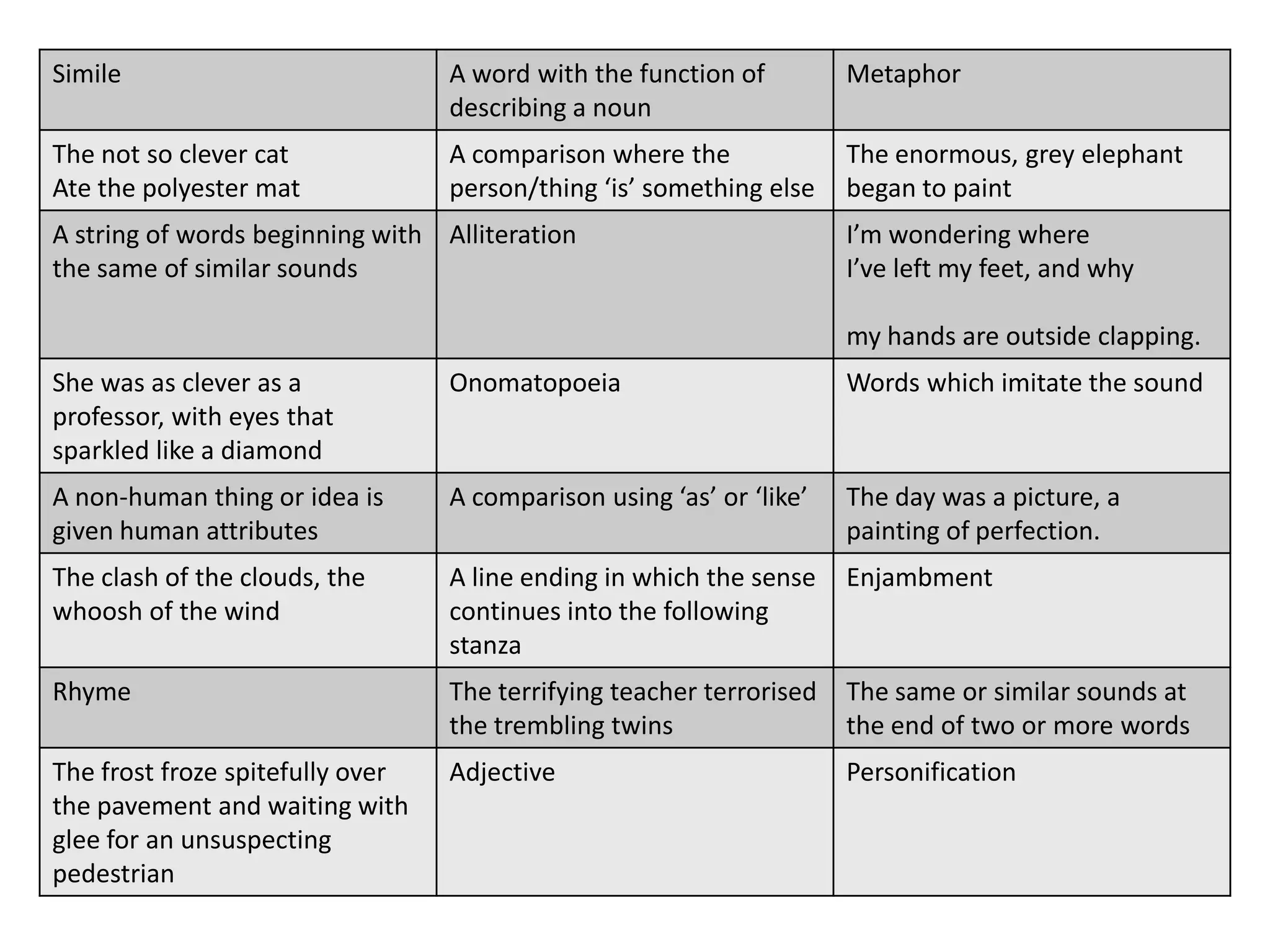
Simile                            A word with the function of         Metaphor
                                  describing a noun
The not so clever cat             A comparison where the              The enormous, grey elephant
Ate the polyester mat             person/thing ‘is’ something else    began to paint
A string of words beginning with Alliteration                         I’m wondering where
the same of similar sounds                                            I’ve left my feet, and why

                                                                      my hands are outside clapping.
She was as clever as a            Onomatopoeia                        Words which imitate the sound
professor, with eyes that
sparkled like a diamond
A non-human thing or idea is      A comparison using ‘as’ or ‘like’   The day was a picture, a
given human attributes                                                painting of perfection.
The clash of the clouds, the      A line ending in which the sense    Enjambment
whoosh of the wind                continues into the following
                                  stanza
Rhyme                             The terrifying teacher terrorised   The same or similar sounds at
                                  the trembling twins                 the end of two or more words
The frost froze spitefully over   Adjective                           Personification
the pavement and waiting with
glee for an unsuspecting
pedestrian
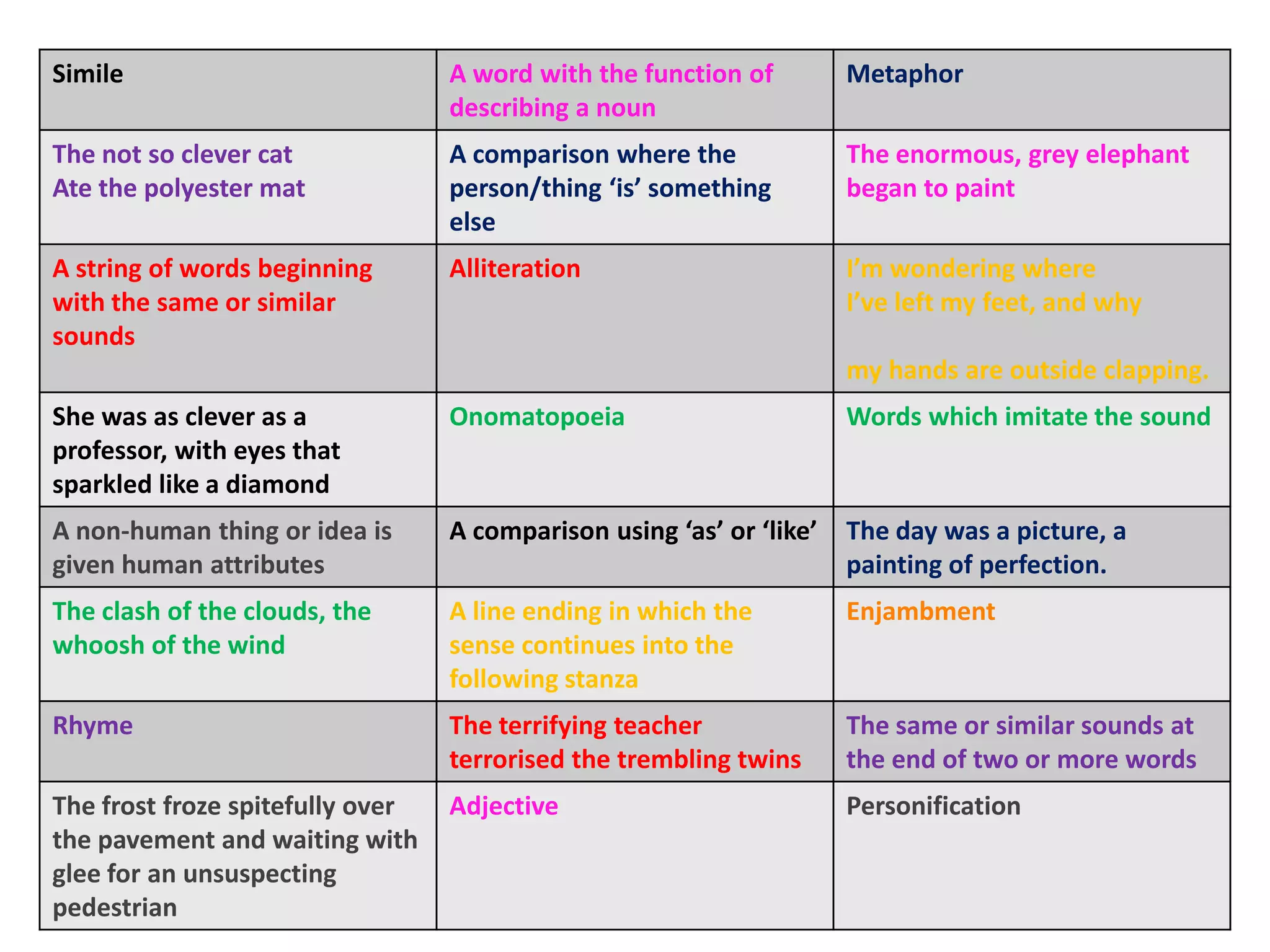
Simile                            A word with the function of         Metaphor
                                  describing a noun
The not so clever cat             A comparison where the              The enormous, grey elephant
Ate the polyester mat             person/thing ‘is’ something         began to paint
                                  else
A string of words beginning       Alliteration                        I’m wondering where
with the same or similar                                              I’ve left my feet, and why
sounds
                                                                      my hands are outside clapping.
She was as clever as a            Onomatopoeia                        Words which imitate the sound
professor, with eyes that
sparkled like a diamond
A non-human thing or idea is      A comparison using ‘as’ or ‘like’   The day was a picture, a
given human attributes                                                painting of perfection.
The clash of the clouds, the      A line ending in which the          Enjambment
whoosh of the wind                sense continues into the
                                  following stanza
Rhyme                             The terrifying teacher              The same or similar sounds at
                                  terrorised the trembling twins      the end of two or more words
The frost froze spitefully over   Adjective                           Personification
the pavement and waiting with
glee for an unsuspecting
pedestrian
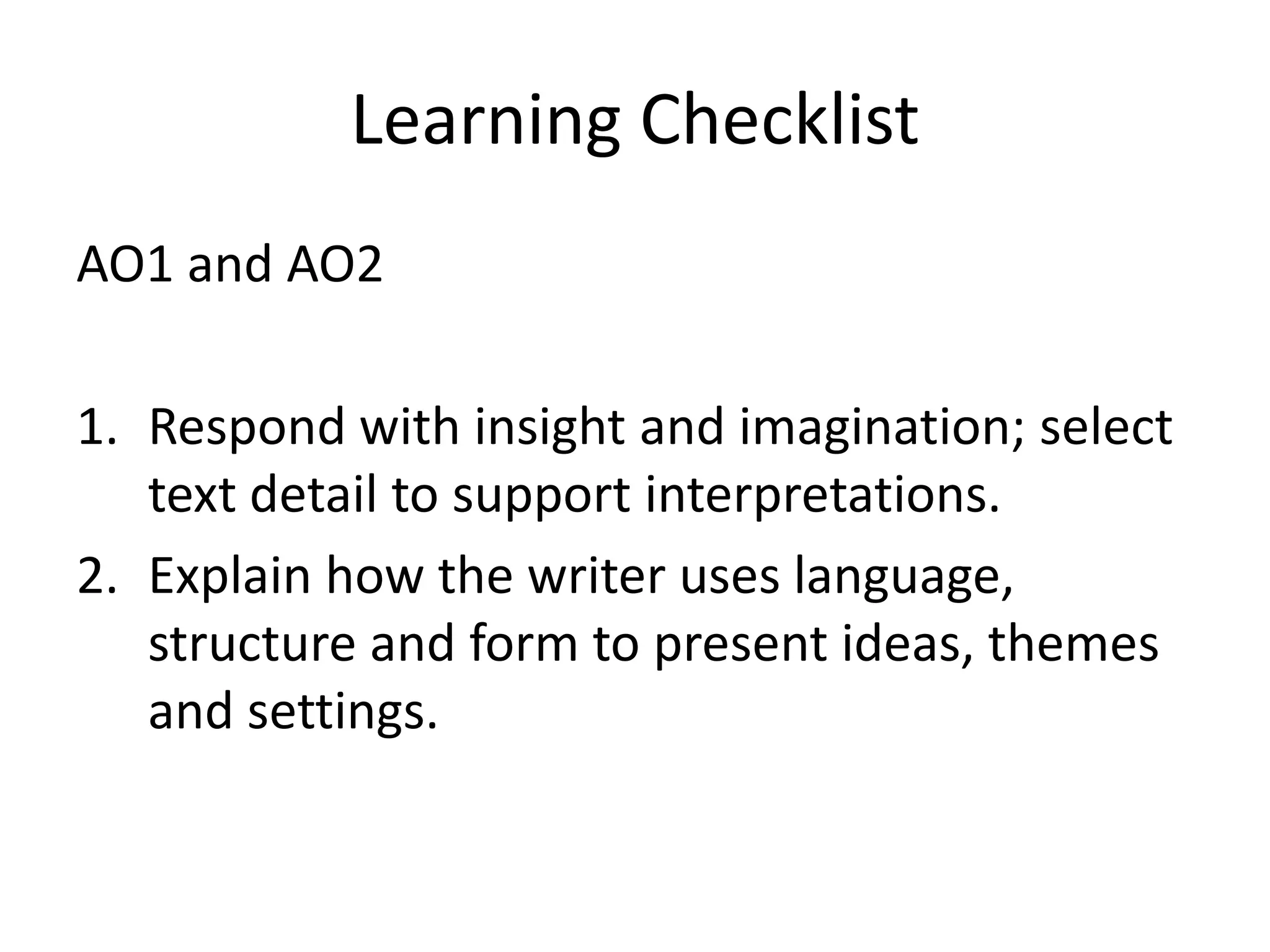
Learning Checklist
AO1 and AO2

1. Respond with insight and imagination; select
   text detail to support interpretations.
2. Explain how the writer uses language,
   structure and form to present ideas, themes
   and settings.
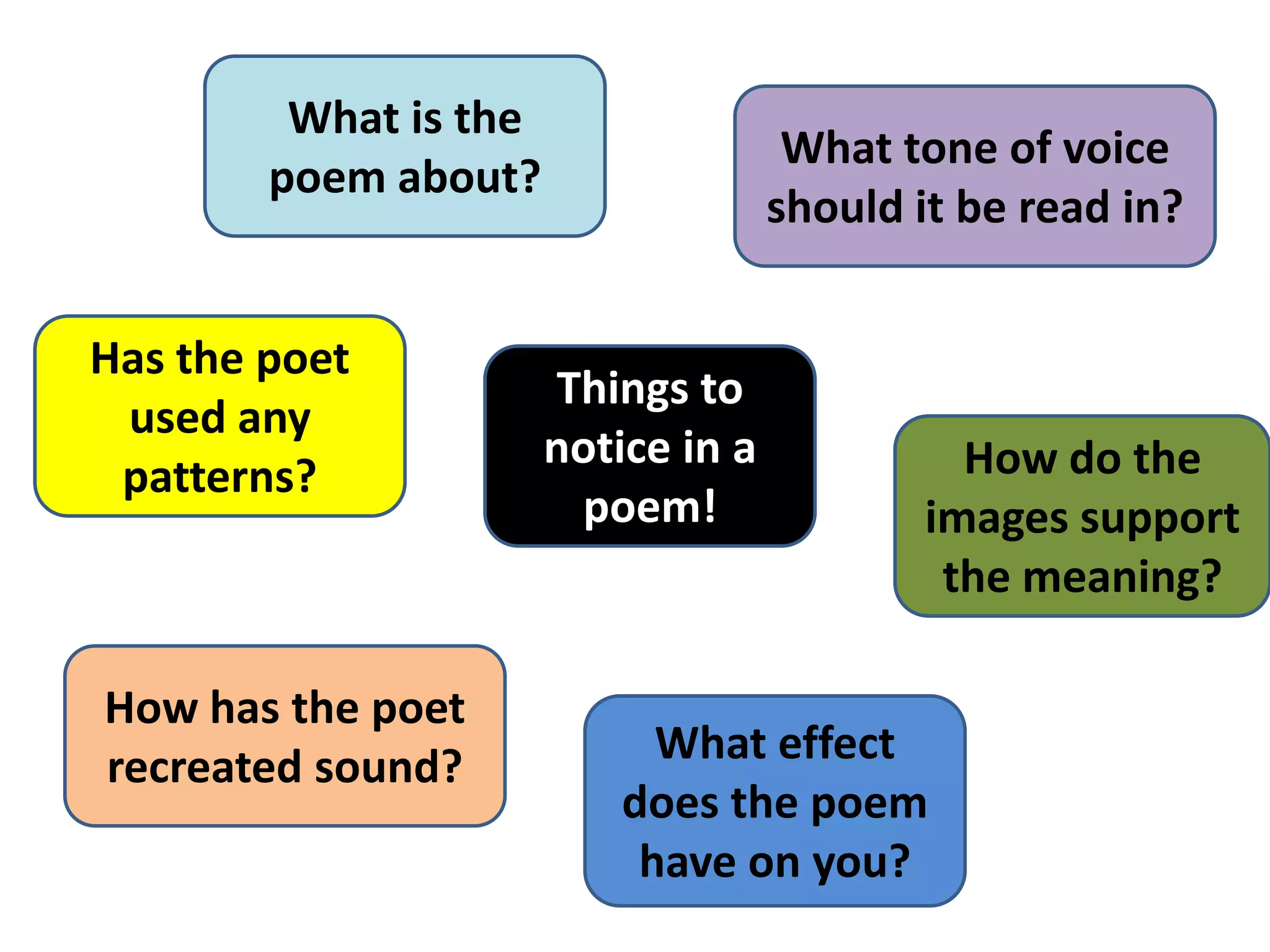
What is the
                                      What tone of voice
        poem about?
                                     should it be read in?


Has the poet
                       Things to
 used any
                       notice in a            How do the
 patterns?
                        poem!               images support
                                             the meaning?

How has the poet
recreated sound?             What effect
                           does the poem
                            have on you?
When you read a poem,
 always remember to SMILE
 S   • Structure (including form,
       rhyme and rhythm)
     • Meaning (including storyline
M      and viewpoint)
     • Imagery (including the senses,
 I     simile, metaphor, adjectives
       and personification)
 L   • Language (including word use
       and onomatopoeia)
 E   • Effect (including mood,
       emotion and tone)
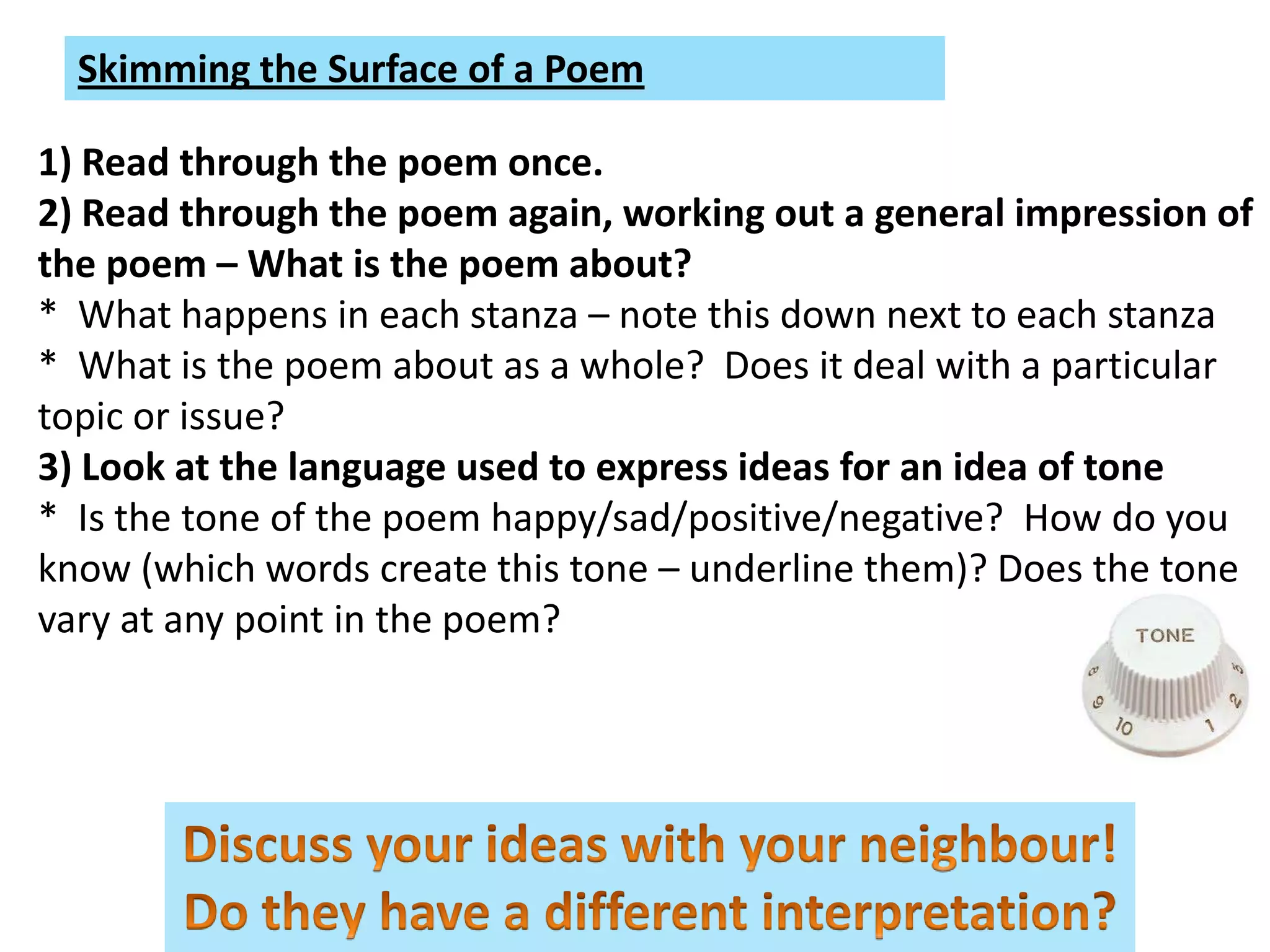
Skimming the Surface of a Poem

1) Read through the poem once.
2) Read through the poem again, working out a general impression of
the poem – What is the poem about?
* What happens in each stanza – note this down next to each stanza
* What is the poem about as a whole? Does it deal with a particular
topic or issue?
3) Look at the language used to express ideas for an idea of tone
* Is the tone of the poem happy/sad/positive/negative? How do you
know (which words create this tone – underline them)? Does the tone
vary at any point in the poem?
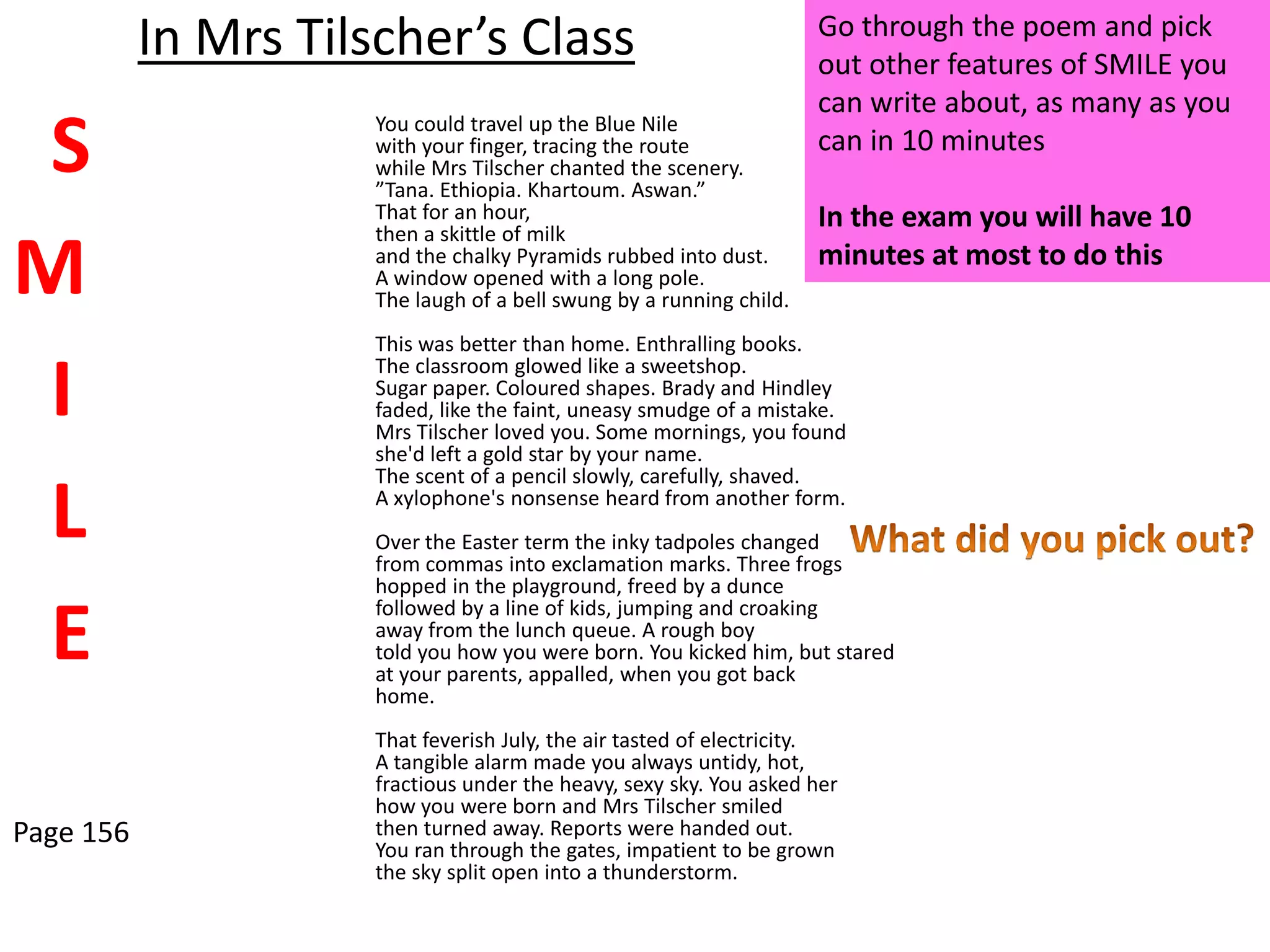
Go through the poem and pick
           In Mrs Tilscher’s Class                                   out other features of SMILE you
                                                                     can write about, as many as you
 S                   You could travel up the Blue Nile
                     with your finger, tracing the route
                     while Mrs Tilscher chanted the scenery.
                     ”Tana. Ethiopia. Khartoum. Aswan.”
                                                                     can in 10 minutes

                     That for an hour,                               In the exam you will have 10
                     then a skittle of milk

M                    and the chalky Pyramids rubbed into dust.
                     A window opened with a long pole.
                     The laugh of a bell swung by a running child.
                                                                     minutes at most to do this

                     This was better than home. Enthralling books.

 I                   The classroom glowed like a sweetshop.
                     Sugar paper. Coloured shapes. Brady and Hindley
                     faded, like the faint, uneasy smudge of a mistake.
                     Mrs Tilscher loved you. Some mornings, you found
                     she'd left a gold star by your name.
                     The scent of a pencil slowly, carefully, shaved.

 L                   A xylophone's nonsense heard from another form.
                     Over the Easter term the inky tadpoles changed
                     from commas into exclamation marks. Three frogs
                     hopped in the playground, freed by a dunce

 E
                     followed by a line of kids, jumping and croaking
                     away from the lunch queue. A rough boy
                     told you how you were born. You kicked him, but stared
                     at your parents, appalled, when you got back
                     home.
                     That feverish July, the air tasted of electricity.
                     A tangible alarm made you always untidy, hot,
                     fractious under the heavy, sexy sky. You asked her
                     how you were born and Mrs Tilscher smiled
Page 156             then turned away. Reports were handed out.
                     You ran through the gates, impatient to be grown
                     the sky split open into a thunderstorm.
Write your introduction
 How does the poet show her feelings about her time
                 at Primary school?
You should consider:
• how the poet describes the sights and sound of the Primary School
• how the poet describes the experiences of Primary School
• what she realises as an adult looking back on her experiences
• the tone of voice in the poem
• the language the poet uses
• how the poem is structured
• anything else that you think important.

  In your introduction it is a good idea to summarise the poem’s
  meaning, tone and the response you think the poet wanted from
  the reader.
PLANNING YOUR PEARL
   So you’ve gathered your evidence to
   answer this question. Now, how will you
   structure your response? What will your
   PEARLs be?
PEARLs:
1.
2.
3.
   Number your evidence/annotations to
   show which PEARL it belongs with. Will
   you cover all elements of the question/
   SMILE with this plan?
Lesson 2

         Learning Objective:
using the PEARL paragraph structure
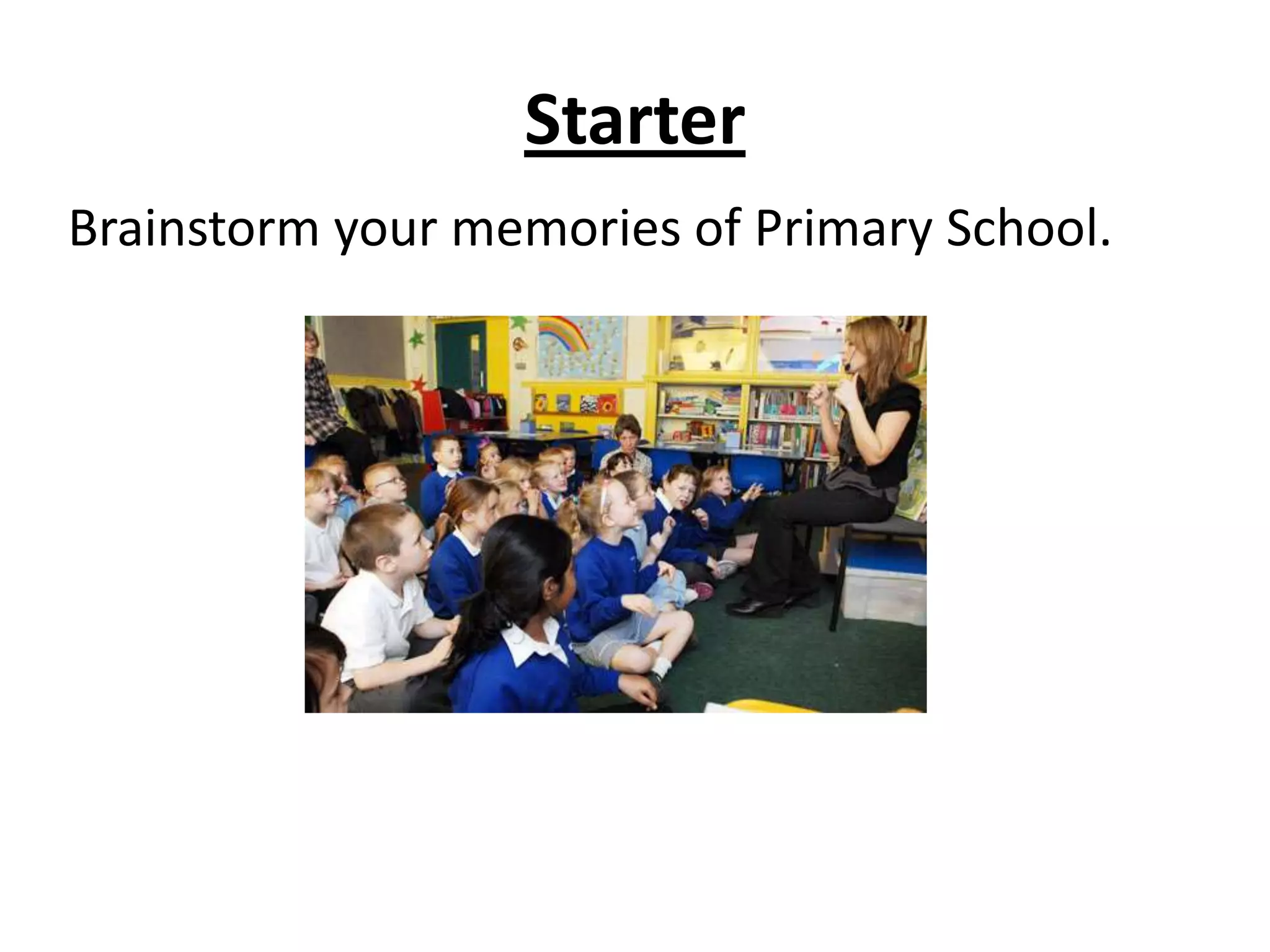
Starter
Brainstorm your memories of Primary School.
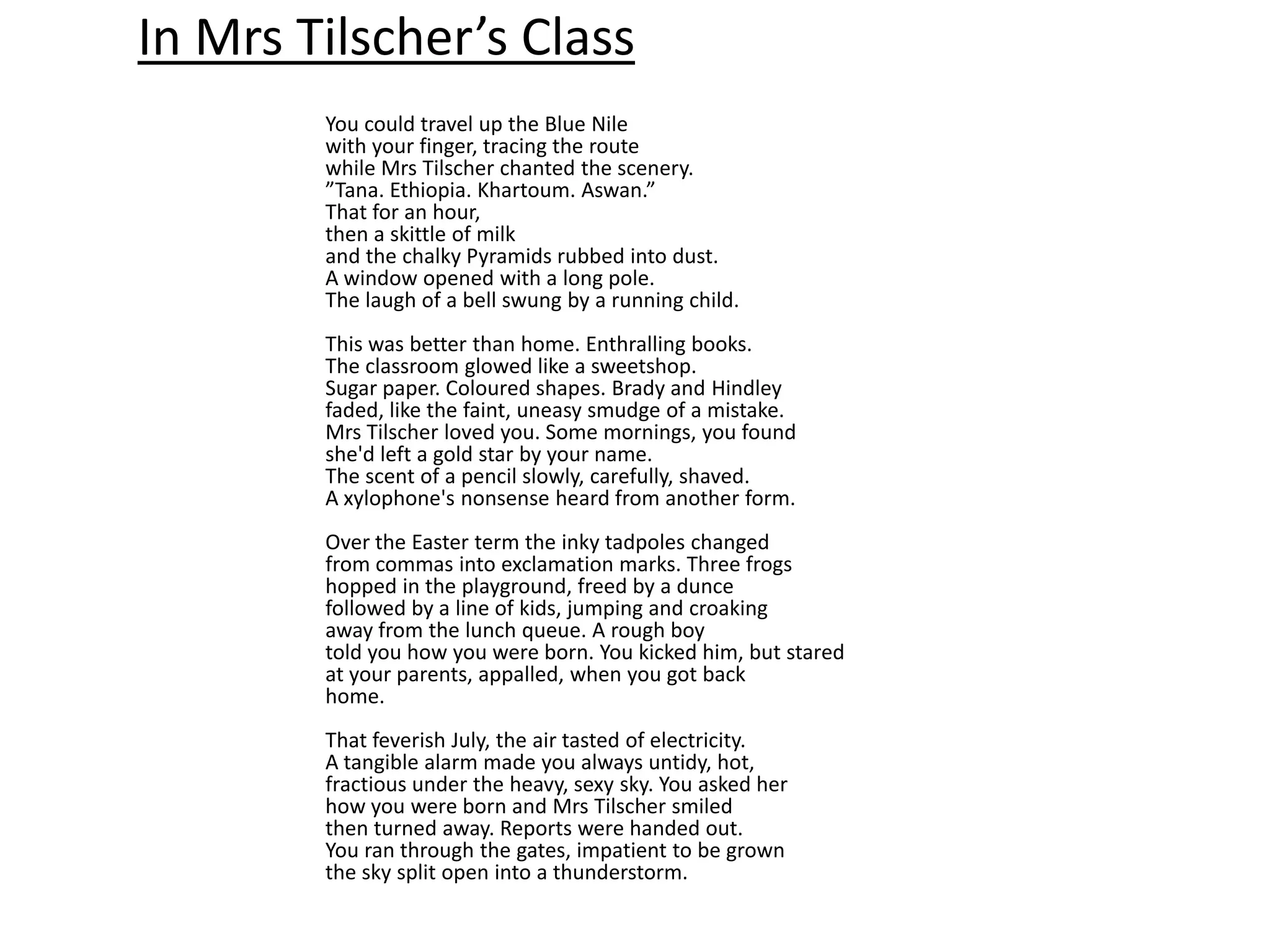
In Mrs Tilscher’s Class
        You could travel up the Blue Nile
        with your finger, tracing the route
        while Mrs Tilscher chanted the scenery.
        ”Tana. Ethiopia. Khartoum. Aswan.”
        That for an hour,
        then a skittle of milk
        and the chalky Pyramids rubbed into dust.
        A window opened with a long pole.
        The laugh of a bell swung by a running child.
        This was better than home. Enthralling books.
        The classroom glowed like a sweetshop.
        Sugar paper. Coloured shapes. Brady and Hindley
        faded, like the faint, uneasy smudge of a mistake.
        Mrs Tilscher loved you. Some mornings, you found
        she'd left a gold star by your name.
        The scent of a pencil slowly, carefully, shaved.
        A xylophone's nonsense heard from another form.
        Over the Easter term the inky tadpoles changed
        from commas into exclamation marks. Three frogs
        hopped in the playground, freed by a dunce
        followed by a line of kids, jumping and croaking
        away from the lunch queue. A rough boy
        told you how you were born. You kicked him, but stared
        at your parents, appalled, when you got back
        home.
        That feverish July, the air tasted of electricity.
        A tangible alarm made you always untidy, hot,
        fractious under the heavy, sexy sky. You asked her
        how you were born and Mrs Tilscher smiled
        then turned away. Reports were handed out.
        You ran through the gates, impatient to be grown
        the sky split open into a thunderstorm.
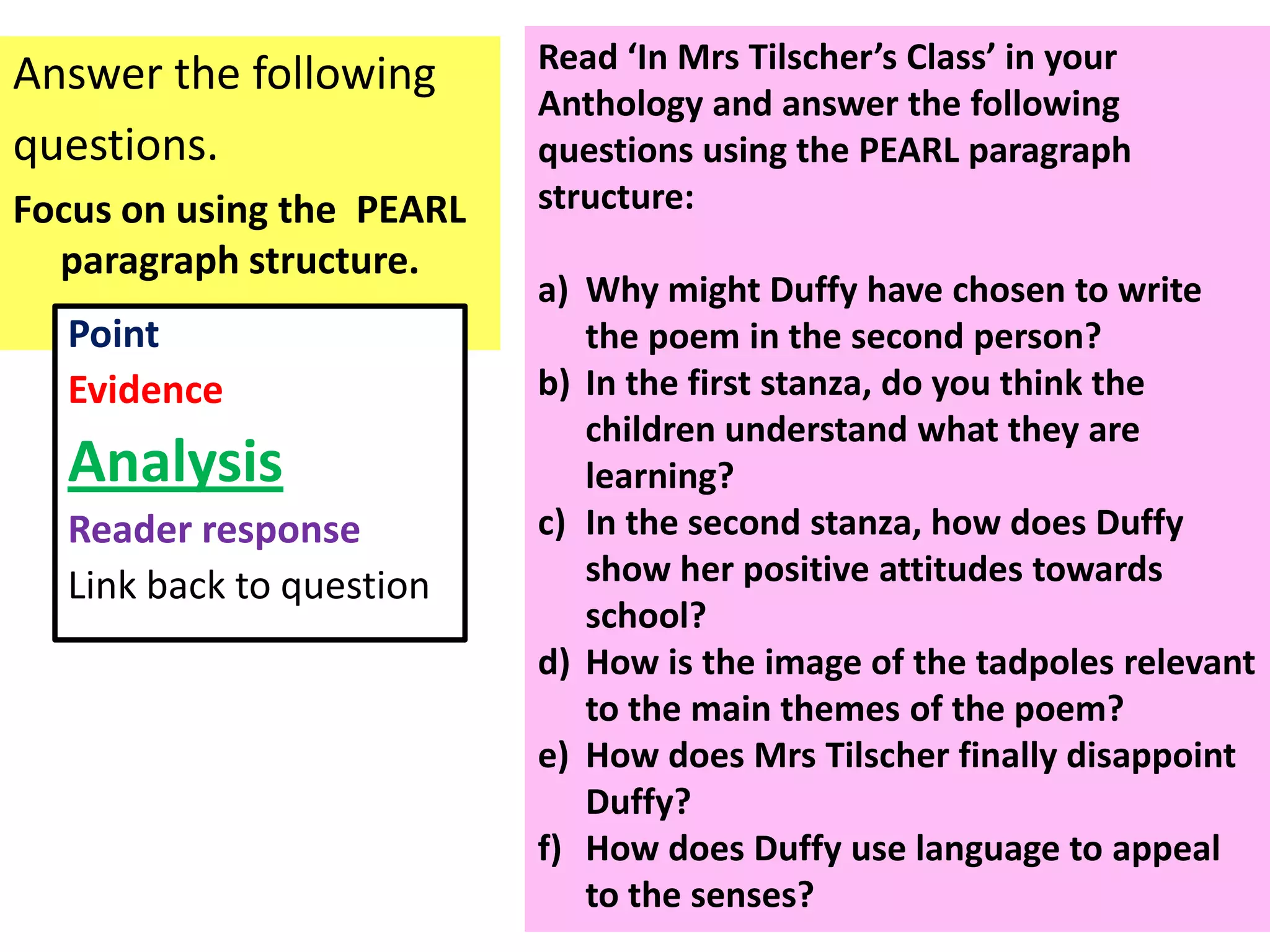
Read ‘In Mrs Tilscher’s Class’ in your
Answer the following
                           Anthology and answer the following
questions.                 questions using the PEARL paragraph
Focus on using the PEARL   structure:
  paragraph structure.
                           a) Why might Duffy have chosen to write
  Point                       the poem in the second person?
  Evidence                 b) In the first stanza, do you think the
                              children understand what they are
  Analysis                    learning?
  Reader response          c) In the second stanza, how does Duffy
  Link back to question       show her positive attitudes towards
                              school?
                           d) How is the image of the tadpoles relevant
                              to the main themes of the poem?
                           e) How does Mrs Tilscher finally disappoint
                              Duffy?
                           f) How does Duffy use language to appeal
                              to the senses?
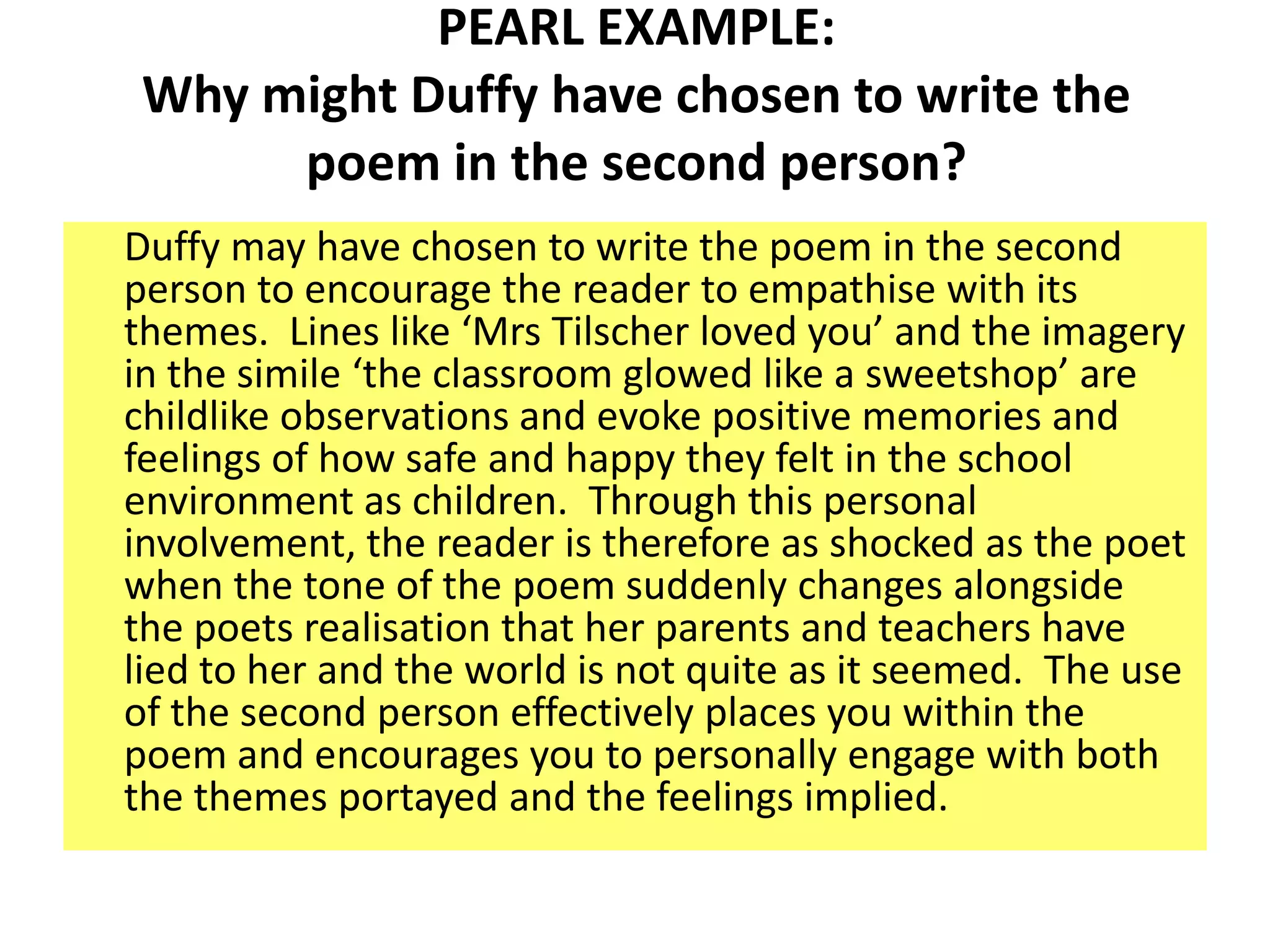
PEARL EXAMPLE:
 Why might Duffy have chosen to write the
      poem in the second person?
Duffy may have chosen to write the poem in the second
person to encourage the reader to empathise with its
themes. Lines like ‘Mrs Tilscher loved you’ and the imagery
in the simile ‘the classroom glowed like a sweetshop’ are
childlike observations and evoke positive memories and
feelings of how safe and happy they felt in the school
environment as children. Through this personal
involvement, the reader is therefore as shocked as the poet
when the tone of the poem suddenly changes alongside
the poets realisation that her parents and teachers have
lied to her and the world is not quite as it seemed. The use
of the second person effectively places you within the
poem and encourages you to personally engage with both
the themes portayed and the feelings implied.
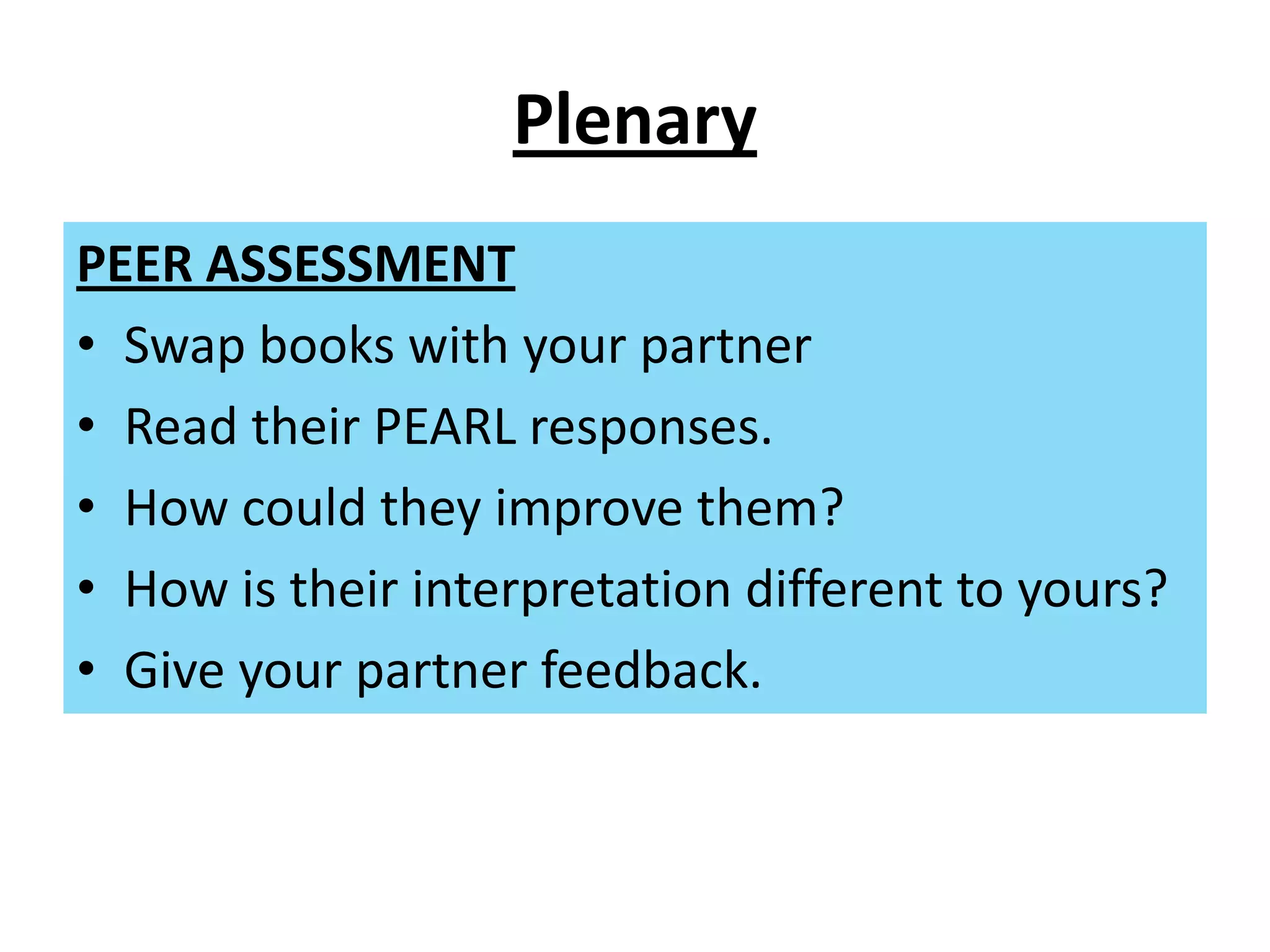
Plenary
PEER ASSESSMENT
• Swap books with your partner
• Read their PEARL responses.
• How could they improve them?
• How is their interpretation different to yours?
• Give your partner feedback.
Write a full answer – 30 minutes
 How does the poet show her feelings about her time
                 at Primary school?
You should consider:
• how the poet describes the sights and sound of the Primary School
• how the poet describes the experiences of Primary School
• what she realises as an adult looking back on her experiences
• the tone of voice in the poem
• the language the poet uses
• how the poem is structured
• anything else that you think important.

  In your introduction it is a good idea to summarise the poem’s
  meaning, tone and the response you think the poet wanted from
  the reader.
Task: Write Miss Allen’s class in
   the style of Duffy’s poem

In mrs tilcher’s class

  • 1.
    In Mrs Tilcher’sClass LO: How to analyse an unseen poem
  • 2.
    Poetry Terms Warm-up Match the terms to their definitions and an example. Use a different colour for each term.
  • 3.
    Simile A word with the function of Metaphor describing a noun The not so clever cat A comparison where the The enormous, grey elephant Ate the polyester mat person/thing ‘is’ something else began to paint A string of words beginning with Alliteration I’m wondering where the same of similar sounds I’ve left my feet, and why my hands are outside clapping. She was as clever as a Onomatopoeia Words which imitate the sound professor, with eyes that sparkled like a diamond A non-human thing or idea is A comparison using ‘as’ or ‘like’ The day was a picture, a given human attributes painting of perfection. The clash of the clouds, the A line ending in which the sense Enjambment whoosh of the wind continues into the following stanza Rhyme The terrifying teacher terrorised The same or similar sounds at the trembling twins the end of two or more words The frost froze spitefully over Adjective Personification the pavement and waiting with glee for an unsuspecting pedestrian
  • 4.
    Simile A word with the function of Metaphor describing a noun The not so clever cat A comparison where the The enormous, grey elephant Ate the polyester mat person/thing ‘is’ something began to paint else A string of words beginning Alliteration I’m wondering where with the same or similar I’ve left my feet, and why sounds my hands are outside clapping. She was as clever as a Onomatopoeia Words which imitate the sound professor, with eyes that sparkled like a diamond A non-human thing or idea is A comparison using ‘as’ or ‘like’ The day was a picture, a given human attributes painting of perfection. The clash of the clouds, the A line ending in which the Enjambment whoosh of the wind sense continues into the following stanza Rhyme The terrifying teacher The same or similar sounds at terrorised the trembling twins the end of two or more words The frost froze spitefully over Adjective Personification the pavement and waiting with glee for an unsuspecting pedestrian
  • 5.
    Learning Checklist AO1 andAO2 1. Respond with insight and imagination; select text detail to support interpretations. 2. Explain how the writer uses language, structure and form to present ideas, themes and settings.
  • 6.
    What is the What tone of voice poem about? should it be read in? Has the poet Things to used any notice in a How do the patterns? poem! images support the meaning? How has the poet recreated sound? What effect does the poem have on you?
  • 7.
    When you reada poem, always remember to SMILE S • Structure (including form, rhyme and rhythm) • Meaning (including storyline M and viewpoint) • Imagery (including the senses, I simile, metaphor, adjectives and personification) L • Language (including word use and onomatopoeia) E • Effect (including mood, emotion and tone)
  • 8.
    Skimming the Surfaceof a Poem 1) Read through the poem once. 2) Read through the poem again, working out a general impression of the poem – What is the poem about? * What happens in each stanza – note this down next to each stanza * What is the poem about as a whole? Does it deal with a particular topic or issue? 3) Look at the language used to express ideas for an idea of tone * Is the tone of the poem happy/sad/positive/negative? How do you know (which words create this tone – underline them)? Does the tone vary at any point in the poem?
  • 9.
    Go through thepoem and pick In Mrs Tilscher’s Class out other features of SMILE you can write about, as many as you S You could travel up the Blue Nile with your finger, tracing the route while Mrs Tilscher chanted the scenery. ”Tana. Ethiopia. Khartoum. Aswan.” can in 10 minutes That for an hour, In the exam you will have 10 then a skittle of milk M and the chalky Pyramids rubbed into dust. A window opened with a long pole. The laugh of a bell swung by a running child. minutes at most to do this This was better than home. Enthralling books. I The classroom glowed like a sweetshop. Sugar paper. Coloured shapes. Brady and Hindley faded, like the faint, uneasy smudge of a mistake. Mrs Tilscher loved you. Some mornings, you found she'd left a gold star by your name. The scent of a pencil slowly, carefully, shaved. L A xylophone's nonsense heard from another form. Over the Easter term the inky tadpoles changed from commas into exclamation marks. Three frogs hopped in the playground, freed by a dunce E followed by a line of kids, jumping and croaking away from the lunch queue. A rough boy told you how you were born. You kicked him, but stared at your parents, appalled, when you got back home. That feverish July, the air tasted of electricity. A tangible alarm made you always untidy, hot, fractious under the heavy, sexy sky. You asked her how you were born and Mrs Tilscher smiled Page 156 then turned away. Reports were handed out. You ran through the gates, impatient to be grown the sky split open into a thunderstorm.
  • 10.
    Write your introduction How does the poet show her feelings about her time at Primary school? You should consider: • how the poet describes the sights and sound of the Primary School • how the poet describes the experiences of Primary School • what she realises as an adult looking back on her experiences • the tone of voice in the poem • the language the poet uses • how the poem is structured • anything else that you think important. In your introduction it is a good idea to summarise the poem’s meaning, tone and the response you think the poet wanted from the reader.
  • 11.
    PLANNING YOUR PEARL So you’ve gathered your evidence to answer this question. Now, how will you structure your response? What will your PEARLs be? PEARLs: 1. 2. 3. Number your evidence/annotations to show which PEARL it belongs with. Will you cover all elements of the question/ SMILE with this plan?
  • 12.
    Lesson 2 Learning Objective: using the PEARL paragraph structure
  • 13.
  • 14.
    In Mrs Tilscher’sClass You could travel up the Blue Nile with your finger, tracing the route while Mrs Tilscher chanted the scenery. ”Tana. Ethiopia. Khartoum. Aswan.” That for an hour, then a skittle of milk and the chalky Pyramids rubbed into dust. A window opened with a long pole. The laugh of a bell swung by a running child. This was better than home. Enthralling books. The classroom glowed like a sweetshop. Sugar paper. Coloured shapes. Brady and Hindley faded, like the faint, uneasy smudge of a mistake. Mrs Tilscher loved you. Some mornings, you found she'd left a gold star by your name. The scent of a pencil slowly, carefully, shaved. A xylophone's nonsense heard from another form. Over the Easter term the inky tadpoles changed from commas into exclamation marks. Three frogs hopped in the playground, freed by a dunce followed by a line of kids, jumping and croaking away from the lunch queue. A rough boy told you how you were born. You kicked him, but stared at your parents, appalled, when you got back home. That feverish July, the air tasted of electricity. A tangible alarm made you always untidy, hot, fractious under the heavy, sexy sky. You asked her how you were born and Mrs Tilscher smiled then turned away. Reports were handed out. You ran through the gates, impatient to be grown the sky split open into a thunderstorm.
  • 15.
    Read ‘In MrsTilscher’s Class’ in your Answer the following Anthology and answer the following questions. questions using the PEARL paragraph Focus on using the PEARL structure: paragraph structure. a) Why might Duffy have chosen to write Point the poem in the second person? Evidence b) In the first stanza, do you think the children understand what they are Analysis learning? Reader response c) In the second stanza, how does Duffy Link back to question show her positive attitudes towards school? d) How is the image of the tadpoles relevant to the main themes of the poem? e) How does Mrs Tilscher finally disappoint Duffy? f) How does Duffy use language to appeal to the senses?
  • 16.
    PEARL EXAMPLE: Whymight Duffy have chosen to write the poem in the second person? Duffy may have chosen to write the poem in the second person to encourage the reader to empathise with its themes. Lines like ‘Mrs Tilscher loved you’ and the imagery in the simile ‘the classroom glowed like a sweetshop’ are childlike observations and evoke positive memories and feelings of how safe and happy they felt in the school environment as children. Through this personal involvement, the reader is therefore as shocked as the poet when the tone of the poem suddenly changes alongside the poets realisation that her parents and teachers have lied to her and the world is not quite as it seemed. The use of the second person effectively places you within the poem and encourages you to personally engage with both the themes portayed and the feelings implied.
  • 17.
    Plenary PEER ASSESSMENT • Swapbooks with your partner • Read their PEARL responses. • How could they improve them? • How is their interpretation different to yours? • Give your partner feedback.
  • 18.
    Write a fullanswer – 30 minutes How does the poet show her feelings about her time at Primary school? You should consider: • how the poet describes the sights and sound of the Primary School • how the poet describes the experiences of Primary School • what she realises as an adult looking back on her experiences • the tone of voice in the poem • the language the poet uses • how the poem is structured • anything else that you think important. In your introduction it is a good idea to summarise the poem’s meaning, tone and the response you think the poet wanted from the reader.
  • 19.
    Task: Write MissAllen’s class in the style of Duffy’s poem