How to Compare

       Free Powerpoint Templates
                                   Page 1
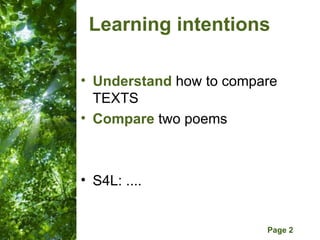
Learning intentions

• Understand how to compare
  TEXTS
• Compare two poems


• S4L: ....


       Free Powerpoint Templates
                                   Page 2
Free Powerpoint Templates
                            Page 3
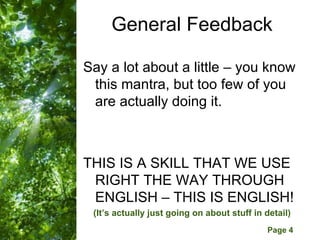
General Feedback

Say a lot about a little – you know
 this mantra, but too few of you
 are actually doing it.


THIS IS A SKILL THAT WE USE
 RIGHT THE WAY THROUGH
 ENGLISH – THIS IS ENGLISH!
 (It’s actually just going on about stuff in detail)
        Free Powerpoint Templates
                                             Page 4
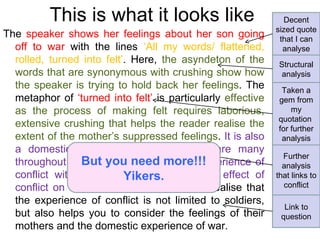
This is what it looks like                           Decent
                                                             sized quote
The speaker shows her feelings about her son going            that I can
  off to war with the lines ‘All my words/ flattened,          analyse
  rolled, turned into felt’. Here, the asyndeton of the      Structural
  words that are synonymous with crushing show how           analysis
  the speaker is trying to hold back her feelings. The        Taken a
  metaphor of ‘turned into felt’ is particularly effective   gem from
  as the process of making felt requires laborious,              my
                                                             quotation
  extensive crushing that helps the reader realise the       for further
  extent of the mother’s suppressed feelings. It is also      analysis
  a domestic reference, of which there are many
                                                               Further
                But you need more!!!
  throughout the poem, that places the experience of           analysis
  conflict with the woman and shows the effect of
                           Yikers.                           that links to
  conflict on mothers. It helps the reader realise that        conflict

  the experience of conflict is not limited to soldiers,
                                                               Link to
  but also helps you to consider the feelings of their        question
  mothers and the domestic experience of war.
General Feedback

Comparison. You need to have
 detailed and sustained analysis
 that is comparative...

How do we merge this together?


     Free Powerpoint Templates
                                 Page 6
Firstly,

Plan.
Look at the question. This must
  be your guide.
Find a point of difference and
  similarity.


     Free Powerpoint Templates
                                 Page 7
Compare how poets
present the experience
 of soldiers in Bayonet
Charge and one other
         poem.


   Free Powerpoint Templates
                               Page 8
Experience of Soldiers
Right, first thing I am thinking is
  which poem? I need one that isn’t
  too similar and is the soldier’s
  experience.

  I’m going to chose Come on
    Come Back.


     Free Powerpoint Templates
                                 Page 9
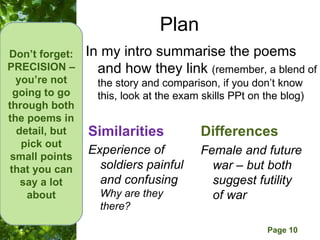
Plan
Don’t forget:   In my intro summarise the poems
PRECISION –       and how they link (remember, a blend of
  you’re not      the story and comparison, if you don’t know
 going to go      this, look at the exam skills PPt on the blog)
through both
the poems in
  detail, but   Similarities               Differences
   pick out
 small points
                Experience of              Female and future
that you can      soldiers painful           war – but both
   say a lot      and confusing              suggest futility
    about         Why are they               of war
                  there?
                       Free Powerpoint Templates
                                                       Page 10
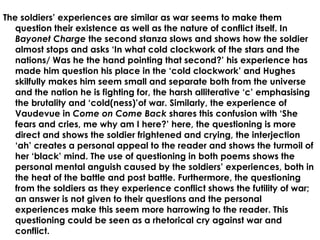
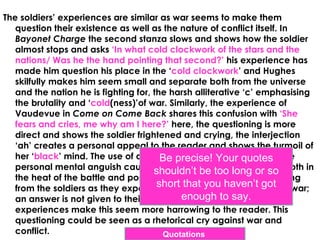
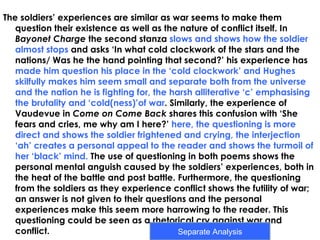
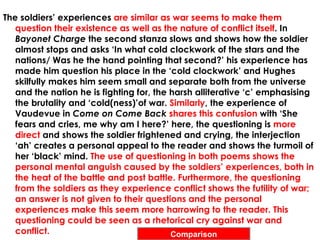
The soldiers’ experiences are similar as war seems to make them
   question their existence as well as the nature of conflict itself. In
   Bayonet Charge the second stanza slows and shows how the soldier
   almost stops and asks ‘In what cold clockwork of the stars and the
   nations/ Was he the hand pointing that second?’ his experience has
   made him question his place in the ‘cold clockwork’ and Hughes
   skilfully makes him seem small and separate both from the universe
   and the nation he is fighting for, the harsh alliterative ‘c’ emphasising
   the brutality and ‘cold(ness)’of war. Similarly, the experience of
   Vaudevue in Come on Come Back shares this confusion with ‘She
   fears and cries, me why am I here?’ here, the questioning is more
   direct and shows the soldier frightened and crying, the interjection
   ‘ah’ creates a personal appeal to the reader and shows the turmoil of
   her ‘black’ mind. The use of questioning in both poems shows the
   personal mental anguish caused by the soldiers’ experiences, both in
   the heat of the battle and post battle. Furthermore, the questioning
   from the soldiers as they experience conflict shows the futility of war;
   an answer is not given to their questions and the personal
   experiences make this seem more harrowing to the reader. This
   questioning could be seen as a rhetorical cry against war and
   conflict.
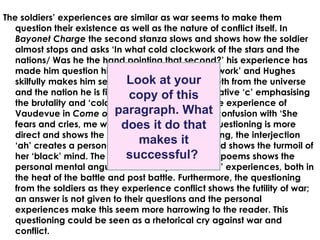
The soldiers’ experiences are similar as war seems to make them
   question their existence as well as the nature of conflict itself. In
   Bayonet Charge the second stanza slows and shows how the soldier
   almost stops and asks ‘In what cold clockwork of the stars and the
   nations/ Was he the hand pointing that second?’ his experience has
   made him question his place in the ‘cold clockwork’ and Hughes
                               Look at your
   skilfully makes him seem small and separate both from the universe
   and the nation he is fighting for, the harsh alliterative ‘c’ emphasising
                               copy of this
   the brutality and ‘cold(ness)’of war. Similarly, the experience of
   Vaudevue in Come on paragraph. What confusion with ‘She
                           Come Back shares this
                             does it do that
   fears and cries, me why am I here?’ here, the questioning is more
   direct and shows the soldier frightened and crying, the interjection
                                  makes it
   ‘ah’ creates a personal appeal to the reader and shows the turmoil of
                               successful?
   her ‘black’ mind. The use of questioning in both poems shows the
   personal mental anguish caused by the soldiers’ experiences, both in
   the heat of the battle and post battle. Furthermore, the questioning
   from the soldiers as they experience conflict shows the futility of war;
   an answer is not given to their questions and the personal
   experiences make this seem more harrowing to the reader. This
   questioning could be seen as a rhetorical cry against war and
   conflict.
The soldiers’ experiences are similar as war seems to make them
   question their existence as well as the nature of conflict itself. In
   Bayonet Charge the second stanza slows and shows how the soldier
   almost stops and asks ‘In what cold clockwork of the stars and the
   nations/ Was he the hand pointing that second?’ his experience has
   made him question his place in the ‘cold clockwork’ and Hughes
   skilfully makes him seem small and separate both from the universe
   and the nation he is fighting for, the harsh alliterative ‘c’ emphasising
   the brutality and ‘cold(ness)’of war. Similarly, the experience of
   Vaudevue in Come on Come Back shares this confusion with ‘She
   fears and cries, me why am I here?’ here, the questioning is more
   direct and shows the soldier frightened and crying, the interjection
   ‘ah’ creates a personal appeal to the reader and shows the turmoil of
   her ‘black’ mind. The use of questioning in both poems shows the
   personal mental anguish caused by the soldiers’ experiences, both in
   the heat of the battle and post battle. Furthermore, the questioning
   from the soldiers as they experience conflict shows the futility of war;
   an answer is not given to their questions and the personal
   experiences make this seem more harrowing to the reader. This
   questioning could be seen as a rhetorical cry against war and
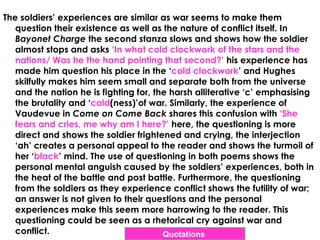
   conflict.                            Quotations
The soldiers’ experiences are similar as war seems to make them
   question their existence as well as the nature of conflict itself. In
   Bayonet Charge the second stanza slows and shows how the soldier
   almost stops and asks ‘In what cold clockwork of the stars and the
   nations/ Was he the hand pointing that second?’ his experience has
   made him question his place in the ‘cold clockwork’ and Hughes
   skilfully makes him seem small and separate both from the universe
   and the nation he is fighting for, the harsh alliterative ‘c’ emphasising
   the brutality and ‘cold(ness)’of war. Similarly, the experience of
   Vaudevue in Come on Come Back shares this confusion with ‘She
   fears and cries, me why am I here?’ here, the questioning is more
   direct and shows the soldier frightened and crying, the interjection
   ‘ah’ creates a personal appeal to the reader and shows the turmoil of
   her ‘black’ mind. The use of questioning in both poems shows the
                                        Be precise! Your quotes
   personal mental anguish caused by the soldiers’ experiences, both in
                                      shouldn’t be too long or so
   the heat of the battle and post battle. Furthermore, the questioning
                                       short that you haven’t got
   from the soldiers as they experience conflict shows the futility of war;
                                            enough to say.
   an answer is not given to their questions and the personal
   experiences make this seem more harrowing to the reader. This
   questioning could be seen as a rhetorical cry against war and
   conflict.                            Quotations
The soldiers’ experiences are similar as war seems to make them
   question their existence as well as the nature of conflict itself. In
   Bayonet Charge the second stanza slows and shows how the soldier
   almost stops and asks ‘In what cold clockwork of the stars and the
   nations/ Was he the hand pointing that second?’ his experience has
   made him question his place in the ‘cold clockwork’ and Hughes
   skilfully makes him seem small and separate both from the universe
   and the nation he is fighting for, the harsh alliterative ‘c’ emphasising
   the brutality and ‘cold(ness)’of war. Similarly, the experience of
   Vaudevue in Come on Come Back shares this confusion with ‘She
   fears and cries, me why am I here?’ here, the questioning is more
   direct and shows the soldier frightened and crying, the interjection
   ‘ah’ creates a personal appeal to the reader and shows the turmoil of
   her ‘black’ mind. The use of questioning in both poems shows the
   personal mental anguish caused by the soldiers’ experiences, both in
   the heat of the battle and post battle. Furthermore, the questioning
   from the soldiers as they experience conflict shows the futility of war;
   an answer is not given to their questions and the personal
   experiences make this seem more harrowing to the reader. This
   questioning could be seen as a rhetorical cry against war and
   conflict.                                Separate Analysis
The soldiers’ experiences are similar as war seems to make them
   question their existence as well as the nature of conflict itself. In
   Bayonet Charge the second stanza slows and shows how the soldier
   almost stops and asks ‘In what cold clockwork of the stars and the
   nations/ Was he the hand pointing that second?’ his experience has
   made him question his place in the ‘cold clockwork’ and Hughes
   skilfully makes him seem small and separate both from the universe
   and the nation he is fighting for, the harsh alliterative ‘c’ emphasising
   the brutality and ‘cold(ness)’of war. Similarly, the experience of
   Vaudevue in Come on Come Back shares this confusion with ‘She
   fears and cries, me why am I here?’ here, the questioning is more
   direct and shows the soldier frightened and crying, the interjection
   ‘ah’ creates a personal appeal to the reader and shows the turmoil of
   her ‘black’ mind. The use of questioning in both poems shows the
   personal mental anguish caused by the soldiers’ experiences, both in
   the heat of the battle and post battle. Furthermore, the questioning
   from the soldiers as they experience conflict shows the futility of war;
   an answer is not given to their questions and the personal
   experiences make this seem more harrowing to the reader. This
   questioning could be seen as a rhetorical cry against war and
   conflict.                              Comparison
The soldiers’ experiences are similar as war seems to make them
   question their existence as well as the nature of conflict itself. In
   Bayonet Charge the second stanza slows and shows how the
   soldier almost stops and asks ‘In what cold clockwork of the stars
   and the nations/ Was he the hand pointing that second?’ his
   experience has made him question his place in the ‘cold
   clockwork’ and Hughes skilfully makes him seem small and
   separate both from the universe and the nation he is fighting for,
   the harsh alliterative ‘c’ emphasising the brutality and
   ‘cold(ness)’of war. Similarly, the experience of Vaudevue in
   Come on Come Back shares this confusion with ‘She fears and
   cries, me why am I here?’ here, the questioning is more direct
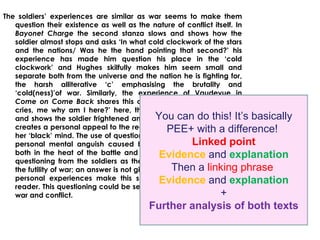
   and shows the soldier frightened and crying, the interjection ‘ah’ basically
                                               You can do this! It’s
   creates a personal appeal to the reader and shows the turmoil of
                                                   PEE+ with a difference!
   her ‘black’ mind. The use of questioning in both poems shows the
   personal mental anguish caused by the soldiers’Linked point
                                                             experiences,
   both in the heat of the battle and post Evidence and explanation
                                                 battle. Furthermore, the
   questioning from the soldiers as they experience conflict shows
   the futility of war; an answer is not given to their questions and thephrase
                                                    Then a linking
   personal experiences make this seem Evidence and explanation
                                                 more harrowing to the
   reader. This questioning could be seen as a rhetorical cry against
   war and conflict.                                               +
                                       Further analysis of both texts
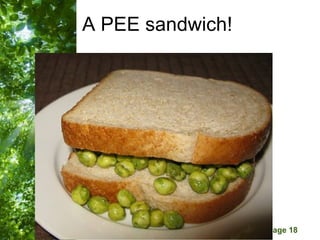
A PEE sandwich!


   Free Powerpoint Templates
                               Page 18
The use of questioning in both poems shows the
    personal mental anguish caused by the soldiers’
    experiences, both in the heat of the battle and
    post battle. Furthermore, the questioning from the
    soldiers as they experience conflict shows the
    futility of war; an answer is not given to their
    questions and the personal experiences make this
    seem more harrowing to the reader. This
    questioning could be seen as a rhetorical cry
    against war and conflict.


This is the skill - write about two texts at the same
 time. Because I am being really precise, focusing
    on a small aspect of the poem, it’s easier to
          discuss both at the same time.
This skill is necessary for both poetry
    and Q4 of the language paper. So
        it’s ESSENTIAL to get it right.


This is the skill - write about two texts at the same
 time. Because I am being really precise, focusing
 on a small aspect of the text, it’s easier to discuss
              both at the same time.
What do you need?

To compare in the topic sentence.
To use comparative words:
Similarly, conversely, likewise, on the
  other hand, in contrast etc.
Discuss both poems at the same
  time.


       Free Powerpoint Templates
                                     Page 21
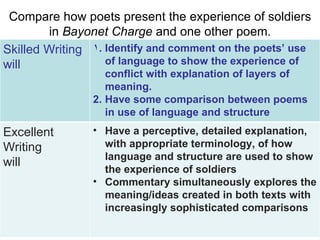
Compare how poets present the experience of soldiers
        in Bayonet Charge and one other poem.
Skilled Writing 1. Identify and comment on the poets’ use
will               of language to show the experience of
                   conflict with explanation of layers of
                   meaning.
                2. Have some comparison between poems
                   in use of language and structure
Excellent       • Have a perceptive, detailed explanation,
Writing           with appropriate terminology, of how
                  language and structure are used to show
will
                  the experience of soldiers
                • Commentary simultaneously explores the
                  meaning/ideas created in both texts with
                  increasingly sophisticated comparisons
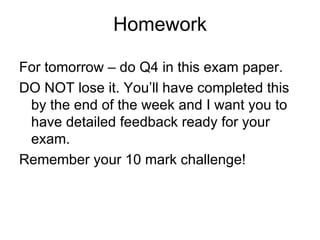
Homework

For tomorrow – do Q4 in this exam paper.
DO NOT lose it. You’ll have completed this
 by the end of the week and I want you to
 have detailed feedback ready for your
 exam.
Remember your 10 mark challenge!

Poetry - How to compare

  • 1.
    How to Compare Free Powerpoint Templates Page 1
  • 2.
    Learning intentions • Understandhow to compare TEXTS • Compare two poems • S4L: .... Free Powerpoint Templates Page 2
  • 3.
  • 4.
    General Feedback Say alot about a little – you know this mantra, but too few of you are actually doing it. THIS IS A SKILL THAT WE USE RIGHT THE WAY THROUGH ENGLISH – THIS IS ENGLISH! (It’s actually just going on about stuff in detail) Free Powerpoint Templates Page 4
  • 5.
    This is whatit looks like Decent sized quote The speaker shows her feelings about her son going that I can off to war with the lines ‘All my words/ flattened, analyse rolled, turned into felt’. Here, the asyndeton of the Structural words that are synonymous with crushing show how analysis the speaker is trying to hold back her feelings. The Taken a metaphor of ‘turned into felt’ is particularly effective gem from as the process of making felt requires laborious, my quotation extensive crushing that helps the reader realise the for further extent of the mother’s suppressed feelings. It is also analysis a domestic reference, of which there are many Further But you need more!!! throughout the poem, that places the experience of analysis conflict with the woman and shows the effect of Yikers. that links to conflict on mothers. It helps the reader realise that conflict the experience of conflict is not limited to soldiers, Link to but also helps you to consider the feelings of their question mothers and the domestic experience of war.
  • 6.
    General Feedback Comparison. Youneed to have detailed and sustained analysis that is comparative... How do we merge this together? Free Powerpoint Templates Page 6
  • 7.
    Firstly, Plan. Look at thequestion. This must be your guide. Find a point of difference and similarity. Free Powerpoint Templates Page 7
  • 8.
    Compare how poets presentthe experience of soldiers in Bayonet Charge and one other poem. Free Powerpoint Templates Page 8
  • 9.
    Experience of Soldiers Right,first thing I am thinking is which poem? I need one that isn’t too similar and is the soldier’s experience. I’m going to chose Come on Come Back. Free Powerpoint Templates Page 9
  • 10.
    Plan Don’t forget: In my intro summarise the poems PRECISION – and how they link (remember, a blend of you’re not the story and comparison, if you don’t know going to go this, look at the exam skills PPt on the blog) through both the poems in detail, but Similarities Differences pick out small points Experience of Female and future that you can soldiers painful war – but both say a lot and confusing suggest futility about Why are they of war there? Free Powerpoint Templates Page 10
  • 11.
    The soldiers’ experiencesare similar as war seems to make them question their existence as well as the nature of conflict itself. In Bayonet Charge the second stanza slows and shows how the soldier almost stops and asks ‘In what cold clockwork of the stars and the nations/ Was he the hand pointing that second?’ his experience has made him question his place in the ‘cold clockwork’ and Hughes skilfully makes him seem small and separate both from the universe and the nation he is fighting for, the harsh alliterative ‘c’ emphasising the brutality and ‘cold(ness)’of war. Similarly, the experience of Vaudevue in Come on Come Back shares this confusion with ‘She fears and cries, me why am I here?’ here, the questioning is more direct and shows the soldier frightened and crying, the interjection ‘ah’ creates a personal appeal to the reader and shows the turmoil of her ‘black’ mind. The use of questioning in both poems shows the personal mental anguish caused by the soldiers’ experiences, both in the heat of the battle and post battle. Furthermore, the questioning from the soldiers as they experience conflict shows the futility of war; an answer is not given to their questions and the personal experiences make this seem more harrowing to the reader. This questioning could be seen as a rhetorical cry against war and conflict.
  • 12.
    The soldiers’ experiencesare similar as war seems to make them question their existence as well as the nature of conflict itself. In Bayonet Charge the second stanza slows and shows how the soldier almost stops and asks ‘In what cold clockwork of the stars and the nations/ Was he the hand pointing that second?’ his experience has made him question his place in the ‘cold clockwork’ and Hughes Look at your skilfully makes him seem small and separate both from the universe and the nation he is fighting for, the harsh alliterative ‘c’ emphasising copy of this the brutality and ‘cold(ness)’of war. Similarly, the experience of Vaudevue in Come on paragraph. What confusion with ‘She Come Back shares this does it do that fears and cries, me why am I here?’ here, the questioning is more direct and shows the soldier frightened and crying, the interjection makes it ‘ah’ creates a personal appeal to the reader and shows the turmoil of successful? her ‘black’ mind. The use of questioning in both poems shows the personal mental anguish caused by the soldiers’ experiences, both in the heat of the battle and post battle. Furthermore, the questioning from the soldiers as they experience conflict shows the futility of war; an answer is not given to their questions and the personal experiences make this seem more harrowing to the reader. This questioning could be seen as a rhetorical cry against war and conflict.
  • 13.
    The soldiers’ experiencesare similar as war seems to make them question their existence as well as the nature of conflict itself. In Bayonet Charge the second stanza slows and shows how the soldier almost stops and asks ‘In what cold clockwork of the stars and the nations/ Was he the hand pointing that second?’ his experience has made him question his place in the ‘cold clockwork’ and Hughes skilfully makes him seem small and separate both from the universe and the nation he is fighting for, the harsh alliterative ‘c’ emphasising the brutality and ‘cold(ness)’of war. Similarly, the experience of Vaudevue in Come on Come Back shares this confusion with ‘She fears and cries, me why am I here?’ here, the questioning is more direct and shows the soldier frightened and crying, the interjection ‘ah’ creates a personal appeal to the reader and shows the turmoil of her ‘black’ mind. The use of questioning in both poems shows the personal mental anguish caused by the soldiers’ experiences, both in the heat of the battle and post battle. Furthermore, the questioning from the soldiers as they experience conflict shows the futility of war; an answer is not given to their questions and the personal experiences make this seem more harrowing to the reader. This questioning could be seen as a rhetorical cry against war and conflict. Quotations
  • 14.
    The soldiers’ experiencesare similar as war seems to make them question their existence as well as the nature of conflict itself. In Bayonet Charge the second stanza slows and shows how the soldier almost stops and asks ‘In what cold clockwork of the stars and the nations/ Was he the hand pointing that second?’ his experience has made him question his place in the ‘cold clockwork’ and Hughes skilfully makes him seem small and separate both from the universe and the nation he is fighting for, the harsh alliterative ‘c’ emphasising the brutality and ‘cold(ness)’of war. Similarly, the experience of Vaudevue in Come on Come Back shares this confusion with ‘She fears and cries, me why am I here?’ here, the questioning is more direct and shows the soldier frightened and crying, the interjection ‘ah’ creates a personal appeal to the reader and shows the turmoil of her ‘black’ mind. The use of questioning in both poems shows the Be precise! Your quotes personal mental anguish caused by the soldiers’ experiences, both in shouldn’t be too long or so the heat of the battle and post battle. Furthermore, the questioning short that you haven’t got from the soldiers as they experience conflict shows the futility of war; enough to say. an answer is not given to their questions and the personal experiences make this seem more harrowing to the reader. This questioning could be seen as a rhetorical cry against war and conflict. Quotations
  • 15.
    The soldiers’ experiencesare similar as war seems to make them question their existence as well as the nature of conflict itself. In Bayonet Charge the second stanza slows and shows how the soldier almost stops and asks ‘In what cold clockwork of the stars and the nations/ Was he the hand pointing that second?’ his experience has made him question his place in the ‘cold clockwork’ and Hughes skilfully makes him seem small and separate both from the universe and the nation he is fighting for, the harsh alliterative ‘c’ emphasising the brutality and ‘cold(ness)’of war. Similarly, the experience of Vaudevue in Come on Come Back shares this confusion with ‘She fears and cries, me why am I here?’ here, the questioning is more direct and shows the soldier frightened and crying, the interjection ‘ah’ creates a personal appeal to the reader and shows the turmoil of her ‘black’ mind. The use of questioning in both poems shows the personal mental anguish caused by the soldiers’ experiences, both in the heat of the battle and post battle. Furthermore, the questioning from the soldiers as they experience conflict shows the futility of war; an answer is not given to their questions and the personal experiences make this seem more harrowing to the reader. This questioning could be seen as a rhetorical cry against war and conflict. Separate Analysis
  • 16.
    The soldiers’ experiencesare similar as war seems to make them question their existence as well as the nature of conflict itself. In Bayonet Charge the second stanza slows and shows how the soldier almost stops and asks ‘In what cold clockwork of the stars and the nations/ Was he the hand pointing that second?’ his experience has made him question his place in the ‘cold clockwork’ and Hughes skilfully makes him seem small and separate both from the universe and the nation he is fighting for, the harsh alliterative ‘c’ emphasising the brutality and ‘cold(ness)’of war. Similarly, the experience of Vaudevue in Come on Come Back shares this confusion with ‘She fears and cries, me why am I here?’ here, the questioning is more direct and shows the soldier frightened and crying, the interjection ‘ah’ creates a personal appeal to the reader and shows the turmoil of her ‘black’ mind. The use of questioning in both poems shows the personal mental anguish caused by the soldiers’ experiences, both in the heat of the battle and post battle. Furthermore, the questioning from the soldiers as they experience conflict shows the futility of war; an answer is not given to their questions and the personal experiences make this seem more harrowing to the reader. This questioning could be seen as a rhetorical cry against war and conflict. Comparison
  • 17.
    The soldiers’ experiencesare similar as war seems to make them question their existence as well as the nature of conflict itself. In Bayonet Charge the second stanza slows and shows how the soldier almost stops and asks ‘In what cold clockwork of the stars and the nations/ Was he the hand pointing that second?’ his experience has made him question his place in the ‘cold clockwork’ and Hughes skilfully makes him seem small and separate both from the universe and the nation he is fighting for, the harsh alliterative ‘c’ emphasising the brutality and ‘cold(ness)’of war. Similarly, the experience of Vaudevue in Come on Come Back shares this confusion with ‘She fears and cries, me why am I here?’ here, the questioning is more direct and shows the soldier frightened and crying, the interjection ‘ah’ basically You can do this! It’s creates a personal appeal to the reader and shows the turmoil of PEE+ with a difference! her ‘black’ mind. The use of questioning in both poems shows the personal mental anguish caused by the soldiers’Linked point experiences, both in the heat of the battle and post Evidence and explanation battle. Furthermore, the questioning from the soldiers as they experience conflict shows the futility of war; an answer is not given to their questions and thephrase Then a linking personal experiences make this seem Evidence and explanation more harrowing to the reader. This questioning could be seen as a rhetorical cry against war and conflict. + Further analysis of both texts
  • 18.
    A PEE sandwich! Free Powerpoint Templates Page 18
  • 19.
    The use ofquestioning in both poems shows the personal mental anguish caused by the soldiers’ experiences, both in the heat of the battle and post battle. Furthermore, the questioning from the soldiers as they experience conflict shows the futility of war; an answer is not given to their questions and the personal experiences make this seem more harrowing to the reader. This questioning could be seen as a rhetorical cry against war and conflict. This is the skill - write about two texts at the same time. Because I am being really precise, focusing on a small aspect of the poem, it’s easier to discuss both at the same time.
  • 20.
    This skill isnecessary for both poetry and Q4 of the language paper. So it’s ESSENTIAL to get it right. This is the skill - write about two texts at the same time. Because I am being really precise, focusing on a small aspect of the text, it’s easier to discuss both at the same time.
  • 21.
    What do youneed? To compare in the topic sentence. To use comparative words: Similarly, conversely, likewise, on the other hand, in contrast etc. Discuss both poems at the same time. Free Powerpoint Templates Page 21
  • 22.
    Compare how poetspresent the experience of soldiers in Bayonet Charge and one other poem. Skilled Writing 1. Identify and comment on the poets’ use will of language to show the experience of conflict with explanation of layers of meaning. 2. Have some comparison between poems in use of language and structure Excellent • Have a perceptive, detailed explanation, Writing with appropriate terminology, of how language and structure are used to show will the experience of soldiers • Commentary simultaneously explores the meaning/ideas created in both texts with increasingly sophisticated comparisons
  • 23.
    Homework For tomorrow –do Q4 in this exam paper. DO NOT lose it. You’ll have completed this by the end of the week and I want you to have detailed feedback ready for your exam. Remember your 10 mark challenge!