Thursday, February      2 nd


 English 9-Second Semester
 Navejar, Dammanna, Huth
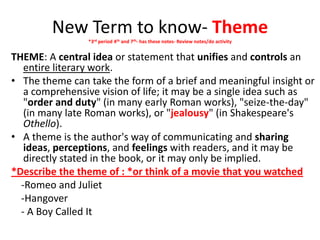
New Term to know- Theme
                *3rd period 4th and 7th- has these notes- Review notes/do activity


THEME: A central idea or statement that unifies and controls an
   entire literary work.
• The theme can take the form of a brief and meaningful insight or
   a comprehensive vision of life; it may be a single idea such as
   "order and duty" (in many early Roman works), "seize-the-day"
   (in many late Roman works), or "jealousy" (in Shakespeare's
   Othello).
• A theme is the author's way of communicating and sharing
   ideas, perceptions, and feelings with readers, and it may be
   directly stated in the book, or it may only be implied.
*Describe the theme of : *or think of a movie that you watched
  -Romeo and Juliet
  -Hangover
  - A Boy Called It
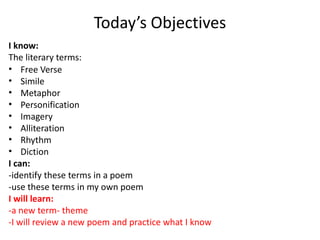
Today’s Objectives
I know:
The literary terms:
• Free Verse
• Simile
• Metaphor
• Personification
• Imagery
• Alliteration
• Rhythm
• Diction
I can:
-identify these terms in a poem
-use these terms in my own poem
I will learn:
-a new term- theme
-I will review a new poem and practice what I know
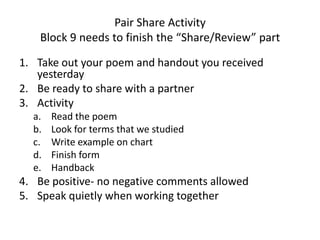
Pair Share Activity
    Block 9 needs to finish the “Share/Review” part

1. Take out your poem and handout you received
   yesterday
2. Be ready to share with a partner
3. Activity
  a.   Read the poem
  b.   Look for terms that we studied
  c.   Write example on chart
  d.   Finish form
  e.   Handback
4. Be positive- no negative comments allowed
5. Speak quietly when working together
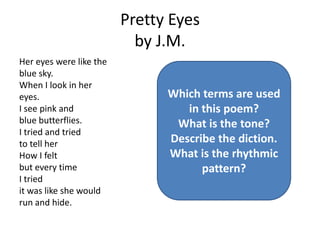
Pretty Eyes
                           by J.M.
Her eyes were like the
blue sky.
When I look in her
eyes.                          Which terms are used
I see pink and                    in this poem?
blue butterflies.               What is the tone?
I tried and tried
to tell her                    Describe the diction.
How I felt                     What is the rhythmic
but every time                       pattern?
I tried
it was like she would
run and hide.
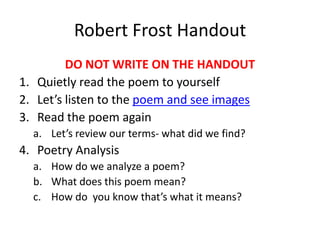
Robert Frost Handout
         DO NOT WRITE ON THE HANDOUT
1. Quietly read the poem to yourself
2. Let’s listen to the poem and see images
3. Read the poem again
  a. Let’s review our terms- what did we find?
4. Poetry Analysis
  a. How do we analyze a poem?
  b. What does this poem mean?
  c. How do you know that’s what it means?
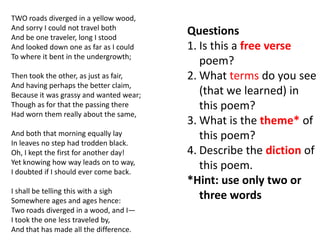
TWO roads diverged in a yellow wood,
And sorry I could not travel both
And be one traveler, long I stood
                                         Questions
And looked down one as far as I could    1. Is this a free verse
To where it bent in the undergrowth;
                                            poem?
Then took the other, as just as fair,    2. What terms do you see
And having perhaps the better claim,
Because it was grassy and wanted wear;      (that we learned) in
Though as for that the passing there        this poem?
Had worn them really about the same,
                                         3. What is the theme* of
And both that morning equally lay           this poem?
In leaves no step had trodden black.
Oh, I kept the first for another day!    4. Describe the diction of
Yet knowing how way leads on to way,
I doubted if I should ever come back.
                                            this poem.
                                         *Hint: use only two or
I shall be telling this with a sigh
Somewhere ages and ages hence:
                                            three words
Two roads diverged in a wood, and I—
I took the one less traveled by,
And that has made all the difference.
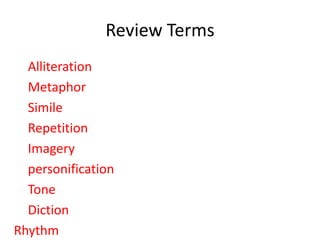
Review Terms
  Alliteration
  Metaphor
  Simile
  Repetition
  Imagery
  personification
  Tone
  Diction
Rhythm

Thursday, february 2nd

  • 1.
    Thursday, February 2 nd English 9-Second Semester Navejar, Dammanna, Huth
  • 2.
    New Term toknow- Theme *3rd period 4th and 7th- has these notes- Review notes/do activity THEME: A central idea or statement that unifies and controls an entire literary work. • The theme can take the form of a brief and meaningful insight or a comprehensive vision of life; it may be a single idea such as "order and duty" (in many early Roman works), "seize-the-day" (in many late Roman works), or "jealousy" (in Shakespeare's Othello). • A theme is the author's way of communicating and sharing ideas, perceptions, and feelings with readers, and it may be directly stated in the book, or it may only be implied. *Describe the theme of : *or think of a movie that you watched -Romeo and Juliet -Hangover - A Boy Called It
  • 3.
    Today’s Objectives I know: Theliterary terms: • Free Verse • Simile • Metaphor • Personification • Imagery • Alliteration • Rhythm • Diction I can: -identify these terms in a poem -use these terms in my own poem I will learn: -a new term- theme -I will review a new poem and practice what I know
  • 4.
    Pair Share Activity Block 9 needs to finish the “Share/Review” part 1. Take out your poem and handout you received yesterday 2. Be ready to share with a partner 3. Activity a. Read the poem b. Look for terms that we studied c. Write example on chart d. Finish form e. Handback 4. Be positive- no negative comments allowed 5. Speak quietly when working together
  • 5.
    Pretty Eyes by J.M. Her eyes were like the blue sky. When I look in her eyes. Which terms are used I see pink and in this poem? blue butterflies. What is the tone? I tried and tried to tell her Describe the diction. How I felt What is the rhythmic but every time pattern? I tried it was like she would run and hide.
  • 6.
    Robert Frost Handout DO NOT WRITE ON THE HANDOUT 1. Quietly read the poem to yourself 2. Let’s listen to the poem and see images 3. Read the poem again a. Let’s review our terms- what did we find? 4. Poetry Analysis a. How do we analyze a poem? b. What does this poem mean? c. How do you know that’s what it means?
  • 7.
    TWO roads divergedin a yellow wood, And sorry I could not travel both And be one traveler, long I stood Questions And looked down one as far as I could 1. Is this a free verse To where it bent in the undergrowth; poem? Then took the other, as just as fair, 2. What terms do you see And having perhaps the better claim, Because it was grassy and wanted wear; (that we learned) in Though as for that the passing there this poem? Had worn them really about the same, 3. What is the theme* of And both that morning equally lay this poem? In leaves no step had trodden black. Oh, I kept the first for another day! 4. Describe the diction of Yet knowing how way leads on to way, I doubted if I should ever come back. this poem. *Hint: use only two or I shall be telling this with a sigh Somewhere ages and ages hence: three words Two roads diverged in a wood, and I— I took the one less traveled by, And that has made all the difference.
  • 8.
    Review Terms Alliteration Metaphor Simile Repetition Imagery personification Tone Diction Rhythm