ELEMENTS OF VISUAL
EXPRESSION
Dot, Line, Plane and Texture
THE DOT
 It is the smallest element in visual language.
 We have the dot and the graphic dot. In digital
art we also have the Digital dot which
correspond to a pixel.
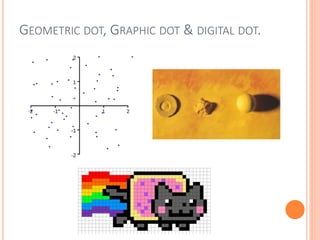
 Geometric dot: it describes a position in space
and it has no length, area or volume.
 Graphic dot: it’s a shape so it can have size,
texture and colour.
GEOMETRIC DOT, GRAPHIC DOT & DIGITAL DOT.
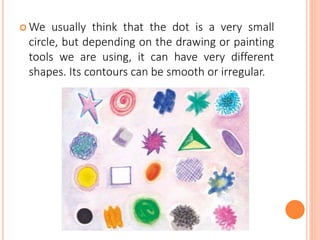
 We usually think that the dot is a very small
circle, but depending on the drawing or painting
tools we are using, it can have very different
shapes. Its contours can be smooth or irregular.
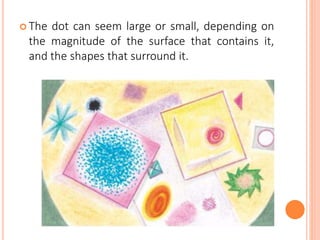
 The dot can seem large or small, depending on
the magnitude of the surface that contains it,
and the shapes that surround it.
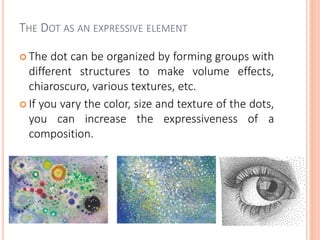
THE DOT AS AN EXPRESSIVE ELEMENT
 The dot can be organized by forming groups with
different structures to make volume effects,
chiaroscuro, various textures, etc.
 If you vary the color, size and texture of the dots,
you can increase the expressiveness of a
composition.
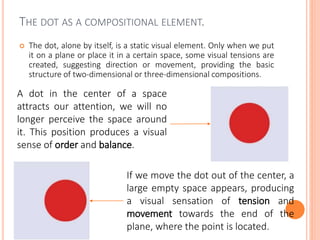
THE DOT AS A COMPOSITIONAL ELEMENT.
 The dot, alone by itself, is a static visual element. Only when we put
it on a plane or place it in a certain space, some visual tensions are
created, suggesting direction or movement, providing the basic
structure of two-dimensional or three-dimensional compositions.
A dot in the center of a space
attracts our attention, we will no
longer perceive the space around
it. This position produces a visual
sense of order and balance.
If we move the dot out of the center, a
large empty space appears, producing
a visual sensation of tension and
movement towards the end of the
plane, where the point is located.
Look how the moon attracts our
attention and its situation, centered on
the image, produces a certain sense of
order.
In this landscape, the sun attracts all the
attention, even over the other forms and colors,
which are dependent on this shape and the
space where it is located.
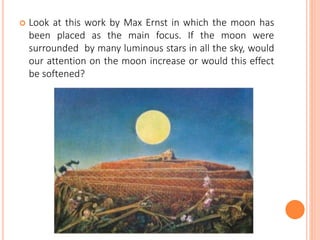
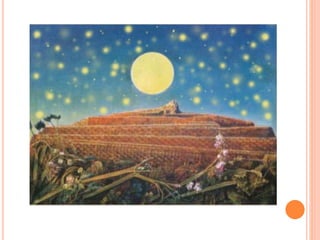
 Look at this work by Max Ernst in which the moon has
been placed as the main focus. If the moon were
surrounded by many luminous stars in all the sky, would
our attention on the moon increase or would this effect
be softened?
THE LINE
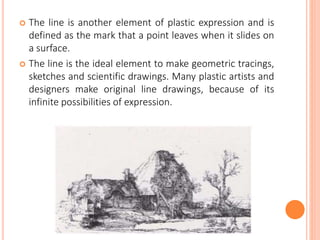
 The line is another element of plastic expression and is
defined as the mark that a point leaves when it slides on
a surface.
 The line is the ideal element to make geometric tracings,
sketches and scientific drawings. Many plastic artists and
designers make original line drawings, because of its
infinite possibilities of expression.
 Like the point, the line can be used in different
ways, always being adapted to the wanted
function.
THE LINE AS AN EXPRESSIVE ELEMENT
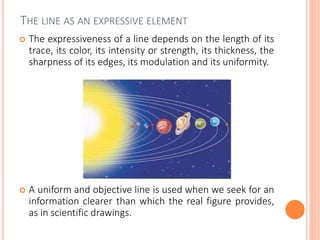
 The expressiveness of a line depends on the length of its
trace, its color, its intensity or strength, its thickness, the
sharpness of its edges, its modulation and its uniformity.
 A uniform and objective line is used when we seek for an
information clearer than which the real figure provides,
as in scientific drawings.
 A modulated and subjective line, combining tracings with
different characteristics like intensity, thickness, colour,
etc., can represent all kinds of abstract or figurative
forms, with infinite expressive possibilities.
THE LINE AS A COMPOSITIONAL ELEMENT
 When we draw a line on a surface there is a visual
movement with a direction and with a tension, capable
of attracting visual attention. The type of movement,
direction and disposition of the lines in the drawing plane
produce emotional feelings that have to be considered
when making a composition.
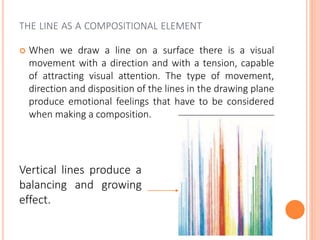
Vertical lines produce a
balancing and growing
effect.
Curved lines are graceful and they contrast with the
roughness of the broken lines and the precision and
rigidity of the straight lines.
Horizontal lines produce
a visual sensation of calm
and rest.
Jagged lines produce an
effect of dynamism,
instability, turmoil and
anxiety.
Ascending
Lines:
- Strength
- Vitality
Downlines:
- Depression
- Melancholy
Radiation
from a
point:
- Unity
- Expansion
Spiral
radiation:
- Wraparound
movement
THE PLANE
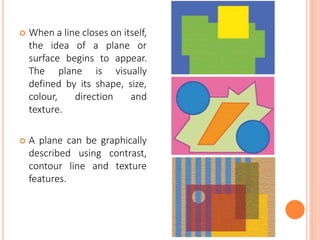
 When a line closes on itself,
the idea of ​​a plane or
surface begins to appear.
The plane is visually
defined by its shape, size,
colour, direction and
texture.
 A plane can be graphically
described using contrast,
contour line and texture
features.
THE PLANE AND THE SENSATION OF THREE-DIMENSIONAL SPACE
Although the plane is two-dimensional, it can create
the illusion of three-dimensional space and produce
visual sensations of approach, distance and volume.
To achieve that, we use these resources:
Difference in size: increasing or
decreasing the size between the
planes, give us the impression of
distance among them.
Color difference: warm colors tend
to seem closer and cold colors
seem to be further from the
viewer.
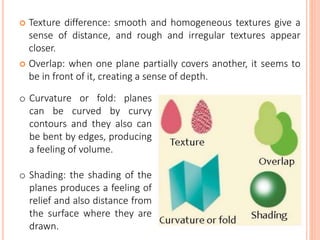
 Texture difference: smooth and homogeneous textures give a
sense of distance, and rough and irregular textures appear
closer.
 Overlap: when one plane partially covers another, it seems to
be in front of it, creating a sense of depth.
o Curvature or fold: planes
can be curved by curvy
contours and they also can
be bent by edges, producing
a feeling of volume.
o Shading: the shading of the
planes produces a feeling of
relief and also distance from
the surface where they are
drawn.
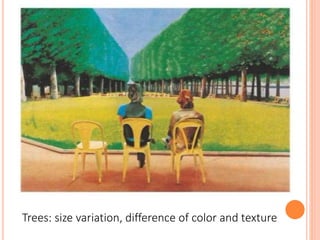
Trees: size variation, difference of color and texture
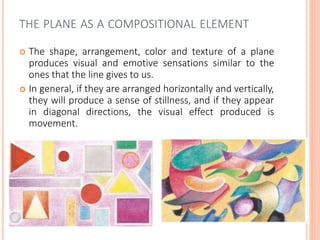
THE PLANE AS A COMPOSITIONAL ELEMENT
 The shape, arrangement, color and texture of a plane
produces visual and emotive sensations similar to the
ones that the line gives to us.
 In general, if they are arranged horizontally and vertically,
they will produce a sense of stillness, and if they appear
in diagonal directions, the visual effect produced is
movement.
THE PLANE IN SPACE
 being the plane the main configurator element of the
volume, one of its fundamental artistic applications is
related to the form and the space, as it happens with the
sculpture and with the architecture.
 in three-dimensional works, we must consider concepts
such as empty and full space, void and solid, concave and
convex, and opened and closed planes.
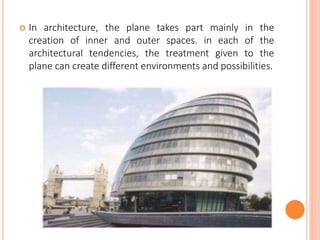
 In architecture, the plane takes part mainly in the
creation of inner and outer spaces. in each of the
architectural tendencies, the treatment given to the
plane can create different environments and possibilities.
THE TEXTURE
 The texture is the appearance of a surface. As a
visual language element, it can enrich the
expressiveness of an artwork or being the main
element to make a composition.
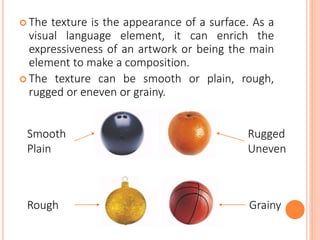
 The texture can be smooth or plain, rough,
rugged or eneven or grainy.
Smooth
Plain
Rough
Rugged
Uneven
Grainy
 Textures are also important for the artwork
expressiveness. For example, a plain texture
gives an static feeling while a rugged or uneven
textures seems more dinamic and emphasizes
the movement sensation.
TYPE OF TEXTURES
 Textures can be:
Tactile Graphic Natural Artificial
TACTILE TEXTURE
 The tactile texture is the one we can perceive
by the touch and the sight. When we touch
and observe the surface, we can perceive
wheter the texture has relief and if it is
smooth, rough, grainy… Each matter has a
different texture.
GRAPHIC TEXTURE
 The graphic texture is the representation of the
tactile textures trough graphic médiums like
painting, drawing, photography… We can only
perceive them by the sight.
 Graphic textures can imitate the tactile textures
of real objets or they can be artistically created,
enhacing the expressiveness of the composition.
 We can make graphic textures by scraping, using
transparencies, by stencil or stamping, with
graphic techniques…
NATURAL TEXTURE
 Natural textures can be found in
elements of nature: a tree bark, a
rhinoceros skin, the Surface of a
quartz glass or in a flower petal.
ARTIFICIAL TEXTURE
 The artificial texture is any natural
material which has been
manufactured. This kind of textures
structures the material surface
which objects are fabriqued with: a
sintetic handbag, the relief of the
paint for a wall, a gift paper…
LIGHT IN TEXTURE
 Light and color are very important aspects which we should consider
when planning an artistical composition, because they can really
change the perception and the expressive capacities of the textures.
 A lateral light will enhace the relief effect of a texture while a front
light can hide or flatten the textures.

UNIT 1 - Elements of visual language (Book unit 4)

  • 1.
    ELEMENTS OF VISUAL EXPRESSION Dot,Line, Plane and Texture
  • 2.
  • 3.
     It isthe smallest element in visual language.  We have the dot and the graphic dot. In digital art we also have the Digital dot which correspond to a pixel.  Geometric dot: it describes a position in space and it has no length, area or volume.  Graphic dot: it’s a shape so it can have size, texture and colour.
  • 4.
    GEOMETRIC DOT, GRAPHICDOT & DIGITAL DOT.
  • 5.
     We usuallythink that the dot is a very small circle, but depending on the drawing or painting tools we are using, it can have very different shapes. Its contours can be smooth or irregular.
  • 6.
     The dotcan seem large or small, depending on the magnitude of the surface that contains it, and the shapes that surround it.
  • 7.
    THE DOT ASAN EXPRESSIVE ELEMENT  The dot can be organized by forming groups with different structures to make volume effects, chiaroscuro, various textures, etc.  If you vary the color, size and texture of the dots, you can increase the expressiveness of a composition.
  • 8.
    THE DOT ASA COMPOSITIONAL ELEMENT.  The dot, alone by itself, is a static visual element. Only when we put it on a plane or place it in a certain space, some visual tensions are created, suggesting direction or movement, providing the basic structure of two-dimensional or three-dimensional compositions. A dot in the center of a space attracts our attention, we will no longer perceive the space around it. This position produces a visual sense of order and balance. If we move the dot out of the center, a large empty space appears, producing a visual sensation of tension and movement towards the end of the plane, where the point is located.
  • 9.
    Look how themoon attracts our attention and its situation, centered on the image, produces a certain sense of order. In this landscape, the sun attracts all the attention, even over the other forms and colors, which are dependent on this shape and the space where it is located.
  • 10.
     Look atthis work by Max Ernst in which the moon has been placed as the main focus. If the moon were surrounded by many luminous stars in all the sky, would our attention on the moon increase or would this effect be softened?
  • 12.
  • 13.
     The lineis another element of plastic expression and is defined as the mark that a point leaves when it slides on a surface.  The line is the ideal element to make geometric tracings, sketches and scientific drawings. Many plastic artists and designers make original line drawings, because of its infinite possibilities of expression.
  • 14.
     Like thepoint, the line can be used in different ways, always being adapted to the wanted function.
  • 15.
    THE LINE ASAN EXPRESSIVE ELEMENT  The expressiveness of a line depends on the length of its trace, its color, its intensity or strength, its thickness, the sharpness of its edges, its modulation and its uniformity.  A uniform and objective line is used when we seek for an information clearer than which the real figure provides, as in scientific drawings.
  • 16.
     A modulatedand subjective line, combining tracings with different characteristics like intensity, thickness, colour, etc., can represent all kinds of abstract or figurative forms, with infinite expressive possibilities.
  • 17.
    THE LINE ASA COMPOSITIONAL ELEMENT  When we draw a line on a surface there is a visual movement with a direction and with a tension, capable of attracting visual attention. The type of movement, direction and disposition of the lines in the drawing plane produce emotional feelings that have to be considered when making a composition. Vertical lines produce a balancing and growing effect.
  • 18.
    Curved lines aregraceful and they contrast with the roughness of the broken lines and the precision and rigidity of the straight lines. Horizontal lines produce a visual sensation of calm and rest. Jagged lines produce an effect of dynamism, instability, turmoil and anxiety.
  • 19.
    Ascending Lines: - Strength - Vitality Downlines: -Depression - Melancholy Radiation from a point: - Unity - Expansion Spiral radiation: - Wraparound movement
  • 20.
  • 21.
     When aline closes on itself, the idea of ​​a plane or surface begins to appear. The plane is visually defined by its shape, size, colour, direction and texture.  A plane can be graphically described using contrast, contour line and texture features.
  • 22.
    THE PLANE ANDTHE SENSATION OF THREE-DIMENSIONAL SPACE Although the plane is two-dimensional, it can create the illusion of three-dimensional space and produce visual sensations of approach, distance and volume. To achieve that, we use these resources: Difference in size: increasing or decreasing the size between the planes, give us the impression of distance among them. Color difference: warm colors tend to seem closer and cold colors seem to be further from the viewer.
  • 23.
     Texture difference:smooth and homogeneous textures give a sense of distance, and rough and irregular textures appear closer.  Overlap: when one plane partially covers another, it seems to be in front of it, creating a sense of depth. o Curvature or fold: planes can be curved by curvy contours and they also can be bent by edges, producing a feeling of volume. o Shading: the shading of the planes produces a feeling of relief and also distance from the surface where they are drawn.
  • 24.
    Trees: size variation,difference of color and texture
  • 25.
    THE PLANE ASA COMPOSITIONAL ELEMENT  The shape, arrangement, color and texture of a plane produces visual and emotive sensations similar to the ones that the line gives to us.  In general, if they are arranged horizontally and vertically, they will produce a sense of stillness, and if they appear in diagonal directions, the visual effect produced is movement.
  • 26.
    THE PLANE INSPACE  being the plane the main configurator element of the volume, one of its fundamental artistic applications is related to the form and the space, as it happens with the sculpture and with the architecture.  in three-dimensional works, we must consider concepts such as empty and full space, void and solid, concave and convex, and opened and closed planes.
  • 27.
     In architecture,the plane takes part mainly in the creation of inner and outer spaces. in each of the architectural tendencies, the treatment given to the plane can create different environments and possibilities.
  • 28.
  • 29.
     The textureis the appearance of a surface. As a visual language element, it can enrich the expressiveness of an artwork or being the main element to make a composition.  The texture can be smooth or plain, rough, rugged or eneven or grainy. Smooth Plain Rough Rugged Uneven Grainy
  • 30.
     Textures arealso important for the artwork expressiveness. For example, a plain texture gives an static feeling while a rugged or uneven textures seems more dinamic and emphasizes the movement sensation.
  • 31.
    TYPE OF TEXTURES Textures can be: Tactile Graphic Natural Artificial
  • 32.
    TACTILE TEXTURE  Thetactile texture is the one we can perceive by the touch and the sight. When we touch and observe the surface, we can perceive wheter the texture has relief and if it is smooth, rough, grainy… Each matter has a different texture. GRAPHIC TEXTURE  The graphic texture is the representation of the tactile textures trough graphic médiums like painting, drawing, photography… We can only perceive them by the sight.  Graphic textures can imitate the tactile textures of real objets or they can be artistically created, enhacing the expressiveness of the composition.  We can make graphic textures by scraping, using transparencies, by stencil or stamping, with graphic techniques…
  • 33.
    NATURAL TEXTURE  Naturaltextures can be found in elements of nature: a tree bark, a rhinoceros skin, the Surface of a quartz glass or in a flower petal. ARTIFICIAL TEXTURE  The artificial texture is any natural material which has been manufactured. This kind of textures structures the material surface which objects are fabriqued with: a sintetic handbag, the relief of the paint for a wall, a gift paper…
  • 34.
    LIGHT IN TEXTURE Light and color are very important aspects which we should consider when planning an artistical composition, because they can really change the perception and the expressive capacities of the textures.  A lateral light will enhace the relief effect of a texture while a front light can hide or flatten the textures.