Poetry
Textual Analysis
Textual Analysis
             UNIT CONTENTS
•   Introduction              Slides 4 - 18
•   Structure and Form        Slides 19 - 37
•   Storyline and Viewpoint   Slides 38 - 52
•   Theme and Message         Slides 53 - 57
•   Rhyme and Rhythm          Slides 58 - 72
•   Tone, Mood and Emotion    Slides 73 - 79
•   Using your Senses         Slides 80 - 83
Textual Analysis - Introduction
                CONTENTS

•   Unit Introduction           Slide 4
•   What is Poetry?             Slide 5
•   Important British Poets     Slides 6 - 15
•   Poetry and Society          Slide 16
•   An Ever Changing Language   Slides 17 - 18
Textual Analysis - Introduction


                Unit Introduction
 In this unit we will be learning how to analyse poetry. We
 will explore the different aspects of poetry, including
 structure, themes, rhyme and rhythm. We will also look at
 a series of different poems to show you how the skills you
 are learning can be put into practice. In the companion
 unit, ‘Analysing Imagery’, you can find lots of information
 about how to identify and comment on images, such as
 similes, metaphors and personification.
 Before we start looking at the examples, first we need to
 learn a little more about poetry itself: what it is, how it has
 changed over time, and how it relates to the society in
 which it is written.
Textual Analysis - Introduction


                What is Poetry?
  Poetry has certain characteristics that make it special. Here are
  a few ideas - you may be able to think of more.
  • Poetry uses vivid images and descriptive language to ‘paint’ a
  picture in the reader’s mind.
  • Poetry cuts out all the excess words that you might find in
  prose, creating its magic with a limited amount of text.
  • Poetry is normally designed to be read out loud - when you
  read it, do try to hear it as well.
  • Poetry often makes the reader emphasise certain important
  words, and it usually has a strong rhythm.
  • Poetry may rhyme, but it does not have to.
Textual Analysis - Introduction


         Important British Poets
  In the next series of slides you will find poems, and
  extracts from poems, written by some important British
  poets, from the fourteenth to the nineteenth century.
  These give just a brief sample of Britain’s long heritage of
  great poets. Why not try to decide which modern poets of
  the twentieth century also deserve a place on this list?
  The poets are organised in chronological order, and for
  each poet you are given the dates that they lived and an
  extract from their work.
  Later on in this unit we will be analysing some of these
  poems in greater detail.
Textual Analysis - Introduction


         Important British Poets
  As you read the poems, think about the following
  questions:
  • How does the language that the poets use change over
  time?
  • Are there any common themes between the poems, or
  do these change too?
  • Do these poets use imagery? If yes, what types of
  images do they use?
  • Which of these poems do you like most? Why?
  • Which of these poems do you like least? Why?
Textual Analysis - Introduction

                    Name: Geoffrey Chaucer
                       Dates: ?1343 - 1400

                      Madam Eglantine (extract)

                   There was also a nun, a Prioress,
              That of her smiling was full simple and coy;
                Her greatest oath was but by Saint Loy;
                And she was clepèd Madam Eglantine.
                 Full well she sang the service divine,
                   Entunèd in her nose full seemely,
               And French she spake full fair and fetisly,
                 After the school of Stratford-atte-Bow,
                For French of Paris was to her unknow.
Textual Analysis - Introduction

                    Name: Sir Walter Ralegh
                       Dates: ?1552 - 1618

                        All the World’s a Stage

                 What is our life? A play of passion,
                   Our mirth the music of division
             Our mothers’ wombs the tiring-houses be,
            Where we are dressed for this short comedy.
              Heaven the judicious sharp spectator is,
            That sits and marks still who doth act amiss.
           Our graves that hide us from the searching sun
           Are like drawn curtains when the play is done.
             Thus march we, playing, to our latest rest.
                Only we die in earnest, that’s no jest.
Textual Analysis - Introduction

                        Name: John Donne
                        Dates: 1572 - 1631

                       Holy Sonnets (extract)

          Thou hast made me, and shall thy work decay?
           Repair me now, for now mine end doth haste;
            I run to death, and death meets me as fast,
              And all my pleasures are like yesterday.
               I dare not move my dim eyes any way;
            Despair behind, and death before doth cast
           Such terror, and my feebled flesh doth waste
            By sin in it, which it towards hell doth weigh.
Textual Analysis - Introduction

                        Name: John Milton
                        Dates: 1608 - 1674


                       Paradise Lost (extract)

            Now came still evening on, and twilight grey
              Had in her sober livery all things clad;
             Silence accompanied, for beast and bird,
          They to their grassy couch, these to their nests
            Were slunk, all but the wakeful nightingale;
           She all night long her amorous descant sung;
                       Silence was pleased.
Textual Analysis - Introduction

                     Name: Alexander Pope
                        Dates: 1688 - 1744

                    A Little Learning (extract)

               A little learning is a dangerous thing;
           Drink deep, or taste not the Pierian spring:
           There shallow draughts intoxicate the brain,
               And drinking largely sobers us again.
         Fired at first sight with what the Muse imparts,
          In fearless youth we tempt the height of Arts;
            While from the bounded level of our mind
        Short views we take, nor see the lengths behind,
        But, more advanced, behold with strange surprise
           New distant scenes of endless science rise!
Textual Analysis - Introduction


                       Name: William Blake
                        Dates: 1757 - 1827

                         The Tiger (extract)

                   Tiger! Tiger! burning bright
                    In the forests of the night,
                   What immortal hand or eye
                Could frame thy fearful symmetry?

                 In what distant deeps or skies
                 Burned the fire of thine eyes?
                 On what wings dare he aspire?
                What the hand dare seize the fire?
Textual Analysis - Introduction


                      Name: Robert Burns
                       Dates: 1759 - 1796

                     Auld Lang Syne (extract)

               Should auld acquaintance be forgot,
                  And never brought to min’?
               Should auld acquaintance be forgot,
                      And auld lang syne?

                   For auld lang syne, my dear,
                         For auld lang syne,
                  We’ll tak a cup o’ kindness yet,
                         For auld lang syne.
Textual Analysis - Introduction


              Name: Christina Georgina Rossetti
                        Dates: 1830 - 1894

                           Song (extract)

                  When I am dead, my dearest,
                    Sing no sad songs for me;
                 Plant thou no roses at my head,
                     Nor shady cypress tree:
                  Be the green grass above me
                 With showers and dewdrops wet;
                    And if thou wilt, remember,
                      And if thou wilt, forget.
Textual Analysis - Introduction


             Poetry and Society
 Throughout history, poets have commented on the society
 in which they live. Just as novelists write in a particular
 social context, so too do poets. Poetry can be a very
 special form of commentary, because part of its magic is
 that it can be read aloud. Some poets in our modern
 society write ‘performance poetry’, specifically designed to
 be heard.
 One of the ways in which poets can comment on their
 society is by choosing particular themes, such as religion or
 politics. We will be looking at the themes that poets
 choose in greater detail later on in the unit.
 When you analyse any piece of poetry, you should take the
 social context into account.
Textual Analysis - Introduction


    An Ever Changing Language
  The English language, like any language, is subject to
  constant change. This change is, perhaps, particularly
  apparent in the poetry that we write, because poetry is
  such a condensed form of language.
  If we read a piece of poetry written a long time ago, it may
  be difficult for us to understand the language that is used.
  We might not understand some of the words, because
  they are no longer used, or we may see a word that we
  know, but spelt in a very different way.
  There are many different reasons that language changes,
  and you will find some examples on the next slide.
Textual Analysis - Introduction


    An Ever Changing Language
  Why, then, do languages change? Here are two reasons. See
  how many more ideas you can think of.

     Because we need to find
   new words to describe new
    ideas and inventions. For
    instance, the words email     Because our own language is
     and internet would have      influenced by other cultures,
     been unknown, even fifty          perhaps through the
            years ago.              integration of people from
                                     around the world into our
                                       country, or by seeing
                                  examples of other cultures in
                                            the media.
Textual Analysis - Structure and Form
                CONTENTS

•   Structure                  Slides 20 - 27
•   Form                       Slide 28
•   The Limerick               Slides 29 - 31
•   The Shakespearean Sonnet   Slides 32 - 37
Structure and Form


                      Structure
When you look at a poem, whether in class or for an
examination or coursework essay, the first thing to explore is
the way that it is structured.
Generally speaking, poems are structured in verses, and
within the verses you may also find a specific line structure.
An example of this is the Shakespearean Sonnet, which we
will be analysing further on in this section.
When commenting on the structure of a poem, you should
ensure that you discuss how the structure affects the impact
of the poem, and the way that it works. Let’s look briefly
now at a poetry extract to see how you might do this.
Structure and Form


                      Structure
When you are analysing a poem’s structure, ask yourself the
following questions:
• The Verses (or stanzas). How many are there and how
long is each one? Are the verses all the same length or are
they different?
• The Punctuation. Does each verse end with a full stop or
not? How does the punctuation affect the flow of the poem?
• The Rhyme Pattern. Is there a constant rhyme pattern?
Does this affect the structure and flow of the poem?
• The ‘Storyline’. Does each verse contain a particular part
of the story, or does it run throughout?
Structure and Form


                       Structure
 The poem below has been annotated to show how it is
 structured.
                                                    The verses each
               Crossing the Bar                        have 4 lines.

          Sunset and evening star,                 Lines 1 & 3 rhyme
          And one clear call for me!                  in every verse.
    And may there be no moaning of the bar,          Verse one ends
            When I put out to sea,                    with a comma.
                                                   Lines 2 & 4 rhyme
   But such a tide as moving seems asleep,
                                                      in every verse.
          Too full for sound and foam,
When that which drew from out the boundless deep    Verse two ends
               Turns again home.                    with a full stop.
Structure and Form


                       Structure
         Crossing the Bar (continued)

          Twilight and evening bell,               Exclamation marks
           And after that the dark!                    are used at the
    And may there by no sadness of farewell,        end of the second
               When I embark;                         and tenth lines.

                                                     Verse three ends
For though from out our bourne of Time and Place
                                                    with a semi-colon.
            The flood may bear me far,
        I hope to see my Pilot face to face
                                                    Verse four ends
            When I have crost the bar.
                                                     with a full stop.

      Alfred, Lord Tennyson (1809 - 1892)
Structure and Form


                      Structure
Once you have annotated the structure of the poem, you
need to think about the effects that this structure creates.
The verses each have 4 lines
This creates a set rhythmic pattern, particularly in conjunction
with the rhyme scheme. It also breaks the poem up into four
clear sections, or parts of the ‘story’. However, the impact of
this break is lessened somewhat by the use of a comma at the
end of verse one, and a semi-colon at the end of verse three.
Lines 1 & 3 rhyme in every verse
  The use of rhyme creates an ‘end stop’, whereby the reader
  pauses slightly, putting emphasis on the words that rhyme.
Structure and Form


                      Structure
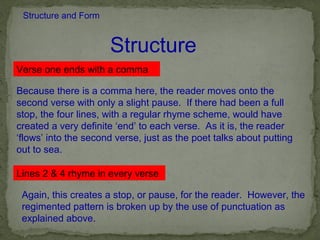
Verse one ends with a comma

Because there is a comma here, the reader moves onto the
second verse with only a slight pause. If there had been a full
stop, the four lines, with a regular rhyme scheme, would have
created a very definite ‘end’ to each verse. As it is, the reader
‘flows’ into the second verse, just as the poet talks about putting
out to sea.

Lines 2 & 4 rhyme in every verse

 Again, this creates a stop, or pause, for the reader. However, the
 regimented pattern is broken up by the use of punctuation as
 explained above.
Structure and Form


                      Structure
Verse two ends with a full stop

The full stop creates a break or divide right in the middle of the
poem. It is at this point that the poet uses the image “turns again
home”, and the full stop seems to echo this.

Exclamation marks are used at the end of the second
and tenth lines

 Exclamation marks can be used to express surprise, or shock, or,
 as seems to be the case here, a kind of unwillingness to go,
 combined with resignation. Because they are followed by the
 word “and”, the exclamation marks do not denote the end of a
 sentence, but rather an exclamation or expression of the poet’s
 feelings.
Structure and Form


                      Structure
Verse three ends with a semi-colon
Again, because there is no full stop here, the reader is pulled
into the fourth verse with only a slight pause. The thought that
the poet was expressing is continued in the last verse. Again,
the image of being pulled out to sea is echoed by the flow
between the verses.
Verse four ends with a full stop

 The poem ends with a full stop, bringing things to a close.
 Although most poems do end with a full stop, here the poet uses
 the punctuation to echo the ‘storyline’ or themes of the poem,
 which is about death or ‘crossing the bar’. The poet hopes to
 meet God, or his “Pilot” on the other side. See the section on
 ‘Storyline’ for more information about this extended metaphor.
Structure and Form

                        Form
Poems come in a variety of specific forms, although not all
poets will be working within these forms, or formats. Poems
that fall within a particular form could have a defined number
of lines, or a specific rhyme pattern. Examples of common
forms are:
• The Ballad.
• The Limerick.
• The Haiku.
• The Sonnet.
On the next slides we will look at two of these forms: the
limerick and the sonnet. We will be looking at a specific
form of sonnet, which is called the Shakespearean Sonnet.
Structure and Form


                The Limerick
A limerick is a comic poem with five lines and a specific
‘a / b’ rhyme scheme. Look at the example below to see
how the rhyme scheme works.

                                            The first, second and
                                            fifth lines rhyme - this
    There was an old lady from Wales            is called rhyme ‘a’.
    Who loved to eat her garden snails
         But she felt quite unwell
      When she crunched on a shell           The third and fourth
    And now she just sticks to the tails.    lines rhyme - this is
                                                 called rhyme ‘b’.
Structure and Form


                The Limerick
Limericks also use a specific ‘meter’, or internal rhythm.
The meter is created by the amount of syllables, and the
stress that is put on certain words. Look at the example
below to see how this works.

   There was an old lady from Wales       12345678

  Who loved to eat her garden snails      12345678

        But she felt quite unwell         123456

     When she crunched on a shell         123456

  And now she just sticks to the tails.   12345678
Structure and Form


                The Limerick
Limericks are a fun and easy form of poem to write. Have a
go at creating your own limerick, using the template below.

           There was a young man from Dundee

        Who ……………………………………………

               But his ………………………….

              And he ………………………….

         And now ……………………………………..
Structure and Form


 The Shakespearean Sonnet
On the next slide you will find a famous Shakespearean
Sonnet. This is a form of sonnet named (obviously!) after
Shakespeare, who wrote many sonnets in this particular
format. When you have seen the analysis of this sonnet,
you might like to have a go at writing your own
Shakespearean Sonnet.
The Shakespearean sonnet has the following form:
• 14 lines
• Rhyme scheme: a, b, a, b, c, d, c, d, e, f, e, f, g, g
• Written in iambic pentameter
• Ends with a rhyming couplet
Structure and Form


 The Shakespearean Sonnet
        Shall I compare thee to a summer’s day?
        Thou art more lovely and more temperate:
     Rough winds do shake the darling buds of May,
      And summer’s lease hath all too short a date:
      Sometime too hot the eye of heaven shines,
        And often is his gold complexion dimmed;
       And every fair from fair sometime declines,
   By chance, or nature’s changing course untrimmed;
          But thy eternal summer shall not fade,
       Nor lose possession of that fair thou owest,
    Nor shall Death brag thou wanderest in his shade,
       When in eternal lines to time thou growest;
     So long as men can breathe, or eyes can see,
       So long lives this, and this gives life to thee.
Structure and Form


  The Shakespearean Sonnet
Here is the Shakespearean Sonnet again, this time
annotated to show the rhyme scheme.


Shall I compare thee to a summer’s day?         a

Thou art more lovely and more temperate:        b   rhymes with
Rough winds do shake the darling buds of May,   a   rhymes with
And summer’s lease hath all too short a date:   b
Structure and Form


    The Shakespearean Sonnet


Sometime too hot the eye of heaven shines,       c

And often is his gold complexion dimmed;         d rhymes with
And every fair from fair sometime declines,      c    rhymes with
By chance, or nature’s changing course untrimmed; d
Structure and Form


    The Shakespearean Sonnet


But thy eternal summer shall not fade,              e

Nor lose possession of that fair thou owest,        f   rhymes with
Nor shall Death brag thou wanderest in his shade,   e rhymes with
When in eternal lines to time thou growest;         f
Structure and Form


    The Shakespearean Sonnet


So long as men can breathe, or eyes can see,       g
                                                       rhymes with
So long lives this, and this gives life to thee.   g


      This is called a ‘rhyming couplet’.
Textual Analysis - Storyline and Viewpoint
              CONTENTS

•   Storyline                Slides 39 - 46
•   Viewpoint                Slides 47 - 49
•   First Person Viewpoint   Slide 50
•   Third Person Viewpoint   Slide 51
•   Omniscient Viewpoint     Slide 52
Storyline and Viewpoint

                          Storyline
It seems strange to use the word ‘storyline’ in connection
with poetry, but just as a novel or short story will have a plot,
so too will the majority of poems.
When you first read a poem, whether in class or in an
examination, you are looking for meaning. What is this
poem about, you ask yourself? Some poems are not ‘about’
anything - they simply evoke a mood, or an emotion, or a
vivid atmosphere. But even these poems can be said to
have a ‘story’, because the poet is saying something to the
reader.
When you are analysing a poem, you should avoid saying it
is definitely about ‘X’ or ‘Y’. Try instead to interpret its
possible meaning or meanings in your analysis.
Storyline and Viewpoint

                          Storyline
  Often, the ‘story’ in a poem will work on more than one level.
   There could be the literal level, at which the plot or action of
  the poem is apparent, but there could also be one or more
  deeper levels of meaning. When you see a poem for the
  first time, take the following steps:
  • On your first reading, simply gain a feeling for atmosphere
  or emotion. Do not try to ‘make sense’ of it.
  • On your second reading, look to see if there is something
  happening in the poem. What is the poet or character
  doing?
  • On your third reading, start to look deeper. Does the poet
  create a metaphor? Is the poem really about something
  else?
Storyline and Viewpoint

                          Storyline
On the next slides you will find the poem “Crossing the Bar”.
We have already looked closely at this poem’s structure.
Now we are going to explore what it is about. Consider the
questions below as you read the poem.
  Questions
  • What sort of atmosphere does the poet create in his
  ‘story’? How does he seem to be feeling?
   • What is the poem literally about? What is the ‘surface
   story’?
   • What deeper meanings might there be? Could the whole
   poem be an extended metaphor? If so, what does the
   metaphor mean? What is the poet trying to say?
Storyline and Viewpoint

                          Storyline
                          Crossing the Bar

                 Sunset and evening star,
                 And one clear call for me!
           And may there be no moaning of the bar,
                   When I put out to sea,

        But such a tide as moving seems asleep,
               Too full for sound and foam,
     When that which drew from out the boundless deep
                    Turns again home.
Storyline and Viewpoint

                          Storyline
                 Crossing the Bar (continued)

                 Twilight and evening bell,
                  And after that the dark!
           And may there by no sadness of farewell,
                      When I embark;

     For though from out our bourne of Time and Place
                 The flood may bear me far,
             I hope to see my Pilot face to face
                 When I have crost the bar.

             Alfred, Lord Tennyson (1809 - 1892)
Storyline and Viewpoint

                          Storyline
   Question
 • What sort of atmosphere does the poet create in his
 ‘story’? How does he seem to be feeling?

    Answer
 The atmosphere in this poem seems to be one of
 peacefulness and calm acceptance. The poet asks that
 there is “no moaning of the bar” and “no sadness of
 farewell”. The words that are used in the poem are soft, with
 much repetition of the letters ‘s’ and ‘f’, which creates a
 gentle feeling. The poet seems to be feeling positive, almost
 hopeful about the journey that he will be making.
Storyline and Viewpoint

                          Storyline
   Question
 • What is the poem literally about? What is the ‘surface
 story’?

    Answer
 On the surface, the poem seems to be about a journey by
 boat. Someone, probably the poet, is preparing to set off on
 a journey of some sort.
 It is evening, as the poet talks of the “sunset and evening
 star”, and the “twilight and evening bell”.
 At the end of the poem he talks of meeting “my Pilot”. On
 the surface, he is making a journey to meet someone.
Storyline and Viewpoint

                          Storyline
   Question
 • What deeper meanings might there be? Could the whole
 poem be an extended metaphor? If so, what does the
 metaphor mean? What is the poet trying to say?

    Answer
 The poem would indeed seem to be an extended metaphor.
 The poet seems to be talking about his journey towards
 death. He is going to “put out to sea” on his final voyage.
 The use of images of evening and coming darkness form a
 part of this metaphor, as they suggest the end of the day,
 and the end of a life. The “Pilot” that the poet talks of could
 be his God, whom he hopes to see “face to face”.
Storyline and Viewpoint

                      Viewpoint
The word ‘viewpoint’ describes the point of view from which a
poem is written. Just as in a novel, a writer might use a first
or third person narrative, so with poetry it is important to
identify what viewpoint the poet is using.
Sometimes, poets will use a real or invented character, to tell
their story, while other poems might be written from the poet’s
own perspective. Some poems use a mixture of viewpoints,
shifting between them in a way not possible in a novel.
Poems that simply describe a place or an emotion might not
use either the first or third person narrator. When the poet
writes as though he or she is a ‘godlike’ voice, looking at the
world from ‘on high’, rather than through a person, this is
known as the omniscient viewpoint.
Storyline and Viewpoint

                      Viewpoint
Here is a brief description of the three main types of
viewpoint:
• First Person Viewpoint. This viewpoint is easily
identifiable, because the writer talks directly to the reader.
Look out for the words “I”, “my”, “me”, and so on.
• Third Person Viewpoint. In the third person viewpoint, the
poet is slightly more distant, talking through a character.
Look for the words “he”, “she”, “him”, “her”, and so on.
• Omniscient Viewpoint. With this viewpoint, the poet is
even further away from the reader, and from his or her
subject. The poem written using this viewpoint might
provide a description, without any sense of character.
Storyline and Viewpoint

                      Viewpoint
 Let’s look now at examples of each of the three types of
 viewpoint to help you understand the different effects that
 they create. Remember, when you are discussing any part
 of a poem, it is important to say why the poet uses this
 technique, and the impact it has on the reader.
 As we have already seen, the three different viewpoints
 identified offer varying degrees of distance from the subject
 and from the reader.
 With the first person viewpoint, the reader tends to associate
 strongly with the writer, feeling what he or she is feeling and
 thinking what he or she is thinking. The third person and
 omniscient viewpoints allow us to ‘remove’ ourselves more.
Storyline and Viewpoint


       First Person Viewpoint
                     The Old Stoic (extract)

                 Riches I hold in light esteem,
                  And Love I laugh to scorn;
               And lust of Fame was but a dream
                 That vanished with the morn -

                   And if I pray, the only prayer
                    That moves my lips for me
              Is - ‘Leave the heart that now I bear,
                       And give me liberty.’

                   Emily Brontë (1818 - 1848)
Storyline and Viewpoint


      Third Person Viewpoint
                The Blessed Damozel (extract)

               The blessed damozel leaned out
                 From the gold bar of Heaven;
             Her eyes were deeper than the depth
                   Of waters stilled at even;
               She had three lilies in her hand,
             And the stars in her hair were seven.

             Dante Gabriel Rossetti (1828 - 1882)
Storyline and Viewpoint


        Omniscient Viewpoint
                   God’s Grandeur (extract)

      The world is charged with the grandeur of God.
       It will flame out, like shining from shook foil;
       It gathers to a greatness, like the ooze of oil
    Crushed. Why do men then now not reck his rod?
       Generations have trod, have trod, have trod;
  And all is seared with trade; bleared, smeared with toil;
 And wears man’s smudge and shares man’s smell: the soil
        Is bare now, nor can foot feel, being shod.

             Gerard Manley Hopkins (1884 - 1889)
Textual Analysis - Theme and Message
             CONTENTS

 • Theme            Slides 54 - 56
 • Message          Slide 57
Theme and Message

                    Theme
 Poets use a huge range of themes or subjects in their
 work. When you are studying a piece of poetry, you
 may find that the theme is immediately apparent, or that
 you need to look deeply into the poem to decide exactly
 what its theme is.
 Often, poets will deal with more than one theme in a
 piece of work. For instance, a poet might deal with the
 themes of childhood, memories and the natural world, all
 within one piece of poetry.
 Remember, when you are analysing poetry, you must
 comment on the effects or images that are created, as
 well as simply identifying the themes.
Theme and Message

                     Theme
The images below symbolise three of the most common
themes. Identify the themes that they represent.


    Love            God / Religion       Nature
Theme and Message

                      Theme
Now look at the poetry extract below and identify which
theme or themes the poet is dealing with.
         The Prince of Love (extract)          The themes
                                               used are ...
     How sweet I roamed from field to field,
      And tasted all the summer’s pride,          Love
        ‘Till I the prince of love beheld,
      Who in the sunny beams did glide!

       He showed me lilies for my hair,           and ...
       And blushing roses for my brow;
      He led me through his gardens fair,        Nature
      Where all his golden pleasures grow.

          William Blake (1757 - 1827)
Theme and Message
                    Message
In addition to using a particular theme or themes, poets will
often give the reader a message through their work. They
could comment on something specific, such as a particular
brand of politics or a war that is taking place. They might
give a more general message, for instance about their
religious beliefs or their feelings about love and beauty.
One example of poetry with a strong message is that written
during the First World War. Well known poets, such as
Wilfred Owen and Siegfried Sassoon used their poetry to
comment on the futility of the war, and to tell the people at
home exactly what was going on.
Again, when looking for a message in a poem, ensure that
you comment on its effectiveness and impact.
Textual Analysis - Rhyme and Rhythm
             CONTENTS

 •   Rhyme            Slides 59 - 60
 •   End Rhyme        Slide 61
 •   Internal Rhyme   Slide 62
 •   Half Rhyme       Slide 63
 •   Rhythm           Slides 64 - 72
Rhyme and Rhythm

                     Rhyme
As we have already noted, poetry does not have to rhyme.
However, when you are analysing a poem, you should
always comment on the effects that rhyme (or the lack of it)
creates.
The use of rhyme within a poem will affect its rhythm.
Rhymes change the way we read poetry, because when we
come to a word that rhymes, we tend to pause slightly,
putting an extra emphasis on that word.
As we have already seen, poets may use a particular rhyme
scheme, such as that in the Shakespearean Sonnet. When
you are identifying and analysing a rhyme scheme, you
must comment on how its use affects you as a reader.
Rhyme and Rhythm
                     Rhyme
The English language has many words that rhyme,
including homonyms, which are words that sound the same
but have a different spelling and meaning, e.g. son and sun.
There are various different types of rhyme that you should
learn to identify:
• End Rhyme: words that rhyme at the end of a line.
• Internal Rhyme: words that rhyme within a line.
• Half Rhyme: words that ‘almost’ rhyme, either within or at
the end of a line.
On the following slide you will find examples of each of
these types of rhymes, to show you how they work, and the
effects that they can create.
Rhyme and Rhythm


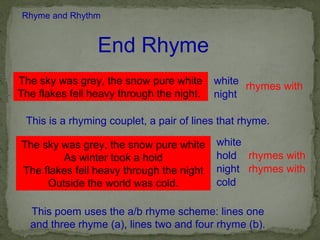
                 End Rhyme
The sky was grey, the snow pure white      white rhymes with
The flakes fell heavy through the night.   night

 This is a rhyming couplet, a pair of lines that rhyme.

The sky was grey, the snow pure white      white
        As winter took a hold              hold rhymes with
The flakes fell heavy through the night    night rhymes with
     Outside the world was cold.           cold

  This poem uses the a/b rhyme scheme: lines one
  and three rhyme (a), lines two and four rhyme (b).
Rhyme and Rhythm


             Internal Rhyme
                    grey today
                    rhymes with
     The sky was grey today, the snow pure white
     As the night fell and light bled from the world.

             night       light
                 rhymes with

Notice the effect of internal rhyme. It alters the rhythm of
the line, making you pause and place emphasis on the
rhyme. This in turn slows the reader down slightly.
Rhyme and Rhythm


               Half Rhyme
                  now      snow     flew
              ‘almost’ rhymes with and with

     The sky was grey, now snow flew pure white


 Notice the effect of half rhyme here. Again, it changes
 the rhythm of the line. Each of the half rhymes is a
 monosyllable, and this adds even further to slowing down
 the reader as he or she says these words.
Rhyme and Rhythm


                     Rhythm
Poetry is about sound as well as about creating images.
Even if you are not reading a poem out loud, you should still
be able to ‘hear it’ in your head, and this will help you
understand its rhythm.
Rhythm is a very important aspect of poetry. As well as
changing the way that you say a poem, it can also link to
the images that the poet describes. For instance, if a poet
were describing a clock ticking, he or she might use short,
alliterative words to help echo the sound of the clock.
As we have seen, rhyme and rhythm are inextricably linked,
and the use of rhyme will create a certain rhythm naturally
within a poem.
Rhyme and Rhythm

                    Rhythm
As well as the poet’s use of rhyme, there are various other
aspects of a poem that will help to create rhythm:
• The length of the words used. A series of monosyllables
will create a very different effect from longer words.
• The length of the lines. When we are reading a poem, we
tend to stop or pause at the end of a line.
• The use of punctuation. Full stops, commas, semi colons
and other forms of punctuation will all have an impact on a
poem’s rhythm.
• The use of techniques such as alliteration and imagery.
These affect the way we say the words and consequently
the rhythm of a poem.
Rhyme and Rhythm


                     Rhythm
Now we are going to look at an example, to see exactly how
rhythm is created. The poem that we are going to look at is
called “No Worst, there is None”. You can see the poem in
full on the next slide.
The writer of this poem, Gerard Manley Hopkins (1844 -
1889) wrote with a style that was ahead of his time. As you
will see from studying this example of his work, he makes
particular use of the rhythm inherent in the English
language. He was very much concerned with the sound of
words and, although he does use rhyme, there are many
other aspects of the work that help to create its rhythm.
Look too at the way this poet ‘plays’ with language, creating
‘new’ words or using old words in unfamiliar ways.
Rhyme and Rhythm

              ‘No Worst, there is None’

  No worst, there is none. Pitched past pitch of grief,
 More pangs will, schooled at forepangs, wilder wring.
     Comforter, where, where is your comforting?
        Mary, mother of us, where is your relief?
 My cries heave, herds-long; huddle in a main, a chief-
woe, world-sorrow; on an age-old anvil wince and sing -
 Then lull, then leave off. Fury had shrieked ‘No ling-
      ering! Let me be fell : force I must be brief’.
     Of the mind, mind has mountains; cliffs of fall
 Frightful, sheer, no-man-fathomed. Hold them cheap
 May who ne’er hung there. Nor does long our small
  Durance deal with that steep or deep. Here! creep,
  Wretch, under a comfort serves in a whirlwind : all
  Life death does end and each day dies with sleep.
Rhyme and Rhythm


                     Rhythm
First, let’s think about how the length of the words affects
the rhythm. Here are the first four lines of the poem again.
Find all the words that have more than one syllable.
                ‘No Worst, there is None’

   No worst, there is none. Pitched past pitch of grief,
   More pangs will, schooled at forepangs, wilder wring.
      Comforter, where, where is your comforting?
        Mary, mother of us, where is your relief?
    Questions
  • What effect is created by the use of monosyllables in the
  first line?
  • How does the rhythm change in lines 3 and 4?
Rhyme and Rhythm


                      Rhythm
  Question
• What effect is created by the use of monosyllables in the
first line?
   Answer
The monosyllables make the tone sound almost angry, as
though the words are being spat out by the speaker.
Alternatively, it might be that the speaker is worn out, with all
the emotion and normal rhythm of speech lost from his
voice. The reader is forced to read the line with an even
emphasis on each word, and this effect is enhanced by the
alliteration of the letter ‘p’ in the words “pitched past pitch”.
Rhyme and Rhythm


                     Rhythm
  Question
• How does the rhythm change in lines 3 and 4?
  Answer
The rhythm changes abruptly in the third and fourth lines.
The word “comforter”, with its three syllables, slows the
reader right down. It is a much softer word that those used
previously, and it is mirrored at the end of the line by the
word “comforting”.
In the fourth line, the rhythm changes again. This time, the
word “Mary” with two syllables, gives a swing to the line,
repeated in the words “mother” and “relief”.
Rhyme and Rhythm


                       Rhythm
Next, let’s look at some of the punctuation in these first four
lines, and the ways that it affects the rhythm of the piece.

                  ‘No Worst, there is None’

   No worst, there is none. Pitched past pitch of grief,
   More pangs will, schooled at forepangs, wilder wring.
      Comforter, where, where is your comforting?
        Mary, mother of us, where is your relief?
The full stop in the middle of the first line creates a break and
causes the reader to stop abruptly on a ‘down’ beat.
The commas in the second line break the line into three.
 The question marks in the third and fourth lines create a pause
 as the question is asked, and add to the poem’s tone.
Rhyme and Rhythm


                       Rhythm
Finally, let’s consider how the use of alliteration and
assonance adds to the rhythm. Here are lines five to eight
from the poem. Find some examples of these techniques.
    Assonance of the letter‘w’
    Alliteration of the letter ‘h’
                               ‘l’
                                ‘o’
                                ‘e’

  My cries heave, herds-long; huddle in a main, a chief-
 woe, world-sorrow; on an age-old anvil wince and sing -
  Then lull, then leave off. Fury had shrieked ‘No ling-
       ering! Let me be fell : force I must be brief’.
    Activity
  • Choose one of these examples of alliteration or
  assonance, and discuss or write about the effects it creates.
Textual Analysis - Tone, Mood and Emotion
                CONTENTS

  • Tone             Slides 74 - 77
  • Mood and Emotion Slides 78 - 79
Tone, Mood and Emotion

                         Tone
The tone of a poem is one of the first things that you will
notice it about it as you read. The word ‘tone’ describes the
overall sort of atmosphere and feeling that the poem seems
to have.
A good way to understand exactly what tone means, is to
think of a poem like a song. Ask yourself: if this poem was
set to music, what sort of music would it have? For instance,
a poem about losing a lover would probably have a sad,
emotional music, because this would fit its tone. On the other
hand, a poem about a beautiful spring day might have a more
energetic, positive tone.
Look at the short extracts on the following slides and choose
the tone or tones that you think best describes them.
Tone, Mood and Emotion

                           Tone
Is the tone of the poem ...

                    Holy Sonnets (extract)

          Despair behind, and death before doth cast
          Such terror, and my feebled flesh doth waste
          By sin in it, which it towards hell doth weigh.

       Happy?                 Sad?             Fearful?

                Excited?             Resigned?

                            Calm?
Tone, Mood and Emotion

                           Tone
Is the tone of the poem ...
                     The Tiger (extract)

                 Tiger! Tiger! burning bright
                  In the forests of the night,
                 What immortal hand or eye
              Could frame thy fearful symmetry?

       Happy?                 Sad?          Fearful?

                Excited?             Resigned?

                           Calm?
Tone, Mood and Emotion

                           Tone
Is the tone of the poem ...
                         Song (extract)

                 When I am dead, my dearest,
                   Sing no sad songs for me;
                Plant thou no roses at my head,
                    Nor shady cypress tree:


       Happy?                 Sad?           Fearful?

                Excited?             Resigned?

                           Calm?
Tone, Mood and Emotion

           Mood and Emotion
When you analyse the mood and emotion of a poem, you
should think both about the feelings of the poet, and the
mood or emotions that the poem creates in you.
There are various ways that a poet can create a strong sense
of mood or emotion. They could use:
• Vivid imagery, for instance metaphor, personification or
alliteration.
• Adverbs and adjectives that give the reader a sense of how
they are feeling.
• A subject or theme that automatically evokes strong feeling,
e.g. war or love.
Tone, Mood and Emotion

               Mood and Emotion
Look at the extracts below, and decide what mood or emotion
the poet is creating.
           Daffodils (extract)

      I wandered lonely as a cloud
 That floats on high o’er vales and hills,
    When all at once I saw a crowd,
        A host, of golden daffodils;
   Beside the lake, beneath the trees,
  Fluttering and dancing in the breeze.
                                             A Red, Red Rose (extract)
   William Wordsworth (1770 - 1850)
                                             My love is like a red, red rose
                                             That’s newly sprung in June:
                                              My love is like the melody
                                             That’s sweetly played in tune.

                                              Robert Burns (1759 - 1796)
Textual Analysis - Using your Senses
            CONTENTS

• Using your Senses Slides 81 - 83
Using your Sense

           Using your Senses
As we have seen throughout this unit, poetry can make vivid
pictures for us to see in our imaginations. Poets also use
sound to great effect, giving added impact to the images that
they create.
However, when we are reading poetry we can also use our
other senses. As we as seeing and hearing a poem, the poet
might also give us a strong sense of smell, or of taste, or of
touch.
The group of poets known as the ‘Romantics’, made
particularly strong use of all the senses in their work.
Famous poets such as Wordsworth, Samuel Taylor Coleridge
and Lord Byron, wrote about the natural world in a highly vivid
way.
Using your Sense

             Using your Senses
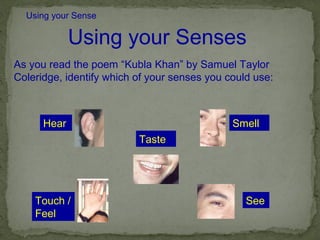
As you read the poem “Kubla Khan” by Samuel Taylor
Coleridge, identify which of your senses you could use:


      Hear                                    Smell
                          Taste


    Touch /                                      See
    Feel
Using your Sense

         Using your Senses
                    Kubla Khan (extract)

                 In Xanadu did Kubla Khan
              A stately pleasure-dome decree:
              Where Alph, the sacred river, ran
           Through caverns measureless to man
                   Down to a sunless sea.
             So twice five miles of fertile ground
         With walls and towers were girdled round:
       And there were gardens bright with sinuous rills
       Where blossomed many an incense-bearing tree;
         And here were forests ancient as the hills,
             Enfolding sunny spots of greenery.

            Samuel Taylor Coleridge (1772 - 1834)
Analysing a Poem

                Detailed Analysis
On the next slides you will find a detailed analysis of the
poem “Wind” by Ted Hughes. The analysis is structured
under the following headings, discussed in detail in this unit:

•   Structure and Form
•   Storyline and Viewpoint
•   Theme and Message
•   Rhyme and Rhythm
•   Tone, Mood and Emotion
•   Using your Senses
In addition, we will consider Ted Hughes’ use of imagery, as
explored in the unit “Analysing Imagery”. First, read the
whole poem through several times, to get a ‘feel’ for it.
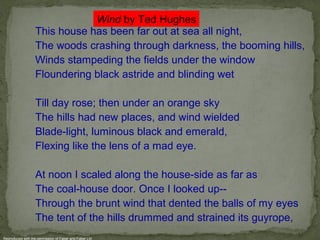
Wind by Ted Hughes
                   This house has been far out at sea all night,
                   The woods crashing through darkness, the booming hills,
                   Winds stampeding the fields under the window
                   Floundering black astride and blinding wet

                   Till day rose; then under an orange sky
                   The hills had new places, and wind wielded
                   Blade-light, luminous black and emerald,
                   Flexing like the lens of a mad eye.

                   At noon I scaled along the house-side as far as
                   The coal-house door. Once I looked up--
                   Through the brunt wind that dented the balls of my eyes
                   The tent of the hills drummed and strained its guyrope,
Reproduced with the permission of Faber and Faber Ltd
The fields quivering, the skyline a grimace,
                      At any second to bang and vanish with a flap:
                      The wind flung a magpie away and a black-
                      Back gull bent like an iron bar slowly. The house

                      Rang like some fine green goblet in the note
                      That any second would shatter it. Now deep
                      In chairs, in front of the great fire, we grip
                      Our hearts and cannot entertain book, thought

                      Or each other. We watch the fire blazing,
                      And feel the roots of the house move, but sit on,
                      Seeing the windows tremble to come in,
                      Hearing the stones cry out under the horizons.
Reproduced with the permission of Faber and Faber Ltd
Analysing a Poem

            Structure and Form
At first glance, the structure of the poem seems quite simple:
it has six verses, each with four lines. However, on closer
inspection you will notice how the punctuation often ‘runs
over’, connecting some of the verses with the ones that
follow them.
Using punctuation in this way can have a variety of different
effects, and these effects will become more apparent the
more times you read the poem. When considering the
impact of punctuation on structure, think carefully about any
possible links to the poem’s meaning. Look too at where
and why the poet does not ‘run over’ with the punctuation.
Let’s look now at one example from “The Wind” to see what
the effects might be.
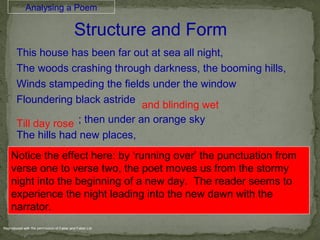
Analysing a Poem

                                          Structure and Form
       This house has been far out at sea all night,
       The woods crashing through darkness, the booming hills,
       Winds stampeding the fields under the window
       Floundering black astride
                                   and blinding wet
       Till day rose ; then under an orange sky
       The hills had new places,
    Notice the effect here: by ‘running over’ the punctuation from
    verse one to verse two, the poet moves us from the stormy
    night into the beginning of a new day. The reader seems to
    experience the night leading into the new dawn with the
    narrator.
Reproduced with the permission of Faber and Faber Ltd
Analysing a Poem

         Storyline and Viewpoint
Clearly, the overall ‘story’ of the poem is about a storm, and
about the narrator’s responses to it. However, notice too how
the storyline and viewpoint change from verse to verse.
One of the ways in which Ted Hughes emphasises the
unfolding story is by using indicators of time. Each of the first
three verses pinpoints the time exactly in the very first line:
“all night”; “Till day rose”; “At noon”. Time is clearly an
important theme here, and this is emphasised by the
repetition of “any second” in the fourth and fifth verses.
Using the charts on the next two slides, summarise what
happens in each verse (the storyline), and what the viewpoint
seems to be. The first verse has been done for you.
Analysing a Poem

        Storyline and Viewpoint
                     Storyline         Viewpoint

Verse One           A storm rages     Omniscient
                    all night long.   (‘god-like’ narrator)

Verse Two


Verse Three
Analysing a Poem

        Storyline and Viewpoint
                    Storyline   Viewpoint

Verse Four


Verse Five


Verse Six
Analysing a Poem

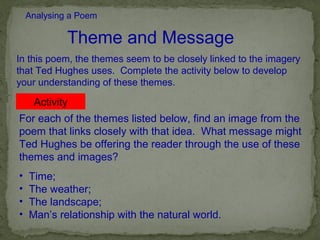
             Theme and Message
In this poem, the themes seem to be closely linked to the imagery
that Ted Hughes uses. Complete the activity below to develop
your understanding of these themes.

     Activity
For each of the themes listed below, find an image from the
poem that links closely with that idea. What message might
Ted Hughes be offering the reader through the use of these
themes and images?
•   Time;
•   The weather;
•   The landscape;
•   Man’s relationship with the natural world.
Analysing a Poem

             Rhyme and Rhythm
Although there is no obvious use of rhyme in this poem,
Hughes does make great use of the sound and rhythmic
possibilities of the English language. As with the structure, the
rhythm within the poem seems closely linked to its meanings.
For instance, in the following line, the monosyllabic nature of
the words makes the reader slow right down as he or she reads
it. This links closely to the image that is being described: the
slow bending of the strong gull is emphasised by the slow,
strong language used:
“a black-/Back gull bent like an iron bar slowly.”
Can you find other examples of this link between rhythm and
meaning in the poem?
Analysing a Poem

       Tone, Mood and Emotion
Answer the questions below to develop your understanding of
Hughes’ use of tone, mood and emotion.
 Questions
• How does the narrator feel about the storm? Look closely at
each verse to find your answer, analysing the range of
emotions that he experiences.
• There is a sense of fear at certain points in the poem.
Where would you say that the fear is at its strongest? What
does the narrator do that emphasises this feeling?
• What is the overall tone and mood of the poem? Does the
tone change as the poem progresses?
• How does the imagery used contribute to the poem’s mood?
Analysing a Poem

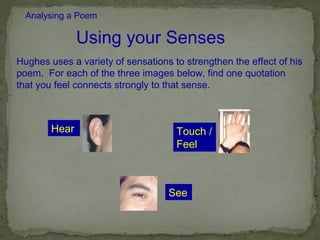
               Using your Senses
Hughes uses a variety of sensations to strengthen the effect of his
poem. For each of the three images below, find one quotation
that you feel connects strongly to that sense.


        Hear                         Touch /
                                     Feel


                                   See
Analysing a Poem

                Use of Imagery
On the next slides, we are going to analyse the imagery that
Ted Hughes uses in detail, looking at each verse in turn. As
you look at the analysis, think about the effects that each
type of imagery creates, and the meanings it implies.
As we have already noted, the imagery in the poem links
closely to its themes and structure. Through the strength of
the ‘word pictures’ that Hughes creates, he gives a sense
that the weather is alive, that the storm has a personality of
its own.
The contrast between the weather and the people sheltering
indoors makes a clear point about the relationship between
humans and nature: these people seem minute in
comparison to the huge force of the natural world.
Analysing a Poem

                                                    Use of Imagery
            Metaphor: the house is
            described as though it is
            a boat


         This house has been far out at sea all night,
         The woods crashing through darkness, the booming hills,
         Winds stampeding the fields under the window
         Floundering black astride and blinding wet

                                                           Personification: the woods
                                                          and winds are described as
                                                                though they are alive


Reproduced with the permission of Faber and Faber Ltd
Analysing a Poem

                                                    Use of Imagery
            Personification: the day
            ‘rose’, as though it were                                Alliteration: this echoes
            getting up out of bed                                    the sound of the wind


                      Till day rose; then under an orange sky
                      The hills had new places, and wind wielded
                      Blade-light, luminous black and emerald,
                      Flexing like the lens of a mad eye.


                                                            Simile: this image continues
                                                               the personification of the
                                                             wind, as though it is a wild,
                                                                             mad person
Reproduced with the permission of Faber and Faber Ltd
Analysing a Poem

                                                    Use of Imagery
            Metaphor: the house is
            ‘scaled’, as though it were
            a dangerous mountain


       At noon I scaled along the house-side as far as
       The coal-house door. Once I looked up--
       Through the brunt wind that dented the balls of my eyes
       The tent of the hills drummed and strained its guyrope,

              Personification: this image                           Metaphor: the hills are
              again continues the                            described using the image of
              personification of the wind,                    a tent, as though they might
              as though it has the strength                                     blow away
              to hurt the narrator
Reproduced with the permission of Faber and Faber Ltd
Analysing a Poem

                                                    Use of Imagery
         Personification: the fields
         ‘quiver’, the skyline is a ‘grimace’
         - notice the sense of fear here

                   The fields quivering, the skyline a grimace,
                   At any second to bang and vanish with a flap:
                   The wind flung a magpie away and a black-
                   Back gull bent like an iron bar slowly. The house


                                    Personification: the image of
                                    the wind as a person is
                                    extended even further - as
                                    though it intends to throw the
                                    bird away
Reproduced with the permission of Faber and Faber Ltd
Analysing a Poem

                                                    Use of Imagery
         Simile: the human made goblet
         can hardly withstand the force of
         nature

                   Rang like some fine green goblet in the note
                   That any second would shatter it. Now deep
                   In chairs, in front of the great fire, we grip
                   Our hearts and cannot entertain book, thought


                                                              Metaphor: the fear of nature
                                                             makes them ‘grip’ their hearts,
                                                              trying to gain courage in the
                                                                       face of the elements
Reproduced with the permission of Faber and Faber Ltd
Analysing a Poem

                                                    Use of Imagery
         Metaphor: these people cling to natural
         things - the fire, the ‘roots’ of the house
         in an attempt to face nature

               Or each other. We watch the fire blazing,
               And feel the roots of the house move, but sit on,
               Seeing the windows tremble to come in,
               Hearing the stones cry out under the horizons.


                                                             Personification: the poem ends
                                                              with the ‘cry’ of the stones, as
                                                               though they too are fearful of
                                                                                     the storm
Reproduced with the permission of Faber and Faber Ltd

Poetry textual-analysis

  • 1.
  • 2.
    Textual Analysis UNIT CONTENTS • Introduction Slides 4 - 18 • Structure and Form Slides 19 - 37 • Storyline and Viewpoint Slides 38 - 52 • Theme and Message Slides 53 - 57 • Rhyme and Rhythm Slides 58 - 72 • Tone, Mood and Emotion Slides 73 - 79 • Using your Senses Slides 80 - 83
  • 3.
    Textual Analysis -Introduction CONTENTS • Unit Introduction Slide 4 • What is Poetry? Slide 5 • Important British Poets Slides 6 - 15 • Poetry and Society Slide 16 • An Ever Changing Language Slides 17 - 18
  • 4.
    Textual Analysis -Introduction Unit Introduction In this unit we will be learning how to analyse poetry. We will explore the different aspects of poetry, including structure, themes, rhyme and rhythm. We will also look at a series of different poems to show you how the skills you are learning can be put into practice. In the companion unit, ‘Analysing Imagery’, you can find lots of information about how to identify and comment on images, such as similes, metaphors and personification. Before we start looking at the examples, first we need to learn a little more about poetry itself: what it is, how it has changed over time, and how it relates to the society in which it is written.
  • 5.
    Textual Analysis -Introduction What is Poetry? Poetry has certain characteristics that make it special. Here are a few ideas - you may be able to think of more. • Poetry uses vivid images and descriptive language to ‘paint’ a picture in the reader’s mind. • Poetry cuts out all the excess words that you might find in prose, creating its magic with a limited amount of text. • Poetry is normally designed to be read out loud - when you read it, do try to hear it as well. • Poetry often makes the reader emphasise certain important words, and it usually has a strong rhythm. • Poetry may rhyme, but it does not have to.
  • 6.
    Textual Analysis -Introduction Important British Poets In the next series of slides you will find poems, and extracts from poems, written by some important British poets, from the fourteenth to the nineteenth century. These give just a brief sample of Britain’s long heritage of great poets. Why not try to decide which modern poets of the twentieth century also deserve a place on this list? The poets are organised in chronological order, and for each poet you are given the dates that they lived and an extract from their work. Later on in this unit we will be analysing some of these poems in greater detail.
  • 7.
    Textual Analysis -Introduction Important British Poets As you read the poems, think about the following questions: • How does the language that the poets use change over time? • Are there any common themes between the poems, or do these change too? • Do these poets use imagery? If yes, what types of images do they use? • Which of these poems do you like most? Why? • Which of these poems do you like least? Why?
  • 8.
    Textual Analysis -Introduction Name: Geoffrey Chaucer Dates: ?1343 - 1400 Madam Eglantine (extract) There was also a nun, a Prioress, That of her smiling was full simple and coy; Her greatest oath was but by Saint Loy; And she was clepèd Madam Eglantine. Full well she sang the service divine, Entunèd in her nose full seemely, And French she spake full fair and fetisly, After the school of Stratford-atte-Bow, For French of Paris was to her unknow.
  • 9.
    Textual Analysis -Introduction Name: Sir Walter Ralegh Dates: ?1552 - 1618 All the World’s a Stage What is our life? A play of passion, Our mirth the music of division Our mothers’ wombs the tiring-houses be, Where we are dressed for this short comedy. Heaven the judicious sharp spectator is, That sits and marks still who doth act amiss. Our graves that hide us from the searching sun Are like drawn curtains when the play is done. Thus march we, playing, to our latest rest. Only we die in earnest, that’s no jest.
  • 10.
    Textual Analysis -Introduction Name: John Donne Dates: 1572 - 1631 Holy Sonnets (extract) Thou hast made me, and shall thy work decay? Repair me now, for now mine end doth haste; I run to death, and death meets me as fast, And all my pleasures are like yesterday. I dare not move my dim eyes any way; Despair behind, and death before doth cast Such terror, and my feebled flesh doth waste By sin in it, which it towards hell doth weigh.
  • 11.
    Textual Analysis -Introduction Name: John Milton Dates: 1608 - 1674 Paradise Lost (extract) Now came still evening on, and twilight grey Had in her sober livery all things clad; Silence accompanied, for beast and bird, They to their grassy couch, these to their nests Were slunk, all but the wakeful nightingale; She all night long her amorous descant sung; Silence was pleased.
  • 12.
    Textual Analysis -Introduction Name: Alexander Pope Dates: 1688 - 1744 A Little Learning (extract) A little learning is a dangerous thing; Drink deep, or taste not the Pierian spring: There shallow draughts intoxicate the brain, And drinking largely sobers us again. Fired at first sight with what the Muse imparts, In fearless youth we tempt the height of Arts; While from the bounded level of our mind Short views we take, nor see the lengths behind, But, more advanced, behold with strange surprise New distant scenes of endless science rise!
  • 13.
    Textual Analysis -Introduction Name: William Blake Dates: 1757 - 1827 The Tiger (extract) Tiger! Tiger! burning bright In the forests of the night, What immortal hand or eye Could frame thy fearful symmetry? In what distant deeps or skies Burned the fire of thine eyes? On what wings dare he aspire? What the hand dare seize the fire?
  • 14.
    Textual Analysis -Introduction Name: Robert Burns Dates: 1759 - 1796 Auld Lang Syne (extract) Should auld acquaintance be forgot, And never brought to min’? Should auld acquaintance be forgot, And auld lang syne? For auld lang syne, my dear, For auld lang syne, We’ll tak a cup o’ kindness yet, For auld lang syne.
  • 15.
    Textual Analysis -Introduction Name: Christina Georgina Rossetti Dates: 1830 - 1894 Song (extract) When I am dead, my dearest, Sing no sad songs for me; Plant thou no roses at my head, Nor shady cypress tree: Be the green grass above me With showers and dewdrops wet; And if thou wilt, remember, And if thou wilt, forget.
  • 16.
    Textual Analysis -Introduction Poetry and Society Throughout history, poets have commented on the society in which they live. Just as novelists write in a particular social context, so too do poets. Poetry can be a very special form of commentary, because part of its magic is that it can be read aloud. Some poets in our modern society write ‘performance poetry’, specifically designed to be heard. One of the ways in which poets can comment on their society is by choosing particular themes, such as religion or politics. We will be looking at the themes that poets choose in greater detail later on in the unit. When you analyse any piece of poetry, you should take the social context into account.
  • 17.
    Textual Analysis -Introduction An Ever Changing Language The English language, like any language, is subject to constant change. This change is, perhaps, particularly apparent in the poetry that we write, because poetry is such a condensed form of language. If we read a piece of poetry written a long time ago, it may be difficult for us to understand the language that is used. We might not understand some of the words, because they are no longer used, or we may see a word that we know, but spelt in a very different way. There are many different reasons that language changes, and you will find some examples on the next slide.
  • 18.
    Textual Analysis -Introduction An Ever Changing Language Why, then, do languages change? Here are two reasons. See how many more ideas you can think of. Because we need to find new words to describe new ideas and inventions. For instance, the words email Because our own language is and internet would have influenced by other cultures, been unknown, even fifty perhaps through the years ago. integration of people from around the world into our country, or by seeing examples of other cultures in the media.
  • 19.
    Textual Analysis -Structure and Form CONTENTS • Structure Slides 20 - 27 • Form Slide 28 • The Limerick Slides 29 - 31 • The Shakespearean Sonnet Slides 32 - 37
  • 20.
    Structure and Form Structure When you look at a poem, whether in class or for an examination or coursework essay, the first thing to explore is the way that it is structured. Generally speaking, poems are structured in verses, and within the verses you may also find a specific line structure. An example of this is the Shakespearean Sonnet, which we will be analysing further on in this section. When commenting on the structure of a poem, you should ensure that you discuss how the structure affects the impact of the poem, and the way that it works. Let’s look briefly now at a poetry extract to see how you might do this.
  • 21.
    Structure and Form Structure When you are analysing a poem’s structure, ask yourself the following questions: • The Verses (or stanzas). How many are there and how long is each one? Are the verses all the same length or are they different? • The Punctuation. Does each verse end with a full stop or not? How does the punctuation affect the flow of the poem? • The Rhyme Pattern. Is there a constant rhyme pattern? Does this affect the structure and flow of the poem? • The ‘Storyline’. Does each verse contain a particular part of the story, or does it run throughout?
  • 22.
    Structure and Form Structure The poem below has been annotated to show how it is structured. The verses each Crossing the Bar have 4 lines. Sunset and evening star, Lines 1 & 3 rhyme And one clear call for me! in every verse. And may there be no moaning of the bar, Verse one ends When I put out to sea, with a comma. Lines 2 & 4 rhyme But such a tide as moving seems asleep, in every verse. Too full for sound and foam, When that which drew from out the boundless deep Verse two ends Turns again home. with a full stop.
  • 23.
    Structure and Form Structure Crossing the Bar (continued) Twilight and evening bell, Exclamation marks And after that the dark! are used at the And may there by no sadness of farewell, end of the second When I embark; and tenth lines. Verse three ends For though from out our bourne of Time and Place with a semi-colon. The flood may bear me far, I hope to see my Pilot face to face Verse four ends When I have crost the bar. with a full stop. Alfred, Lord Tennyson (1809 - 1892)
  • 24.
    Structure and Form Structure Once you have annotated the structure of the poem, you need to think about the effects that this structure creates. The verses each have 4 lines This creates a set rhythmic pattern, particularly in conjunction with the rhyme scheme. It also breaks the poem up into four clear sections, or parts of the ‘story’. However, the impact of this break is lessened somewhat by the use of a comma at the end of verse one, and a semi-colon at the end of verse three. Lines 1 & 3 rhyme in every verse The use of rhyme creates an ‘end stop’, whereby the reader pauses slightly, putting emphasis on the words that rhyme.
  • 25.
    Structure and Form Structure Verse one ends with a comma Because there is a comma here, the reader moves onto the second verse with only a slight pause. If there had been a full stop, the four lines, with a regular rhyme scheme, would have created a very definite ‘end’ to each verse. As it is, the reader ‘flows’ into the second verse, just as the poet talks about putting out to sea. Lines 2 & 4 rhyme in every verse Again, this creates a stop, or pause, for the reader. However, the regimented pattern is broken up by the use of punctuation as explained above.
  • 26.
    Structure and Form Structure Verse two ends with a full stop The full stop creates a break or divide right in the middle of the poem. It is at this point that the poet uses the image “turns again home”, and the full stop seems to echo this. Exclamation marks are used at the end of the second and tenth lines Exclamation marks can be used to express surprise, or shock, or, as seems to be the case here, a kind of unwillingness to go, combined with resignation. Because they are followed by the word “and”, the exclamation marks do not denote the end of a sentence, but rather an exclamation or expression of the poet’s feelings.
  • 27.
    Structure and Form Structure Verse three ends with a semi-colon Again, because there is no full stop here, the reader is pulled into the fourth verse with only a slight pause. The thought that the poet was expressing is continued in the last verse. Again, the image of being pulled out to sea is echoed by the flow between the verses. Verse four ends with a full stop The poem ends with a full stop, bringing things to a close. Although most poems do end with a full stop, here the poet uses the punctuation to echo the ‘storyline’ or themes of the poem, which is about death or ‘crossing the bar’. The poet hopes to meet God, or his “Pilot” on the other side. See the section on ‘Storyline’ for more information about this extended metaphor.
  • 28.
    Structure and Form Form Poems come in a variety of specific forms, although not all poets will be working within these forms, or formats. Poems that fall within a particular form could have a defined number of lines, or a specific rhyme pattern. Examples of common forms are: • The Ballad. • The Limerick. • The Haiku. • The Sonnet. On the next slides we will look at two of these forms: the limerick and the sonnet. We will be looking at a specific form of sonnet, which is called the Shakespearean Sonnet.
  • 29.
    Structure and Form The Limerick A limerick is a comic poem with five lines and a specific ‘a / b’ rhyme scheme. Look at the example below to see how the rhyme scheme works. The first, second and fifth lines rhyme - this There was an old lady from Wales is called rhyme ‘a’. Who loved to eat her garden snails But she felt quite unwell When she crunched on a shell The third and fourth And now she just sticks to the tails. lines rhyme - this is called rhyme ‘b’.
  • 30.
    Structure and Form The Limerick Limericks also use a specific ‘meter’, or internal rhythm. The meter is created by the amount of syllables, and the stress that is put on certain words. Look at the example below to see how this works. There was an old lady from Wales 12345678 Who loved to eat her garden snails 12345678 But she felt quite unwell 123456 When she crunched on a shell 123456 And now she just sticks to the tails. 12345678
  • 31.
    Structure and Form The Limerick Limericks are a fun and easy form of poem to write. Have a go at creating your own limerick, using the template below. There was a young man from Dundee Who …………………………………………… But his …………………………. And he …………………………. And now ……………………………………..
  • 32.
    Structure and Form The Shakespearean Sonnet On the next slide you will find a famous Shakespearean Sonnet. This is a form of sonnet named (obviously!) after Shakespeare, who wrote many sonnets in this particular format. When you have seen the analysis of this sonnet, you might like to have a go at writing your own Shakespearean Sonnet. The Shakespearean sonnet has the following form: • 14 lines • Rhyme scheme: a, b, a, b, c, d, c, d, e, f, e, f, g, g • Written in iambic pentameter • Ends with a rhyming couplet
  • 33.
    Structure and Form The Shakespearean Sonnet Shall I compare thee to a summer’s day? Thou art more lovely and more temperate: Rough winds do shake the darling buds of May, And summer’s lease hath all too short a date: Sometime too hot the eye of heaven shines, And often is his gold complexion dimmed; And every fair from fair sometime declines, By chance, or nature’s changing course untrimmed; But thy eternal summer shall not fade, Nor lose possession of that fair thou owest, Nor shall Death brag thou wanderest in his shade, When in eternal lines to time thou growest; So long as men can breathe, or eyes can see, So long lives this, and this gives life to thee.
  • 34.
    Structure and Form The Shakespearean Sonnet Here is the Shakespearean Sonnet again, this time annotated to show the rhyme scheme. Shall I compare thee to a summer’s day? a Thou art more lovely and more temperate: b rhymes with Rough winds do shake the darling buds of May, a rhymes with And summer’s lease hath all too short a date: b
  • 35.
    Structure and Form The Shakespearean Sonnet Sometime too hot the eye of heaven shines, c And often is his gold complexion dimmed; d rhymes with And every fair from fair sometime declines, c rhymes with By chance, or nature’s changing course untrimmed; d
  • 36.
    Structure and Form The Shakespearean Sonnet But thy eternal summer shall not fade, e Nor lose possession of that fair thou owest, f rhymes with Nor shall Death brag thou wanderest in his shade, e rhymes with When in eternal lines to time thou growest; f
  • 37.
    Structure and Form The Shakespearean Sonnet So long as men can breathe, or eyes can see, g rhymes with So long lives this, and this gives life to thee. g This is called a ‘rhyming couplet’.
  • 38.
    Textual Analysis -Storyline and Viewpoint CONTENTS • Storyline Slides 39 - 46 • Viewpoint Slides 47 - 49 • First Person Viewpoint Slide 50 • Third Person Viewpoint Slide 51 • Omniscient Viewpoint Slide 52
  • 39.
    Storyline and Viewpoint Storyline It seems strange to use the word ‘storyline’ in connection with poetry, but just as a novel or short story will have a plot, so too will the majority of poems. When you first read a poem, whether in class or in an examination, you are looking for meaning. What is this poem about, you ask yourself? Some poems are not ‘about’ anything - they simply evoke a mood, or an emotion, or a vivid atmosphere. But even these poems can be said to have a ‘story’, because the poet is saying something to the reader. When you are analysing a poem, you should avoid saying it is definitely about ‘X’ or ‘Y’. Try instead to interpret its possible meaning or meanings in your analysis.
  • 40.
    Storyline and Viewpoint Storyline Often, the ‘story’ in a poem will work on more than one level. There could be the literal level, at which the plot or action of the poem is apparent, but there could also be one or more deeper levels of meaning. When you see a poem for the first time, take the following steps: • On your first reading, simply gain a feeling for atmosphere or emotion. Do not try to ‘make sense’ of it. • On your second reading, look to see if there is something happening in the poem. What is the poet or character doing? • On your third reading, start to look deeper. Does the poet create a metaphor? Is the poem really about something else?
  • 41.
    Storyline and Viewpoint Storyline On the next slides you will find the poem “Crossing the Bar”. We have already looked closely at this poem’s structure. Now we are going to explore what it is about. Consider the questions below as you read the poem. Questions • What sort of atmosphere does the poet create in his ‘story’? How does he seem to be feeling? • What is the poem literally about? What is the ‘surface story’? • What deeper meanings might there be? Could the whole poem be an extended metaphor? If so, what does the metaphor mean? What is the poet trying to say?
  • 42.
    Storyline and Viewpoint Storyline Crossing the Bar Sunset and evening star, And one clear call for me! And may there be no moaning of the bar, When I put out to sea, But such a tide as moving seems asleep, Too full for sound and foam, When that which drew from out the boundless deep Turns again home.
  • 43.
    Storyline and Viewpoint Storyline Crossing the Bar (continued) Twilight and evening bell, And after that the dark! And may there by no sadness of farewell, When I embark; For though from out our bourne of Time and Place The flood may bear me far, I hope to see my Pilot face to face When I have crost the bar. Alfred, Lord Tennyson (1809 - 1892)
  • 44.
    Storyline and Viewpoint Storyline Question • What sort of atmosphere does the poet create in his ‘story’? How does he seem to be feeling? Answer The atmosphere in this poem seems to be one of peacefulness and calm acceptance. The poet asks that there is “no moaning of the bar” and “no sadness of farewell”. The words that are used in the poem are soft, with much repetition of the letters ‘s’ and ‘f’, which creates a gentle feeling. The poet seems to be feeling positive, almost hopeful about the journey that he will be making.
  • 45.
    Storyline and Viewpoint Storyline Question • What is the poem literally about? What is the ‘surface story’? Answer On the surface, the poem seems to be about a journey by boat. Someone, probably the poet, is preparing to set off on a journey of some sort. It is evening, as the poet talks of the “sunset and evening star”, and the “twilight and evening bell”. At the end of the poem he talks of meeting “my Pilot”. On the surface, he is making a journey to meet someone.
  • 46.
    Storyline and Viewpoint Storyline Question • What deeper meanings might there be? Could the whole poem be an extended metaphor? If so, what does the metaphor mean? What is the poet trying to say? Answer The poem would indeed seem to be an extended metaphor. The poet seems to be talking about his journey towards death. He is going to “put out to sea” on his final voyage. The use of images of evening and coming darkness form a part of this metaphor, as they suggest the end of the day, and the end of a life. The “Pilot” that the poet talks of could be his God, whom he hopes to see “face to face”.
  • 47.
    Storyline and Viewpoint Viewpoint The word ‘viewpoint’ describes the point of view from which a poem is written. Just as in a novel, a writer might use a first or third person narrative, so with poetry it is important to identify what viewpoint the poet is using. Sometimes, poets will use a real or invented character, to tell their story, while other poems might be written from the poet’s own perspective. Some poems use a mixture of viewpoints, shifting between them in a way not possible in a novel. Poems that simply describe a place or an emotion might not use either the first or third person narrator. When the poet writes as though he or she is a ‘godlike’ voice, looking at the world from ‘on high’, rather than through a person, this is known as the omniscient viewpoint.
  • 48.
    Storyline and Viewpoint Viewpoint Here is a brief description of the three main types of viewpoint: • First Person Viewpoint. This viewpoint is easily identifiable, because the writer talks directly to the reader. Look out for the words “I”, “my”, “me”, and so on. • Third Person Viewpoint. In the third person viewpoint, the poet is slightly more distant, talking through a character. Look for the words “he”, “she”, “him”, “her”, and so on. • Omniscient Viewpoint. With this viewpoint, the poet is even further away from the reader, and from his or her subject. The poem written using this viewpoint might provide a description, without any sense of character.
  • 49.
    Storyline and Viewpoint Viewpoint Let’s look now at examples of each of the three types of viewpoint to help you understand the different effects that they create. Remember, when you are discussing any part of a poem, it is important to say why the poet uses this technique, and the impact it has on the reader. As we have already seen, the three different viewpoints identified offer varying degrees of distance from the subject and from the reader. With the first person viewpoint, the reader tends to associate strongly with the writer, feeling what he or she is feeling and thinking what he or she is thinking. The third person and omniscient viewpoints allow us to ‘remove’ ourselves more.
  • 50.
    Storyline and Viewpoint First Person Viewpoint The Old Stoic (extract) Riches I hold in light esteem, And Love I laugh to scorn; And lust of Fame was but a dream That vanished with the morn - And if I pray, the only prayer That moves my lips for me Is - ‘Leave the heart that now I bear, And give me liberty.’ Emily Brontë (1818 - 1848)
  • 51.
    Storyline and Viewpoint Third Person Viewpoint The Blessed Damozel (extract) The blessed damozel leaned out From the gold bar of Heaven; Her eyes were deeper than the depth Of waters stilled at even; She had three lilies in her hand, And the stars in her hair were seven. Dante Gabriel Rossetti (1828 - 1882)
  • 52.
    Storyline and Viewpoint Omniscient Viewpoint God’s Grandeur (extract) The world is charged with the grandeur of God. It will flame out, like shining from shook foil; It gathers to a greatness, like the ooze of oil Crushed. Why do men then now not reck his rod? Generations have trod, have trod, have trod; And all is seared with trade; bleared, smeared with toil; And wears man’s smudge and shares man’s smell: the soil Is bare now, nor can foot feel, being shod. Gerard Manley Hopkins (1884 - 1889)
  • 53.
    Textual Analysis -Theme and Message CONTENTS • Theme Slides 54 - 56 • Message Slide 57
  • 54.
    Theme and Message Theme Poets use a huge range of themes or subjects in their work. When you are studying a piece of poetry, you may find that the theme is immediately apparent, or that you need to look deeply into the poem to decide exactly what its theme is. Often, poets will deal with more than one theme in a piece of work. For instance, a poet might deal with the themes of childhood, memories and the natural world, all within one piece of poetry. Remember, when you are analysing poetry, you must comment on the effects or images that are created, as well as simply identifying the themes.
  • 55.
    Theme and Message Theme The images below symbolise three of the most common themes. Identify the themes that they represent. Love God / Religion Nature
  • 56.
    Theme and Message Theme Now look at the poetry extract below and identify which theme or themes the poet is dealing with. The Prince of Love (extract) The themes used are ... How sweet I roamed from field to field, And tasted all the summer’s pride, Love ‘Till I the prince of love beheld, Who in the sunny beams did glide! He showed me lilies for my hair, and ... And blushing roses for my brow; He led me through his gardens fair, Nature Where all his golden pleasures grow. William Blake (1757 - 1827)
  • 57.
    Theme and Message Message In addition to using a particular theme or themes, poets will often give the reader a message through their work. They could comment on something specific, such as a particular brand of politics or a war that is taking place. They might give a more general message, for instance about their religious beliefs or their feelings about love and beauty. One example of poetry with a strong message is that written during the First World War. Well known poets, such as Wilfred Owen and Siegfried Sassoon used their poetry to comment on the futility of the war, and to tell the people at home exactly what was going on. Again, when looking for a message in a poem, ensure that you comment on its effectiveness and impact.
  • 58.
    Textual Analysis -Rhyme and Rhythm CONTENTS • Rhyme Slides 59 - 60 • End Rhyme Slide 61 • Internal Rhyme Slide 62 • Half Rhyme Slide 63 • Rhythm Slides 64 - 72
  • 59.
    Rhyme and Rhythm Rhyme As we have already noted, poetry does not have to rhyme. However, when you are analysing a poem, you should always comment on the effects that rhyme (or the lack of it) creates. The use of rhyme within a poem will affect its rhythm. Rhymes change the way we read poetry, because when we come to a word that rhymes, we tend to pause slightly, putting an extra emphasis on that word. As we have already seen, poets may use a particular rhyme scheme, such as that in the Shakespearean Sonnet. When you are identifying and analysing a rhyme scheme, you must comment on how its use affects you as a reader.
  • 60.
    Rhyme and Rhythm Rhyme The English language has many words that rhyme, including homonyms, which are words that sound the same but have a different spelling and meaning, e.g. son and sun. There are various different types of rhyme that you should learn to identify: • End Rhyme: words that rhyme at the end of a line. • Internal Rhyme: words that rhyme within a line. • Half Rhyme: words that ‘almost’ rhyme, either within or at the end of a line. On the following slide you will find examples of each of these types of rhymes, to show you how they work, and the effects that they can create.
  • 61.
    Rhyme and Rhythm End Rhyme The sky was grey, the snow pure white white rhymes with The flakes fell heavy through the night. night This is a rhyming couplet, a pair of lines that rhyme. The sky was grey, the snow pure white white As winter took a hold hold rhymes with The flakes fell heavy through the night night rhymes with Outside the world was cold. cold This poem uses the a/b rhyme scheme: lines one and three rhyme (a), lines two and four rhyme (b).
  • 62.
    Rhyme and Rhythm Internal Rhyme grey today rhymes with The sky was grey today, the snow pure white As the night fell and light bled from the world. night light rhymes with Notice the effect of internal rhyme. It alters the rhythm of the line, making you pause and place emphasis on the rhyme. This in turn slows the reader down slightly.
  • 63.
    Rhyme and Rhythm Half Rhyme now snow flew ‘almost’ rhymes with and with The sky was grey, now snow flew pure white Notice the effect of half rhyme here. Again, it changes the rhythm of the line. Each of the half rhymes is a monosyllable, and this adds even further to slowing down the reader as he or she says these words.
  • 64.
    Rhyme and Rhythm Rhythm Poetry is about sound as well as about creating images. Even if you are not reading a poem out loud, you should still be able to ‘hear it’ in your head, and this will help you understand its rhythm. Rhythm is a very important aspect of poetry. As well as changing the way that you say a poem, it can also link to the images that the poet describes. For instance, if a poet were describing a clock ticking, he or she might use short, alliterative words to help echo the sound of the clock. As we have seen, rhyme and rhythm are inextricably linked, and the use of rhyme will create a certain rhythm naturally within a poem.
  • 65.
    Rhyme and Rhythm Rhythm As well as the poet’s use of rhyme, there are various other aspects of a poem that will help to create rhythm: • The length of the words used. A series of monosyllables will create a very different effect from longer words. • The length of the lines. When we are reading a poem, we tend to stop or pause at the end of a line. • The use of punctuation. Full stops, commas, semi colons and other forms of punctuation will all have an impact on a poem’s rhythm. • The use of techniques such as alliteration and imagery. These affect the way we say the words and consequently the rhythm of a poem.
  • 66.
    Rhyme and Rhythm Rhythm Now we are going to look at an example, to see exactly how rhythm is created. The poem that we are going to look at is called “No Worst, there is None”. You can see the poem in full on the next slide. The writer of this poem, Gerard Manley Hopkins (1844 - 1889) wrote with a style that was ahead of his time. As you will see from studying this example of his work, he makes particular use of the rhythm inherent in the English language. He was very much concerned with the sound of words and, although he does use rhyme, there are many other aspects of the work that help to create its rhythm. Look too at the way this poet ‘plays’ with language, creating ‘new’ words or using old words in unfamiliar ways.
  • 67.
    Rhyme and Rhythm ‘No Worst, there is None’ No worst, there is none. Pitched past pitch of grief, More pangs will, schooled at forepangs, wilder wring. Comforter, where, where is your comforting? Mary, mother of us, where is your relief? My cries heave, herds-long; huddle in a main, a chief- woe, world-sorrow; on an age-old anvil wince and sing - Then lull, then leave off. Fury had shrieked ‘No ling- ering! Let me be fell : force I must be brief’. Of the mind, mind has mountains; cliffs of fall Frightful, sheer, no-man-fathomed. Hold them cheap May who ne’er hung there. Nor does long our small Durance deal with that steep or deep. Here! creep, Wretch, under a comfort serves in a whirlwind : all Life death does end and each day dies with sleep.
  • 68.
    Rhyme and Rhythm Rhythm First, let’s think about how the length of the words affects the rhythm. Here are the first four lines of the poem again. Find all the words that have more than one syllable. ‘No Worst, there is None’ No worst, there is none. Pitched past pitch of grief, More pangs will, schooled at forepangs, wilder wring. Comforter, where, where is your comforting? Mary, mother of us, where is your relief? Questions • What effect is created by the use of monosyllables in the first line? • How does the rhythm change in lines 3 and 4?
  • 69.
    Rhyme and Rhythm Rhythm Question • What effect is created by the use of monosyllables in the first line? Answer The monosyllables make the tone sound almost angry, as though the words are being spat out by the speaker. Alternatively, it might be that the speaker is worn out, with all the emotion and normal rhythm of speech lost from his voice. The reader is forced to read the line with an even emphasis on each word, and this effect is enhanced by the alliteration of the letter ‘p’ in the words “pitched past pitch”.
  • 70.
    Rhyme and Rhythm Rhythm Question • How does the rhythm change in lines 3 and 4? Answer The rhythm changes abruptly in the third and fourth lines. The word “comforter”, with its three syllables, slows the reader right down. It is a much softer word that those used previously, and it is mirrored at the end of the line by the word “comforting”. In the fourth line, the rhythm changes again. This time, the word “Mary” with two syllables, gives a swing to the line, repeated in the words “mother” and “relief”.
  • 71.
    Rhyme and Rhythm Rhythm Next, let’s look at some of the punctuation in these first four lines, and the ways that it affects the rhythm of the piece. ‘No Worst, there is None’ No worst, there is none. Pitched past pitch of grief, More pangs will, schooled at forepangs, wilder wring. Comforter, where, where is your comforting? Mary, mother of us, where is your relief? The full stop in the middle of the first line creates a break and causes the reader to stop abruptly on a ‘down’ beat. The commas in the second line break the line into three. The question marks in the third and fourth lines create a pause as the question is asked, and add to the poem’s tone.
  • 72.
    Rhyme and Rhythm Rhythm Finally, let’s consider how the use of alliteration and assonance adds to the rhythm. Here are lines five to eight from the poem. Find some examples of these techniques. Assonance of the letter‘w’ Alliteration of the letter ‘h’ ‘l’ ‘o’ ‘e’ My cries heave, herds-long; huddle in a main, a chief- woe, world-sorrow; on an age-old anvil wince and sing - Then lull, then leave off. Fury had shrieked ‘No ling- ering! Let me be fell : force I must be brief’. Activity • Choose one of these examples of alliteration or assonance, and discuss or write about the effects it creates.
  • 73.
    Textual Analysis -Tone, Mood and Emotion CONTENTS • Tone Slides 74 - 77 • Mood and Emotion Slides 78 - 79
  • 74.
    Tone, Mood andEmotion Tone The tone of a poem is one of the first things that you will notice it about it as you read. The word ‘tone’ describes the overall sort of atmosphere and feeling that the poem seems to have. A good way to understand exactly what tone means, is to think of a poem like a song. Ask yourself: if this poem was set to music, what sort of music would it have? For instance, a poem about losing a lover would probably have a sad, emotional music, because this would fit its tone. On the other hand, a poem about a beautiful spring day might have a more energetic, positive tone. Look at the short extracts on the following slides and choose the tone or tones that you think best describes them.
  • 75.
    Tone, Mood andEmotion Tone Is the tone of the poem ... Holy Sonnets (extract) Despair behind, and death before doth cast Such terror, and my feebled flesh doth waste By sin in it, which it towards hell doth weigh. Happy? Sad? Fearful? Excited? Resigned? Calm?
  • 76.
    Tone, Mood andEmotion Tone Is the tone of the poem ... The Tiger (extract) Tiger! Tiger! burning bright In the forests of the night, What immortal hand or eye Could frame thy fearful symmetry? Happy? Sad? Fearful? Excited? Resigned? Calm?
  • 77.
    Tone, Mood andEmotion Tone Is the tone of the poem ... Song (extract) When I am dead, my dearest, Sing no sad songs for me; Plant thou no roses at my head, Nor shady cypress tree: Happy? Sad? Fearful? Excited? Resigned? Calm?
  • 78.
    Tone, Mood andEmotion Mood and Emotion When you analyse the mood and emotion of a poem, you should think both about the feelings of the poet, and the mood or emotions that the poem creates in you. There are various ways that a poet can create a strong sense of mood or emotion. They could use: • Vivid imagery, for instance metaphor, personification or alliteration. • Adverbs and adjectives that give the reader a sense of how they are feeling. • A subject or theme that automatically evokes strong feeling, e.g. war or love.
  • 79.
    Tone, Mood andEmotion Mood and Emotion Look at the extracts below, and decide what mood or emotion the poet is creating. Daffodils (extract) I wandered lonely as a cloud That floats on high o’er vales and hills, When all at once I saw a crowd, A host, of golden daffodils; Beside the lake, beneath the trees, Fluttering and dancing in the breeze. A Red, Red Rose (extract) William Wordsworth (1770 - 1850) My love is like a red, red rose That’s newly sprung in June: My love is like the melody That’s sweetly played in tune. Robert Burns (1759 - 1796)
  • 80.
    Textual Analysis -Using your Senses CONTENTS • Using your Senses Slides 81 - 83
  • 81.
    Using your Sense Using your Senses As we have seen throughout this unit, poetry can make vivid pictures for us to see in our imaginations. Poets also use sound to great effect, giving added impact to the images that they create. However, when we are reading poetry we can also use our other senses. As we as seeing and hearing a poem, the poet might also give us a strong sense of smell, or of taste, or of touch. The group of poets known as the ‘Romantics’, made particularly strong use of all the senses in their work. Famous poets such as Wordsworth, Samuel Taylor Coleridge and Lord Byron, wrote about the natural world in a highly vivid way.
  • 82.
    Using your Sense Using your Senses As you read the poem “Kubla Khan” by Samuel Taylor Coleridge, identify which of your senses you could use: Hear Smell Taste Touch / See Feel
  • 83.
    Using your Sense Using your Senses Kubla Khan (extract) In Xanadu did Kubla Khan A stately pleasure-dome decree: Where Alph, the sacred river, ran Through caverns measureless to man Down to a sunless sea. So twice five miles of fertile ground With walls and towers were girdled round: And there were gardens bright with sinuous rills Where blossomed many an incense-bearing tree; And here were forests ancient as the hills, Enfolding sunny spots of greenery. Samuel Taylor Coleridge (1772 - 1834)
  • 84.
    Analysing a Poem Detailed Analysis On the next slides you will find a detailed analysis of the poem “Wind” by Ted Hughes. The analysis is structured under the following headings, discussed in detail in this unit: • Structure and Form • Storyline and Viewpoint • Theme and Message • Rhyme and Rhythm • Tone, Mood and Emotion • Using your Senses In addition, we will consider Ted Hughes’ use of imagery, as explored in the unit “Analysing Imagery”. First, read the whole poem through several times, to get a ‘feel’ for it.
  • 85.
    Wind by TedHughes This house has been far out at sea all night, The woods crashing through darkness, the booming hills, Winds stampeding the fields under the window Floundering black astride and blinding wet Till day rose; then under an orange sky The hills had new places, and wind wielded Blade-light, luminous black and emerald, Flexing like the lens of a mad eye. At noon I scaled along the house-side as far as The coal-house door. Once I looked up-- Through the brunt wind that dented the balls of my eyes The tent of the hills drummed and strained its guyrope, Reproduced with the permission of Faber and Faber Ltd
  • 86.
    The fields quivering,the skyline a grimace, At any second to bang and vanish with a flap: The wind flung a magpie away and a black- Back gull bent like an iron bar slowly. The house Rang like some fine green goblet in the note That any second would shatter it. Now deep In chairs, in front of the great fire, we grip Our hearts and cannot entertain book, thought Or each other. We watch the fire blazing, And feel the roots of the house move, but sit on, Seeing the windows tremble to come in, Hearing the stones cry out under the horizons. Reproduced with the permission of Faber and Faber Ltd
  • 87.
    Analysing a Poem Structure and Form At first glance, the structure of the poem seems quite simple: it has six verses, each with four lines. However, on closer inspection you will notice how the punctuation often ‘runs over’, connecting some of the verses with the ones that follow them. Using punctuation in this way can have a variety of different effects, and these effects will become more apparent the more times you read the poem. When considering the impact of punctuation on structure, think carefully about any possible links to the poem’s meaning. Look too at where and why the poet does not ‘run over’ with the punctuation. Let’s look now at one example from “The Wind” to see what the effects might be.
  • 88.
    Analysing a Poem Structure and Form This house has been far out at sea all night, The woods crashing through darkness, the booming hills, Winds stampeding the fields under the window Floundering black astride and blinding wet Till day rose ; then under an orange sky The hills had new places, Notice the effect here: by ‘running over’ the punctuation from verse one to verse two, the poet moves us from the stormy night into the beginning of a new day. The reader seems to experience the night leading into the new dawn with the narrator. Reproduced with the permission of Faber and Faber Ltd
  • 89.
    Analysing a Poem Storyline and Viewpoint Clearly, the overall ‘story’ of the poem is about a storm, and about the narrator’s responses to it. However, notice too how the storyline and viewpoint change from verse to verse. One of the ways in which Ted Hughes emphasises the unfolding story is by using indicators of time. Each of the first three verses pinpoints the time exactly in the very first line: “all night”; “Till day rose”; “At noon”. Time is clearly an important theme here, and this is emphasised by the repetition of “any second” in the fourth and fifth verses. Using the charts on the next two slides, summarise what happens in each verse (the storyline), and what the viewpoint seems to be. The first verse has been done for you.
  • 90.
    Analysing a Poem Storyline and Viewpoint Storyline Viewpoint Verse One A storm rages Omniscient all night long. (‘god-like’ narrator) Verse Two Verse Three
  • 91.
    Analysing a Poem Storyline and Viewpoint Storyline Viewpoint Verse Four Verse Five Verse Six
  • 92.
    Analysing a Poem Theme and Message In this poem, the themes seem to be closely linked to the imagery that Ted Hughes uses. Complete the activity below to develop your understanding of these themes. Activity For each of the themes listed below, find an image from the poem that links closely with that idea. What message might Ted Hughes be offering the reader through the use of these themes and images? • Time; • The weather; • The landscape; • Man’s relationship with the natural world.
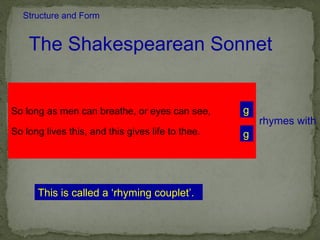
  • 93.
    Analysing a Poem Rhyme and Rhythm Although there is no obvious use of rhyme in this poem, Hughes does make great use of the sound and rhythmic possibilities of the English language. As with the structure, the rhythm within the poem seems closely linked to its meanings. For instance, in the following line, the monosyllabic nature of the words makes the reader slow right down as he or she reads it. This links closely to the image that is being described: the slow bending of the strong gull is emphasised by the slow, strong language used: “a black-/Back gull bent like an iron bar slowly.” Can you find other examples of this link between rhythm and meaning in the poem?
  • 94.
    Analysing a Poem Tone, Mood and Emotion Answer the questions below to develop your understanding of Hughes’ use of tone, mood and emotion. Questions • How does the narrator feel about the storm? Look closely at each verse to find your answer, analysing the range of emotions that he experiences. • There is a sense of fear at certain points in the poem. Where would you say that the fear is at its strongest? What does the narrator do that emphasises this feeling? • What is the overall tone and mood of the poem? Does the tone change as the poem progresses? • How does the imagery used contribute to the poem’s mood?
  • 95.
    Analysing a Poem Using your Senses Hughes uses a variety of sensations to strengthen the effect of his poem. For each of the three images below, find one quotation that you feel connects strongly to that sense. Hear Touch / Feel See
  • 96.
    Analysing a Poem Use of Imagery On the next slides, we are going to analyse the imagery that Ted Hughes uses in detail, looking at each verse in turn. As you look at the analysis, think about the effects that each type of imagery creates, and the meanings it implies. As we have already noted, the imagery in the poem links closely to its themes and structure. Through the strength of the ‘word pictures’ that Hughes creates, he gives a sense that the weather is alive, that the storm has a personality of its own. The contrast between the weather and the people sheltering indoors makes a clear point about the relationship between humans and nature: these people seem minute in comparison to the huge force of the natural world.
  • 97.
    Analysing a Poem Use of Imagery Metaphor: the house is described as though it is a boat This house has been far out at sea all night, The woods crashing through darkness, the booming hills, Winds stampeding the fields under the window Floundering black astride and blinding wet Personification: the woods and winds are described as though they are alive Reproduced with the permission of Faber and Faber Ltd
  • 98.
    Analysing a Poem Use of Imagery Personification: the day ‘rose’, as though it were Alliteration: this echoes getting up out of bed the sound of the wind Till day rose; then under an orange sky The hills had new places, and wind wielded Blade-light, luminous black and emerald, Flexing like the lens of a mad eye. Simile: this image continues the personification of the wind, as though it is a wild, mad person Reproduced with the permission of Faber and Faber Ltd
  • 99.
    Analysing a Poem Use of Imagery Metaphor: the house is ‘scaled’, as though it were a dangerous mountain At noon I scaled along the house-side as far as The coal-house door. Once I looked up-- Through the brunt wind that dented the balls of my eyes The tent of the hills drummed and strained its guyrope, Personification: this image Metaphor: the hills are again continues the described using the image of personification of the wind, a tent, as though they might as though it has the strength blow away to hurt the narrator Reproduced with the permission of Faber and Faber Ltd
  • 100.
    Analysing a Poem Use of Imagery Personification: the fields ‘quiver’, the skyline is a ‘grimace’ - notice the sense of fear here The fields quivering, the skyline a grimace, At any second to bang and vanish with a flap: The wind flung a magpie away and a black- Back gull bent like an iron bar slowly. The house Personification: the image of the wind as a person is extended even further - as though it intends to throw the bird away Reproduced with the permission of Faber and Faber Ltd
  • 101.
    Analysing a Poem Use of Imagery Simile: the human made goblet can hardly withstand the force of nature Rang like some fine green goblet in the note That any second would shatter it. Now deep In chairs, in front of the great fire, we grip Our hearts and cannot entertain book, thought Metaphor: the fear of nature makes them ‘grip’ their hearts, trying to gain courage in the face of the elements Reproduced with the permission of Faber and Faber Ltd
  • 102.
    Analysing a Poem Use of Imagery Metaphor: these people cling to natural things - the fire, the ‘roots’ of the house in an attempt to face nature Or each other. We watch the fire blazing, And feel the roots of the house move, but sit on, Seeing the windows tremble to come in, Hearing the stones cry out under the horizons. Personification: the poem ends with the ‘cry’ of the stones, as though they too are fearful of the storm Reproduced with the permission of Faber and Faber Ltd