Immunoglobulin
By
Swetha smenon
2nd msc
• Specialized group of proteins mostly
associated with γ globulin fraction.
• Immunoglobulins is a functional term while γ
globulin is a physical term.
• Abbreviated as Ig
• Ig are produced by plasma cells in response to
an antigen and which function as antibodies.
Structure of immunoglobulins
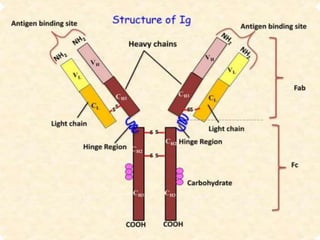
• All immunoglobulin molecules basically consist
of : two identical heavy chains and two identical
light chains held together by disulfide linkages
(Inter-chain and Intra-chain ) and non-covalent
interactions.
• It is Y shaped tetramer (H2L2) Each heavy chain
contains 450 amino acids Light chain has 212
amino acids
• Heavy chain of Ig are linked to carbohydrates
hence Ig are glycoproteins.
• Amino acid sequence of variable regions of
light and heavy chains is responsible for
specific binding of immunoglobulin (antibody)
with antigen.
• There are certain hypervariable regions
interspersed between the relatively invariable
regions.
• Light chain has 3 hypervariable regions
• Heavy chain has 4.
• The hypervariable regions more specifically
determine the antigen-antibody binding.
Immunoglobulin Classes
• IgG - Gamma heavy chains
• IgM - Mu heavy chains
• IgA - Alpha heavy chains
• IgD - Delta heavy chains
• IgE - Epsilon heavy chains
• Two types of light chains : kappa (Κ) and
lambda (λ)
• An Ig contains two Κ or two λ light chain and
never a mixture.
• Kappa chain (60%) is more common in
human.
Ig G
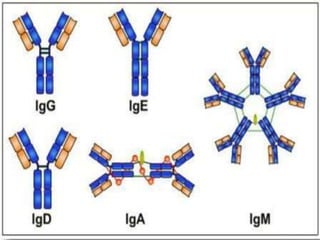
• Major serum Ig – 75 -80 % Single Y shaped
unit (monomer)
• It is the antibody seen in secondary immuno
response.
• It can transverse blood vessels readily. IgG is
only Ig that can cross the placenta and
transfer the mothers immunity to developing
fetus
Ig M
• J Chain Largest Ig composed of 5 Y shaped
units held together by a J polypeptide chain.
• Pentamer –bind with 5 antigenic sites
• Due to its large size, IgM cannot transverse
blood vesssels, hence it is restricted to the
blood stream.
• IgM is first antibody to be produced in
response to an antigen and is most effective
against invading micro-organism.
• IgM Ab cannot cross placenta
• So if the fetus even though it carries an
incompatible Ag , is protected from natural Ab
of the mother
IgA
• Single (monomer) or double unit (dimer) held
together by J chain
• Mostly found in body secretions such as saliva,
tears, sweat, milk and the walls of intestine.
• Most predominant Ab in colostrum.
• Ig A molecules bind with bacterial Ag present on
body surface and remove them. So IgA prevents
the foreign substances from entering the body
cells.
IgE
• Single Y shaped (Monomer)
• Normally present in minute conc in blood – 0.3g/ml
• IgE levels are elevated in individuals with allergies as it
is associated with the body’s allergic response – Hay
fever, Asthma, Anaphylactic shock.
• IgE tightly binds with Fc receptors on basophils and
mast cells which release histamine and cause allergy.
• Immediate type Hypersensitivity reaction – peak at 30
min
IgD
• Single Y shaped unit (Monomer)
• Present in low concentration in circulation.
• Present on surface of B cells
• Their function is not known
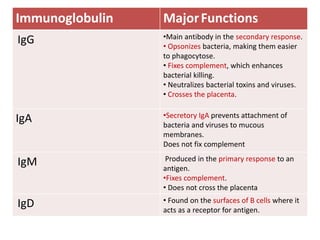
Immunoglobulin MajorFunctions
IgG •Main antibody in the secondary response.
• Opsonizes bacteria, making them easier
to phagocytose.
• Fixes complement, which enhances
bacterial killing.
• Neutralizes bacterial toxins and viruses.
• Crosses the placenta.
IgA •Secretory IgA prevents attachment of
bacteria and viruses to mucous
membranes.
Does not fix complement
IgM Produced in the primary response to an
antigen.
•Fixes complement.
• Does not cross the placenta
IgD • Found on the surfaces of B cells where it
acts as a receptor for antigen.
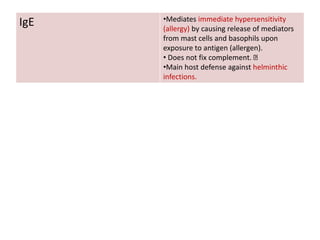
IgE •Mediates immediate hypersensitivity
(allergy) by causing release of mediators
from mast cells and basophils upon
exposure to antigen (allergen).
• Does not fix complement.
•Main host defense against helminthic
infections.
• REFERNCE
• A text of microbiology ,Dr. R.C Dubey & Dr. D.K
Maheswari
• https://www.dianova.com/en/faq/antibody-
structure-what-is-a-secondary-antibody/
• https://www.biologyexams4u.com/2012/11/d
ifferent-types-of-immunoglobulins-igg.html
imunoglobulin.pptx

imunoglobulin.pptx

  • 1.
  • 2.
    • Specialized groupof proteins mostly associated with γ globulin fraction. • Immunoglobulins is a functional term while γ globulin is a physical term. • Abbreviated as Ig • Ig are produced by plasma cells in response to an antigen and which function as antibodies.
  • 3.
    Structure of immunoglobulins •All immunoglobulin molecules basically consist of : two identical heavy chains and two identical light chains held together by disulfide linkages (Inter-chain and Intra-chain ) and non-covalent interactions. • It is Y shaped tetramer (H2L2) Each heavy chain contains 450 amino acids Light chain has 212 amino acids • Heavy chain of Ig are linked to carbohydrates hence Ig are glycoproteins.
  • 5.
    • Amino acidsequence of variable regions of light and heavy chains is responsible for specific binding of immunoglobulin (antibody) with antigen. • There are certain hypervariable regions interspersed between the relatively invariable regions. • Light chain has 3 hypervariable regions • Heavy chain has 4. • The hypervariable regions more specifically determine the antigen-antibody binding.
  • 6.
    Immunoglobulin Classes • IgG- Gamma heavy chains • IgM - Mu heavy chains • IgA - Alpha heavy chains • IgD - Delta heavy chains • IgE - Epsilon heavy chains
  • 7.
    • Two typesof light chains : kappa (Κ) and lambda (λ) • An Ig contains two Κ or two λ light chain and never a mixture. • Kappa chain (60%) is more common in human.
  • 8.
    Ig G • Majorserum Ig – 75 -80 % Single Y shaped unit (monomer) • It is the antibody seen in secondary immuno response. • It can transverse blood vessels readily. IgG is only Ig that can cross the placenta and transfer the mothers immunity to developing fetus
  • 9.
    Ig M • JChain Largest Ig composed of 5 Y shaped units held together by a J polypeptide chain. • Pentamer –bind with 5 antigenic sites • Due to its large size, IgM cannot transverse blood vesssels, hence it is restricted to the blood stream. • IgM is first antibody to be produced in response to an antigen and is most effective against invading micro-organism.
  • 10.
    • IgM Abcannot cross placenta • So if the fetus even though it carries an incompatible Ag , is protected from natural Ab of the mother
  • 11.
    IgA • Single (monomer)or double unit (dimer) held together by J chain • Mostly found in body secretions such as saliva, tears, sweat, milk and the walls of intestine. • Most predominant Ab in colostrum. • Ig A molecules bind with bacterial Ag present on body surface and remove them. So IgA prevents the foreign substances from entering the body cells.
  • 12.
    IgE • Single Yshaped (Monomer) • Normally present in minute conc in blood – 0.3g/ml • IgE levels are elevated in individuals with allergies as it is associated with the body’s allergic response – Hay fever, Asthma, Anaphylactic shock. • IgE tightly binds with Fc receptors on basophils and mast cells which release histamine and cause allergy. • Immediate type Hypersensitivity reaction – peak at 30 min
  • 13.
    IgD • Single Yshaped unit (Monomer) • Present in low concentration in circulation. • Present on surface of B cells • Their function is not known
  • 15.
    Immunoglobulin MajorFunctions IgG •Mainantibody in the secondary response. • Opsonizes bacteria, making them easier to phagocytose. • Fixes complement, which enhances bacterial killing. • Neutralizes bacterial toxins and viruses. • Crosses the placenta. IgA •Secretory IgA prevents attachment of bacteria and viruses to mucous membranes. Does not fix complement IgM Produced in the primary response to an antigen. •Fixes complement. • Does not cross the placenta IgD • Found on the surfaces of B cells where it acts as a receptor for antigen.
  • 16.
    IgE •Mediates immediatehypersensitivity (allergy) by causing release of mediators from mast cells and basophils upon exposure to antigen (allergen). • Does not fix complement. •Main host defense against helminthic infections.
  • 17.
    • REFERNCE • Atext of microbiology ,Dr. R.C Dubey & Dr. D.K Maheswari • https://www.dianova.com/en/faq/antibody- structure-what-is-a-secondary-antibody/ • https://www.biologyexams4u.com/2012/11/d ifferent-types-of-immunoglobulins-igg.html