ANTIBODIES
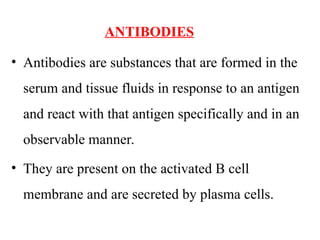
• Antibodies aresubstances that are formed in the
serum and tissue fluids in response to an antigen
and react with that antigen specifically and in an
observable manner.
• They are present on the activated B cell
membrane and are secreted by plasma cells.
3.
PROPERTIES OF ANTIBODIES
•Chemical nature of antibodies is globulin.
• Named Immunoglobulins.
• Constitute 20-25% of the total serum proteins.
• Mainly synthesized by Plasma cells.
4.
STRUCTURE OF IMMUNOGLOBULIN
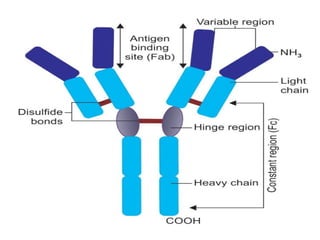
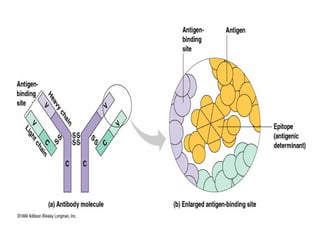
•An antibody molecule is a ‘Y-shaped’ hetrodimer,
composed of four polypeptide chains.
• Two identical light (L) chains, of molecular weight
25,000 Da (daltons) each.
• Two identical heavy (H) chains each having molecular
weight 50,000 Da or more.
• Each light chain is also attached to the heavy chain by a
disulphide bond.
5.
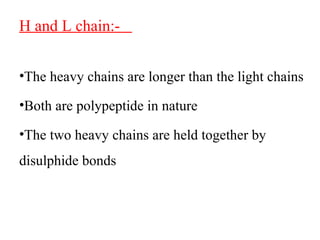
H and Lchain:-
•The heavy chains are longer than the light chains
•Both are polypeptide in nature
•The two heavy chains are held together by
disulphide bonds
7.
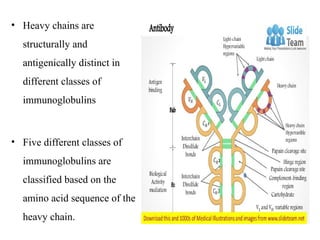
• Heavy chainsare
structurally and
antigenically distinct in
different classes of
immunoglobulins
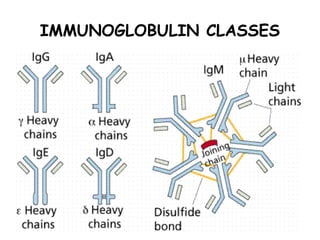
• Five different classes of
immunoglobulins are
classified based on the
amino acid sequence of the
heavy chain.
8.
• The Lchains are similar in all classes of
immunoglobulins
• They are present in two forms : kappa and lambda
• Each immunonoglobulin has either two kappa or two
lambda (Korngold & Lapari )light chains
• Kappa and lambda chains are never found together
9.
• Variable andconstant regions:-
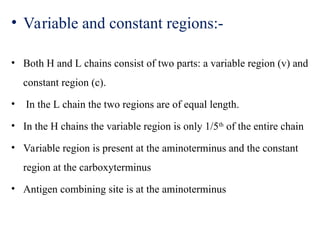
• Both H and L chains consist of two parts: a variable region (v) and
constant region (c).
• In the L chain the two regions are of equal length.
• In the H chains the variable region is only 1/5th
of the entire chain
• Variable region is present at the aminoterminus and the constant
region at the carboxyterminus
• Antigen combining site is at the aminoterminus
11.
Function of immunoglobulins:
•Antigenbinding (by fab region)
•Binding to the antigen is the primary function of an antibody
which can result in protection of the host.
•The fab fragment bears the variable region and is involved in
interaction with the antigen.
•Effector functions(by fc region):-
•Fixation of complement
•Binding to various cell types
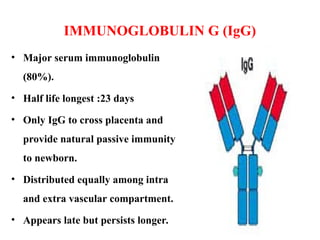
IMMUNOGLOBULIN G (IgG)
•Major serum immunoglobulin
(80%).
• Half life longest :23 days
• Only IgG to cross placenta and
provide natural passive immunity
to newborn.
• Distributed equally among intra
and extra vascular compartment.
• Appears late but persists longer.
14.
• Participates inprecipitation, complement fixation and
neutralisation of toxin and viruses.
• Protective against those microorganisms that are active
in blood and tissues.
• IgG is raised after long time following infection and
represents chronic or past infection (recovery).
• Four subclasses of IgG (IgG1,IgG2,IgG3,IgG4).
15.
FUNCTION OF IgG
•IgG can cross placenta
• Complement fixing
• Phagocytosis
• coagglutination
16.
IMMUNOGLOBULIN -A
• Secondmajor immunoglobulin in
serum (10-13%)
• Half life is 6-8 days
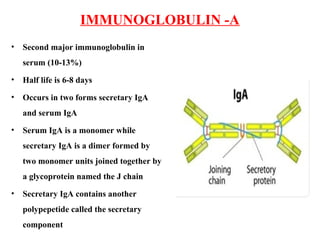
• Occurs in two forms secretary IgA
and serum IgA
• Serum IgA is a monomer while
secretary IgA is a dimer formed by
two monomer units joined together by
a glycoprotein named the J chain
• Secretary IgA contains another
polypepetide called the secretary
component
17.
• This Spiece protects the IgA from denaturation by
bacterial proteases in sites such as intestinal mucosa which
is rich in bacterial flora
• It is the principle immunoglobulin present in secretions
such as milk, saliva, tears , sweat, nasal fluid and in the
secretions of the respiratory, intestinal and genital systems
• It protects the mucosal membranes against
microorganisms
• Mainly synthesized locally by plasma cells
18.
IMMUNOGLOBULIN -M
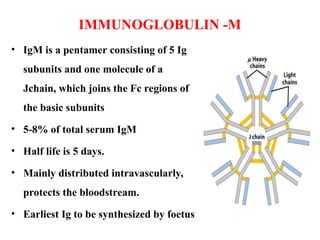
• IgMis a pentamer consisting of 5 Ig
subunits and one molecule of a
Jchain, which joins the Fc regions of
the basic subunits
• 5-8% of total serum IgM
• Half life is 5 days.
• Mainly distributed intravascularly,
protects the bloodstream.
• Earliest Ig to be synthesized by foetus
19.
• IgM existsin both monomeric and
pentameric forms:
o When present as membrane-bound antibody
on B cells, it exists in monomeric form.
o When present in secreted form, it is
pentameric in nature
20.
• Earliest toappear in response to infection
• Shortlived ,disappear earlier than IgG, therefore its
presence indicates recent infection
• Does not cross placenta
• Presence of IgM in newborn indicates congenital
infection
• More efficient than IgG in agglutination and
complement fixation
21.
Function of IgM
•Acute infection
• Complement fixing
• Fetal immunity
• Protection against intravascular organism
• Mediate agglutination
22.
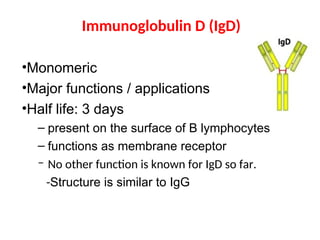
Immunoglobulin D (IgD)
•Monomeric
•Majorfunctions / applications
•Half life: 3 days
– present on the surface of B lymphocytes
– functions as membrane receptor
– No other function is known for IgD so far.
-Structure is similar to IgG
23.
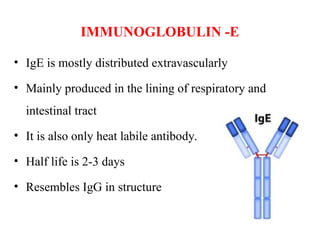
IMMUNOGLOBULIN -E
• IgEis mostly distributed extravascularly
• Mainly produced in the lining of respiratory and
intestinal tract
• It is also only heat labile antibody.
• Half life is 2-3 days
• Resembles IgG in structure
24.
Function of IgE
•IgE is highly potent and mediate type first
hypersensivity reactions.
• IgE response is seen in various allergic conditions, such
as asthma, anaphylaxis, hay fever etc.
• IgE is elevated in helminthic infections.
25.
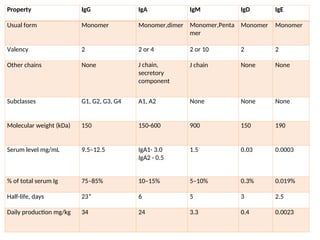
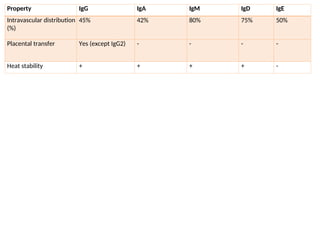
Property IgG IgAIgM IgD IgE
Usual form Monomer Monomer,dimer Monomer,Penta
mer
Monomer Monomer
Valency 2 2 or 4 2 or 10 2 2
Other chains None J chain,
secretory
component
J chain None None
Subclasses G1, G2, G3, G4 A1, A2 None None None
Molecular weight (kDa) 150 150-600 900 150 190
Serum level mg/mL 9.5–12.5 IgA1- 3.0
IgA2 - 0.5
1.5 0.03 0.0003
% of total serum Ig 75–85% 10–15% 5–10% 0.3% 0.019%
Half-life, days 23* 6 5 3 2.5
Daily production mg/kg 34 24 3.3 0.4 0.0023