Information Management Solutions.
Maintenance Management
Best Practices
The Journey to Maintenance Excellence
and
Advanced Asset Management
Maintenance
Excellence
A journey……not a destination
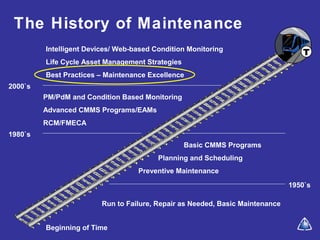
The History of Maintenance
Beginning of Time
1950`s
1980`s
2000`s
Run to Failure, Repair as Needed, Basic Maintenance
Basic CMMS Programs
Planning and Scheduling
Preventive Maintenance
PM/PdM and Condition Based Monitoring
Advanced CMMS Programs/EAMs
RCM/FMECA
Intelligent Devices/ Web-based Condition Monitoring
Life Cycle Asset Management Strategies
Best Practices – Maintenance Excellence
“Even if you are on the right track, you will get run over if you just sit
there.”
Will Rogers
Where are you in the journey?
• Is your CMMS/EAM operational ?
• Have the integrations been tested and verified ?
• Are your business practices and systems
synchronized ?
• Are your personnel trained and gaining expertise ?
• Or are you just getting started selecting a
CMMS/EAM ?
Where would you like to go?
Maintenance Management
Best Practices
Utilizing your CMMS/EAM to
drive Continuous Improvement
toward Maintenance Excellence
“What doesn’t get
measured,
doesn’t get better….”
• Identifying Maintenance
Management Best Practices that
align with your business vision and
mission statements
• Selecting metrics and Key
Performance Indicators (KPIs) to
baseline and track improvement
• Utilizing a CMMS/EAM to generate
those metrics and KPIs
Where you are in the evolutionary stage of Maintenance
Excellence can be evaluated with a formal assessment
process
CMMS Business Assessment Results
0
10
20
30
40
50
60
70
80
90
100
Organization
Planning and Scheduling
Maintenance Workflow
MRO
Preventive MaintenanceCondition Monitoring
Unscheduled Maintenance
RCM
Utilities
Customer Average Maximum Score
Where you are …….Where you are …….
Where you are going …….
Your goals are ideally based on the vision and
mission statements of your organization:
• Is your focus on maintenance cost?
• Are your business drivers asset uptime and
Reliability?
• Do you have regulatory requirements that define your
level of maintenance performance?
• What are your gaps, and how do you address them?
• What “Maintenance Management Best Practices” do
you need to instill, or improve on, in your
organization to reach your goals?
Where you are going…..Where you are going…..
Where you are going …….
Example:
“The mission of the Water and
Sewerage Department is to exceed
our customer’s expectations through
the reliable, cost-effective and
innovative treatment and
transmission of water and
wastewater.”
Your Mission Statement…..Your Mission Statement…..
Which “Maintenance Management Best Practices”
in the following Body of Knowledge categories
can support that mission statement?
1. Preventive Maintenance
2. Inventory & Purchasing
3. Organization
4. CMMS Usage
5. Predictive Maintenance
6. Reliability Engineering
7. Total Productive Maintenance
8. Asset Care Work Flow
9. Financial Optimization
10. Continuous Improvement
Maintenance Management Best Practice
There are many references from which to obtain standards of
maintenance performance. These references are
available for a wide variety of industry verticals.
• The Environmental Protection Agency (C-MOM)
• The Code of Federal Regulations (CFR 211)
• OSHA
• The Nuclear Energy Institute (AP-913)
• The Electrical Power Research Institute (EPRI-TR-112500)
• The Society of Automotive Engineers (SAE-1011,1012)
• The Society of Maintenance and Reliability Professionals
• The Marshall Institute
• Management Resources Group
• Solomon Associates
• Reliabilityweb.com
Maintenance Management Best Practice
“A best practice is a technique or methodology
that, through experience and research, has
proven to reliably lead to a desired result.”
Example:
One Maintenance Management Best Practice would be to have a well
trained and highly skilled maintenance workforce. This practice may
involve developing and administering training to the workforce
through Job Requirement Analysis. Training documentation and
review or assessment at regular intervals would be required.
The desired result would be that repairs would be facilitated quickly,
safely, efficiently and would be successful.
The result would be verified through the calculation of one or more
maintenance metrics, for example “% Maintenance Rework”
Maintenance Management Best Practice
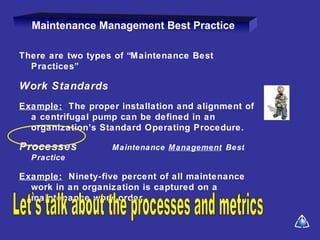
There are two types of “Maintenance Best
Practices”
Work Standards
Example: The proper installation and alignment of
a centrifugal pump can be defined in an
organization’s Standard Operating Procedure.
Processes Maintenance Management Best
Practice
Example: Ninety-five percent of all maintenance
work in an organization is captured on a
maintenance work order.
Maintenance Management Best Practice
Typical Best Practice examples:
• Asset criticality has been determined for 100 percent of
the asset base.
• Predictive maintenance tasks have been applied to the
top 30th
percentile of applicable critical assets.
• 95 percent of a maintenance person’s labor hours is
documented on maintenance work orders.
• Documented maintenance job plans exist for critical
assets and are reviewed on an annual basis.
• Parts are pre-kitted for all planned corrective maintenance
work orders that require them.
• Planned and scheduled work is completed on time 90
percent of the time.
• Overtime is less than 2 percent of total maintenance time.
Maintenance Management Best Practice
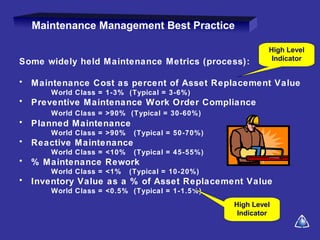
Some widely held Maintenance Metrics (process):
• Maintenance Cost as percent of Asset Replacement Value
World Class = 1-3% (Typical = 3-6%)
• Preventive Maintenance Work Order Compliance
World Class = >90% (Typical = 30-60%)
• Planned Maintenance
World Class = >90% (Typical = 50-70%)
• Reactive Maintenance
World Class = <10% (Typical = 45-55%)
• % Maintenance Rework
World Class = <1% (Typical = 10-20%)
• Inventory Value as a % of Asset Replacement Value
World Class = <0.5% (Typical = 1-1.5%)
High Level
Indicator
High Level
Indicator
Maintenance Management Best Practice
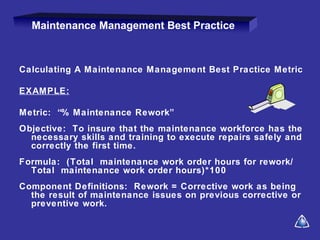
Calculating A Maintenance Management Best Practice Metric
EXAMPLE:
Metric: “% Maintenance Rework”
Objective: To insure that the maintenance workforce has the
necessary skills and training to execute repairs safely and
correctly the first time.
Formula: (Total maintenance work order hours for rework/
Total maintenance work order hours)*100
Component Definitions: Rework = Corrective work as being
the result of maintenance issues on previous corrective or
preventive work.
Maintenance Management Best Practice
Calculating A Maintenance Management Best Practice Metric
–
The CMMS/EAM Connection
Component Definitions: Rework = Corrective work as being the
result of maintenance issues on previous corrective or
preventive work.
Count of the number of work orders where:
Work Order Type= ‘Corrective’, ‘Emergency’
Work Order Status is ‘ALL’ (WAPPR,APPR,INPROG, etc.)
The Work Order ‘Reported Date’ is within user defined period
The Work Order Custom Field ‘REWORK’ box is checked,
indicating that the ‘Originator’ has determined that a recent
maintenance activity has caused additional damage or that the
initial repair was not successful.
Maintenance Management Best Practice
Calculating A Maintenance Management Best Practice Metric
–
The CMMS/EAM Connection
Many CMMS/EAMs have pre-configured reports
for many of the common metrics for
Maintenance Management Best Practices
• PM Work Order Compliance
• Actual vs. Estimated Hours
• Maintenance Related Downtime
• % Preventive Maintenance
• Inventory Turns
Maintenance Management Best Practice
Calculating A Maintenance Management Best Practice Metric
–
The CMMS/EAM Connection
Maintenance Management Best Practice
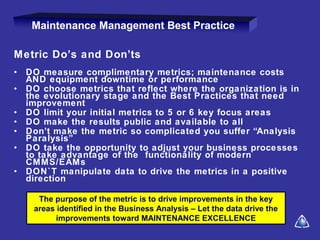
Metric Do’s and Don’ts
• DO measure complimentary metrics; maintenance costs
AND equipment downtime or performance
• DO choose metrics that reflect where the organization is in
the evolutionary stage and the Best Practices that need
improvement
• DO limit your initial metrics to 5 or 6 key focus areas
• DO make the results public and available to all
• Don’t make the metric so complicated you suffer “Analysis
Paralysis”
• DO take the opportunity to adjust your business processes
to take advantage of the functionality of modern
CMMS/EAMs
• DON`T manipulate data to drive the metrics in a positive
direction
The purpose of the metric is to drive improvements in the key
areas identified in the Business Analysis – Let the data drive the
improvements toward MAINTENANCE EXCELLENCE
Maintenance Management Best Practice
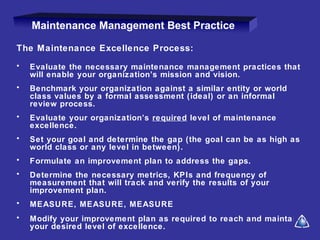
The Maintenance Excellence Process:
• Evaluate the necessary maintenance management practices that
will enable your organization’s mission and vision.
• Benchmark your organization against a similar entity or world
class values by a formal assessment (ideal) or an informal
review process.
• Evaluate your organization’s required level of maintenance
excellence.
• Set your goal and determine the gap (the goal can be as high as
world class or any level in between).
• Formulate an improvement plan to address the gaps.
• Determine the necessary metrics, KPIs and frequency of
measurement that will track and verify the results of your
improvement plan.
• MEASURE, MEASURE, MEASURE
• Modify your improvement plan as required to reach and maintain
your desired level of excellence.
Maintenance Management Best Practice
Drivers for Maintenance
Excellence in the
Water/Wastewater Sector
• Regulatory Pressures - Environmental
Protection Agency, State Departments
of Conservation, etc.
• Economic Pressures – Increasing
maintenance costs and asset
replacement requirements for aging
infrastructure; limits on rate increases.
• Business Pressures - Increasing
demand for services, especially in high
growth areas.
• Resource Pressures – Difficulty in
hiring and retaining qualified
maintenance personnel.
Benefits and Return on Investment
for Maintenance Excellence in the
Water/Wastewater Sector
• Reduce or eliminate regulatory
fines associated with equipment
failure
• Control maintenance costs
• Reduce total asset lifecycle costs
• Hold or minimize rate increases
• Do more work with less
maintenance personnel and fewer
assets
• Reduce inventory level of spare
parts
• Improve overall water quality
Risk of Maintaining Status Quo
A recent survey by Relibilityweb.com
revealed the following:
57% of the 600 respondents failed to
generate the anticipated ROI of a
CMMS/EAM implementation due to:
1. Lack of clear goals and planned
outcomes
2. Lack of Integration
3. Lack of a Comprehensive
Maintenance Strategy
4. Garbage Data
5. Lack of Accountability
Conclusions
CMMS/EAMs fully support Maintenance
Excellence initiatives.
Return on Investment for a CMMS/EAM
can only come from improvements
to processes.
Maintenance Excellence, through the
development of Maintenance
Management Best Practices, can
be the single greatest source for
Return on Investment of your
CMMS/EAM.
Maintenance Excellence is a continuous
improvement process, a journey
which can begin prior to, during or
after a CMMS/EAM implementation.
Ims Maint Mgmt Best Practice

Ims Maint Mgmt Best Practice

  • 1.
    Information Management Solutions. MaintenanceManagement Best Practices The Journey to Maintenance Excellence and Advanced Asset Management
  • 2.
  • 3.
    The History ofMaintenance Beginning of Time 1950`s 1980`s 2000`s Run to Failure, Repair as Needed, Basic Maintenance Basic CMMS Programs Planning and Scheduling Preventive Maintenance PM/PdM and Condition Based Monitoring Advanced CMMS Programs/EAMs RCM/FMECA Intelligent Devices/ Web-based Condition Monitoring Life Cycle Asset Management Strategies Best Practices – Maintenance Excellence
  • 4.
    “Even if youare on the right track, you will get run over if you just sit there.” Will Rogers
  • 5.
    Where are youin the journey? • Is your CMMS/EAM operational ? • Have the integrations been tested and verified ? • Are your business practices and systems synchronized ? • Are your personnel trained and gaining expertise ? • Or are you just getting started selecting a CMMS/EAM ? Where would you like to go?
  • 6.
    Maintenance Management Best Practices Utilizingyour CMMS/EAM to drive Continuous Improvement toward Maintenance Excellence
  • 7.
    “What doesn’t get measured, doesn’tget better….” • Identifying Maintenance Management Best Practices that align with your business vision and mission statements • Selecting metrics and Key Performance Indicators (KPIs) to baseline and track improvement • Utilizing a CMMS/EAM to generate those metrics and KPIs
  • 8.
    Where you arein the evolutionary stage of Maintenance Excellence can be evaluated with a formal assessment process CMMS Business Assessment Results 0 10 20 30 40 50 60 70 80 90 100 Organization Planning and Scheduling Maintenance Workflow MRO Preventive MaintenanceCondition Monitoring Unscheduled Maintenance RCM Utilities Customer Average Maximum Score Where you are …….Where you are …….
  • 9.
    Where you aregoing ……. Your goals are ideally based on the vision and mission statements of your organization: • Is your focus on maintenance cost? • Are your business drivers asset uptime and Reliability? • Do you have regulatory requirements that define your level of maintenance performance? • What are your gaps, and how do you address them? • What “Maintenance Management Best Practices” do you need to instill, or improve on, in your organization to reach your goals? Where you are going…..Where you are going…..
  • 10.
    Where you aregoing ……. Example: “The mission of the Water and Sewerage Department is to exceed our customer’s expectations through the reliable, cost-effective and innovative treatment and transmission of water and wastewater.” Your Mission Statement…..Your Mission Statement…..
  • 11.
    Which “Maintenance ManagementBest Practices” in the following Body of Knowledge categories can support that mission statement? 1. Preventive Maintenance 2. Inventory & Purchasing 3. Organization 4. CMMS Usage 5. Predictive Maintenance 6. Reliability Engineering 7. Total Productive Maintenance 8. Asset Care Work Flow 9. Financial Optimization 10. Continuous Improvement Maintenance Management Best Practice
  • 12.
    There are manyreferences from which to obtain standards of maintenance performance. These references are available for a wide variety of industry verticals. • The Environmental Protection Agency (C-MOM) • The Code of Federal Regulations (CFR 211) • OSHA • The Nuclear Energy Institute (AP-913) • The Electrical Power Research Institute (EPRI-TR-112500) • The Society of Automotive Engineers (SAE-1011,1012) • The Society of Maintenance and Reliability Professionals • The Marshall Institute • Management Resources Group • Solomon Associates • Reliabilityweb.com Maintenance Management Best Practice
  • 13.
    “A best practiceis a technique or methodology that, through experience and research, has proven to reliably lead to a desired result.” Example: One Maintenance Management Best Practice would be to have a well trained and highly skilled maintenance workforce. This practice may involve developing and administering training to the workforce through Job Requirement Analysis. Training documentation and review or assessment at regular intervals would be required. The desired result would be that repairs would be facilitated quickly, safely, efficiently and would be successful. The result would be verified through the calculation of one or more maintenance metrics, for example “% Maintenance Rework” Maintenance Management Best Practice
  • 14.
    There are twotypes of “Maintenance Best Practices” Work Standards Example: The proper installation and alignment of a centrifugal pump can be defined in an organization’s Standard Operating Procedure. Processes Maintenance Management Best Practice Example: Ninety-five percent of all maintenance work in an organization is captured on a maintenance work order. Maintenance Management Best Practice
  • 15.
    Typical Best Practiceexamples: • Asset criticality has been determined for 100 percent of the asset base. • Predictive maintenance tasks have been applied to the top 30th percentile of applicable critical assets. • 95 percent of a maintenance person’s labor hours is documented on maintenance work orders. • Documented maintenance job plans exist for critical assets and are reviewed on an annual basis. • Parts are pre-kitted for all planned corrective maintenance work orders that require them. • Planned and scheduled work is completed on time 90 percent of the time. • Overtime is less than 2 percent of total maintenance time. Maintenance Management Best Practice
  • 16.
    Some widely heldMaintenance Metrics (process): • Maintenance Cost as percent of Asset Replacement Value World Class = 1-3% (Typical = 3-6%) • Preventive Maintenance Work Order Compliance World Class = >90% (Typical = 30-60%) • Planned Maintenance World Class = >90% (Typical = 50-70%) • Reactive Maintenance World Class = <10% (Typical = 45-55%) • % Maintenance Rework World Class = <1% (Typical = 10-20%) • Inventory Value as a % of Asset Replacement Value World Class = <0.5% (Typical = 1-1.5%) High Level Indicator High Level Indicator Maintenance Management Best Practice
  • 17.
    Calculating A MaintenanceManagement Best Practice Metric EXAMPLE: Metric: “% Maintenance Rework” Objective: To insure that the maintenance workforce has the necessary skills and training to execute repairs safely and correctly the first time. Formula: (Total maintenance work order hours for rework/ Total maintenance work order hours)*100 Component Definitions: Rework = Corrective work as being the result of maintenance issues on previous corrective or preventive work. Maintenance Management Best Practice
  • 18.
    Calculating A MaintenanceManagement Best Practice Metric – The CMMS/EAM Connection Component Definitions: Rework = Corrective work as being the result of maintenance issues on previous corrective or preventive work. Count of the number of work orders where: Work Order Type= ‘Corrective’, ‘Emergency’ Work Order Status is ‘ALL’ (WAPPR,APPR,INPROG, etc.) The Work Order ‘Reported Date’ is within user defined period The Work Order Custom Field ‘REWORK’ box is checked, indicating that the ‘Originator’ has determined that a recent maintenance activity has caused additional damage or that the initial repair was not successful. Maintenance Management Best Practice
  • 19.
    Calculating A MaintenanceManagement Best Practice Metric – The CMMS/EAM Connection Many CMMS/EAMs have pre-configured reports for many of the common metrics for Maintenance Management Best Practices • PM Work Order Compliance • Actual vs. Estimated Hours • Maintenance Related Downtime • % Preventive Maintenance • Inventory Turns Maintenance Management Best Practice
  • 20.
    Calculating A MaintenanceManagement Best Practice Metric – The CMMS/EAM Connection Maintenance Management Best Practice
  • 21.
    Metric Do’s andDon’ts • DO measure complimentary metrics; maintenance costs AND equipment downtime or performance • DO choose metrics that reflect where the organization is in the evolutionary stage and the Best Practices that need improvement • DO limit your initial metrics to 5 or 6 key focus areas • DO make the results public and available to all • Don’t make the metric so complicated you suffer “Analysis Paralysis” • DO take the opportunity to adjust your business processes to take advantage of the functionality of modern CMMS/EAMs • DON`T manipulate data to drive the metrics in a positive direction The purpose of the metric is to drive improvements in the key areas identified in the Business Analysis – Let the data drive the improvements toward MAINTENANCE EXCELLENCE Maintenance Management Best Practice
  • 22.
    The Maintenance ExcellenceProcess: • Evaluate the necessary maintenance management practices that will enable your organization’s mission and vision. • Benchmark your organization against a similar entity or world class values by a formal assessment (ideal) or an informal review process. • Evaluate your organization’s required level of maintenance excellence. • Set your goal and determine the gap (the goal can be as high as world class or any level in between). • Formulate an improvement plan to address the gaps. • Determine the necessary metrics, KPIs and frequency of measurement that will track and verify the results of your improvement plan. • MEASURE, MEASURE, MEASURE • Modify your improvement plan as required to reach and maintain your desired level of excellence. Maintenance Management Best Practice
  • 23.
    Drivers for Maintenance Excellencein the Water/Wastewater Sector • Regulatory Pressures - Environmental Protection Agency, State Departments of Conservation, etc. • Economic Pressures – Increasing maintenance costs and asset replacement requirements for aging infrastructure; limits on rate increases. • Business Pressures - Increasing demand for services, especially in high growth areas. • Resource Pressures – Difficulty in hiring and retaining qualified maintenance personnel.
  • 24.
    Benefits and Returnon Investment for Maintenance Excellence in the Water/Wastewater Sector • Reduce or eliminate regulatory fines associated with equipment failure • Control maintenance costs • Reduce total asset lifecycle costs • Hold or minimize rate increases • Do more work with less maintenance personnel and fewer assets • Reduce inventory level of spare parts • Improve overall water quality
  • 25.
    Risk of MaintainingStatus Quo A recent survey by Relibilityweb.com revealed the following: 57% of the 600 respondents failed to generate the anticipated ROI of a CMMS/EAM implementation due to: 1. Lack of clear goals and planned outcomes 2. Lack of Integration 3. Lack of a Comprehensive Maintenance Strategy 4. Garbage Data 5. Lack of Accountability
  • 26.
    Conclusions CMMS/EAMs fully supportMaintenance Excellence initiatives. Return on Investment for a CMMS/EAM can only come from improvements to processes. Maintenance Excellence, through the development of Maintenance Management Best Practices, can be the single greatest source for Return on Investment of your CMMS/EAM. Maintenance Excellence is a continuous improvement process, a journey which can begin prior to, during or after a CMMS/EAM implementation.