Retention -
How managers can identify
which employees are most
likely to quit
July 21, 2014
© Dr John Sullivan
www.drjohnsullivan.com 1
Identifying “who" might leave?
The top 12 ways a manager can determine if an
employee is considering a search for a new job
Who might leave?
Conduct individual “stay interviews” – asking on
their last day “why are you leaving” doesn’t
provide useful information in time to prevent this
turnover. A stay interview helps you understand
why an individual employee stays in their job by
simply asking them in an informal one-on-one
meeting to identify the principal reasons why they
stay, so that these important factors can be
reinforced. As part of the interview, managers can
also ask the employee to identify any major
“frustrators” that have in the past made them, even
for a moment considering leaving.
Who might leave?
Proactively search the Internet for indications –
finding out if an employee is searching or is about
to search for a job begins with looking at their
LinkedIn profile to see if it has been updated
recently. You can also search niche and large job
boards to look to see if they have posted their
resume or you can do a simple “Google search” on
this employee in order to find if they have recently
updated their resume.
Who might leave?
Previous job tenure can predict – one of the most
accurate predictors of when someone will leave a
job is their average tenure in the last few jobs. If an
employee has a pattern of leaving a job after a
certain number of months or years, it only makes
sense to examine their resume to get a good
indication of when they are likely to leave again.
Obviously it’s better to under estimate their
departure date, so that the worst that will happen
will be that you will begin “too early” to try to
retain them.
Who might leave?
Identifying past reasons for quitting can predict
– most employees are consistent in that the factors
that cause them to leave previous jobs will also
make them consider leaving this current job. That is
why it is good idea to ask new hires during
interviews or as part of onboarding specifically
“which specific factors caused you to leave your
last jobs?” Obviously managers need to be vigilant
in order to spot whether those past reasons for
quitting may be reoccurring in their current job.
Who might leave?
Identify those in high turnover jobs – frequently
employees get the idea to leave simply because
many other employees in their job family are
leaving to what they consider to be better jobs.
Manager should work with HR order to develop
what is known as a “Heat Map”, which simply
indicates which jobs, teams and business units are
experiencing a currently high rate of turnover.
Manager should then obviously target their own
most desirable employees (i.e. innovators and top-
performing employees) that are in those high
turnover jobs for retention efforts.
Who might leave?
Target new hires
Because research has shown that 50% of new hires
are unhappy with their job decision and 46% of
new hires fail within 18 months, it makes sense for
managers to particularly target all recent hires in
any job as high probability turnover risks
Who might leave?
Someone close to them leaves the team – having a
manager, a close colleague or even a close friend
leave the team can provide a powerful impetus for
an employee to leave. In many cases the exiting
employee may actively encourage them to follow
as a referral (as many as 3 to 5 employees will
follow an influential employee). But the thought of
not being able to work alongside great friend,
having to work under new manager or having to
train a new hire may be enough to drive them into
considering a new job.
Who might leave?
A career damaging event occurs – for most
simply having a weak manager or an uninteresting
job isn’t by itself enough to cause them to look for
a new job. Instead an additional catalyst or negative
event (a.k.a. career trauma) is needed. These
negative events might include having a major
project canceled, a project proposal rejected, major
layoffs or a reorganization, being rejected for a
promotion, being assigned a new manager or a
major resource reduction or staff cut in their job
area.
Who might leave?
Recognize when an employee’s career stage is
ending – most individuals go through predictable
stages or steps in their career. And many employees
change jobs when they reach the end a stage. Those
career stages often include entry-level, becoming a
journeyman/ professional, becoming a team lead,
promotion to a higher level and eventually
complacency and preparing for retirement.
Who might leave?
Look for major life events - it’s also true that
important outside of work “life events” can also
cause an employee to move into their next career
stage. These life events that can trigger job search
include marriages and divorces, new births,
children reaching school age, the last child
finishing school, deaths, health issues, a large
amount of their company stock vesting, an
extremely negative performance review and certain
landmark ages (turning 30, 40, 50 or 60).
Who might leave?
Identify employees that are “overdue” for
important things – one of the key frustrators for
employees is when they perceive that they are
unjustly "overdue" for something important. It's
partially an equity issue, in which they see others
unfairly getting things before them. Common
overdue factors include too long a period since
their last pay raise, promotion, training opportunity,
chance to lead but also (especially among techies)
upgrades in their tools, equipment, computers and
mobile phones.
Who might leave?
Recognize when a top performer feels
underutilized - top performers and innovative
employees will begin considering a new job simply
if the feel “underutilized”. Almost all top
performers want to be continually challenged, as
well as to make a major contribution. As a result,
managers need to be aware that once a top
employee feels that their skills are either eroding or
that their talents are being underused, they will
likely begin considering leaving (Google research
indicates that the feeling of being underutilized is their #1 reason).
15
Also consider these
approaches
16
Identifying which employees are likely to leave
Develop a process for identifying “who” is at risk
of leaving
The process might include external approaches:
A search of the web for resumes
Blind recruiter calls… to see who responds
A dry search by a headhunter to see who is desirable
Run blind ads to identify who is applying
Suddenly speaking at conferences
17
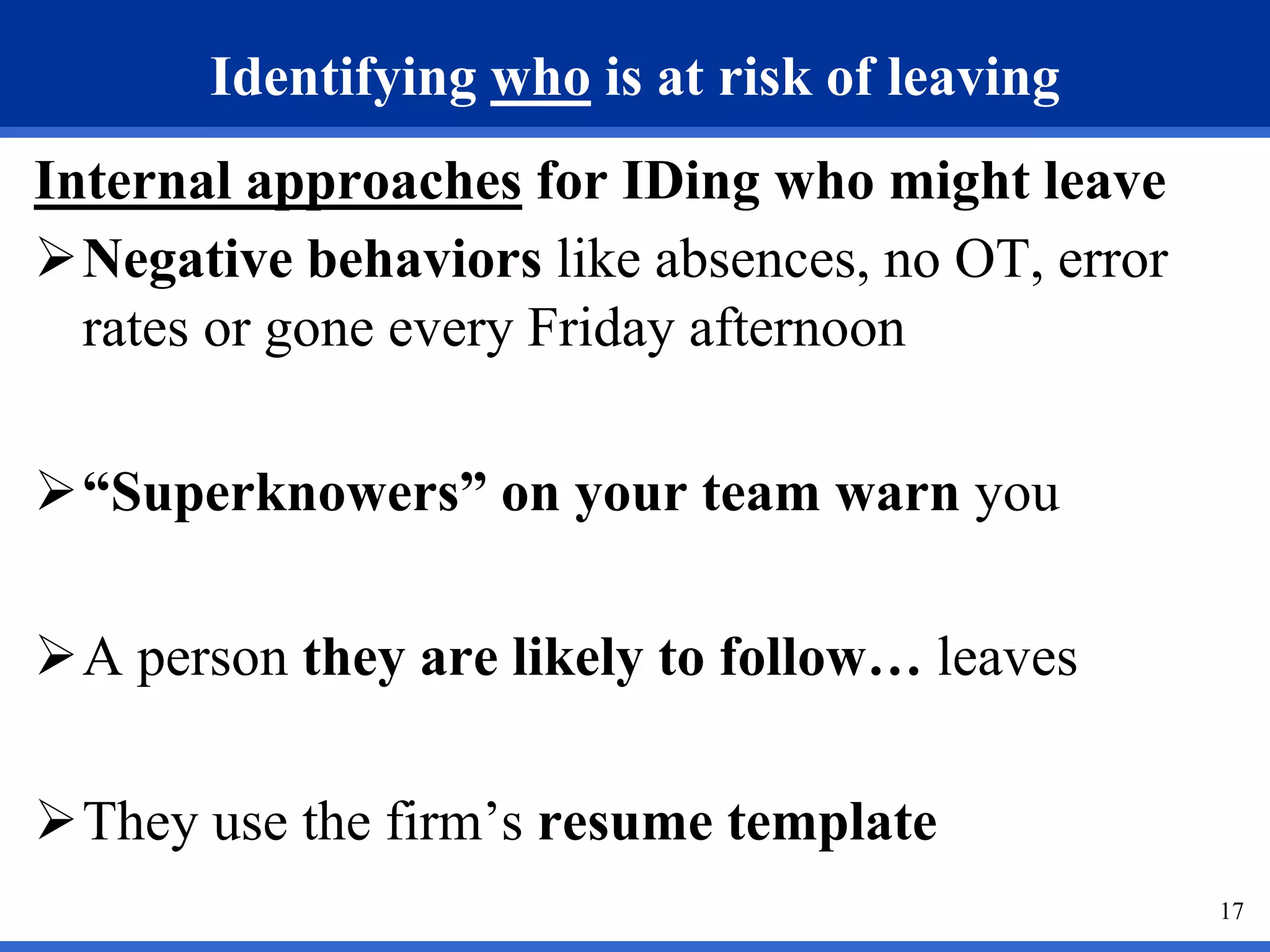
Identifying who is at risk of leaving
Internal approaches for IDing who might leave
Negative behaviors like absences, no OT, error
rates or gone every Friday afternoon
“Superknowers” on your team warn you
A person they are likely to follow… leaves
They use the firm’s resume template
JohnS@sfsu.edu 18
Did I make you think?

Retention - How individual managers can idenify who might quit

  • 1.
    Retention - How managerscan identify which employees are most likely to quit July 21, 2014 © Dr John Sullivan www.drjohnsullivan.com 1
  • 2.
    Identifying “who" mightleave? The top 12 ways a manager can determine if an employee is considering a search for a new job
  • 3.
    Who might leave? Conductindividual “stay interviews” – asking on their last day “why are you leaving” doesn’t provide useful information in time to prevent this turnover. A stay interview helps you understand why an individual employee stays in their job by simply asking them in an informal one-on-one meeting to identify the principal reasons why they stay, so that these important factors can be reinforced. As part of the interview, managers can also ask the employee to identify any major “frustrators” that have in the past made them, even for a moment considering leaving.
  • 4.
    Who might leave? Proactivelysearch the Internet for indications – finding out if an employee is searching or is about to search for a job begins with looking at their LinkedIn profile to see if it has been updated recently. You can also search niche and large job boards to look to see if they have posted their resume or you can do a simple “Google search” on this employee in order to find if they have recently updated their resume.
  • 5.
    Who might leave? Previousjob tenure can predict – one of the most accurate predictors of when someone will leave a job is their average tenure in the last few jobs. If an employee has a pattern of leaving a job after a certain number of months or years, it only makes sense to examine their resume to get a good indication of when they are likely to leave again. Obviously it’s better to under estimate their departure date, so that the worst that will happen will be that you will begin “too early” to try to retain them.
  • 6.
    Who might leave? Identifyingpast reasons for quitting can predict – most employees are consistent in that the factors that cause them to leave previous jobs will also make them consider leaving this current job. That is why it is good idea to ask new hires during interviews or as part of onboarding specifically “which specific factors caused you to leave your last jobs?” Obviously managers need to be vigilant in order to spot whether those past reasons for quitting may be reoccurring in their current job.
  • 7.
    Who might leave? Identifythose in high turnover jobs – frequently employees get the idea to leave simply because many other employees in their job family are leaving to what they consider to be better jobs. Manager should work with HR order to develop what is known as a “Heat Map”, which simply indicates which jobs, teams and business units are experiencing a currently high rate of turnover. Manager should then obviously target their own most desirable employees (i.e. innovators and top- performing employees) that are in those high turnover jobs for retention efforts.
  • 8.
    Who might leave? Targetnew hires Because research has shown that 50% of new hires are unhappy with their job decision and 46% of new hires fail within 18 months, it makes sense for managers to particularly target all recent hires in any job as high probability turnover risks
  • 9.
    Who might leave? Someoneclose to them leaves the team – having a manager, a close colleague or even a close friend leave the team can provide a powerful impetus for an employee to leave. In many cases the exiting employee may actively encourage them to follow as a referral (as many as 3 to 5 employees will follow an influential employee). But the thought of not being able to work alongside great friend, having to work under new manager or having to train a new hire may be enough to drive them into considering a new job.
  • 10.
    Who might leave? Acareer damaging event occurs – for most simply having a weak manager or an uninteresting job isn’t by itself enough to cause them to look for a new job. Instead an additional catalyst or negative event (a.k.a. career trauma) is needed. These negative events might include having a major project canceled, a project proposal rejected, major layoffs or a reorganization, being rejected for a promotion, being assigned a new manager or a major resource reduction or staff cut in their job area.
  • 11.
    Who might leave? Recognizewhen an employee’s career stage is ending – most individuals go through predictable stages or steps in their career. And many employees change jobs when they reach the end a stage. Those career stages often include entry-level, becoming a journeyman/ professional, becoming a team lead, promotion to a higher level and eventually complacency and preparing for retirement.
  • 12.
    Who might leave? Lookfor major life events - it’s also true that important outside of work “life events” can also cause an employee to move into their next career stage. These life events that can trigger job search include marriages and divorces, new births, children reaching school age, the last child finishing school, deaths, health issues, a large amount of their company stock vesting, an extremely negative performance review and certain landmark ages (turning 30, 40, 50 or 60).
  • 13.
    Who might leave? Identifyemployees that are “overdue” for important things – one of the key frustrators for employees is when they perceive that they are unjustly "overdue" for something important. It's partially an equity issue, in which they see others unfairly getting things before them. Common overdue factors include too long a period since their last pay raise, promotion, training opportunity, chance to lead but also (especially among techies) upgrades in their tools, equipment, computers and mobile phones.
  • 14.
    Who might leave? Recognizewhen a top performer feels underutilized - top performers and innovative employees will begin considering a new job simply if the feel “underutilized”. Almost all top performers want to be continually challenged, as well as to make a major contribution. As a result, managers need to be aware that once a top employee feels that their skills are either eroding or that their talents are being underused, they will likely begin considering leaving (Google research indicates that the feeling of being underutilized is their #1 reason).
  • 15.
  • 16.
    16 Identifying which employeesare likely to leave Develop a process for identifying “who” is at risk of leaving The process might include external approaches: A search of the web for resumes Blind recruiter calls… to see who responds A dry search by a headhunter to see who is desirable Run blind ads to identify who is applying Suddenly speaking at conferences
  • 17.
    17 Identifying who isat risk of leaving Internal approaches for IDing who might leave Negative behaviors like absences, no OT, error rates or gone every Friday afternoon “Superknowers” on your team warn you A person they are likely to follow… leaves They use the firm’s resume template
  • 18.
    JohnS@sfsu.edu 18 Did Imake you think?